




Abstract
This article responds to the paucity of literature on Māori success and presents data from follow-up interviews with eight Māori young adults (pakeke), 6 years after they participated as secondary students (rangatahi) in an initial study titled Ka Awatea: An Iwi Case Study of Māori Students’ Success in 2014. Emerging outcomes reveal the central role of Māori culture and identity in their transition to adulthood. Secondary schooling nurtured their inner confidence and capacity to achieve, but did not play a significant role in development of positive Māori identity and cultural efficacy. However, as school-leavers approaching adulthood, they drew on their cultural efficacy and cultural assets, predominantly acquired from whānau, to navigate dominant culture environments. In doing so, they demonstrate that traditional Māori developmental paths have contemporary relevance, and that their roles—as cultural bearers, passing on the gifts of their ancestors—are fundamental to their aspirations and achievements.
Introduction
For centuries, Māori leaders and scholars in Aotearoa New Zealand have reiterated the value that Māori have always placed on mātauranga Māori (Māori knowledge), learning and education (Macfarlane, 2015; Penniman, 1986; Walker, 2016). Numerous narratives abound depicting pre-European Māori communities that eagerly embraced the acquisition and sharing of knowledge, and had long established learning practices to acquire, protect and transmit knowledge for the benefit of current and future generations (Jahnke & Taiapa, 2003; Metge, 1995; Penniman, 1986). Historians acclaim the alacrity with which Māori gained English literacy with the arrival of European colonists. The extensive use of letter writing by Māori is documented from the 1830s, and in 1840, European missionaries travelling out to share their gospel were surprised to discover that Māori could already read and write in English (Elsmore, 1985, in Walker, 2016). Furthermore, Māori were not slow to combine literacy and understanding of European ways with their existing skills and knowledge base (Jenkins & Matthews, 1995). Historians describe their early uptake of European technology, business innovation and economically thriving Māori settlements that were the envy of European settlers in the 1840s and 1850s (O’Malley, 2016).
In the 21st century, education continues to be a crucial domain for contributing to Māori success and wellbeing, yet national education data predominantly describes poor educational outcomes for Māori in mainstream education (Ministry of Education, 2018; Office of Auditor General, 2016; Tertiary Education Commission, 2018). As shown in the historical narratives outlined earlier, the current situation is counter-cultural—the antithesis of traditional Māori attitudes towards knowledge and learning.
Government analysis of Māori student achievement has positioned them as a minority cohort within school populations, whose data are compared against dominant culture (New Zealand European or Pākehā culture) benchmarks. This situation is in stark contrast to the tenets of the Treaty of Waitangi which promised to preserve and protect Māori rights over, and access to, mātauranga Māori, kaupapa Māori (Māori philosophy) te reo Māori (Māori language), and tikanga Māori (Māori customs). The confronting reality—commencing with early mission schools in 1816 and then legally founded through the 1867 Native Schools Act—is that New Zealand’s education system has focused on all students gaining the dominant culture’s language and knowledge base (Macfarlane, 2007; Penetito, 2010; Walker, 2016). This disturbing yet illuminating situation continued until the renaissance of several kaupapa Māori educational initiatives in the early 1980s. Despite this renaissance, statistics indicate that approximately 89% of Māori students continue to attend mainstream schooling where dominant culture norms still pervade (Education Counts, 2019).
Bishop et al. (2007) contend that Māori students should be seen as bearers of the rich, unique and dynamic cultural assets inherent in Indigenous peoples (Bishop et al., 2007). A consequence of education failing to see Māori in such terms has been the negative (re)framing within the literature, of Māori as incapable learners, resulting in widely held perceptions that reflect a deficit focus about Māori and Māori education (Bishop & Berryman, 2006; Macfarlane, 2004; Simmonds et al., 2014). The need to reinterpret, reframe and restructure thinking and action towards Māori potential and success (rather than deficit and failure) is called for (Webber, 2011). Interestingly, in summarising their multiple reports on education for Māori, the Office of Auditor General (2016) describes a “ . . . significant gap in information . . . ” (p. 27) about educational success as Māori.
Success as Māori
An example of research that centres on Māori students’ success is the large research project; Ka Awatea: An Iwi Case Study of Māori Students’ Success (Macfarlane et al., 2014). This study focused on Māori secondary school students, and explored individual, family, school and community conditions that enabled Te Arawa (confederation of local tribes) students, being educated in local secondary schools (in Rotorua, New Zealand, part of the Te Arawa tribal area), to thrive and to unleash their strengths and potential. The Ka Awatea project was funded by Ngā Pae o te Māramatanga (New Zealand’s Māori Centre of Research Excellence) and the data were gathered from 2012 to 2013. The study showed that Māori student success represents a complex, socially constructed concept grounded in cultural identity, with four replenishing themes. These themes were Mana Motuhake (sense of identity), Mana Tū (sense of resilience), Mana Ūkaipo (sense of place) and Mana Tangatarua (sense of walking in two worlds), with Mana Whānau (sense of family) emerging as the overarching lever.
In 2018, Ngā Pae o te Māramatanga funded, through a Platform Project, a follow-up Ka Awatea study. Eight participants from the original study were interviewed and the findings provide insights into their varied journeys into adulthood through dominant culture Higher Education, Kaupapa Māori education and marae-based living. It is argued that the data from this sample of eight participants provide valuable insights for how Māori identity contributes to educational success and wellbeing. The numerical reference, by either design or coincidence, fits admirably with the tribal axiom that connects to the beating hearts of Te Arawa.
Methodology
Original Ka Awatea project
The original Ka Awatea study (Macfarlane et al, 2014) was undertaken in 2012–2013, by a roopū (group) of Te Arawa researchers and was premised on Te Arawa tikanga (local tribal protocol), ensuring local participation and the valuing of local cultural concepts. A cohort of high achieving Māori students was identified by schools, and they—along with whānau, teachers, school leaders and key community members—were invited to participate in a study exploring Māori student success. Data were gathered through questionnaires, individual interviews and focus groups. In total, 283 participants were involved, including 132 students from local secondary schools.
Ka Awatea revisited
The follow-up study, albeit small, was modelled on the earlier project. During the planning phase, the research team engaged with the original researchers, eliciting their guidance on the approach and focus, in accordance with Te Arawa tikanga. The Principal Investigator retained oversight of both studies. Ethics approval was granted by the Educational Research Human Ethics Committee of the University of Canterbury.
The research objectives were to answer three questions:
What themes emerged in their transition experiences?
What differences and similarities emerged in the follow-up study?
Is the 2014 Mana Model reflected in the follow-up study?
Participants and data-gathering
A total of 30 prior participants were able to be located and invited into the follow-up study. Eight participants were willing and available for a follow-up interview. This cohort, aged 21 to 24 years, comprised five wāhine (women) and three tāne (men), who represented three of the secondary schools from the original study.
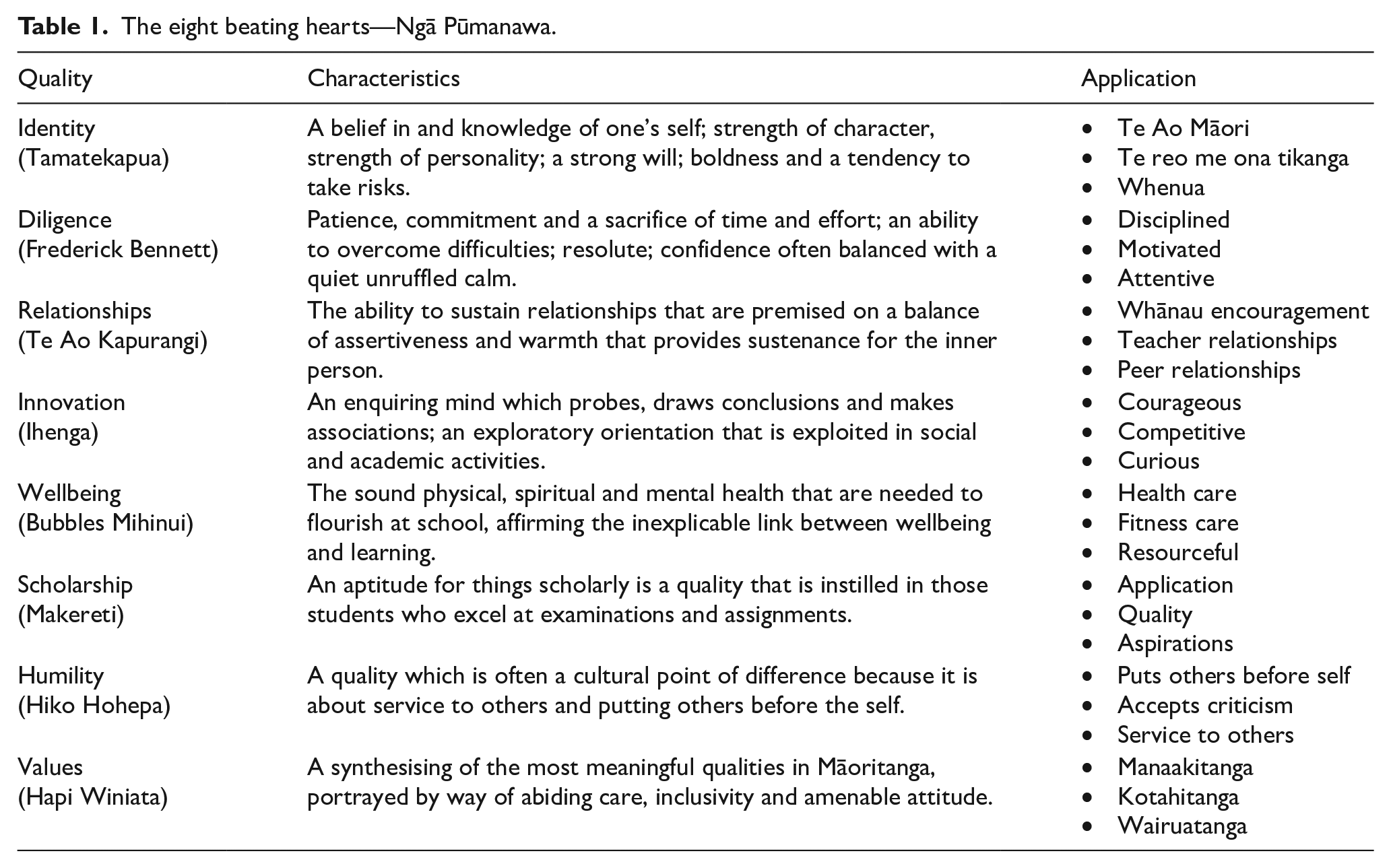
Earlier foundational work exploring Te Arawa cultural imperatives had identified eight success characteristics—pou (pillars)—exemplified by Te Arawa tūpuna, referred to collectively as Ngā Pūmanawa e Waru (Macfarlane et al., 2014). These informed the structure of the earlier study, where participants responded to questions grouped around each of these pou (see Table 1). These pou also informed the follow-up study interview questions.
The eight beating hearts—Ngā Pūmanawa.
Kaupapa Māori research methodology was woven into the approach whereby Māori values were privileged. Individual interviews were carried out kanohi-ki-te-kanohi (face-to-face) and included whanaungatanga (strengthening connections), modelling ako (reciprocity) and respecting the mana (dignity) of the participants. The interviews were approximately 50-min long, audio-recorded and then transcribed by one of the interviewers.
Data analysis
The full data set was subjected to analysis across the three research questions listed earlier. Coding and thematic analysis (Braun & Clarke, 2006) specific to the eight pou was also undertaken. The data were coded separately by two analysts, from the research team. Initial codes were generated, compared and agreed. A further process of comparison and agreement was used to sort the codes into themes, and map them. Replication of the eight pou allowed for deductive analysis specific to their relevance in the lives of the participants. In addition, the process of coding and identifying themes enabled inductive analysis of the emerging themes from participants repeated commentary on issues of importance to them.
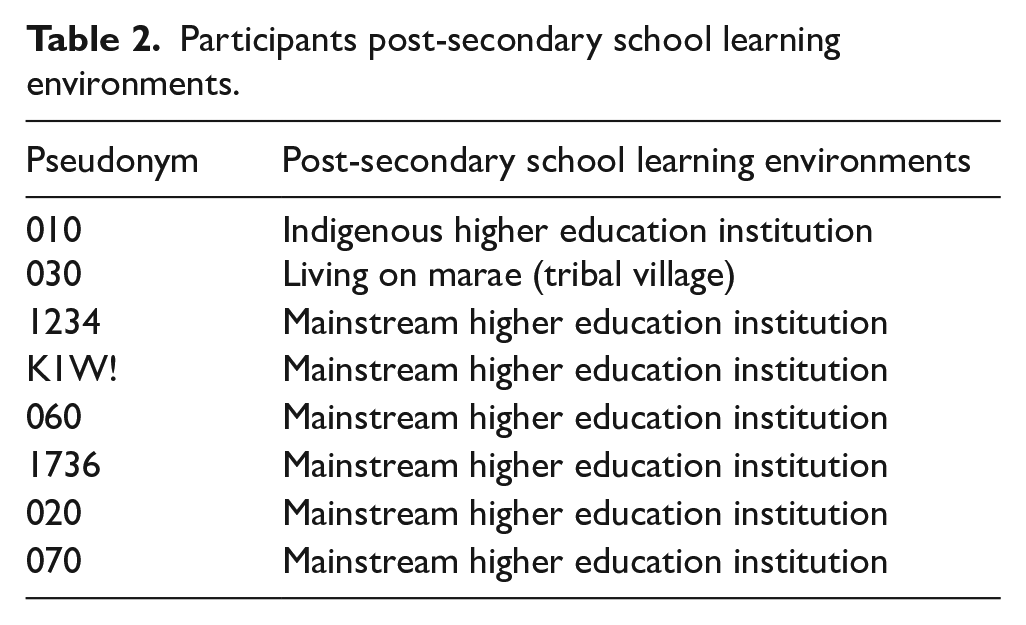
Quotes of participants are used extensively in the data stories and discussion below. To contextualise these quotes with respective learning environments, Table 2 shows the varying educational pathways taken by participants.
Participants post-secondary school learning environments.
Data stories from the follow-up study
Māori identity
In the earlier study (2012–2013), the rangatahi (young people) overwhelmingly associated Māori identity with the concept of belonging, and felt that their connections to whānau (families), whakapapa (ancestory; heritage) and whenua (land) shaped who they were, and gave them security. None of these themes had diminished in the intervening years. Instead, there was a marked increase in focus and engagement with their culture since leaving school. The follow-up study participants had taken more steps to learn their whakapapa, had discovered the depth of their connection to their tūrangawaewae (place of belonging) and the renewed strength that came from spending time at their marae (tribal village).
Throughout the transcripts, the words “connect,” “connected,” connections” appeared repeatedly, in reference to te ao Māori (Māori world), rather than typical social life contexts. Their identity was embedded in representing their whānau, hapū and iwi,
Our connections to people and our whanau through our whakapapa help us understand our places of belonging. (Participant K1W!, female, age 21–24 years) That just goes back to our identity . . . you are literally a representative of your whānau, hapū and iwi. You’ve got all of those people behind you, even the ones that have passed on. [. . .] Why wouldn’t you want to show them the best that you can be? (Participant 010, female, age 21–24 years)
As pakeke (adults), they had found ways to strengthen cultural competency and share their Māori identity. Some described how they had learned te reo Māori for the first time, and all described how they had shared these assets with others in Higher Education settings or within their workplaces:
I wasn’t able to learn my reo while I was a child and growing up but as an adult, I made the decision to pursue gaining this taonga for myself. (Participant 060, male, age 21–24 years) So, I was always a little bit jealous of those Māori kids who could korero Māori and knew all the cool songs and that kind of stuff. It wasn’t until I moved to Auckland that I realised I was so deeply entrenched in my culture that I hadn’t noticed. (Participant 1736, female, age 21–24 years)
Those who were parents were committed to their children acquiring Māori as their first language. “Te reo is my kids’ first language, so they speak Māori, they be Māori, they are Māori.” Others described a multitude of ways in which they shared te reo and tikanga,
But when I was at university yeah it was an absolute struggle trying to maintain that. But doing big things like releasing kīwaha every week so everyone could learn and be on the same waka was something that I did. (Participant 020, female, age 21–24 years) And then bringing it to mahi here. I’ve been asked to project manage te wiki o te reo Māori here for the New Zealand [name of institution]. (Participant 070, male, age 21–24 years) . . . and a lot of trying to educate people on [. . .] pōwhiri is when you do this and this, but this is why. (Participant, 1736, female, age 21–24 years)
Diligence and commitment
In the earlier study, most rangatahi felt that their school created environments where they were motivated to learn. Six years later, the pakeke identified the need to find their own reasons and strategies to stay committed to their goals. A key theme was their sense of identity being central to their motivation, resilience and determination to succeed. One noted, “That resiliency will be what got me through my degree. That comes from my strong sense of identity” (Female, age 21–24 years). Conversely, one of the six participants who attended a dominant culture Higher Education institution (see Table 2 earlier) chose to not use the cultural supports that were available to Māori students, and this participant also described not completing their course of study. After leaving Higher Education however, they strongly embraced their Māori identity and observed in hindsight that cultural support and engagement would have made the difference for them during their Higher Education experience.
Perseverance and determination also emerged as a strong theme. They spoke of the need to “make it through the worst so as to get to the best” and to “just hold on.” They described themselves as being a “problem-solver not an excuse-maker,” taking opportunities that arose and using strategies such as setting small goals to achieve the bigger goals and learning time management skills. In dominant culture Higher Education settings, they spoke of unfamiliar approaches to learning, isolation and interpersonal racism:
So, it’s very different. The way we learn is very . . . It’s not how we would do things. It’s been really hard struggling with that. (Participant 1234, female, age 21–24 years) It was a culture shock to be so separate from my whānau and be in an environment where Māori isn’t as celebrated or normalised. Not everyone there is Māori or understands what it’s like to be Māori, so you can get quite lonely in those instances. (Participant 020, female, age 21–24 years) Probably one of the biggest struggles and I feel like it would be like this for a lot of Māori health students is the interpersonal racism you get from your peers. [. . .] I know a few who have changed their whole degrees or changed the whole uni just because they couldn’t deal with the discrimination that they felt from their peers. [ . . . ] For me though, I kind of saw it as a motivator. I flipped it. I was a little bit different from my peers. (Participant 020, female, age 21–24 years)
The repeated solution was to engage with other Māori students and groups, and kaupapa Māori activities, while negotiating dominant culture contexts. A striking comparison with studying at a wānanga (Māori medium tertiary institution) emerged, where a participant attributed her high levels of achievement in her degree (which was taught from a Māori worldview) to ease and fit, “ . . . that’s why I was so passionate about it and it was easy. I found it easy because I fitted that criteria” (Participant 010, female, age 21–24 years).
Relationships
In the earlier study, the majority of students felt that the support of whānau and teachers was vital to their success. Similarly, in the follow-up study participants identified the unwavering support of whānau and whānau whānui (extended family); “their belief in me” and “being reminded of my whakapapa.” Touchstone people in their lives (such as partners and key friends) were also described, and along with whānau helped with staying connected, financial support and “talking stuff out”:
They [Mum and Dad] have always been the backbone of me and then having my hapori . . . with pakeke, and kaiako from Kōhanga reo to Kura tuatahi, all of them shaped and instilled the foundations and core values that I have within me, like a hard work ethic, always being motivated to pursue excellence, be the best that I could be at whatever I do, that really set the tone. (Participant 070, male, age 21–24 years) Every time I feel like I’m having a rough patch, I always have to go home. And it just makes me feel better. Then I can carry on going, doing my [mainstream Higher Education] stuff. I feel like going home is a big thing. It just keeps me focussed. (Participant 1234, female, age 21–24 years)
As noted earlier, connecting with other Māori students in dominant culture Higher Education contexts was also a key:
If it wasn’t for us [Māori students], coming together, we would have just hated studying. I reckon because we stayed as a group, it really helped a lot. (Participant 1234, female, age 21–24 years)
Innovation and creativity
In the earlier study, rangatahi felt their schools had encouraged them to have a go, explore and question things. Some exploration was in the Māori world, such as kapahaka (Māori performing group) and Manu Kōrero (Māori speech competition), while some was mainstream oriented (Stage Challenge, Spirit of Adventure). By comparison, the pakeke were all active innovators and, significantly, their innovation had a Māori worldview focus. They backed themselves to grasp opportunities such as starting businesses, promoting traditional Māori practices and bringing in a “modern” innovation twist. They were often motivated in these endeavours by Māori role models or whānau:
When I was thirteen I was introduced to [name]. She’s great. She’s also another Kaiako, but she was a mentor for me because she’s a fashion designer, she’s just her own person and she just expresses that on everybody. She’s like, be your own person, find your own way. What’s your quirk? She really took me under her wing and appreciated the skills I had . . . (Participant 010, female, age 21–24 years)
Overall, the commentary spoke of pakeke who were finding fresh ways of using and sharing their cultural traditions. Their impetus as culture bearers, sharing taonga tuku iho (cultural treasures handed down), emerged in creative, innovative expressions of their passion for being Māori:
. . . sourcing resources from the whenua that we are singing about and helping to tell the stories of our ancestors that help us honour our responsibilities as mana whenua. Composing waiata that reflect contemporary issues and delivering them in traditional art, that kinda thing. (Participant K1w!, female, age 21–14 years) Poi was used to strengthen [. . .], so why not take it back, but in a modern way coming forward. So that’s how it came about. I wanted to teach people, I wanted to pass on my style and show them where it actually came from. (Participant 010, female, age 21–24 years)
Wellbeing
The most common methods of addressing wellbeing described by pakeke were cultural practices. Maintaining connections to people and places (whānau, whenua, marae) and drawing sustenance from tai ao (the environment) were central:
That, whaikorero, going home, putting my feet in the awa, standing on my whenua, on my marae. That’s all to rejuvenate, recharge and come back stronger. (Participant 070, male, age 21–24 years)
Walking and kapahaka were the main activities for physical wellbeing. Having people with whom they could converse openly, resting well and maintaining balance in their lives were recurring strategies for emotional wellbeing. Participants were at ease in describing how they cared for their spiritual wellbeing and connections to marae and whenua, often through tangihanga (funeral rituals), were key themes:
I think spiritual is probably the easiest one for me—going to the marae—everything there—tapu, noa, all that sort of stuff. Karakia is a big thing. [. . .] I always know that my tūpuna are behind me . . . (Participant 030, male, age 21–24 years)
Valuing education
The earlier study showed that the rangatahi valued education, and this was linked to their whānau valuing education. Six years later, whānau were once again noted for emphasising the importance of education. One pakeke was the first in their whānau to attend Higher Education. Pakeke saw education as a pathway to the future and had a broad view of learning, seeing it as lifelong rather than only formal education. The motivation given for their studies was invariably to give back to others, particularly whānau and their communities. The interview questions did not ask about their ongoing learning about te ao Māori (the Māori world). Despite this, every participant described multiple ways in which they were pursuing knowledge of te ao Māori:
Education is still highly valued and that’s learning more about Te Ao Māori. Being able to share it. Also, there’s the looking after manuhiri part of tourism that’s big as well. Knowing different cultures, being able to plan a menu for people that can’t eat certain things because of religion [. . .] Education is still a huge part. You’re forever learning. (Participant 030, male, age 21–24 years)
Humility
It’s [humility] probably the most pivotal thing that’s changed for me from high school to now. (Participant 070, male, age 21–24 years)
In the earlier study, rangatahi saw humility as a positive personal value, and defined it with phrases such as “not being cocky,” and “not regarding ourselves as more important.” Six years later, the view of humility had shifted. Some struggled to define humility, and one participant immediately described it as “over-rated.” Being humble in dominant culture education and workplace settings was seen as detrimental to several participants. In discussing humility, many of the pakeke referred to the importance of knowing when to be confident in themselves, and where and when they acknowledged their achievements. For their Māori world, they described it as to “not think that I’m better than anyone because I’ve achieved what I have.”
Māori values
Pakeke were asked to describe what being Māori meant to them, and how they would describe manaakitanga (caring), kotahitanga (unity) and Te Arawatanga (their tribal ways). Having a sense of belonging, connections with others and the environment were resonant themes, as were the responsibilities and leadership which come with these connections. They described being Māori as quintessential to their view of themselves, showcasing their pride but also their awareness that being Māori has made them who they are “Being Māori is everything,” “Yeah, I feel special. I have so much extra things in me. Extra knowledge, I feel privileged to be Māori” and “It’s like my superpower,” “I am Te Arawa first, then Māori.” Their sense of honour was accompanied by their sense of leadership, responsibility and reciprocity. Practical descriptions included “Being Māori means finding a space for it in your home first,” “Māori and manaaki go together hand in hand” and the importance of the spiritual, “Acknowledging that we have a spiritual side in us and that we . . . focus on it” (Participant 1234, female, age 21–24 years).
Overarching themes emerging from analysis
As with the previous study, four key themes and one overarching lever inductively emerged from the messages that were woven into the commentaries. Each are listed below and then expanded on individually. The four themes were:
Mana tangata (leadership, authority);
Moemoeā (aspirations, goals);
Manukura (role models);
Tikanga (customs, protocols).
The overarching lever:
Whakapapa (heritage, ancestry).
Mana tangata—the motivation to lead
The empowerment that accrues through taking opportunities to lead things Māori—taking the initiative and actively leading—was mentioned by all eight pakeke. In response to the question, “What does being Māori mean to you?” one replied, “Rangatiratanga.” Leadership was shown in multiple ways,
. . . being MC for our claims hui. (Participant 070, male, age 21–24 years) They only know those things [gang lifestyle]—that’s what they think being Māori is—whereas I introduce to them these things . . . (Participant 010, female, age 21–24 years) . . . keeping an eye on them (other Māori Higher Education students) and just making sure they have the support they need. (Participant 020, female, age 21–24 years)
Leadership was also shown in the cultural advisor roles they were already holding,
In terms of my cultural responsibilities I am the [cultural advisor] and in that capacity, just yesterday, had to run up to [name] Marae and perform a wero (challenge) because Chief Justice [name] was retiring [. . .], so again using that role to embody our tikanga and our reo in that capacity. (Participant 070, male, age 21–24 years)
A particular focus was initiatives that advanced te ao Māori, demonstrated through leading and promoting te reo and tikanga in dominant culture Higher Education institutions and workplaces. This was also demonstrated in several business start-ups that looked to fuse traditional and innovative expressions of art. They became culture bearers who were enriched by sharing their culture with peers and colleagues.
Moemoeā—the motivation to maintain focus
The importance of remaining focused on goals was an integral thread in the narratives. Pakeke spoke implicitly about their hopes and aspirations, and the sense of purpose which shaped their activities,
I originally wanted to do that [rongoa] but then our family tohunga told me “No! Go get a Pākehā certificate and then come back.” [. . .] He also said I wasn’t ready to learn everything that he has, so he was like “Nah you go, then come back to me and I’ll teach you.” So that’s like one of the main reasons why I’m still here. (Participant 1234, female, age 21–24 years)
Using setbacks and challenges as opportunities for motivation and learning was emphasised by five pakeke and illustrated commitment to their moemoeā,
But every time I’ve stumbled, I’ve always got back up. That’s the biggest learning. I always talk to people, if you fail in life it’s all good. If you fail a paper, you’re not going to die. Making sure that you learn from things. I failed my driver’s test four times. Four times! . . . and every single failed test was a different mistake. I’m glad it wasn’t a repetitive mistake. (Participant 060, male, age 21–24 years)
Manukura—the motivation to emulate others
Manukura (Māori role models) were a key source of motivation for the pakeke, and included whānau members, “I’ve got Dr . . . over here, [aunt] . . . and then my sister had just done the degree before me,” senior Māori students, Māori workplace managers, and iwi leaders. Manukura extended beyond school and into university settings, creating a pathway for others to follow:
Pōwhiri day, meeting the head boy, who still today is my role model, even though I only went to school with him for a year. But seeing him, he’s done it. We share the same attributes as young Māori males, I followed a lot in his pathway. Just to watch and observe those type of people succeed and know that if they can do it, I can do it. That has influenced me a lot in where I am today. (Participant 070, male, age 21–24 years)
This aligns with the earlier Ka Awatea study, which highlighted the impact of role models on tuākana participants: “I wanted to follow in his footsteps” (Macfarlane et al., 2014, p. 133), and also notes that “every tuākana participant could name an individual or group of individuals who they considered had been a positive influence on their goals and aspirations” (Macfarlane et al., 2014, p. 135).
Tikanga—the motivation to act with integrity
Doing the right thing, doing things right and for the right reason, frequently surfaced in the data. The advice one participant would have given to his younger self was, “You don’t have to please everyone. It’s making sure that your heart stays in it for the right reason and your mana stays intact for the right reason” (Male, age 21–24 years). Another reflected on his career path since leaving school,
I didn’t feel that I needed to go to a university or anything like that because I knew I wasn’t passionate about it. I would have gone if I knew in my heart that it was right for me. (Participant 030, male, age 21–24 years)
Integrity was very important and informed the decisions they made, “It’s about my integrity as a person . . . I’m not going to do that to another teacher.” This emphasis extended into how they integrated their Māori values into their lives. It was notable how often all of the eight pakeke used the words “day” or “daily” when they spoke of te reo, tikanga or cultural values:
Te reo me ona tikanga is part of everyday life. Everyday life. I mean it’s even in the smallest things. [. . .] Everyday life for me. (Participant 030, male, age 21–24 years) It had to intertwine with everything I do. It can’t just be an extra. (Participant K1w!, female, age 21–24 years)
Whakapapa—the motivation to carry the gifts of one’s tūpuna
Having a strong sense of identity, belonging and connectedness was intrinsic. Pakeke who had grown up with less engagement in te ao Māori, had been strongly drawn to their whakapapa as they matured. Those raised close to marae or te ao Māori had grown more deeply into their culture. Pakeke were proud of their identity, and proud and aware of the tūpuna who stood behind them. The significance of their tūrangawaewae, their passion for te reo and toi (cultural arts), and the importance of tikanga had emerged into their lived reality, woven into their lives, often deepened by the sense of loss they had experienced by being away from home in dominant culture Higher Education settings. Whakapapa—this sense of connectedness implicitly came with a collective view of life and a motivation to give back to their whānau, and iwi community.
Discussion
The earlier Ka Awatea study was structured as an iwi case study, and drew on the iwi construct, Ngā Pūmanawa e Waru (eight beating hearts), which comprises eight pou exemplified by Te Arawa tūpuna (see Table 1). These underpinned the initial and follow-up studies, providing a framework for enquiry within which other consistent themes emerged.
To convey and give context to the emerging themes from the earlier study, the researchers developed the “Ka Awatea Mana Model” (see Figure 1) for educational success (Macfarlane et al., 2014, p. 177).
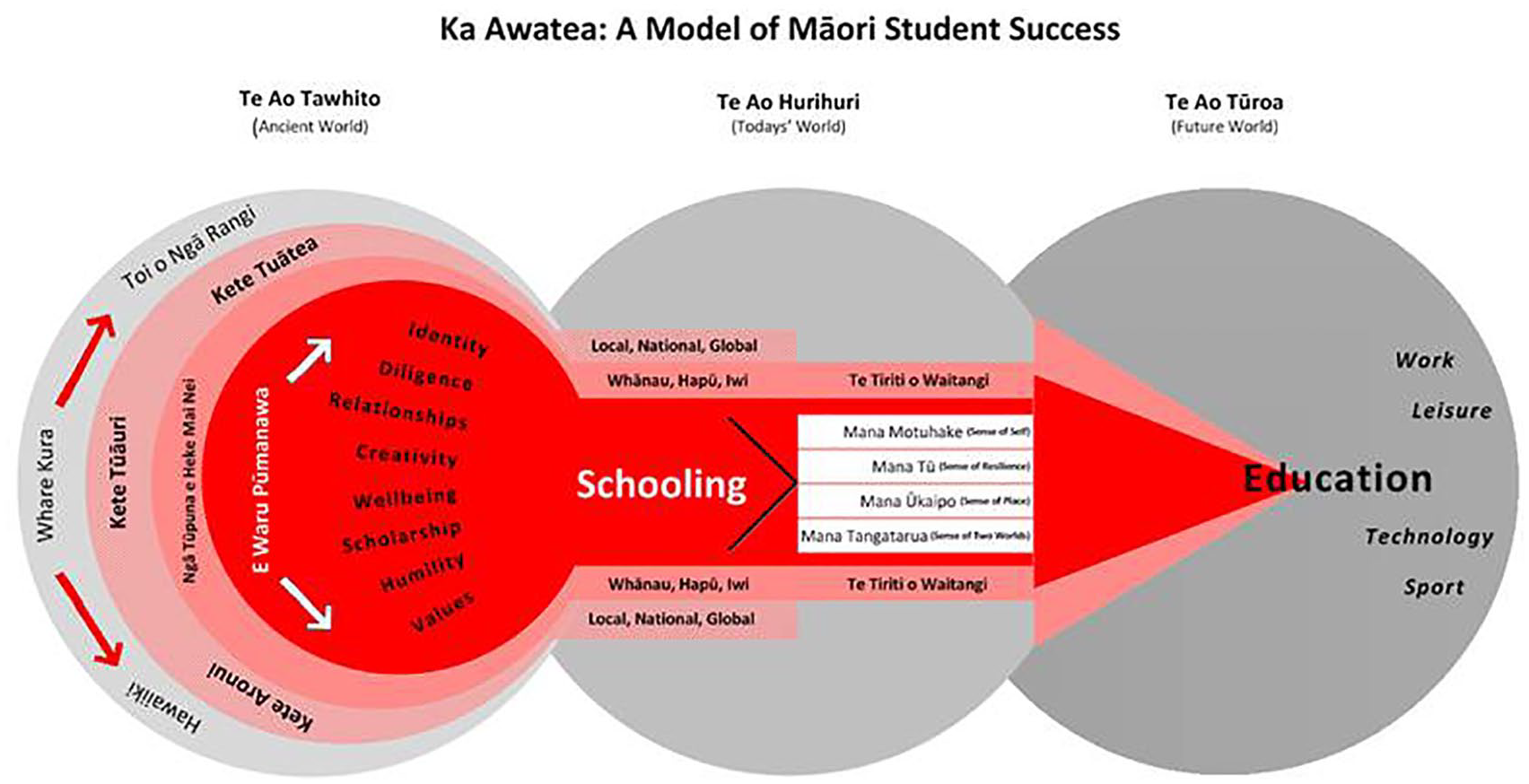
The Ka Awatea Mana Model.
The authors describe the Mana Model as showing three inter-connected worlds (ancient, today, future). The model espouses education as being lifelong and spanning the ascension to retrieve the three baskets of knowledge—to the first wharekura (place of learning), to the eight beating hearts (and what they each represent), to the political influences nationally and globally, to the influences of the Treaty of Waitangi, to the four key themes that emerged from the research project (Macfarlane et al., 2014, p. 176).
One goal of the follow-up study was to test the Mana Model and identify synergies and changes. As described earlier, messages from the eight pakeke also revealed four key themes and an overarching lever, however, while there are synergies across the themes, they have been more acutely defined (see Table 3).
The studies’ emerging themes.
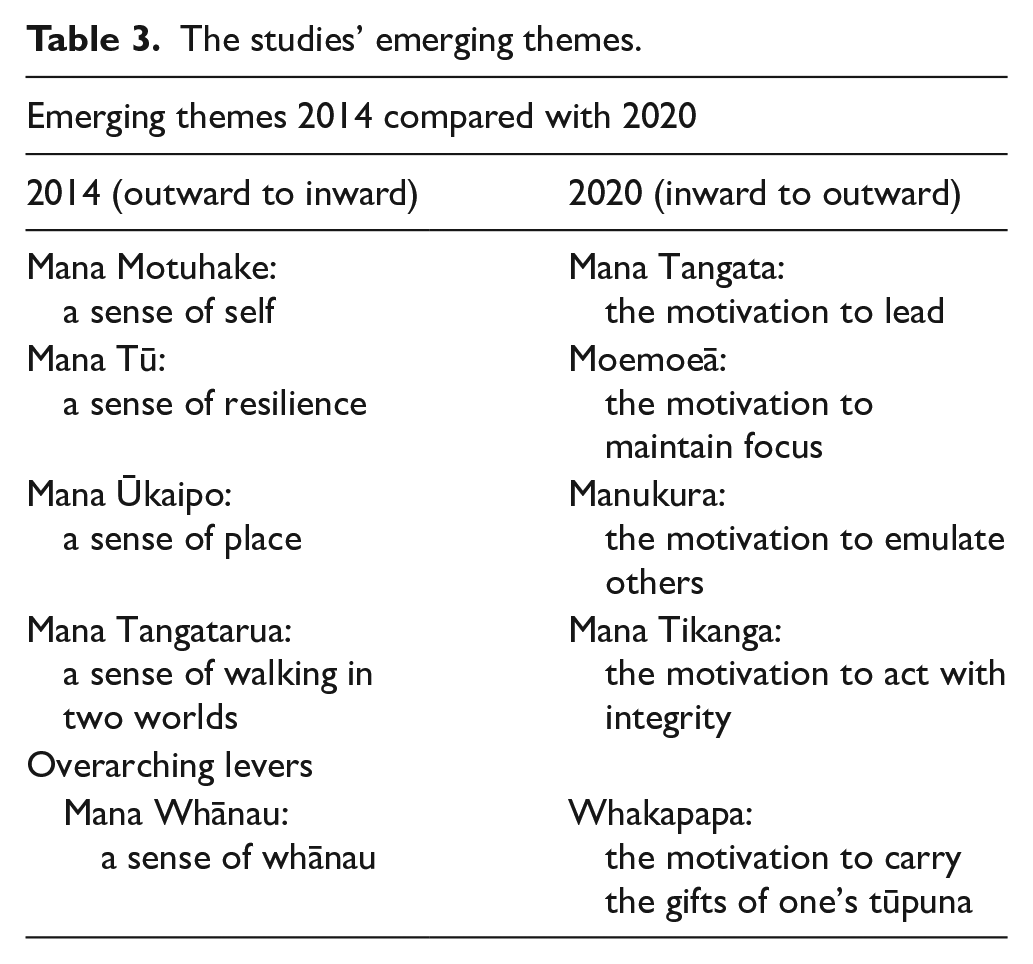
A significant dynamic of the reframing of the themes is a change in directional focus. In 2014, rangatahi were drawing from their outer world to build, foster and nourish their inner world—inner selves—as they grew. In 2020, the pakeke are drawing on their inner world—inner selves—to live in, build and contribute to their outer world. The data position Māori identity as the most important, core and central element to the lives of the pakeke. As noted earlier, “It’s everything.” The scale for this embrace of Māori identity was conveyed through responses imbued with Māoritanga (Māori way of life) throughout—even to questions which did not specifically ask about identity or things Māori. One participant articulated the empowerment drawn from identity saying, “It’s my super power.” These responses resonate with Hutnik (1991, quoted in Houkamau & Sibley, 2011, p. 381) who suggests that unique cultural traditions provide “powerful sources of personal dignity and pride.” Similarly, empowerment is identified as a consistent wellbeing outcome alongside cultural identity and pride in a 2016 meta review of North American literature on cultural continuity for Indigenous peoples (Auger, 2016).
Mana Motuhake to Mana Tangata
The Mana Motuhake theme from the earlier study emphasised that a positive sense of Māori identity is crucial if Māori students are expected to succeed, and that mana motuhake is experienced through developing a sense of cultural efficacy and being able to engage meaningfully with Māori culture. The data on cultural efficacy emerging from the pakeke suggested a further step; “mana tangata” which Webber (2011) describes as an endowment of status for one’s knowledge and appropriate demonstration of traditions, language and culture.
The pakeke had all acted intentionally to further their enculturation, despite their differing paths, suggesting that they recognised the value of cultural practices in their lives. They articulated this repeatedly,
. . . and just making sure that my kids are being raised in a healthy home, and what that looks like is mentally, physically, spiritually—we’re in contact with the marae, we’re always going back to those spiritual connections with the land, whenua, marae and village and all that.
Mana Tū to Moemoeā
Positive self-efficacy, self-concept and an internal locus of control to thrive underpinned the resilience theme, described in the earlier study. However, the Te Arawa researchers also noted that many rangatahi expressed a fear of failure and that there were no descriptions of additional strategies to manage this possibility: “What was made clear was that success was all that mattered and failure was not an option” (Macfarlane et al., 2014, p. 165). This provides a sharp contrast to the data stories that emerged 6 years later. The pakeke were not asked about failure, but five mentioned failure and a sixth described not yet having achieved a key goal. Significantly, there was a pattern to how participants used failure to increase motivation,
So, I was like okay. I’m just back at the bottom [participant had failed to meet a required academic benchmark]. Fuel me up ‘cos I’m ready to go. I always set my goals high and hit them one way or another.
When asked about what had helped in meeting goals, another said, “Failure, I think is a big one. I’ve always learned a lot from all of my failures that I’ve encountered in my life.” This theme has resonance with tuākana who were interviewed for the earlier study and who were at an equivalent life stage to follow-up pakeke. Earlier data from tuākana provided examples of how failure and negative experiences fuelled motivation for further achievement:
experiencing a sense of failure “when a whaikōrero [formal address] . . . didn’t go so good” motivated him to overcome an adverse experience and to put greater effort into everything he did. (Macfarlane et al., 2014, p. 138) Another mentioned her resolve to do well when she was asked “if she was the new cleaner” when she was reporting for a new academic position at a university. (Macfarlane et al., 2014, p. 138)
Similar to the tuākana, pakeke not only overcame fear of failure but they were also able to harness failure and negative experiences as motivation for success. In discussing Māori development, Tangaere (1997) describes negotiating challenges as an integral element for growth and success, pointing to the challenges inherent in Tāne-nui-a-Rangi’s ascent to the heavens as embodying this developmental process. In Māori legend, Tāne-nui-a-Rangi ascended to the highest realm of sacred places to retrieve three baskets of knowledge which he brought back to earth.
Pakeke spoke about giving back to their whānau and iwi, and espoused aspirations of giving to others, the importance of communal wellbeing and obligations to a collective; this was central to their moemoeā, and reflects traditional Māori development norms (Macfarlane et al., 2008). Specific areas through which they wanted to offer reciprocity were health, education, law, tourism, the environment, and youth work. The focus on giving back to others, and the notable absence of commentary about large salaries or opportunities for personal acquisition, fits with other research demonstrating the enduring collectivist values held by Māori (Houkamau & Sibley, 2017). It also aligns with literature describing drivers of success for Indigenous students as contributing to their community’s development (Theodore et al., 2017).
The sense of reciprocity and collective responsibility is one of several indicators of prioritising inner world ahead of material world values. Most of the pakeke described financial hardship and its impact on their goals, yet none of them spoke of financial or material acquisitions as a goal. Their values of tika and pono were emphasised and, in one example, these values were adhered to even if this resulted in financial loss.
Mana Ūkaipo to Manukura
The earlier Ka Awatea study described Mana Ūkaipo as a synergy between school-based learning and place-based learning, specifically to the tribal context. As discussed, bringing their skills back to whānau and iwi was regularly mentioned as both a motivation and a goal for pakeke. Furthermore, many noted regular trips back to their tūrangawaewae to draw sustenance, resilience and wellbeing.
Outcomes from the earlier study also described students as “wanting to see Te Arawa role models of success made visible and prominent in schools” (Macfarlane et al., 2014, p. 175). The importance of role models was strongly endorsed in the follow-up study where manukura were a powerful source of motivation. The successful trajectory of peers such as the head boy at school or family members who have succeeded academically or in wider career paths were described. Literature on Māori role models describes that in te ao Māori, the role of manukura and mentors extends into adulthood (Macfarlane, 2004; Metge, 2015; Tangaere, 1997) and this was illustrated in comments in the follow-up study, “Meeting the head boy, who still today is my role model.” The data conveyed a dynamic where manukura opened doors and forged a path along which these pakeke were travelling.
Mana Tangatarua to Mana Tikanga
All participants in the earlier Ka Awatea study endorsed the need to have the appropriate “navigational skills” and “a strong sense of emotional and spiritual wellbeing to navigate the two worlds of Aotearoa successfully” (Macfarlane et al., 2014, p. 175).
The eight pakeke had needed to navigate paths within dominant culture environments, either through study and/or employment. However, in negotiating these environments they did not describe navigational skills acquired from dominant culture secondary school environments (e.g. social capital and “know-how” about how to achieve things). They described drawing on their Māori identity, the resilience they derived from cultural practices and finding sustenance in belonging to Māori-specific groups, either formal (a structured programme) or informal (culturally supportive study groups) to resource their path through dominant culture higher education or employment contexts. The latter “informal” example is discussed in the literature, where the term, “enclave” is used (Nikora et al., 2002). Cultural enclaves can enable Indigenous students to adapt to majority culture environments without surrendering their cultural identity. The pakeke did not perceive themselves as withdrawing from alien cultural norms—they were doing something that worked for them; “It’s better that we do things in groups.” Webber (2012) describes equivalent racial-ethnic group membership with unique language, traditions and tools as giving a sense of belonging and connection.
The pakeke sustained their navigation in the Western world by reaching to their Māori identity and cultural assets for nourishment and resilience. In keeping with their assertion that “Being Māori is everything,” they expected a high degree of integrity from themselves, an authenticity to their individual selfhood and maintaining tikanga and whakapapa connections in their lives. Whakapapa also provided the support of their tūpuna and “acknowledging that we have a spiritual side in us and that we can practice it, like going to the marae and all that tikanga . . . ”
Comparative overarching levers—Whānau to Whakapapa
The earlier study emphasised that successful Māori students occupy a central position of importance within their whānau. The follow-up study regularly referenced whānau as integral to supporting pakeke wellbeing, and also to the degree of enculturation which they had received as rangatahi. But emerging into adulthood, whakapapa was now the most dominant theme and shaped many other responses.
Whakapapa was described as the most important aspect of their Māori identity, “that determines who I am and where I come from . . . . that I stem from mountains, from awa, from my marae, who have all left a legacy for me to fulfil in the hope that one day, I’ll pass that on to the next generation.” They expressed a profound sense of identity and connection; they reported drawing strength from whakapapa in threatening environments, noting that whānau helped by “always reminding me of whakapapa.”
A strong message was that pakeke had received strength from whakapapa, from whānau, and had also sought and gained cultural assets which shaped and enriched their selfhood. Their sense of responsibility and instinctive roles as culture bearers recurs throughout the transcripts.
As described earlier, all pakeke were actively sharing their cultural assets with others, grasping opportunities to lead initiatives that advance te ao Māori. This occurred through specific Māori initiatives in Higher Education settings, through ensuring te reo Māori was their children’s first language, through teaching roles in Māori medium and mainstream schools, through responding to cultural inadequacies in mainstream employment, through tourism roles and through several creative business initiatives which expressed traditional values with innovative twists.
One community message emerging from the earlier study was the importance of rangatahi as critical players in the continuation of Māori culture, language and traditions (Macfarlane et al., 2014, p. 145). The extent to which the pakeke are undertaking this role, perhaps surpasses the best hopes of their communities.
The small body of literature on positive rangatahi-to-pakeke transitions aligns with the emerging theme of the cultural bearers sharing knowledge. Elkington (2011, p. 35) has set out a traditional framework for Māori development, identifying pakeke as a stage of “reviewing” and “publishing”. The practice of “reviewing” was described by pakeke, especially those whose Māori knowledge acquisition had started later; the practice of “publishing” was described by all. Tangaere describes a development poutama and the importance of assisting one another in that learning, drawing on Reedy to define mana tangata as “development of self-esteem through contributing” (Tangaere, 1997, p. 56). Simmonds et al. (2014, p. 211) list cultural efficacy (including “wanting to share this knowledge with others”) as one of five indicators of positive rangatahi development.
The 2014 Ka Awatea study asserts that,
schools do not currently play a significant role in enabling positive Māori identity to be fully developed, apart from student interactions with a few key Māori teachers who purposefully engage with Māori students around kapahaka, Māori studies and/or Māori language. (p. 147)
Rather, whānau were the predominant source of cultural competence and assets (Macfarlane et al., 2014, p. 145). The follow-up interviews support this view also noting the impact of role models. The follow-up further revealed the participants with fewer cultural assets intentionally seeking them for themselves as adults. Overall, this follow-up study reveals that the assets that enabled the participants to effectively transition into adulthood were the very assets that were not proactively accessible or disseminated in their secondary schooling settings.
Conclusion
This study, albeit small, has strongly reaffirmed a set of enduring themes that were highlighted in the earlier study; themes of Māori success. Four themes and one overarching lever were identified in both studies. These themes were aligned in essence, however they differed in their representation and framing—specifically in terms of enacting and directionality. When referring to enacting, the pakeke had moved from a passive to an active positioning; from thinking to doing; from naming to describing. When referring to directionality, the pakeke had shifted from drawing on the cultural supports that were around them to strengthen their inner wellbeing, to drawing on their own inner cultural strengths for the greater good.
In 2014, Macfarlane et al. noted that “If education is about successful learning and development then it must also be about enhancing cultural continuity and cultural growth” (p. 176). How fortuitous were these words. How powerfully do they contrast to the deficit positioning, that has been reflected for many decades in literature that has described Māori educational achievement. And, how pertinent, as this study highlights again the long-standing need for cultural identity and growth to be implicit in Aotearoa New Zealand’s mainstream schooling. The pakeke in this study are succeeding because of their culture, their identity, their whakapapa—not despite it.
Footnotes
Declaration of conflicting interests
The author(s) declared no potential conflicts of interest with respect to the research, authorship and/or publication of this article.
Funding
The author(s) disclosed receipt of the following financial support for the research, authorship, and/or publication of this article: The authors received funding from Ngā Pae o te Māramatanga, New Zealand’s Māori Centre of Research Excellence.
Glossary
Te reo Māori English
ako Reciprocity
Aotearoa Land of the Long White Cloud (New Zealand)
awa River
hapori A kinship group, a community
hapū Sub-tribe; kinship group
Hawaiiki The ancient mythical homeland of Māori
iwi Tribe(s); large group(s) of many people who descend from a common ancestor
kaiako Teacher
kanohi-ki-te-kanohi Face-to-face
kanohi kitea “the seen face”; being seen; being visible
karakia Prayer; incantation; blessing
kapahaka Māori performing arts
kaupapa Māori Māori philosophy
Kete Aronui The basket of knowledge of peace, arts and crafts
Kete Tuātea The basket of ancestral knowledge
Kete Tuāuri The basket of sacred knowledge
kīwaha Māori saying(s), colloquialisms
kōhanga reo Māori medium preschool
kotahitanga Unity
kura tuatahi Māori medium primary school
mahi Work
mana Dignity
mana motuhake Sense of identity
mana tangata Status accrued through leadership and contributing
mana tangatarua Sense of walking in two worlds
mana tikanga Status accrued through doing things correctly
mana tū Sense of resilience
mana ūkaipo Sense of place
mana whānau Sense of family
manaakitanga Caring for others
manu kōrero Māori speech competition
Māoritanga Māori way of life
manuhiri Visitors
manukura Role models
marae Tribal village
mātauranga Māori Māori knowledge
moemoeā Vision, dream, goal
Ngā Pūmanawa e Waru The eight beating hearts (tribes) of the Te Arawa canoe
noa Not sacred, free from the extensions of tapu (sacred)
Pākehā New Zealanders primarily of European descent; New Zealanders descended from European settlers
pakeke Adults
poi Cultural arts
pono Working with integrity and honesty
pōwhiri Traditional formal welcome extended To visitor(s)
pou Pillars
rangatahi Youth; young person or people
rangatiratanga Self efficacy; autonomy
rongoa Traditional Māori healing
roopū Group
tāne Men
tangihanga Funeral rituals
tapu Sacred
taonga Treasure
taonga tuku iho Cultural treasures handed down
te ao Hurihuri The present world
te ao Māori The Māori world
te ao Tawhito The ancient world
te Ao Tūroa The future world
Te Arawa A canoe which brought ancestors to Aotearoa
Te Arawa tikanga Te Arawa tribal protocol
Te Arawatanga Te Arawa tribal ways or ways of doing things
te reo Māori The Māori language
te reo me ona tikanga The language and customs
te wiki o te reo Māori Māori language week
tika To be correct; doing the right thing
tikanga Māori Māori customs
Toi o Ngā Rangi The uppermost (summit) of the 12 heavens
tuākana Older person of the same gender
tūpuna Ancestors
tūrangawaewae Place of belonging
wāhine Women
waka Canoe
wero Challenge
wānanga Māori medium tertiary institution
whaikōrero Formal speech; oration
whakapapa Ancestry; heritage
whānau Family; families
whānau whānui Extended family
whanaungatanga Strengthening connections
wharekura Place of learning
whenua Land; placenta; source of nourishment