




Abstract
Acknowledgement that Indigenous Knowledge cannot be assimilated and readily generalised within reductionist scientific paradigms is emerging. The reluctance of Indigenous Peoples to adopt reductionist science-based interpretations is justified. Science that stops at the point where reality is universal excludes consideration of how outcomes are understood and experienced by more holistic epistemologies including those of Indigenous Peoples. Culturally derived ways of knowing are beyond the realm of reductionist science and require approaches to decision-making frameworks that are capable of including culturally specific knowledge. Cultural indicators are a geographically specific means of enabling measurement of a particular culture’s attributes; however, to be appropriately recognised, the method of inclusion is at least as important. Therefore, cultural indicators, their definition and their measurement are the sole prerogative of Indigenous Peoples, and how Indigenous epistemologies are effectively empowered in frameworks is critical, as decisions are no longer being made in purely Indigenous contexts.
Introduction
Pohewa Pae Tawhiti (Visualising Horizons) is a co-designed research project, funded under the Our Land and Water National Science Challenge, that has the aim of creating land-use change evaluation tool based on the Māori concept of mauri (life force, life essence, life supporting capacity)—hereafter referred to as the Tool—that will assist discussions and decisions about land-use change that appropriately incorporates cultural considerations. The Tool and the research project in which it is embedded are being co-designed by Te Arawa Iwi (Te Arawa confederation of tribes) and five Crown Research Institutes (CRIs) in Aotearoa New Zealand (NZ). While the tool will initially be with and for Te Arawa Iwi, its design is intentionally flexible to include multiple worldviews.
What will be different about a mauri-based land-use change evaluation tool co-designed by Te Arawa and CRIs in Aotearoa NZ? The opportunity for Te Arawa Iwi to co-design a Tool that incorporates Māori values and perspectives, and which can communicate predicted outcomes of land-use change is important. It is important for a number of reasons, but foremost it could assist Māori land-owners and land users to make decisions that are inclusive of their cultural norms and aspirations, and further will provide the ability to communicate these understandings across cultures. The capability to communicate multiple ontologies using the same tool has not been available previously as inherent assumptions in the design of many of the existing tools have been that a scientifically derived representation of reality should be the same for everyone.
Acknowledgement that Indigenous knowledge (IK) cannot be assimilated and readily generalised within the typically reductionist scientific paradigm is emerging in different ways including international declarations, treaties with Indigenous Peoples, educational reforms, resource management and research. This change is incremental and often project by project. Concurrently, Indigenous Peoples themselves are often wary of science-based interpretations due to past failures of the imposition of rules drafted by scientists and enforced by governments in the areas of wildlife conservation and resource management. Compelling examples of such scientific failures are available in the literature with two examples shared later in this article.
The identifier Tangata Whenua reinforces the understanding and positioning of the Indigenous Peoples of Aotearoa NZ as the people of the land. As reductionist scientific perspectives stop at the point where reality is the same for everyone—mass balance—it must therefore exclude considerations of worldview and how outcomes are understood and experienced. Worldviews are culturally derived and beyond the realm of reductionist science. It is for this reason that the incorporation of the cultural, social and environmental implications for Indigenous communities was integral to impact assessment and was negotiated as part of the UN Convention on Biological Diversity (CBD) in 2004. Indigenous Peoples, including the Tangata Whenua of Aotearoa NZ, understand and experience reality in more nuanced ways than reductionist science can communicate or understand.
Communicating the Tangata Whenua way of knowing within a tool introduces the need for the inclusion of culturally specific knowledge. One approach explored in the Pohewa Pae Tawhiti project is through the inclusion of cultural indicators to inform the Tool. This article identifies the state of knowledge of cultural indicators and their relevance to Pohewa Pae Tawhiti and other endeavours that require inclusion of cultural indicators. The structure used here is to first provide a definition of cultural indicator, explore the extent of cultural indicator use within international contexts via 10 case studies, then compare the characteristics evident to cultural indicator use in Aotearoa NZ as it relates to rural land use by Te Arawa Iwi and other Iwi (tribes).
Finally, for any tool to be useful, it must be fit for purpose. A primary purpose of the Tool is to indicate the likely consequences of a course of actions pertaining to land-use change in a way that is perceived as credible to the end-user. The Tool is likely to be useful and credible to the user if it is able to communicate with a person’s present understanding of an issue and predict consequences of possible alternatives in a way that builds and then retains the confidence and trust of the user to a degree sufficient to then influence the subsequent actions of that user. For this reason, the way in which cultural indicators are incorporated into the Tool is potentially more important than the augmented understanding provided by the cultural indicators themselves.
A Pohewa Pae Tawhiti definition of cultural indicator
Tikanga-ā-iwi means the practices of a people specific to themselves and is used to define this area of learning in Te Marāutanga o Aotearoa (2017), the Māori medium school curriculum, demonstrating alignment with Tangata Whenua understandings of indigeneity. Durie (2005) defines indigeneity as geographic specificity characterised by a distinct geographic relationship and belonging, unity with that ecosystem of origin, endurance over many generations, a system of knowledge, a unique language, and the development of a distinctive culture. In summary, Durie is describing an enduring relationship between peoples and their ecosystems of origin.
Consistent with these definitions, culture is defined here as a geographically specific expression of identity. Therefore, cultural indicators are the appropriate geographically specific means of representing that identity which enables that culture to be recognised or measured. It follows then in Aotearoa NZ that cultural indicators must be identified and defined by the Iwi or Hapū (sub-tribes) who have occupied a particular location for a length of time sufficient to have developed a unique connection to a place. Thus, cultural indicators, their definition and their measurement are the sole prerogative of Indigenous Peoples.
International frameworks and ways of knowing using cultural indicators
From the position of Indigenous Peoples’ empowerment, the United Nations Declaration on the Rights of Indigenous Peoples (UNDRIP) and the Aashukan Declaration principles regarding Indigenous Peoples’ rights, relationships, processes and outcomes in Impact Assessment help to identify current expectations. Aashukan means bridge in the language of the First Nations Cree. The holistic perspective of Indigenous Peoples is further reinforced by the Akwé: Kon Voluntary Guidelines. Akwé: Kon is a holistic Mohawk term meaning “everything in creation” (CBD Guidelines, Secretariat of the Convention on Biological Diversity, 2004). Akwé: Kon presents a set of “voluntary guidelines for the conduct of cultural, environmental and social impact assessment” (CBD, 2004, p. 1). From the perspective of ecology and systems thinking, there is work being done that recognises the value inherent in Indigenous epistemologies with regard to resilience and adaptation strategies for climate change (Folke, 2006; Miller et al., 2008).
The international context for the use of cultural indicators in relation to Indigenous Peoples’ human rights is now protected under the UNDRIP. The UN General Assembly adopted UNDRIP on 13 September 2007, which was later officially endorsed by the NZ Government in 2010 after opposing it for almost 3 years alongside Australia, Canada and the USA. UNDRIP (2007) recognises “the urgent need to respect and promote the inherent rights of Indigenous Peoples” (p. 3), which derive from their identities, tikanga (practices) and kawa (protocols), and especially their rights to traditional lands, waters and other taonga (treasured possession). The UN declaration is clear in that “control by Indigenous Peoples over developments affecting them and their lands and resources will enable them to maintain and strengthen their institutions, cultures and traditions” (UNDRIP, 2007, p. 4), aligned to their aspirations and needs. The UN recognises that “respect for indigenous knowledge, cultures and traditional practices contributes to sustainable and equitable development” (UNDRIP, 2007, p. 4) and the proper management of the ecosystems of their origin. The declaration identifies rights that are directly relevant to cultural indicator development (UNDRIP, 2007):
The right to practise and revitalise cultural traditions, including past, present and future manifestations of Indigenous culture (pp. 12–13).
The right to participate in decision making (pp. 15–16).
The right to strengthen their distinctive spiritual relationship with taonga and to uphold responsibilities to future generations (p. 19).
The right to the conservation of their ecosystems of origin. Assistance programmes for conservation must ensure that no storage or disposal of hazardous materials takes place without their free, prior and informed consent (p. 21).
The right to maintain, control, protect and develop their cultural heritage, traditional knowledge and traditional cultural expressions (p. 22).
The right to determine and develop priorities and strategies for the use of lands and resources. Appropriate measures shall be taken to mitigate adverse impacts (pp. 23–24)
Akwé: Kon voluntary guidelines and the Aashukan Declaration
Two additional frameworks assist the development of cultural indicators: the Akwé: Kon voluntary guidelines developed at the UN Secretariat of the Convention on Biological Diversity in 2004 (CBD, 2004) and the Aashukan Declaration (2017) adopted by the International Association of Impact Assessment in 2017. The holistic worldview reflected in Akwé: Kon is evident in many Indigenous cultures of the world and resonates with the understandings of Tangata Whenua in Aotearoa NZ that humankind are an inseparable part of their ecosystems of origin. Similarly, the Aashukan Declaration (2017) asserts Indigenous expert-crafted principles for impact assessment best practice. The declaration sets out how impact assessments must centre Indigenous rights, relationships, processes and outcomes in order to be effective and enhance the well-being of Indigenous Peoples according to their own criteria.
Together, these frameworks demonstrate that Impact Assessment usefulness is to a large degree determined by the completeness of the cultural indicator sets used to represent the way of life of the affected community. The extent to which the cultural indicators inform the decision maker is also important and cultural indicators must be represented in a way that enables the information they represent to be given at least equal consideration in decision making alongside other social, economic and environmental considerations.
Indigenous ways of knowing
Do Indigenous ways of knowing add anything to the understandings available from modern technology and science? Despite evidence to the contrary, many developed societies challenge whether these antiquated Indigenous views are really necessary or relevant in the modern technological world. Mander (1991) provides two useful examples when he challenges the assumption that modern systems of resource management will always be more efficient. He describes the formulaic management of wildlife based on computer modelling—quota, maximum sustainable yield and satellite tracking—that unconsciously incorporates the economic, environmental, social and cultural assumptions of Western society. Two examples are given:
Canadian wildlife managers told the Inuit that they should hunt only large or male caribou, a practice that contradicts traditional IK. The annual limit of only 26 kills was far less than had been hunted historically; however, the abundant population decreased sharply.
Similarly, government policy was created to permit sport hunting of the old, biologically superfluous Musk-Ox bulls in the Arctic, also contradicting traditional IK.
In essence, the recommendations were made from a limited understanding of the Caribou and Musk-ox populations and based only on quantitative data. In both cases, the scientific and Indigenous People’s ways of knowing, empirical evidence is based on the systematic accumulation of detailed observation over an extended period of time and the abstraction of norms from disparate data sets. However, while IK assesses deviation from the norm in a qualitative sense, where diversity is valued for the particular qualities that it encompasses, the inherent limitations of discrete scientific observations typically do not, and this leads to different levels of understanding, decision processes and outcomes. The wildlife managers in both cases were ignorant of the hugely important qualitative IK regarding the social structures of these animals, where the older males have more experience, greater endurance and physical strength that is essential for a herd’s survival given the marginality of the harsh winter environment. In effect, the old males are not surplus at all but rather have similar roles to elders in their social groupings. In both cases, the government policies were reversed.
These two examples provide a valuable insight into how the assumptions regarding scientific thought can undermine the intended results in the real world. The examples highlight the difference manifest in management of resources for instrumental value rather than intrinsic value. The difference between economic rationalism that emphasises numbers and individual value on one hand and traditional IK systems that emphasise relationships that help to maintain the biosphere in equilibrium on the other. Recent international case studies reinforce this observation.
The use of culturally grounded indicators in the international context
International case studies have demonstrated a range of examples of cultural indicators in decision-making processes, which draw on local cultures and values to capture Indigenous ways of knowing. The incorporation of culturally grounded indicators has revealed complex mechanisms already in place in Indigenous societies to regulate and protect resources, which incorporate sustainable resource management, traditional economies and systems of reciprocity. Inclusion of these indicators can complement physical measurements, facilitate collaborative stewardship of the environment, and support community-led decision making and ownership of projects. This section focuses on the outcomes of 10 case studies, as shown in Table 1, which have mostly been developed within socio-ecological systems within or adjacent to Te Moana-Nui a Kiwa (the Pacific Ocean). Seven of these case studies were previously summarised by Sterling et al. (2017).
International case studies of cultural indicators.
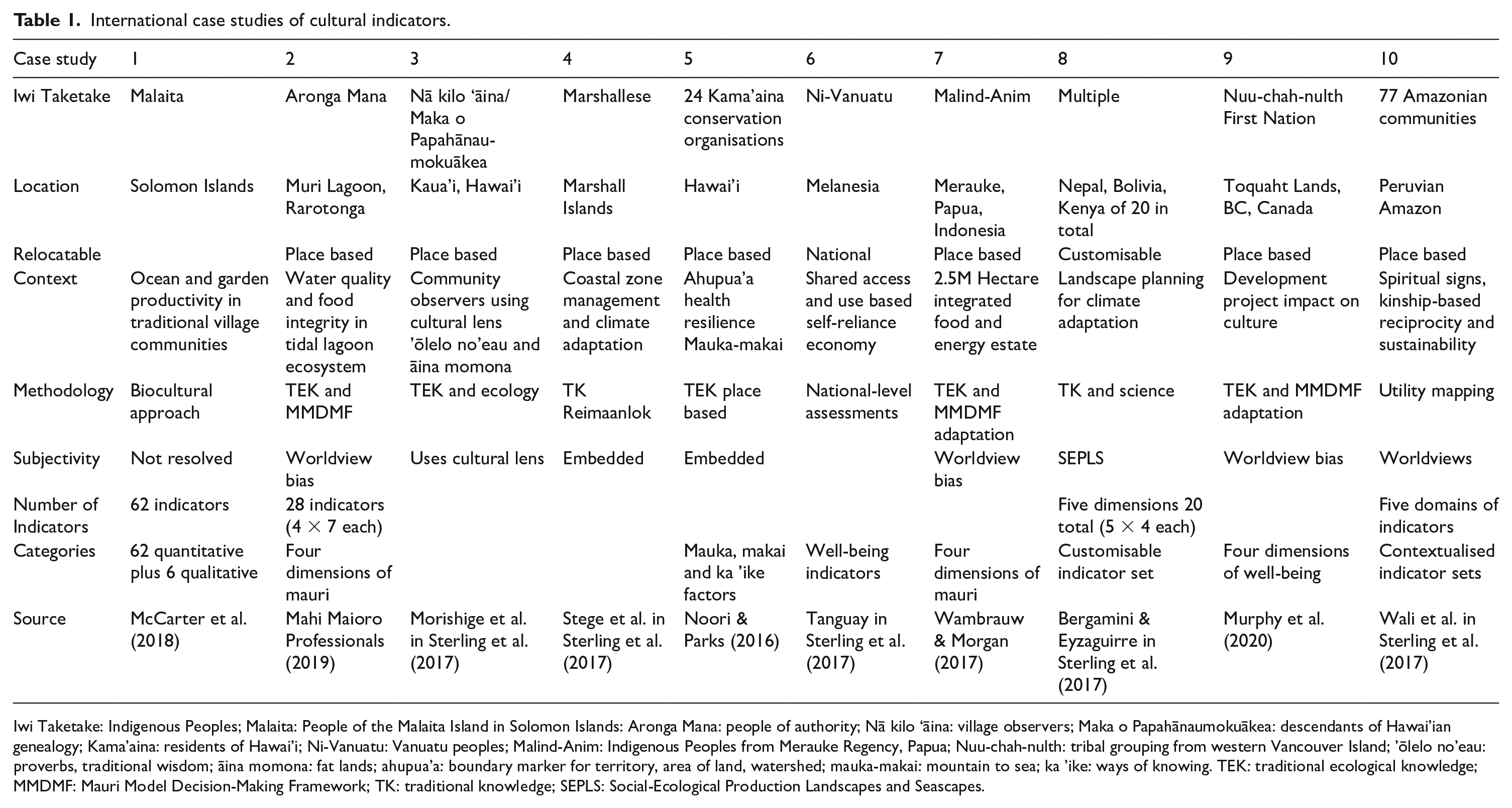
Iwi Taketake: Indigenous Peoples; Malaita: People of the Malaita Island in Solomon Islands: Aronga Mana: people of authority; Nā kilo ‘āina: village observers; Maka o Papahānaumokuākea: descendants of Hawai’ian genealogy; Kama’aina: residents of Hawai’i; Ni-Vanuatu: Vanuatu peoples; Malind-Anim: Indigenous Peoples from Merauke Regency, Papua; Nuu-chah-nulth: tribal grouping from western Vancouver Island; ’ōlelo no’eau: proverbs, traditional wisdom; āina momona: fat lands; ahupua’a: boundary marker for territory, area of land, watershed; mauka-makai: mountain to sea; ka ’ike: ways of knowing. TEK: traditional ecological knowledge; MMDMF: Mauri Model Decision-Making Framework; TK: traditional knowledge; SEPLS: Social-Ecological Production Landscapes and Seascapes.
The incorporation of cultural effects into existing frameworks can present challenges, particularly within existing Western-science models. For example, a set of 68 sustainability indicators were developed in the Solomon Islands to represent “garden and ocean productivity, local knowledge of resource management, state and trends of the environment, governance, and leadership” (McCarter et al., 2018, in Sterling et al., 2017, p. 81). Of these 68 indicators, 6 were specific to the community’s relationships to the environment, and researchers noted difficulties in standardising these into their existing frameworks. The cultural indicators considered important by the community use Indigenous measurement that is context-dependent but misaligned with the Western characterisations adopted by the research. While interpreted as a problem, these indicators could instead have been used to ensure that the relevance of cultural well-being is retained in the absence of scientific data.
One adaptation of an existing Indigenous-based decision framework showed greater success. An evaluation of the Merauke Integrated Food and Energy Estate, which comprised the destruction of more than 2.5 million hectares of Indigenous rainforest for timber, rice paddies and palm oil plantations in Papua, adapted the Mauri Model Decision-Making Framework (MMDMF) to suit the local needs (Wambrauw & Morgan, 2014). The conceptual framework within Papua culture to underpin the model was identified, and the tool was adapted to suit the local needs. In this case, the use of the cultural indicators and adaption of an existing tool provided a more complete understanding of the ecosystem in synergy with Indigenous approaches to well-being. Trust in the process was also built by applying the tool to a small, relatively uncontentious project, before scaling it up.
Multiple international cases have highlighted the use of cultural indicators to communicate local relevance, including factors such as access to customary lands, forest and marine resources, and place-based values. While conventional indicator development typically focuses on indicators which are widely accepted, this is not appropriate for cultural indicators which communicate place-based values. In one case study, an ocean outfall for treated wastewater was proposed in Rarotonga (Mahi Maioro Professionals, 2019). The ocean outfall was a pragmatic and cost-efficient solution to the ongoing Muri Lagoon water quality issues, which ignored the cultural implications of discharging wastewater into an important food source of the local Aronga Mana. The outfall also ignored the risks and uncertainty of discharging micropollutants and emerging contaminants into a culturally important ecosystem. The adoption of an Indigenous perspective can help avoid irreversible consequences that may only become obvious to a reductionist science-based understanding once it is too late. In this example, the relevant importance of traditional knowledge is acknowledged by having a discrete indicator set for cultural well-being, which ensures Indigenous priorities are included in the modelling and explanation of the proposed options.
Cultural indicators have been adopted in a similar fashion in the Marshall Islands within the Reimaanlok Framework. Here an eight-step process was developed to aid the collection of local and traditional knowledge where there was “a paucity of scientific data, and where decision-making about use of natural resources occurs primarily at local level” (Stege et al. in Sterling et al., 2017, p. 79).
Similar studies have highlighted Indigenous measures of health and well-being which do not fully align with reductionist scientific perspectives, but instead are based on human–environment interactions and more complex understandings of well-being. One study in the Peruvian Amazon (Chirif, 2007, in Sterling et al., 2017; Wali, 2016) involves place-based assessment of ecological knowledge, forms of social organisation and the capacities of local institutions, which are combined with communities’ perceptions of quality of life across five domains: natural resources, cultural practices, social relationships, governance or political processes, and household economics (Wali et al., 2008, in Sterling et al., 2017, p. 72). The assumption that perceived quality of life would correlate with per capita income, education level and urban survival were found to be untrue. Instead, healthy forest ecosystems, quality of fresh food, air, water, happiness of their children, self-determination and identity were the strongest predictors of perceived quality of life. Studies such as this one can be used to demonstrate direct well-being effects from sustainable resource management and maintenance of traditional practices. Similarly, a study in Hawai’i (Noori et al. in Sterling et al., 2017) involving The Alliance, a collaboration of 24 organisations, used a set of mauka (Hawaiian: terrestrial), makai (Hawaiian: ocean) and ka’ike (Hawaiian: social-economic) indicators to measure the health of communities. These are viewed through a socio-ecological context using local descriptions, priorities and understandings. The integration of multiple knowledge systems allowed for the reactivation of an intergenerational collaborative stewardship model, which had previously defined how Hawaiian resources were managed prior to colonisation.
International case studies have highlighted the importance of cultural indicators being selected in a way which is consistent with the holistic ways of knowing of the local Indigenous peoples. This can only be achieved by including the community in a participatory role in the selection, definition and ongoing measurement of these indicators. The Toquaht Nation, on the Pacific-facing side of Vancouver Island, developed a system to evaluate potential economic developments and measure their outcomes based on four dimensions: community, culture, economy and the environment (Murphy et al., 2020). The participatory action research approach which was adopted allowed the community to identify an entirely different side of economic development in which the community plays a central role. Similarly, the Hawaiian worldview based Nā Kilo ‘Āina (culturally grounded, community monitoring) indicator set demonstrates the success of including the community in the ongoing measurement of cultural indicators (Morishige et al. in Sterling et al., 2017). The indicator set captures community-level indicators and follows the Hawaiian process of Kilo (observation), which uses seasonal and ecological indicator sets customised to monitoring needs. Huli ‘Ia (observational process) identify seasonal “environmental patterns in the atmosphere, lands and oceans” (Sterling et al., 2017, p. 75) and identify links which serve as vessels of Hawaiian IK. The community engagement in the ongoing monitoring of these indicators therefore ensures that all available knowledge is drawn upon to inform development.
Cultural indicators can also support traditional economies by empowering IK to support self-reliance of whānau (families) and ensuring that access and control over the land is kept intact. The Melanesian Wellbeing Indicators (Tanguay in Sterling et al., 2017) provide “national-level assessments of well-being” within the Melanesian traditional economy which depends on “equitable distribution of wealth and opportunity, within a society which is governed by shared cultural values and rules dictating control over available resources” (Regenvanu, 2010, as cited in Sterling et al., 2017, p. 68). Three dimensions of well-being are used: “access to land and natural resources; the skills to be productive with those resources; and community vitality” (Regenvanu, 2010, in Sterling et al., 2017, p. 69). Biocultural indicators are intended to be used to ensure the work programme delivers Melanesian well-being by strengthening the ability of communities to manage their own resources and improve access to customary lands, forests and marine resources, and form a measure of self-reliance which is uniquely Melanesian. Similarly, Social-Ecological Production Landscapes and Seascapes (SEPLS) demonstrate examples of ecosystems which have evolved as resilient systems which foster human well-being while maintaining biodiversity and ecosystem services (Gu & Subramanian, 2012). In this approach, 20 indicators are used which represent biodiversity and resilience at a community level and support sustainable economies which are fundamentally linked to these ecosystems. The centring of traditional knowledge towards managing productive landscapes and seascapes can assist defining resilience-strengthening strategies, by reaching agreements on threats as well as solutions (Sterling et al., 2017).
Overall, these case studies have demonstrated that the incorporation of cultural indicators can reveal forms of well-being which are unlikely to otherwise be incorporated; however, this only occurs when Indigenous communities and their knowledge are centred in the decision-making process. The adaptation of existing tools can be successful in capturing effects; however, caution should be taken when adapting Western frameworks as they may have the unintended effect of displacing Indigenous ways of knowing. When successfully captured, these Indigenous ways of knowing can accommodate the complexity of physical, historical and spiritual interactions of humans and ecosystems, as well as their unique effects on human health. Approaches that are inclusive of all knowledge sources, all ways of knowing, and all those who are impacted, will produce results that are understandable to all, relevant and valued.
A context for cultural indicator introduction in Aotearoa NZ
The term cultural indicators can be used for a variety of purposes from measuring the instrumental value of cultural identity within the national or regional economy to measurements of cultural well-being typically aligned to cultural impact assessments. For the purposes of Pohewa Pae Tawhiti, the intention is to better understand the implications of resource management decisions and so this review focuses more specifically on the types of cultural indicators that are relevant to land-use change in Te Arawa rohe. Where such cultural indicators are of an instrumental type purposed for economic understanding, it is suggested these belong more appropriately within assessments of economic well-being.
The relationship of Māori with their ancestral lands, including cultures and traditions, was first recognised as an issue of national importance in the Town and Country Planning Act 1977 just over 40 years ago. The recognition of Tangata Whenua relationships followed 2 years behind the Treaty of Waitangi Act introduced by private member bill by the Hon. Matiu Rata. This was the first official recognition of the Treaty of Waitangi (NZ founding document) by the NZ government since it was signed 135 years earlier and the Act indirectly fulfilled an empty promise by the Labour Party dating back to 1935. The Treaty of Waitangi Act introduced the Waitangi Tribunal which was authorised to investigate breaches of the Treaty by the crown occurring after 1975. Early Waitangi Tribunal claims focused on the cultural offence caused to particular Iwi and Hapū as the result of development initiated environmental degradation. Reports from 1983 onwards relied on anecdotal evidence often citing negative impacts upon mauri as the basis of cultural offence experienced. It can be argued that these successful claims initiated the awakening of environmentalism in Aotearoa NZ and new laws such as the Environment Act 1986 which was to ensure that, in the management of natural and physical resources, full and balanced account would be taken of (The Environment Act, 1986) (i) the intrinsic value of ecosystems; (ii) all values which are placed by individuals and groups on the quality of the environment; (iii) the principles of the Treaty of Waitangi; (iv) the sustainability of natural and physical resources; and (v) the needs of future generations (p. 2).
The Environment Act 1986 was world leading in its time, with the draft legislation referring to the mauri of ecosystems, and clauses (iii) and (v) deriving from Indigenous ways of knowing. The interpretation included a holistic definition of the environment as ecosystems including people and communities, as well as social, economic, aesthetic and cultural considerations. Thus, Aotearoa NZ began its journey of discovery in terms of conceiving the measurement of the holistic environment. The Environment Act quite possibly initiated the extensive legal framework review that resulted in the Resource Management Act (RMA) being introduced into law in 1991.
Te Puni Kokiri (Ministry of Māori Development) provided the earliest efforts to interpret the broadened inclusion of Māori concepts in the RMA 1991 several years after its introduction (Mauri Ora Ki Te Ao, 1993). The earliest indicator sets were conceived as a subset of the environmental performance indicators developed by the Ministry for the Environment in the late 1990s.
Cultural indicators in Aotearoa NZ today
Fast forward more than two decades to now. Cultural indicator sets are now being created on a project-by-project basis in keeping with the need to ensure the integrity of the indicators and essentially their local relevance. The extant literature is dominated by cultural indicator sets related to the ecosystem and in particular the health of freshwater, wetlands and forests. Due to the plethora of reports, theses and journal articles, selected examples have been summarised below.
Recent forest ecosystem services research (Lyver et al., 2017) confirms the importance of cultural ecosystem services in Aotearoa NZ. Mapping forest values from interviews, four biocultural themes were identified, and the cultural concepts most commonly associated with these were documented. Twenty-eight concepts were identified with mauri, mahinga kai (food gathering practices), oranga (health) and te ohanga whairawa (economic wealth) being those most commonly used as shown in Table 2.
Cultural ecosystem services Māori values.
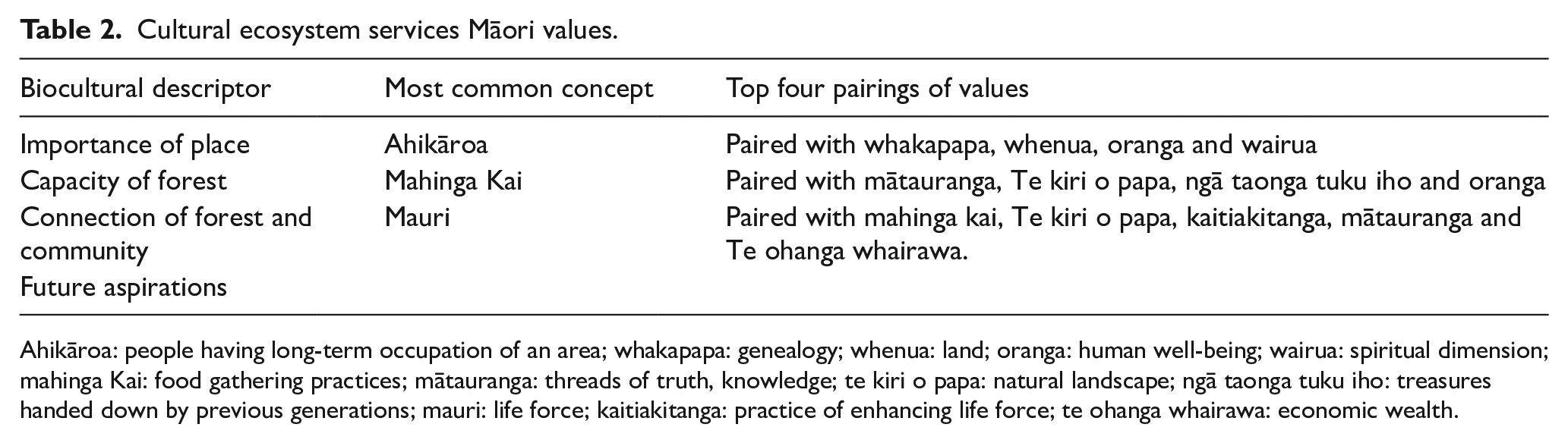
Ahikāroa: people having long-term occupation of an area; whakapapa: genealogy; whenua: land; oranga: human well-being; wairua: spiritual dimension; mahinga Kai: food gathering practices; mātauranga: threads of truth, knowledge; te kiri o papa: natural landscape; ngā taonga tuku iho: treasures handed down by previous generations; mauri: life force; kaitiakitanga: practice of enhancing life force; te ohanga whairawa: economic wealth.
In particular, mauri was associated with all four primary ecosystem services categories—biocultural descriptors—and the observation is made that if mauri taiao (ecological integrity) is healthy and vibrant, it follows that ecosystem services central to the local community will also be supported. In this way, mauri is able to represent the relationship between and the socio-ecological resilience of a Māori community and their ecosystem of origin. It is this relationship that is vitally significant as it constitutes the embodiment and growth of the culture and cannot be substituted by physical sustenance alone.
Harmsworth (2002, 2013) identifies general principles for cultural indicator development for wetland ecosystems that it is suggested apply generally to all cultural indicators:
Indicators originate from a Māori epistemology of origin, knowledge and application.
Indicators are interconnected through whakapapa (genealogy) linkages to Atua (the Gods).
Indicators are built from intergenerational knowledge, technology, relationships, experience and interaction with ecosystems over long periods of association with a place.
Indicators reflect values, including rangatiratanga (right to exercise authority), kaitiakitanga (practice of enhancing life force), whakapapa, wairuatanga (spirituality), mauri and tapu (sacredness). Values define tikanga and kawa for the local area.
Tikanga and kawa inform customary use, based on observations and learnings, related to seasonal phases, animal behaviour and resource condition.
Indicators have local context, meaning and relevance to whānau, marae (traditional meeting places), hapū and iwi. Indicators are important for assessing or monitoring, and can indicate current state, change, trends over time, such as changes in harvest levels of specific taonga species.
Cultural indicators must be developed in collaboration with whānau, marae, hapū, iwi and kaitiaki (enhancer of life force) communities to ensure that they are relevant and connected to place.
These principles strongly resonate with those from the international case studies, and are all demonstrated in the values identified by Lyver et al., in relation to cultural ecosystem services.
Ngā tohu o te taiao: Sustaining and enhancing wai māori and mahinga kai project (Awatere & Harmsworth, 2014) provides a comprehensive review of IK, mātauranga-based frameworks for planning and monitoring, and reviews four cultural monitoring frameworks. Ngā tohu o te taiao means a collection of ecosystem indicators and wai māori is fresh water. The framework reviews demonstrate similarities in terms of the basis for measurement, but more importantly, differences in terms of what the frameworks are able to do, and their epistemological and ontological positioning. The cultural monitoring frameworks are summarised in Table 3.
Cultural monitoring framework comparison.
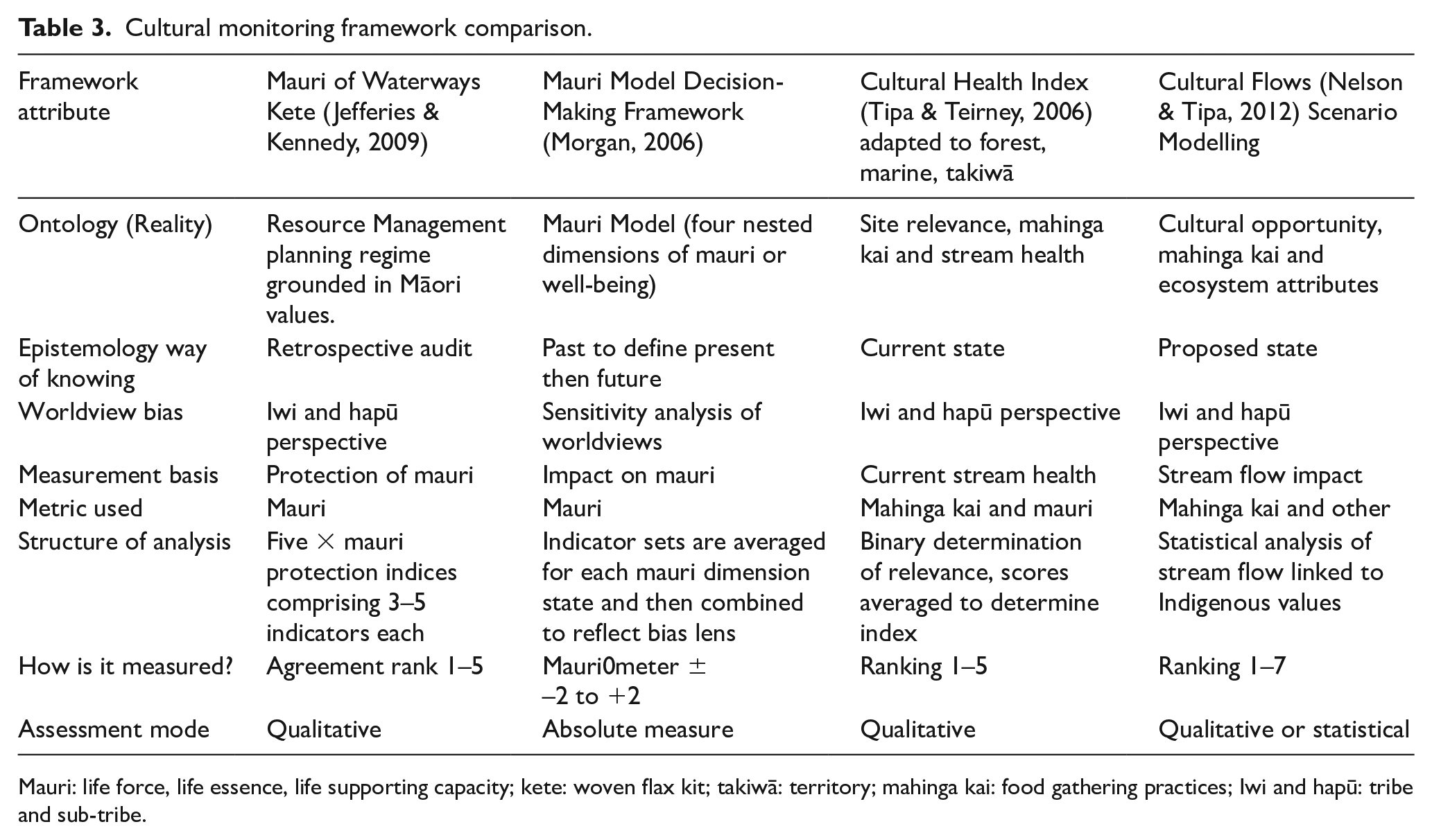
Mauri: life force, life essence, life supporting capacity; kete: woven flax kit; takiwā: territory; mahinga kai: food gathering practices; Iwi and hapū: tribe and sub-tribe.
Mauri to varying degrees is the basis for understanding the current or preferred state of freshwater in the frameworks reviewed above. However, apart from their common reliance on understandings of mauri, the Mauri Model (Morgan, 2006 & 2007) differs in several important ways from the other three frameworks.
Ontology and epistemology are accounted for differently for the frameworks. Three accept the current ontology of NZ’s Resource Management planning regime, seeking to communicate Iwi preferences related to cultural well-being within the statutory framework or to audit the planning regime’s performance. The Mauri Model instead repositions reality as four dimensions of mauri, effectively redefining what is important and enabling Iwi preferences to be expressed across all four dimensions. The mauri dimensions of the Mauri Model are aligned to the RMA well-beings which means that when necessary, the Mauri Model findings can be communicated within that regime. Likewise, the epistemology or way of knowing of Iwi and Hapū—via impact upon mauri—is positioned explicitly within the Mauri Model as the basis for reality and the means of measurement. In this way, any worldview bias evident in decision making, including the planning regime or developers, can be quantified and understood ensuring transparency and clearer communication for all involved. How mauri is measured is a definitive differentiation between the frameworks as the Mauri Model uses the unique absolute measure of mauri (Morgan, 2008) called the mauri0meter. The mauri0meter allows the robust measurement of indicator mauri whether measured using quantitative or qualitative knowledge. The remaining frameworks use less intuitive, qualitative measurement based on arbitrary scales of agreement, availability of kai (food) and stream health. In fact, the most recent 2012 cultural flows framework states that it deliberately avoids the explicit quantification of mātauranga Māori, and rather “outputs from a scenario model present data based on attributes derived from Māori ways of knowing” (Awatere & Harmsworth, 2014, p. 20).
When published, a cultural flows report has mandatory recognition under the RMA. This positions Māori ways of knowing on an equal footing with the statistics-based rationalisations of science regarding stream flows and water quality. However, while this approach may level the playing field in adversarial fora such as the Environment Court and the Waitangi Tribunal, the framework is exposed by the same weakness as the mono-cultural scientific assessments that it is intending to challenge. That is, it explicitly represents a Māori epistemology which then has to be weighed against a commercially driven activity that is justified within the RMA planning ontology by the dominant mind-set of our society. The Mauri Model in contrast avoids this positioning by including all available knowledge as disaggregated dimensions of mauri and then prioritising these within the framework to represent the understandings of different worldviews.
In conclusion, regarding the four frameworks considered here, due to the different values and beliefs underpinning the Māori ontology and epistemology, it is important to clearly state how these differences are accommodated within a framework. This clarity is essential so that the analysis results are able to be communicated and understood within decision-making contexts where others’ ontologies are involved and will have influence as well.
Our Land and Water Indicators Working Group
The Our Land and Water National Science Challenge Indicators Working Group (IWG) (2019) has completed a review of existing agri-environmental indicators for Sustainable Development Goals reporting needs regarding farm sustainability. The review proposes six criteria for a good indicator. The criteria appear to be driven by economic rationalism, expressing a preference for indicators that are widely accepted, clearly defined, easily communicated, performance based, accessible data and valid.
The ontological singularity created by these criteria is evident when the criteria are questioned from an Indigenous perspective. Cultural indicators are not widely accepted as they are by definition place-specific and derived from a different ontology and epistemology. Similarly, if indicators are clearly defined, this does not guarantee scalability, comparability or standardisation. Ease of communication is necessary but not just as individual indicators. Rather, the basis for measurement and combination of indicators should allow easy communication of the bigger picture. The differentiation between performance indicators and practice-based indicators is emerging to measure differences between the actions of land managers and the outcomes of those actions. While this distinction can be useful for modelling purposes with the intention to simplify the indicator set, this may unintentionally exclude locally relevant information. The adept observers functioned as repositories of traditional and ecological knowledge in the international case studies by applying such an arbitrary selection. Agrawal (2002) cautions that indicators not aligned to place-based epistemologies can misrepresent the lived and spiritual ontology of Indigenous Peoples.
Accessible data are described as cost-effective to generate, collect, distribute and access. The positioning of data accessibility in this way constrains economic considerations to an unnecessarily narrow definition of what is important and could unintentionally position existing data sets of poor quality as being more suitable for decision making. It is more likely that the depth of monitoring against indicators will always be limited by the amount of resourcing available to monitor. Consequently, decisions will need to be made about what to prioritise in terms of ongoing monitoring. Prioritisation will likely require an unequal distribution of monitoring investment, possibly 75% environment, 10% cultural, 10% social and 5% economic.
Finally, validity is described as indicator interdependence which is useful as it reflects a holistic worldview. The exception however is that the cause-and-effect relationships may not always be complementary in nature, rather the indicators could relate to one another in an adversarial way. As well, some indicators will not be interdependent, but it does not automatically follow that because of this an indicator will be invalid, rather it may just be independent of other indicators and measure something that matters but is not linked to that particular ontological frame. In conclusion, the IWG criteria, while possibly relevant to indicators, are unlikely to provide useful guidance on cultural indicator suitability.
It is possible that a framework could perform in reality despite identified ontological shortcomings, so further consideration has been given to the actual application of this approach. The IWG test-measured rural community resilience using a dimension framework that mimics the RMA four well-beings with the addition of an institutional dimension. Twenty-three indicators are used. When grouped under the five dimensions, 43% (10) measure economic well-being, 40% (9) measure social well-being, and the remaining 17% are split evenly between environmental and cultural well-being. Institutional indicators were not explicit. The “good” indicators criteria identified in the same research are unlikely to be met in the case of the two cultural indicators as the number of Māori and the proportion of Te Reo (Māori language) speakers is a very limited description of cultural well-being. Vegetation cover and erosion may perform better in terms of understanding environmental well-being; however, unless the sub-conscious bias evident in indicator selection is compensated for, the understanding communicated by these resilience assessments is ultimately driven by a disproportionate emphasis on economic and social well-being indicators.
Discussion
The majority of indicator sets and frameworks adopt or adapt existing conceptual ontologies. Sterling et al. (2017) noted that many of the culturally grounded indicator sets used internationally have been framed using existing conceptual frameworks that have already determined how to convert data from indicators into decisions. Examples include; Driving Forces, Pressures, State, Impacts, Responses and Social-Ecological Systems. The result is that decisions on the relevance of information and the selection of indicators, and the relative importance of indicators have already introduced bias before any evaluation is undertaken. Therefore, even when included through participatory processes, cultural indicators can be overwhelmed by the “sheer scale of over-representation of other ways of knowing” (Sterling et al., 2017, p. 82) as demonstrated in the IWG framework above.
The MMDMF quantifies and then utilises the bias inherent in a stakeholder worldview for this reason. Its basis is set out in Sterling et al. (2017) as follows (pp. 82–83): [The MMDMF] identifies its ontological basis and provides an alternative Indigenous conceptual measure of sustainability. It is a unique approach to indicator set development that includes processes designed to ensure repeatability and objectivity in the evaluation being undertaken. [. . .] As an expert-weighted decision matrix, the Mauri Model is holistic, simple to use, objective and produces repeatable results. The Mauri Model is unique, as it provides a cultural neutral template within which Indigenous values are explicitly empowered alongside scientific data. [. . .] The capability to measure both physical quantities and metaphysical qualities allows for a wide, inclusive range of sustainability indicators that better reflect the physical, culturally, psychologically and spiritually defined reality of Indigenous Peoples.
The foundation for the MMDMF is further set out in Morgan (2006, 2008). Independent research determined the MMDMF to be an exemplar sustainability indicator set when benchmarked against the Bellagio STAMP (Sustainability Assessment and Measurement Principles), and the study concluded that the Mauri Model is “the most useful indicator set regardless of community” (Challenger, 2013).
Indigenous epistemologies are typically related to concepts such as intergenerational equity and uniqueness to place (Durie, 2005), principles that resonated in the international case studies as well as Harmsworth’s principles. In this regard, cultural indicator sets and frameworks should facilitate a better understanding of a system and its inherent complexity. And all indicator sets and frameworks should provide credible qualitative or quantitative insights.
Returning to stakeholder worldviews, the quantified priorities created using the MMDMF will reveal the inherent bias of stakeholders in a useful way as it reflects the dimensions which most strongly influence a particular party’s understanding and their likely areas of expertise. Similarly, the MMDMF allows Tangata Whenua to contribute their own understandings based on IK to ensure that they are effectively included in resource management decision-making processes.
The MMDMF represents a potential pathway to more sustainable and inclusive decisions in national and international contexts (Papua, Hawai’i, China, Canadian First Nations, Rarotonga), including for rural land management if adapted to this purpose. Thus, through integrating systems techniques and the Indigenous concept of mauri, the MMDMF creates an opportunity for “cross-cultural communication and action” (Sterling et al., 2017, p. 84). As the MMDMF is applied more broadly within Pohewa Pae Tawhiti, enhancements to transferability of impact on decision making will be sought out, including issues like short-term and long-term dynamics, translation of stakeholder worldviews into decisions, governance and land rights, and feedback between dimensions.
International studies have recognised that universal measurement systems may not be very well aligned for local contexts, cultures and needs (Sterling et al., 2017), so understanding how to build culturally relevant indicator sets is an essential aspect of determining preferred actions in the face of increasing environmental, social and economic instability. Incorporating the insights provided here, the process of identifying cultural indicators is likely to now become more time-consuming and less transferable; however, a greater time investment will likely be compensated for by the more robust and enduring decisions that result.
Neither organisational processes nor ecological processes can be understood in isolation (Olsson et al., 2004, in Sterling et al., 2017); likewise, cultural indicators cannot be separated from their ecosystem of origin. There is a necessity for cultural indicators of ecosystem mauri and other dimensions to provide historical depth and engage IK to effectively communicate the socio-cultural interactions that often govern ecosystem functioning and resilience. Ideally, when an Indigenous community, such as Te Arawa Iwi, are involved in framework and cultural indicator development, the opportunity is provided to co-create indicators that capture the social, cultural, environmental and economic context for managing ecosystems holistically. Locally developed indicators and criteria greatly facilitate local understanding of their use, and therefore may also increase community ownership, adoption and acceptance.
Thus, the development of cultural indicators for Pohewa Pae Tawhiti must be locally focused and relevant. Extension to a wider ranging spatial scale than the community they stem from raises the potential for perpetuation of colonising processes of the past. Cultural indicator sets need to be specific enough to reflect the cultural context of their ecosystem of origin, first and foremost, only then it is likely that understandings will be able to be compared and possibly aggregated across regions to trigger appropriate decision making in other contexts such as at the national and international level. To achieve the later, however, will likely require effective representation at the decision-making table from the Indigenous communities from which the enhanced understandings are being generated.
Conclusion
The purpose of this article has been to explore the state of knowledge of cultural indicators internationally and in Aotearoa NZ. However, the scope of this investigation revealed broader issues that require attention before cultural indicator sets can simply be tacked on to existing Western scientific modelling approaches. In all case studies that reflected best practice, the cultural indicator sets were developed as part of the project. While some indicators are transferable, the accuracy and appropriateness of the evaluation cannot be assumed unless the cultural indicator set to be used is verified with the relevant Indigenous community.
The weakness of the majority of ecosystem modelling and its application within the reductionist scientific paradigm is the assumption that accurate representations of reality can be effectively achieved by only acknowledging the instrumental value and physical characteristics of the environment. A potential weakness of more holistic approaches that incorporate the intrinsic value of the ecosystem is that within the scientific paradigm, these understandings can become inefficient due to the sheer complexity created. The challenge therefore is to avoid the constrained approach of only acknowledging the instrumental value but also ensure that the approach is manageable in terms of scale to ensure the effective incorporation of concepts not readily understood in the Western scientific paradigm.
Cultural indicator sets can potentially address issues within frameworks whose comparatively superficial scope is a constraint. Cultural indicator sets could enhance the mauri or intrinsic understanding of a decision-making context providing the deeper more meaningful understanding available from Iwi and Hapū. The framework within which the indicator sets are to be used, however, must also be consistent with the holistic way of knowing of Iwi and Hapū, and the method of indicator measurement for all indicators must be consistent across indicator sets and robust in its application.
Glossary
ahikāroa people having long-term occupation of an area
Atua Gods
hapū sub-tribes
iwi tribe(s)
Iwi Taketake Indigenous Peoples
kai food
kaitiaki enhancer of life force
kaitiakitanga practice of enhancing life force
kawa protocol(s)
kete woven flax kit
mahinga kai food gathering practices
marae traditional meeting place(s)
mātauranga threads of truth, knowledge
mauri life force, life essence, life supporting capacity
mauri taiao ecological integrity
ngā taonga tuku iho treasures handed down by previous generations
ngā tohu o te taiao ecosystem indicators
oranga human well-being
Pohewa Pae Tawhiti Visualising Horizons
rangatiratanga right to exercise authority
takiwā territory
Tangata Whenua People of the Land
taonga treasured possession
tapu sacredness
Te Arawa Iwi Te Arawa confederation of tribes
Te Arawa rohe Te Arawa confederation of tribes territory
te kiri o papa natural landscape, skin of mother earth
Te Marāutanga o Aotearoa Māori medium school curriculum
Te Moana-Nui a Kiwa Pacific Ocean, The Great Ocean of Kiwa
te ohanga whairawa economic wealth
Te Reo Māori language
tikanga practice(s)
tikanga-ā-iwi practices of a people
wai māori fresh water
wairua spiritual dimension
wairuatanga spirituality
whakapapa genealogy
whānau families
whenua land
Aronga Mana people of authority, tribal leaders
ahupua’a boundary marker for territory, area of land, watershed
āina momona fat lands
huli ‘ia observational process documenting seasonal changes
ka ’ike ways of knowing
kama’aina residents of Hawai’i
kilo observation
maka o Papahānaumokuākea descendants of Hawai’ian genealogy
mauka-makai mountain to sea
nā kilo ‘āina culturally grounded community monitoring
’ōlelo no’eau proverbs, traditional wisdom
Ni-Vanuatu Vanuatu Indigenous Peoples
aashukan bridge or jetty
Malind-Anim Indigenous Peoples from Merauke Regency, Papua
akwé: kon everything in creation
Nuu-chah-nulth First Nations tribe from western Vancouver Island
Footnotes
Acknowledgements
Te Arawa Primary Sector; Pohewa Pae Tawhiti research team members not listed as co-authors; Ngā Pae O Te Maramatanga New Zealand’s Māori Centre of Research Excellence; Our Land and Water National Science Challenge and Ministry of Business, Innovation and Enterprise for funding support.
Declaration of Conflicting Interests
The author(s) declared no potential conflicts of interest with respect to the research, authorship and/or publication of this article.
Funding
The author(s) disclosed receipt of the following financial support for the research, authorship and/or publication of this article: Ngā Pae O Te Maramatanga New Zealand’s Māori Centre of Research Excellence; Our Land and Water National Science Challenge and Ministry of Business, Innovation and Enterprise for funding support.
