




Abstract
Yarning as a research method has its grounding as an Aboriginal culturally specified process. Significant to the Research Yarn is relationality, however; this is a missing feature of published research findings. This article aims to address this. The research question was, what can an analysis of Social and Family Yarning tell us about relationality that underpins a Research Yarn. Participant recruitment occurred using convenience sampling, and data collection involved Yarning method. Five steps of data analysis occurred featuring Collaborative Yarning and Mapping. Commonality existed between researcher and participants through predominantly experiences of being a part of Aboriginal community, via Aboriginal organisations and Country. This suggests shared explicit and tacit knowledge and generation of thick data. Researchers should report on their experience with Yarning, the types of Yarning they are using, and the relationality generated from the Social, Family and Research Yarn.
Keywords
Introduction
For researchers applying an Indigenous Research Paradigm, relationality and relational accountability are paramount. In this article, the researchers provide relational accountability in a Yarning study by transparently visualising and celebrating the relationality occurring between the first author and study participants. Yarning methods are central to and informed by Indigenous knowledge. Worldwide, Indigenous knowledge is ancient and there is strong movement by Indigenous researchers to include this in research, which inevitably involves relational responsibilities to Country, Ancestors, Families, Communities, Elders and future generations. This requires concerted effort as Indigenous knowledge is undermined and eliminated by settler colonisation, including within research academies (Smith, 1999). Settler colonialism is premised on destruction to replace, to obtain territory at the expense of Indigenous lands and livelihood (Wolfe, 2006). Indigenous knowledge and stories link people to their tribal lands and each other, challenging the settler colonial story of their belonging (Tuck & Yang, 2012).
Yarning methods, when deployed appropriately, can mitigate settler colonial processes in research as they strongly feature relationality (Barlo et al., 2021) and Indigenous peoples’ lived experiences (Bessarab & Ng’andu, 2010; Walker et al., 2014). However, despite its fundamental place in Yarning, analysis and reporting of relationality are a missing feature of published research findings. As such, we are writing this article to improve understanding of relationality in Yarning. Therefore, underpinned by an Indigenous Research Paradigm and Indigenous Standpoint Theory, the objective of this research was to describe the Social and Family Yarning occurring within a broader Yarning study to further understand the relationality present.
What is Yarning research?
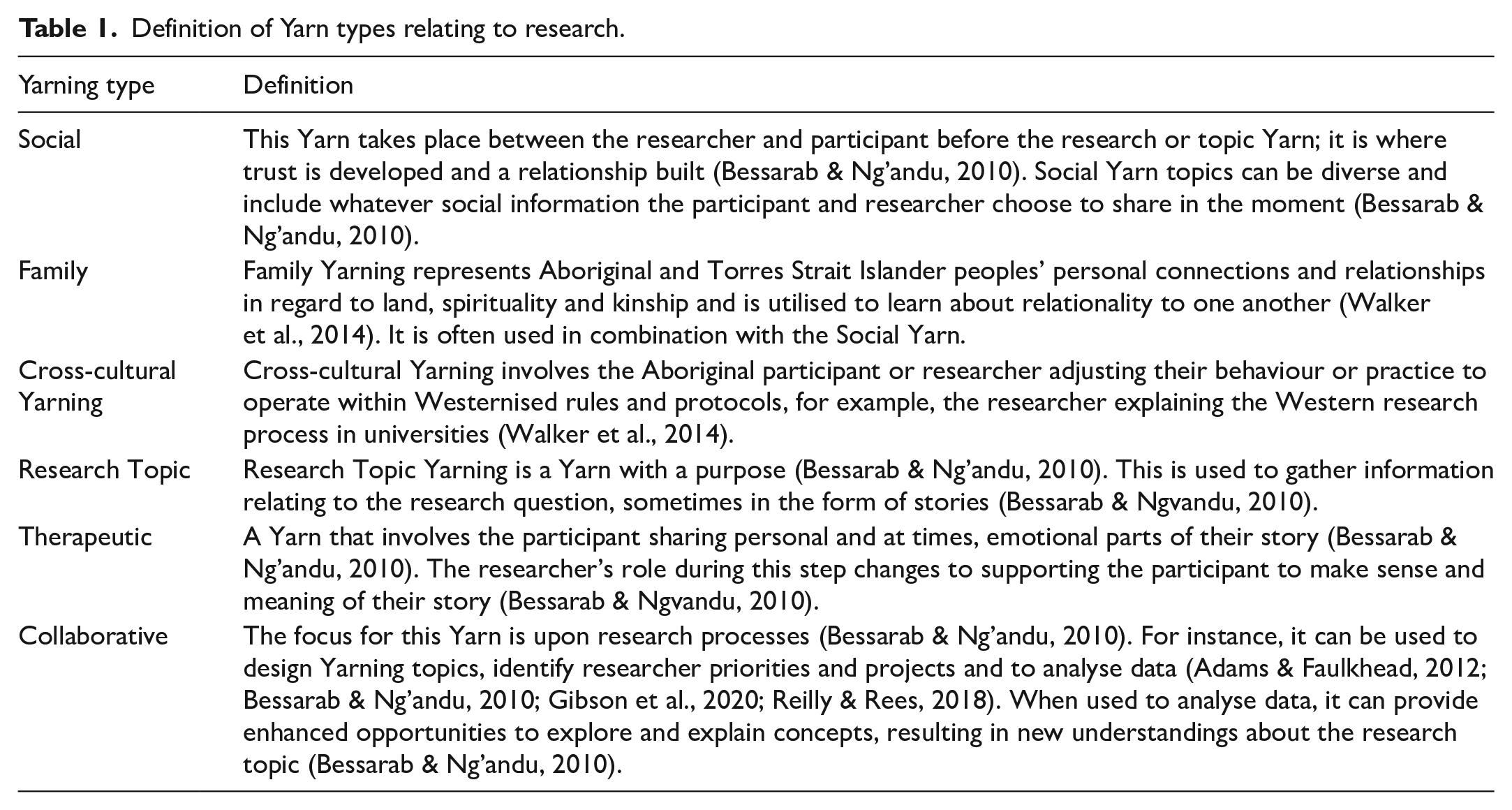
Australian Aboriginal people have been practicing Yarning for thousands of years. It is integral to Aboriginal peoples’ ways of understanding and learning throughout life. Yarning is connected to storytelling (Bessarab & Ng’andu, 2010), which in many Indigenous cultures is one of the significant ways of knowing the social world (Datta, 2018). Yarning essentially involves a purposeful “sharing of stories” (Walker et al., 2014, p. 2). Yarning as a research method has its grounding as an Aboriginal culturally specified process whereby researcher and participant contribute to the Yarn creating a collaborative space where, ideally, both voices are important. Typically connected aspects embody the research method such as, voices, experience and knowledge, and relationships (Dean, 2010). It is the combination of these aspects of the method that help to promote cultural safety via a process familiar to Aboriginal people and thus improve data authenticity (Datta, 2018). A further strength of Yarning as a research method is its flexibility which enables researchers to adapt to community or participant needs thereby respecting Aboriginal peoples’ diversity (Dean, 2010). There are various Yarning types employed in research (see Table 1). Each may be used independently or in sequence with each other (Bessarab & Ng’andu, 2010).
Definition of Yarn types relating to research.
Approaches to application of methodology in Yarning research vary. Some researchers do not identify a methodology (Gibson et al., 2020; Jennings et al., 2014; Lin et al., 2016; Lukaszyk et al., 2017), and some have described Yarning as a methodology (Barlo et al., 2021; Dean, 2010; Geia et al., 2013; Mooney et al., 2018; Shay, 2019; Walker et al., 2014); however, Yarning is most often applied as a method for data collection, collaboration and information sharing. The methodology underpinning Yarning methods includes the research axiology, epistemology, ontology and researcher’s socio-cultural position (see Figure 1). These inform the choice of research theory, and for Yarning methods, the Indigenous Research Paradigm and Indigenous Standpoint Theory are a harmonious fit.
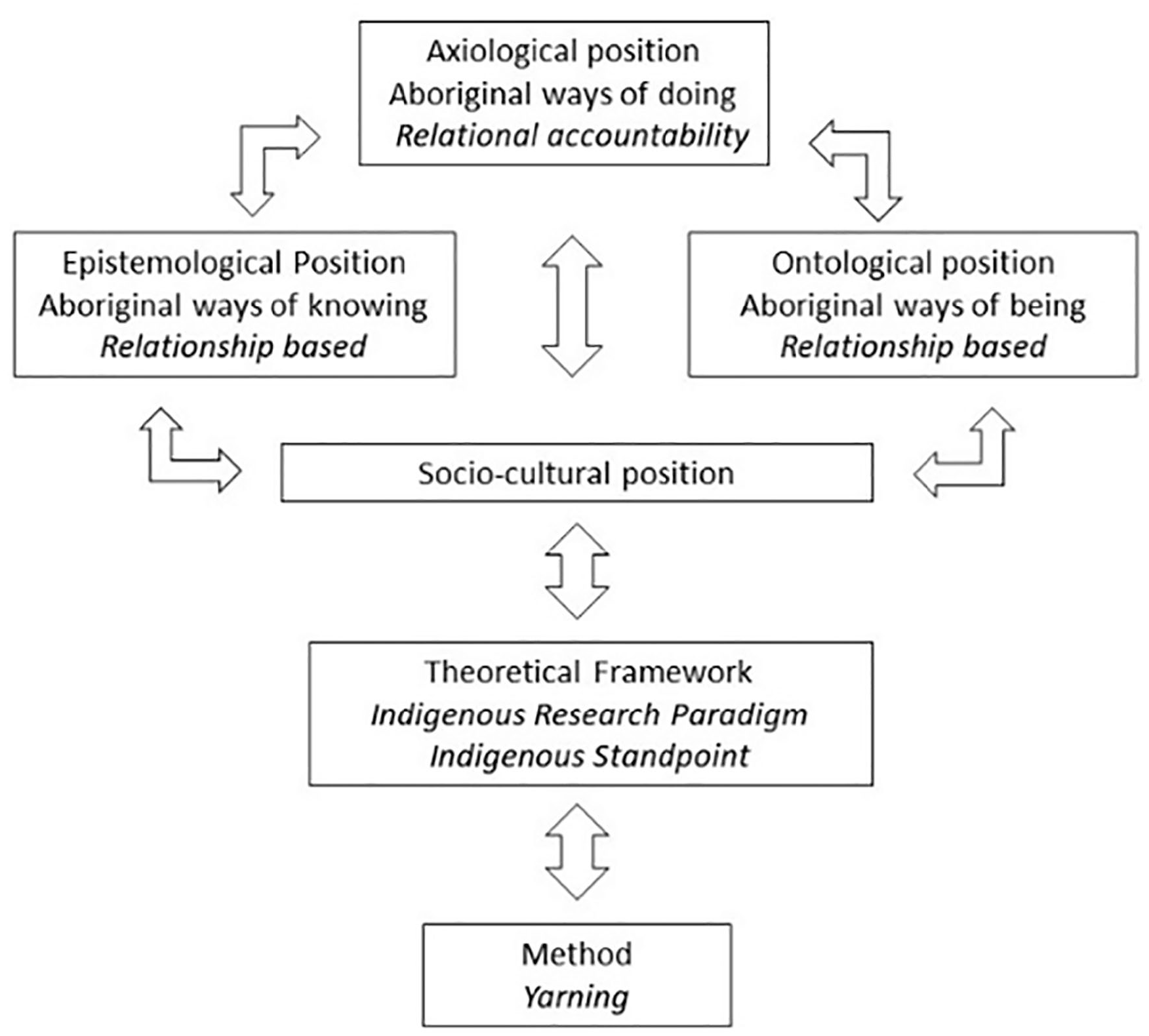
Methodology underpinning choice of Yarning method.
An Indigenous Research Paradigm recognises ongoing settler colonialism and privileges Indigenous voices to understand assumptions about reality (Rigney, 1999). In this paradigm, the separation between researcher and those being researched is rejected, and reflexivity, not objectivity, is the norm (Kovach, 2010). The paradigm not only informs how research should be conducted (Kovach, 2010; Wilson, 2001), but importantly, holds researchers responsible for research delivery and its potential impact upon the Indigenous peoples involved (Datta, 2018). This paradigm recognises that an Indigenous epistemology (knowing) and ontology (being) is based upon relationships, and axiology (doing) is based on relational accountability (Wilson, 2008). Important to relational accountability in research is ensuring the research methodology is based in the community context (Wilson, 2008). In order to demonstrate accountability, the research approach must show respect for the relationship between the research participants, the topic and the researcher (Wilson, 2008). Using Yarning reflects these key components of Indigenous Research Paradigm (Dean, 2010). Important to this is, who the researcher is, therefore, Indigenous Standpoint Theory is highly relevant.
Research standpoint is an important factor in any research methodology (Walter & Andersen, 2013) and standpoint “ranges in definition from being a perspective to being a socially situated subject of knowledge” (Moreton-Robinson, 2013, p. 332). Indigenous Standpoint Theory has been explained as, A method of inquiry, a process for making more intelligible “the corpus of objectified knowledge about us” as it emerges and organises understanding of our lived realities. I see this as theorising knowledge from a particular and interested position—not to produce the “truth” of the Indigenous position but to better reveal the workings of knowledge . . . (Nakata, 2007, p. 350)
As such, an Indigenous Standpoint Theory includes the unique perspective the Indigenous researcher brings to inform the subject (unique, as Indigenous researchers have common, and individual, understandings; Nakata, 2007) and how knowledge is created and shared. This theory is pertinent to Yarning research as the method engages with Indigenous knowledge and perspective. These two theoretical perspectives, therefore, underpin the choice of Yarning methods as they are highly congruent with it.
Some researchers erroneously describe Yarning research as a conversational method. This method involves active construction of an interview agenda via a collaborative conversation between researcher and participant and researcher positionality shaping interpretation of the data (Burgess-Limerick & Burgess-Limerick, 2011). In contrast, in Yarning research, relationality—for example, with family, country, community and cosmos—rather than position, is central to the method (Figure 1). Neither is Yarning a narrative method: Do Aboriginal people say, “Come sit, tell me a narrative” Good go! The term narrative would be ridiculed and mocked as yet another white concept that has snuck its way in, to colonise, to reconfigure the freedoms inherent within Aboriginal talking spaces. (Phillips & Bunda, 2018, p. 4)
While sharing stories is common for Indigenous peoples globally (Kovach, 2010), Indigenous peoples are also diverse with local uniqueness based in normativity (Simpson, 2017). Hence Yarning methods are distinctly related to the localised nuances of Aboriginal ways of knowing, being and doing (Martin & Mirraboopa, 2003), which have assisted sustain the oldest continuing culture on the planet.
How has Yarning research been applied?
Researchers describe the use of Yarning methods in multiple ways with some identifying Yarning types employed and others simply stating they have used it. Some studies include Yarning in research preliminaries, such as Yarning with Aboriginal community to build connection (Walker et al., 2014), design Yarning topics (Gibson et al., 2020), develop Yarning questions (Reilly & Rees, 2018) and identify key priorities for data analysis (Gibson et al., 2020). Participant recruitment and data collection strategies also vary. For instance, recruitment can occur via flyers and posters (Lukaszyk et al., 2017; Meiklejohn et al., 2019), personal invitations (Jennings et al., 2014), snowballing (N. Priest et al., 2017; Vujcich et al., 2018), letters to Aboriginal organisations with an information pack (Walker et al., 2014) and radio (Meiklejohn et al., 2019). Yarning data collection can involve practices such as individual and group Yarning sessions (Dean, 2010; Gibson et al., 2020); Yarning circles (Bovill et al., 2018; Coombes et al., 2016; Lukaszyk et al., 2017; Rogers, 2017); Yarning groups (Chapman et al., 2014; Goulding et al., 2016; Meiklejohn et al., 2019); or Kapati, whereby the announcement of Kapati signalled a time to come together, Yarn and share stories that strengthen family and kinship ties (Ober & Bat, 2007). What should concern the research community is when published studies suggest the use of Yarning methods but upon closer inspection they have used focus groups and face-to-face interviews (Chapman et al., 2014; Fitzpatrick et al., 2017; Goulding et al., 2016; Jennings et al., 2014; Nagel et al., 2011; N. Priest et al., 2017; Reilly & Rees, 2018; Vujcich et al., 2018).
Yarning data have been recorded in multiple ways, such as, audio recording and transcribing (Bovill et al., 2018; Meiklejohn et al., 2019; Reilly & Rees, 2018), note taking and observation (Lukaszyk et al., 2017), and the development of text story boards (Shay, 2019). There are diverse approaches to analysing Yarning data. Some researchers have created predetermined themes related to Yarning questions asked and then applied inductive analysis to identify emergent themes (Bovill et al., 2018; Jennings et al., 2014; Vujcich et al., 2018). Others have used framework analysis (Vujcich et al., 2018), thematic analysis (Gibson et al., 2020; Meiklejohn et al., 2019) or content analysis (Jennings et al., 2014; Lukaszyk et al., 2017) to analyse data. There is an example of a study that themed and coded data by placing data on pieces of paper for participants to move and group or add anything missing (Butten et al., 2019). Collaborative Yarning has also been used (Adams & Faulkhead, 2012) as well as seeking feedback from participants on Yarning data interpretations (Gibson et al., 2020; Reilly & Rees, 2018). Some studies have been transparent about researcher expertise and experience with Yarning (Bessarab & Ng’andu, 2010; Dean, 2010; Lin et al., 2016; Mooney et al., 2018; Shay, 2019; Walker et al., 2014) showing researcher reflexivity (Kleinsasser, 2000).
Overall descriptions of Yarning methods application are diverse and likely relate to the method being an emerging field requiring more understanding (Shay, 2019). To date, analysis of Yarning data has focussed on the Research Topic Yarn (Bessarab & Ng’andu, 2010). However, important to Yarning methods is the formation of relationship (Bessarab & Ng’andu, 2010) and a key element of this is found in the Social and Family Yarn. Despite its integral importance, neither the Social nor Family Yarn data appear to have been collected or analysed in publications on Yarning research to understand relationality. The objective of this article is to describe the collection and analysis of Family and Social Yarning that occurred in a broader Yarning study to address a gap in understanding of relationality in Yarning.
Researcher positionality
The first author is Petah Atkinson, I am a Yorta Yorta (Aboriginal Tribal nation, North Eastern Victoria, Southern New South Wales), Waywurru (Aboriginal Tribal group, Northern Victoria), Wurundjeri (Aboriginal Tribal group, Melbourne and surrounding area), Taungurung (Aboriginal Tribal group, southcentral Victoria) mother and grandmother. I have worked for more than 25 years in Aboriginal health, including many years in the Aboriginal Community Controlled Health sector. I work as a Lecturer within the Gukwonderuk Indigenous Health Unit at Monash University where I am completing a PhD in medical education. The second author is non-Indigenous, has over 30 years of teaching experience at the undergraduate and postgraduate level of medical imaging and oversees quality and academic governance associated with the education portfolio of a health faculty. The third author is a Wiradjuri (Tribal group, central New South Wales) woman and Director of the Gukwonderuk Indigenous Health Unit at Monash University. She has over 25 years’ experience working in Indigenous health as a practitioner, health service manager, educator and researcher.
This study arose as the authors considered that while it had been theorised that relationality was important in Yarning methods, relational data in Yarning research was lacking consideration or analysis. Therefore, the authors’ sought to analyse the relational data collated within a Yarning study to create further understanding of the Yarning method. This research provides benefit to Aboriginal people by further contributing to evidence and understanding of the applicability of Indigenous research methods informed by an Indigenous Research Paradigm which fundamentally values relationality.
Important to my—the first author—positionality and Indigenous Standpoint (Nakata, 2007) in this study is my experience with Yarning. It is often assumed that anyone can practice Yarning as a skill; however, I propose that researchers have different Yarning expertise based on their experience. My experience with Yarning has accumulated across my lifetime. I am a Yorta Yorta woman and my ancestors provide my link to 1 of the 16 key families within the Yorta Yorta Nation, via the Edgar Atkinson line. I also have strong family connections to Waywurru people and to Kulin Nations (alliance of five Aboriginal nations in south central Victoria) through Wurundjeri and Taungurung. I am actively involved in the Victorian Aboriginal community particularly across Yorta Yorta country in North Eastern Victoria and Wurundjeri country in metropolitan Melbourne. I have spent more than 25 years working in Aboriginal health, including in Aboriginal Community Controlled Health Organisations and at universities, teaching medical and health profession students about Aboriginal health.
As a child, I was immersed in Yarning that was used to generate and share knowledge. I remember watching my mum Yarn with her sisters and friends about all sorts of things, often to develop solutions to problems. For example, mitigating the Social Welfare Department’s interference in families and finding ways to support parenting, as mum was often a sole parent and single parents were a target for investigation by the welfare. Mum would share her stories of successfully dealing with the welfare with other women so they knew what to do if the dreaded welfare came calling.
Family Yarning was also used to find out more about other Aboriginal people who had moved to the area where we lived. When I was a child, there were no local Aboriginal organisations so people would gather at family or friend’s houses to connect with each other. Bringing someone new in the community to another person’s house was the way they were introduced to the community with Family Yarning used to share their connection with other Aboriginal people throughout Victoria. This is where they would ask each other about family, who are your parents? Where is your country? Whom are you connected with?
My experience using Yarning throughout my life includes Social and Family Yarning where I introduce myself, my people, my country and where I live. By exchanging this information, it places me in the Yarn for all involved, and provides an opportunity to explore connections. I have used this in my travels around Australia in my work in Aboriginal health. Using Social and Family Yarning has helped me make many connections with other Aboriginal people who either know one of my family or community members, or have themselves visited or worked on my traditional country. This connection can help build relationship and trust dependent on peoples’ relationship to my story. Using Social and Family Yarning often shifts the way I communicate; it becomes a lot more personal and can facilitate a genuine understanding with people I meet that did not exist before. When I use Social and Family Yarning with other Aboriginal people, there is assumed prior knowledge of these rules and the cultural context. This is why with non-Aboriginal people when I say “let’s have a yarn” in reality, we talk, even if we share information about our place and story. For example, the way I Yarn about my birthing experience with other Aboriginal women is different to the way I talk to a non-Aboriginal woman based on cultural context.
My practise of Yarning is limited to Aboriginal community or Aboriginal spaces. When conversing with a non-Aboriginal person about a topic of interest, I would rarely, if ever, exchange personal or family information. Building relationship and connection has not been the key element in our exchange; it does not have a place. We might exchange things we are interested in but the importance of connection through family, language or country is not considered. For example, when talking with a non-Aboriginal woman about my experience giving birth, the conversation would be limited to facts, such as, the hospital, the weight of the baby or the amount of hair. Intuitively I know that for non-Aboriginal women many of my cultural nuances would be misunderstood, bewildering or go unheard so the story changes to fit the non-Aboriginal context. If it is not changed, there is either the risk of judgement by non-Aboriginal people about my story or the chance that I would spend an exhausting amount of time trying to explain my worldview and context.
Whereas, if I was Yarning with another Aboriginal woman about this experience, there would be two purposes for the chosen details in the Yarn. First, it would be to share information so the other person might learn something from it. Second, it would help me to make sense and meaning of my experience. Both of these purposes require shared Aboriginal tacit and explicit knowledge. The shared understanding of the context allows the story to go deeper quicker as concepts do not need explanation and this supports sense of humour through common comprehension of particular situations that may be deemed funny. In my health professional life, I also have experience of Yarning. As a health worker in the community assisting Aboriginal community to access mainstream drug and alcohol and mental health services, I often participated as a key provider in the Clinical and Therapeutic Yarn (Lin et al., 2016). This included Cross-Cultural Yarning (Walker et al., 2014) advocating for health consumers. This experience with Yarning across my lifespan and experience in the Aboriginal community has informed my socio-cultural position and standpoint in this study (see Figure 1).
Methods
The inquiry question was, what can an analysis of Social and Family Yarning tell us about relationality that underpins a Research Yarn. This qualitative study was informed by an Indigenous Research Paradigm (Wilson, 2001) and Indigenous Standpoint Theory (Moreton-Robinson, 2013; Nakata, 2007). Indigenous Research Paradigm together with the first author standpoint, privileges Aboriginal voices to understand our shared assumptions about social reality. Yarning methods, integral to Aboriginal peoples’ ways of understanding and learning, was utilised to collect data. Yarning methods contains various types of Yarns that occur at relevant stages of the Yarn, Social Yarn, Research Topic Yarn, Therapeutic Yarn, Collaborative Yarn (Bessarab & Ng’andu, 2010), Family Yarn and Cross-Cultural Yarning (Walker et al., 2014). The Social Yarn takes place between the researcher and participant, before the Research or topic Yarn and is where it is theorised that trust is developed and relationship built (Bessarab & Ng’andu, 2010). It is often used with the Family Yarn which embodies the personal connections Aboriginal and Torres Strait Islander peoples’ have to land, spirituality and kinship, and facilitates learning about relationality to one another (Walker et al., 2014). Used together, these Yarns are theorised to provide for an accountable relationship to be established, where the researcher and participant are responsible for sharing of knowledge (Barlo et al., 2021).
The Social and Family Yarns are consistent with Indigenous Research Paradigm as it privileges Indigenous voices and supports Aboriginal relational ways of knowing, being and doing, as opposed to colonial methods. Indigenous Standpoint also links to Social and Family Yarning as it includes the unique perspective the Indigenous researcher brings to the subject and respects the way knowledge is created and shared. Relational accountability is a key element of this study as the first author holds herself accountable as a researcher through transparently investigating the relationship with research participants.
This study formed part of PhD research exploring Aboriginal health consumers’ experiences with medical practitioners in relation to an Aboriginal and Torres Strait Islander Health Curriculum Framework. This is a Monash University Human Research Ethics Committee approved study (number 10569).
Study sampling and recruitment
Convenience sampling was used to recruit participants for the study. Recruitment included flyers posted on Aboriginal organisation’s message boards and in newsletters. Participant inclusion criteria was being Aboriginal, over 18 years of age and having experience seeing a medical practitioner. Interested participants contacted the researcher via phone or email. Following this, a phone call established eligibility and coordinated suitable time and place to meet. A family member or friend who had participated in the study referred two participants. Seventeen Aboriginal health consumers participated including 12 women and five men with an age range from 20 to 70. Ten participants lived in urban areas and seven lived in rural locations. During the eligibility phone call, five participants were identified as previously known to the first author through the Victorian Aboriginal community or attendance at training.
Data collection
Yarning methods were employed by the first author to collect data and Yarns took place between late-2018 and mid-2019. This included a Social and Family Yarn followed by a Research Topic Yarn. A Yarning programme was constructed by the first author with questions to guide the Yarns and this was reviewed by the second and third authors. The Social and Family Yarn consisted of an explanation of who the researcher was, culturally and professionally, followed by a question “can you tell me a bit about yourself?” Open discussion ensued between participant and researcher reflecting on their personal stories. Each Yarn was 60 to 90 min in length, including the Social and Family Yarn. These were audiotaped and transcribed verbatim for analysis.
Data analysis
We used four steps to analyse data. The first author reviewed all transcripts and identified the Social and Family Yarning data within. Second, the first and third authors met to Collaboratively Yarn about these data and identified relational elements. Third, for the researcher and each participant, these elements were placed in a table (see Table 2). To ensure confidentiality of participants, we anonymised some data (see Table 2). Fourth, we created a relational map of the relational elements in common between the researcher and each participant (see Figure 2). This was achieved by mapping the relational elements that the researcher described and then connecting each participant to these if they had the element in common with the researcher. We chose mapping to make meaning of the data for several reasons. Mapping Aboriginal knowledge is not contained to geography and includes depiction of holistic worldviews, as Mapping connects Aboriginal people by privileging stories of identity and culture stories of our ancestors are more available to us when we start here; so too are stories of the skills and knowledge that have been passed down through the generations. (Butler, 2017, p. 52)
Mapping is both quantitative—the map—and qualita-tive—the story of the map—and is used widely across the country by Aboriginal people in artworks to depict stories about country, family and community. Visual language of mapping can reduce reliance on colonial English to convey messages and improve inclusivity of Indigenous knowledge and worldviews (K. Priest et al., 2008). Mapping can also be used with small sample sizes and allows local Aboriginal communities to be seen and valued (Adams, 2006).
Elements identified in the Social and Family Yarning.
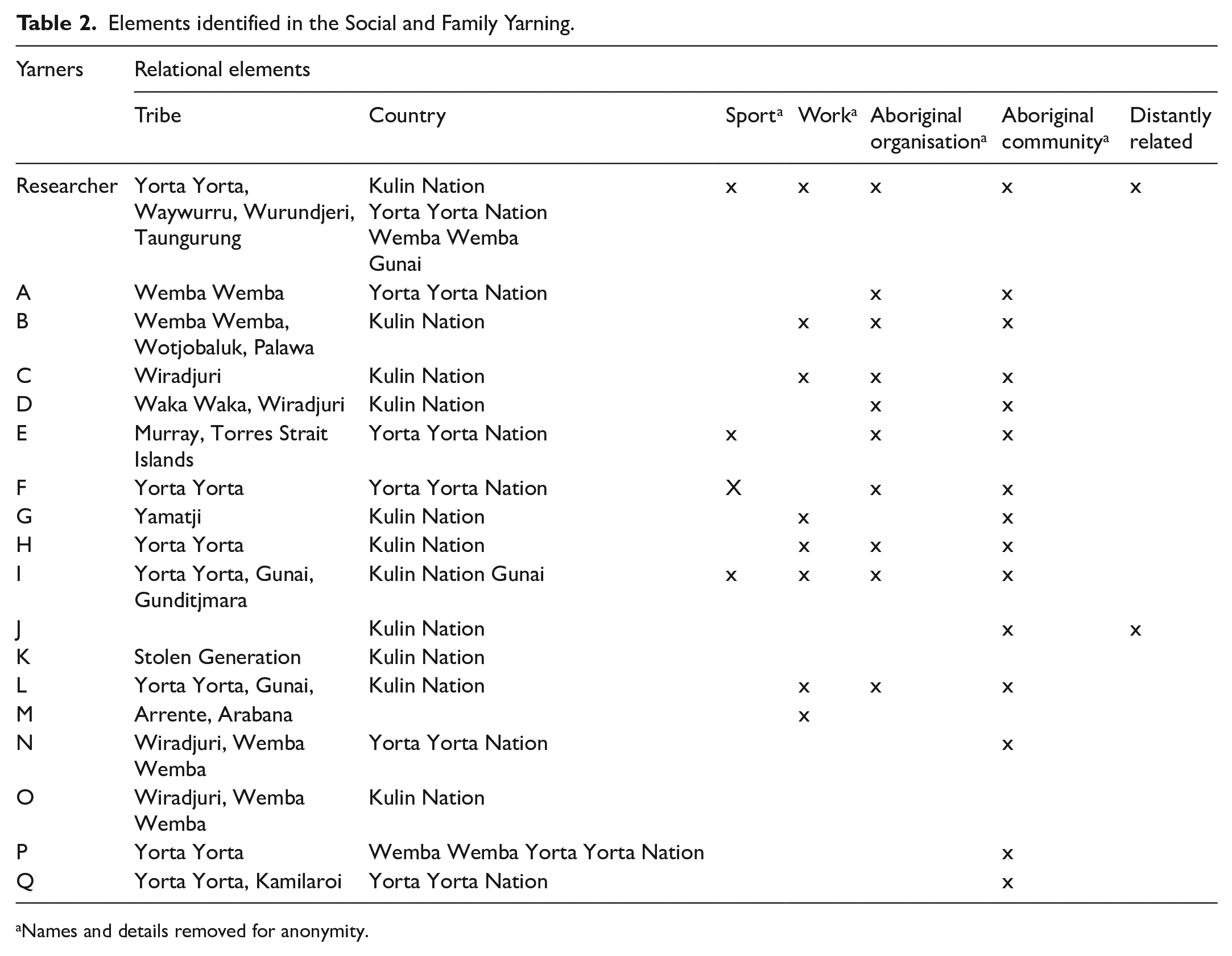
Names and details removed for anonymity.
Results
The initial question at the beginning of the Yarn, “can you tell me a bit about yourself?” provided some of the Social and Family Yarning information; however, this Yarning was also present across the Research Topic Yarn. The researcher and participants explained multiple Social and Family Yarn elements with some describing more than others (see Table 2 and Figure 2). Elements included the researcher and participants’ Tribal affiliations, and shared experiences of Country, Sport, Work, Aboriginal organisations, Aboriginal community and being distantly related (see Table 2 and Figure 2). Tribe was a person’s traditional connection to their Tribal Country, language group and people. Country was the Tribal or language group area where the researcher and participant lived, where our families lived or where the nearest mission or Aboriginal community camp in common. Sport captured experiences, such as, a Netball Club or annual Aboriginal sporting carnival. Work was an employment role, a workplace or a work sector. For example, working in an Aboriginal organisation or area, such as, Aboriginal health. Aboriginal organisations comprised of shared involvement with or access to the services these organisations provided. Aboriginal community was an embodied experience of being part of a community and the tacit and explicit knowledge gained from this. Distantly related was being related but beyond a first cousin.
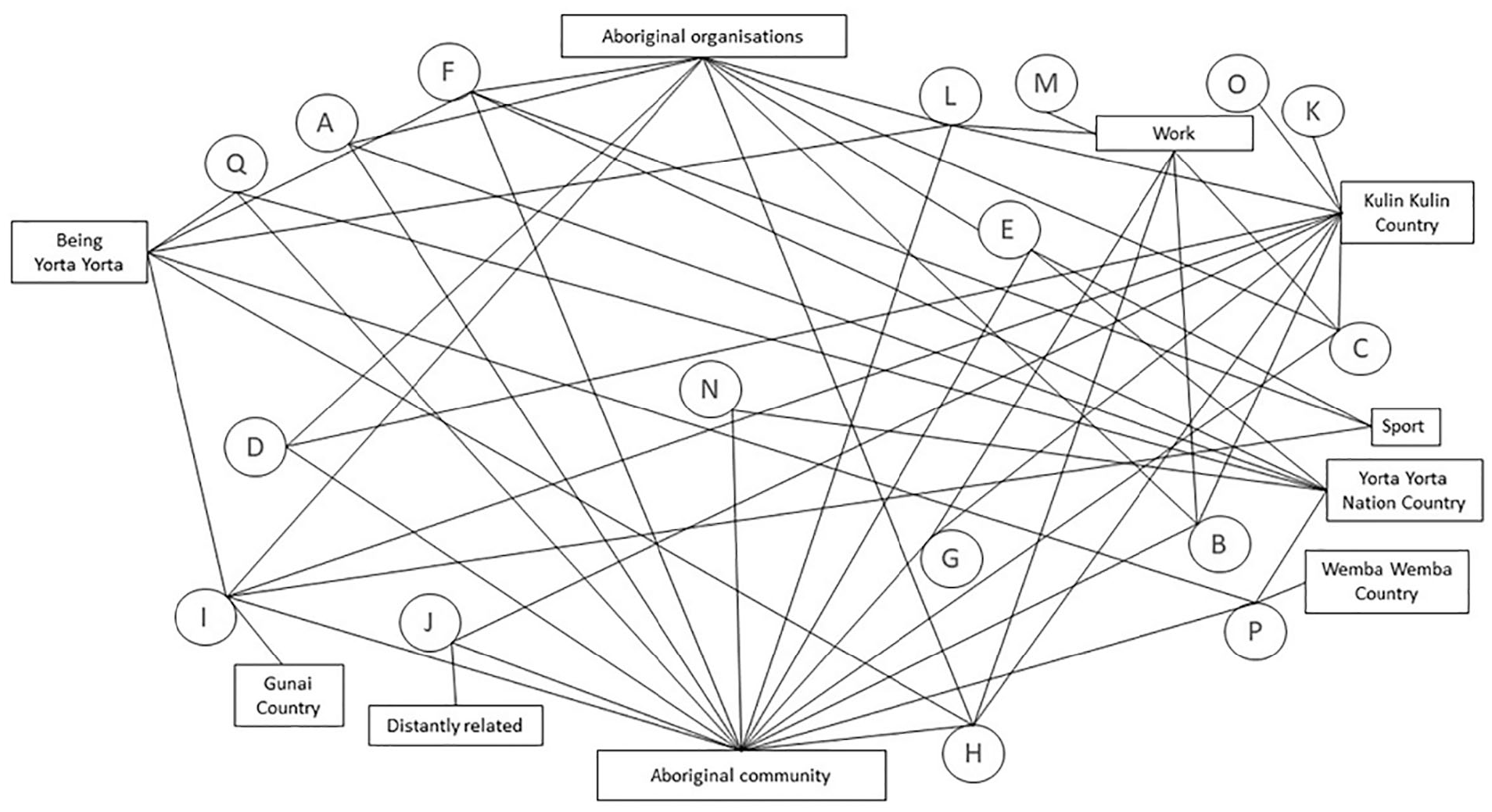
Mapping relational elements between the researchers (A–Q) and participants.
In the Social and Family Yarn, participants and the researcher described affiliation with many Tribes and living on multiple Countries. Whose Country the participant and researcher lived on did not necessarily always coincide with their Tribe’s Country (see Table 2).
Mapping connections identified that while multiple Tribes were named in the Social and Family Yarn, few were in common between the researcher and participants (see Figure 2). Notably more commonality occurred through shared experiences of work, Aboriginal organisations, Aboriginal community and Country lived on (see Figure 2).
Discussion
This study sought to collate and analyse the Social and Family Yarning (conducted as part of a larger Yarning study) to understand more about the relationality that underpins the Research Yarn. Participants described various Family and Social Yarn elements; however, almost all identified themselves via Tribe and Country. Although no one was specifically asked about this, it suggests it was of high importance and value to relationality. Relationality is a core element of being Indigenous and we express this through our epistemology—knowing—and ontology—being (Wilson, 2008). Mapping the Family and Social Yarn elements allowed the relationality in this research to become visible and transparent (see Figure 2) and this is the first study to do this. The multiple shared relational elements existing between the researcher and participants (see Figure 2) indicate presence of mutual tacit and explicit memories and knowledge. The declaration of who a person is in the Social and Family Yarn provides oral information for people to cognitively and spiritually locate where and how that person has likely attained memories and knowledge—in order for commonality to be identified and relationality to be established. This is what underpins and informs the Yarn and creates relational accountability as “Yarning is reliant upon relationships and thus the integrity of the process requires responsibility and accountability among the researcher, participants, Country, culture, and Knowledges” (Barlo et al., 2021, p. 42). The existence of relational understanding and accountability presumably deepened the Yarn and created thicker data (Geertz, 2003) with this aiming for strengthened authenticity rather than validity (Wilson, 2008) and allowing for more informed data analysis. In contrast, the presence of limited connections would indicate low-shared experience, including tacit and explicit knowledge, inevitably diminishing the quality of the Yarning research. For example, in this study, fewer shared relational elements between researcher and participant was driven by settler colonial assimilation processes (Stolen Generations). This not only highlights the damage and trauma these processes cause, but additionally led to creation of thinner data with less shared memories and knowledge to inform the Yarn and build relationality with.
The types of connections present between researcher and participants in this study are not necessarily transferrable throughout Aboriginal and Torres Strait Islander communities. For example, it would not be acceptable to take my—the first author’s—Yorta Yorta and Kulin Nation knowledge and experience and apply this to a community in Brisbane. First, that would be highly disrespectful to this community by arrogantly assuming that I have lived experience and understanding of their knowledge system, which I do not. Second, this would be me applying my interpretation to the Yarning data, which is a different worldview. Any role I could play in this scenario would be best suited to a support role to a local Aboriginal research team. Acknowledging connection, or lack of, prior to undertaking research is important as it shows respect to uniqueness of the local community and clearly identifies the researcher’s responsibility to learn.
Despite the crucial importance of the Social and Family Yarn for establishing relationality and therefore data rigour (Bessarab & Ng’andu, 2010; Datta, 2018), to date Yarning researchers have not reported on this. This may be because settler colonists diminish importance of Indigenous worldviews (Hart, 2010) whereby Family and Social Yarn data would be considered of lesser (or no) value compared to Research Topic Yarn data. Another method concern is that not all researchers make transparent their expertise in Yarning and sometimes there is an assumption that anyone can use it. This may relate to researchers referring to the method as informal (Bessarab & Ng’andu, 2010; Walker et al., 2014) but this does not equate to simple. In reality, not everyone has the skills and experience to utilise Yarning. Being born and raised with Yarning provides deep learning and experience with the practice. Even Aboriginal researchers will have a spectrum of skill and expertise in Yarning reflecting the diversity of Aboriginal people. The superficial reporting on Yarning methods and skill suggests potential cultural appropriation as when dominant cultures, including institutions, use objects and practices “from another culture without thorough research, and remain ignorant of the cultural context, cultural appropriation takes place” (Han, 2019, p. 9). This practice understands relationality at a surface level, failing to acknowledge the deeper importance of Aboriginal memories, knowledge and worldview in Yarning method, and this is a feature of settler colonisation which aims to eliminate this story (Tuck & Yang, 2012).
It is important that as Indigenous researchers, we review our research methods so that we can strengthen, respect and practice Indigenous knowledge and worldviews (Little Bear, 2000). Yarning methods are still developing and so it is not surprising that there is inconsistent and patchy reporting on the methodology and method. There is still a need to consider whether Yarning data analysis needs refining, particularly as we commonly use techniques that break up, rather than maintain holism of stories consistent with an Aboriginal worldview. It may be that methods that can encompass holism are more relevant, such as, mapping and storying.
Given the considerations outlined in this article about Yarning methodology and method, we provide the following recommendations for researchers and reviewers with aim to improve research quality. Consider whether the Yarning research
Uses an Indigenous Research Paradigm and Indigenous Standpoint Theory.
Includes a declaration of researcher socio-cultural position. Including relationality to the Aboriginal peoples the research is being conducted with and Yarning experience.
Describes the Yarning types applied in the research and associated methods for these.
Reports on, at least, the Social, Family and Research Topic Yarn.
Limitations
This Yarning study may have found additional connections if more Social and Family Yarn questions had been included. Currently, there is very little exploration of methods to analyse Social and Family Yarn data and this may be further developed in the future. In addition, quality appraisal of Yarning research may also change as the method is refined.
Conclusion
The Indigenous Research Paradigm respects Indigenous ways of knowing, being and doing. Critically, this holds researchers accountable for research delivery and its potential impact on Indigenous people. Supplementing this, Indigenous Standpoint Theory provides the unique social knowledge of the research subject. It is important to embrace the diversity of Indigenous people and design research that meets the needs of the participants and answers the research questions. Hence, Yarning methods are distinctly related to the nuances of Aboriginal ways of knowing, being and doing and central to this is voice, knowledge and relationality.
Of concern, some published studies claim use of Yarning methods, however, provide no methodology or method, raising questions about whether it was used and appraised for quality. Researchers have theorised but not demonstrated Social and Family Yarn relationality in their research which may be due to non-Indigenous paradigmatic assumptions about research. Relationality in Yarning is important to report on or we risk paying lip service to use of Yarning methods. This study provides further information about how relational Social and Family Yarning data can be collected and analysed to improve the quality of Yarning methods. The study highlights the more relational the Yarn, the greater the thickness of data, and an Indigenous Standpoint is likely to generate more relationality through shared implicit and explicit understanding for the Yarn. Researchers should report on their experience with Yarning, the types of Yarning they are using, and the relationality generated from the Social, Family and the Research Topic Yarn. Without transparency of this information, there are risks of cultural appropriation.
Yarning methods also need further refinement, particularly in respect to data analysis. Attention to these shortcomings will lead to richer and more rigorous research, maximising the potential of Yarning methods.
Footnotes
Glossary
Arabana Aboriginal Tribal group, South Australia
Arrente Aboriginal Tribal group, Northern Territory
Gunai Aboriginal Tribal group, southern Victoria
Gunditjmara Aboriginal Tribal group, southwestern Victoria
kapati yarning time; cup of tea; cuppa tea
Kulin Nations Alliance of five Aboriginal tribal nations in southcentral Victoria: Wurundjeri, Boon wurrung, Wathaurong, Taungurung and Dja Dja Wurrung
Palawa Aboriginal Tribal group, Tasmania
Taungurung Aboriginal Tribal group, southcentral Victoria
Waka Waka Aboriginal Tribal group, southeast Queensland
Waywurru Aboriginal Tribal group, northern Victoria
Wemba Wemba Aboriginal Tribal group, north-western Victoria
Wiradjuri Aboriginal Tribal group, central New South Wales
Wotjobaluk Aboriginal Tribal group, Victoria and South Australia
Wurundjeri Aboriginal Tribal group, Melbourne and surrounding area
Yamatji Aboriginal Tribal group, Midwest West Australia
Yorta Yorta Aboriginal Tribal nation, north eastern Victoria and Southern New South Wales
Declaration of conflicting interests
The author(s) declared no potential conflicts of interest with respect to the research, authorship and/or publication of this article.
Funding
The author(s) received no financial support for the research, authorship and/or publication of this article.
Ethical approval
Monash University Human Ethics Research Committee.
