




Abstract
This article explores an important facet of the New Wave of Indigenous filmmaking in Canada: residential school system history and imagery, its place in the historical archive, and the way it is being retold and reclaimed in films like Rhymes for Young Ghouls (2013), Savage (2009), Sisters & Brothers (2015), Indian Horse (2017), and The Grizzlies (2018). While researching this topic, one unanswered question has left me feeling sometimes frustrated and often troubled: Is there a risk of producing pan-Indigenous readings, or worse, repeating the original propagandistic intentions of the original residential school photographs when they are used in new media?
Since the Isuma-produced Atanarjuat: The Fast Runner in 2001 and the establishment of the Truth and Reconciliation Commission (TRC) in 2008, there has been a major swell in Indigenous dramatic filmmaking in Canada. Indigenous filmmakers have found ways of expressing new and traditional forms of indigeneity in Before Tomorrow (2008), Uvanga (2013), Fire Song (2015), Searchers (2016), Falls Around Her (2018), The Body Remembers When the World Broke Open (2019), and Blood Quantum (2019). Themes that feature prominently in this recent upsurge of filmmaking include the land and Creation for survival; Two-Spiritedness, Urban Indians, and female resilience; interracial relationships and mixed-identity children; and the bleak realities of suicide and how their narratives help us with the work of mourning Indigenous lives. This New Wave of dramatic filmmaking dedicates its focus specifically to Indigenous cultural resurgence. In this article, I will explore another important facet of the New Wave of Indigenous filmmaking in Canada: residential school system history and imagery, its place in the historical archive, and the way it is being retold and reclaimed in films like Rhymes for Young Ghouls (2013), Savage (2009), Sisters & Brothers (2015), Indian Horse (2017), and The Grizzlies (2018). While researching this topic, one unanswered question has left me feeling sometimes frustrated and often troubled: Is there a risk of producing pan-Indigenous readings, or worse, repeating the original propagandistic intentions of the original residential school photographs when they are used in new media?
Archiving truth and reconciliation
The 2015 TRC Calls of Action called on nearly every civic, health-related, and legal aspect of the country to work with Indigenous peoples towards the mutual goal of reconciliation. The Commission also identified media and cultural expression as areas that required greater efforts and support for advocating reconciliation (“Truth and Reconciliation Commission of Canada: Calls to Action, 2015”). Reconciliation is a loaded term that can mean very different things from one community to the next. Some scholars even question the assumption that reconciliation refers to improving relations between Indigenous and non-Indigenous peoples in favour of reconnecting with Creation and earth-teachings (Asch et al., 2018). One potential pathway to fostering a critical perspective of how the TRC as a cultural and political phenomenon frames the contentious concepts of truth and reconciliation is through the work of filmmakers, artists, and media makers.
The civic imperative to educate and create opportunities for identification with victims of trauma is not necessarily a negative tendency unless its implications become mis-construed. If the archive of real-life images of Indigenous people is to be used for creative purposes, then we must pay attention to the potential meanings—or lack thereof—associated with the imagery in use. In addition, in order to preserve the authenticity of the images in use, scholars have a responsibility to pose ethical questions concerning how such imagery can and should be used for different kinds of storytelling that might be attempting other political interventions. This article focuses on the function of residential school imagery in popular culture artefacts, such as news reporting and films, and seeks to offer context in terms of the photo-colonial project. The article also argues the importance of reclaiming residential school history at a time when Canada has made a concerted effort to settle its grievances, both past and present, with Indigenous peoples. The years following the initiation of the TRC have encouraged a progressive shift in visual media’s representation of Indigenous culture. This is when many Indigenous filmmakers are realizing their stories on film, often for the first time. I describe various representations of residential school children and their place in Canada’s public archive, and, as such, I try not to censor the traumatic realities and feelings that lie behind so many of these images. This topic grows out of my wider interest in archive theory and what is included and what is excluded from History, the role of visual culture in colonialism, and the nature of photography as a spectral medium.
In the early 2010s, the TRC gathered the official testimonies of former students and other victims of intergenerational trauma brought on by residential schools. As media scholars Miranda J. Brady and John M. H. Kelly (2017) explain, the TRC framed the act of testimony within an artificial narrative of reconciliation or redress and imposed limitations to survivor’s accounts, such as a 10-minute cut-off (p. 41). Thus, opportunities for testimonials to critique ongoing forms of colonization, racism, or land dispossession were not encouraged in favour of this injunction for reconciliation. As with all archiving practises, the archive that is being created under the mandates of the TRC leaves certain elements out. Furthermore, many records for claims of Indigenous peoples against the Canadian government are now in a precarious state, as the government plans to destroy certain records, including testimonies, in little over a decade from now. In 2017, the Supreme Court of Canada ruled that the testimonies of survivors that were part of the Canadian government’s assessment of financial compensation would be destroyed if survivors no longer wanted their testimonies to be archived with the National Centre for Truth and Reconciliation or if they had died (Morin, 2017). The role of the archive is highlighted at this time when the threat of destruction—forgetting—looms large.
An archival compulsion, or archive fever, can be felt in the sudden re-discovery of Indigenous-related media history and its archiving in the Library and Archives Canada, Heritage Canada, and the National Centre for Truth and Reconciliation at University of Manitoba. Digital archives allow for images to be seen and shared widely. By archiving everything related to reconciliation, the public TRC archive gains an authoritative position over history but it cannot and should not predict the future: By incorporating the knowledge deployed in reference to it, the archive augments itself, engrosses itself, it gains in auctoritas. But in the same stroke it loses the absolute and meta-textual authority it might claim to have. One will never be able to objectivize it with no remainder. The archivist produces more archive, and that is why the archive is never closed. It opens out of the future. (Derrida, 1996, p. 68)
What is at stake for Indigenous artists reclaiming their history through images and other media within a context of reconciliation? What does it mean to inherit such an archive in a relatively short amount of time? And what kinds of knowledges are left out of these official government records and testimonies?
One common thread of Indigenous New Wave cinema is the power of unpredictable storytelling through resilient characters who tap into the contemporary Indigenous imagination. As they weave traditional knowledge and historical traumas together, the circular narrative movement of these films pushes them to open onto new territories and possibilities where past, present, and future collide to offer guidance, hope, and transformative change and reconciliation between Indigenous relations. Whether it is in the form of the courageous young woman, Aila, in Rhymes, the world-changing Elder in Fire Song, the mixed-blood baby who survives the apocalypse in Blood Quantum, or the dead father in Uvanga, tradition, circularity, repetition, and spectres often provide the narrative push of these films and spark the characters’ resilience. Each film has a place around a circle that teaches us something about what it means to be Indigenous in Canada today, and what it means to tell stories about the past from a distinctly Indigenous point of view.
The establishment of the TRC was preceded by the government apology from Stephen Harper which was met with near universal scepticism. Delivered in 2008, Harper’s apology speech came more than a decade after the final closure of Canada’s remaining residential school. During the silent interim between school closures and the government’s statement of reflection, Indigenous rights activists had long been advocating for a national apology. Alberta Billy, a member of the Laichwiltach We Wai kai Nation in British Columbia and member of the United Church, demanded an apology from the United Church of Canada for its role in running 15 residential schools. As the subject of Hoi Cheu’s 2017 documentary Truly and Humbly, Billy recounts receiving an apology from the Church in 1986. As a result of the government’s relatively late action, critics claimed the investigations that followed focused too much on residential school abuse instead of the systemic racism at the core of colonization.
Does reconciliation not imply that the truth has been found? That, since the two parties—the aggressor and victim of the affront—agree to reconcile, they understand clearly and in a most sober fashion, the truth that they are agreeing to apologize for and to forgive? It is largely what remains unsaid and unseen in the mainstream, and in the official archives, that has propelled so much creativity, as disturbing as that might seem. Certain cultural and political forces push for reconciliation even when we know that to forgive something unforgivable is deeply problematic. Reconciliation must then be approached with a pinch of irony. Derrida (2013) argues there is a paradox involved in forgiving what is by definition unforgivable: “[T]here is only forgiveness, if there is any, where there is the unforgivable. That is to say that forgiveness must announce itself as impossibility itself” (pp. 32–33). For Derrida, there is always a political calculation involved in these kinds of apologies and pleas for reconciliation by the state: a way to maintain sovereignty over the victim. We need to acknowledge the aporia of forgiveness, to take up the ironic position of both forgiving and never forgiving so that we can do justice to the victims: to the others who are no longer here to speak their own stories or offer testimony for themselves.
Photo-colonialism 2.0
The images of First Nations, Inuit, and Métis children in residential schools, being moulded and refashioned to fit within White Christian society, provide significant evidence of an attempt at cultural assimilation. Signifiers of assimilation might include non-Indigenous languages for instruction, European haircuts and clothing, child labour, and the rigid arrangement of bodies in classrooms and other settings. The use of photography was part of an elaborate and organized effort to cover up the very real poor treatment and abuse of Indigenous children (Farrell Racette, 2009). “Photo-colonialism has been defined as the use of photography to collect evidence for and construct a colonial narrative”, explains Sherry Farrell Racette (2011). “Most discussions of photo-colonialism include a critique of Edward S. Curtis” (p. 79). Using ethnography as his justification, Curtis was ironically obsessed with creating a record of pre-contact, pre-technological Indigenous culture. “The most damaging and persistent aspect of photo-colonialism”, argues Farrell Racette (2011), “have been its nostalgic celebration of ‘vanishing races’ and the authority given to its representations. Regardless of rigorous critiques of the inaccuracy and artificiality of photo-colonialism, its authority continues to have power” (p. 79). A prime example of photo-colonialism exists in the before and after photographs of Thomas Moore Keesick, a student at the Regina Industrial school. The two images were first published in an 1896 annual report of the Department of Indian Affairs. The pairing of the images and implied successful assimilation relies on at once realism and an ideological view that reproduces the savage–civilized binary. Recent scholarship invites us to question the accuracy of not only the second image, where Keesick appears in Western clothing, but the first image too: The first photograph is staged as an outdoor scene, complete with a fur rug seemingly emblematic of the Indigenous child’s “authentic” natural living. The fact that Keesick had already attended school and converted to Protestantism is a strong indicator that he would have dressed in Western-style clothing. According to Loyie (2014), Thomas Moore Keesick’s “before” clothing is actually more typical of a woman’s outfit. Similarly, ChiefCalf (2002) argues that photographing Keesick in flower embroidery and long braids was a means of feminizing him and that the later photograph offers a prototypically masculine pose, hand placed firmly on hip, in conjunction with masculine military attire. (Brady & Hiltz, 2017, p. 74)
Recently, mainstream news media have used the black and white residential school images to prompt us to recall a past government policy. By including them in articles that only briefly touch on the residential school system or public opinion polls, the media routinely bypasses their historical applications (Ballingall, 2018; Hensley, 2015). By not asking questions about the individuals in the photographs or by using them to frame the findings of current commissions and government legal disputes, there is a risk of emptying out their cultural and political significance, not to mention their phenomenological force. Such images are highly constructed artefacts that seek to legitimate the Indian Residential School system (IRSS) taken from the perspective of either church officials or government workers; they were used in official Department of Indian Affairs reports to showcase the success of assimilationist policy, and this remained the mainstream view of these images for decades. When some filmmakers incorporate them into their films, it is unclear if they are unintentionally repeating aspects of that official historical narrative or attempting to communicate a history of genocide that affects Canada to this day. In the past few years, there have also been multiple attempts from politicians and other conservative voices to deny the impact of the residential school history or to question the assimilationist ideology at their heart (Gilmore, 2020; Graveland, 2018).
While the question of genocide looms over every image used in the mainstream press reporting, the role of the image seems to be to offer evidence of the existence of the schools and perform the transmission of transparent history. Rarely do news articles, or documentary films, that include and draw on archival photographs explicitly examine how genocide is accomplished or assimilationist strategies are developed through visual culture. It is odd that in the era of fake news and TRC reports, few seek to question the truth of the images themselves. The question of photo-colonialism returns here: so much of what it does, much like the impetus of the archive and archive fever, is about holding the subjects in place; to place them under the surveillance of the state apparatus that promises to assimilate the savage Indian within. Photographs in particular in this historical archive offer the illusion of transparent reality as they “exhume a more archaic impression” of the events (Derrida, 1996, p. 97). The conservative dimension of the archive and its search for commencement and origin can have a censoring effect on what it leaves out. In the Where are the children? app, Jeff Thomas comments on the IRSS images, “Rather than simply dismissing them as images of colonialism or racism we can choose as Indigenous people to make them our own, to add them to our stories, and to give the children of residential schools a voice” (Acoustiguide Interactive Inc, 2017).
Many photographs of children looking orderly and productive and simultaneously submissive were produced as marketing tools for the church-run schools; these signs of good behaviour were intentionally constructed by the photographers for the sole purpose of relaying the effectiveness of the school’s assimilationist raison d’être. The onus is on the students to display productiveness and signs of being properly educated. It is an insidious immaterialist labour that they had to do as slaves of the government. If we can start to seriously question the truth of such highly constructed imagery, we can begin the ethical work of putting agency back into the subjects of these photographs. The idea of returning the voice to the children has been a major part of recent films, many of which are written and directed by Indigenous filmmakers. I think this is an important part of reclaiming identity and history perhaps best exemplified by the work of Jeff Barnaby, Georgina Lightning, and Kent Monkman. For me, to restory the archive means to allow for more play within the imagery, to allow the subjects to breathe, even though that remains an impossible task, but at least its performance denies the grip of official, transparent history.
Recent iterations of residential school images
There have been numerous films made of late that put the events of residential schools front and centre. Indian Horse and The Grizzlies played at Toronto International Film Festival in 2017 and 2018, respectively. These films were made with government financial support, including from Telefilm and the Ontario Media Development Fund, and had relatively big budgets and big production values. They are explicit about their connection to real events and history; through montages of archival images and informative text summarizing historical contexts, both films present themselves as historical dramas exploring the raw subject matter of violence against Indigenous peoples for audiences that may not have experience with these stories. Both productions collaborated closely with the Indigenous communities in which they are set. Both put forward powerful stories of resilience in the face of abuse and inequality; and both draw from the historical archive of residential school imagery and testimonials. They can therefore be described as complex cultural artefacts made in the context of the TRC.
Indian Horse is a critically acclaimed film based on a Richard Wagamese novel and directed by long-time Clint Eastwood collaborator and camera operator, Stephen S. Campanelli. Saul Indian Horse, first played by Sladen Peltier, is taken to a fictional residential school in northern Ontario when he is very young and suffers abuse at the hands of a priest who encourages him to play hockey. Eventually, Saul grows up, becomes a professional hockey player, and then later suffers from addiction and depression. The film incorporates residential school archival images in its concluding montage sequence, ending with title cards informing viewers about the history of government policy and abuse related to the residential schools. Several voices are heard in voice-over offering testimony of the effects of trans-generational trauma, the loss of Indigenous languages, and the importance of healing. This aural montage, however brief, simulates a sharing circle and ostensibly guides our attention from the protagonist’s story to other real-life survivors and experiences. While the film includes over a dozen archival images in its closing credit sequence, including multiple class and hockey team photos, at no point in the film do you see school or government officials producing such images, and no critical commentary on their production is provided. As Krista McCracken notes, sports teams were a prominent photographic subject in those schools where sports activities took place. They argue the images’ consistent focus on happy-looking children in groups suggest the colonial effort “to remove community and individual cultural identity from the students, and the photographs often reflect this desire to create a unified acceptable social group” (McCracken, 2017, p. 172). The text that introduces the montage suggests the abuse and forced assimilation of the children may not be visible, thus requiring further contextualization. No description of the location and no mention of the Indigenous communities the children belong to are included in the montage. One photograph, taken in 1939 at the Fort George Catholic Indian Residential School in Fort George, Québéc, features rows of children sitting at their desks looking straight into the lens.
The Grizzlies, written by two Hollywood writers, directed by Toronto-born Miranda de Pencier and produced by two Inuit women, Alethea Arnaquq-Baril and Stacey Aglok MacDonald, officially asserts itself as a true story and incorporates archival images in its strategic opening credits montage. They connect the present to the past, where Inuit people were taken to government-run residential schools in the 1950s. The story centres on Russ, played by Ben Schnetzer, a young teacher from Toronto who comes to the community and introduces lacrosse to his students and slowly turns the community around. In the first act of the film, the students and members of Kugluktuk are very apprehensive of Russ; his insensitivity regarding social problems and his slipshod approach to pedagogy do not exactly win him any friends. The teacher–student dynamic is shot-through by the history of the IRSS and the intergenerational trauma that results from it.
The opening montage shows the Inuit living traditional lifestyles, colonizers arriving in the area by boat, and children being taken to schools. Classroom images that commonly include a prominent person of authority are shown. Teachers stand, overseeing the students, they write on the board, while students who never speak sit in straight rows and adopt rigid bodily behaviour. As Jeff Thomas describes one of the photographs of Cree students used in the film which was originally taken by a National Film Board of Canada (NFB) photographer at the Anglican-run Lac la Ronge Mission School in La Ronge, Saskatchewan in 1949, “Thou shall not tell lies” was written on the blackboard . . . It must have been confusing for the children to read that on the board while their culture was treated as bad and being demonized . . . At first glance it seems like the abuse wasn’t taking place in the classrooms. Isn’t it the children who are being told lies about their own culture? Journeying into the past is full of twists and turns . . . (Acoustiguide Interactive Inc, 2017)
In this example, the film incorporates the archival images in its opening montage sequence in a pan-Indigenous, generic way wherein the historical specificity of school experiences in Nunavut is swept away: mass, state-run residential schools were established in the mid-20th century in the North, much later than those operating down South. In general, Inuit people were able to practise their traditional lifestyles longer than Indigenous people in the rest of Canada (Fraser, 2020). In one photo, taken in 1940 at Cross Lake Indian Residential School in Cross Lake, Manitoba, a nun poses with a class full of children. In another, from 1945 taken at Old Sun Indian Residential School in Gleichen, Alberta, that I have seen included in news articles, there is a row of children sitting at desks looking straight ahead in the foreground as one of them in the middle of the frame defiantly looks at the camera (Figure 1).
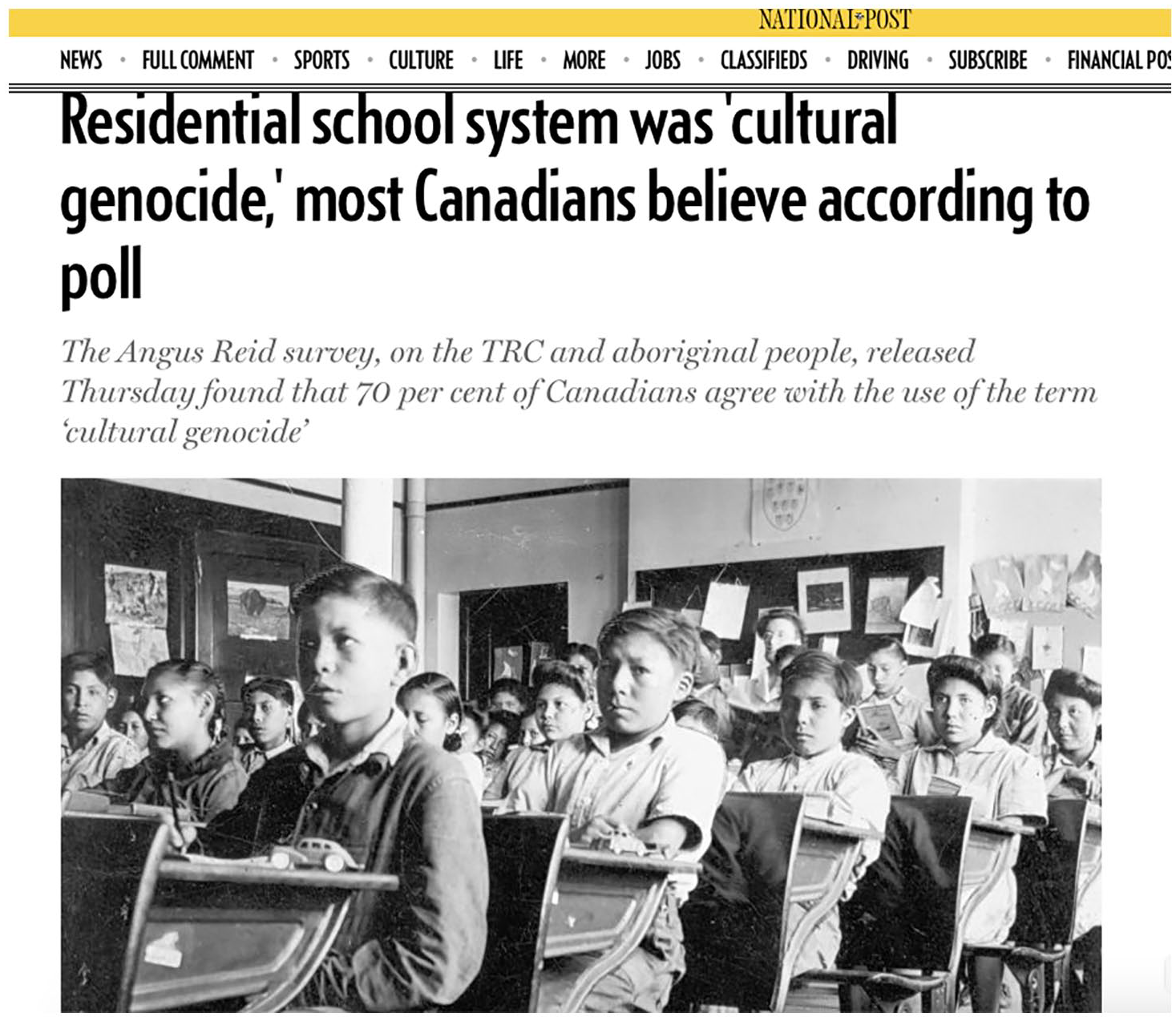
Children at the Old Sun Indian Residential School in Gleichen, Alberta, in 1945. The school shown in the photograph was not named in this article published by National Post (Hensley, 2015).
Russ cannot wait to go teach at a private catholic school, but while he is there, he will introduce the locals to an activity that he is passionate about. This film frames itself as a direct continuation of this IRSS history wherein the White saviour figure enters the community, disrespects everyone in it, and assumes responsibility for its turn around. But The Grizzlies attempts to offer a resolution to the problem of outsider ignorance; although Russ is initially situated as the teacher figure, his lacrosse lessons eventually cultivate an environment for him to expand his own cultural understanding and empathy.
New wave of Indigenous filmmaking in Canada
The film Older than America, released in 2008, also broaches the topic of residential schools head-on in the form of a personal narrative of a daughter of a boarding school survivor. The protagonist, played by Cree actor Georgina Lightning, and other residents in a small U.S. reserve town are haunted by the ghosts of the children of the school that were buried in unmarked graves many years ago. The film, also written and directed by Lightning, braids together several complex themes, such as trans-generational trauma, continued secrecy and cover-up by the church officials, as well as cultural revitalization and learning to communicate with ancestors. In one scene, a scientist played by Bradley Cooper, researches archival photos of the Catholic-run school at a local library. And later, a group of ghostly children confront the main priest who is responsible for a widespread cover-up in the community. The film played at several Indigenous film festivals and closed the Truth and Reconciliation Closing Event conference held in Ottawa in June 2015. While Older than America is an American independent production, it has much relevance to reconciliatory efforts in Canada. The film’s interlacing of past and present is incredibly heightened, and the children appear in multiple ways, including flashbacks and as ghosts. In fact, every aspect of the film’s story draws us back to past trauma. There is even an earthquake emanating from the old school that no one can explain. As such, the film dramatizes the call of justice itself.
In 2009’s Savage, Anishinaabe director Lisa Jackson draws on Hollywood musical genre tropes to tell the story of a young girl being sent to residential school (Figure 2). The short film, produced in Canada with the support of the imagineNATIVE Film Festival, features two musical numbers: one, inspired by 1950s Hollywood technicolour musicals, depicts a mother lamenting the loss of her little girl who has just been taken by the Indian agent. The other number incorporates hip-hop dance moves as a group of zombified children start to dance when their teacher leaves the classroom for a few minutes. Is the young girl a living dead ghoul or is she a malnourished girl being mistreated in a school? In Holy Angels (2017), by Cree and Métis filmmaker Jay Cardinal Villeneuve, another reimagined version of the schools is presented as a girl dances in ballet style in the empty school. This is intercut with an interview with Lena Wandering Spirit, a survivor. By showing a girl dancing ballet in the empty hallways, classrooms, and basement and then switching to traditional powwow style dance in regalia, the film reminds me of a more poetic version of Claude Lanzmann’s Shoah (1985). What kind of angel is the girl? It is not until the end when the ballet, a Western style of dance, is replaced by traditional dance that we understand she may be a spirit. The girl seems cursed to roam these hallways, and not somewhere else, like her own land. Or is she breaking free? The director met the subject of the film while working as a videographer for the TRC. Performing and playing in the site of genocidal events might strike some as inappropriate or triggering but reimagining previously unsafe spaces is a strategy that Indigenous artists are using today to carve out a new futurity and thus offer hope. “New Indigeneities are being articulated in the process of travelling between spaces”, argues urban Cree cultural theorist Karyn Recollet (2015). “The reformulation or remixing of new Indigenous identities involves a recognition of our own body sovereignty as Indigenous women claim a rightful presence in motion on Indigenous lands” (p. 100).
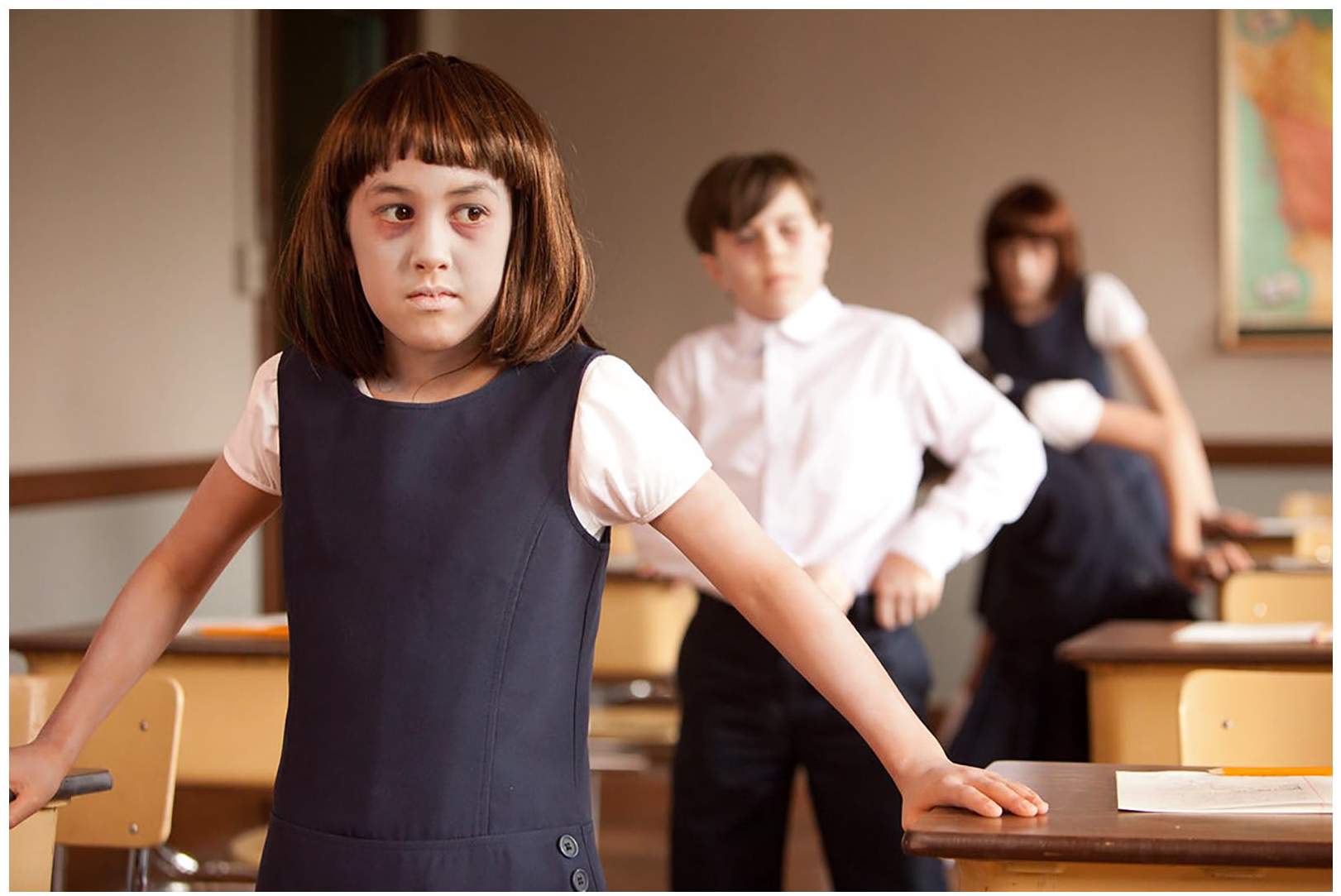
Lisa Jackson, Savage (2009).
Recollet originally developed the notion of the new futurity in reference to new media and music, how Indigenous artists are incorporating traditional knowledge and ceremony in new media and popular genres, and also redefining traditional uses of space. Describing A Tribe Called Red’s music video Sisters ft Northern Voice (2013), she observes an approach to space where Indigenous women may freely express themselves in traditionally unsafe spaces like highway gas stations and nightclubs. The idea of the new futurity paves the way for expressing traditional beliefs in new spaces and new media genres that have long-standing colonial affiliations and implications. The concept also has much relevance for the study of Indigenous New Wave Cinema, particularly the work of Mi’kmaq filmmaker Jeff Barnaby, who draws on established genre filmmaking, like the Western and horror film, two genres that have historically been quite cruel to Indigenous peoples, either by villainizing them or turning them into a kitschy joke.
Barnaby’s NFB-produced short film Bleed Down from 2015 uses archival footage of other NFB productions from the past but remixes them to mount a scathing indictment of Canadian history and policy. The children are sent off to schools; we see environmental destruction, smokestacks, and animal carcasses buried in oil; and this is juxtaposed with Indigenous people being examined and prodded as they are ostensibly treated for tuberculosis or experimented upon in a clinical setting. His feature-length Rhymes for Young Ghouls presents an unsettling reserve fever dream wherein the teenager Aila, played by Kawennáhere Devery Jacobs, bravely goes up against the reprehensible Indian Agent Popper, on the fictional Red Crow Mi’kmaq reservation (Figure 3). Aila dons different faces throughout the film to help her survive threatening situations and unwelcoming spaces, culminating in a residential school heist. Although the film takes place during Halloween, the playful spirit is turned upside down by the haunting tone of horrific memories and restless ghosts. Costumes connote a more symbolic meaning to Aila’s lifestyle than the typical dress-up attire of the season. In an effort to come out unscathed, she wears a gas mask when she sells drugs to her community members at a party. Later, she wears an old lady mask and ghoul makeup: [T]he old woman mask represents her soul, aged a thousand years by the trauma of the Indian Act and what it did to her mother, the ghoul makeup a means of transforming herself to do battle with the sadistic Popper and St. Dymphna’s. (Gittings, 2018, p. 236)
As a perennial survivor, Aila knows what it means to put on a face which allows her to trick those in charge.
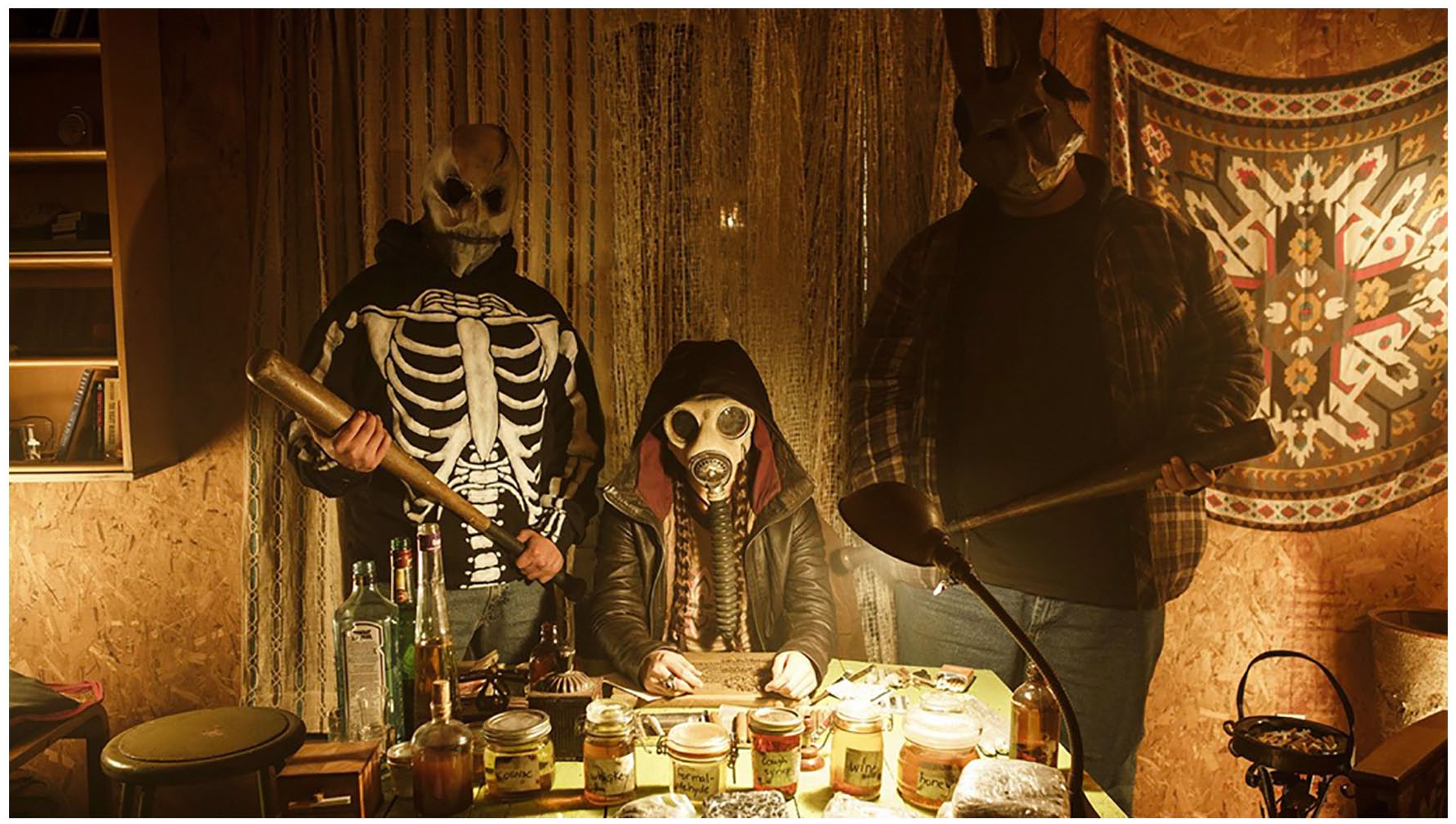
Jeff Barnaby, Rhymes for Young Ghouls (2013).
The film is replete with moments that critically draw on archival imagery of the schools, but offers its own acidic commentary and twist, sometimes in the form of hard-hitting, but believable dialogue or visual punishments towards both the students and those in charge. One scene in particular is especially reminiscent of numerous archival photos of children praying before bedtime. The required authority figure, Popper, appears centre frame and in a medium long shot as he speaks to about a dozen boys as they pray before bed in a dormitory. The boys and their beds form two rows on each side of the frame. Popper walks in-between the rows as he addresses them while the camera zooms out to reveal all the boys. The scene is dimly lit, so many of the boys at the front of the frame appear as partial silhouettes without defined features. At least visually, the shot can be compared to the archival photographs, but the dialogue is new: For you new boys, the rules are simple. You get caught out of your beds, you catch a beating, you mend in isolation. You get caught talking to each other, you get beat. You get caught coughing, crying, sneezing, [urinating], breathing too [expletive] loud you get beat and put in isolation. Now, habitually [expletive] with these rules and you’ll wind up on the hill! Oh, and uh, from here on in, it’s the Queen’s [expletive] English. Relish it. (Barnaby, 2013)
The staccato delivery of these lines by Popper suggests the underlying abuse and outbursts of violence that existed in many of the schools.
Mid-way through the film, the young heroine is taken to a residential school where nuns cut her long hair, give her the standard Western-style bowl cut, wash her with the insecticide DDT, and lock her up in a basement dungeon. Thankfully, her time at the school is short-lived. Aila escapes from her prison with the help of her friends, returning to the school to seek their vengeance against Popper. The group dresses in Halloween costumes for the heist, including a demonic rabbit and a skeleton mask. Barnaby sends his ghouls to fight the monsters inside the school and they do not disappoint: they break into the school, take control of the hallways and stairs, and then connect the water pipe to a can of faeces. When the Indian agent, Popper, takes a shower at night after groping a boy, he gets a taste of his own medicine, a filthy shower of excretion. Barnaby intermixes childhood fantasy, realist church abuse narrative, Tarantino-esque over-the-top violence, and affective filmmaking to bring his IRSS story to life.
The use of visceral violence and intense emotional outbursts while potentially triggering do at least allow Indigenous audiences to experience catharsis as they identify closely with the young, defiant protagonist. As Christopher E. Gittings (2018) alludes to, emotional appeals to Indigenous pride and past injustices have been a relatively recent development in Canadian cinema (p. 234). Rhymes for Young Ghouls’ revenge fantasy is also an historical reimagining of alternative outcomes, and therefore also a species of retroactive futurism. What if a character like Aila had in fact existed and how would her plight have inspired future generations? Her fight would have undoubtedly reverberated among the larger community and indeed become the stuff of legend, another very common trait in Barnaby’s work. Take, for example, the elder who stays on the reserve to fight the zombie onslaught with his samurai sword in Blood Quantum.
Due to the ways colonial society has delegitimized and systematically oppressed Indigenous people, their lives have been marked as ungrievable, according to Anishinaabe political scientist Veldon Coburn. He argues, We should understand the media as a colonial institution. It is not merely a neutral channel for funneling information to the people. It is deeply implicated in colonialism by framing popular perceptions of Indigenous peoples as less deserving in life and ungrievable in death and violence. This is especially true in how the media treats Indigenous women, girls and 2SLGBTQQIA people, amplifying the precariousness of their lives, and desensitizing a public to the horrors of Indigenous genocide. (Coburn, 2019, para. 17)
Often in these films there are characters that are never seen that play a big role in the development of the story. The dramatic narrative push of Darlene Naponse’s masterful Every Emotion Costs (2010), Rhymes, Uvanga, and Fire Song hinges on the work of mourning as the textual apparatus of the films delays and defers full comprehension of the dead other. By not fully assimilating the dead, these films offer instances where spectral relations contrast and offer justice to those Indigenous lives that are otherwise relegated to soundbites in mainstream Canadian news coverage. In Fire Song, Shane mourns his sister and her suicide propels him to seek out an open and honest life for him and David. Rhymes connects the mourning of Aila’s mother and brother to her sobriety and general fighting spirit. In one memorable scene, Aila, her father, and her uncle go to her mother’s burial site where they have a darkly telling exchange about the unmarked graves of native suicides. Before the final showdown with Popper, Aila has an encounter with her mother and younger self as they paint an Indian in full headdress on the side of a boat. When Aila’s younger self asks her mother why they are drawing in the dark, her mother explains, “[D]rawing of an Indian on some piece of wood isn’t that big of a deal. Two Indians drawing an Indian is. And to some people, that’s scary and we can get in trouble for it” (Barnaby, 2013).
By reclaiming the imagery of the past and by fighting back, a film like Rhymes attempts to bring the images back to life. The film avoids using archival images of Indigenous suffering either for the purposes of communicating official history or even as denunciation and therefore for the sake of compassion. Instead, Rhymes proposes a new dualistic approach that stresses at once the resonance of the historical imagery and the undeniable singularity of the children and subjects in front of the cameras. This aspect of agency, singularity, and the immensity of the loss is of course what Barnaby and other Indigenous filmmakers inherit. I believe Barnaby’s approach makes it possible to begin the work of inheriting these images as a part of Indigenous heritage and justice. Whereas The Grizzlies repeats the images for the sake of sober clear historical accuracy where the children’s singularity and agency get lost in the mix, Rhymes, Holy Angels, and Savage—in other words the new storytelling of the New Wave of Indigenous cinema—draw on Indigenous perspectives to restory our common national history. This is not just re-enactment of traumatic events that occurred years ago, but performances that explore, challenge, and critique the history and logic of the IRSS. Thus, there appears to be a clear distinction between films that recirculate the ideological and propagandistic images—the ones that are being archived so intensely—and those that do away with the official images and produce their own new reimagined ones that make room for Indigenous heroes and legends that can in turn haunt us in new ways, based on agency, pride, and a willingness to laugh, fight, or otherwise surmount the injustices wreaked by the IRSS.
How do we get the archive to perform different and inventive tasks today with the goal of truth and Indigenous resurgence in mind? Originally produced by the NFB as a part of a series of shorts created using archival stock footage called Souvenir, Cree artist Kent Monkman’s Sisters & Brothers from 2015 challenges the classic message of the successful operation of the residential school. By juxtaposing hitherto underseen documentary footage of buffalo being herded on the plains with children being prepped, transported, and finally attending residential schools, the film adds a dynamic use of dialectical montage on top of its effective use of visuals. As in many of these photos, the expressions on the children’s faces suggest a mixture of confusion, despair, and resignation as they are expected to repeatedly perform tasks. I suspect the images of the children in Monkman’s short film carries with it a spectral dimension to anyone watching, and thus affords them a chilling but singular respect in place of a known name or identity. The 3-minute film synthesizes two seemingly distinct forms of violence to create a critique of what might be called ethno-logo-centric genocide. By positing the residential school system as a form of extinction where children are treated like animals for industry, we as viewers are compelled to hold onto students’ gazes. What’s so unique here is that Sisters & Brothers uses archival images of real children and schools taken from other, unseen NFB productions. The abuse and violence exist within and, importantly, in-between the images as colonial history is being remixed by Monkman. As archive fever chases the origin of history, there is a sense of violence and murder that comes by stiffening and holding history in place, as in a straitjacket or in an electric chair. By looking at the archival images more carefully and associatively, a work like Sisters & Brothers sharpens and focuses the students’ spectral gaze (Figure 4).
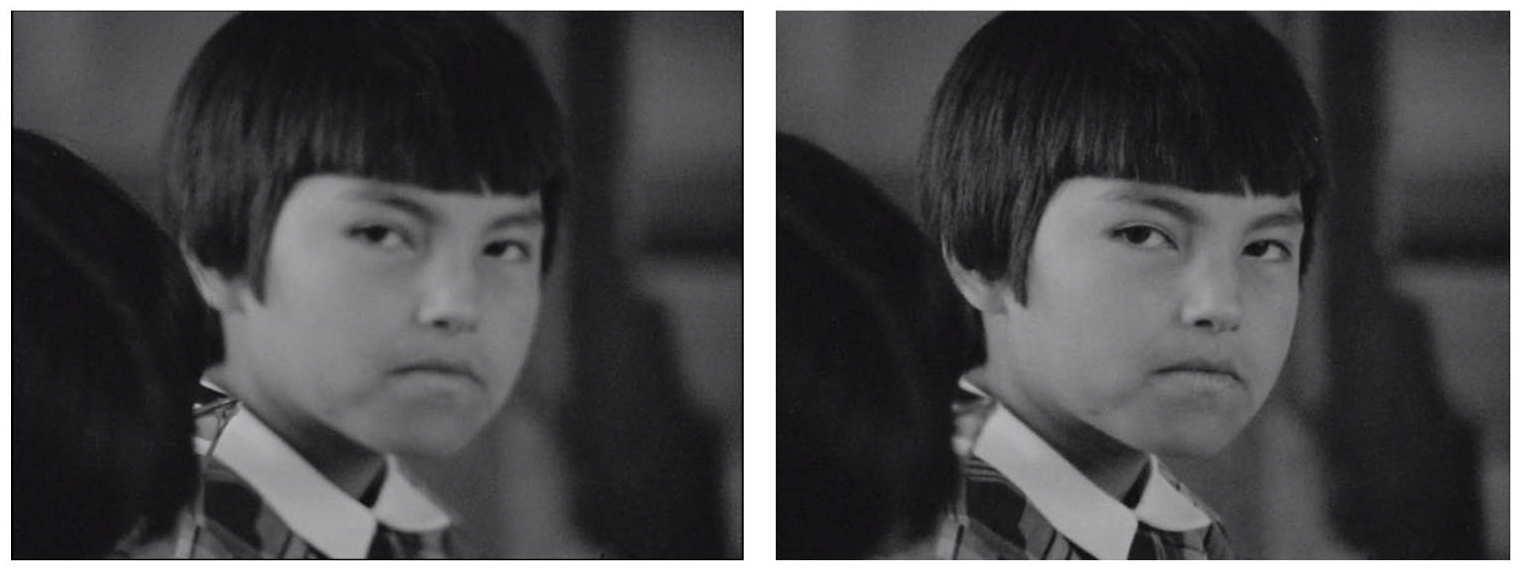
Kent Monkman, Sisters & Brothers (2015).
Coda
There has been a recent effort to identify as many students as possible, to give them back their names in order to conduct archival research and to view the photos in a more ethical way. As McCracken (2017) notes, Adding names to archival photographs can have a profound impact on the individuals, families, and communities that have been directly affected by the residential school system, and equally important effects on broader society . . . The act of naming begins the process of individualising the historical record and eliminating the erasure enacted through past archival and government approaches to record keeping . . . Identifying people in residential school images can start conversations about healing in families and communities. It also allows researchers to connect textual records and survivor testimonies to actual photographs. (p. 178)
Identification is the explicit goal of the Shingwauk Residential Schools Centre’s Remember the Children Photo Identification Project launched in 2005. But the inevitable question comes back to haunt us: what if we cannot identify the students in the photographs? What remains of the archive and how do the children continue to haunt the archive even without a name? It seems to me that to not show the photos because of a lack of context is not an adequate solution either. The original images were produced in a colonial context for the purposes of demonstrating a successful assimilation. But right from the start there is something that resists their successful appropriation. I have written elsewhere on the asymmetrical gaze inherent in spectral looking: “We are inheritors of the other and we must decide what to do with the ghost’s injunction: in the case of Hamlet and all spectrality, to correct an injustice” (Stewart, 2020, p. 34). This political struggle of the failure of appropriation, this failure of consumption, that is what haunts, that is alterity. The various montages of residential school photos frame the subjects in a pan-Indigenous way. But we know there were many different kinds of Indigenous children at the schools from the many bands and nations across the country. The assimilation of these images in new media always risks a certain failure; the Monkman and Barnaby films are evidence of this, and it is intimately bound with what Derrida understood as spectrality, an ethical injunction to offer the other respect as one is under their ghostly gaze.
Footnotes
Acknowledgements
To verify the historical information of archival photographs discussed in the article, I used both the Legacy of Hope Foundation (www.legacyofhope.ca) and Library and Archives Canada ( ) websites. The author wishes to thank Cassidy Korhonen for her help with research and editing and Donna Cowan at the National Film Board of Canada for providing archival information. Miigwech, Sharla Peltier for reading a very early draft and encouraging me to continue. Thanks are also due to the two reviewers at AlterNative for their attentive readings of the article.
Declaration of conflicting interests
The author(s) declared no potential conflicts of interest with respect to the research, authorship, and/or publication of this article.
Funding
The author(s) disclosed receipt of the following financial support for the research, authorship, and/or publication of this article: This article was written with the support of a Social Sciences and Humanities Research Council (SSHRC) Insight Development Grant.