




Abstract
This article reports on recommendations made by urban Métis women for improving access to health and social services in Toronto, Canada. By applying a conversational method, this research followed up with a subgroup of urban Métis women who participated in the Our Health Counts Toronto longitudinal cohort. Métis women (n = 11) provided holistic and practical recommendations for improving access to health and social services. These recommendations include (a) Métis presence, (b) holistic interior design, (c) Métis specific or informed service space, (d) welcoming reception/front desk, and (e) culturally informed service providers. During the conversations, the women shared positive experiences with an Indigenous-informed midwifery practice called Seventh Generation Midwives Toronto. Examples from the women will be provided of Seventh Generation Midwives Toronto to illustrate how the recommendations may look in practice. This research illustrates that Métis women hold solutions for improving access to health and social services for the Métis community.
Introduction
Métis Peoples comprise over 35% of the Indigenous population in Canada, yet they experience major gaps in access to culturally safe 1 health services (Smylie, 2008; Statistics Canada, 2017). Previous research has found that Métis Peoples are unlikely to engage in health services that do not value their cultural identities, and are often left utilizing mainstream options (Laliberte, 2013; Smylie, 2008). However, the needs of Métis have not always been met by mainstream services, or pan-Indigenous health services (Richardson, 2016). Métis being caught “betwixt and between” services is an outcome based on decades of colonial and racial divides inflicted upon Métis Peoples by the Canadian government in an attempt to get access to Indigenous land (Fiola, 2015; Smylie, Adomako, & Wellington, 2009). These gaps in services are problematic given the severe disparities in health determinants and outcomes that Métis Peoples experience compared to the non-Indigenous Canadian population (Chartrand, 2011; Smylie, 2008).
To address the Métis health and social service gap, this research engaged with Métis women who lived, worked, or received health services in Toronto, Canada. The reasoning behind engaging with Métis women was because traditionally, Métis women held knowledge central to the health and well-being of their communities (Anderson, 2011). Kermoal (2016) states that Métis medical knowledge—lii michin “the medicines”—was often passed down through matrilineal lines. Métis kinship systems, which are at the core of Métis identity and survival, were upheld and nurtured by Métis women (Macdougall, 2010). Yet, decades of assimilative and racist colonial policies that tried to eradicate Métis Peoples, coupled with settler religious beliefs, have targeted and silenced Métis women’s voices (Fiola, 2015; National Inquiry into Missing and Murdered Indigenous Women and Girls, 2019). This silencing of Métis women has had detrimental effects on Métis Peoples identity, health, and well-being.
The aim of this research was to give space, gather stories, and explore urban Métis women’s perspectives on identity and their experiences with health and social services in Toronto. This article provides recommendations from a larger research study by the Métis women for improving access to health and social services in Toronto for the urban Métis community. Following each recommendation, the Métis women provide an example of what a culturally safe space may look in practice by drawing on their experiences with Seventh Generation Midwives Toronto (SGMT).
Methods
Our Health Counts Toronto
This research was Indigenous led and community-driven at all stages. It was nested in the project Our Health Counts (OHC) Toronto, a longitudinal cohort study that has developed population-based health status and health care utilization databases profiling urban Indigenous Peoples’ health and well-being across four Ontario cities, including Toronto. OHC Toronto was co-led by SGMT. SGMT retains full ownership and control over all data in accordance with the project’s academic–community partnership agreement as described in Rotondi et al. (2017; Schnarch, 2004).
From March 2015 to March 2016, Indigenous adults who lived, worked, or received health services in the city of Toronto were recruited to OHC Toronto using a community-based respondent-driven sampling (RDS) design (Rotondi et al., 2017). A total of 917 Indigenous adults (15+ years old) were recruited and deemed eligible for the study. Of this, 97 participants self-identified as Métis and 8 participants self-identified as both First Nations and Métis. Overall, the total size of the Métis population of the City of Toronto was estimated to be 8340 (95% confidence interval [CI] = 6533-11676) 2 ; 44% of the Métis population in Toronto (95% CI = 31 -65) identified as female, 53% (95% CI = 31 -74) identified as male, and 3% (95% CI = 0 -5) identified as trans or other. Results from OHC Toronto found that of the Métis female population, 34% said they needed health care services but did not receive them (95% CI = 13 -55), 34% have been treated poorly or unfairly because they are Indigenous (95% CI = 16 -53), and 42% have been treated unfairly because of their gender (95% CI = 21 -63). The study presented here represents an in-depth qualitative follow-up to these results and was supported by an expansion of research engagement with the Métis community in Toronto. This included a series of informal consultation meetings with members of the local Métis council, Toronto Métis community members, a talking circle, and during the OHC Toronto community report launch.
Theoretical and methodological framework
This research was theoretically guided by a Decolonizing Praxis woven with Indigenous Feminist Theory. Indigenous Feminist Theory recognizes that colonialism is the most prominent structural condition affecting Indigenous women (Green, 2017). Whereas a Decolonizing Praxis means returning to Indigenous knowledge systems (Simpson, 2011), it involves centering what has become marginalized, reconstructing what has been fragmented, and communicating what has been silenced (Starblanket, 2017). These two theoretical approaches are interwoven, as Green (2017) states that “patriarchy and colonialism are inextricably related for Indigenous Peoples and condition what Indigenous women experience” (p. 11). These interwoven approaches acknowledge that Métis women hold intergenerational knowledges that have kept their communities well. The Indigenous methodology of this research was inspired both by Ojibway scholar Kathy Absolon’s (2011) work and the first author’s worldview as a member of the Métis community in Toronto. The methodology facilitated a reciprocal healing journey between the participants and first author that enabled the reconnection, remembering, learning, recovering, and reclaiming of Métis women’s histories, worldviews, and culture (Absolon, 2011). 3 Most importantly, this methodology created a safe space that allowed for Métis women to share their perspectives on identity and experiences with health and social services in Toronto.
Recruitment and sampling
The first author attempted to contact all Métis OHC Toronto participants in the OHC Toronto cohort who identified as female, other, or trans and gave consent to be contacted for follow-up research studies. In total, 58 participants in the OHC Toronto cohort met these criteria and provided contact telephone numbers. The first author contacted each of the 58 participants through phone. If no one picked up during the first call, a second or third call, if necessary, was made over the course of a month. Thirteen participants responded and agreed to be interviewed. However, two individuals were unable to coordinate a meeting time. The remaining 45 phone calls were either unanswered or a wrong number. This high non-response rate is consistent with the high mobility found in the larger OHC Toronto study (Well Living House, 2018).
Ethical considerations
In accordance with the OHC Toronto’s academic–community partnership agreement (Rotondi et al., 2017), consent was received from SGMT prior to the implementation of this follow-up study. Next, ethics approval was gained from St. Michael’s Hospital and the University of Toronto prior to contacting the participants.
Data collection
The first author conducted interviews with each participant, applying conversational interview methods (Absolon, 2011). This conversational method facilitated the emergence of each women’s story in a style and form that reflected their knowledge and experience and avoided the externally imposed structuring of a more formal interview guide. Collecting the stories through a conversational method provided an informality and flexibility. The conversations were dialogic, relational, and reflective and were nested within preexisting relationships with the first author. Each woman was given a CAD$50 honorarium, herbal tea, and wild blueberry jam made by the first author prior to the conversations. Ten open-ended questions guided the conversations (Appendix 1) that were centered around the following themes: (a) Métis identity, (b) experiences with health and social services, (c) racism and discrimination, (d) relationship to land/traditional medicines, and (e) recommendations for improving access to health and social services. This article focuses on the recommendations for improving access to health and social services.
Data analysis
All of the conversations were electronically recorded and transcribed verbatim. Before the coding process, the first author read the transcripts to identify major themes and consulted with the second author—both are a part of the Métis community in Toronto. Once the first two authors came to consensus on the individual themes, the transcripts were mailed to the respective participant for verification and corrections. To ensure rigor and validity, participants were asked if the themes were an accurate reflection of their experience and if their transcripts were written correctly. Upon request, verification, corrections, or requested deletions were integrated into the themes and transcripts. To make meaning of the conversations, a holistic coding method was applied using NVivo software by the first author to interpret the larger themes of all the transcripts and incorporate the themes proposed by the participants (QSR International, 2018; Saldaña, 2015). A final thematic analysis (Braun & Clarke, 2006) was conducted by the first two authors.
Results
A total of 11 women were interviewed. All of the participants self-identified as female, Métis, and confirmed that they provided consent in the OHC Toronto survey to be contacted for further research. For the women who chose to remain anonymous, a pseudonym was provided in Michif (Île-à-la Crosse dialect). 4 Saturation was reached within the 11 conversations and was determined by the first two authors. Conversations were on average 75 min and conducted in the summer and fall of 2018.
Five cross-cutting recommendation groupings emerged from the analysis. The following groupings represent the most common recommendations that emerged. These groupings were woven together with many overlapping themes. Examples are included of how each recommendation can be actualized in practice, drawing on features of SGMT, which as described above is an Indigenous-focused midwifery practice. SGMT is co-located in the Toronto Birth Centre (TBC). When the Métis women were asked during the conversations if they could imagine a relationship with a health or social service provider/space where they feel comfortable, respected, and able to be themselves, many described positive experiences with SGMT 5 and TBC.
Five recommendations from Métis women to improve access to health and social services in Toronto for the Métis community
Métis presence
The women spoke of the importance of having Métis presence within a health and social service space. This included having staff who identified as Métis, signs on staff member’s doors indicating if they identify as Métis and could assist with supporting Métis clients, or Métis “symbolism.” For example, women shared, I could see Métis People who had jobs [at an Indigenous social service organization in Toronto] . . . It makes a big difference . . . it’s this little reminder like, “Oh hey, I’m welcomed here.” Even though no one told me I wasn’t welcome, it’s still nice to have that little reassurance. Or seeing a Sash hanging out. (Misâskwatômin) Try to create more visible spaces, even if it’s something like signage or . . . some kind of symbolic imagery . . . that they could put on your door to symbolize, “I’m Métis . . . I know a little bit about the services that you could be looking for.” Small little things that can go a long way. (Otîhimin)
SGMT fulfills this recommendation as they have Métis staff who are employed at their midwifery practice. Some women shared that being a midwife at SGMT allowed them to fulfill their responsibilities as a Métis person. For example, My work as a midwife, I really got to . . . start living what I had imagined as a kid; being able to provide care and interact with women in our community, and . . . really living and working as a Métis person. (Kâ-Wâpiscikwâniyâsiki)
This same woman further shared about her role as a Métis midwife and simultaneously caring for the land: As a midwife you always talk about woman as the first environment and so . . . if I’m able to provide good care to a client . . . simultaneously my work needs to be caring for the land and making sure that there’s something for this person, and this baby, to be able to eat and a safe place for them to be. I think that is a big piece. (Kâ-Wâpiscikwâniyâsiki)
Holistic interior design
All of the women spoke about the importance of the interior design in a health and social service setting. Locally relevant Indigenous artwork, warm colors, and incorporating natural elements into the space made them feel more comfortable in an otherwise clinical, sterile, unwelcoming environment. For example, women shared, Wood tables and having art around and having the medicines present and things like that I really appreciate . . . it seems . . . basic but I think it is important and just like making you settle in and feel comfortable, because I don’t feel comfortable at a doctor’s office at all. (Misâskwatômin) Rather than it being like cold white walls everywhere, a little bit of colour on the drywall, that goes a long way. Like some warm colours in the room. (Otîhimin)
While incorporating holistic interior design may be preferred by the Métis women who were interviewed for this project, one woman shared that this might not be considered a safe space for everyone. She shared how some may prefer a mainstream health care setting, and “it’s about being able to navigate that and about being able to acknowledge that”: What I think is most important is that . . . you need to create space that people are going to feel safe in. Because if people feel safe in the space, they’re going to get better care. They’re going to allow themselves to get better care, and they’re going to have better outcomes . . . And . . . for some people, that is at home, and for some people that is . . . a much more mainstream health care setting . . . And so it’s about being able to navigate that and about being able to acknowledge that. (Kâ-Wâpiscikwâniyâsiki)
Both SGMT and the TBC fulfill this recommendation as they incorporate a holistic design throughout the midwifery practice and the birth center, while providing high quality maternity care. SGMT and TBC share the same approach to inclusion and representation through the design of space. Each birthing room at the TBC has Métis artist Christi Belcourt’s mural called “Grandmother Teachings.” Furthermore, Muskrat Magazine (2014) writes, “Bringing in elements of nature such as fire, water, and earth, and welcoming extended family, [SGMT and TBC] have integrated a holistic design.” Some Métis women shared that SGMT and TBC are a comfortable and welcoming space. Part of this is attributed to the Métis relevant artwork and photos of newborn babies. For example, women shared, At SGMT, it’s very quiet, warm, calm type of environment partly because of the photos that make it so personable in there . . . People have given photos of the babies that were born through them and . . . some . . . traditional artwork up on the walls. (Otîhimin) I love the Toronto Birth Centre with all of Christi Belcourt’s designs in it . . . it is the birthing space. You know, it has that . . . welcoming space and I think they have their Code of Ethics right on the front for you to see when you walk in the door too . . . So that is a safe space. It doesn’t look so clinical even though it’s a clinical space. (Tohtôsâpôwaskaw)
Métis specific or informed service space
Building from the first two recommendations, some of the women shared the need for Métis specific or informed health or social services. Having a Métis specific space would increase the likelihood of the women accessing health or social services in Toronto. This included having a Métis specific space within an existing health or social service organization.
If there was Métis services, I would go to Métis services . . . Because I probably would feel more comfortable. (Masân) Nothing big, nothing huge, just an office or something. Some little room . . . and it can be embedded in whatever organization . . . But just somewhere that’s specifically Métis. Or a specific Métis person somewhere . . . almost like a walk-in, where you can just go to . . . talk about health or find resources . . . But that is specifically Métis. (Misâskwatômin) Just making a space, making physical spaces for offering services to Métis People . . . It would be really cool if there was a Métis health clinic in Toronto, or it could be somehow partnered with [an existing Indigenous health centre in Toronto] in some way. (Jenna)
One woman shared how a Métis specific health service may not be the solution as it may create divisions among Indigenous People in Toronto. She suggested that a health or social service should be Métis informed, rather than Métis specific.
I don’t know if . . . there actually can be or should be Métis specific health services. And maybe in like an hour or a couple days, I’ll disagree with myself and . . . there’s certain things that can support Métis People to feel safer in those spaces or more connected to but . . . I just think there’s some counter-productiveness with that . . . Because it’s separating us and a lot of us in this urban center of Toronto, we very much are connected to different Nations. So the Métis People I know, there isn’t one distinct Métis identity, culturally, spiritually, anything. Some people I know . . . connect to and find strength from Anishinaabe culture and spirituality . . . And there’s others that are very much connected to Cree culture and spirituality . . . But what is happening in this colonial mindset right now, is that . . . some people are trying to box ourselves in so distinctly that it’s isolating and creating a polarization of those people that do connect with their First Nations roots . . . I really think that . . . maybe it shouldn’t be Métis specific services, it should be more Métis informed. (Okinîwâpikwaniy)
SGMT is an Indigenous-informed midwifery practice that strives to provide culturally safe care to the Indigenous and non-Indigenous clients in Toronto. The midwives and midwifery students who founded SGMT were from diverse Indigenous backgrounds, including the co-founder who is Métis. This is evident in the culturally safe services they provide. For example, one woman shared about feeling accepted for who she was at SGMT: I’m grateful that Seventh Generation Midwives exists within this city . . . I feel accepted for my background, my identity, my experiences, for everything from the minute I walk in the door. And it’s been that way since my first interactions with them. (Otîhimin)
Welcoming reception/front desk
Many of the women shared the importance of friendly and welcoming reception staff when accessing health and social services in Toronto. Aligning with holistic interior design, they also shared how the open concept design of the front desk would impact their experience. If receptionists were blocked off, the women would feel stigmatized, disconnected, and unwelcome. For example, some of the women shared, Friendly receptionist staff, admin staff . . . I think is really important . . . I find that’s what makes me think, “Oh, this is a . . . resource I can use,” . . . that first sort of interaction with whoever is there is actually kind of a big thing. (Misâskwatômin) I think what makes some of the spaces seem so much more comfortable is the openness of it. Even something so simple as how a front desk is set up. And sometimes they’re very high and it seems like they want to be barricaded away from the people that they serve. You know, like [a mainstream social service centre in Toronto] . . . it’s typically a very cold, daunting, unhappy experience . . . The receptionists are completely blocked off, there’s Plexiglas in front of them, you have to speak through a little speaker and microphone system to communicate. You can barely hear anything. And then even when you get brought into the office to meet with your case worker, this tiny little office that you sit in is completely separated by a desk that runs from one wall to the other and it’s a big desk, right in the way . . . the purpose of that structure is for is to literally keep the worker “safe” quote unquote from their service users and keep them separated and disconnected. And that really doesn’t sit well with me, it’s so stigmatizing to people who are trying to receive the social services in that environment. (Otîhimin)
SGMT fulfills this recommendation as the women from the conversations shared how the front desk staff are welcoming, are compassionate, and go “above and beyond” for their clients and visitors. SGMT has an open concept that is inclusive of a children’s play area, kitchen, and comfortable seating. For example, some of the women shared, I had my first appointment booked with Seventh Generation about two days before I miscarried. So, I had to call them back and say, I’m so sorry, I had a loss. I don’t need the appointment anymore, and I started crying on the phone. And the receptionist just handled it so well, you could just feel the warmth and the compassion and the love in her voice. And she’s still the same receptionist there now, I love going there and seeing her. She’s such a great woman. (Otîhimin) Anytime I’m there, they’ll even ask, “Are you hungry? Do you want a sandwich? We could probably make you something in the kitchen.” . . . [SGMT] go above and beyond or maybe they don’t see it as above and beyond and they just see it as this is how health care should be. And I’m just not used to it. I’m used to that more western medical model type of approach. (Tohtôsâpôwaskaw)
One woman who is employed by SGMT in an administrative and outreach role shared how she has built relationships with other Métis women in the community and that SGMT does “a lot more than just midwifery”: When I see Métis on their intake . . . if I get the chance to ask them a little bit about themselves . . . I’ve made actually some pretty great friendships with clients. Just knowing them and then they come back . . . And then also just seeing them around, seeing them at powwows . . . we’re a different kind of midwifery practice because we do a lot more than just midwifery. It’s nice to see and give people the experience that you want them to have. Like a good experience and a safe space to go to because . . . they’re not going to get that at another clinic . . . Also, just talking to people on the phone who are requesting care . . . [I’ll ask] . . . well did you have another baby before. What was your experience like? And they’ll tell me it was . . . horrible and I have major trauma from it, and so . . . we just try to make sure that they feel safe. (Jenna)
Culturally informed service providers
Women provided recommendations on what traits a health or social service provider should encompass. Common recommendations included a provider with knowledge and understanding of Indigenous Peoples’ histories and complexities of Métis identity, a holistic approach to care, non-judgmental, and awareness of issues surrounding power, privilege, and oppression. For example, women shared, A very good understanding of experiences of Indigenous People. I guess ideally Indigenous . . . And definitely a more holistic approach . . . someone that you can talk about things holistically, who can offer a variety of options. (Misâskwatômin) I would prefer to have my health care provided over a cup of tea any day, as opposed to having the formality . . . that comes with going into . . . a medical office. It just can feel really oppressive. (Kâ-Wâpiscikwâniyâsiki) For me it’s actually more important to have people that have a lens of equity and anti-oppressive practice . . . I don’t care if they know anything about Métis People to be honest, it’s more for me that they understand the complexities . . . to not have to explain the basic issues of power and privilege and how different parts of your identity intersect or overlap . . . I just don’t think we can have any service providers that perfectly understand Métis identity because it’s something that we’re figuring out. (Okinîwâpikwaniy)
SGMT fulfills this recommendation as the women shared how service providers at SGMT were non-judgemental and compassionate. For example, one woman shared how SGMT reacted to her when she was having a hard time quitting smoking while pregnant: They’re so women centered, they’re so client centered and non-judgemental and supportive . . . even when I told them . . . I smoke cigarettes and I’m having a really, really hard time even cutting down. I didn’t feel an ounce of judgment . . . where I know that if I had an OB, some of them would say, you can’t be my patient because of something like that, right? (Otîhimin)
Discussion
This research demonstrates that Métis women carry solutions for improving access to health and social services for the Métis community in Toronto. By re-centering what was marginalized, reconstructing what has been fragmented, and communicating what has been silenced (Starblanket, 2017), the recommendations illustrate that the Métis women continue to hold the intergenerational knowledges that have kept their communities well. Despite decades of assimilative and racist colonial policies that continue to try and target and silence Métis women’s voices, this research illustrates that Métis women continue to carry the knowledge that was passed down to them into an urban landscape.
The recommendations are directed at creating health and social service spaces that are culturally safe to be Métis. Cultural safety is when the people who receive the care decide what is culturally safe or unsafe (National Collaborating Centre for Aboriginal Health [NCCAH], 2013). To the Métis women in this research, a safe health and social service space includes having a Métis presence within services, culturally relevant design, Métis specific or informed services, welcoming reception, and service providers with an understanding of Indigenous Peoples’ histories and complexities.
A fact sheet to provide culturally safe health care for Métis patients (NCCAH, 2013) aligns with the recommendations. This includes having staff who hold knowledge around the complexities of Métis People’s identity. Another fact was to have a Métis “presence” such as culturally relevant artwork/symbols. Artwork has been shown to act as a distraction from the stress or discomfort that can occur in a clinical setting (Matthews, 2017). However, it is critical to recognize that artwork is not a quick solution. NCCAH (2013) recognizes that “cultural safety involves deep systemic change and is much more than interior design” (p. 7). NCCAH also suggests the importance of a welcoming reception by providing “training to all staff in cultural safety and review all policies and procedures for unintended bias and/or administrative and other barriers to care” (p. 7). Feeling welcome, comfortable, and safe is often determined on the first experience entering a health or social service center (Wilson et al., 2013). Despite these aligning recommendations, challenges persist on putting these needs into practice.
The Truth and Reconciliation Commission of Canada’s (2015) Calls to Action number 23 and 24 state “Provide cultural competency training for all healthcare professionals” and “We call upon medical and nursing schools in Canada to require all students to take a course dealing with Aboriginal health issues” (p. 3). Despite good intention, enforcing one university course or a pan-Indigenous cultural competency training, often completed online, will not be sufficient in improving service access for Métis Peoples. These interventions also often leave out administrative and support staff.
The recommendations for the need to have Métis specific or informed services is also reinforced in the literature (Smylie, Kaplan-Myrth, & McShane, 2009). Métis specific or informed services are currently limited in Toronto, as mainstream services in Toronto accommodate predominately non-Indigenous Peoples, while Indigenous-specific services are only accsessible to First Nations Peoples. While SGMT is not Métis specific, the women in this research shared how it is an ideal example of what a culturally safe health and social service space can look like, and that other service spaces in Toronto could learn from. SGMT was established through the vision of Indigenous midwives and midwifery students and was inclusive of diverse Indigenous backgrounds. This was inclusive of a strong Métis presence. SGMT is a leader in delivering culturally safe care that is meeting the needs of Métis mothers and their families in Toronto. This can be partially attributed to the strong Métis presence among the founding SGMT midwives. Métis women in this project feel welcomed, safe, and accepted for their identity at SGMT. These experiences speak to the importance of having Métis informed health and social services in Toronto.
Acting on these recommendations requires having access to Métis specific health funding. Much of the current funding for Indigenous health programming and research is pan-Indigenous and is utilized largely by First Nations groups. Evans et al. (2012) share four barriers to receiving funding for health research with Métis communities: a lack of Métis specific health care centers, limited human resources support, reliance upon volunteers, and political instability. A result of the barriers to accessing funding is a lack of culturally safe and effective health services for Métis People (Evans et al., 2012). Indigenous health resources and funding need to be made accessible for Métis communities by acknowledging the limited resources rooted in an ongoing history of assimilation. The Final Report of the National Inquiry into Missing and Murdered Indigenous Women and Girls (2019) echo the need for Métis specific funding in the Calls for Justice and state: 17.7—We call upon all governments to fund and to support culturally appropriate programs and services for Métis people living in urban centres, including those that respect the internal diversity of Métis communities with regards to spirituality, gender identity, and cultural identity. (p. 211)
Strengths and limitations
While we did reach saturation in our interviews, the recommendations may not be representative of the entire Métis community in Toronto. Our sample was not random, but rather represented only those women who participated in OHC Toronto, gave consent for future research projects, and were reachable by phone. The RDS design used to recruit Métis People in OHC Toronto may have been impacted by population-level heterogeneity in Métis participation in Indigenous initiatives, services, and networks. Furthermore, the lack of Métis specific dedicated spaces in Toronto may pose challenges to Métis gathering on a regular basis.
In addition, while those who identified as female, other, or trans were contacted to participate, only those whom identified as female were involved in the study. During recruitment for this study, the small number of those who identified as other or trans in OHC Toronto did not return the phone calls. Those who identify as other, trans, or two-spirited are often left out of conversations around the health and well-being of Métis communities. Hunt (2016) states that “people working to shape both Aboriginal and non-Aboriginal health policies, programs and frameworks have a responsibility to educate themselves about the cultural, gender and sexual identities of Two-Spirit People in order to provide appropriate, accessible, nonjudgmental and safe services” (p. 22).
Despite these limitations, this research contributes to the limited literature surrounding access to health and social services for urban Métis People, and is the first of its kind regarding the Métis community in Toronto. While the urban Métis community in Toronto is unique, these recommendations may be applicable in other urban Canadian contexts. This is critical as Métis People are most likely of the three Indigenous groups (First Nations, Inuit, Métis) to live in a city, with 62.6% living in a metropolitan area of at least 30,000 (Statistics Canada, 2017).
Conclusion
When given the opportunity, support, and appropriate setting, Métis women hold practical solutions for improving access to health and social services in Toronto for the Métis community. Kermoal (2006) states that Métis women in the 19th century held special roles such as “midwives and doctors without diplomas, pharmacists and herbalists without shops. They went from house to house, village to village, to share their knowledge and care for patients” (as cited in Anderson, 2011, p. 148). Two centuries later, Métis women continue to carry knowledge into urban landscapes that is central to the health of the Métis community.
Footnotes
Appendix
Conversation Question Guide.
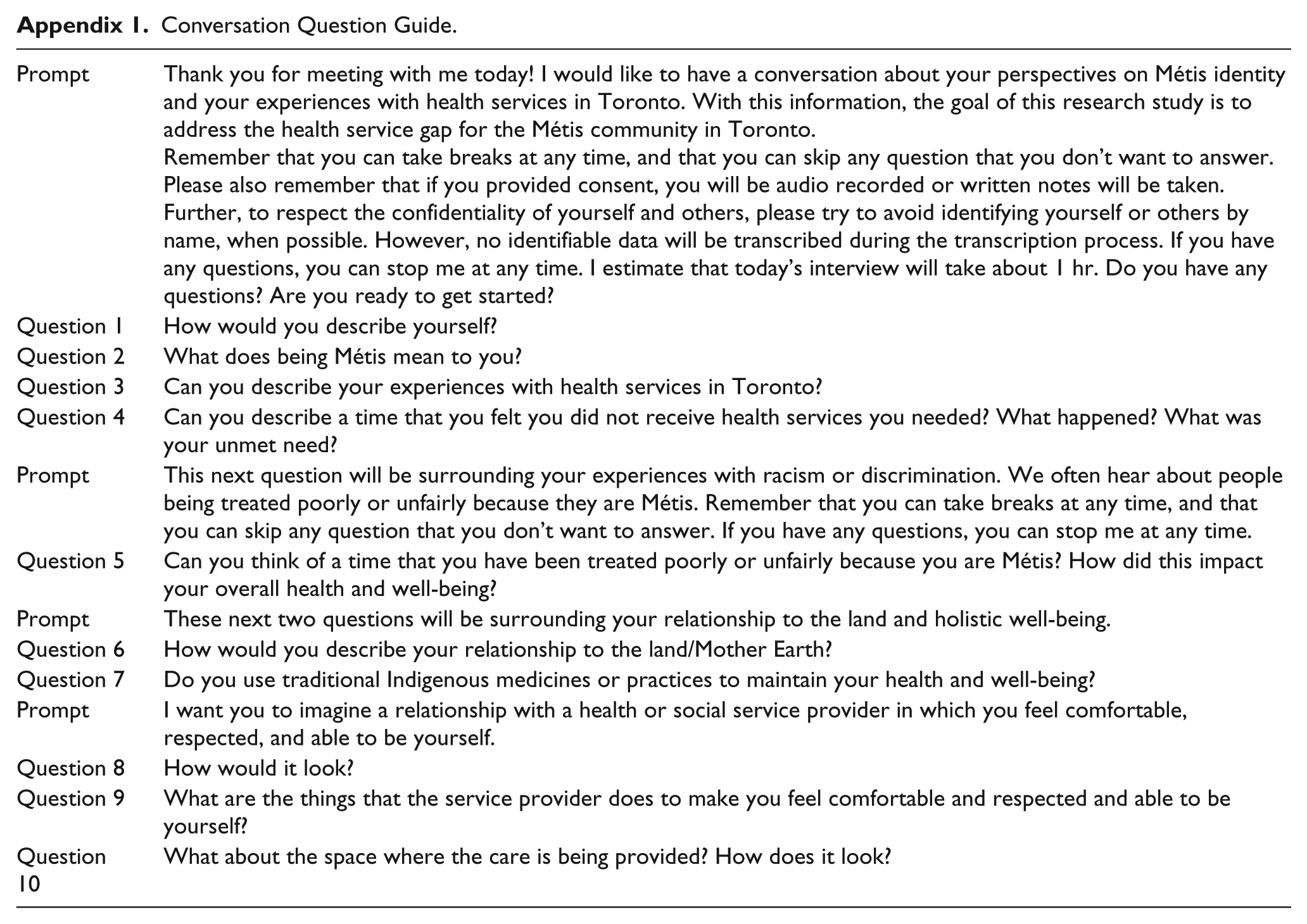
| Prompt | Thank you for meeting with me today! I would like to have a conversation about your perspectives on Métis identity and your experiences with health services in Toronto. With this information, the goal of this research study is to address the health service gap for the Métis community in Toronto. Remember that you can take breaks at any time, and that you can skip any question that you don’t want to answer. Please also remember that if you provided consent, you will be audio recorded or written notes will be taken. Further, to respect the confidentiality of yourself and others, please try to avoid identifying yourself or others by name, when possible. However, no identifiable data will be transcribed during the transcription process. If you have any questions, you can stop me at any time. I estimate that today’s interview will take about 1 hr. Do you have any questions? Are you ready to get started? |
| Question 1 | How would you describe yourself? |
| Question 2 | What does being Métis mean to you? |
| Question 3 | Can you describe your experiences with health services in Toronto? |
| Question 4 | Can you describe a time that you felt you did not receive health services you needed? What happened? What was your unmet need? |
| Prompt | This next question will be surrounding your experiences with racism or discrimination. We often hear about people being treated poorly or unfairly because they are Métis. Remember that you can take breaks at any time, and that you can skip any question that you don’t want to answer. If you have any questions, you can stop me at any time. |
| Question 5 | Can you think of a time that you have been treated poorly or unfairly because you are Métis? How did this impact your overall health and well-being? |
| Prompt | These next two questions will be surrounding your relationship to the land and holistic well-being. |
| Question 6 | How would you describe your relationship to the land/Mother Earth? |
| Question 7 | Do you use traditional Indigenous medicines or practices to maintain your health and well-being? |
| Prompt | I want you to imagine a relationship with a health or social service provider in which you feel comfortable, respected, and able to be yourself. |
| Question 8 | How would it look? |
| Question 9 | What are the things that the service provider does to make you feel comfortable and respected and able to be yourself? |
| Question 10 | What about the space where the care is being provided? How does it look? |
Declaration of conflicting interests
The author(s) declared no potential conflicts of interest with respect to the research, authorship, and/or publication of this article.
Funding
The author(s) disclosed receipt of the following financial support for the research, authorship, and/or publication of this article: This research would not be made possible without the wisdom and knowledge shared by the urban Métis women in Toronto, and support from the Well Living House and Seventh Generation Midwives Toronto. Funding for this research was provided by Canadian Institutes of Health Research.
