




Abstract
Recent research data reveal complex, network-based interactions between mobile elements and regulatory systems of eukaryotic cells. In this article, we focus on regulatory interactions between Alu elements and micro RNAs (miRNAs). Our results show that the majority of the Alu sequences inserted in 3'UTRs of analyzed human genes carry strong potential target sites for at least 53 different miRNAs. Thus, 3'UTR-located Alu elements may play the role of mobile regulatory modules that supply binding sites for miRNA regulation. Their abundance and ability to distribute a set of certain miRNA target sites may have an important role in establishment, extension, network organization, and, as we suppose – in the regulation and environment-dependent activation/inactivation of some elements of the miRNA regulatory system, as well as for a larger scale RNA-based regulatory interactions. The Alu-miRNA connection may be crucial especially for the primate/human evolution.
Introduction
In many aspects, the eukaryotic cells, including our own, still live in a RNA world. Genomes of most multicellular eukaryotes are flooded with mobile elements, especially retroelements – products of 3–4 billion years of activity of an ancient enzyme reverse transcriptase [7]. Related to this phenomenon is another one: the abundance of non-protein coding RNA transcripts, many of them being functional participants in a hypercomplex RNA-based regulatory networks [8,10]. Revealing the numerous and complex connections existing between these two RNA-related phenomena could be crucial for the understanding of modern life and evolution.
In this article we focus on the connection of a specific group or mobile elements – Alu elements to miRNA regulation.
Mobile elements—agents of permanent change
Mobile elements are segments of DNA that can move to different positions in the genome of a single cell. In this process, called transposition, they may cause a substantial range of changes in DNA sequences (from point mutations to large scale recombinations). They also may increase (or decrease) the amount of DNA in the genome [11–14].
There are two (in some classifications – three) distinct types of mobile elements [12,14]:
Class II – DNA Transposons
They consist only of DNA that moves directly from place to place. Most of the DNA transposons move by a ‘cut and paste’ process: the transposon is cut out of its location and pasted in another. This process requires a transposase, an enzyme encoded within some of DNA transposons. Often transposons have lost their transposase genes (they have become non-autonomous) but still can transpose with the help of enzymes encoded by other DNA transposons.
After sequencing of many genomes, some authors distinguish a third class of mobile elements:
Class III Transposons or Miniature Inverted-repeats Transposable Elements or MITEs
MITEs are too small to encode any protein, so probably they also make use of enzymes from larger transposons. MITE elements often reside near or within genes, so they might have some useful role there, i.e. they are ‘genetic symbionts’ [15].
Class I – Retroelements
As the main subject of our research is the Alu element (a SINE retroelement), we discuss this group in more detail below.
Retroelements use reverse transcriptase (RT) to make a DNA copy of their RNA transcript and then insert it in a new location. The mode of retroelements’ transposition is ‘copy and paste’, so they generate numerous copies and appear to be the main reason for expansion of many eukaryotic genomes. About 40% of the entire human genome consists of discernible retroelements, and perhaps more than other 40% of non-protein coding DNA is made of ancient retroelement copies that have accumulated many mutations and became indiscernible [6,7]. Main classes of retroelements are:
LINEs (Long interspersed elements)
The human genome contains more than 850,000 LINEs (about 21% of it). Most of them belong to LINE-1 (L1) family. L1s are about 6,500 bp long and encode an endonuclease and a reverse transcriptase. L1 elements are the main producers of retropseudogenes, of functional retrogenes, and of non-authonomous SINE retroelements [11,12,14].
SINEs (Short interspersed elements)
SINEs are short DNA sequences (100–400 base pairs). They represent reverse-transcribed small nonprotein coding RNA molecules originally transcribed by RNA polymerase III (tRNA, 5S rRNA, 7SL RNA etc.) [3,4,6,11,14]
The most abundant SINEs are the
During the past 65 million years, Alu elements have propagated to more than one million copies in primate genomes, which have resulted in the generation of a series of Alu subfamilies and sub-subfamilies. There are three Alu subfamilies, Alu J (oldest), Alu S (intermediate age), and Alu Y (youngest), divided on the base of their evolutionary age. These subfamilies are further classified into sub-subfamilies based on their divergence from consensus sequence [3].
Generally, the autonomous and non-autonomous mobile elements have different behavior to genes. The autonomous elements usually insert away from gene-rich areas, while the non-autonomous elements, including Alus, often insert near and even within the genes. The ‘Alu transporters’ – autonomous L1 elements, preferentially insert in gene poor genome positions; in contrast, they often insert Alu elements in close proximity and even within protein coding genes. Like MITEs, Alu elements are thought to be generally genetic symbionts, although their insertions often cause mutations and diseases. Human hnRNAs are often found to contain Alu elements; most of them in introns, but also in UTRs and even exons (2% of Alu inserts). Interestingly, among the UTR-located insertions, there is strong preference to 3'UTRs (84%) compared to 5'UTRs (14%) [3,4,13].
Mobile elements in evolution and regulation of gene expression
The abundance and sequence similarity of mobile elements’ copies make them triggering force of all scales of genome reshaping events. Mobile elements are the main cause for genome plasticity, which, although often deleterious for individual organisms, in evolutionary means appear to be a “genomic treasure” - a main driving force of genome evolution. [7,8,11,12,14]
Mobile elements have also various and deep impacts on establishment, function and evolution of cellular regulatory systems. Below we discuss in brief some of the most important effects of mobile elements on the gene regulation.
Mobile elements – donors of ready-to-use regulatory motifs
Various mobile elements are found to carry almost all known regulatory elements:
RNA polymerase II enhancers [11].
Pol II Transcription-Modulating Elements (TMEs) and other transcription regulatory elements [11,13,14]
The sequence similarity within the groups of mobile elements and ‘copy and paste’ mode of transposition may have contributed to broader distribution and network propagation of such regulatory motifs in genomes.
Mobile elements in the emergence and the evolution of epigenetic regulatory systems
Mobile elements in the DNA methylation and imprinting
It is thought that DNA methylation initially emerged as genomic defense mechanism against invasion of mobile elements. Then, insertions of mobile elements near and within genes may have facilitated the “switch” of this epigenetic mechanism from transposons to cellular genes. [3,18 19,20] CpG islands, residing within Alus are often differentially methylated, sometimes in parental-dependent manner – a link of Alu elements to the phenomenon of genomic imprinting. [3].
Mobile elements and the histone modifications
Recently a novel link was discovered between his-tone modifications and activity of mobile elements. A specific histone deacethylase in human genome is engaged with control of transposons [16].
Mobile elements and the alternative splicing
Alu elements inserted in UTRs and CDS often contain splicing sites, thus mediating the alternative splicing and it may be a widespread phenomenon. [3,4,19,20]
Mobile elements and RNA editing
The transcripts of mobile elements, especially Alus are often subjects to intensive and specific A to I editing [17,23].
Mobile elements and srRNA-based regulation (RNA interference and miRNA regulation).
Recent research revealed at least two complex regulatory systems based on so called small regulatory RNAs (srRNAs).
The RNAi and miRNA regulatory systems are different, but appear to be closely related.
An evolutionary model with ideas similar to these about the origin of methylation is proposed for the establishment of the RNAi-based “genome immune system” [48]. It is thought that it has emerged in order to defend the genomes from viruses, mobile elements and defective mRNA transcripts. In C. elegans mutations in genes involved in RNAi lead to increase of the rate of transposition.
Apart from the role of mobile elements in RNAi, recently some facts reveal a relation of mobile elements to miRNA regulatory system. It is shown that some miRNA genes originate from genomic L2 and MIR retroelements which also contribute to establishment of target sites [5].
If we summarize all above-mentioned facts, it is clear that mobile elements have almost unlimited regulatory potential. Therefore, it is not surprising that practically all recent cellular regulatory systems are related to them in one way or another. (
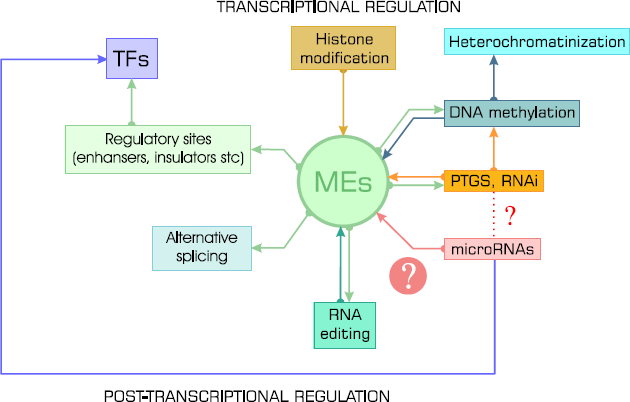
Mobile elements (MEs) and their relation to cellular regulatory processes. The connection between retroelements and miRNAs is the objective of current study.
Recent investigations suggest that previous estimations of the number of human miRNA genes were low, and that miRNAs regulate at least 20% (and perhaps up to 50%) of human genes [34]. The predicted abundance of miRNA regulation and recent discoveries of involvement of L2 and MIR elements in miRNA regulation, as well as the wide regulatory potential of Alu elements, directed us to analyze their sequences for possible relationships to the miRNA regulatory network. Another promising implementation for such interaction might be the affinity of Alus to gene-rich regions and the preference to Alu insertions in human genome for the 3'UTRs. So we tested
Materials and Methods
Consensus Alu sequences we downloaded from the
Alu J sub-family:
Alu S sub-family:
Alu Y sub-family:
(The 22 sub-sub families of Alu elements that we found inserted in 3'UTRs of analyzed genes are shown in
Then we performed 32 BLAST searches using the 32 consensus Alu sequences as a queries against the
BLAST searches were performed using the BLAST search engine at NCBI (http://www.ncbi.nlm.nih.gov/BLAST). We used BLASTN method (nucleotide-nucleotide BLAST, version 2.2.11).
Using BLAST, we collected an initial set of 239 genes with known or strongly predicted functions, having at least one Alu insertion in their 3'UTRs. 3'UTRs of all genes, selected for further analysis were obtained from the
Then we used the specialized repeat-searching software
Functions and processes in which the analyzed genes were involved were defined using the
For the
Supporting information about miRNAs and their targets we have obtained from the following databases:
In order to find micro RNA target sites, we analyzed the 3'UTRs of selected genes with a
The
Results and Discussion
Description of Alu sequences, inserted in 3'UTRs and found miRNA target sites
Our initial set includes 239 genes with known functions/processes and with at least one Alu insertion in their 3'UTR. All genes were analyzed with
CENSOR searches showed that analyzed 3'UTRs are quite densely populated with Alus and other mobile elements. They contain 383 Alu inserts and 249 insertions of various other elements (L1 fragments, LTR-elements, MER, MIR, and SVA etc.). The total length of all Alu inserts in 3'UTRs is 102543 NT, which represent 19, 78% of the total length of the 3'UTRs (518360 nt). There are 24 genes in which Alu insertions contributed more than 50% of the UTR length. On the extreme are the 3'UTRs of the genes ZNF91 (NM_003430), ZNF669 (NM_024804) and NFKBIL2 (NM_013432) which 3'UTRs are practically completely Alu-made (Alu insertions occupy about 90% of their length). Interestingly, all these 3 proteins are involved in transcription regulation – two zinc finger proteins are predicted transcription factors, and NFKBIL2 is a transcription corepressor.
The ratio Alu inserts/gene is 1,6025 – there are many proteins (95, or 39,75% of all genes analyzed) that have more than 1 Alu insertion in their 3'UTR. The record here belongs to BIRC4 (NM_001167) and ZNF490 (NM_020714) genes. The first, containing 8 Alu inserts is involved in apoptosis and protein ubiqutinization, and the second, containing 6 Alu inserts, is a transcription factor.
The CENSOR results about the number and distribution of repeats are interesting by themselves, but the big surprise came when we analyzed the 239 3'UTRs with the

Distribution of target sites on the 3'UTR of the protein chemokine ligand 5 (NM_002985). It carries 2 Alu insertions in direct orientation: AluYc1 and AluS that have occupied 53,5% f the 3'UTR length. All six probable target sites with proper structure (red lines) map in the two Alu inserts. All the rest are ‘cryptic target sites’ with sequence complementarity to relevant miRNAs but without proper structure (green lines).
Initially analyzing all UTRs with the
Then we calculated the
This procedure was performed for all 3'UTRs. Additionally, we made one more statistical clearance only for Alu inserts. We generated 383 random sequences, each 268 nt long (268 nt is the average length of Alu inserts in the 3'UTRs) and with the same nucleotide background as the sum of 32 consensus Alu sequences. Again we calculated the occurrence ratio and removed all results that have lower or equal OR in real Alu inserts than in random sequences.
After removing the insignificant hits, there were still many target sites remaining. 3'UTRs as a whole contain 1980 target sites for 153 miRNAs. Of them, 1095 sites for 53 miRNAs are localized in the Alu inserts. Of the 1095 miRNA sites localized in Alu inserts, 660 (60,3%) occur in Alu inserts with direct (sense) orientation and 435 (39,7%) are in inserts with complementary (antisense) orientation.
Thus, it appears that Alu elements have contributed to 3'UTRs 55,3% of their miRNA target sites. The miRNA target site density in 3'UTRs as a whole is one miRNA target site at every 262 nt, or about 3,8 target sites/Kb. The miRNA target site density in Alu inserts is remarkably high (about 3 times higher than in 3'UTRs as a whole) – one miRNA target site at every 93,7 nt, or about 10,67 sites/Kb.
Moreover, the analyzed 3'UTRs contain 78 significant target sites localized in other mobile elements: various types of LTR elements, L1 fragments, L2, MIR, SVA and MER elements. They contain target sites for 56 different target sites for 56 different miRNAs, and are resided in 3'UTRs of 37 of the genes. In the present ‘Alu-centered’ study we regard these sites as localized outside of Alu insertions, namely, as a part of the total miRNA target site content of the 3'UTRs, but they could be a subject of separate analysis in the future.
The micro RNA sites that occur 5 or more times in Alus are listed in
Some of the most abundant Alu-related miRNA target sites.

This column denotes the orientation of the Alu insert in which the target sites are localized: ‘d’ is for direct (sense) orientation, ‘c’ – for complementary (antisense) orientation of the Alu inserts.
All predicted sites have low free energy, which means they represent stable miRNA/mRNA duplexes. In some cases the free energy is extremely low, the record −42,30 kcal/mol is for a target site for hsa-mir-339 (almost perfect complementary miRNA/mRNA duplex, localized in L2B element). Over 75% of target sites localized in Alu inserts have free energy lower than −25 kcal/mol, over 15% -lower than −30 kcal/mol.
All target sites, in and out, of Alu insertions reported here have a secondary structures characteristic for a functional miRNA/target duplex (Figure 3). All sites reported here have at least 7 nt ‘seed’ complementary region at the 5’ region of the site with maximum 2 G:U pairs; and at least 4 complementary nucleotides at 3’ region.

Structures of some miRNA/mRNA duplexes at target sites localized in Alu insertions. 3’ end of miRNA is shown at the top of the figures, 5’ – at the bottom. miRNAs are colored in red, mRNA targets – in black. (a) – (e) – target sites in antisense Alu insertions. over page: (f) – (j) target sites in sense Alu insertions.
Such sites match all criteria for a functional target site, described in [2]. According to classification given in the same source, most of the target sites are of canonical type. There are also some typical 3’ compensatory sites and others that are closer to 5’ seed (not shown) but they are rare.
The miRNA target sites in Alus naturally divide in three major categories according to their abundance and distribution:
miRNA target sites with
miRNA target sites with
This distribution of Alu-related miRNA target sites is interesting because it may imply some insights about the network relationships in the miRNA-based regulatory pathways. The widespread target sites of the first group, if proved functional, may be crucial in processes as stress response and quick morphological and/or evolutionary transitions, where many proteins with various functions have to be repressed/activated at a same time. In the case with the second group of ‘more individualized’ Alu-related target sites, insertions of Alu elements may have caused expansion of existing miRNA regulatory networks, adding new members to them. The same possibility, but in more restricted scale, may have happened to Alu-related target sites from the third group. The very existence of these three groups indicates that Alu elements could play not only the role of distributors of identical target sites to various otherwise unrelated proteins, but they could also cause individual, protein-specific changes.
Besides all these considerations, there is a very important question remaining: why are there so many miRNA target sites? Having in mind the strict selection system we used (only the sites matching all criteria for a functional target sites were selected) and the additional manual inspection of the results, we consider not very probable that the abundance of miRNA target sites is due to the hypersensitivity of the
Origin of Alu-localized miRNA target sites
How and when did all these target sites appear in the Alu insertions?
All the Alu elements in primate genomes originate from retrotransposed copies of a single noncoding RNA – the small cytoplasm RNA, component of signal recognition particle (SRP) – 7SL RNA. In the Genbank database, we found 2 genes and 6 pseudogenes of the human 7SL RNA.
We tested the presence of miRNA target sites in the two 7SL RNA genes with the use of the
With exception of the mentioned sites, all the rest miRNA target sites found in Alu insertions in the 3'UTRs sites are not present in the 7SL sequence. It means that they are generated during the initial transcription of the Alu by the polymerase III [3], or, what is more probable, during the reverse transcription of the Alu sequence by the L1-RT, which is known to be a process generating many mutations.
Nevertheless, the 7 SL RNA, as well as Alu sequences, contains many miRNA target sites with small differences from the proper structure but still with a high degree of sequence complementarity to some miRNAs (hsa-miR-187, 151, 210, 217 and 328), i.e. some kind of ‘cryptic’ miRNA target sites. Such cryptic sites abound in Alu insertions in analyzed 3'UTRs too (
Then we tested consensus sequences of the three subfamilies (oldest AlyJ, intermediate AluS and youngest AluY) to see if they have miRNA target sites. They showed presence of all widespread target sites and about 50% of other sites, including let-7b and let-7c site. It means that these sites are conserved across all Alu subfamilies, for more than 55 million years of evolution of the Alu sequences. This could be another implication for their functionality.
BLAST searches and CENSOR inspections revealed no homologous Alu insertions in chimpanzee orthologous mRNAs. Instead, there were some other, nonhomologous chimp genes containing Alu insertions, but they were much rare than human genes. This may be due partly to less advanced annotation process of the chimp genome (many of the mRNAs have status ‘predicted’, and in many cases only the coding sequence (without UTRs) is deposited in Refseq_RNA database). Nevertheless it is probable that the majority of UTR-located Alu insertions, even these of Alus of older subfamilies, to be species-specific. Further comparative studies are needed to reveal this problem in more details.
Functional relationships
GOA keywords-based characterization of genes
Based on
14 main groups of proteins, defined on the base of most often occurring GOA keywords among the set of analyzed genes. The ratios ‘target sites/protein’ are shaded in yellow for total 3'UTRs and in light green for Alu inserts only. The 3 highest scores are shown in bold.

Additionally we decided to include one more group of 8 proteins, matching the term ‘information processing’ (In fact, this is not a GOA keyword but we used it to indicate genes involved in DNA replication and repair, transcription (excluding TFs and other regulators of transcription, which are in separate category), translation, mRNA processing and splicing.
The sum of proteins exceeds 238, and the sum of percents exceeds 100, because some of the proteins match 2 or more keywords simultaneously.
The functional distribution shown on
As we can see in
The contribution of Alu insertions to the miRNA site content in the different categories is different. Most significant is the contribution of Alu inserts in the categories ‘cell cycle’, ‘cell adhesion’ and ‘information processing’. The last fact is itself very interesting, as the 8 proteins in this category are involved in housekeeping information processes, previously thought to be ‘forbidden’ for mobile element insertions (this is true also for the homeobox genes, which are represented in our dataset too). The contribution of Alus to miRNA-based regulation in genes related to nervous system is also considerable. This fact is very important in the light of the idea that Alu elements may have contributed to establishment of some human-specific characteristics.
Different gene categories have different miRNA target content
As it is expected, the distribution of miRNA target sites between categories of genes is non-homogenous. Certain groups are enriched in certain miRNA sites and decreased in others. In some cases we could predict, on the base of their distribution among categories, the specific function for some of the miRNAs with target sites in or out of the Alu insertions.
Because the above groups represent relatively small populations, we performed once again statistical clearance of the matches that appear insignificant for a certain group. We used the shuffled sequences of 3'UTRs from each category to find miRNA target sites that occur at higher or equal frequency to the target sites in the 3'UTRs in that particular category. This way we calculated the occurrence ratios (OR) dividing the number of relevant target site to the number of proteins in the particular category. Then we calculated ΔOR - the difference between OR for each category and OR for all analyzed proteins, OR- total:

All miRNA target sites that have ΔOR ≥ 0,05 are accounted as significantly enriched in the relevant group; the sites with ΔOR≤ −0,05 are accounted as significantly decreased. The observation of the enrichment/diminution in a certain category is more useful when certain miRNA has many targets, as it is the case with the widespread Alu-localized sites; cases of ‘individual relationships’ (a miRNA having 1–2 targets) could hardly be detected in this system. An additional obstacle comes from the fact that we are not sure what the functional range of targets of miRNAs is. So we tried to find keywords general enough to cover a biological process, and at the same time specific enough to discern between different functional categories. We made some interesting observations about the distribution of different target sites among different categories of genes. On this base, we made also some assumptions about putative functions of some miRNAs. Some of our conclusions are directly or indirectly supported by the
A) Distribution of the widespread target sites
The category of genes matching the keyword ‘development’ is significantly enriched in antisense (complementary) Alu-localized target sites for
The existence of all miRNAs that target widespread sites in Alu insertions is experimentally validated in human cells by cloning and/or Northern analysis. A common problem when investigating miRNAs is that their targets, especially in animals and human, is much harder to be found and proved than the miRNAs themselves. There are no experimentally validated targets in the databases for the hsa-mir-367, −25, and 92.
A little more is known about the targets for hsa-mir-93, −17–5p, −20, −106. There are some experimentally validated targets for these miRNAs. In
Beyond their non-homogenous distribution, hsa-mir-367/-25/92 and hsa-mir-93/17–5p, /20/106 target sites occur in too many genes with quite different functions. So we suppose that here we have encountered not a known form of miRNA regulation (which is more individualized process), but, more likely, this is a part of unknown cellular signaling system. Before discussing some ideas about this in more details, we have to tell a little more about the other miRNA target sites.
B) Distribution of intermediate and rare target sites
Unlike for the widespread target sites, we can not understand much about the functions of these two groups of Alu-related sites from their distribution among the functional categories in our dataset. Anyway, some cases allowed us to make some plausible predictions.
Not surprisingly, the ‘development’ category is enriched in target sites for
3 of 8 occurrences of
The predicted hsa-mir-452, for which there is no information in miRNA databases, has 5 of 12 occurrences in the ‘development’ group (of them, 2 in Alu insertions), so it is very probable that its function also is related to development.
Some miRNAs that are not localized in Alus occur almost exclusively in the ‘development’ category: hsa-mir-199b (which validated target LAMC2 is involved in epidermis development), hsa-mir-149, −500, −512–5p −519b, −519e* and 527.
Besides the above mentioned hsa-mir-452, the ‘cell cycle’ category contains increased number of target sites for
Other predictions, based on our dataset are:
Two miRNAs (not related to Alus in our dataset),
The category ‘metabolism’ is perhaps too broad to distinguish any clear possibility. There is some probability for
Alu insertions in 3'UTRs as stress sensors for regulatory responses?
Not regarding their non-homogenous distribution, hsa-mir-367/-25/92 and hsa-mir-93/17–5p, /20/106 target sites occur in too many genes with quite different functions. Does this fact have any reason for the cell? Contemplating on this question guided us to a hypothesis for another, perhaps broader than miRNA regulation alone, scale of interactions.
In addition to Alu elements inserted in Pol II transcripts, a population of Pol III Alu transcripts is proved to exist in the cytoplasm of cells of almost all tissues [3,38]. Two main forms of such Alu RNAs have been detected: full length Alu RNAs and small cytoplasmic Alu RNAs, including monomeric Alu sequences and some Alu-like sequences like BC200 gene (which is necessary for the function of neurons). All Alu sub-sub families are represented among cytoplasmic Alu RNAs, but the young ones predominate. Despite the high number of Alu copies in genomes, in normal conditions the cytoplasm of each cell typically contains less than 1000 copies of different Alu RNAs. The situation changes dramatically in cases of viral infection, alterations of nucleotide methylation status, heat shock and chemical manipulation. All these events cause accumulation of high levels of Alu RNAs in the cytoplasm [3,39,40]. Moreover, these Alu RNAs, like the 7SL RNA (from which they have originated about 60 million years ago) have retained their ability to bind SRP proteins and their homologs and to form SRP-like RNP particles [41,42]. SRP function in eukaryotes is to target newly-translated proteins to membrane and/or to inhibit protein translation. On this base, some anti-viral function of the Alu RNAs is proposed [43].
When we connected these facts to the data described in our analysis so far (many cases of Alu insertions in 3’ UTRs of genes, carrying potential miRNA target sites), an intriguing possibility emerged: in periods of cell stress, the antisense Alu insertions in 3'UTRs of mRNAs could interact complementarily and form RNA:RNA duplexes with the increased amount of sense Alu transcripts in the cytoplasm. This could have various and dramatic effects on miRNA- and other types of 3'UTR-localized regulation. For instance, in the case of miRNA regulation, the binding of such Alu RNA to the complementary Alu insertion in the 3'UTR could block the access of Alu-localized (and perhaps other) miRNAs and their miRNPs to their target sites. this could cause rapid increase in cellular concentration of many different proteins simultaneously. In this sense, it is also remarkable that, in our dataset, antisense Alu insertions and their miRNA target sites are enriched in the categories of proteins involved in ‘development’, ‘cell cycle’, ‘transport’, ‘transcription regulation’ and ‘immune response’. Moreover, antisense Alu inserts occur in all categories of proteins we investigated. Thus, the concentration of free Alu RNAs in the cytoplasm could play the role of a environment-sensitive, multi-state switch, flexible enough to adjust the level of miRNA regulation to requirements of the cell.
The expression of hsa-mir-367, −25, and 92 is experimentally validated in various cell types and tissues, including neurons and embryonic stem cells [29, 31, 45, 46]. Many of the proteins in our analysis are also expressed in embryo. This opens a perhaps very important link between various conditions and the response miRNA- and others of cellular regulatory network in development, and the mediator of these signals could be the increased level of Alu RNAs in cytoplasm, competing to miRNPs for connecting to the 3'UTRs. The possibilities for sensitive regulation that such system opens to the cells are almost unlimited. If we add to this picture the similar abilities of Alu elements inserted in 5'UTRs (not analyzed here), that gives another, even more direct ways for Alu elements to affect gene expression.
This Alu-mediated response system perhaps is not restricted to the antisense insertions and miRNA target sites they carry. In the case of sense (direct) Alu insertions, the SRP- and SRP-like proteins may be involved. They could bind the Alu elements inserted in 3'UTRs affecting this way the translation in various ways. In cases of increased amounts of Alu and Alu-like transcripts in cytoplasm (in times of stress), greater amount of such proteins could bind to them, leaving the 3'UTR-localized insertions uncovered. This, on its turn, could open some blocked miRNA target sites or other regulatory motifs or to trigger other types of regulation.
Conclusions
As mentioned in the beginning of our article, our cells still live in an RNA-protein world. It seems that various, hypercomplex, epigenetic interactions underlie our life and evolution.
As we can conclude on the basis of our results,
But this is only the first plan of the picture.
Alu elements are relatively evolutionary young, which makes the situation even more intriguing. The Alu-mediated interactions could be a new, recently formed and even still developing system of regulatory interconnections, ‘caught’ in a process of evolution. And as far as all of these interactions are primate-specific and many are human-specific, the Alu-mediated miRNA regulation could be an important explanation for the appearance of some primate-specific and human-specific traits.
As it becomes clear, the mobile elements interconnect practically all local and global systems of regulation of gene expression, and mediate their globalization and network support. The Alu-miRNA interaction, revealed originally in this study, brings a powerful support to the idea that mobile elements are universal interconnection link between cellular regulatory systems.
The mobile elements are universal agents of evolutionary change. The latest developments in the evolutionary ideas at molecular level are that evolution is a natural system engineering process. The natural genetic engineering has the potential to create hierarchical subsystems and complex networks of genome regulation [9]. Mobile elements, including Alus are perhaps the most important tool of this natural engineering. So we will be glad if, in this article, we could set on its place even a single piece from the astonishing puzzle of the molecular evolution.
Footnotes
Acknowledgements
This investigation has been supported by the grants BG1/2005, MUB 1402/2004; K1202/2002 and G3-03/2003 from the Bulgarian National Science Fund.