




Abstract
The scientific community is facing one of its greatest challenges to solve a global health problem such as the COVID-19 pandemic. This situation has generated an unprecedented volume of publications. The impact of COVID-19 on teaching has meant that moments of social contact have disappeared in exchange for meetings, classes, exams or virtual meetings. In this scenario, the university virtual classrooms when reopened will not be the same. The aim of the study was to identify the scientific publications on the teaching-learning process in university virtual classrooms during the period from 2019 to mid-2020, that is, from its beginnings until June 2020. For this, a bibliometric analysis of the scientific literature was performed. The number of publications in the period of the pandemic in the most diverse disciplines is reported, as well as the interaction between research clusters. The COVID-19 pandemic has revealed the serious deficiencies of our educational system, due to the poor theoretical-methodological preparation of teachers, and, in addition, it has revealed the fallacy that the constructivist model is the only way to educate our students.
The current COVID-19 pandemic is having devastating effects on the health and lives of much of the world’s population. To the enormous human losses are added the nefarious effects that are already beginning to be seen on the economy of almost all countries: facing one of the greatest recessions in history (Di Franco et al., 2020). To protect their populations and mitigate contagions, which multiply exponentially, governments have recommended, and in some cases forced, their citizens to take shelter in their homes. This has meant the closure of shops and the suspension of industrial activities, with the consequent loss of jobs. In a globalized world like the current one, the rupture of the production, distribution and consumption chains is causing untold economic losses. The rapid advance of the pandemic has put the health systems of many countries, even the most developed ones, in serious difficulties. In some cases, the emergency has been so great that the capacity to care for those infected has collapsed. This serious situation has been spreading in education and the pandemic has extended all over the planet like a great wave since the beginning of the year: beginning in Asia and spreading to Europe, Africa and America (Bonilla-Guachamín, 2020).
Among the first measures to contain its progress was the closure of schools at all levels of the educational system. According to UNESCO reports, as of 30 March 2020, 166 countries had closed their schools and universities. Globally, 87% of the student population was affected by these measures: that is, about 1.52 billion students. Furthermore, around the world, around 63 million teachers stopped working in classrooms (IESALC-UNESCO, 2020). Faced with the abrupt and unexpected suspension of their academic activities, the world’s educational systems have turned to digital media to continue their school activities. This led to a forced trial of new ways of teaching, learning and evaluating (Quintana-Avello, 2020; L. O. Rodríguez et al., 2020). This emergency has also revealed the deficiencies and inequalities both in the availability of these digital resources and in the preparation of teachers and students to move towards the modalities of distance education (Instefjord & Munthe, 2017; Wautelet et al., 2016).
In a recent report, De Vincenzi (2020) describes the international panorama of the reactions of some universities and higher education institutions (HEIs) to the transition to online education. Although a number of university institutions have closed and attempted to adopt online learning, very few are well prepared to make this change quickly and abruptly. Many confusions and improvisations have occurred, and administrators, teachers and students struggle to implement online learning broadly and effectively. The transition to this modality requires effective learning management systems, videoconference facilities and academic staff with experience in distance education (García-García, 2020).
In contrast, L. O. Rodríguez et al. (2020) affirm that HEIs around the world have suspended international travel and exchange programmes, as well as many research activities. Also discussed are the decisions to be made to assess learning, whether to postpone or cancel final exams and how to select new students for the following school year. But not all universities have agreed to transition to online education. In several faculties it has been decided to postpone classes and reorganize the academic calendar, under the argument that only face-to-face courses can guarantee quality. The dimension of equity, stresses L. J. C. Rodríguez (2020), has been one of the most outstanding in this global health emergency. It is necessary to emphasize that online education has provided another method (not a means) of accessing knowledge.
The pandemic has shown, again, that students from the most vulnerable groups have been the most affected. In poorer countries where students from vulnerable groups will have more problems, many of these young people have limited internet access and low broadband capacity, so their online learning opportunities are very likely to be drastically limited, especially in rural areas. Not only a significant number of low-income students but even some teachers lack computers or tablets. Gaps are not just reduced to the digital divide in poor countries (Hueso, 2020). HEIs will also have trouble rapidly developing quality distance education programmes. In this context, learning spaces necessarily require redesign to return to being habitable, healthy and safe spaces (González-Zamar & Abad-Segura, 2020b). Classrooms as social spaces should offer flexibility and versatility to reorganize groups when necessary. One of the keys is to leave behind the rigid and inflexible classrooms of the master class and move forward in open, open and flexible spaces.
In this way, the current crisis will serve as a wake-up call to re-evaluate the vulnerabilities of the private sector of higher education and the challenges of living in a globalized and interdependent world. In addition, the crisis has demonstrated the importance of contingency planning and risk management, as well as the benefits of supporting innovative forms of education and the need to make learning assessment and admissions processes more flexible. The current health emergency has also allowed us to recognize that achieving equity in higher education for vulnerable groups in society continues to be one of the greatest challenges (Echeita, 2020; Valenzuela, 2020).
The start of the confinement was an extraordinary situation, in which educational agents were forced to apply strategies that would allow them to continue with the teaching-learning processes remotely. These strategies are not the same as what a formal distance education project requires to be structured, since in these situations, skills are needed to help adapt to a way of life that is not part of normality. Accordingly, the objective of the study was to identify the scientific publications on teaching-learning process in university virtual classrooms during the period from 2019 to mid-2020, that is, during the brief period that brought about the outbreak of this disease. Likewise, the collaboration networks between authors, countries and institutions, and the relationships between the main keywords, are analysed. The bibliographic visualization methods used allowed analysing and representing the characteristics of the selected publications. The result yielded a total of 657 selected publications during the period from 2019 to mid-2020, following the research criteria. Therefore, recognizing scientific productions is of interest by allowing us to explore the effects that the pandemic has had on education and on university physical spaces.
To research the evolution of scientific production, bibliometric analysis was used. In this way, it is possible to determine by means of the obtained indicators the growth of publications in this scientific area and understand the research trends. The database used was Scopus. The field of higher education was selected, examining the publications that included terms related to the COVID-19 disease and the university classroom. Likewise, the formation of the clusters that originated according to the bibliographic link was considered, attending to the most productive countries, institutions and authors, in addition to the keywords.
Finally, it should be noted that among the lines of research that are currently being developed in relation to the subject of study, these refer, among others, to correlating through empirical research, the return to educational spaces with variables such as well-being and the happiness of the students. Other actions correspond to implementing proposals for more functional, efficient and sustainable designs for the entire university campus.
The impact of the incipient COVID-19 on teaching-learning process in university virtual classroom
In recent years, the changes experienced in the educational and social fields have been reflected in the growing interest in knowing the variables that intervene in the academic act. With the COVID-19 pandemic and the state of confinement, the need to know how the return to physical spaces will be and the measures to consider for their correct virus-free management will increase. Research, such as that of Barret et al. (2017) and Daniels et al. (2017), has addressed the relationship between the attributes of physical space, the methodology used and the influence that both have on the teaching and learning process and the students. Regarding the significance of learning spaces, the previous literature shows clear and reliable evidence of the link between student satisfaction with their environment and the academic results obtained. In this way, if students experience personal well-being and attachment to the place where they spend much of their daily life, this translates into a positive impact on their attention, motivation and learning (Hopland & Nyhus, 2015).
Maxwell (2016) emphasizes that the design, quality and adequacy of learning spaces favour students to maintain positive emotions and feel integrated and valued. On the other hand, the incidence that design has on learning spaces, considering that the space intervenes in the social connection of the students, thus promoting collaboration, reflection, exchange and interaction. On the contrary, if the design is insufficient, it can favour the development of childhood disorders, such as tacit dumbness and lack of social interaction. Acaso López-Bosch and Megías (2013) propose to rethink space, which implies considering time to create a new model where physical space is related to educational pedagogies. In this context, learning spaces necessarily require redesign to return to being habitable, healthy and safe spaces (González-Zamar & Abad-Segura, 2020b). Classrooms as social spaces should offer flexibility and versatility to reorganize groups when necessary. One of the keys is to leave behind the rigid and inflexible classrooms of the master class and advance in open, open spaces, that is, multi-spaces.
In this sense, both flexibility and functionality are qualities sought by design professionals in any school project. Tse et al. (2015) demonstrated the need to conceive educational spaces as cultural tools. Prioritizing the design, construction and use made of them together with the appropriate performance of the pedagogical discourse can really make the environment become the third teacher (Malaguzzi, 2000). Currently, university spaces require a greater transformation than other levels of teaching and learning, and even more so after COVID-19. Thus, the need to include new pedagogical formats and make way for the design of spaces that house information and communication technologies (ICT) and satisfy students in aesthetic terms of functionality, flexibility and versatility (Yang et al., 2013) is inescapable. Another challenge facing education and its university campuses is knowing how to take advantage of the material technology that we have together with the social technologies that develop on them — networks, collaborative groups, cooperation between people regardless of physical space — to organize a more useful, effective and efficient learning context (Abad-Segura et al., 2020).
The co-teaching and multidisciplinarity of wide and flexible classrooms promote the resolution of challenges in a collaborative way, which helps to develop soft skills such as autonomy in learning, empathy or critical thinking with information sources, very useful skills to face moments of insecurities, uncertainties and constant changes. Education analysts (Hargreaves, 2018) agree that this closure of educational and university centres should not be how to recover what has been delayed or how they will catch up. Rather, it should affect those other deep learnings for life that, in conjunction with families and the community, the school has neglected. The crisis of COVID-19 can be, then, an opportunity for these other learnings that the inherited school culture has made impossible. When they return to the physical classrooms, in addition to diagnosing the state, and inequality, of the essential learning, these other deep learnings must be valued, and the social capital of families must be promoted, while rebuilding the lost community through this long period of social isolation. It will be time to increase learning networks with the community environment, with other schools and educational agents (Gutiérrez-Moreno, 2020; Rojas et al., 2020).
In this sense, education plays a key role in the development of a society, so that teaching and learning must continually adapt to the characteristics of the individuals that make it up and to the reality that arises. We will come out of this situation, but in a different world, also for universities. Instead of doing more of the same, we must reimagine what is the role of education in these uncertain times (Arce-Peralta, 2020). Get lessons on what is happening, how we have arrived at the situation we are in, and what to do next. The pessimism of intelligence and optimism of will propose to bravely face the magnitude of COVID-19 to arm ourselves with the courage and discipline necessary to overcome this crisis. There is no waiting or wanting to return to what we used to call normal everyday life. We can, and we must, achieve something much better, especially in the field of education (Ramírez, 2020). Given that the health emergency is not over, it is not yet time to take stock of the damage or of the strategies that will have to be developed to recover what has been lost, mainly in terms of the advances or setbacks in the teaching and learning processes from both students as well as teachers.
Materials and method
A bibliometric analysis has been carried out to present a general approach to documentary research related to the teaching-learning process in the university virtual classroom at the beginning of the COVID-19 pandemic. For this, the results obtained from the bibliometric analysis are presented. Bibliometrics is a part of Scientometrics and the application of mathematical and statistical methods to analyse scientific literature, as well as the authors who produce it (Pritchard, 1969). The objective of this methodology is to identify, organize and analyse the main components within a specific research field. The bibliometric indicators obtained are tools that allow measuring scientific productions and analysing the impact caused by scientific work in the community (Abad-Segura & González-Zamar, 2019b). They also make it possible to present the evolution of interest in the subject matter under study by reflecting the most relevant authors, countries, journals and keywords in recent years (Durieux & Gevenois, 2010).
Its application is based on the leading role that publications play in the dissemination of new knowledge. In this sense, statistical data are not the limit of the function of the indicators of scientific activity, but their use is as a tool to integrate to achieve solid explanations related to science. Using these techniques, it is possible to create, visualize and explore bibliographic maps. Also, there are links between pairs of articles. Links show the connections or relationships between elements. In this study, bibliographic coupling links and concurrency links are illustrated. Links and articles form a joint bibliographic network.
An analysis of the scientific literature was performed from the Scopus database. This contains extensive coverage reaching almost 25,000 journals published by more than 5,000 international publishers, and with coverage of more than two decades ago. The search included the following terms that combine the production of this research field: ‘covid-19’, ‘2019-nCoV’, ‘covid19’, ‘coronavirus disease 2019’, ‘coronavirus 2019’, ‘SARS-CoV-2’, ‘education’, ‘higher education’, ‘classroom’ and ‘learning’.
The choice of search fields caters to those with the highest descriptive value within each record and that are most representative, according to the literature review carried out (Abad-Segura & González-Zamar, 2019a). This includes the title, abstract and keyword fields. On the other hand, it has been considered to enrich the records from own or external thesauri in the Index Terms field. The temporary coverage considered corresponds to the period of onset of the disease as of June 2020.
Therefore, the final sample included a total of 657 articles, with a wide variety of variables to analyse for each record, such as the year of publication, the journal, the subject area, the author and co-authors of the work, the institutional affiliation of the authors, as well as the country of affiliation and the keywords that define the article. It should be noted that no limits were applied in the language of the document. In addition, documents, in addition to those of scientific research, from trade publications, conference proceedings and book series were included.
Results
The results of the bibliometric analysis are presented in groups in order to respond to the bibliographic coupling of countries, authors, research institutions and keyword matches. Productivity is also included, according to the units of analysis and temporality. In this first section, it is necessary to mention that only scientific articles are included in the search carried out, due to their proven quality in the peer review processes. Regarding the thematic areas in which the publications of this field of research are included, it is observed that there is a majority prevalence for Medicine (409; 40.1%), followed by Social Sciences (130; 6.4%), Computer Sciences (65; 6.4%), Engineering (125; 5.2%), Biochemistry, Genetics and Molecular Biology (48; 4.7%), and finally, within the first five areas is the Nursing area (39; 3.8%). On the other hand, it is relevant to highlight the language of the publications, with the supremacy of English (627; 95.4%), followed by Chinese (20; 3.0%) and Spanish (8; 1.2%).
Hence, the temporal distribution of scientific production is a relevant fact, since it allows us to observe the flow of publications and the importance or depth that a topic in the investigation is acquiring. The evolution of scientific production in this field of research of recent and deep interest contemplates a single article published in 2019 and the rest (656) up to June 2020.
Figure 1 shows the collaboration between countries based on the co-authorship of the most productive authors. The results revealed the coupling in five groups. Each of the colours represents a group and the countries that make it up, while the size of the circle refers to the number of articles that group produces.
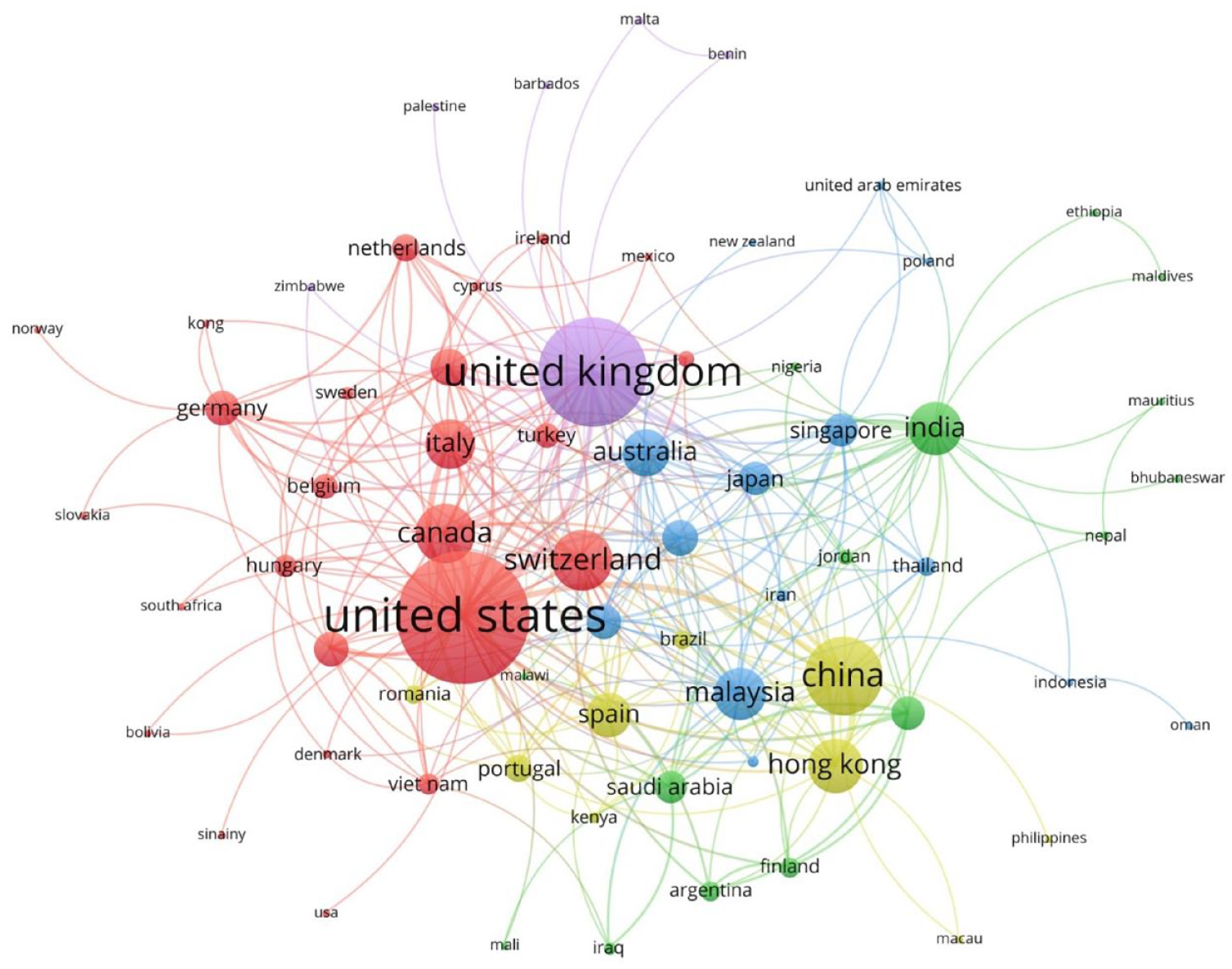
Network between countries based on co-authorship method.
The first group includes 26 countries, the second 15, the third 12, the fourth group consists of seven countries, and the fifth group consists of five countries. Therefore, group 1 (red) is led by the United States and works with Canada, Switzerland, Germany, the Netherlands, Turkey, Sweden, Belgium and Hungary among the most representative. For its part, group 2 (green) is headed by India and cooperates with India, Saudi Arabia, Finland, Argentina, Jordan, among others. Group 3 (blue) is led by Australia, and makes up the group with Japan, Singapore, Malaysia, Thailand and Iran, among others. Group 4 (yellow) is led by China along with Hong Kong, Spain, Portugal, Brazil and Romania. Finally, group 5 (violet) is led by the United Kingdom and includes Palestine, Malta and Barbados.
In relation to the collaboration between the main authors who have published on the subject analysed, based on the co-authorship method, Figure 2 shows that they are grouped into eight groups. Group 1 (red) is led by Zhang X, along with Zheng, Li, Chang, Huang, Zhang; while group 2 (blue) consists of Wang J, Xu, Liang, Xu, Wang L; and group 3 (green) Chen, Shen, Yu, Fang and Pan. Finally, group 4 (yellow) includes Wang, Zhang, Guo, Du, Liu, and Feng, and group 5 (cyan) Xu, Hu, Chen and Ye.
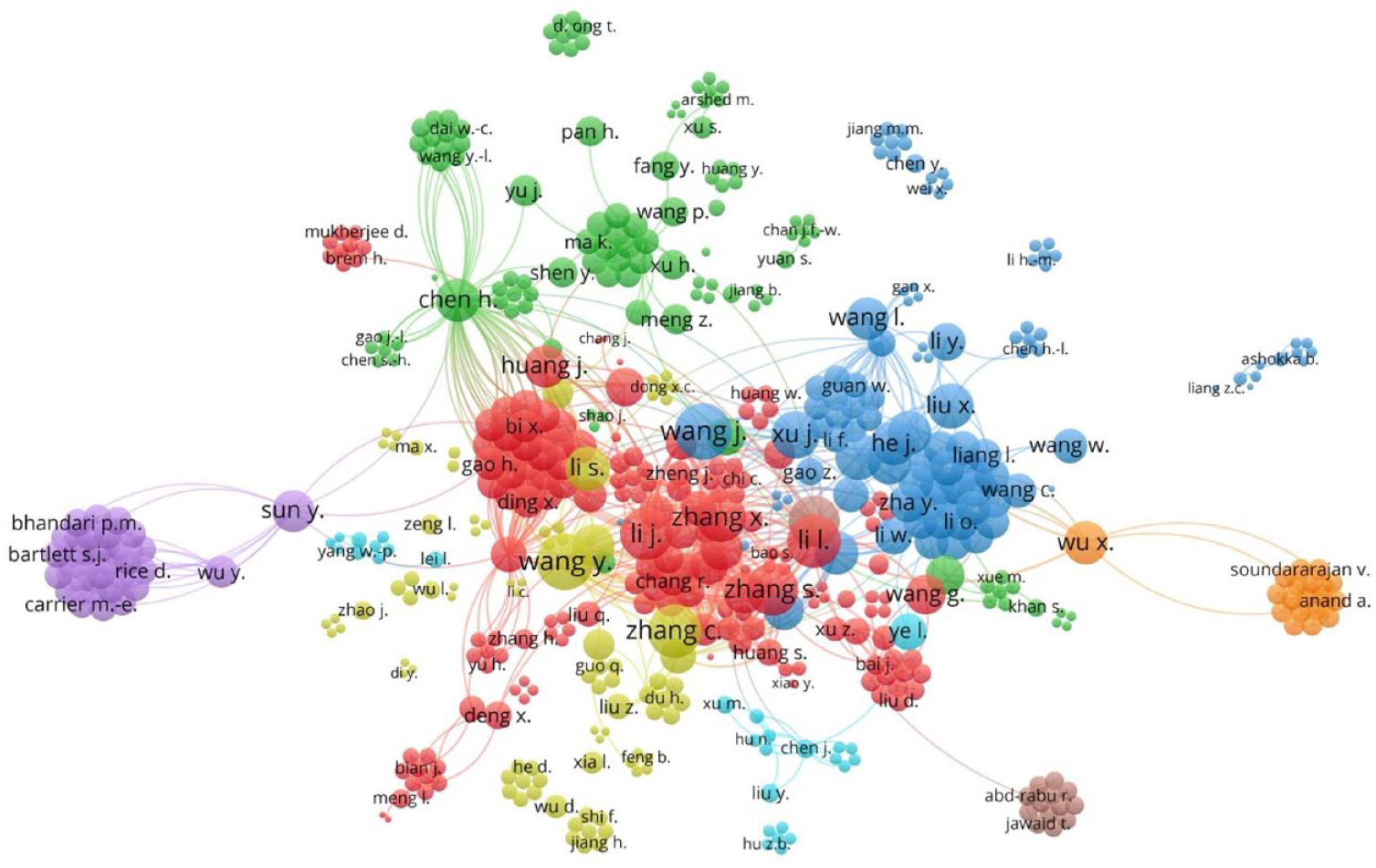
Network between authors based on co-authorship method.
As for the main research institutions, where the publications and documents analysed have been made, the University of Toronto and the University of California, San Francisco stand out in first place, with 12 documents each. They are followed by the University of Hong Kong, with 11 documents, and Wuhan University, with 10 documents. The University of Washington (Seattle) and the University of Sydney have nine documents each, while Harvard Medical School, Chinese University of Hong Kong and The National University of Singapore have seven documents each.
Figure 3 displays the network of keywords during the period analysed, based on co-occurrence method, associated in six clusters. The most relevant groups are mentioned. The first group (blue) is made up of the words COVID-19, human, world health, organization, coronavirus infection, genome, machine learning, deep learning and pathology, among others. Group 2 (red) is made up of the keywords pandemic, infection, healthcare, education, China, clinical competence, learning, young adult and physician, among others. Group 3 (green) is then made up of education, pandemics, pneumonia virus, viral, infection and pneumonia. Group 4 (yellow) is led by the words medical education, intensive care, intubation surgery, critical care, personal protective and equipment. Group 5 (violet) is made up of words like pathology, thorax, dyspnoea, integration, and group 6 (cyan) of words like radiography, glucose, diabetes, complication and monitoring. In the analysis of the keywords in this research field, it is observed that the terms ‘COVID-19’, ‘pandemic’, ‘virus’, ‘education’ and ‘pedagogy’ are the most representative.
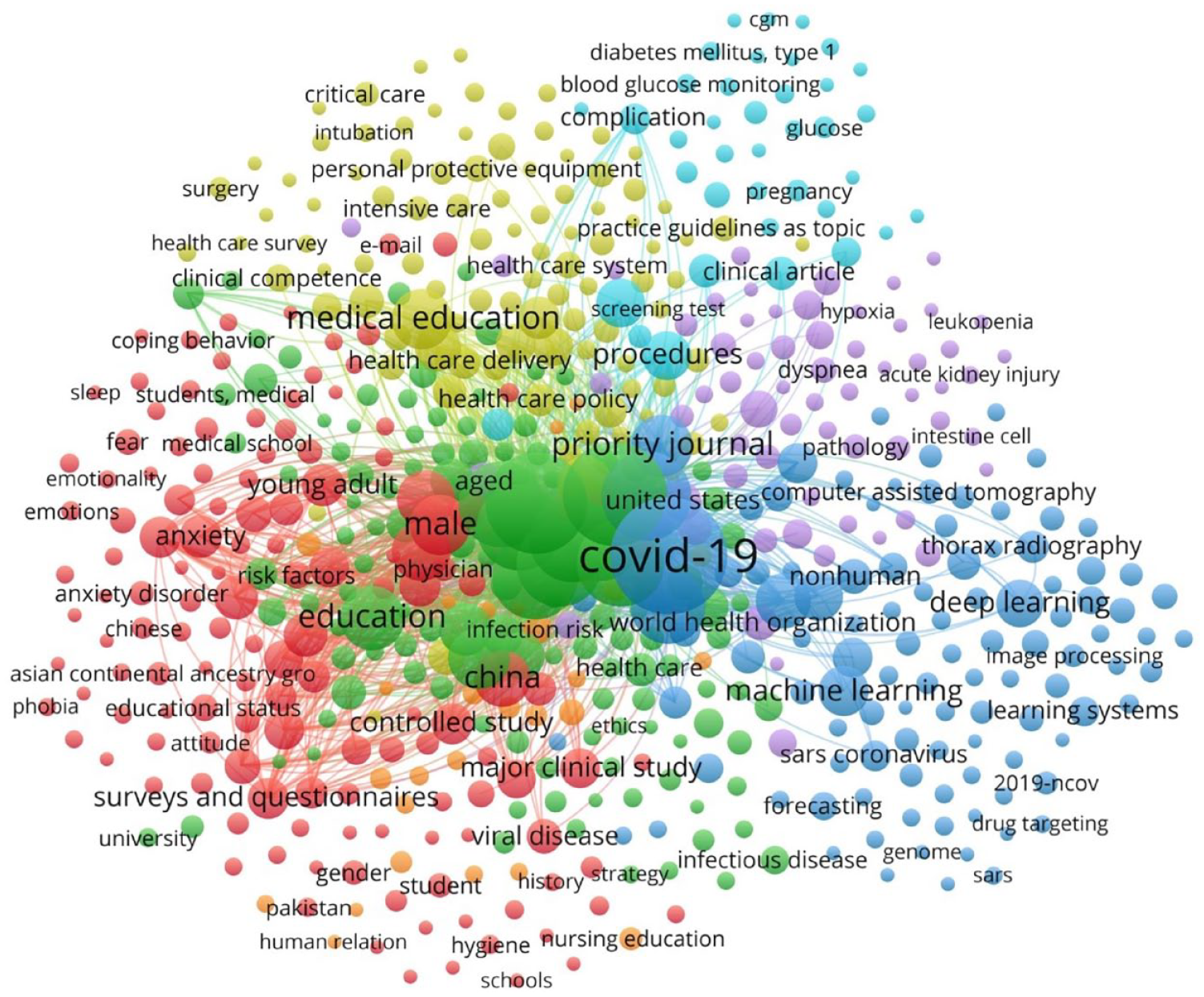
Keyword network based on co-occurrence method.
Discussion
A growing trend can be seen in the elaboration of articles, which begins to rise in January 2020, coinciding with the upturn in cases of COVID-19 (Cáceres-Piñaloza, 2020). In this sense, the production has made rapid progress in relation to issues associated with the search for vaccines and solutions to the pandemic, after the pandemic was declared on 11 March 2020 (World Health Organization [WHO], 2020).
The vision of the research
The results obtained show the progress and evolution on this topic, manifested in studies that correlate the problems of health systems around the world and the adoption of guidelines on operational planning to balance the demands of the direct response to COVID-19 with the need to continue providing essential health services and mitigate the risk of system collapse (Pegado et al., 2020).
Therefore, education in the days of COVID-19 faces an enormous challenge of educational equity that can have consequences that alter the lives of vulnerable students (Moreno & Molins, 2020). Other questions refer to the change that virtual learning requires in terms of flexibility and the recognition that the controlled structure of an educational centre is not replicable online. Unfortunately, the colleges and universities that can offer a complete virtual academic experience, with students who have electronic devices, teachers who know how to design functional online lessons and a culture based on technological learning, are not many. The reality is that most of them are not prepared for this change that allows us to recognize that unequal access to the internet is just one of the many problems facing our education system at the global level (Gutiérrez-Moreno, 2020; Zapatería, 2020).
With technological innovation, it is possible to create new learning, both pedagogical, communicative and expressive, which enables the development of new training and educational experiences. Likewise, the presence of ICT in university virtual classrooms guarantees the development of skills highly valued by the labour markets where students will be inserted. In this way, the gap between skills and labour strategies in the medium and short terms are covered (Imbernón Muñoz et al., 2011). Some of these ICT skills for learning refer to the ability to solve information, communication and knowledge problems, as well as legal, social and ethical dilemmas in a digital environment (Abreu, 2020; Fadeev, 2019).
Hence, it is verified that digital resources and meaningful learning can develop research and practices to cultivate skills in all students. Young people who are immersed in an educational system in which the knowledge applicable to their future work is valued and promoted will be able to count on additional preparation that they will be able to use without a doubt in the changing world of work. What is sought is that learning is active and meaningful, and that technology is transversal to all areas of knowledge and ultimately constitutes a transversal axis of society as a whole (He & Zhu, 2017; Instefjord & Munthe, 2017). Likewise, these results are related to initiatives that seek to integrate digital competences with students’ attitudes towards ICT (Cabero, 2014) as a proposal that harmoniously fits with the social and individual requirements pursued by each of them, and in transversal skills to acquire (Instefjord & Munthe, 2017).
Research on this topic that relates the emerging and future challenges of COVID-19 with the prevention and implementation of actions that mitigate the collapse of health systems around the world — these are the studies that have produced the greatest volume of scientific production in recent months (De Vincenzi, 2020; Quintana-Avello, 2020). Regarding the social sciences, specifically the impact on education, the manuscripts go online on the concern to achieve a quality distance and virtual education (Quintana-Avello, 2020), to close the gap between students and countries (Hueso, 2020) and take the times of the pandemic as an opportunity to think about how to make our educational systems more inclusive (Echeita, 2020). On the other hand, the attitude towards confinement is of interest, where in general students have a good predisposition towards ICT, considering them interesting and essential to enhance collaborative work, showing a high interest in updating their ICT knowledge with a view to their professional future (Rony & Awal, 2019).
Digital competence involves the acquisition of knowledge, skills and attitudes based on the elementary use of computer hardware, its operating systems, software as a working tool, offline and online communication, as well as the use of ICT that have to do with the processes of locating, accessing, obtaining, selecting and using information (García, 2020; He & Zhu, 2017). These results are related to the line of research that investigates, values and describes creativity as a necessary skill for students of the twenty-first century in higher education (González-Zamar & Abad-Segura, 2020a) and the positive effects it causes in the motivation of the students. This is consistent with various studies reviewed in the literature (Fink, 2013; Huber, 2008), which demonstrate how ICT help students to develop creativity and, therefore, flexibility, expressiveness and adaptability in situations of life. Hence, there is clear evidence that in learning the design and organization that physical space acquires exerts a motivating effect on those who inhabit it (Baum, 2018), thus favouring reflection and cognitive rigor. Thereby, the results show what has been exposed in various investigations, that a pandemic changes the lives of those who suffer from it, with the human being having to make a great effort of adaptation and resilience (Chang et al., 2019; Cortina & Conill, 2020).
In other words, these times offer value in terms of innovation, or the ability to develop innovative and effective solutions to the problems stimulated by change.
Moreover, it is key to point out, based on the historical cultural theory of development and education, that the process of social and human development is constituted by the productive and transformative activity of culture based on language, enabling spaces for reflection on the implications that the discussion, dialogue and the power of the word have on the learning and development of university students (Erbil, 2020; Fadeev, 2019).
For this reason, the social origin of psychic processes and the notion of semiotic mediation offer the possibility of reformulating principles for teaching and learning, so that what is suggested by the theory of the zone of proximal development (ZPD) allows the dimensioning of the teaching function and that of classmates in the classroom from a cooperative relationship, which is the basis of developer teaching. In addition, it is opportune to clarify the function of the social, cultural and scientific context, which provides support to the pedagogical trends of teaching, because this is not based on its dynamics nor does it derive exclusively from an educational rationale (Barnett, 2019).
The works that coincide in the importance of generating a digital literacy for university education that benefits students in general are of interest, since there is currently a growing need for a digital structuring of knowledge (Choi & Behm-Morawitz, 2018). Therefore, it is necessary to train students in basic competences, to participate creatively and critically in the construction not only of the knowledge that, given the technological conditions of the moment, is increasingly built from sensitive and intelligible processes but of the changing labour market that awaits them.
Furthermore, it is also necessary to highlight that the presence of ICT in the classroom has allowed students to have a series of technological resources that provide them with stimuli and motivate their curiosity to access learning and information in a playful, visual and creative way.
In this order, in the analysis of educational failure it is assumed that the processes of knowledge construction vary depending on the structure and organization of the school. Therefore, learning difficulties can be exacerbated or minimized by the type of social interaction, especially those that take place in the educational centre (Baum, 2018).
Both face-to-face and online teaching have their ideal student profile and usually respond to age and time. Younger people, whose only obligation is to study, do not need to resort, with few exceptions, to online training. On the contrary, older people, active at work and/or with family responsibilities, consider online training the only way to combine their personal and professional obligations with training (Ayhan et al., 2021).
In general terms, the COVID-19 pandemic, on the one hand, has revealed the serious deficiencies of our educational system, derived from the poor theoretical-methodological preparation of teachers, and, on the other hand, has unmasked the fallacy that the constructivist model is the only way to educate our students. Likewise, it cannot be stated emphatically that there is clear evidence that the physical space (the classroom) favours reflection and cognitive rigor, although some authors support it (From, 2017; Instefjord & Munthe, 2017). Space, of course, is basic, but not what determines learning (Abad-Segura & González-Zamar, 2019a).
The educational effects of confinement
As it is established that not all students have access to technology, students, from basic education, know how to interact with new technologies, for the reason that educational systems, at all levels, start from the premise that the student is the one who must build their own knowledge, so that the teacher, in this scenario, only acts as a guide in the academic sessions on the way teachers teach and, consequently, on student learning.
In this sense, despite the fact that technological tools can be used to overcome physical distance, they require a contextual, planned and meaningful use to shape the educational event. Although distance education is not the perfect solution, there is a need for institutions, teachers, students and families to be willing to adapt and take useful aspects of it, having an approximation and appropriation of what it is.
As is known, the virtual classroom is a community in which students with convergences and divergences coexist day by day and participate in the same educational event, which is interpreted from each reality in a different way.
The elements of distance education, which make it different from face-to-face education, have an impact on teaching, student learning and the achievement of programmatic and institutional objectives (Rojas et al., 2020). The use of technology becomes a mediator of distance education. In general, the presence of technologies has pushed society towards a paradigm shift in daily life, from the devices we have at home to the ways in which we communicate (Baum, 2018).
If technology is considered as part of the solution, as an element with the power to stimulate and transform the educational act, it is necessary, on the one hand, to shorten the digital divide and, on the other, to have an approach that highlights the learning experience, as well as the consolidation of teachers’ confidence, giving importance to the identification of problems and their solutions (Hueso, 2020).
Given that inequality has been revealed and exacerbated by the pandemic, the options that are designed must guarantee the right to education, both in terms of the availability and access to learning opportunities, as well as the provision of an education quality, relevant and adapted to their conditions, needs and aspirations (González-Zamar et al., 2021). From the point of view of educational continuity, it is important to consider the diverse needs and responses required by different groups, incorporating pedagogical responses that are sensitive and relevant to cultural, linguistic, gender and accessibility differences.
Distance education as an educational scenario is not exempt from taking place in a social and economic context, so it is necessary to recognize, on the one hand, the characteristics of each nation and the region in question, and on the other, the characteristics of the context family and community, so as not to increase a gap in access and a gap in appropriation of resources, where learning will go to the background and only the report of results in figures that show achievements in doing and not achievements in learning will be sought (Hueso, 2020).
Learning occurs throughout life, oriented towards the acquisition and mastery of generic and transversal skills and competencies that allow learning to learn and that ICTs generate multiple languages (Baum, 2018; Rojas et al., 2020). A particular situation that must be addressed is the risk of educational disengagement and school dropout in the groups most vulnerable to the effects of the pandemic and the consequent health, social and economic crisis. To avoid the definitive interruption of school trajectories, measures must be implemented in the short and medium terms.
In the short term, it is necessary to promote the continuity of ties with students with the highest probability of dropping out of education and use all possible means to promote continuity in learning.
While in the medium term, it is necessary to generate mechanisms that ensure that there is no pedagogical prejudice in promotion, in the case of students who have not achieved continuity in learning in this period. This implies articulating measures such as the elimination of repetition, establishing flexible curricular continuity mechanisms together with support strategies for the recovery and acceleration of learning. These pedagogical measures must be complemented with socio-emotional support measures for students (González-Zamar et al., 2021).
Despite the fact that the global pandemic situation has generated widespread uncertainty and fear, these are not equally distributed among social groups. The inequality of conditions experienced by families, students and educational centres is not only about having technological devices to be able to carry out the school activities that the educational centres command but also to have accompaniment and help to carry out said activities (Leach, 2021). Students could adapt to online activities as long as the variables of access and availability to a connectivity team, trained and empathetic teachers with the emerging situation and a workload similar to face-to-face activities are present.
Conclusions
The main objective of this study was to identify research trends on learning in university virtual classrooms, during the short period from the appearance of the virus in 2019 to mid-2020. A bibliometric analysis of 657 articles obtained from the Scopus database has been developed. The number of publications in the period of the pandemic in the most diverse disciplines is reported, as well as the interaction between research clusters. The numerous scientific articles generated in this period have supposed a rate of daily growth of scientific production on this subject. The scientific communication and publication system have been tested in the face of the enormous amount of knowledge generated in such a short period of time.
As for the countries that have carried out a greater international collaboration in their work, they have been the United States, China, the United Kingdom, India, Canada, Italy, Australia, Hong Kong and Singapore. Likewise, the main authors who have published on the subject in international collaboration are Zhang X, Zheng, Li, Chang, Huang, Zhang. On the other hand, the main keywords that are related to register publications with the same subject line are ‘COVID-19’, ‘pandemic’, ‘learning’, ‘classroom’ and ‘higher education’. Consequently, research on the effects of COVID-19 in university vitual classrooms, and ultimately on individuals, should continue to develop in the coming months and years, incorporating new and productive lines of research related to other disciplines. In this sense, researchers can set their sights on a multidisciplinary research work that combines education, psychology and architecture.
Due to the multidisciplinary nature of the research front of COVID-19 and the multitude of data sources, an urgent quantification and a global characterization, even if it is descriptive, would help science professionals to understand and visualize an informative phenomenon which we have to face in the coming months, returning to the physical spaces of the classrooms and university campuses. This study shows that there is a strong link between authors and countries, so more work should be invested in the review of collaboration frameworks to describe, classify and identify new opportunities. Also interesting are the analyses and pilot tests carried out in various educational centres, since they have allowed the verification of successes and errors in the implementation of specific work actions.
Scientific publishers have turned to the provision of works on COVID-19, reaching unprecedented open access percentages in journals. Repositories are also central, although they are not a substitute for scientific journals. The current challenge not only concerns research in the medical field but also requires a response from professionals in education and other disciplines to an unprecedented explosion of information that places us at the centre of the pandemic. It cannot be stated emphatically that there is clear evidence that the classroom favours reflection and cognitive rigor. The physical space is basic, but it does not determine learning.
Future lines of research will focus on the impact of returning to the classroom with the effects on cognitive processes, motivations and academic performance of students. Among others, these should study the impact of classroom design and its impact on personal attitudes and the generation of motivating behaviours towards learning that has changed forever and has incorporated digital tools as allies. Likewise, it could be addressed to what extent the physical variables influence: (i) the cognitive and emotional processes of the students; (ii) interactive learning; and (iii) the improvement and transformation of learning communities, considering the relationships between motivation, perception and student learning outcomes.
The pandemic has transformed the contexts for implementing the curriculum, not only because of the use of platforms and the need to consider conditions different from those for which the curriculum was designed but also because there are learning and skills that are more relevant in the current context (Leach, 2021). It is necessary to make decisions, make adjustments and prioritize curricular contents and the necessary contextualization to ensure the relevance of the content to the emergency situation that is being experienced, based on consensus among all the relevant actors. It is important that in these adjustments the skills and values that have emerged as priorities in the current situation are prioritized: solidarity, autonomous learning, self-care, socio-emotional skills and health, among others.