




Abstract
Diversity management is a core priority in the definition of international education policies, and educational inclusion is a strategic indicator of quality and excellence. As a contribution to improving educational inclusion in higher education, this study seeks to map out the opinions and positions expressed by university lecturers regarding their teaching action in the classroom with respect to educational diversity and inclusion. To this end, qualitative research was designed and developed in eight Spanish public universities. A total of 17 interviews and eight focus group were held, analysing and interpreting the output by means of mixed deductive and emerging thematic analysis. Findings indicate two stances or positions expressed, identified as conventional logic and critical logic, which point to different conceptions of diversity held by the lecturers, the purpose of inclusion in university and its justification, the difficulties they encounter and their proposals for improvement. Global integrated approaches are necessary for the institutionalization of inclusion, despite conceptual confusion, poor training and institutional difficulties encountered by teachers in the classroom.
Educational inclusion is currently being addressed globally within education policy. It can be defined as the response to diversity through positive channels, identified with the participation, achievement and erasure of barriers for all the collectives involved (students, managers, teachers, family and community) (Plancarte, 2017; Plows & Baker, 2017), providing students with greater opportunities in terms of academic and social achievement (Freda et al., 2017).
In short, steps are being taken on this issue, as shown by the numerous investigations and the continuing demand that seeks to respond to all groups eligible for inclusion (Lawrie et al., 2017; Stentiford & Koutsouris, 2020). In Spain, despite the advances promoted within the institution (Benet, 2020; Moliner et al., 2020; Rodríguez-Fuentes & Caurcel-Cara, 2020), ‘there is still a long way to go before universities are fully inclusive’ (Melero et al., 2018, p. 1,128).
Based on the belief that an inclusive university can be imagined (Green et al., 2020), it is important to study the role of teachers in this construction (Lawrie et al., 2017; Moriña et al., 2020). Therefore, the aim of this study is to explore the stances taken by university lecturers regarding the development of their teaching in the classroom with regard to the management of educational diversity and inclusion.
Theoretical framework
From the perspective of education policy, Black-Hawkins (2017) recognizes that inclusive education has been more concerned with broad political, social and cultural processes than with modelling education systems that would make provisions for all people to be educated together. Under this initial consideration, higher education aims to internalize the principle of inclusion at the very heart of its university policy together with equity, from its mission statement through to quality teaching and learning at all levels (Symaco & Tee, 2019), taking into account criteria such as presence, participation and achievement of learners. It also makes reference to all the areas within an education institution: policies, strategies, programmes, curriculum, instructional and methodological aspects, practices, assessment design, evaluation and innovation processes, as well as investigation, inclusive climate and culture and projection and transfer (Bayrak, 2020; Blessinger et al., 2018; Carballo et al., 2021; Morrison & Grbic, 2015; Nind & Lewthwaite, 2018), which are taken into account through indicators for institutional evaluation.
Currently, higher education institutions are implementing policies and practices that have been engineered in accordance with inclusive parameters and are taken into account through indicators for their institutional evaluation (Association of American Colleges and Universities, 2015; New England Resource Center for Higher Education, 2016). At the present time, a plethora of research, reports and compilations of good practices are being collated, attesting to the presence of elements that must be recorded in an institutional analysis that wishes to make visible, measure and accredit the policies undertaken for inclusion (Lawrie et al., 2017). This testifies to the idea of inclusive leadership (Blessinger et al., 2018; Stefani & Blessinger, 2017) and inclusive excellence (Department of Education, 2016) as important factors in creating dynamic environments conducive to inclusive access, curriculum, services, research, innovation, evaluation, climate and culture (Buenestado-Fernández et al., 2019) that foster equitable teaching and learning models on the basis of cognitive and social justice (Dias & Soares, 2018; Lumb et al., 2019; Teodoro, 2020) and even epistemic (De Bie et al., 2019) and emancipatory justice (Walker, 2020).
In Spain, the latest University and Disability Study (2021) — carried out by the Universia Foundation in collaboration with CERMI (Spanish Committee of Representatives of People with Disabilities), Crue Spanish Universities, the ONCE Foundation, the Spanish Royal Board on Disability and the iS + D Foundation — presented data on the level of inclusion of people with disabilities in the Spanish university system. The data show that in the 2019–20 academic year, a total of 19,919 students with some type of disability were enrolled in universities, representing 1.5% of the total number of students (1,364,654), according to the data provided by the 61 participating universities (out of a total of 76 universities in Spain). The study concludes that most universities have a similar disability support unit, which focuses on identifying students with disabilities within the university and designing specific curricula and/or tutoring and monitoring activities. From the point of view of students with disabilities, the main obstacles they encounter are architectural barriers (40%), although 20% consider that there is a lack of adaptation of theoretical and practical content, and 15% believe that there is a lack of adapted didactic resources. It should be noted that 20% of students with disabilities have felt discriminated against in their university life due to some of the barriers identified (Universia Foundation, 2021).
A special point could be made regarding teachers and their link to education policies for university inclusion, constituting a dominant trend in research over other approaches (Lawrie et al., 2017). In this sense, a three-stranded approach to research is detected, although further progress is required since the studies are not yet sufficient: one strand analyses the beliefs, attitudes and values of teachers with regard to this universal principle (Carballo et al., 2021; Emmers et al., 2020; Martins et al., 2018; Moberg et al., 2020; Rubio, 2017); another identifies the training needs of this group with respect to university educational diversity and inclusion (Collins et al., 2019; Moriña & Carballo, 2017; Moriña et al., 2020; Sanahuja et al., 2020); and the third strand focuses on the adaptation of teaching methodologies to this principle, consistent with inclusive pedagogy, of which there is no single definition (Melero et al., 2018; Stentiford & Koutsouris, 2020; Thomas & May, 2010).
Conceptual framework
Based on the state of the question examined here, the conceptual framework defined for this research begins with the need to map out the position or stance taken by university lecturers, in this case, with regard to the role played by classroom methodologies. Its heuristic strength will lie in the fact that, through this approach, we will be able to deduce the actions that accompany their perceptions of educational inclusion in their daily teaching, as well as the implications of developing an inclusive model in the classroom.
In this respect, several studies present profiles that we identify with two stances: conventional versus critical. Previous studies follow the line we are developing here. Bergeron (2015) questions the reactive versus proactive logic of teaching staff in the face of inclusion, as do Collins et al. (2019), who recognize how trained teaching staff implement proactive programmes for all their students in contrast to teaching staff who are reactive towards individual adjustments. Melero et al. (2018) distinguish between teachers identified as a barrier and those who stand out for their positive attitudes towards student diversity. Gordon et al. (2010) review teachers’ conceptions of diversity through teaching models, recognizing their homogeneous (no focus), group (diversity in groups), individual (diversity in different students) and comprehensive (exists at macro and micro levels) nature. Finally, Rubio (2017) identifies integrating and inclusive faculty members, claiming the pre-eminence of the latter, consistent with university practices for students.
Returning to our proposal, the conventional profile views inclusion as an extra task that even distorts their work and sinks into their teaching (Zepke & Leach, 2007): it pertains to teachers who often reveal a lack of knowledge of methodologies considered inclusive, given their lack of training (Bhopal & Rhamie, 2014; Martins et al., 2018; Sanahuja et al., 2020). In addition, there is a feeling of helplessness both because of the lack of guidance from specialist services and because of the obstacles encountered in terms of ratio, language, curriculum and a whole host of other factors (Moriña & Orozco, 2020).
The second, the critical profile, is grounded in a prior awareness (Carballo et al., 2021) that allows teachers to imagine a university inextricably linked to principles of university social responsibility, human rights and social justice through intersectionality and exclusion of the other (Gibson, 2015). These act as prisms through which lecturers display a purposeful attitude, learning from good practices and assuming the constant learning and adaptation of methodologies as a beneficial (Sharma & Mullick, 2021), inherent and even compulsory part (Moriña & Carballo, 2017) of their teaching task. From this perspective, programmes and practices are holistically and temporally redesigned (Ryder et al., 2016), making the appropriate adjustments (Melero et al., 2018). Experience is considered indispensable (Emmers et al., 2020) and these teachers display a preference for participatory and cooperative models (Sanahuja et al., 2020).
Method
The research designed incorporates qualitative procedures in accordance with the ethical criteria of the institution promoting this study, aimed at exploring the positions of teachers with respect to educational diversity and inclusion in university classrooms.
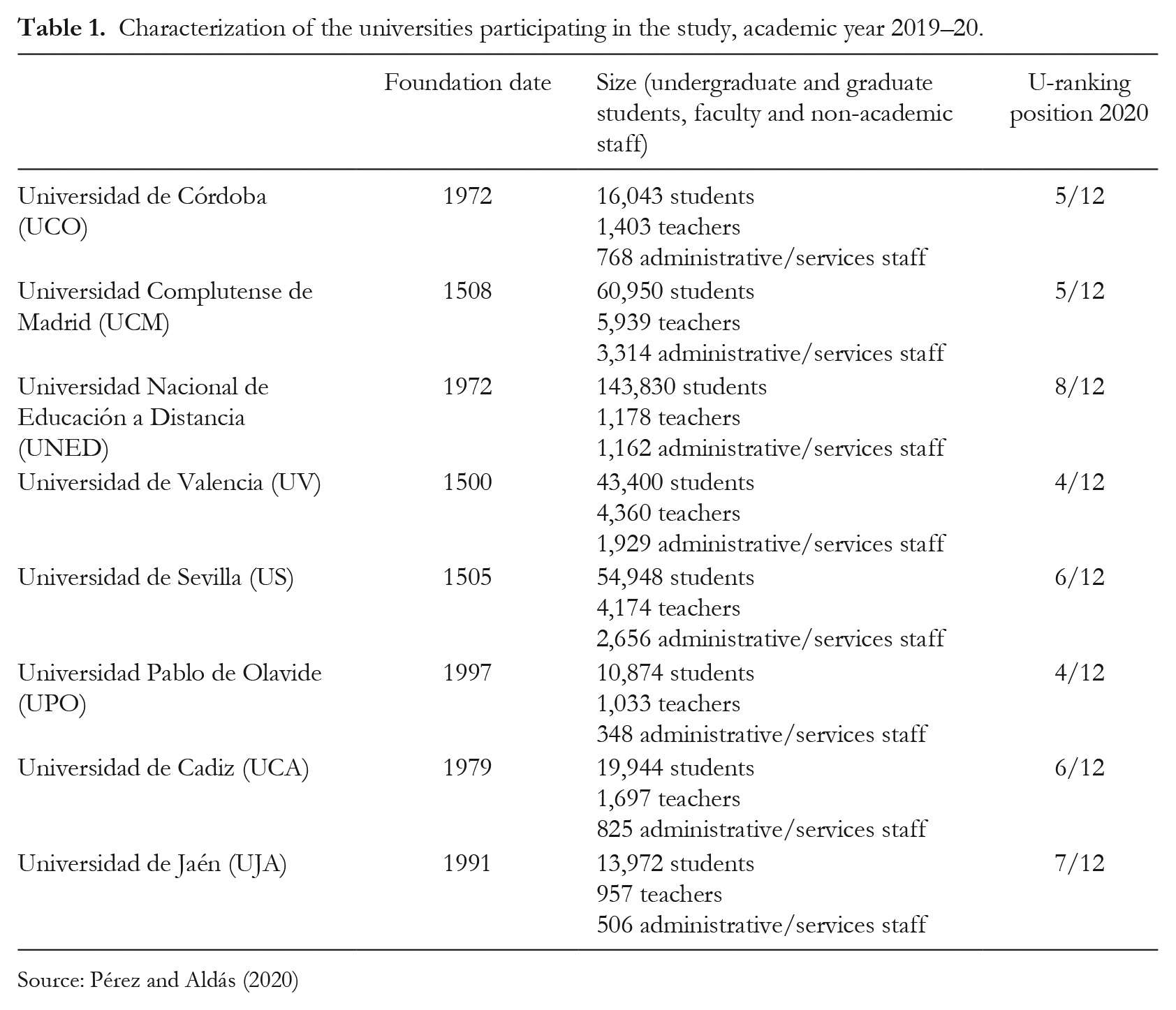
It was carried out in eight Spanish universities, deliberately chosen because they were the ones where the research team worked and therefore offered the greatest opportunity to access and contextualize the data. These institutions have different characteristics that illustrate the landscape of the public university system in Spain (see Table 1): they are located in three Spanish autonomous communities (Andalusia, Madrid and Valencia) and one national one (UNED), with both face-to-face and distance learning; they represent the different periods in which universities were founded in Spain (sixteenth century, 1970s and 1990s) and are of different sizes, which also makes them representative of the diversity of public universities in Spain.
Characterization of the universities participating in the study, academic year 2019–20.
Source: Pérez and Aldás (2020)
Participants and instruments
17 interviews and eight focus groups were conducted with university lecturers, using previously agreed scripts, structured in three parts: concepts of diversity and inclusion, teaching action, and proposals for improvement. The interviews sought to ascertain the individual experiences and opinions of the lecturers, while the focus groups provided a more in-depth understanding of intersubjectivities through dialogue and interaction.
To conduct the interviews, intentional sampling was applied at each university, depending on age, gender, macro-area of knowledge and seniority in the institution. The focus groups were configured according to these criteria of heterogeneity and homogeneity between universities in terms of the macro-area to which the teachers belonged. The text identifies the strategy used (I or FG), university, gender (M or W) and date of interview.
The interviews lasted between one hour and one hour 30 minutes, on average, and the focus groups between one hour 30 minutes and two hours. They were recorded on audio media and transcribed literally. The analysis used Atlas.ti v9 software in several stages: (1) open and inductive coding to answer the following questions: How do teachers manage diversity in their classrooms? What elements are involved? A total of 155 codes emerged in this first cycle of open and inductive coding; (2) then, in the categorization cycle, the previous codes were organized into four groups or categories: problem-solving, concept of diversity, difficulties and proposals, establishing the direction of the relationships to allow an interpretative and inferential analysis according to the conceptual framework and the identification of two positions: conventional (reactive logic, legitimizing the dominant model) and critical (proactive logic, a position of resistance to the dominant model, seeking transformation and a change in one’s practice); (3) writing the final report after a critical review and creating semantic networks to facilitate its understanding by the whole team (Braun & Clarke, 2013) (see Figure 1).
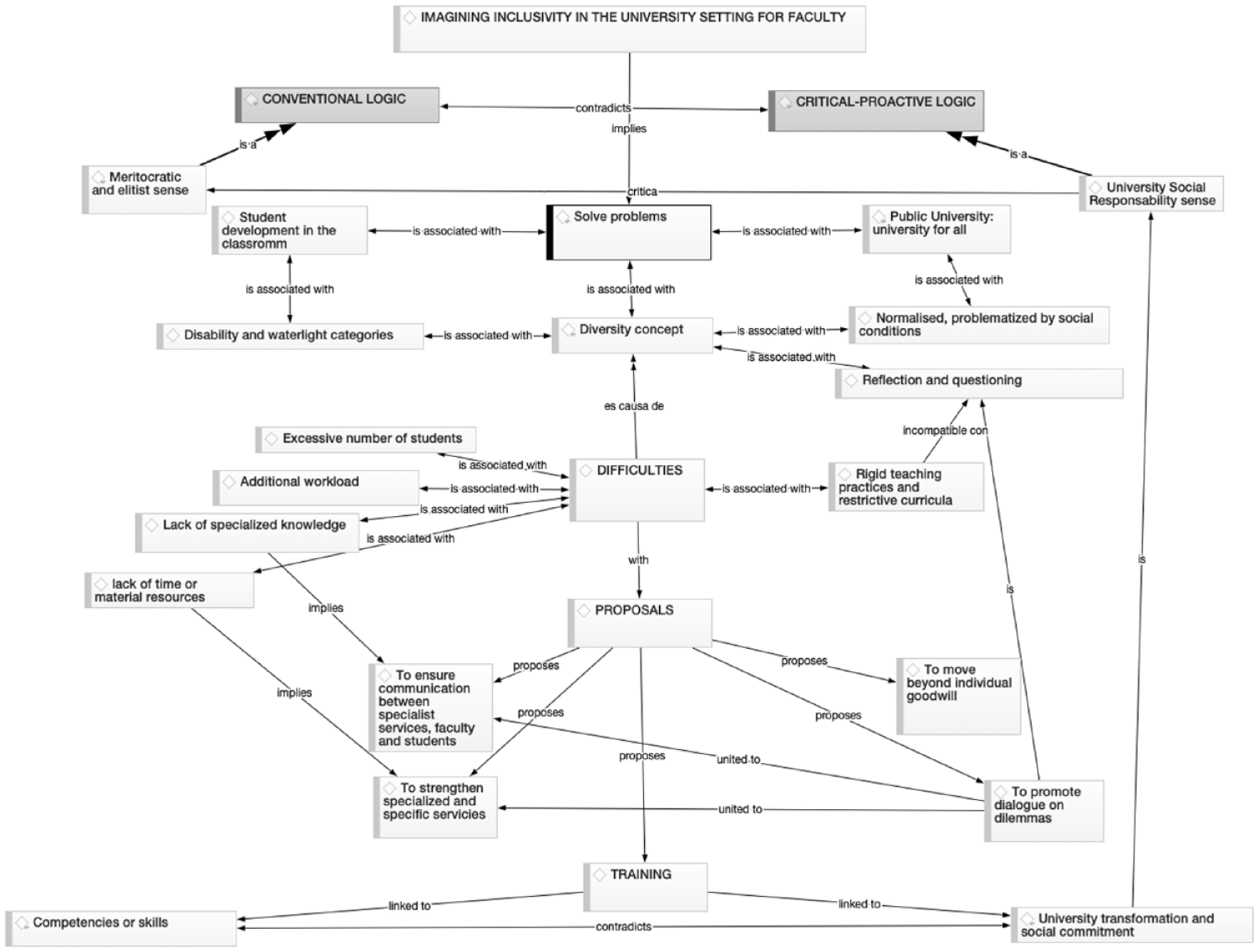
Semantic network of codes and categories for faculty discourse.
Findings
Conventional logic
Lecturers refer to the need to address diversity in order to solve problems that students present in the classroom during their teaching–learning process. In this respect, they identify specific issues and, therefore, immediate solutions.
I understand that we have to make both the university in general and our classroom in particular, our subject. . . accessible to everyone regardless of the difficulty they face or the degree of disability they have. That we have the possibility to adapt or tailor what we want to offer to the needs of our students. (FG_UJA_W1_19_02_2019)
They point to problems that have to do with the development of students in the institution and more specifically in the classroom, chiefly linked to disability. Other considerations are not recognized in terms of their interest or influence in the classroom, so either such considerations are not perceived or, if they are, their relevance within the university institution is ignored: it seems to me that someone who has a disability might have difficulty adapting it. Because, ultimately, if they are from an ethnic group or have a certain sexual tendency. . . I can’t see that they would have any special problems, or that I would have to do anything to integrate them. . . (FG_UCM_W2_25_03_2019)
According to this stance, the concept of diversity is practically reduced to a category that, although plural (mainly referring to students with sensory and physical disabilities), is framed within a defined, determinable condition related to the individual person and is considered stable. What makes this position more significant is the typification of this condition as a problem for the individual who possesses it, since it means being outside the norm, having additional needs, because it is not usual at university: ‘In our case it is a fairly homogeneous population we have’ (I_US_M_13_12_2018_9). This places the emphasis on the direct actions of lecturers to deal with the individual needs of the student rooted in a clearly recognizable cause that pertains to the individual: Well, nowadays, when it comes to diversity, the first thing that comes to mind is. . . above all, uh, people who. . . have different abilities. Within the university context, I mean. Different capacities . . . or, or problems, rather, to internalize knowledge with what is understood as standard or the general rule, you know? And which might be caused by a dysfunctionality, even if that concept is not politically correct. . . (I_US_W_12_12_2018_7)
Hence, lecturers talk about specific actions within the classroom, in some cases unstructured and unrelated but which enable the student to access the curriculum. The most common approach is to adapt the study materials or to extend the time allowed to take exams. However, according to this logic, such actions are identified as extraordinary, something that may or may not occur depending on the presence and demand of students in their subject: ‘[. . .] What will happen the day a student with a disability arrives? I’ll have to solve it’ (FG_US_M2_12_12_2018). Diversity management linked to out-of-the-ordinary situations is described, meaning that diversity is seen as something that is not normal or habitual. From this point of view, the teachers express reservations, since this is an extraordinary function, additional to their daily teaching and research work: [. . .] When the problem is not specific, then that is where if. . . if you are in an exam you have to decide. . . That is where a teacher has to think about whether there is a formula to assess that person in a special way. (FG_UNED_W2_09_05_2019)
Insofar as it is identified as something unusual, it is seen as an additional workload, justified with arguments such as lack of knowledge, lack of training, excessive number of students per subject or lack of time or material resources. Therefore, according to the logic identified as conventional, the teachers describe the pedagogical approach taken to diversity in the classroom, both in interviews and in focus groups, linking diversity with ‘difficulties’: I recognize that it is a difficulty, in terms of physical spaces, and times when you have to stop to explain more concepts, more ideas. (I_UJA_M_09_01_2019_11) And that takes time, a lot of time, specialist staff that we don’t always have, that no one really has. (FG_UNED_W2_09_05_2019)
The recurrent mentioning of difficulties is consistent with the relationship mentioned above, according to which the pedagogical management of diversity in the classroom consists fundamentally of solving problems presented by the students. However, it is also done in a reactive way, when problems arise, since it is linked to the demands made by students. Therefore, from this conventional stance, specialist services are called for in universities, so that the knowledge of experts and specialists in disability can provide the necessary resources and knowledge, either to the faculty members or to the students, to solve their problems. These services are identified as key support for their work, which implies two types of demands: on the one hand, it is the responsibility of the students to declare their needs and to report them to the specialist services and, on the other, it is the obligation of the services to transmit expert knowledge to the teachers. Thus, any difficulties and problems that the student faces in the subjects they are taking become the responsibility of the student and the specialist service: When that happens, for example, where do we send them? I mean, that I, I am, look, I have taught at a university where they have a system for that kind of thing. You say: ‘I have a problem with written expression’, ‘Here’s the email of someone who can help you with that’. (FG_US_M3_12-12-2018)
Hence, teachers do not see themselves as experts in catering to the students’ needs and they appeal to the institution, its services and organizational structure as being responsible for dealing with it. Diversity management is seen, therefore, to be a specialist service, which requires prior identification by students of their vulnerabilities for a specialized approach. Lecturers identify themselves as teachers who pass on content, specializing in their own subject, but not in tending to the needs of students with disabilities: The faculty itself as an educational environment, because it is all very organized here, so, for example, if there is someone in class with some kind of functional diversity, then the teacher is informed and given some guidelines or advice so that they can treat this person as inclusively as possible and adapt to any needs they might have, you know? (I_UCM_M_22_11_2018_15)
Derived from these justifications and the stance adopted by lecturers with regard to the pedagogical management of diversity in the classroom, proposals made from the perspective of conventional discourse are channelled through different lines that come together to form two key considerations: the conception of diversity as a problem that requires therapeutic or specialized treatment and self-identification as teachers whose job is to convey knowledge beyond other considerations: ‘But you know, we’re not therapists, we’re teachers, that’s where we’re at now’ (FG_UJA_M2_19_02_2019). In relation to both premises, the proposals for the institutionalization of diversity management focus on two fundamental aspects: having specialized services and specialists for students with needs derived from their disability; and strengthening the channels of information and communication between services, teachers and students: We have to make sure the organization is done properly, that the roles are properly defined, with hierarchies in place and individual tasks properly defined to ensure we have a situation in which we can act. Know who to go to, how to address them and what our role is because right now I have colleagues who have Asperger’s in class and who find out after three months of having them in class and because they are told by others. (FG_UCM_W1_25_03_2019)
Critical logic
The second logic that characterizes the lecturers’ discourse also refers to the need to approach diversity management as a means to solve problems, but in contrast to the previous approach, considerations go beyond solving the problems presented by the student in the classroom individually, shifting towards a more group-based, structural, intersectional and cross-sectional consideration. In this regard, it is understood that the concept of diversity is not a watertight category, delimited by a condition that a student either does or does not have; instead it questions the identification or criteria in relation to which needs occur in students and which become a cause for inequality within the university institution.
When you talk about diversities, I believe that there is also a broader sense, not only in terms of functional diversity or disability, but diversity throughout the entire conception of human diversity. You have to take that into consideration, inclusive education focused on gender diversity, cultural diversity, even intergenerational diversity especially in educational processes, because it’s not the same having a student of a certain age who approaches education with different motivations. . . (GD_UJA_M1_19_02_2019)
Thus, although this stance agrees with conventional logic regarding the importance of solving problems, in critical logic, ‘diversity’ is not a deficit or a consequence of the student’s lack of capacity; rather, the teachers provide a more natural and normalized vision of the concept. In this regard, the presence of collectives that traditionally had no presence in the institution is emphasized, and it is precisely for this reason that it is difficult to think about diversity, to recognize it and to learn from it: Prof_3: It’s the first time I have come across a case that really stood out to me, where Unidis wrote to me asking how I was going to adapt examination times for a person who has psychological problems. To see if the student had approved the adaptation. So suddenly I found myself thinking, ‘Why does the student have to give me his approval?’ So, you know, my initial reaction. . .. Prof_2: It’s up to me, not him. Prof_3: And so you let the question sink in and you think, ‘Well, they must be asking this for a reason’, you know. . . And then they wrote back saying, ‘The student is ok with it’. And so, ok, fine. . . and then you start thinking. . . ‘Why don’t I learn more about these things? Because. . .’ Prof_2: It’s reciprocal, the risk is for you but the risk is for him. He’s dealing with something and you’re dealing with something. (FG_UNED_09_05_2019)
The meaning of diversity and the presence of diverse groups is interpreted here in a positive sense, arguing their social dimension, while emphasizing and questioning their elitist and traditional character: ‘I think there are. . . filters that mean that people who go on to. . . who go on to study at university, have less diversity’ (I_US_W_12_12_2018 _9). For this reason, the value of public universities, open and responsive to social inequality, is explicitly defended: ‘[. . .] a public university above all and a university such as this has a vocation to reach out as far as possible, to encompass as much as possible. [. . .] for everyone. A university for all’ (FG_UNED_M1_08-5-2019).
In light of these considerations, lecturers point to the advantage of having specialist services within the institution to meet specific needs as per the conventional logic. But now, moreover, that work is considered useful if it ties in with the dialogue and reflection that lecturers establish with their students. Hence, the specific context of the classroom, dynamic and situated, acquires full meaning in the critical logic. Teachers refer to the student through their own experiences and in consideration of their own background: They send a closed report to teachers of how teachers should act with that particular case and also only in terms of the difficulties they believe they might have for that subject, without taking into account the sociocultural conditions, the transition they are in. . . I have seen that same report for someone in the first and fourth years of their course. And I say, ‘Ok. . .! [. . .] That’s for all subjects, isn’t it?’ You might want to talk to the person. No one has said in those reports, ‘Talk to the person one to one about what’s happening with your subject or in class, or the needs they might have to see what can be done.’ (FG_UJA_W1_21_02_2019)
The teachers, therefore, acknowledge that addressing diversity is an uncomfortable process that involves questioning deep-rooted, conventional conceptions about what has traditionally been done in the classroom. In this process of reflection and questioning lie the difficulties flagged by teachers in the critical logic. They affect two fundamental elements: the debate around diversity questions on teachers to improve as education professionals and calls for the transformation of teaching content and the incorporation of emancipating theoretical approaches to the transversalization of diversity in curricula. Given the purposeful nature of critical discourse, these aspects are recognized as difficulties for inclusion within the classroom, since they are described as incompatible ideals with rigid teaching practices and restrictive curricula.
You have objectives to achieve, certain topics to cover, and you don’t divert from that, or at least you meet these targets. There comes a time when you don’t even have time to take a breath or even to demonstrate your identity as a teacher — and we certainly have much more to offer — and those experiences will surely connect with students; they will help at any given time to deal with diversity. (FG_UV_M2_23_10_2018)
Derived from this diagnosis of methodology and inclusive education, the proposals made through teachers’ critical discourse coincide with conventional logic, pointing out the importance of teacher training. However, there are some interesting nuances. Firstly, in critical logic, training for diversity is linked to transformation and social commitment, that is, not only to obtain skills or competences that allow teachers to solve specific problems but as a broader university project with a social and global meaning. Secondly, training calls for awareness and not just knowledge of practices developed by teachers according to their goodwill. Thirdly, training as an instrument to verbalize and visualize classroom dilemmas about how to meet student needs without undermining equality of opportunity.
Discussion
The intention here has been to interpret lecturers’ perceptions in imagining inclusivity in the university setting, researching issues that reflect its development within the classroom. Organizing discursively the ideas expressed in the individual and group interviews, interpretations are grouped into the two logics identified, conventional and critical (see Figure 1), some of which are added to those of previous investigations that support some of the aspects detected here.
With regard to the conception of diversity, first of all, there is no uniform vision of how to define it, as demonstrated in previous studies such as Rubio (2017), Emmers et al. (2020) and Stentiford and Koutsouris (2020), which consequently leads to the fact that the information they receive from the institutionalization of this principle within the university is not sufficiently effective, or it is defined at a political level but not through holistic integrated programming in terms of organizational and socio-educational practice. All of the above results, as shown in this study but also in others (Moliner et al., 2020), in a perceived lack of sensitivity on the part of lecturers to the inclusive policies detected.
The historical legacy of policies for the management of functional diversity shows a reality according to which, although this trend has been superseded in universities, it is implied that not all diversities are approached through parametric equity, recognizing the shortcomings detected regarding certain collectives. Following this idea, Martins et al. (2018) also corroborate through their research that the vision of disabilities is still prevalent in university programme agendas.
With regard to the ambivalence detected in the perceptions of lecturers, a discourse emerges that shows both the benefits of the educational consideration of diversity and the barriers generated around it, in constant balance, where no single perspective prevails over any other: the well-being of students, the mutual enrichment for teachers and the promotion of University Social Responsibility are all caught between the lack of training to tackle diversity and the lack of awareness and perception of increased workload among teachers. Hence, the discourse detected here follows the findings of Carballo et al. (2021) and Moriña and Carballo (2017), who highlight how the perceptions and attitudes of teachers have changed, developing empathy and sensitivity, and, in terms of difficulties, it follows Moriña and Orozco (2020), who point out, in addition to obstacles such as psychological barriers, a lack of resources and information offered by the faculties themselves.
Secondly, with regard to the discursive field generated around how teaching methodologies are contributing elements to establish a classroom policy of educational inclusion, our work confirms, from the critical logic, the consideration of cooperative methodologies, as in previous studies that find them to be relevant to teachers (Lawrie et al., 2017; Moriña & Carballo, 2017; Nind & Lewthwaite, 2018) and highlight the importance of inclusive pedagogies (Orozco & Moriña, 2023). In addition, the results refer to the need for emancipatory, transformative methodologies that help teachers to feel and experience inclusion as an intrinsic part of the pedagogical project.
In conjunction with the expressed perceptions, the research presented here flags the continuing pressing need to find and validate practices that facilitate coherence between teaching and learning paradigms (as in the findings of Ryder et al., 2016), the methodologies used and the teaching practices referred to, in line with the study conducted by Maringe and Sing (2014), who identified up to eight strategic methodologies for teaching diverse students. The results found in the critical logic evidence the strong need to further develop the Universal Design for Learning model, initially created to work with disability-related groups, resonating with the findings of Collins et al. (2019), Rubio (2017) and Stentiford and Koutsouris (2020). The need to continue legitimizing educational practices consistent with inclusion policies is also highlighted in this paper, adding our voices to the call to action made by Emmers et al. (2020). This indicates the need to validate useful practices in terms of responding to diversity with a view to its institutionalization, as inferred from this study, noting in this regard the current lack of research in this direction.
Thirdly and finally, in terms of the demands of the lecturers interviewed, their testimony highlights a lack of systematic pedagogical training, holistically sensitized and tailored to the needs of the students, as shown also by the recent work of Moriña et al. (2020) as well as Sanahuja et al. (2020), whose survey of 241 teachers reveals that they have not received sufficient training to work from an inclusive model. In one way or another, this constitutes a primordial need if we wish to discern a clear horizon in the polymorphic construction of an inclusive project within universities.
With regard to the need identified by the research data, teachers demand training. Other studies also highlight this need, including management staff as well (Lombardi et al., 2011; Wise et al., 2020), in addition to students (Bhopal & Rhamie, 2014; Ryder et al., 2016) and stakeholders (Collins et al., 2019). Much more research has been undertaken with regard to teachers (Nind & Lewthwaite, 2018), so the results coincide with previous investigations (Carballo et al., 2021; Emmers et al., 2020; Moberg et al., 2020; Moriña & Carballo, 2017; Moriña et al., 2020), although a more detailed sense of the meaning such training should acquire is gained.
Finally, this section on training highlights the fact that, while it is true that all universities have specific services to address diversity, this study also shows that teachers feel these services are limited to detecting sensitive users and providing guidance primarily in relation to evaluation. The demand based on the need generated for appropriate pedagogical advice to transfer it effectively to the classroom is a challenge highlighted by our analysis. Again, it should be stressed that permeating university settings with a culture of Universal Design for Learning would alleviate many of the shortcomings detected, including those with regard to evaluation.
Conclusion
Our analysis reveals that the voice of academic staff remains fundamental, as a key strategic interstitial agent in the process of institutionalizing university educational inclusion. Although this is a heuristic study with a limited number of participants, discourses allow us to interpret significantly many of the practices and demands of universities in Spain, so they may well be useful in guiding policy and the role of teachers for educational inclusion.
The research conducted here has produced a great deal of information, even though the small number of interviews conducted is a limitation of the study. However, in accordance with other research, it highlights the distance between strong institutionalization supported by the legislative development of inclusion policies, both internationally (Association of American Colleges and Universities, 2015; New England Resource Center for Higher Education, 2016) and in the case of Spain (Carballo et al., 2021; Orozco & Moriña, 2023), in contrast to the discourses that emerge from the interviews. There is a gap detected, therefore, between the degree of regulatory maturity and its concretion through a systemic and structural approach to policies and actions consistently developed within the classroom by the teaching staff.
We acknowledge three main limitations of this study: firstly, the fact that the sample could have been even larger; and secondly, we recognize that we are working on the elaboration of teachers’ discourses, but we did not observe classroom practice; lastly, based on our findings, we would argue for the need to continue conducting research, also from the perspective of other key stakeholders and triangulating the findings, to recognize how student diversity is an opportunity, beyond the imagination, to continue sketching out an inclusively possible university in which we believe.