




Abstract
Many research works have claimed the relevance that students’ maturity may have in their academic achievement, but in spite of this importance, this maturity concept is not so easy to delimit and measure. Because of that, the current work proposes to measure students’ maturity by three different proxies: the ages when children begin to read and write, the bimester of birth and grade retention. To perform this analysis, a representative sample of primary (age 11–12) and secondary education (age 15–16) Andalusian students (the most populated region in Spain) was used. Our results have shown the unsuitability of the bimester of birth and the ages when children begin to read and write as instruments for grade retention, which supports that the three measure different dimensions of students’ maturity. In addition, results show that an early beginning in reading and writing positively associates with students’ academic achievement.
Many research works have pointed at students’ maturity as a relevant characteristic which relates to their academic performance and future outcomes. In this sense, it has been found that the different maturity levels presented by students in OECD countries may have a significant long-term influence on their academic achievement (Bedard & Dhuey, 2006). Furthermore, doting students with enough maturity to choose their future career track supposes an essential objective in terms of socio-economic policies, due to the high costs triggered by students’ dropout originated by inappropriate academic track elections, which becomes particularly problematic in a context of budgetary constraints. In this sense, Arce et al. (2015) indicated that dropout in the first university cycle in Spain — the country under scrutiny — meant a cost of 7,120 euros per student (equivalent to 1,500 million euros per year, in 2005 constant prices). What is more, when students do not possess the maturity and skills needed in the grade they are attending, this could lead them to repeat a course (Agasisti & Cordero, 2017), which has been highlighted as one of the most important predictors of dropping out (Eide & Showalter, 2001). This early leaving of compulsory education also involves a high cost for society, as many studies emphasize the positive correlation between education, productivity and economic growth (Asteriou & Agiomirgianakis, 2001; Cabus & De Witte, 2012). To the extent that early school leaving translates into an incomplete learning process — which is a proxy for populations’ skills — it is also correlated with higher risk of long-term unemployment, intergenerational poverty or exclusion from society. Hence, all these relationships with students’ maturity highlight its relevance for any society.
The relevance of this topic has also been highlighted by supranational organizations. For example, the European Union established in the Lisbon Agenda and in ‘Horizon 2020’ the design of policies aimed at reducing the early school leaving rate to 10%. Unfortunately, Spain — the country under analysis — is experiencing a rate which exceeds twice the European target, making the analyses of the contribution of maturity to academic achievement a key issue for the educational policy. Similarly, the United States passed the Title I, part A in 1965, in 2001 the ‘No Child Left Behind Act’ and, recently, the ‘Every Student Succeeds Act’ (2015), which are programmes aimed at distributing public funding to schools and school districts with a high percentage of students from low-income families. This means the recognition of a clear link between socioeconomic status and academic achievement. Moreover, if the endowment of maturity among students from low and high socioeconomic backgrounds is uneven, this could contribute to deepening the already existing educational inequalities in the access to higher levels of education and social mobility (Agasisti & Cordero, 2013). In this context, we propose to analyse this maturity issue and its influence on students’ academic achievement in the Spanish educational context. According to the obtained results, we will propose the design of educational policies to foster the development of students’ maturity.
The delimitation of the concept of maturity
In spite of the relevance of this topic, maturity is not so easy to delimit and measure. In fact, it has been frequently proxied by students’
Focusing on the association of this quarter of birth (as a proxy for students’ maturity) with students’ academic performance along their academic progression, Ponzo and Scoppa (2014) analysed students of the fourth, eighth and tenth grades and emphasized that the lower scores of students born in the third and fourth quarters of the year — compared to older students — were kept during the students’ whole academic track. A similar association was found by Gutiérrez-Domènech and Adserà (2012) for Catalan students in the second, fourth and sixth grades. Likewise, Cunha et al. (2006) indicated that differences in starting ages could perpetuate along the years, as older students are able to retain more skills than younger ones due to their maturity. Herbst and Strawiński (2016) analysed a recent reform in Poland which let parents enrol their children in the first grade at ages six or seven (at their discretion), so that children in this course may have differences in ages of more than one year’s timespan. They found that, although older students performed better than youngsters, this early start was beneficial for younger students, who caught up to the older ones and closed the gap with them.
Another alternative in the literature to proxy students’ maturity has been the use of
An additional link between maturity and
The approach on maturity of the present study
Building on the revision of the previous literature on the relationship between students’ maturity and academic performance, the
The
To estimate our empirical models, we have employed a representative sample of the most populated Spanish region (Andalusia) for students attending primary compulsory education (aged 11–12) and secondary compulsory education (aged 15–16). The relevance of studying this region can be found in that Andalusia was among the three worst-performing Spanish regions in the three competences evaluated by PISA 2009 (in reading literacy, mathematics and science; MECD, 2010) — we are employing 2009 figures to the extent that our data are referred to this year, as we will see. Furthermore, this situation is more alarming when looking at Andalusian students’ dropping-out figures (students not finishing compulsory education), which are very high: 37.2%, which was 6.3% above the Spanish average in 2009 (IECA, 2019). Hence, our
The rest of the research is structured as follows: first, we describe the data and methodology employed; then our main results are presented, followed by a discussion and conclusions.
Data
The dataset employed in this research is that from the Social Survey 2010: Education and Housing (ESOC10) conducted by the Andalusian Institute of Statistics (Instituto de Estadística de Andalucía, IECA). This survey is publicly available and comprises information on a wide set of personal, family and school environment characteristics for Andalusia, gathered by student, household and parental questionnaires. It was conducted in 2009–10 among students born in 1998 (aged 11–12 at the time of the survey, when they were attending sixth grade) and in 1994 (aged 15–16 at the time of the survey, when they were attending tenth grade), and their families. In addition, this survey was linked to the results from the administrative records (SENECA) of teacher-based scores — provided by the Education Ministry of Andalusia (Consejería de Educación de la Junta de Andalucía) — and to the Andalusian diagnostic assessment tests (competence-based tests which are similar to those conducted by PISA) exclusively for the authors of this research study (for research purposes) and for the academic year 2009–10; this combined database has been renamed as ESOC10-SEN from now on. The employed sampling procedure was a stratified multistage sampling. Firstly, households were stratified in two subsamples, according to whether their children were born in 1994 or 1998. In each subsample a three-stage conglomerate sampling, with stratification in the first stage, was employed. The units of the first stage were composed by census sections, those of the second stage were households, and in the third stage, the child of the corresponding age group was selected. Finally, those students who presented some kind of disability or attended private schools were not included. This left the database with a subsample of 1,597 observations for students born in 1994 and 1,868 for those born in 1998.
A set of variables which has been found in the Economics of Education literature as good predictors of students’ academic achievement has been chosen for this research. Concretely, these variables are: students’ sex, immigrant status, school funding (semi-private or public), education level of the father and the mother, the household level of income, the ages at which the student began to R&W and the bimester of birth, all of them from ESOC10. Specifically, the R&W question was asked in the parental questionnaire as: ‘At what age did the child begin to: (1) read; (2) write’. Parents could answer with the number of years, the number of months or any of the four following options: ‘He/she has not begun yet’, ‘Do not know’, ‘No answer’ and ‘Not applicable’. The information about grade retention was obtained from administrative records (SENECA). 3 Although the variables on the ages when the student began to R&W originally presented a continuous structure, they have been split into categories according to their distribution, in order to pick up their potential non-linearities. The results related to them should be taken with caution, as parents may not remember with high precision the ages when their child began to R&W; however, the use of categories for these variables may solve in a certain way this parental memory issue. Furthermore, the concepts of reading and writing handled by parents may not be the same in all cases. However, in spite of these drawbacks, the lack of empirical applications which make use of these variables to analyse students’ maturity (due to the difficulty of finding a database which contains information about them) highlights the relevance and novelty of the current research.
As dependent variable, students’ scores in diagnostic assessment tests were chosen, to the extent that they measure students’ competences, which are more related to maturity than academic content-based knowledge in a certain subject (which is measured by administrative records of teacher-based scores). These scores in diagnostic assessment tests will be those referred to as the linguistic communication and mathematical competences, which are measured in a scale with an average of 500 points and a standard deviation of 100 points. In order to avoid losing observations due to individuals who did not provide information about their household income level, ages when their child began to R&W or the child’s bimester of birth, we made use of a missing flag methodology. This missing flag methodology consists of recoding all missing information from the explanatory variables that present them to a value of ‘0’, also including a missing flag variable in the estimation for each variable that has been recoded; these missing flag variables display the value ‘1’ for those observations in which there was a missing value in the original variable and a value of ‘0’ otherwise. This methodology avoids losing observations due to missing values.
Methodology
The estimation procedure used in this research has been Ordinary Least Squares (OLS). First, it is necessary to highlight that we cannot control by all the variables which may explain students’ academic achievement; hence, we are cautious and interpret our results as conditional associations rather than causal effects. Particularly, we analyse the association of students’ maturity with students’ academic achievement by estimating the following model:

where
Then, as a final model to analyse the association of our proxies of maturity with students’ academic achievement, we plug in both alternative specifications of R&W from equation (1) the bimester of birth (

We focus on students born in 1994, as information about both non-repeaters and repeaters is only available for diagnostic assessment test scores in this cohort, so we can check whether grade retention could be considered as a third proxy for students’ maturity or not. Nevertheless, before including grade retention as control variable in our final model in equation (2), we need to start checking whether we can solve its endogeneity problems to the extent that, if we are not able to do this, we will get biased estimates for our complete model. As we will see in the Results’ section (subsection 4.1), this is not possible, at least with the information in our database, so we will keep our model of equation (2) for non-repeater students as our final model and analyse it in subsection 4.2. We only have information of diagnostic assessment tests for non-repeater students in the cohort of students born in 1998, 4 so it will be employed only to estimate our final model in equation (2), in order to see whether the influence of the ages of beginning to R&W and the bimester of birth on students’ academic achievement appears at early ages or not.
Results
The use of grade retention as a third proxy of students’ maturity
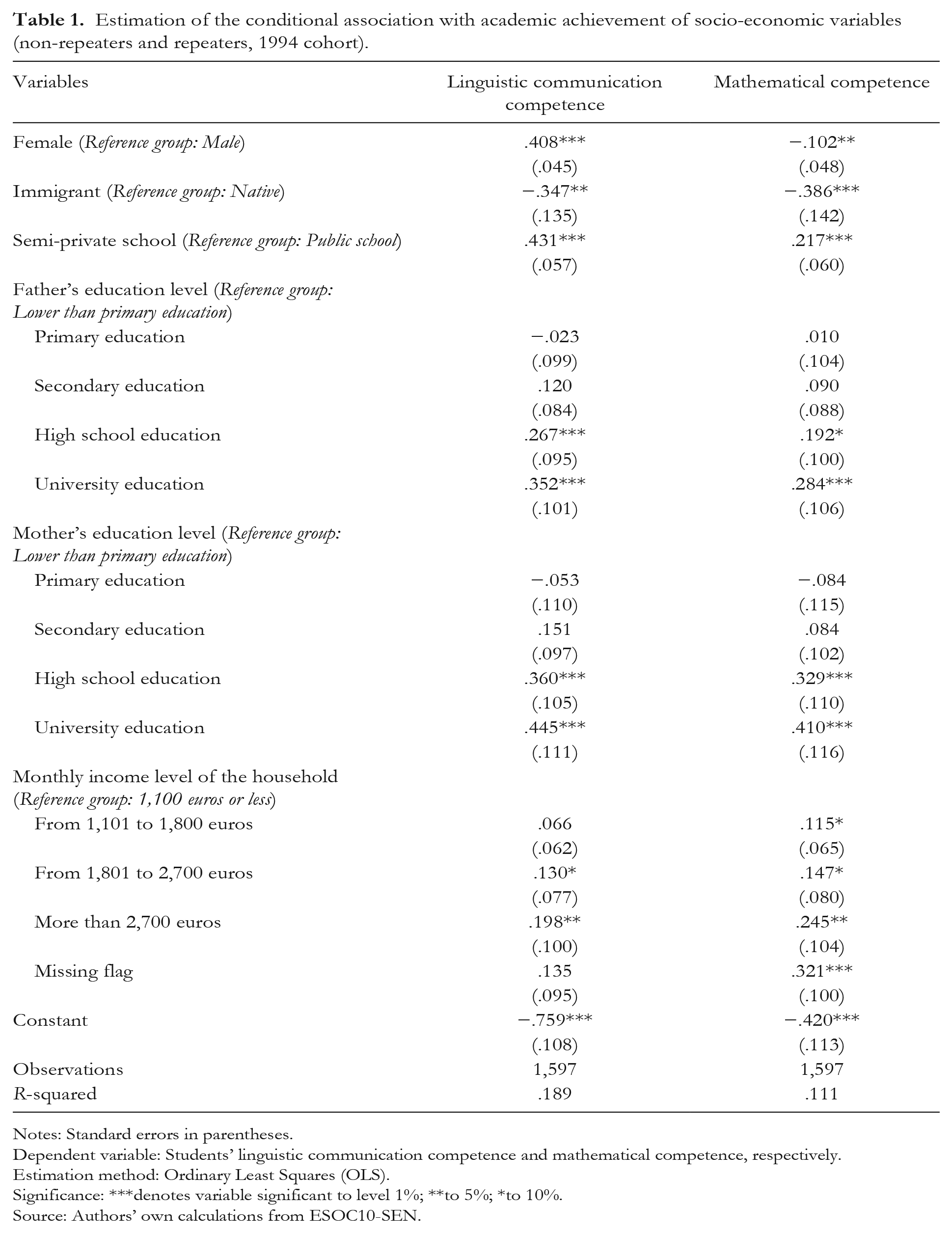
Table 1 presents the results for the main specification in the case of non-repeater and repeater students born in 1994, based on the model in equation (1) but not including
Estimation of the conditional association with academic achievement of socio-economic variables (non-repeaters and repeaters, 1994 cohort).
Notes: Standard errors in parentheses.
Dependent variable: Students’ linguistic communication competence and mathematical competence, respectively.
Estimation method: Ordinary Least Squares (OLS).
Significance: ***denotes variable significant to level 1%; **to 5%; *to 10%.
Source: Authors’ own calculations from ESOC10-SEN.
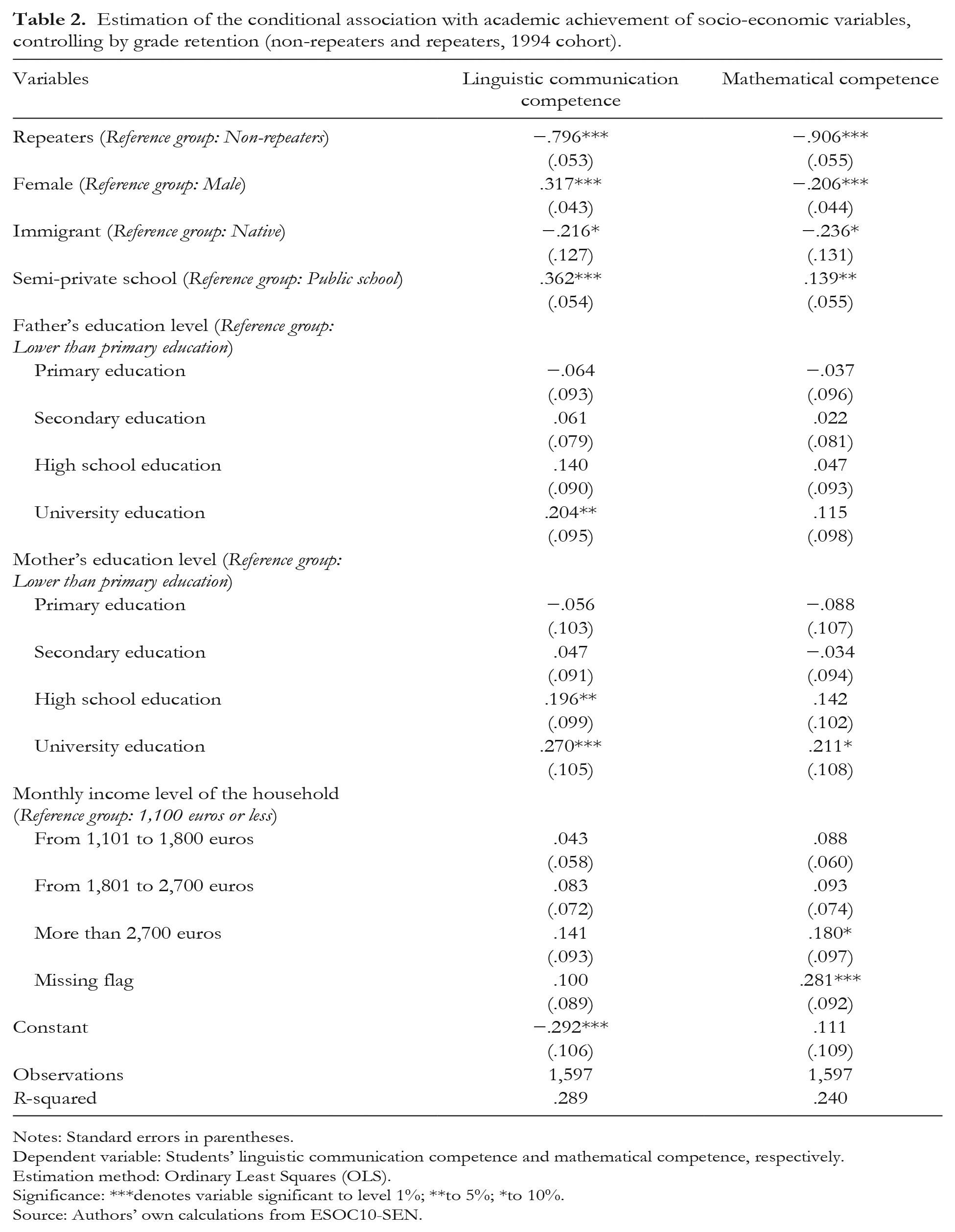
Table 2 presents the same specification as in Table 1 but when the repeater condition — the dimension of maturity related to academic content-based knowledge — is controlled. These repeater students present a different education production function compared to non-repeaters, as repeater students have different characteristics that influence their own education attainment and, to the extent that these characteristics are unobservable, estimated differences in educational outcomes between repeaters and non-repeaters may be biased under OLS, so the grade retention control variable would be a stochastic regressor (García-Pérez et al., 2014). This problem is easily visible when taking into account that the inclusion of the grade retention control variable in Table 2 increases the R-squared of the estimations in more than 10%, together with the high and significant association with students’ competences of the coefficient of this grade retention control variable (approximately between .80 and .90 SD) and the loss of significance in the rest of conditional variables. This means that, in order to control by grade retention in our model, we need to find a proper instrument for it, which accomplishes the relevance requirement (to account for a significant variation in the endogenous variable) and the validity requirement (not being correlated to the error term).
Estimation of the conditional association with academic achievement of socio-economic variables, controlling by grade retention (non-repeaters and repeaters, 1994 cohort).
Notes: Standard errors in parentheses.
Dependent variable: Students’ linguistic communication competence and mathematical competence, respectively.
Estimation method: Ordinary Least Squares (OLS).
Significance: ***denotes variable significant to level 1%; **to 5%; *to 10%.
Source: Authors’ own calculations from ESOC10-SEN.
As students could repeat one or more courses due to a delay in the acquisition of the necessary academic content-based knowledge (because of their late birth, i.e., bimester of birth) or due to their low mental maturity (proxied by the ages of beginning to R&W) it was checked whether or not these variables would be proper instruments for the repeater condition of students born in 1994. It was found that the bimester of birth satisfies the relevance requirement (to account for a significant variation in the endogenous variable, as can be seen in Figure A1, Appendix 1) but not the validity requirement (not being correlated to the error term). Hence, when used as an instrument of grade retention in Two-Stage Least Squares (2SLS) estimations it does not work for the sample under analysis (also postestimation tests support this conclusion 5 ), as highlighted in some international studies (Barua & Lang, 2016; Buckles & Hungerman, 2013) — these 2SLS estimations have not been included for reasons of space, but they will be provided upon request to the authors. In the case of alternatively using the ages of beginning to R&W as instruments for grade retention, both variables presented the same problems as the bimester of birth. This is because they accomplish the relevance requirement (as can be seen for the age of beginning to read in Figure A2, Appendix 1; the age of beginning to write has not been presented to conserve space, but it will be provided upon request to the authors) but not the validity requirement. In addition, estimation results and postestimation tests do not recommend their use as instruments. Furthermore, there are not any other variables which could work as a proper instrument for grade retention in this database. Therefore, these results reinforce the argument which states that the ages of beginning to R&W, the bimester of birth and grade retention may be measuring different dimensions of students’ maturity.
Main results for two proxies of students’ maturity: the ages of beginning to R&W and the bimester of birth
As controlling by repeaters introduces endogeneity problems in our estimations, in the following the analysis will be focused on non-repeater students born in 1994. To perform this analysis, maturity will be proxied by the ages of beginning to R&W (i.e., ‘mental age’) and the bimester of birth (i.e., ‘chronological age’), which will be sequentially included in the estimations. The results of a preliminary bivariate descriptive analysis are displayed in Table A1 (Appendix 1) and show that for non-repeater students born in 1994, scores in the linguistic communication and mathematical competences present a decreasing trend with the ages of beginning to R&W, so a late start in these practices relates to lower scores in the two competences; the same applies to those born in the last bimesters of the year.
These associations with academic achievement of the ages of beginning to R&W are corroborated when estimating Table 3, which presents the results of our model in equation (1), so the ages of beginning to R&W are alternatively included. 6 When students start soon with these practices, this correlates with higher achievement in both competences — with the exception of writing for the mathematical competence. In addition, the association of a very early start (24 to 35 months) in reading and writing is even higher for both linguistic communication and mathematical competences (around .60 SD for the linguistic communication competence and around .47 SD for the mathematical competence, except for early writing with the mathematical competence).
Estimation of the conditional association with academic achievement of the ages of beginning to read and write (non-repeaters, 1994 cohort).
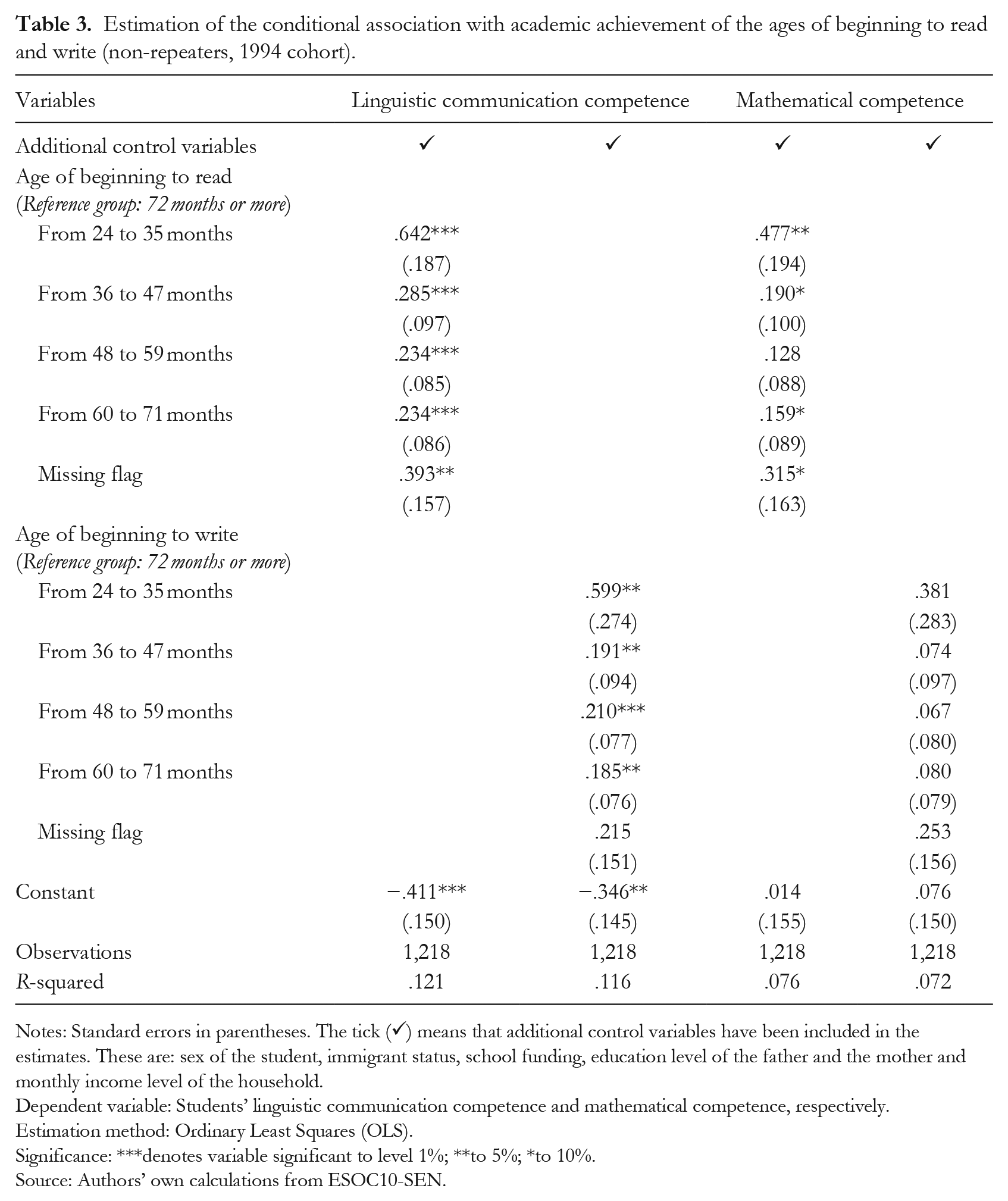
Notes: Standard errors in parentheses. The tick (✓) means that additional control variables have been included in the estimates. These are: sex of the student, immigrant status, school funding, education level of the father and the mother and monthly income level of the household.
Dependent variable: Students’ linguistic communication competence and mathematical competence, respectively.
Estimation method: Ordinary Least Squares (OLS).
Significance: ***denotes variable significant to level 1%; **to 5%; *to 10%.
Source: Authors’ own calculations from ESOC10-SEN.
Table 4 includes as an additional control variable the bimester of birth of the student, as presented in our final model in equation (2). Being born in the five first bimesters has a positive association with students’ academic achievement in the linguistic communication competence (between .32 and .22 SD), while only the first and fourth bimesters have a positive association with the mathematical competence (between .32 and .23 SD). From the view of these results — and comparing with Table 3 — it can be concluded that the bimester of birth does not take part in the association of the ages at which the student began to R&W with students’ competences, which highlights the robustness of these estimates. Moreover, this result may be denoting that they are measuring different dimensions of students’ maturity: on the one hand, that related to students’ chronological age — the bimester of birth — and, on the other hand, that related to students’ mental age — in the case of the ages of beginning to R&W. In addition, the bimester of birth has been included without the ages of beginning to R&W — keeping the rest of the socio-economic variables of Table 1 — and its association with students’ competences is similar to that shown in Table 4. These tables have not been included for reasons of space, but they will be provided upon request to the authors.
Estimation of the conditional association with academic achievement of the ages of beginning to read and write and the bimester of birth (non-repeaters, 1994 cohort).
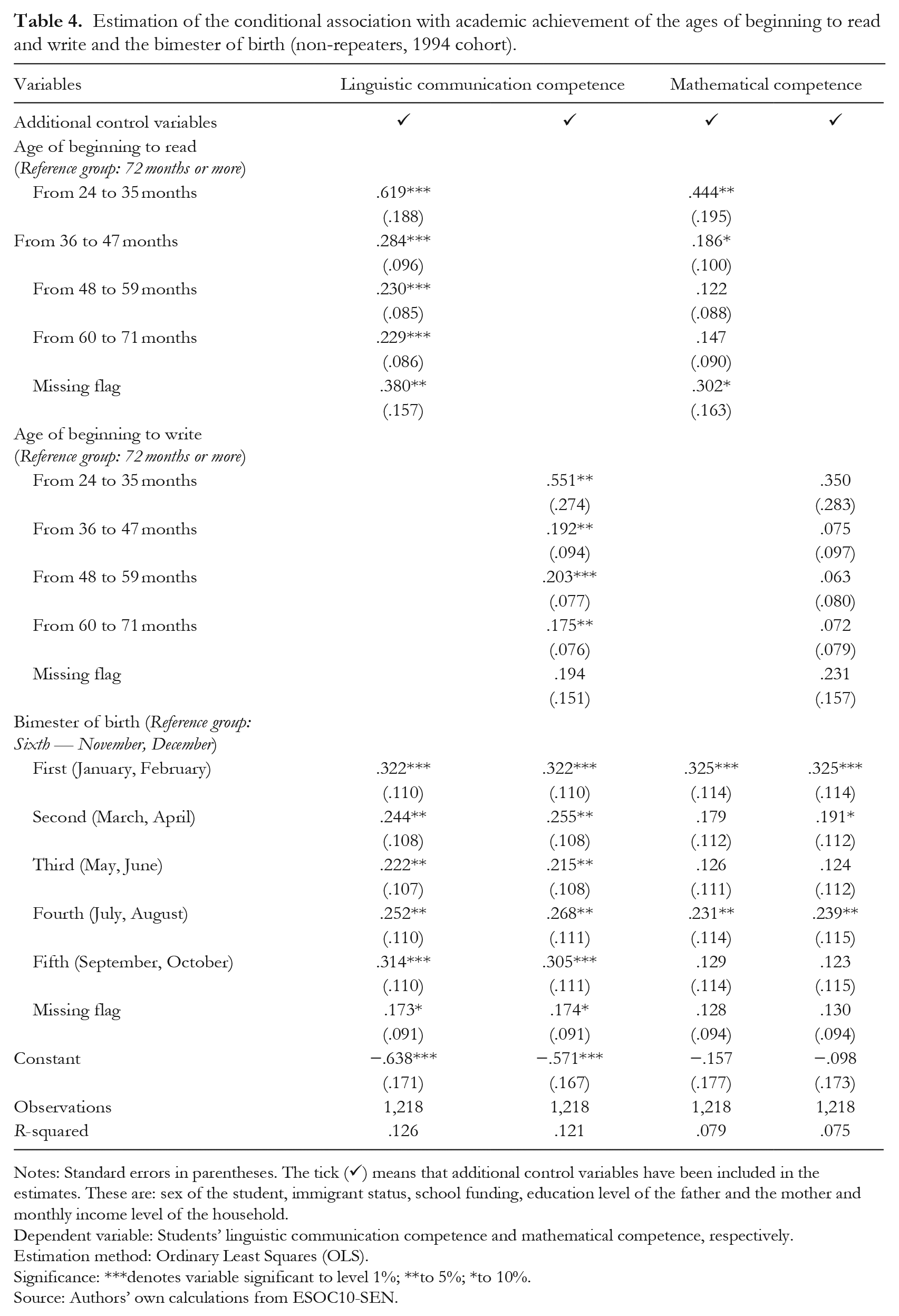
Notes: Standard errors in parentheses. The tick (✓) means that additional control variables have been included in the estimates. These are: sex of the student, immigrant status, school funding, education level of the father and the mother and monthly income level of the household.
Dependent variable: Students’ linguistic communication competence and mathematical competence, respectively.
Estimation method: Ordinary Least Squares (OLS).
Significance: ***denotes variable significant to level 1%; **to 5%; *to 10%.
Source: Authors’ own calculations from ESOC10-SEN.
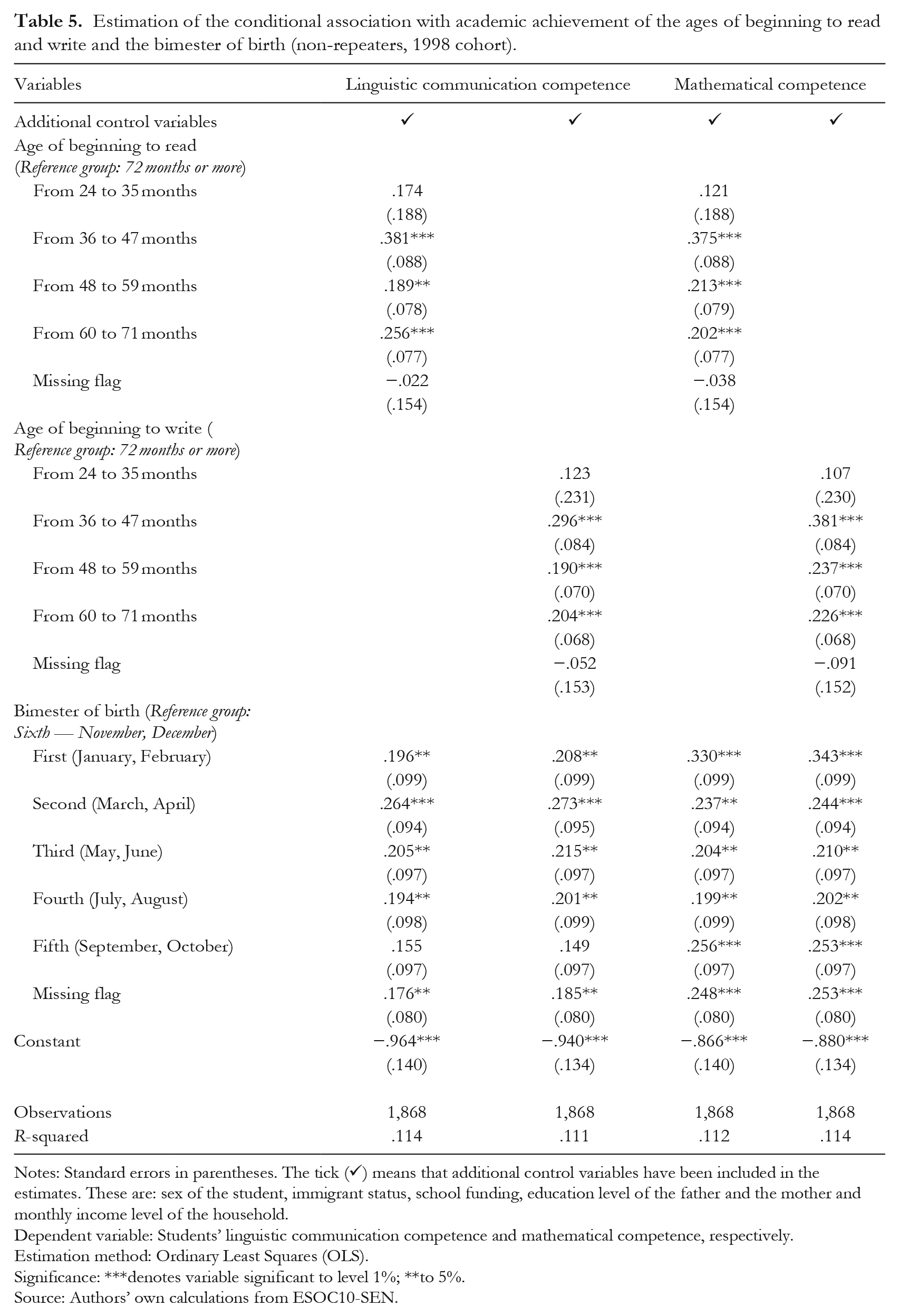
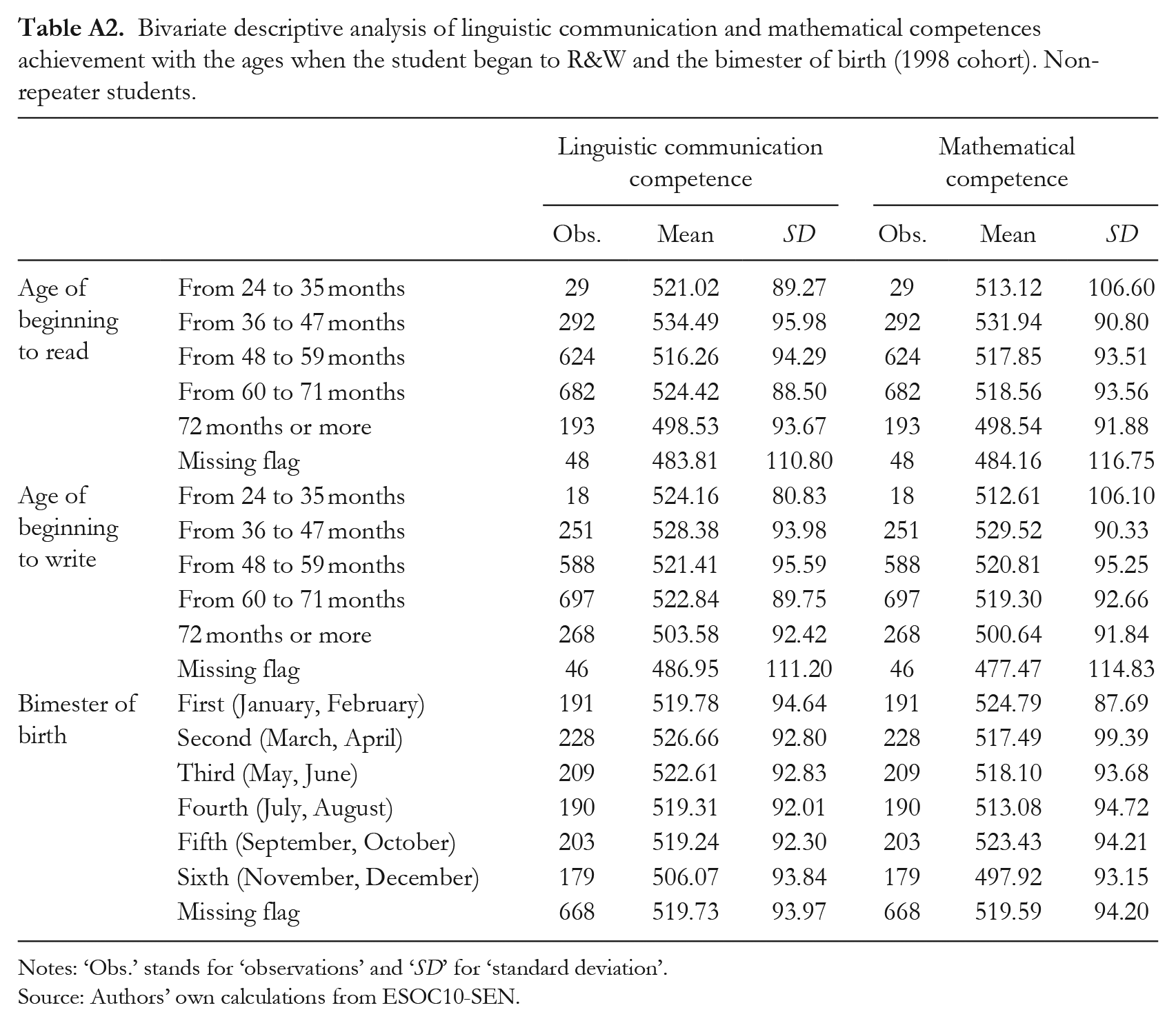
In the case of non-repeater students born in 1998, a preliminary bivariate descriptive analysis in Table A2 (Appendix 1) shows that scores in the linguistic communication and mathematical competences have a decreasing trend with the ages of beginning to R&W, so a late start in these practices relates to lower scores in the two competences; a similar trend is found for those born in the last bimesters of the year. Table 5 replicates the same specifications of Table 4 but for students born in 1998. 7 These results also support the positive association with students’ competences of an early start in reading and writing (from around .38 to .19 SD for both ages). Focusing on the bimester of birth, the five first have a positive influence on students’ linguistic communication and mathematical competences scores — from around .34 to .19 SD, with the exception of the fifth bimester for the linguistic communication competence. Hence, the association of the bimester of birth and the ages of beginning to R&W with students’ competences are present for non-repeaters in primary education (those born in 1998) and for those in secondary education (those born in 1994), with similar effect sizes for both cohorts.
Estimation of the conditional association with academic achievement of the ages of beginning to read and write and the bimester of birth (non-repeaters, 1998 cohort).
Notes: Standard errors in parentheses. The tick (✓) means that additional control variables have been included in the estimates. These are: sex of the student, immigrant status, school funding, education level of the father and the mother and monthly income level of the household.
Dependent variable: Students’ linguistic communication competence and mathematical competence, respectively.
Estimation method: Ordinary Least Squares (OLS).
Significance: ***denotes variable significant to level 1%; **to 5%.
Source: Authors’ own calculations from ESOC10-SEN.
Discussion and conclusions
Maturity has been found in the literature as a relevant element to explain students’ academic achievement. The
Dealing with our empirical results, an early start in reading and writing and being born in the first bimesters of the year have been found to be positively associated with students’ academic achievement, with a decreasing trend of this positive association when increasing the age or the bimester. In addition, these positive associations have been found both for primary education students — those born in 1998 — and for those in secondary education — those born in 1994 — with very similar effect sizes. Furthermore, to the extent that our results are based on associations with students’ competences (i.e., real-life skills) and not on academic content-based knowledge, fostering students’ maturity becomes a more relevant objective. Hence, an important policy implication of this research might be the increase of public support for the early education of students, in order to assure them a proper command of reading and writing skills as soon as possible. This might be achieved by increasing the number of public early education centres and subsidies to help students who are late learners in these skills (as indicated by authors such as Cortázar, 2015, Felfe et al., 2015, or Haeck et al., 2015, among others). Moreover, libraries might also be relevant to support the potential lack of educational resources and books in the household, so public investment in these institutions should be fostered (as found by Lance et al., 2000), or even in programmes to make accessible these book resources in other places (such as, e.g., in a laundromat, as was analysed by Neuman & Knapczyk, 2022).
But funding is not the only intervention needed. For instance, libraries might also play a relevant role by, for example, organizing events to attract young students and their parents to reading (as explored by authors such as Celano & Neuman, 2015, or Lopez et al., 2017). It is also relevant that schools inform parents about the benefits of reading to their children, as it may be favourable for students’ reading achievement (Demir-Lira et al., 2019; Kleeck et al., 2003; Kraaykamp, 2003; Sénéchal & LeFevre, 2002). In this sense, Patall et al. (2008) studied the association of parental involvement with students’ academic achievement, finding that it helps students to develop skills which they have not learned yet in early stages of their education. Furthermore, it might be advisable to put special emphasis on parents with lower socio-economic background, as they are less likely to perform these practices with their children (Bracken & Fischel, 2008; Parsons & Bynner, 2007). What is more, to the extent that students from this group may present higher likelihood of grade retention and, consequently, higher early school leaving rates, this disadvantage might be compensated by parents’ actions providing their children with early literacy skills (Bracken & Fischel, 2008). This improvement of their academic situation might help to avoid the economic costs of students dropping out of their studies and might also foster social mobility and equity (Marcenaro-Gutiérrez & Micklewright, 2015; Pascual, 2009). In other words, helping students to develop enough maturity to choose their future career track supposes an essential objective in terms of social policies, due to the high costs triggered by students’ dropout potentially originated by inappropriate academic track elections. This dropout supposes an incomplete learning process and, hence, a lack of basic skills by the population, which may have further negative influence on economic growth (Lamb et al., 2011).
Regarding the bimester of birth, students who were born in the last bimester of the year may also need additional help in order to compensate for the lower experience that they could present in relation to their older classmates (Cáceres-Delpiano & Giolito, 2019). One of the interventions which might help to solve this problem — together with the lack of an adequate level of reading and writing skills — might be to provide students with preparatory classes in which they can reinforce the concepts learned before compulsory education (as indicated by authors such as, e.g., Havrylenko & Kuziomko, 2018, Hendrychová, 2018, or Vítová et al., 2021). In addition, the concept of ‘family-schools’, denoted by O. González (2012), is also interesting; this author also highlighted the need to improve the relationship of parents with the school and increase their participation, creating an ‘alliance’ between families and school. The positive influence on students’ academic achievement of this parental involvement in schools has been remarked by the literature along the years (see, e.g., Benner et al., 2016; Carvalho, 2000). In the Spanish case, the school entry cut-off is set in the year that students reach six years old, so that students at that age start the first grade of compulsory education in September of that year, and parents cannot choose to advance or delay this school entry. Thus, a useful policy — as indicated by McEwan and Shapiro (2008) — might be giving parents the option to delay one year their children’s incorporation into compulsory education when they are born very close to the school entry cut-off — for example, in the last bimester — so they will be among the youngest in the classroom and, hence, they may not be mature enough. To the extent that this is a very important decision, it could be useful to base it in objective criteria such as making students pass cognitive tests before their school enrolment (this has been performed in many countries, such as, e.g., the United Kingdom; Marcenaro-Gutiérrez et al., 2007). Therefore, it could be possible to check whether students are cognitively prepared to start compulsory education and objectively substantiate such an important decision as delaying students’ school enrolment by one year.
This research presents the previously highlighted limitation that the accuracy of the results related to the ages when students began to R&W is subject to the capacity of parents to accurately remember the exact age when their children started these practices — a figure which may not be registered by some families. Nevertheless, this issue is, to some extent, reduced when using categorical measures for these variables, as stated in our estimates. In addition, the concepts of reading and writing handled by the parents may not be the same in all cases. For instance, parents may associate reading and writing with decoding and encoding processes, respectively, but they may not consider that reading is also accessing meaning and that writing is also producing meaning. Furthermore, we do not have longitudinal data, so we cannot measure students’ academic progression, but we can check for differences between two cohorts of students; in addition, we cannot obtain causal effect estimates, but conditional associations. However, these drawbacks are further compensated by the novelty of this research, as the analysis of students’ maturity based on these three dimensions is — to the best of our knowledge — a less studied field in the Economics of Education literature — due to the difficulty to find datasets which contain information on these variables simultaneously, especially the ages of beginning to R&W. This novelty may also set up a precedent for future research, for example the analysis of the influence of boys’ and girls’ differences in maturity endowments on the potential gap between their academic achievement — or their high school track choices.
Yet, the reality today is that worldwide education and training systems are, to a greater or lesser extent, marked by inequalities in terms of access to quality education as well as in outcomes (as indicated by, e.g., PISA results): a crude fact that is known to increase the socio-economic inequality of countries themselves (Agasisti & Cordero, 2013; Checchi & Peragine, 2010). Thus, to the extent that students from diverse socio-economic backgrounds are able to access the same high-quality education and start their education from a similar maturity starting point, we will be moving towards a more equal society.
Footnotes
Appendix 1
Bivariate descriptive analysis of linguistic communication and mathematical competences achievement with the ages when the student began to R&W and the bimester of birth (1998 cohort). Non-repeater students.
| Linguistic communication competence | Mathematical competence | ||||||
|---|---|---|---|---|---|---|---|
| Obs. | Mean | SD | Obs. | Mean | SD | ||
| Age of beginning to read | From 24 to 35 months | 29 | 521.02 | 89.27 | 29 | 513.12 | 106.60 |
| From 36 to 47 months | 292 | 534.49 | 95.98 | 292 | 531.94 | 90.80 | |
| From 48 to 59 months | 624 | 516.26 | 94.29 | 624 | 517.85 | 93.51 | |
| From 60 to 71 months | 682 | 524.42 | 88.50 | 682 | 518.56 | 93.56 | |
| 72 months or more | 193 | 498.53 | 93.67 | 193 | 498.54 | 91.88 | |
| Missing flag | 48 | 483.81 | 110.80 | 48 | 484.16 | 116.75 | |
| Age of beginning to write | From 24 to 35 months | 18 | 524.16 | 80.83 | 18 | 512.61 | 106.10 |
| From 36 to 47 months | 251 | 528.38 | 93.98 | 251 | 529.52 | 90.33 | |
| From 48 to 59 months | 588 | 521.41 | 95.59 | 588 | 520.81 | 95.25 | |
| From 60 to 71 months | 697 | 522.84 | 89.75 | 697 | 519.30 | 92.66 | |
| 72 months or more | 268 | 503.58 | 92.42 | 268 | 500.64 | 91.84 | |
| Missing flag | 46 | 486.95 | 111.20 | 46 | 477.47 | 114.83 | |
| Bimester of birth | First (January, February) | 191 | 519.78 | 94.64 | 191 | 524.79 | 87.69 |
| Second (March, April) | 228 | 526.66 | 92.80 | 228 | 517.49 | 99.39 | |
| Third (May, June) | 209 | 522.61 | 92.83 | 209 | 518.10 | 93.68 | |
| Fourth (July, August) | 190 | 519.31 | 92.01 | 190 | 513.08 | 94.72 | |
| Fifth (September, October) | 203 | 519.24 | 92.30 | 203 | 523.43 | 94.21 | |
| Sixth (November, December) | 179 | 506.07 | 93.84 | 179 | 497.92 | 93.15 | |
| Missing flag | 668 | 519.73 | 93.97 | 668 | 519.59 | 94.20 | |
Notes: ‘Obs.’ stands for ‘observations’ and ‘SD’ for ‘standard deviation’.
Source: Authors’ own calculations from ESOC10-SEN.