




Abstract
The purpose of this study was to explore the nature, emergence and maintenance of episodes of shared regulation and their relationship with argumentative discourse during collaborative work in the sciences. It consisted of an exploratory case study that tracked two groups in the fourth year of primary school (eight participants) through four collaborative activities. The sessions were filmed and analysed for their social regulation and argumentative discourse patterns. The frequency and length of the episodes identified and the association between regulation and argumentation were examined. Additionally, all the episodes of shared regulation of fundamental aspects of the task were further analysed. The results showed that argumentation was significantly associated with shared regulation and that counter-arguments were present when regulation focused on understanding the content. Disagreement within the group, individual regulatory behaviours and the characteristics of the activities appeared as relevant dimensions in the emergence and maintenance of the episodes of regulation of fundamental aspects of the task. The implications for educational practice and research are discussed.
Collaborative work occupies an important place in pedagogical practices at all educational levels (Volet et al., 2013). Even though the benefits of successful collaboration have been documented (Baines et al., 2007; Howe & Mercer, 2007), the core purpose of the research is still to understand the processes and characteristics of peer interaction which have an impact on student learning (Mercer & Littleton, 2007; Schoor et al., 2015; Vass & Littleton, 2010).
Within the lines of research that have addressed this phenomenon, studies of shared regulation stand out, which is defined as ‘constant monitoring and regulation of joint activity, which cannot be reduced to mere individual activity’ (Vauras et al., 2003, p. 35). This refers to ‘the processes by which multiple others regulate their collective activity’ (Hadwin & Oshige, 2011, p. 259). Studying them emerged from the field of metacognition and self-regulation of learning and has spread to regulatory processes within collaborative activities (Rogat & Linnenbrink-Garcia, 2011; Vauras & Volet, 2013; Volet, et al., 2013). The leading researchers of shared regulation claim that it benefits learning within collaborative work (Iiskala et al., 2004; Vauras et al., 2003; Volet et al., 2013).
On the other hand, the line of research that studies discourse in the classroom has acknowledged a type of effective talk for collaborative learning, characterized by the presence of argumentative discourse, which involves students justifying and contrasting ideas in an attempt to reach agreement (Howe & Mercer, 2007; Kuhn, 2015; Larraín et al., 2019).
Both lines of research on peer work have generally been pursued separately and have had little influence on each other. According to Mercer (2013), they could benefit from being integrated, by attending to regulation in studies on classroom talk and rigorously analysing discourse in studies on regulation. In this regard, Volet et al. (2013) claim that analysing shared regulation in combination with discourse could provide information on the emergence and maintenance of high-quality interactions in group work.
Given the above, this study explores how shared regulation is associated with argumentation during collaborative work in the classroom. Specifically, the study question is: What is the role played by argumentative discourse in the nature, emergence and maintenance of shared regulation processes? This study hopes to contribute to the research on a topic that is still new (Iiskala et al., 2011; Panadero & Järvelä, 2015; Volet et al., 2013) and still faces the challenge of developing methodologies to capture and analyse the nature of shared regulation (Vauras & Volet, 2013; Järvelä et al., 2019). Furthermore, the emergence of productive forms of collective thinking during group interactions has received limited attention (Barron, 2003; Volet et al., 2009), and what keeps groups in episodes of shared regulation has not yet been well determined, as this type of interaction is fragile in its emergence and maintenance (Rogat & Linnenbrink-Garcia, 2011; Volet et al., 2009). Further exploring these aspects also seeks to contribute to the design of pedagogical activities that promote students’ involvement in interactions that foster learning.
Shared regulation during collaborative work
The leading researchers of shared regulation claim that it fosters learning and the development of self-regulation skills (Iiskala et al., 2004; Vauras et al., 2003; Volet et al., 2009), given that working collectively helps the other members of a group support the individual cognitive processes involved in learning (Hadwin & Oshige, 2011; Iiskala et al., 2004). Likewise, the need to monitor and regulate reciprocal use of the joint representation of the tasks requires that the participants externalize and articulate their ideas with the other group members, which promotes the development of metacognition (Iiskala et al., 2004). Even though studies on shared regulation have proliferated in the past decade, there is still little research into the effect of shared regulation on learning (Khosa & Volet, 2014; Panadero & Järvelä, 2015).
Some methodological issues that hinder research into shared regulation have to do with the complexity of the phenomenon and its context dependency. Thus, one of the relevant distinctions is between shared regulation, co-regulation and self-regulation, as they often occur simultaneously in collaborative activities (Mercer, 2013). A second distinction is about the focus, that is, what is being regulated. The literature has distinguished between core focuses like: (a) regulation of understanding of the content and/or production of the task (funnelling efforts to completing it and achieving the expected results) (Rogat & Linnenbrink-Garcia, 2011; Volet et al., 2013); (b) regulation of aspects of the task, organizational aspects and/or socioemotional aspects of the group; (c) regulation of core aspects (objectives and fundamental knowledge of the task) versus superficial aspects (Grau & Whitebread, 2012). The research concurs in highlighting the value of shared regulation focused on understanding and regulating the fundamental knowledge involved in the task. However, there is little information on the factors that promote the emergence and maintenance of these episodes (Grau & Whitebread, 2012; Rogat & Linnenbrink-Garcia, 2011; Volet et al., 2009).
Relationships between shared regulation and discourse
Some authors have tried to integrate shared regulation and discourse (see Freire & Grau, 2016, and Whitebread et al., 2018, for a review). Within studies on regulation, the research by Volet et al. (2009) combines the constructs of social regulation and content processing. Within studies on discourse, Mercer (2013) states that when a group gets involved in exploratory talk — defined as dialogue that fosters learning characterized by the participants’ critical but constructive engagement with others’ ideas, which can be challenged and counterargued (Mercer et al., 2004) — at the same time they are together regulating their collective thinking or problem-solving activity. What is more, if they remember the rules about groupwork during discussion, they are demonstrating metacognitive awareness and regulating their learning strategies together. In this regard, Howe (2013) states that when the participants invoke rules (‘We have to share our ideas’), they are metacognitively defining the dialogue as a symmetrical exchange of viewpoints, which is crucial to how they learn in this group context. In turn, in a study with primary and secondary school students, Grau et al. (2018) explicitly related aspects of shared regulation and exploratory talk and found that both the metacognitive regulation within the group and the level of symmetry and reciprocity correlated positively with the presence of exploratory talk in episodes of collaborative work. Another study, conducted by Pino-Pasternak et al. (2018) and also using the Mercer typology, found that the type of talk was a tool that impacted the social and regulatory aspects of preschool children’s collaborative interactions.
Argumentative discourse, which is found in exploratory talk, has been proven to have an effect on school learning (Howe & Abedin, 2013), with relevant evidence in science content (Asterhan & Schwarz, 2009; Howe et al., 2007; Larraín et al., 2014, 2019; Mercer et al., 2004). The results of studies suggest that the benefit to learning is greater if the argumentation has discussion with opposing viewpoints (Howe et al., 2007), even when the group does not reach the correct ideas (Howe, 2009; Larraín et al., 2019). Leitão (2000) posits that counter-argument is the key element in argumentative discourse, as it promotes both the construction of knowledge and the development of metacognition. In a group context, when faced with a counter-argument, the speaker has to assess the underpinnings of their opinions and review their own thinking and the limits of their position.
Given this, the question arises of the relationship between shared regulation and argumentative discourse. Even though some authors propose a theoretical relationship between the two constructs, there are no empirical studies that relate them beyond studies on exploratory talk, a broader concept that also encompasses different aspects of argumentation (Grau et al., 2018; Whitebread et al., 2018). Given that discourse seems to be the core tool in exercising regulation in a group, we should inquire into the specific relationship between argumentative talk and the nature, emergence and/or maintenance of interactions of shared regulation.
Method
Design
This exploratory study of multiple cases presents the tracking of two groups of four students each (two girls and two boys) in four sessions of collaborative work. We chose a naturalistic design with authentic educational activities to capture the complex nature of this regulation in real situations in order to foster ecological validity (Grau & Whitebread, 2012; Perry & Winne, 2013; Volet et al., 2009).
Participants
Eight students (four girls and four boys) in the fourth year of primary school (nine to 10 years old) at a privately owned, subsidized school with a middle socioeconomic status in the city of Santiago, Chile (private administration unit which more than 50% of Chilean students attend, which receives state subsidies and requires a copayment by the parents). The participating students were chosen randomly among those who had the consent form signed by their parents or guardians.
Procedure
For seven months, five collaborative activities were conducted in fourth-grade science classes. All the students did the activities, but only the participating groups were filmed, with the children’s assent. The tasks were designed by the science teacher with the support of the research team. For this study, we analysed eight video recordings from the two groups’ first four science activities. The average length of the sessions was 38 minutes, and five recorded hours were analysed, which corresponds to 4,009 individual utterances. All the videos were transcribed and later analysed using Observer XT software.
Data analysis
Analysis of shared regulation: a methodological template was developed based on a prior study (Grau & Whitebread, 2012), which includes two units of analysis: individual utterances and interactional episodes (see Table 1).
Social regulation scheme (abbreviated).
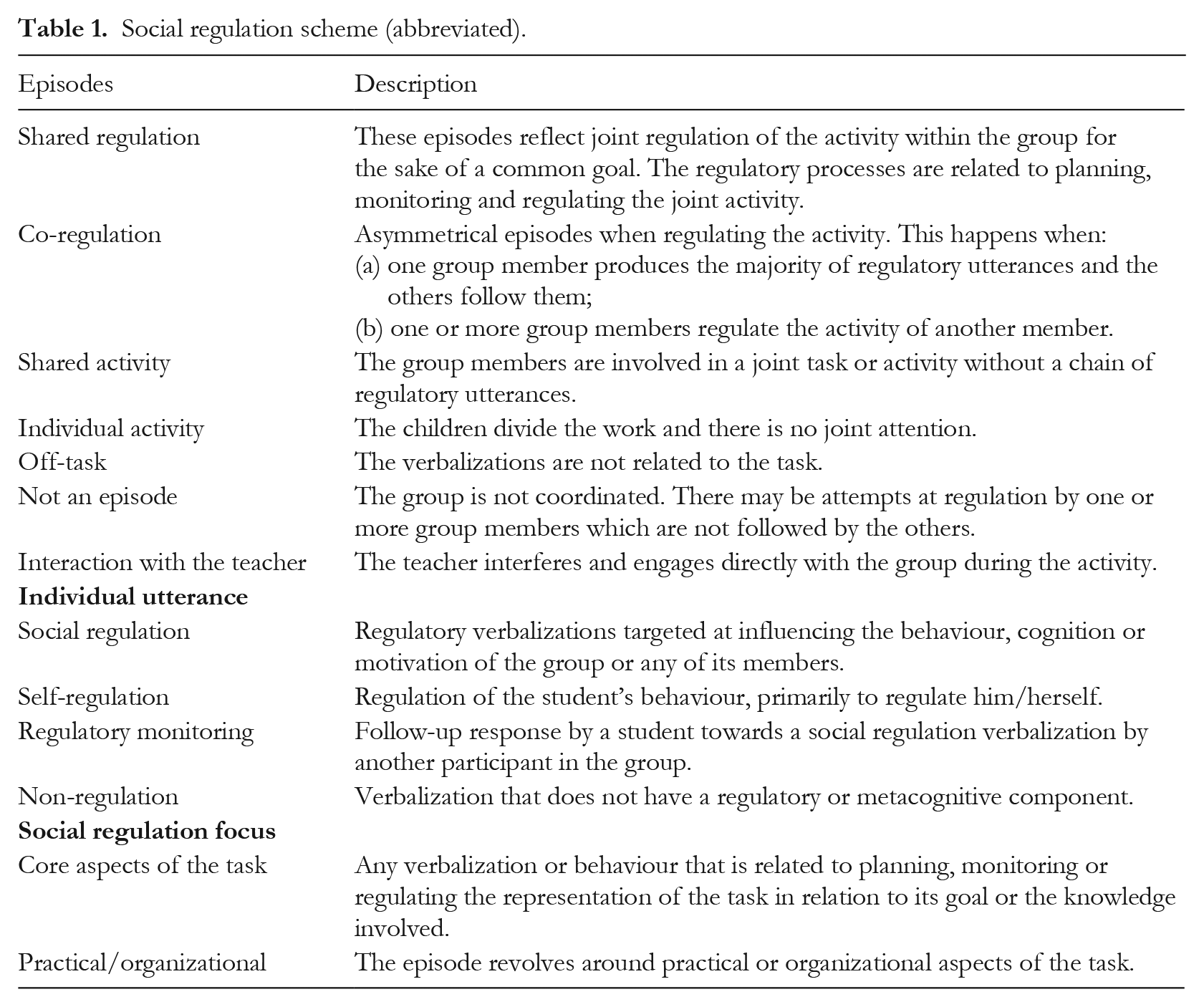
The analysis of the episodes was supported by the previous individual coding: a regulatory utterance which was continued by a chain of regulatory follow-ups by one or more members indicated the presence of an episode of shared regulation (SR). The regulatory episodes were coded according to their focus: core aspects of the task or organizational/practical aspects. Furthermore, the SR of core aspects was coded according to whether they were aimed at producing the task or understanding the content. Ten per cent of the videos were coded twice to ensure the reliability of the review procedure. There was 92% agreement in the individual analysis by utterance and 87% agreement in the analysis by episodes.
Analysis argumentative discourse: Later, the argumentation was analysed by constructing a template based on the one developed by Larraín et al. (2014) for whole-class interactions. The codes included argument (justification that supports a position), counter-argument (justified opposition targeted at an argument), opposition (objections or disagreement, not necessarily targeted at an explicit argument), justifying questions (‘Why?’) and other argumentative questions (‘Do you agree?’). In order to ensure the reliability of the analysis model, the eight videos were coded twice and all cases of disagreement were discussed. A 95% agreement rate was reached when identifying argumentative versus non-argumentative utterances.
Analysis of the relationship between shared regulation and argumentation: After analysing the argumentation, we described the SR episodes on core aspects as episodes with non-argumentative discourse, non-argumentative discourse with disagreement, justifying argumentative discourse and argumentative discourse with contrasting ideas. Quantitative descriptive analyses were performed to ascertain the frequency and length of the episodes, and chi-square tests were performed to analyse the association between regulatory and argumentative utterances and regulatory episodes and argumentative utterances. Then we conducted an in-depth review of all the SR episodes on core aspects in the task to describe them and identify the conditions under which they emerge and are maintained.
Results
Within the total of 4,009 utterances analysed, 2,807 individual regulatory utterances and 1,202 non-regulatory utterances were identified. Regarding group interactions, 120 episodes of SR were identified. Group A showed a total of 46 episodes of SR targeted at core aspects of the task (corresponding to 25.3% of the total time used in the groupwork) and 16 (9.1%) targeted at practical/organizational aspects. Group B showed 47 (28.3%) episodes of SR on core aspects and 12 (3.9%) focused on practical/organizational aspects.
Of all the sessions analysed, 161 argumentative utterances were found, which account for only 4% of total utterances. Justifications (J) were the most frequent, with a total of 128 utterances, while only 33 counter-arguments (CA) were identified. A full 86.3% (139) of the argumentative utterances coincided with utterances coded as regulatory (significant association, χ2(1) = 21.28, p < .001). Likewise, the majority of argumentative utterances (75.8%) were found within episodes of SR (significant association, χ2(5) = 73.50, p < .001). What is more, all the counter-arguments identified were found in these episodes. On the other hand, while 103 argumentative utterances were found in episodes of SR on core aspects (7.2% of the utterances were within these episodes) and only 19 in episodes of SR on practical/organizational aspects (5.4%), the interactions with the lowest presence of argumentation were those related to co-regulation (1.9%) and shared activity (0.4%).
We should note that of all the SR on core aspects of the task, only nine focused on understanding the content, while the majority were targeted at completing the task. Whenever the focus was on understanding the content, the SR episode included indicators of counter-argumentation (objections and counter-arguments).
Based on these results, the episodes of SR related to core aspects were described according to the presence of argumentative discourse. Table 2 presents the description and examples of the four types of episodes identified.
Examples of episodes of shared regulation of core aspects of the task, according to the presence of argumentative discourse.
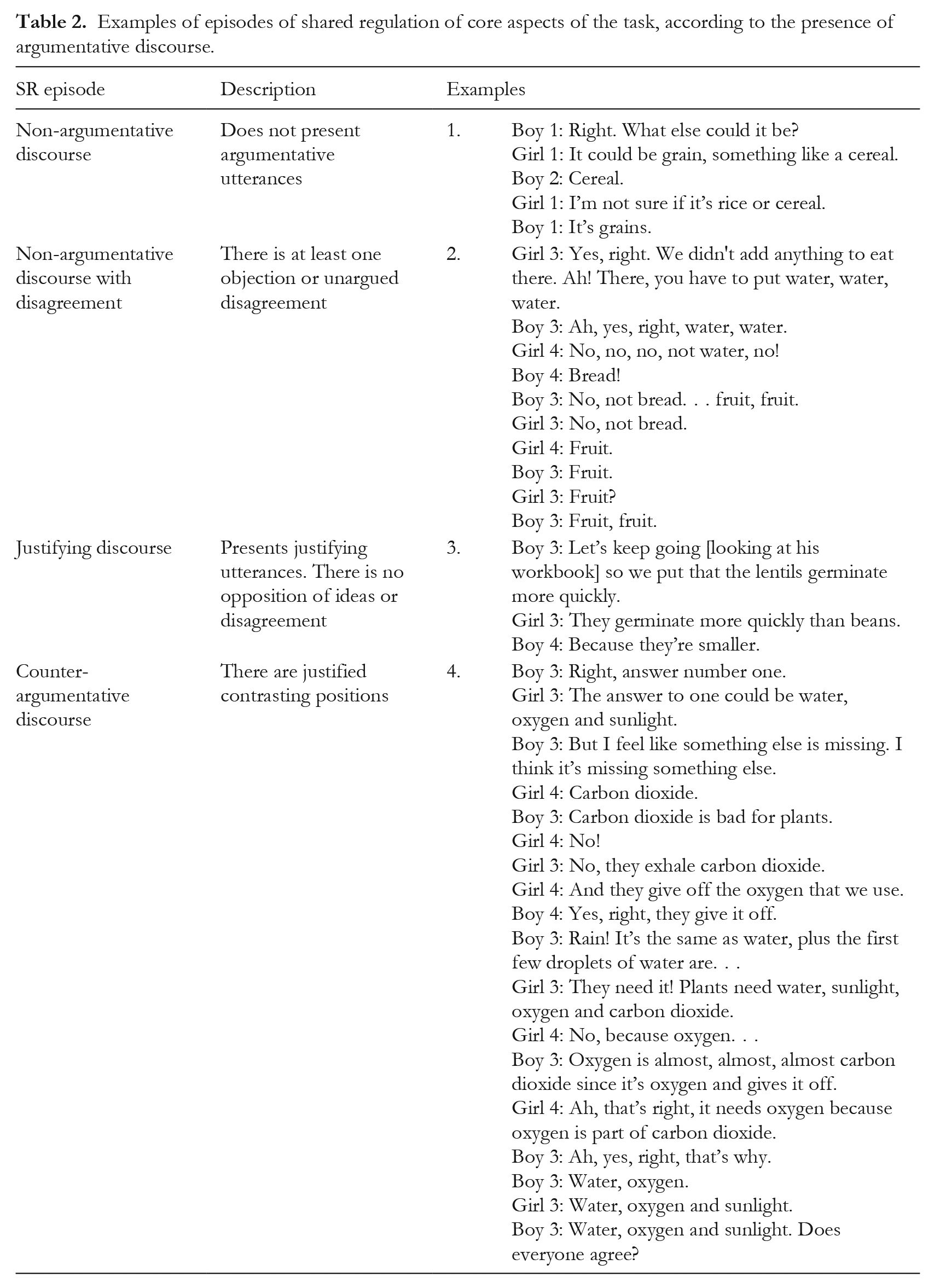
The episodes that appeared the most frequently throughout all the sessions were those that presented non-argumentative discourse without disagreement (Group A, 33; Group B, 20), followed by argumentative discourse with contrasting ideas (Group A, eight; Group B, 18). Here is where we found a difference between the groups: while Group A was in non-argumentative episodes without disagreement 55.7% of the SR time, Group B participated with predominantly argumentative interactions (57.2%) and with contrasting ideas and/or disagreement (58.7%).
On the other hand, the episodes with the shortest average length were those in which there was no disagreement within the group: episodes with justifying discourse (38.2 seconds) and non-argumentative episodes without disagreement (40.7 seconds). In contrast, the episodes that lasted the longest were those that presented argumentative discourse with contrasting ideas, which lasted more than one minute on average (77 seconds), and non-argumentative discourse with disagreement (58.2 seconds).
The main dimensions that stood out in the analysis of the emergence and maintenance of the episodes of shared regulation targeted at core aspects of the task were related to individual regulatory behaviours, disagreement in the group and characteristics of the tasks.
With regard to the emergence of episodes of SR related to core aspects of the task, they started with regulatory planning utterances, monitoring the task and behavioural involvement uttered by one member of the group, followed by other member(s) with other related regulatory utterances. Table 3 presents the main functions identified.
Main regulatory functions that started episodes of SR of core aspects.
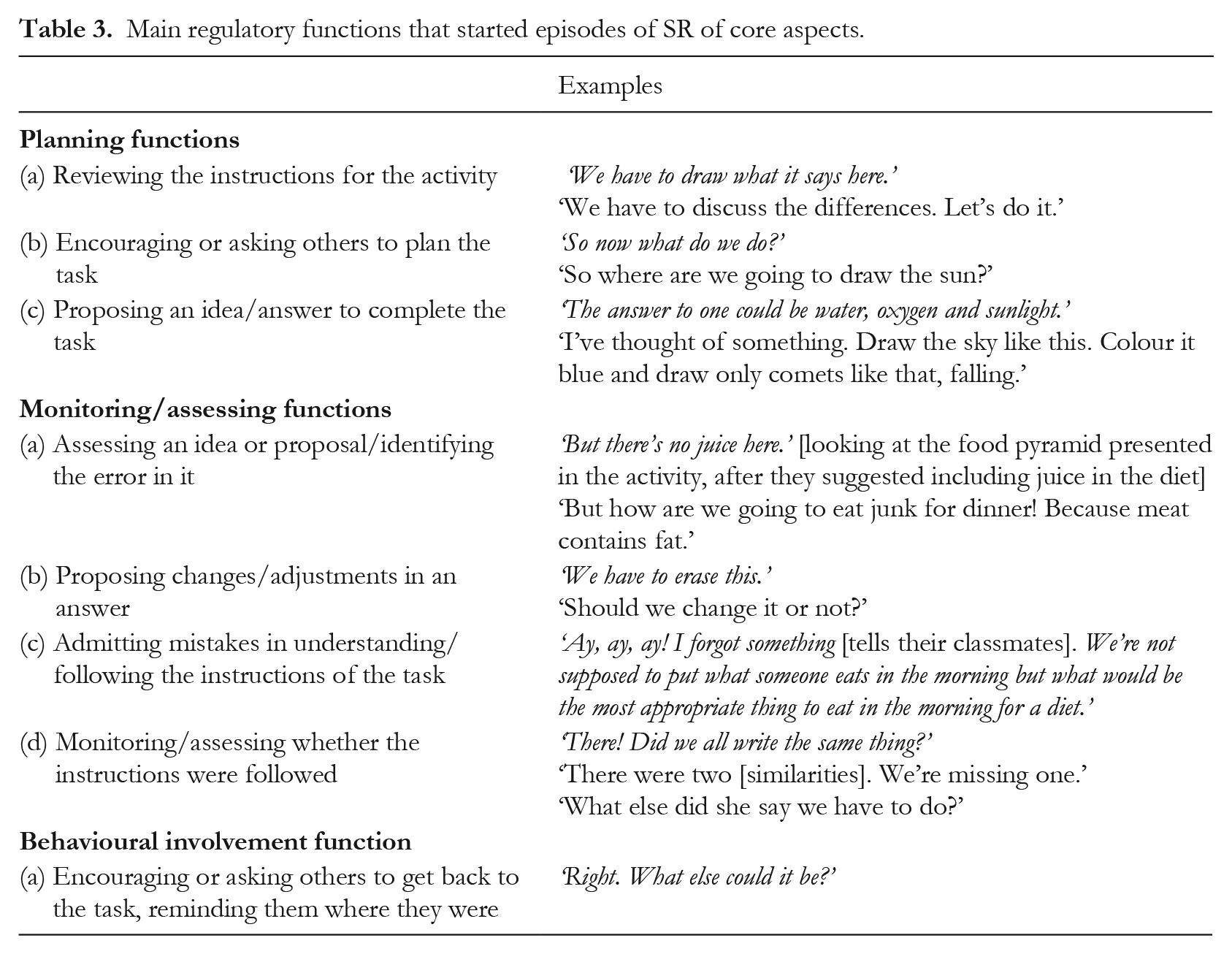
In both groups, the regulatory utterances that started episodes of SR were made primarily by certain students within the group. In Group A, one of the girls initiated 33% of the episodes and one of the boys 37%. In Group B, one member initiated 63% of the episodes.
With regard to the maintenance of SR, the episodes which included disagreement, both argumentative and non-argumentative, lasted longer than those without any opposition (episodes with disagreement: 75.1 seconds; episodes without disagreement: 40.4 seconds). When analysing the 32 episodes of SR with disagreement among the members, we found that after the appearance of an utterance of explicit opposition, the groups remained jointly involved in regulation processes and strove to resolve the disagreement and/or to provide new ideas. Likewise, the presence of opposition appeared as a point of departure for the emergence of arguments to support and debate ideas (81% of the episodes that included opposition were argumentative). The episodes of SR with argumentative discourse with contrasting ideas were always related to utterances that served the purpose of monitoring/assessing the ideas, as shown in example 4 in Table 2. In them, the process of planning the group’s response was accompanied by monitoring the ideas proposed and pausing on content related to the task (e.g., carbon dioxide). Of all the SR on core aspects of the task, only nine focused on understanding the content, while the majority were aimed at producing or completing the task. Whenever the focus was on understanding the content, the episode of SR included indicators of counter-argumentation (objections and counter-arguments). In contrast, the episodes with justifying argumentation without contrast (see example 3, Table 2) were characterized by being very brief episodes of planning responses, with a scant presence of monitoring.
Finally, when analysing the structure of the different activities, we found that the episodes of SR on core aspects of the task emerged when the tasks presented challenges in the following aspects:
(a) They required dialogue and constant collaboration to be completed: Activities 1, 2 (which showed a higher frequency and percentage of time in episodes of SR with contrasting ideas) and, to a lesser extent, 3, were designed such that they required the groups to constantly interact in order to reach agreement, including brief moments of reading and writing. In contrast, activity 4, which had a high percentage of individual and off-task activity, required the groups to collectively draw a brief text on the Milky Way, a task that did not require dialogue and discussion to successfully complete it.
(b) They included challenging questions and asked for reasons: Activities 2 and 3 were based on questions that the groups had to answer collectively. Shared regulation emerged from all of them as the children were planning what to include in their answers. The episodes of SR with counter-argumentative discourse emerged from the questions that explicitly asked the students for arguments or inferences (e.g., ‘Why do you think that the dog chose this place to have her puppies?’, ‘What do you think the little animals will be like when they become adults?’). Episodes characterized by agreement came from the questions that asked the students to describe or analyse (e.g., ‘What similar and different characteristics can you observe in them?’), where the group’s regulatory efforts were focused on minor adjustments that did not change the meaning of the answers.
(c) They required comprehension of more complex concepts: As stated above, nine episodes with counter-argumentative discourse were the only regulatory interactions where efforts to complete the task (producing the task) were suspended to instead check understanding of the content. This happened when a concept that the group was largely unfamiliar with appeared in the task or among the students’ ideas, such as the concepts of starch, fat and alcohol in the first session, the concept of relationship (‘What is the relationship among these animals?’) in the second activity and the concepts of oxygen, carbon dioxide and the Milky Way in the third and fourth sessions.
Discussion
The purpose of this study was to explore the relationship between shared regulation and argumentative discourse during collaborative work. The results indicate that not all shared relation is argumentative by nature. However, argumentation was primarily found in the episodes of shared regulation, and counter-argumentation appeared only during these episodes but was absent in asymmetrical regulations (co-regulation). Finally, counter-arguments were always present when the episodes of SR focused on monitoring understanding of the content, but not when they focused on producing the task. This suggests that argumentative discourse is closely related to shared regulation when it is targeted at monitoring comprehension of the content of the task, which is consistent with what Leitão (2000) posited when stating that counter-argumentation is a key element in constructing knowledge and meta-cognitive processes.
These findings also suggest that episodes of shared regulation are fertile ground for argumentation to emerge. When the students symmetrically regulate their activity and have to externalize and articulate their ideas, they may be more willing to get involved in debates. As Webb et al. (2013) noted, sharing ideas and getting involved in others’ opinions are at the core of collaborative episodes that are productive for learning.
The results lead us to reflect on the role of disagreement in shared regulation. The definitions of this phenomenon refer to a consensual monitoring and regulation of joint cognitive activity targeted at a goal, with the emphasis on agreement and complementarity (Iiskala et al., 2004; Vauras et al., 2003), characteristics which turn shared regulation into a deeper form of social regulation (Volet et al., 2009). Likewise, when high-level episodes of shared regulation have been described, the importance of justification is noted, but the place of disagreement and counter-argumentation is not mentioned (Rogat & Linnenbrink-Garcia, 2013; Volet et al., 2009). In contrast, the results of this study showed that shared regulation may involve disagreement in a joint attempt to plan and monitor the production of the task or understand the relevant content. What is more, the results suggest that disagreement could benefit the quality and maintenance of the regulatory episode by serving as a point of departure for the emergence of interactions that debate contrasting stances regarding core aspects of the task.
The results of this study also suggest that activity planning is relevant in promoting episodes of shared regulation. First, the results support the need for group activities to require constant collaboration to be solved, be challenging by demanding complex thinking skills, require points of view to be taken and reasons given and necessarily force the students to use concepts. Secondly, while implementing activities, it seems necessary to emphasize with students the value of disagreement and the need to explore it when it arises. Thirdly, the results suggest the importance of monitoring for the emergence of productive interactions with contrasting ideas. In this regard, when these processes do not emerge from the students, they can be promoted in interactions with the teacher, who can try to get the group to look back to their answers and assess them. Finally, bearing in mind that certain children may regulate more, and their regulations are also followed more by others within groups, it seems relevant to identify these students in order to check that their leadership facilitates instead of hindering symmetry and the appearance of disagreement within the group. This also suggests the importance of promoting social skills that enable students to tolerate disagreement on ideas (Baines et al., 2007).
On the other hand, one core limitation of this exploratory study is the time-consuming methodology used to identify episodes of shared regulation, given that it is sustained on analysing all the individual utterances. This hinders its use in subsequent large-scale studies, a limitation which has been recurrent in research on shared regulation. In this regard, it is urgent to develop reliable methods that enable us to identify and analyse shared regulation in extensive data sets without compromising the scholarly rigour of research in this field (Panadero & Järvelä, 2015).
Finally, the relationships between argumentative discourse and shared regulation suggested in this study should be examined in larger-scale studies. The proposed association between these two lines of research is valuable in order to understand how children may learn and develop their thinking within collaborative work. However, this study does not directly address the impact of shared regulation on school learning. Future studies should examine the relationship between the quantity and quality of shared regulation and the results on tasks and learning. Even though there are studies that suggest a tendency for shared learning to improve group performance, studies are needed that examine the contribution of shared regulation to student learning (Panadero & Järvelä, 2015).