




Abstract
This study inquires into how students in primary education teaching degrees professionally view teaching–learning situations during their practicum period at schools. In particular, it examines how they professionally view aspects of the teaching models they observe in the classroom. Using a qualitative approach, we analyse the narratives written by the teachers-in-training in which they had to identify and describe teaching–learning situations related to the mathematics competence and the linguistic communication competence. To focus the gaze of the teachers-in-training on the teaching models, they were given several guiding questions. The results show that in their narratives, the students highlight relevant aspects of the teaching models in the situations they observed. However, the changes they proposed show that they focus on the mathematics or language content without taking changes in the aspects of the teaching models observed into account. Therefore, they do not observe changes aimed at including new strategies or resources which resemble the characteristics of a more collaborative model common to learning communities. The main conclusions suggest taking decisions in pre-service teacher training towards a more collaborative model based on participative, dialogic and active collaboration in the educational process.
The new educational perspectives in the twenty-first century propose a change in the way classroom interactions are handled by creating a dialogic, interactive learning atmosphere in which action decisions are taken according to ideas that emerge from the students (NCTM, 2000). These reforms advocate greater teacher flexibility in the sense that teachers should be aware of what is happening around them so they can effectively lead the class (Mason, 1998). Thus, these perspectives reveal the need for teachers to develop the skills of identifying and interpreting important classroom situations in order to take decisions as teachers that help to develop the students’ competences. This is the competence of viewing the class professionally. The conceptualization and identification of contexts for the development of this competence (Mason, 2002; van Es & Sherin, 2002) in future teachers during their pre-service training is a current line of research (Fernández et al., 2018). These studies have proposed different contexts and strategies that are favourable for its development during pre-service training, like analysing video clips with real teacher–student interactions and analysing students’ responses to different activities (Fernández et al., 2018). This analysis has also been applied to specific practices, like literary reviews, to train students in the Bachelor’s in Early Childhood Education (Rovira-Collado et al., 2016). These contexts enable teachers-in-training to use the knowledge they have acquired during their education to interpret real classroom situations and take decisions as teachers that help the students to develop school competences.
Reflective practice in pre-service teacher training
The curricula for pre-service teacher training include curricular elements that foster the connection between theoretical and practical knowledge. However, few studies focus on analysing how teachers-in-training view their practicum at schools professionally to identify contexts that could help their development. The reconceptualization of practical knowledge (Clarà & Mauri, 2010) enables dialogue and collaborative reflection (Clarà et al., 2019) to be integrated among both kinds of knowledge, like discourse analysis in teacher training, and stresses the importance of how a teacher learns how to reflect and inquire into their own classroom situations (Cochran-Smith & Villegas, 2015a) in order to recognize the possibilities and producing and constructing knowledge in the practicum through an exercise of reflective practice (Domingo & Gómez, 2014). The goal is to foster reflection on teaching and learning (Schön, 1992) in pre-service teacher training with the goal of training reflective teachers (Perrenoud, 2004). Our study focuses on this line of research and therefore contributes information to the debate between theory and practice in pre-service teacher training, which is still a problem for theoreticians to resolve (Álvarez & Hevia, 2013; Iglesias et al., 2019). Specifically, Zeichner (2010) argues that it is necessary to connect the university and schools to foster ‘hybrid spaces’ where dialogue can occur, given that this is capable of bringing together postures and allows joint work to transfer the learning communities model to schools. In fact, authors like Cochran-Smith and Lytle (2009) and Méndez (2012) suggest using the practicum to incorporate the knowledge from these communities into pre-service teacher training, given that practicums are spaces where patterns of a collective system that developed within an educational community are acquired. More recently, Sarceda-Gorgoso and Rodicio-García (2018) confirm that the practicums that teachers-in-training do at schools are authentic sites of training that allow for a structural connection between theory and practice. In this sense, Saiz and Susinos (2017) also stress that training through the practicum enables pedagogical issues to be questioned, which entails learning in their professional development (Iglesias et al., 2019).
The reflections by Cochran-Smith and Villegas (2015a, 2015b) primarily focus on the fact that studies focused on pre-service teacher training are immersed in a ‘historically situated social practice’, and they argue that studies on pre-service teacher training should go beyond the relationship between what they believe and what they do in the classroom and be geared at ‘how and under what conditions future teachers learn (in their practicums), fostering the development of an attitude as a reflective professional’ (Cochran-Smith et al., 2015, p. 390). This reflection is in line with studies focused on the competence of viewing professionally, which seeks to inquire into contexts in which future teachers learn how to interpret classroom situations and take decisions as teachers.
Teaching models in learning the profession of teaching
The teaching models or implicit theories that future teachers observe in their practicums are based on three theoretical perspectives on learning. The traditional model interprets that the construction of knowledge is based on the teacher’s transmission of contents, and therefore academic-style learning predominates, in which the teacher teaches contents and the students receive them. In this model, importance is given to conceptual contents (focused on conceptual and scientific knowledge), which are considered the sole element of the curriculum, where the teacher’s role is to transmit content while the students accumulate it. The cognitive-constructivist model considers students to be individuals who actively construct knowledge and transform their cognitive structure through their experiences (Novak, 1988). This model has a broader concept of knowledge which gives significance to conceptual, procedural and attitudinal contents, as it also considers them valuable elements of the curriculum based on an individualizing function of learning. The learning communities model fosters dialogic, collaborative learning (Hord, 1997, cited by Hargreaves & Fullan, 2014) in which the teacher is the guide in the educational process and, according to Hargreaves and Fullan (2014), ‘is guided by the experience of the collective criterion and stimulated by mature, challenging conversations on effective and ineffective practice’ (p. 155). Darling-Hammond (2009) argues that the quality of teaching and learning at schools stems from the design of local participative communities that support and design schools that can meet society’s new needs. Therefore, education professionals have to work in collaboration to ensure the right to education individually and socially through learning communities. This model gives more importance to the procedural and attitudinal contents, as well as conceptual ones, but in a more constructive, cooperative and social sense of learning.
The complex fit of these ‘shared practices’ is the formative core for future teachers (Grossman et al., 2009), as it is the way to go from a siloed to a more collaborative culture among teaching professionals (Flecha, 2009; Hargreaves & Fullan, 2014; G. L. Huber, 2008). Therefore, it is a space where learning develops through social participation, in which all peers interact and the development of social theories of learning predominates as acknowledgement of the social nature of knowledge (Lave & Wenger, 1991). Within this context, our study seeks to inquire into how future primary school teachers professionally view classroom situations during their practicum period at schools. In particular, we focus on how they professionally view aspects of the teaching models that they observe in the classrooms. Our specific goals are: (1) to identify what aspects the teachers-in-training highlight (or assess positively) when observing teaching models during their practicum periods; and (2) to analyse what aspects of the teaching models that they observe the teachers-in-training would change.
Method
Participants and context
This study included 130 narratives by 65 teachers-in-training who observed didactic situations with 65 teacher-supervisors during their eight-week practicum at primary schools. All students, who were chosen intentionally, were asked to participate in this study. All the students participated voluntarily. The majority of the students had a mean age of 22, given that the practicum is done in the fourth year of the degree programme. With regard to gender, 84.62% of the students were women and 15.38% were men. The observations were done in primary classrooms at the practicum schools affiliated with an education faculty corresponding to the educational grades (years) of primary school, grouped into three cycles: 25% first cycle (first and second grades), 35.71% second cycle (third and fourth grades) and 39.29% third cycle (fifth and six grades). The sample was intentional and non-probabilistic.
This practicum is part of the last year of training in the Bachelor’s in Primary Education. This period is divided into two parts. In the first part, the teachers-in-training conduct a classroom observation, and in the second part they design a teaching proposal and implement it under the supervision of their teacher-tutor. During the course of the observation period (two weeks out of a total of eight), the participants were asked to write narratives in which they identified teaching–learning situations related to the mathematical competence and the linguistic communication competence. Of the 130 narratives in total, 65 referred to mathematics and 65 to language and literature.
Data collection and processing
The instrument used for this study (see Appendix 1) consisted of a set of guiding questions geared at the primary school teachers-in-training in the process of narrating teaching–learning situations. The students were asked to fill out this information during the practicum period and send the information to the research team at the end of their eight-week formative period. This instrument asked them to view the classes professionally to identify the most salient aspects of authentic learning in primary school students. We chose to use this narrative tool because it captures the richness and variety of the participants’ narratives and interpretations in the educational context (J. Huber et al., 2013). Connelly and Clandinin (1990) defend the use of narratives in educational research, stating that ‘we human beings are storytelling organisms, organisms that live storied lives both individually and socially. Studying narrative, therefore, means studying the way human beings experience the world’ (p. 2). Thus, viewing teachers-in-training as narrators of their own stories may help them to look in an increasingly structured way (that is, professionally) at teaching situations to make their experience during the practicum period meaningful. The teachers-in-trainings’ narratives, in which they describe what they consider important about learning, thus become a tool for their learning that also enables them to connect theory with practice (Ivars & Fernández, 2018).
With the intention of directing the future teachers’ attention towards the salient aspects of classroom situations, they were provided with guiding questions focused on identifying these salient aspects of teaching and learning situations, as well as any changes they would propose as teachers. The questions were initially designed by the interdisciplinary research group and validated by two qualitative research experts in the field of school teaching and organization, two in the field of teaching mathematics and one in the field of teaching language and literature. Likewise, it was reviewed by students, who offered their suggestions. The definitive instrument (see Appendix 1) was drawn up based on this feedback and handed out to the participating students. The questionnaire was filled out anonymously and voluntarily during the participating students’ school practicum period.
The information was processed with the support of the qualitative computer program AQUAD 6 (G. L. Huber & Gürtler, 2012). The qualitative data analysis included deductive-inductive processes which articulated the emerging codes in the narratives with the scholarly structure of the conceptual framework. Thus, we sought to include in the interpretation and codification process the interaction between the emergence of the codes coming from the participants’ own voices and the perspective of the researchers, and finally to merge them in each of the categories. These maps were analysed and validated (Onwuegbuzie & Leech, 2007) by four researchers using an interdisciplinary perspective. Later, this configuration underwent subsequent minor changes as a consequence of the adjustments stemming from the intensity of the codification and the possible emerging variants or nuances in order to achieve deeper compression of the study while respecting the guidelines of the qualitative methodology at all times (Corbin & Strauss, 2008). To generate the categories, we bore two aspects in mind: (i) what characteristic of the teaching models observed do the teachers-in-training identify; and (ii) what changes do the teachers-in-training suggest, bearing in mind the aspects of the teaching models identified. The analysis process yielded six categories: teaching contents, type of activities, groupings, materials and resources, social interaction and change in the activity. Different codes emerged for each category, which are presented in the results section. In order to preserve the participants’ anonymity and confidentiality, the narratives were identified by the following alphanumeric system: EPM000 (primary school mathematics, grade — 1st, 2nd, 3rd, 4th, 5th or 6th — and the document number) or EPL000 (primary school language, grade — 1st, 2nd, 3rd, 4th, 5th or 6th — and the document number).
Results
The results are presented in two sections. In the first section, we describe the aspects of the teaching models observed that the teachers-in-training highlighted, and in the second section we present the different changes that the teachers-in-training proposed. In order to more clearly outline the results, we include tables showing the codes in each category, the description of each code and a percentage quantification of absolute frequency (%AF) for each code.
Aspects of the teaching models highlighted by the teachers-in-training
Five of the six categories generated in the analysis show aspects of the teaching models that the teachers-in-training identified. Below, we describe the codes generated in each of the categories and present examples of them and the frequency with which that code appeared in the participants’ narratives (%AF).
Table 1 contains the results (codes generated and their frequencies) of the category Teaching contents category (category 1).
Codes of category 1. Teaching contents.
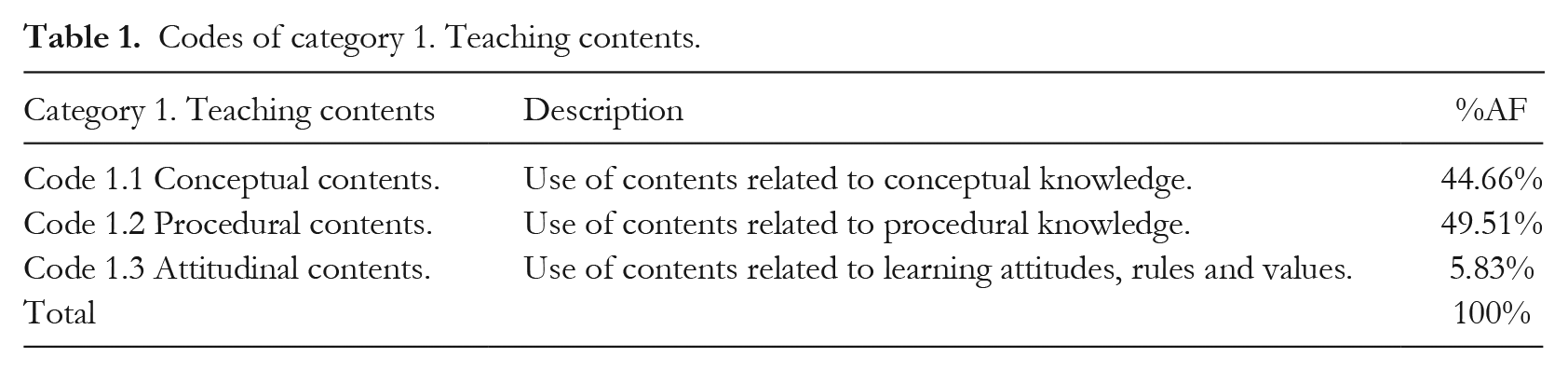
The teachers-in-training identified conceptual contents in the area of mathematics (44.66%):
Multiplication. Division with up to three numerals (EPM4th048). Learning the expressions ‘double’ and ‘triple’ via the times table for 2 and 3 (EPM3rd006). The following narratives note the presence of procedural contents (49.51%). The contents worked on are reading and understanding the problems, searching for and interpreting data in tables and graphs and recognizing the operations needed to solve problems (EPM4th015). They worked on rounding (EPM5th004).
There are few narratives in which the teachers-in-training identified attitudinal contents (5.83%) in the primary school classrooms. Furthermore, they were only identified in the language area: ‘And in this case, cross-curricular issues, that is, values that help the students to be better people’ (EPL4th005).
With regard to category 2, Type of activities (Table 2), the teachers-in-training identified different types of activities (conceptual, procedural or activities focused on problematic situations in real contexts).
Codes of category 2. Type of activities.
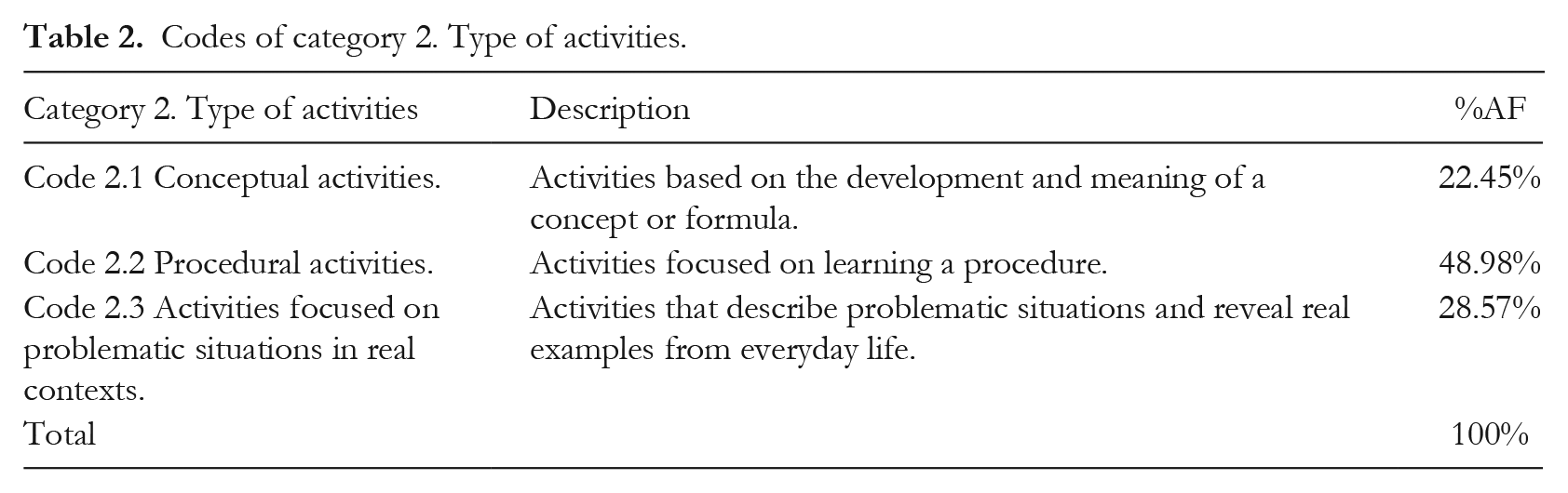
Even though some teachers-in-training identified conceptual activities (22.45%) in their narratives, the majority (48.98%) focused on procedural activities. For example, in the mathematics area, the conceptual activities tend to be based on mathematical content, in which the meaning of the concept or a formula is developed and practised:
In a mathematics class session, the students did an activity that consisted of identifying the number before and after a given number. First, the teacher put the number line on the blackboard (0–19) and used examples to explain what the activity consisted of. The examples he used fell between 0 and 19, beginning with the ones that were easier for students (0 to 5) (EPM4th023). Basically, the teacher introduces the topic and tries to relate it with previous topics (EPM6th046). The procedural activities tend to describe those involving mathematical calculation: multiplication practice, where they worked based on a series of exercises and activities on estimating products according to the order of proximity indicated (tens, hundreds, thousands) (EPM1st054). The teacher asks the students how much one number is missing to reach another number, so the students use their information sheet to put their index finger on the first number mentioned and count how many times they have to ‘jump’ to reach the second number. For example, the teacher asks ‘How much is 5 missing to reach 9?’, so the students put their finger on number 5 and count up to 9 (EPM1st008).
There are also narratives in which we can see that the teachers-in-training identified activities focused on solving problematic situations, sometimes combined with examples that are meaningful for the students. One example of this type of activity is the one identified in the excerpt below:
I have five bookshelves, each of them has five shelves and each of these five shelves has three sections. How many sections do I have? Express it as a power and calculate it. The students are allowed to work on this problem for two or three minutes and then they discuss it with the whole class (EPM6th050). In a mathematics problem using division, what the teacher tried to show them is that this happens in everyday life, like when they go shopping at the supermarket (EPM4th002).
One important aspect in the development of teaching actions in the school classrooms is the arrangement of the learning environments, which contributes to improving the educational process. Student groupings are an important aspect when working in primary school classrooms and were borne in mind in the Groupings category (category 3; Table 3) generated after the analysis, with the following codes: 3.1 Individual; 3.2 Pairs; 3.3 Small groups; 3.4 Whole class.
Codes of category 3. Groupings.
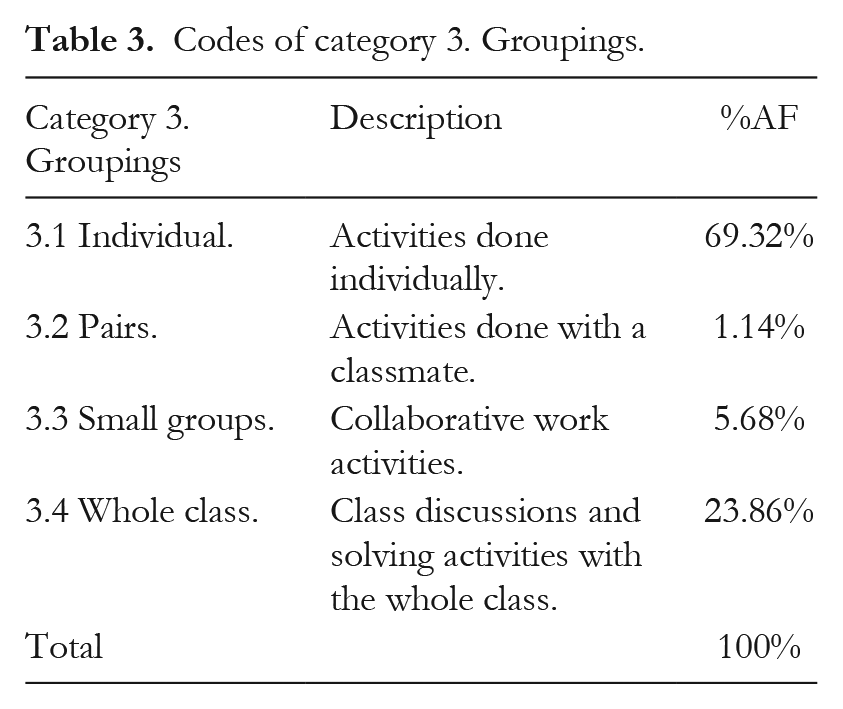
We found that the majority of the teachers-in-trainings’ descriptions primarily identified individual activities (69.32%), which were later corrected with the whole class (23.86%):
In this situation, they then read a song twice in such a way that each student reads one paragraph. After that, they do exercises individually, and finally, when they’re finished with them, they correct the exercises as a group, with one student randomly correcting each exercise (EPL5th015). The teacher explains the characteristics and elements in a recipe. He tells the children that they will answer any questions that arise. The methodology I observed is based on individual teaching, where the student only receives and is passive (EPL3rd060).
Table 4 shows the results of another feature of the teaching models that the teachers-in-training identified, namely the type of materials and resources that the teachers used (category 4: Materials and resources). Three codes emerged from this: 4.1 Outside teaching materials, based on the application or use of the textbooks or worksheets designed by the publishers; 4.2 Teacher-designed teaching materials, which the teachers themselves made; and 4.3 Interactive materials, electronic media (digital blackboard) or digital tools (computers and tablets).
Codes of category 4. Materials and resources.
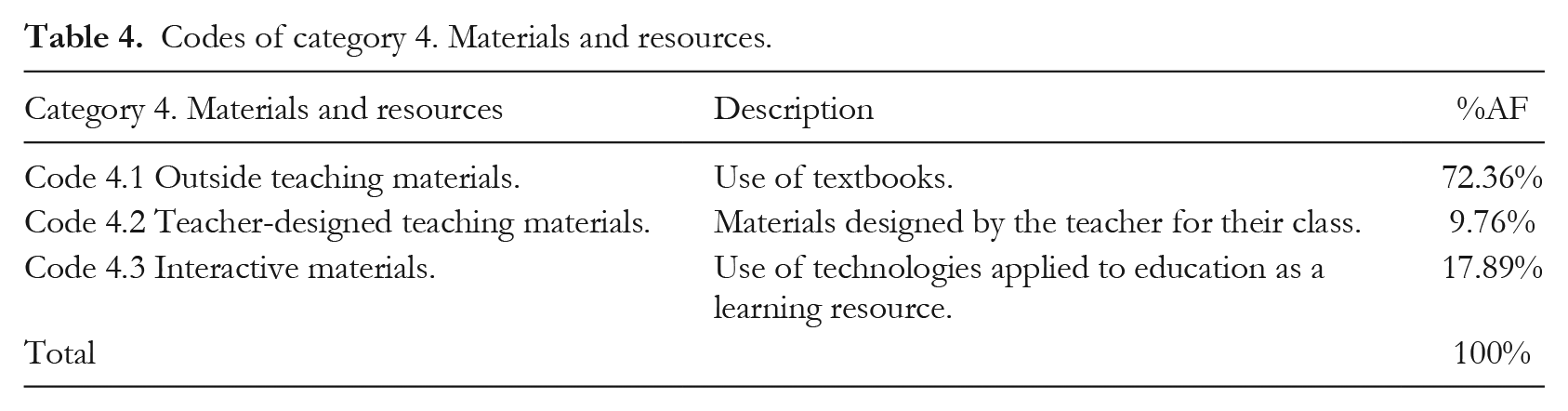
A high percentage of the students’ narratives mention the teaching units planned by the publishers as the materials and resources (72.36%):
Once the mathematics textbooks had been handed out to each of the students (except for three that had an adaption to attend to specific individual needs), the teacher started her explanation by recapitulating the work they had done in the previous session (EPM5th044). The task that the teacher did was explaining ‘polysemic words’. To do so, she used the textbook and her own examples that she provided. After her explanation was over, she then asked students to do exercises in the textbook on the new concept they had learned (EPL5th004).
The use of ICT (code 4.3; 17.89%) was also highlighted as important, although the majority of them only noted the use of the digital blackboard to write the exercise they were doing at the time: ‘The teacher explained the problems using the digital blackboard and interacting with the students (questions/answers)’ (EPM1st049). This involves replacing the traditional blackboard with one that is more motivating or attention-grabbing: ‘The digital blackboard may also help them because it is a motivating element for the students’ (EPL6th001).
Finally, the participants’ narratives primarily highlighted two-way interactions (85.59%), that is, interactions between the teacher and students (category 5: Social interaction), referring to the teacher’s two-way communication (code 5.1, Two-way), or communication in which participation is more active and cooperative, in which dialogues and communication foster collaborative learning (code 5.2, Collaborative). The results are shown in Table 5.
Codes of category 5. Social interaction.
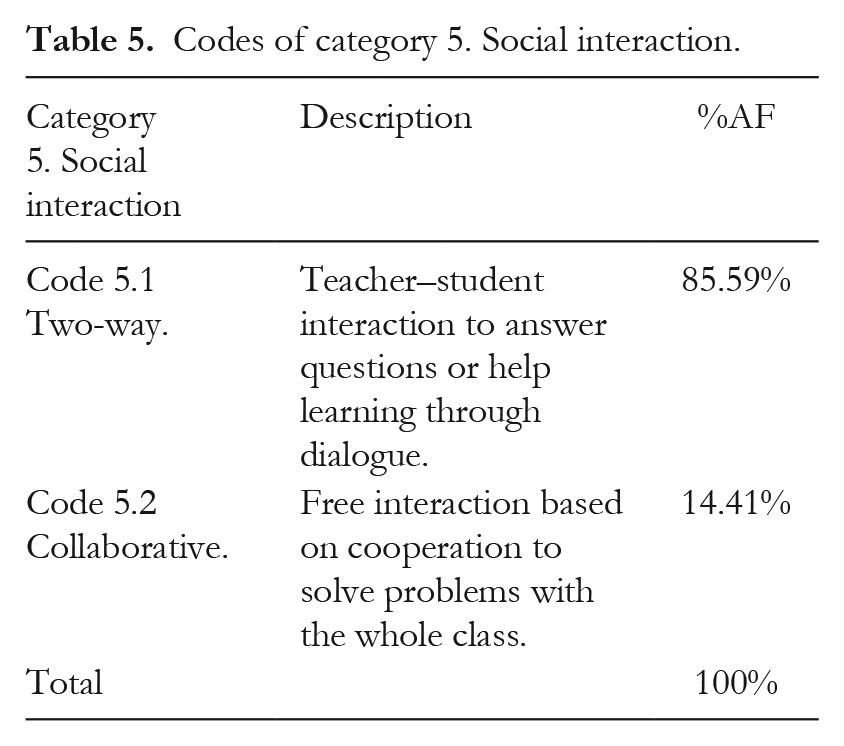
Very few teachers-in-training highlighted collaborative interactions focused on a more cooperative model in which everyone ends up solving the problem together. This is because the way of working in the majority of the activities that the teachers-in-training observed was not collaborative but individual, as highlighted in this dialogue:
Where does this multiplication begin?
By multiplying 1 by 25.
Good. So how does it continue?
You have to multiply 1 by 25.
Good, but where do I put the result? Under the ones or the tens?
Under the first result, the tens.
Are you sure? The second 1 we multiplied by 25 is ones or tens?
Tens.
So we have to leave an empty space or put a zero under the ones, and then write the other result under the tens. Finally, we have to add the two numbers obtained.
The students then did three multiplications individually (EPM2nd039).
Therefore, we see that through their narratives, the teachers-in-training highlight relevant aspects of the teaching models in the situations observed, such as the type of teaching content, the type of activities, the type of grouping, the type of resources and materials used and the type of interaction used in the teaching–learning situations.
Changes proposed by the teachers-in-training on aspects of the teaching models identified
After identifying the relevant aspects of the teaching models observed, the teachers-in-training reported on possible changes in what they were observing (Table 6). In this way, we were able to see whether the teachers-in-training tended to change teaching–learning situations with a change in the teaching models observed and identify whether they were able to integrate new strategies and resources that resemble the features of a more collaborative model common to learning communities.
Codes of category 6. Change in the activity.
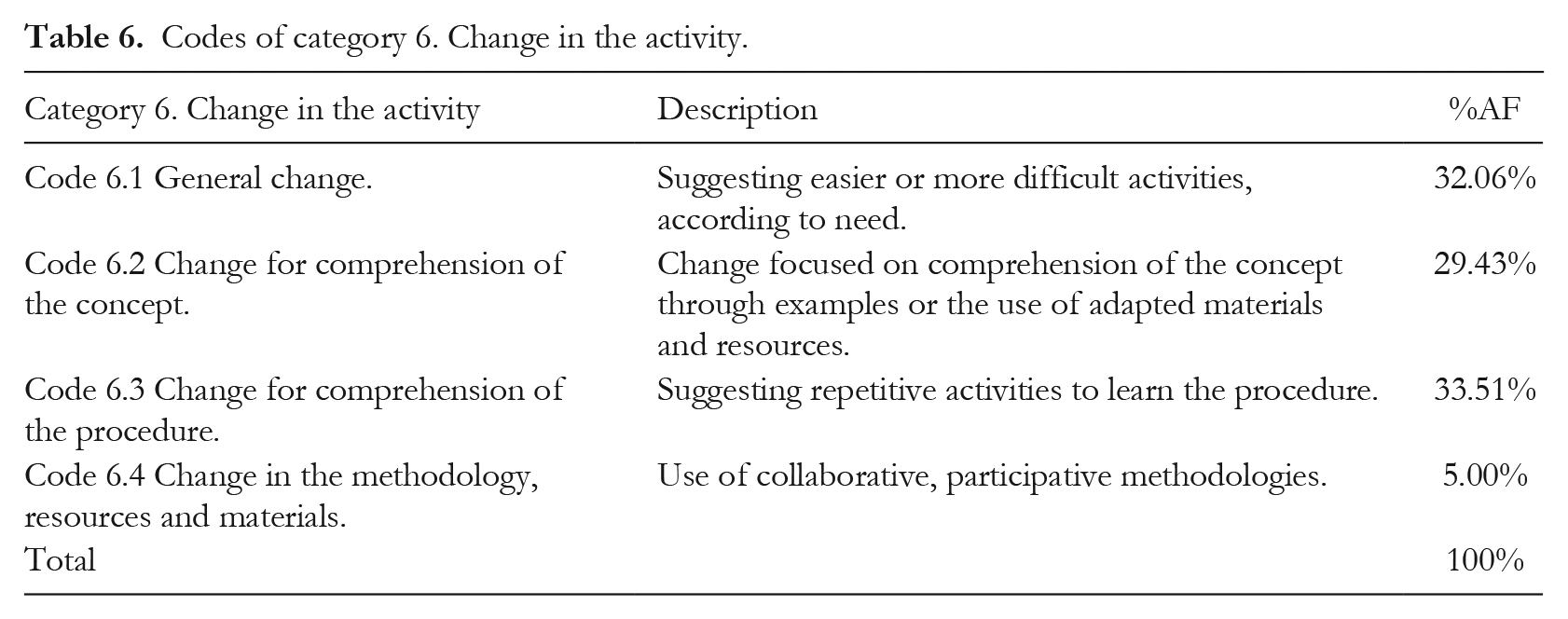
The teachers-in-training proposed general changes in the activity (code 6.1, General change) with a higher or lower degree of difficulty, an aspect which is in the majority in both areas (32.06%). Here is an example from the language area:
Begin with simple words like for antonyms: white-black, high-low. . .; and in synonyms perhaps begin with simple words like: walk-stroll, trainer-gym shoe, cat-kitty, mummy-mother. . . (EPL2nd007). And in the mathematics area: Use more complicated problems which combine more difficult mathematical concepts (EPM6th001).
On the other hand, many of the teachers-in-training (29.43%) focus on changes for the comprehension of the teaching content being covered (code 6.2, Change for comprehension of the concept). Thus, in the mathematics area they present changes focused on the use of multi-base blocks to teach the meaning of some operations: ‘Although to do this students have to recognize that numbers are formed of tens and ones (two-digit numbers), so before that I would work on canonical decomposition using multi-base blocks’ (EPM008), or on the use of strategies or diagrams for text comprehension, as in this case in the language area: ‘One example of a proposal would be to give the students a text where they have to underline the common nouns in one colour and the proper nouns in another’ (EPL040).
The same thing occurs with code 6.3, Change for comprehension of the procedure (33.51%), in which they describe changes based on the repetition of mathematical or linguistic operations covered in the activity observed:
I would propose that the students do an exercise at a higher level than the initial activities so they can learn more (EPM1st054). I would propose using the dictionary to look up words that end in the same syllable so they can later use them in the proposed poem (EPL4th053).
Only a few of the teachers-in-trainings’ narratives propose methodological resources and strategies for the change in the activity (5%; Code 6.4, Change in the methodology, resources and materials), especially where changes towards a collaborative model are suggested:
To work more on reading the text, because there are many students who don’t understand all the ideas in the story; I would do this activity via collaborative work. When reading it, I’d divide the class into working groups, and each group would read with their peers, and together they would understand what it’s saying (EPL2nd031).
The changes proposed by the teachers-in-training show that they focus on the mathematics or language content without taking into account changes in aspects of the teaching models observed. Therefore, changes are not observed towards integrating new strategies or resources which resemble the features of a more collaborative model, common to learning communities, a formative aspect that has been developed in the curricula in which the participants are being trained. The teachers-in-training have not developed a critical eye regarding the methodologies observed in the practicum period, even though their training is associated with knowledge and implementation of different teaching and learning methods based on collaboration and dialogue.
Discussion and conclusions
The results show that the teachers-in-training identify relevant aspects of the teaching models in the school classroom in their narratives, in which they underscore a traditional teaching–learning model. This can be seen in the fact that the majority of activities identified and described by the teachers-in-training as relevant to the development of student competences are based on conceptual or procedural contents, without stressing the attitudinal contents that are so necessary for integrating all the capacities of basic competence.
Furthermore, very few teachers-in-training identified activities or tasks related to solving real problems focused on dialogic, meaningful learning. It is important to note that the development of the methodology based on work projects, which allows for experimentation with everyday activities and provides the possibility for interdisciplinarity to solve authentic, real problems that students must solve as citizens (Monarca & Rappoport, 2013), improves the quality of dialogic learning. Therefore, we find that the teachers-in-training identified aspects of teaching focused on the assimilation of contents. This kind of teaching does not reflect the acquisition of basic competences, nor does it overcome the traditional models, and it does not allow for the possibility of using other models that more closely approximate the reading competence (Cambra, 2013) or the mathematical competence (Vicente et al., 2013).
Furthermore, the teachers-in-training identified that these activities are done individually, without a tendency towards collaborative work in small groups in which students help and cooperate with each other in their learning. In their narratives, they tend to identify a two-way relationship: interactions led by the teacher that do not allow for the possibility of collaborative and social learning, and therefore the absence of a socializing teacher. And this is despite the fact that specific studies in the area of mathematics, such as García-Carrión and Díez-Palomar (2015), highlight the benefit of working in collaborative and interactive groups, common to learning communities, for learning mathematics.
Likewise, the participants’ narratives point out that the main teaching materials and resources used are based on the textbook; that is, they identify the use of materials published by outside agents (like publishers) and a selection of the content offered by them as fostering learning, as noted in studies conducted on the practicum (Bretones, 2013). They also point to the implementation of these materials in the traditional way, without the possibility of designing their own materials in a flexible, open way that improves the quality of student learning (Schneider & Kipp, 2015). This would foster a reflective, critical teacher who designs, develops, reflects and acts (Abrami et al., 2015), in which the constitution of knowledge is grounded on collective, dialogic interactions.
On the other hand, regarding the digital competence, the majority of narratives do not identify the use of digital technologies to search for and choose information or to do interactive activities or games to practise the content covered. The future teachers only identified the use of the digital blackboard to capture, explain or solve the activity under way by the teacher. Therefore, its use is still simply replacing the traditional blackboard. They do not mention blogs or other important websites, even though they are the model of many didactic actions (Rovira-Collado, 2016). Moreover, ICT are not identified as an element that fosters the digital competence (Cabero & Barroso, 2016; Mishra & Koehler, 2006).
To change the teaching situations observed, the teachers-in-training continue to maintain the same teaching model they observed in the classrooms, with matching postures and only making minor changes in their teaching actions, without introducing new methodological strategies that approximate a collaborative model. That is, the teachers-in-training did not try to change the teaching situation observed and described with all the possible curricular elements to work towards a more collaborative teaching and learning model where the entire community learns. In their descriptions, they did not transform the model observed, which we interpret as a sign that they consider the model ideal for teaching, without reflecting on other proposals studied in their degree programme. The participating teachers-in-training do not adopt the posture of reflective, critical teachers, which would have enabled the entire teaching situation to be changed by integrating the necessary curricular elements. Most of the teachers-in-training continue to use neutral thinking in their educational intentions, lacking a critical, innovative reflection which questions the observations of the teaching actions undertaken. The spontaneity and innovation that could enrich student learning towards greater collaboration between students and teachers is missing (Fuentes-Abeledo et al., 2020).
Through their written narratives, the teachers-in-training were able to identify relevant aspects of the teaching models. This result corroborates the results obtained by other students, which conclude that narratives can be a tool that helps teachers-in-training focus on relevant aspects of teaching–learning situations (Ivars & Fernández, 2018). However, they had difficulties suggesting changes as teachers after identifying these relevant aspects. This result may suggest that the skill of deciding what to do next (a skill which is also part of the competence of viewing professionally), which in this study is associated with changing aspects of the teaching models observed, is difficult for the teachers-in-training (Fernández et al., 2018). To change aspects associated with the teaching models, knowledge of these models is needed. Perhaps the teachers-in-training did not have this knowledge, and because they did not observe different models, they were not able to change the situation (Hogg & Yates, 2013). Fostering the observation of different teaching models in teacher training (Gairín-Sallán et al., 2019), specifically those aimed at dialogic and collaborative learning, would lead to pre-service training that integrates professional knowledge based on collaboration and social interaction (McAlister, 2012; Poveda et al., 2021).
In short, we believe that the narratives that the participants have provided on their experience and learning at the start of teaching are abundant and rich, especially because they chose the teaching situations that were relevant or meaningful for their learning. However, we should also point to several limitations of this study, like the possibility of expanding the number of participants and conducting it in other settings. In this way, new studies could be performed in a range of different settings with the goal of analysing the view or perspective of other teachers-in-training. For example, it could be expanded to stages like early childhood education and secondary education. In summary, we conclude that the practicum period is an opportunity for observation and meaningful reflection using a critical gaze, but the learning communities model (Mena-Marcos et al., 2013; Zhu, 2011) must be expanded at schools and the training of critical, reflective teachers must be promoted.