




Abstract
Background:
The arteriovenous fistula is the main vascular access in hemodialysis. Arteriovenous fistula access is generally evaluated by a vascular surgeon after 2 weeks of its surgery, however, exercise programs may begin earlier for improving outcomes. Therefore, we propose this guide with simple, but potentially effective exercises, using low-cost materials that can be safely performed by the patients at home or in the dialysis center. It also provides to the dialysis staff team a starting point for implementing an upper-limb exercise program that may facilitate arteriovenous fistula maturation and maintenance.
Methods:
This exercise routine for arteriovenous fistula maturation can be performed three to four times a day, every day, from 2 to 4 weeks. After its maturation, it can be performed on every non-dialysis day for conventional treatment and every other day, before dialysis, for short daily treatment.
Conclusions:
Based on the available evidence, we have gathered some exercises, in a very easy and understandable language, that may potentially help arteriovenous fistula maturation and maintenance for hemodialysis patients.
The arteriovenous fistula (AVF) is the main vascular access in hemodialysis. 1 During AVF surgery an anastomosis of an artery and a vein is created. This is usually located in the forearm or upper arm, but can also be created in the thigh. After AVF surgery, the vessel undergoes a maturation process of arterialization to reach the appropriate depth, vessel wall thickness, diameter, and blood flow rates to facilitate regular repetitive cannulation for hemodialysis.1,2 This maturation process takes approximately 4–8 weeks, with significant variability across centers regarding when AVF cannulation first occurs following surgery.1,2 The upper-limb physical stimulus may help the new AVF in its maturation process, and whole arm exercise programs for the AVF limb might avoid complications during this process.3–5
Arteriovenous fistula access is generally evaluated by a vascular surgeon after 2 weeks of its surgery, 2 however, exercise programs may begin earlier for improving outcomes.6,7 Maturation failure may reduce the quality of life and treatment efficiency, so exercise interventions may become important. Some dialysis centers indicate common exercises such as squeezing a soft rubber ball and the opening and closing of the hand, but this is not routinely seen in many. When exercise professionals are part of the staff team, whole arm exercises have also been used as coadjutant therapy in the postoperative period.6–8
Recent systematic reviews have shown that hand and whole arm exercises may be effective in improving draining vein blood flow rate, brachial artery blood flow, upper-limb arm strength, and clinical maturation rate.5,9 This might indicate that other benefits could be potentially achieved, such as local blood circulation, which increases vasodilation and may help to maintain vessel integrity.4,10 Previous studies have used dumbbells and elastic bands, progressive manual gripping, structured isometric, and blood flow restriction exercises.6,11–13 These studies investigated whether exercises would improve AVF maturation and despite it seems they do, which was confirmed by previous systematic reviews, the evidence is not well-established yet.5,14
Based on the available evidence, we have chosen some exercises that may potentially help AVF maturation and maintenance. They are clinical routine in our dialysis center in Brasília, Brazil. We, therefore, propose this guide with simple, but potentially effective exercises, using low-cost materials that can be safely performed by the patients at home or in the dialysis center. It also provides to the dialysis staff team a starting point for implementing an upper-limb exercise program that may facilitate AVF maturation and maintenance.
Why is exercise important for your arteriovenous fistula health?
→ It may help in its maturation after surgical creation and also in its maintenance during dialysis treatment.
→ Gives you strength and autonomy to daily life activities when using your arm with fistula.
→ Exercise may increase blood flow and vasodilation of your arteriovenous fistula.
→ The adequate maturation and maintenance of your fistula also depend on your commitment, and this exercise guide may help you to achieve that!
Are there any risks for your arteriovenous fistula in doing exercises?
As far as we know, no evidence has shown any harm, but there are many more risks of not exercising than doing it! However, it is always important to take some care:
→ Perform the movements slowly;
→ Avoid high intensities;
→ Perform exercises before or after dialysis treatment;
→ Stop the exercise if you feel any pain symptoms.
→ Do not start until 2 weeks after surgery or when the surgical wound is completely healed (whichever is longer).
→ For the safety of your arteriovenous fistula, we suggest you do the 1 min access check. 15 Look at the skin over, Listen to your access, and Feel for a thrill and a pulse.
What do you need to exercise your arteriovenous fistula arm?
Before exercising, make sure you are following the recommendations from the previous section, but also consider some simple tools, such as:
→ A very simple and easy-to-find squeeze ball can be very helpful.
→ A clothespin from your laundry can be another easy and cheap option.
→ A dumbbell or even bottles of water can be used as extra weights.
How can you organize your exercise program for your arm with fistula?
→ This exercise routine for arteriovenous fistula maturation can be performed three to four times a day, every day, from 2 to 4 weeks. 7
→ After maturation, it can be performed on every non-dialysis day for conventional treatment and every other day, before dialysis, for short daily treatment.
→ Try to do 10 repetitions, rest for 1 or 2 min, and then repeat two to three times in each exercise.
Why should clinicians use this guide in clinical practice?
→ The proposed exercises may be important in reducing the risk of maturation failure.
→ It may be effective in improving draining vein blood flow rate, brachial artery blood flow, and upper-limb arm strength.
→ It requires low-cost materials that can be safely performed by the patients at home or in the dialysis center before the treatment session.
Exercise guide
Tighten a clothespin
With a clothespin, use your index finger and thumb, to open it. Then, progressively release your fingers to allow the clothespin to close (Figure 1).
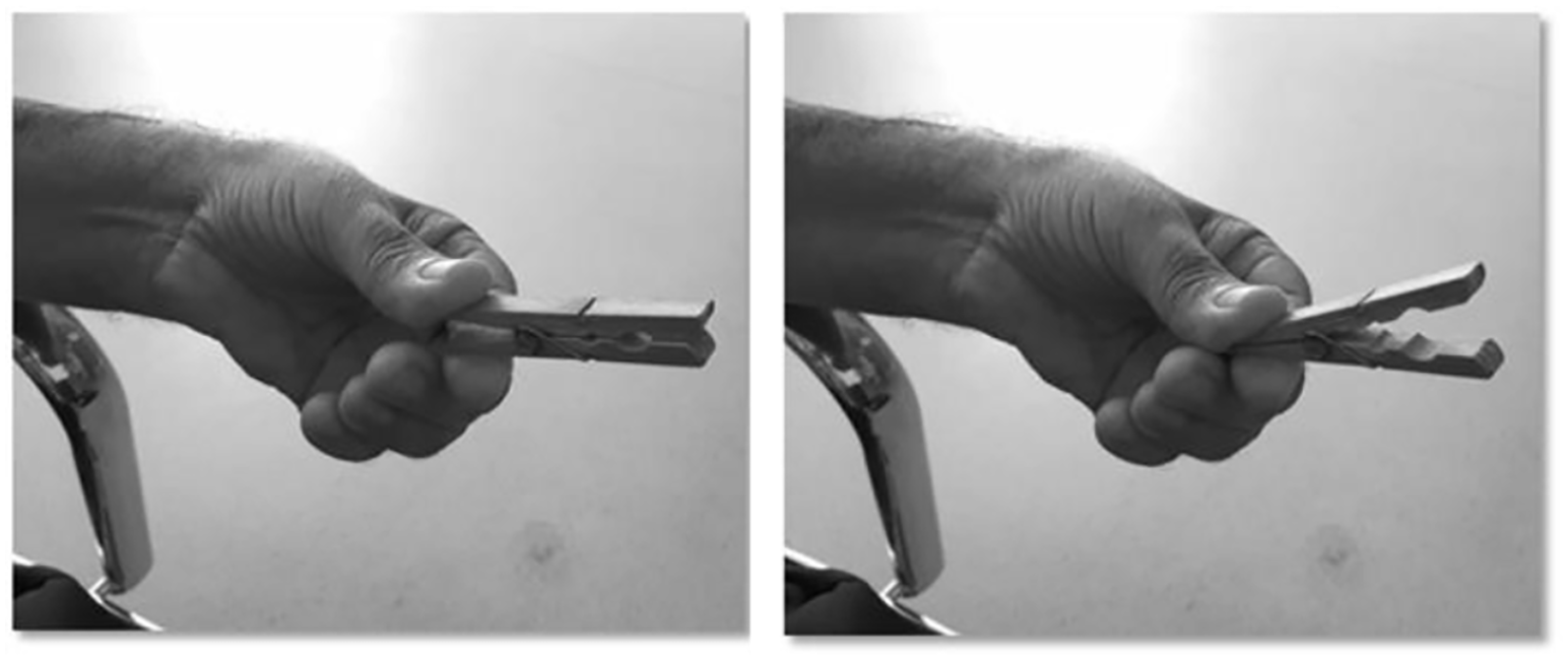
Tighten a clothespin exercise.
2. Do three sets of 10 repetitions. After each set, take 1-min rest.
Squeezing a softball
Hold a softball with the hand of your arteriovenous fistula arm, place your arm by your side and squeeze the ball by opening and closing your hand (Figure 2).
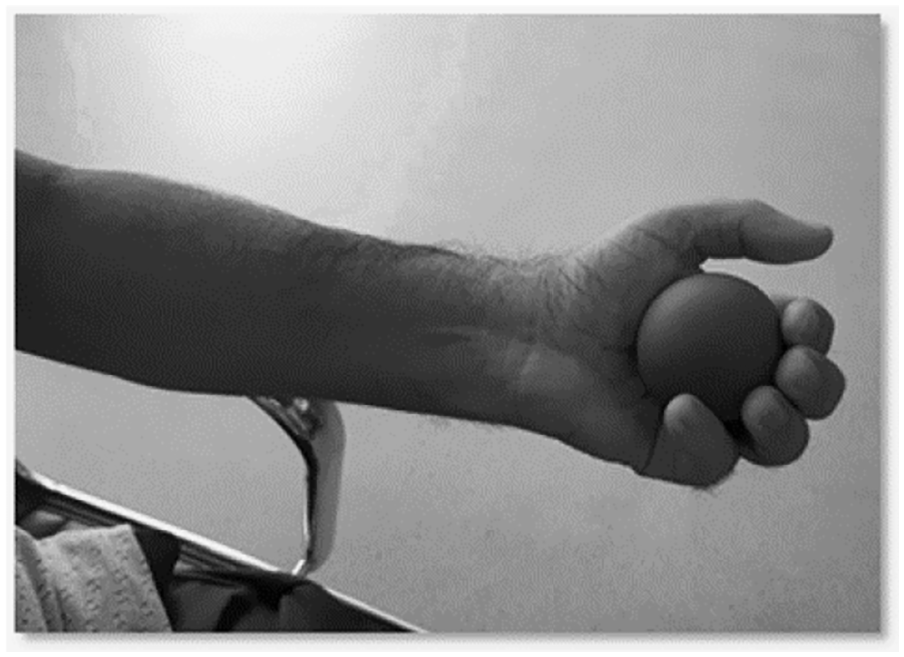
Squeezing a softball exercise.
2. Open and close your hand repeatedly 10 times for three sets. For each set, have 1-min rest.
Biceps curl
Sitting with your arms straight down on the side of your body, with your palms facing forward, hold a weight in each hand (e.g. a water bottle or a dumbbell) (Figure 3).
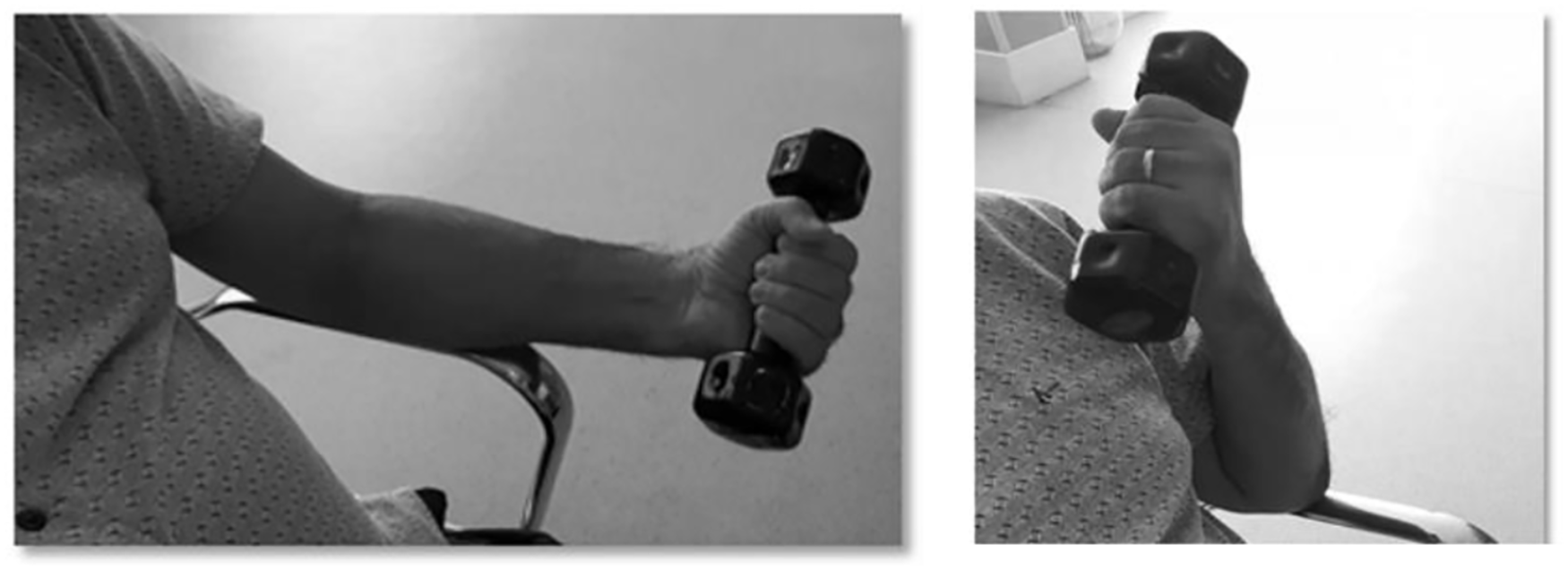
Biceps curl exercise.
2. Flex your elbow slowly to lift the weight to your shoulder, or as far as you can without pain. Slowly lower the weights back down to the starting position, straightening your arm again.
3. Do three sets of 10 repetitions of this movement. For each set, take 1-min rest.
Wrist curl
Sitting with your arms straight beside your body, with your palms facing forward, hold a weight in each hand (e.g. a water bottle or a dumbbell) (Figure 4).
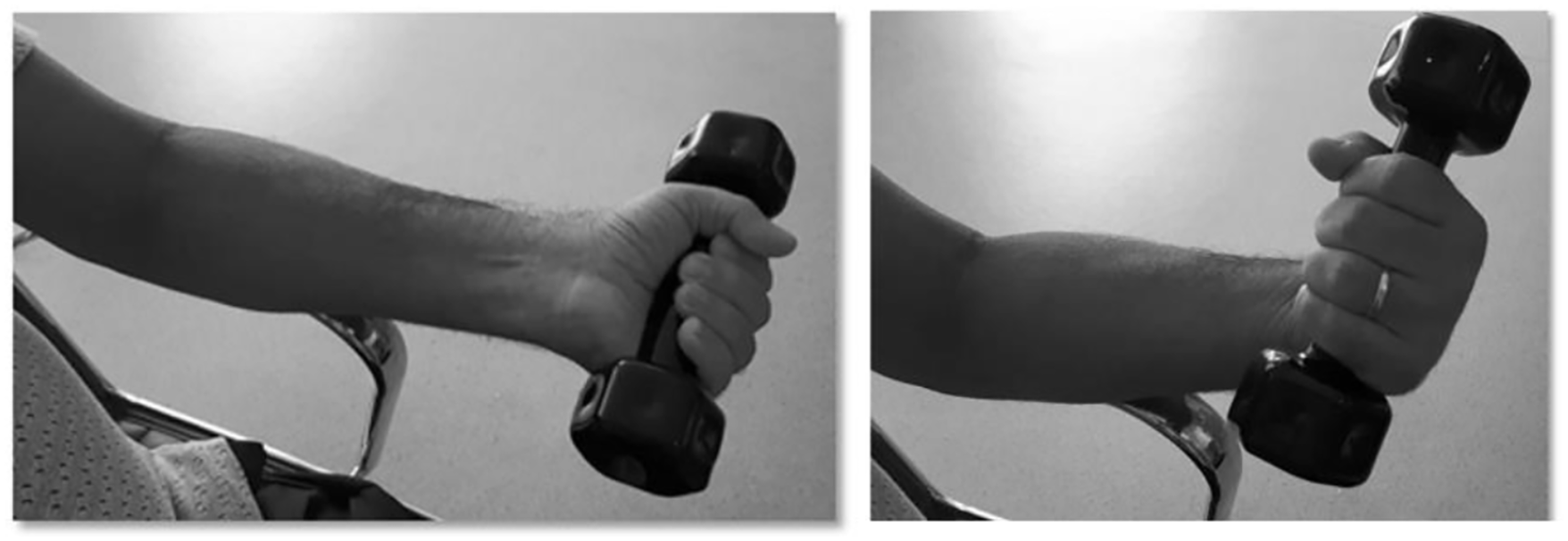
Wrist curl exercise.
2. Flex and extend your wrist 10 repetitions for three sets. For each set, have 1-min rest.
To watch the exercise videos, scan Figure 5 QR code!

QR code to the videos of the exercises.
Footnotes
Acknowledgements
We thank all the dialysis staff team and patients involved in the development of this guide. This study is endorsed by the Grupo Brasileiro de Reabilitação em Nefrologia (GBREN). The interpretation and conclusions contained herein are those of the researchers and do not represent the views of GBREN.
Contributorship
All authors have worked together during the construction of this exercise guide. HSR, MPD, FPA, MRS, and VMB designed, drafted the first version, and wrote it. JSM and APF supervised and approved the final version.
Declaration of conflicting interests
The author(s) declared no potential conflicts of interest with respect to the research, authorship, and/or publication of this article.
Funding
The author(s) disclosed receipt of the following financial support for the research, authorship, and/or publication of this article: This guide was supported by the Fundação de Apoio à Pesquisa do Distrito Federal (FAPDF) (grant 0193.001.558/2017), by Pró-Reitoria de Extensão (PROEX) of the University Center ICESP, and by DaVita Kidney Care, Brazil.
Ethical approval
The proposed exercise guide is part of a clinical routine in a dialysis center in Brasília, Brazil. Ethical approval has been obtained by the dialysis center committee and by the Institutional Review Board of the University Center ICESP.

Supplemental material
Supplemental material for this article is available online.
References
Supplementary Material
Please find the following supplemental material available below.
For Open Access articles published under a Creative Commons License, all supplemental material carries the same license as the article it is associated with.
For non-Open Access articles published, all supplemental material carries a non-exclusive license, and permission requests for re-use of supplemental material or any part of supplemental material shall be sent directly to the copyright owner as specified in the copyright notice associated with the article.
