



Abstract
Purpose
Understanding trends in female researcher representation can inform strategies to improve equity in academic ophthalmology. This study evaluates authorship and citation trends over 25 years amongst the highest-cited articles in leading ophthalmology journals to assess female co-authorship and differences in authors’ degrees in publications at a highly visible research level.
Methods
A retrospective analysis was conducted on 443 authors who published the most highly cited articles in high-impact journals from 2000 to 2024. Articles were chosen as the three most cited articles per year from the three highest-impact ophthalmology journals per h5-index. Identities were confirmed via institutional websites, PubMed, and Google Scholar. Gender and degrees were determined using professional profiles. Outcomes included authorship position, first-last author pairings, citation impact, and differences in authors’ degrees by gender.
Results
From 2000 to 2024, female first authorship rose 38.11%, and overall authorship 43.73%. Female last authorship, though lowest, increased the most (53.63%). Female co-authorship and overall representation peaked in 2010–2014. Male first-authored papers had more citations (p = 0.011) and were 9.36 times more likely to involve same-gender mentors (CI [4.56, 19.23], p < 0.00001). Men were more often ophthalmologists; women more frequently held PhDs, PharmDs, or ODs (p = 0.0036).
Conclusions
Female authorship is rising, but citation gaps and underrepresentation persist. Non-physician female research and female co-authorship success suggest mentorship and interdisciplinary work may enhance women's visibility in ophthalmology research. Continued interventions to promote female ophthalmic career networks are essential in closing the gender gap in research and fostering equitable professional advancement.
Introduction
A diverse medical workforce that reflects the racial and gender composition of the population has been linked to improved patient outcomes and stronger healthcare team performance.1–4 In academic medicine, gender diversity contributes to more inclusive research practices, such as incorporating gender-specific analyses into study design and outcomes.5–7 Underrepresentation of practicing female ophthalmologists remains when compared to practicing female physicians across all specialties. In 1969, women comprised only 4% of practicing ophthalmologists. 8 By 2021, this figure increased to 27.2%, according to the Association of American Medical Colleges (AAMC), but still remains below the overall percentage of practicing female physicians.9,10 However, recent American Academy of Ophthalmology (AAO) data show that in 2022, 38.6% of AAO members-in-training were women, compared to just 26.2% of practicing AAO members–reflecting a growing representation trend among trainees. 11 Furthermore, female applicants to ophthalmology residencies have been shown to produce higher numbers of ophthalmology-related publications and presentations than their male counterparts, 12 indicating strong early academic engagement.
Despite this early academic enthusiasm, women's involvement in ophthalmic research often declines later in their careers as they more often pursue non-research-focused paths after residency, with male ophthalmologists more likely to lead research efforts. 8 Female ophthalmologists who pursue research are also less likely than men to hold first, last, or corresponding author positions—roles that signal recognized leadership and influence in academic publishing. 8 Several factors may contribute to this disparity, including disproportionate domestic responsibilities. Female ophthalmologists report greater responsibilities outside of work, such as childcare and elder care, which limit time and energy for research participation. Combined with fewer opportunities for academic promotion and compensation disparities, these factors contribute to higher burnout rates nearly twice that of male colleagues and reduced integration of female ophthalmologists into research and leadership.13,14 The decline of women in ophthalmic research as they transition from their early training may also be from the limited availability of senior female mentors and leaders who may understand the unique challenges women in medicine may face. Women were only 10% of ophthalmology department chairs in 2018 and 28% of residency program directors in 2020.15,16 Additionally, women held only 1 in 24 editors-in-chief roles in ophthalmology journals, 26% of board member seats in professional ophthalmology societies, 17 and were less frequently featured speakers at national surgical conferences. 18 Many female trainees strongly prefer women mentors who can relate to gender-specific challenges to support their career advancement,19–24 and evidence suggests that female trainees are more likely to publish when mentored by women.25,26 Together, these factors highlight the importance of increasing women's representation in research and leadership to promote gender equity in the field.
This study examines authorship trends and citation impact by gender over the past 25 years in high-impact ophthalmology journals. It is hypothesized that female-female co-authorship and mentorship relationships may be associated with improved female authorship representation and research recognition. Differences in degree types held by gender may also illuminate pathways with fewer barriers for women in ophthalmic research. This study aims to inform strategies for cultivating a more equitable and inclusive academic environment for the lasting success of women in ophthalmology research and leadership.
Methods
A retrospective bibliometric analysis was conducted on 443 authors from high-impact ophthalmology publications between 2000 and 2024. The three leading ophthalmology journals were selected based on the 2022 Google Scholar h5-index: Investigative Ophthalmology & Visual Science, Progress in Retinal and Eye Research, and Ophthalmology. For each journal, the three most-cited articles per publication year were identified, resulting in 75 articles per journal (225 total articles). Citation counts for each article were sourced exclusively from the Web of Science database to ensure consistency in citation metrics and avoid variability across platforms. For each article, the following variables were recorded: publication year, title, citation count, and the names of the first and last authors. Author identity was verified through cross-referencing names and institutional affiliations using Google Scholar, PubMed, and institutional websites.
The decision of the number of articles selected per year for a total of 225 articles was made to utilize a stratified sampling strategy. As statistical analysis was solely done to compare across all time periods, a power calculation with an alpha of 0.05 and a power of 0.80 was done, which indicated a sample of 55 papers being sufficient to detect a moderate effect size of at least 15%, for the difference in citation counts and gender presence. The cohort of 443 authors represented eligible individuals identified from sample papers, excluding repeats.
To determine author gender, web-based searches were conducted using institution-affiliated profiles and publicly available professional platforms (e.g., ResearchGate, LinkedIn, Doximity). Author gender was assigned based on biographical pronouns and/or profile photographs. Authors were excluded and marked as “unknown” if no verifiable gender information was available from professional or institutional sources. Each author's academic credentials were also collected. Authors were categorized as ophthalmologists if they held an MD or DO (or international equivalent) and had completed or were currently in ophthalmology residency or fellowship training. Categories were also recorded for authors defined as optometrists (holding an OD degree), holders of other doctorate degrees (PhD or PharmD), or non-doctoral researchers. All listed academic degrees were included. Authors holding dual degrees (e.g., MD-PhD, OD-PhD) were accounted for by including them in all relevant categories, rather than assigning each author to a single degree group.
The primary outcomes included female and male authorship trends over time, stratified by authorship position (first, last, and overall). Gender pairings between first and last authors were categorized into four groups: female first author / female last author, female first author / male last author, male first author / female last author, male first author / male last author. This classification was used to assess patterns of gender-aligned collaboration and potential mentorship dynamics. Citation impact was analyzed by comparing the average number of citations articles received based on the gender of the first and last authors. Additionally, authorship trends were compared with national demographic data on practicing ophthalmologists from the Association of American Medical Colleges (AAMC) over the same period.
All data were analyzed by publication year and aggregated in five-year intervals (e.g., 2000–2004, 2005–2009, etc.) to assess trends. Descriptive statistics were used for demographic breakdowns to assess mentorship and research collaboration patterns between junior and senior researchers that have led to successful, quality published ophthalmology research. Comparative statistics (e.g., chi-square tests, unpaired t-tests, and odds ratios) evaluated the significance of observed differences in gender distribution and citation outcomes to convey research recognition by gender. No formal correction for multiple comparisons was applied, as the primary analyses for statistical significance were focused on overall group differences. Time-stratified analyses were primarily descriptive. This approach was selected to minimize the risk of type I error inflation while preserving interpretability.
Results
Author gender distribution
Four hundred and forty-three authors with articles published from 2000 to 2024 in leading ophthalmology journals were analyzed. Twenty-seven authors were excluded due to unverifiable data on gender. Table 1 highlights the distribution of authorship by gender over time. Female scholars were significantly underrepresented as first, last, and overall authors, comprising only 25.96% of all contributing authors (χ² = 96.15, p < 0.0001). From 2000–2004 to 2020–2024, female first authorship increased 38.11%, last authorship increased 53.63%, and overall authorship increased 43.73%. In concordance, male authorship showed a 10.51% decrease in first authorship, 8.94% decrease in last authorship, and 9.64% decrease in overall authorship. Although female last authorship increased the most, it was the most underrepresented position amongst female researchers.
Distribution of authorship position by gender, 2000–2024.
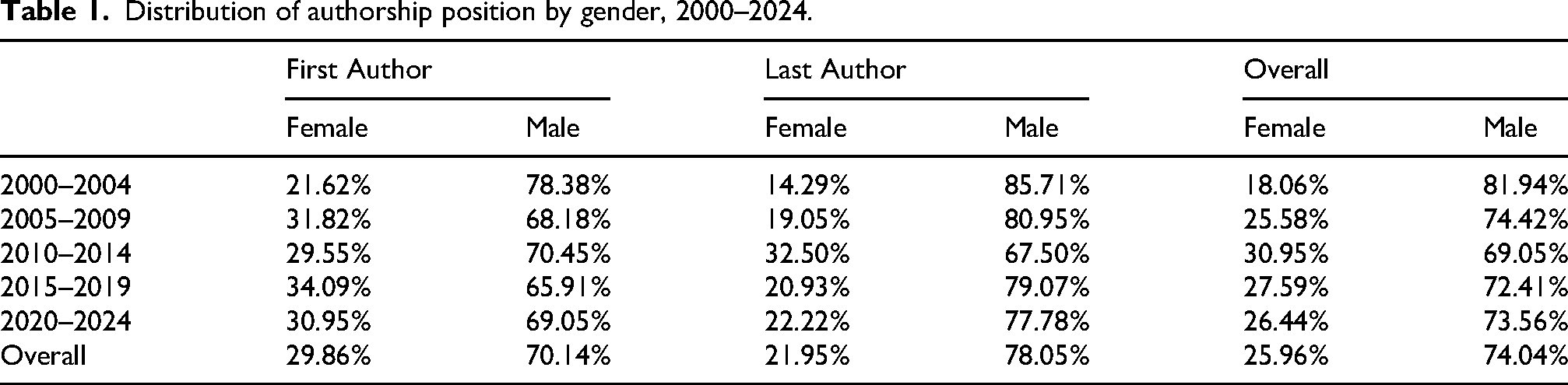
Female authorship in the first author role was at greater proportions than total and last female authorship across all stratified years except 2010–2014, which reported a higher proportion of female authors amongst last authors and overall authorship positions (Table 1). The highest overall female authorship was noted in 2010–2014 (30.95%). The larger percentage of female authors in the first author category indicates that female authorship in ophthalmology is most likely to result from junior faculty. Although this suggests junior research success as more women are training to become ophthalmologists, women are less likely to be senior faculty on published research. However, the findings showed the greatest increase was among female last authors, with a 53.63% rise from 2000–2004 to 2020–2024, indicating improved representation of senior female researchers.
Overall female authorship was higher than the percentage of active practicing female ophthalmologists according to AAMC data in 2007, 2013, and 2017. However, female authorship was below the percentage of practicing female ophthalmologists in 2022. Conversely, overall male authorship trended below AAMC data on active practicing male ophthalmologists in 2007, 2013, and 2017, but a higher percentage of men published than there were practicing male ophthalmologists in 2022 (Figure 1).
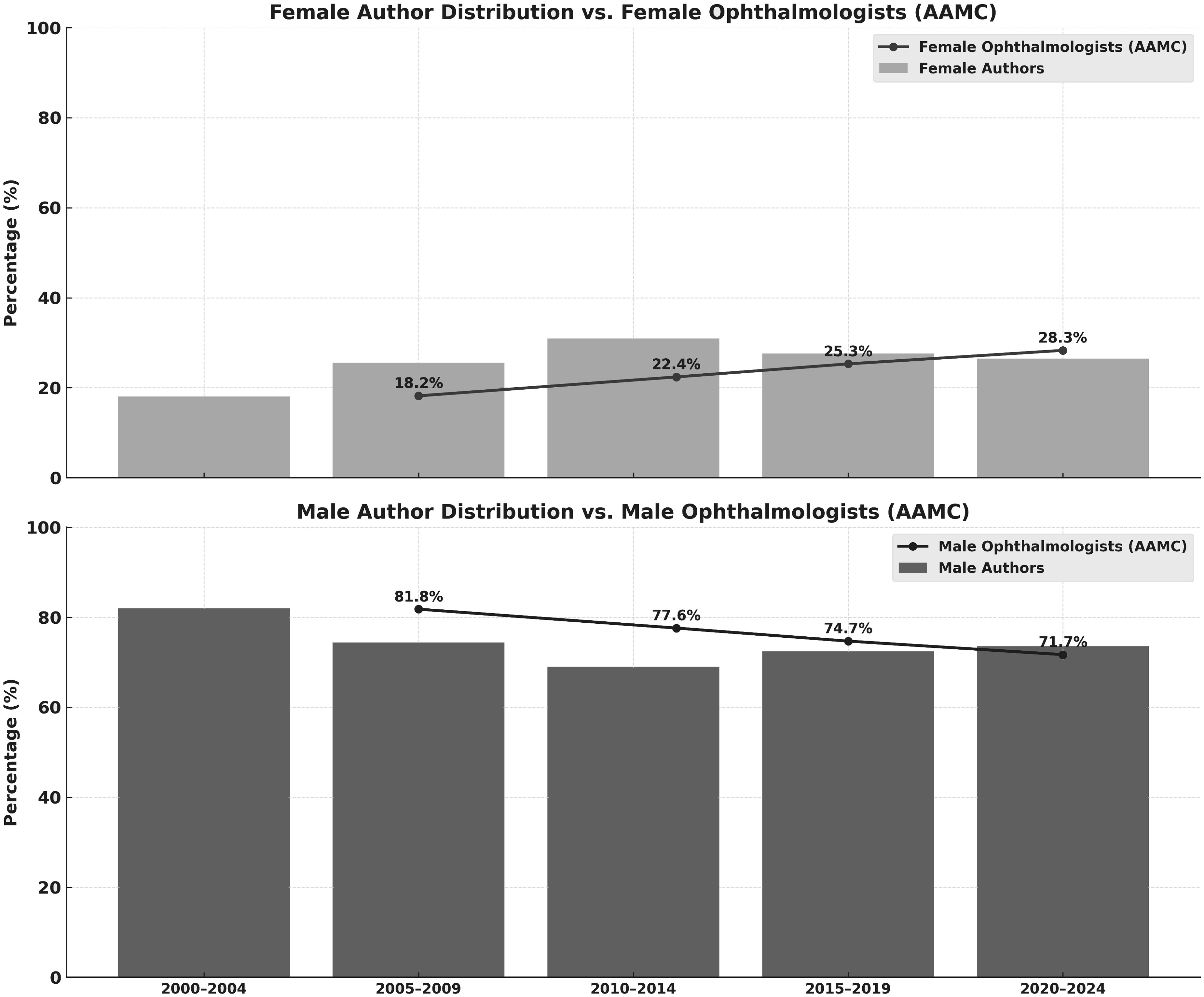
Female and male authorship compared to percentages of practicing ophthalmologists per AAMC in 2007, 2013, 2017, 2022, respectively.
Average number of citations
Male first-authored papers were associated with higher citation counts overall and across all stratified periods except 2020–2024, which demonstrated higher citation counts with female first authors. Female last authors were associated with lower citations overall and across all periods (2000–2024). The average number of citations per time is illustrated in Figure 2 and Figure 3.
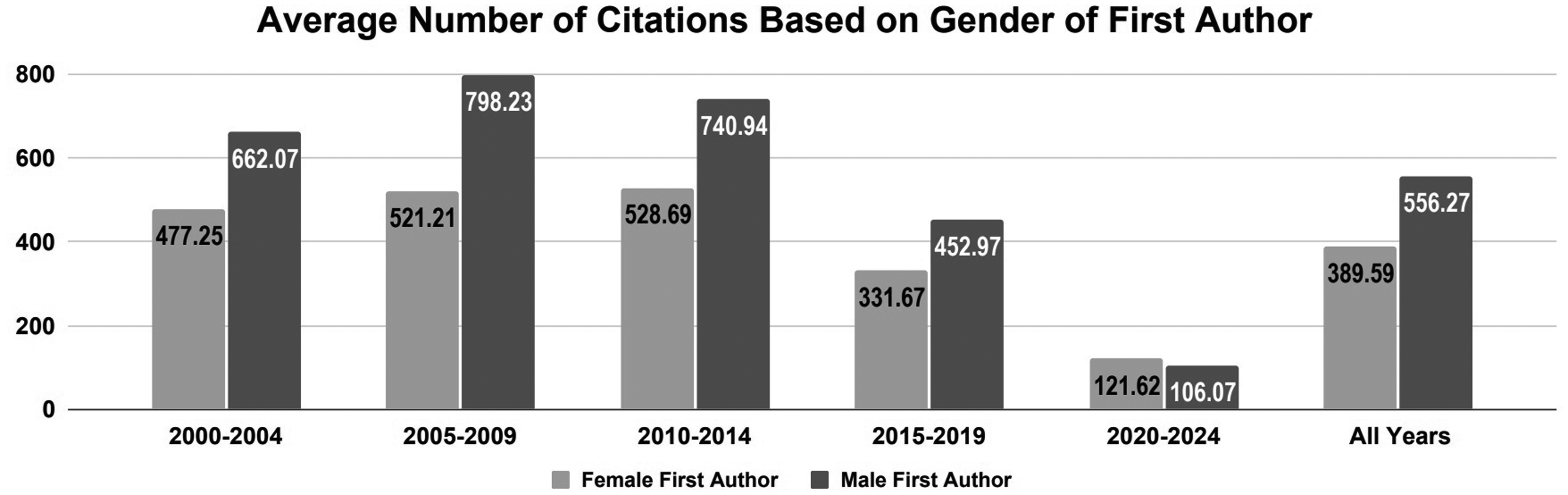
Average number of citations based on gender of first Author, 2000–2024.
The average number of citations received by authors across all periods (2000–2024) was compared by gender using unpaired t-tests. For first authors, articles with male first authors received significantly more citations on average than those with female first authors (M = 556.27 vs 389.59, p = 0.011). For last authors, while male authors again had a higher average citation count (M = 535.91) than female last authors (M = 406.04), the difference was just above the statistical significance (p = 0.059).
Mentorship pairings
A total of 218 pairings between the first and last author were found. One hundred and ninety-two first-last author pairings included full data on the genders of both authors in the pairing. The frequency and counts of gender pairings over time are outlined in Table 2. The most common pairing overall was male junior researchers mentored by male seniors—56.25%, which mirrors the male-dominated author pool (74%). Male-male pairing was highest (71.43%) in 2000–2004. Female juniors are more often mentored by male seniors (20.31%) than by female seniors (7.81%), suggesting that female mentees may not have as many opportunities for same-gender mentorship.
Frequency of first-last author pairings by gender, 2000–2024.
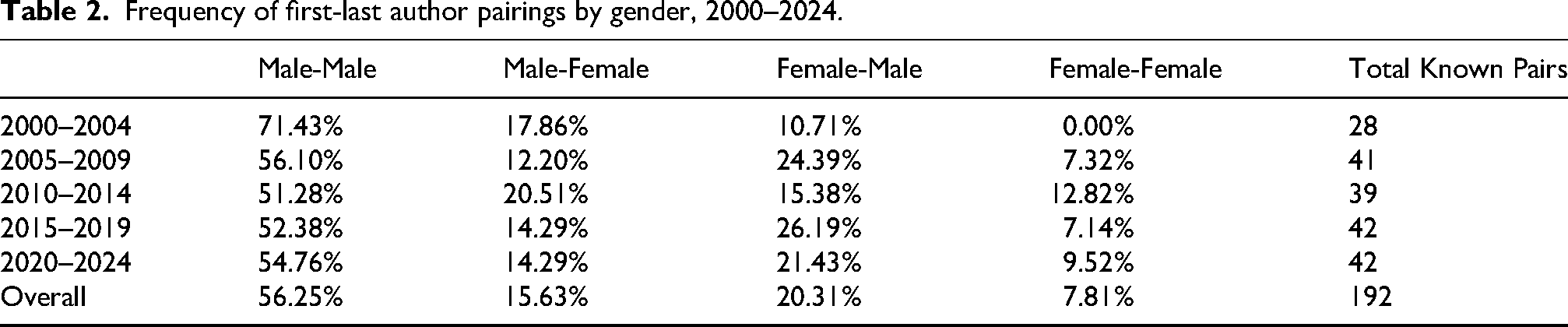
Male first authors were 9.36 times more likely to publish with a last author of the same gender than female first authors were. Male co-author gender concordance was significantly higher than that of female authors (OR = 9.36, 95% CI [4.56, 19.23], p < 0.00001). These results were consistent with findings from a chi-square test for independence, which also indicated a significant association between mentee gender and mentor gender pairing, χ²(1, N = 192) = 45.43, p < 0.0001. These findings support that female first authors were far less likely to collaborate with senior faculty of their gender background. The highest female-female co-authorship rate (12.82%) was in 2010–2014, which was also the time period of the highest overall female authorship (30.95%), suggesting that female collaboration was associated with greater female presence in leading ophthalmic literature.
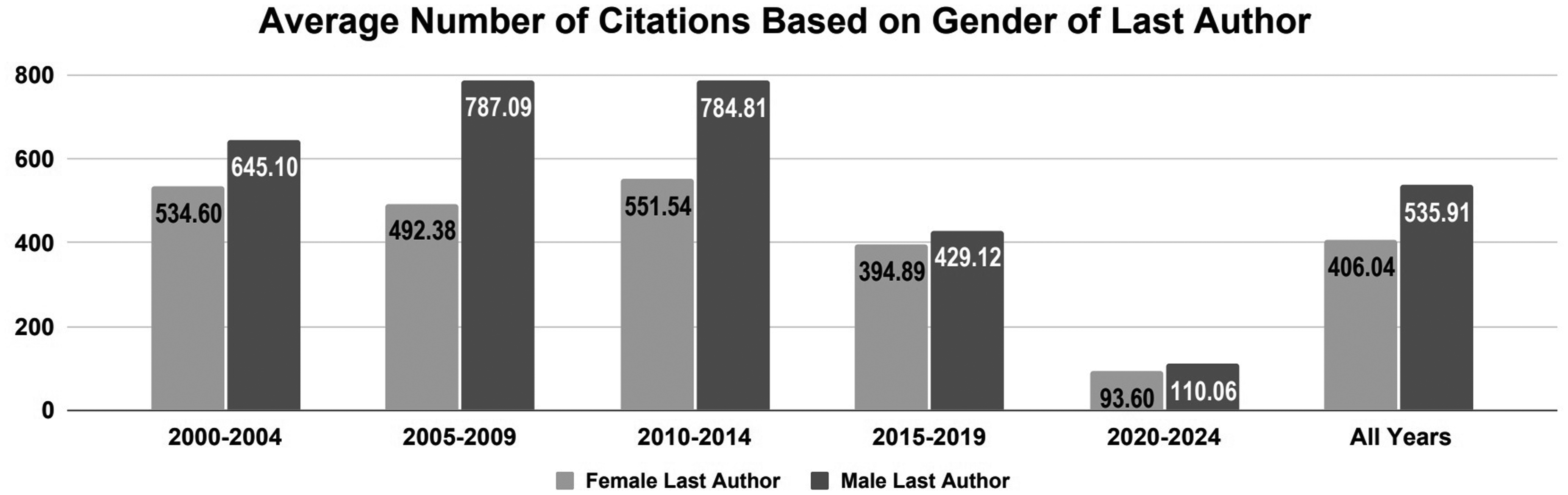
Average number of citations based on gender of last Author, 2000–2024.
The null hypothesis assumes that mentorship pairings occur randomly. A chi-square goodness-of-fit test was used to compare observed mentorship pairing frequencies to those expected under the assumption of random pairing based on overall junior and senior gender distributions. The analysis found no statistically significant difference between observed and expected pairing rates (χ²(3, N = 192) = 1.58, p = 0.66). Each of the four pairing types (male–male, male–female, female–male, female–female) occurred at roughly the rate expected by chance.
While not statistically significant, male-male and female-female pairings are both slightly more observed than expected, which may suggest a mild preference or tendency toward gender concordance in mentorship. Regarding gender-discordant mentorship pairings, female junior / male senior pairings were less common than expected (20.31% observed vs 23.30% expected), while male junior / female senior mentorships met expectations.
Degrees held by gender
Overall, male authors were more likely to be ophthalmologists than female authors (62.66% vs 46.30%). Conversely, female authors were more likely to hold non-ophthalmology doctorates like PhD or PharmD degrees compared to male authors (67.59% vs 53.57%), be optometrists (10.19% vs 4.22%), or hold no doctoral degree (2.78% vs 1.30%). A chi-square test of independence revealed a significant association between gender and degree type (χ²(3, N = 416) = 13.57, p = 0.0036).
The percentage of women who were ophthalmologists increased from 23.07% (2000–2004) to 62.50% (2020–2024), while the percentage of male ophthalmologists remained stable (66.67% to 65.71%). Similarly, the proportion of women holding PhDs or PharmDs increased from 59.09% to 72.91%, and the proportion of women as optometrists increased from 7.7% to 13.0%.
Discussion
The results of this study highlight progress in ophthalmology research on gender equity but underscore the persistent underrepresentation of female authors and researchers. Women were not only less frequently featured than men in high-impact ophthalmology journals, but they also received fewer citations, particularly among female first authors. These gaps in presence and recognition of women may reflect disparities in institutional support or implicit bias in citation practices by other researchers. The citation gap by gender also suggests lower visibility of female researchers, impacting their recognition, and possibly influenced by the size and reach of their professional networks. The high gender concordance among male co-authors points to a well-established, large male ophthalmologist professional network. If researchers are more likely to cite familiar names (e.g., names seen at conferences or within professional circles), this reinforces that established male networks may pose a visibility advantage. This highlights the importance of expanding female ophthalmologist networks to increase women researchers’ visibility.
A notable strength of this study is its inclusion of degree distribution by gender to highlight differences in professional backgrounds. Female authors were more likely to hold PhD, PharmD, and OD degrees, whereas male authors were more often ophthalmologists. This distinction may reflect better gender balance in optometry and basic science fields compared with ophthalmology. For example, women make up 46.1% of practicing optometrists. 11 However, gender disparities persist even in these disciplines, including compensation inequities. 27 Further research is needed to clarify why gender representation differs across training pathways related to eye health and, therefore, vision research. Importantly, promoting interdisciplinary collaboration with female optometrists, research scientists, and ophthalmologists may be a possible avenue to reduce the research gender gap and increase female representation in ophthalmic publications.
Additionally, a gender imbalance in mentorship and collaboration patterns is noted. Male authors were far more likely to co-author with other men, while female–female co-authorship remained rare (7.81%). Further, female authors were most underrepresented in the last authorship position, despite an overall 43.73% rise in female authorship over the last 25 years. This may reflect the reality of the smaller presence of senior female mentors, but may also indicate that male researchers may show a tendency to associate or interact with others of the same gender, coined as gender homophily.28,29 Same-gender mentorship is beneficial for fostering belonging, career advancement, and navigating gender-specific challenges through shared experiences, yet female junior researchers have fewer opportunities for this kind of support. Institutional efforts to expand mentorship, such as through formal mentoring programs, may help address this disparity. Higher rates of female authorship were associated with more female co-authorship, reinforcing the impact of having women available to support each other in academic spaces.
Notably, gender-concordant relationships were observed at higher rates than expected, although not at a statistically significant rate. Male senior and female junior mentorship pairings were observed at lower rates than expected, although further research is needed to explore whether this stems from mentor or mentee preference (e.g., whether women have less access to high-profile male mentors or if they prefer female mentors).
A limitation of the study is the assumption that author order reflects mentorship relationships. The study also can not evaluate informal or off-paper mentorship relationships that are not reflected in author pairings. While last authorship is usually associated with seniority, it does not always indicate a formal mentorship dynamic and may not universally apply, especially in interdisciplinary, multi-institutional, or basic science collaborations. In such contexts, the first author may be a more senior contributor, and mentorship dynamics may be distributed or not reflected in authorship order at all. While gender concordance in authorship still offers valuable insight into collaboration patterns and the persistence of male representation, interpretations regarding mentorship should be approached cautiously. Co-authorship patterns also still provide valuable insight into the value of women's collaborations in supporting female career success. These findings are supported by prior research—for example, a 2020 study found that while only 23.9% of program directors in cornea and anterior segment fellowships were women, they were significantly more likely to be found in departments led by female chairs, highlighting the impact of women in leadership on promoting women's academic advancement. 30
Another limitation is the focus on the most cited articles from high-impact ophthalmology journals based on the 2022 h5-index. This approach was intentionally chosen to examine gender representation within the field's most visible and influential research outputs. By targeting highly cited work in prestigious journals, the aim was to assess representation at the highest levels of academic recognition, offering a complementary perspective to prior studies that have evaluated broader or more generalized publishing trends. However, this strategy likely overrepresents established research groups. The pronounced male predominance observed in our findings reflects the visibility gap for early-career researchers and less-cited yet valuable contributions, possibly from women and underrepresented groups. While this approach offers insights into high-impact academic visibility, it limits the generalizability of findings to the broader ophthalmology research landscape. Our analysis also included the journal, Progress in Retinal and Eye Research, which primarily publishes retina research. Because retina remains a male-dominated subspecialty, authorship in this journal may underrepresent women compared with other subspecialities, such as pediatric ophthalmology, where women are more highly represented. Nevertheless, we intentionally selected high-impact journals to capture authorship in the most visible and influential research. This journal's high visibility and influence may reflect broader trends in ophthalmology, where male-dominated fields receive greater recognition and prestige, and may influence authorship visibility across subspecialties.
The findings elucidated in this study emphasize the need for targeted institutional efforts to promote equity in authorship, mentorship, and recognition of women in ophthalmology. Visibility in high-impact journals and strong citation counts are critical for advancing careers in research through greater outreach and opportunity for future collaborations. Organizations such as Women in Ophthalmology (WIO) and Envision Summit have already contributed meaningfully to these efforts by promoting female networking with female membership across all training levels and interdisciplinary teamwork with optometrists and research scientists. Continued support for promoting female ophthalmic career networks is essential to closing the gender gap in research and fostering equitable professional advancement.
Supplemental Material
sj-pdf-1-ejo-10.1177_11206721251388307 - Supplemental material for 25-year analysis of gender and professional trends in authorship of highly cited articles in leading ophthalmology journals
Supplemental material, sj-pdf-1-ejo-10.1177_11206721251388307 for 25-year analysis of gender and professional trends in authorship of highly cited articles in leading ophthalmology journals by Angelica Piccini, Amaal Khan and Donald Solomon in European Journal of Ophthalmology
Footnotes
Acknowledgments
The authors would like to thank Cooper Health Care for general support.

Ethics approval statement
The Ethical Committee deemed this study exempt from required approval due to involving publicly available data without patient involvement.
Authorship contribution statement
All authors contributed to the conception, design, data collection, analysis, and interpretation of the study. All authors approved the final version for submission.
Funding
The authors received no financial support for the research, authorship, and/or publication of this article.
Declaration of conflicting interests
The authors declared no potential conflicts of interest with respect to the research, authorship, and/or publication of this article.
Data availability statement
The datasets generated and analyzed during this study are available from the corresponding author upon reasonable request. All data were obtained from publicly accessible journal articles and institutional profiles.
Supplemental material
Supplemental material for this article is available online.
References
Supplementary Material
Please find the following supplemental material available below.
For Open Access articles published under a Creative Commons License, all supplemental material carries the same license as the article it is associated with.
For non-Open Access articles published, all supplemental material carries a non-exclusive license, and permission requests for re-use of supplemental material or any part of supplemental material shall be sent directly to the copyright owner as specified in the copyright notice associated with the article.
