



Abstract
Purpose
Geographic atrophy (GA) is a severe complication of age-related macular degeneration (AMD) and leads to irreversible visual decline. To date, no effective treatment is available for GA patients. However, a number of new therapies have recently been approved and several others are in the pipeline. This rapid evolution of prospects for GA patients requires constant updating of ophthalmologists’ understanding of GA and its management so as to provide the appropriate treatment. For this reason, Società Italiana di Scienze Oftalmologiche (S.I.S.O.) has designed a specific survey to gauge the position of Italian ophthalmologists in this regard.
Methods
The three hundred and sixty-five Italian ophthalmologists who agreed to take part received a seventeen-part questionnaire guaranteeing privacy and anonymity. The survey was compiled through an online portal and the results were sent directly to S.I.S.O. ETS. Two graders analyzed the data and recorded the results.
Results
The results showed a high level of self-assessed awareness and understanding of GA, as well as considerable willingness to further improve knowledge of the disease. Most of the participants claimed to have effective rules of conduct in place for managing GA patients, including prompt response, involving a high prevalence of nutraceutical prescriptions and lifestyle recommendations.
Conclusions
This survey provided an overview of how GA patients are managed in Italy. The Italian ophthalmology community appears to be ready to adopt the upcoming treatments for GA.
Introduction
Geographic atrophy (GA) is a severe complication of age-related macular degeneration (AMD) leading to severe visual deterioration – up to legal blindness. 1 GA is considered to have a high clinical and psychological impact on AMD patients on account of the lack of therapeutic options. However, the situation is changing, and new therapies are almost ready to be introduced in clinical practice. 2 A potentially powerful therapeutic mechanism is the inhibition of the complement system. 3 A good example is pegcetacoplan (Apellis Pharmaceuticals), the first approved C3 complement inhibitor, which is associated with significantly slower growth of GA lesions.4,5 However, many other molecules are proving to be promising avenues in the treatment of GA, including the recently approved C5 inhibitor avacincaptad pegol, as well as many other medications.6,7 In this evolving scenario, ophthalmologists are called upon to improve their awareness and knowledge of GA, so as to be able to select and manage patients effectively and be in a position to take advantage of these emerging treatments.
Società Italiana di Scienze Oftalmologiche (S.I.S.O.) ente del terzo settore (ETS) is the largest Italian ophthalmological association and its aim in this survey was to identify the main unmet needs in the management of GA patients. SISO ETS developed a concise questionnaire designed to test Italian ophthalmologists’ level of awareness of GA, ascertain their current mode of management of the condition, and gauge their willingness to increase their knowledge about it. It was the objective of S.I.S.O. ETS to provide a general picture of the state of affairs in Italian ophthalmology in this regard, with a view to paving the way for the introduction of these new GA therapies.
Methods
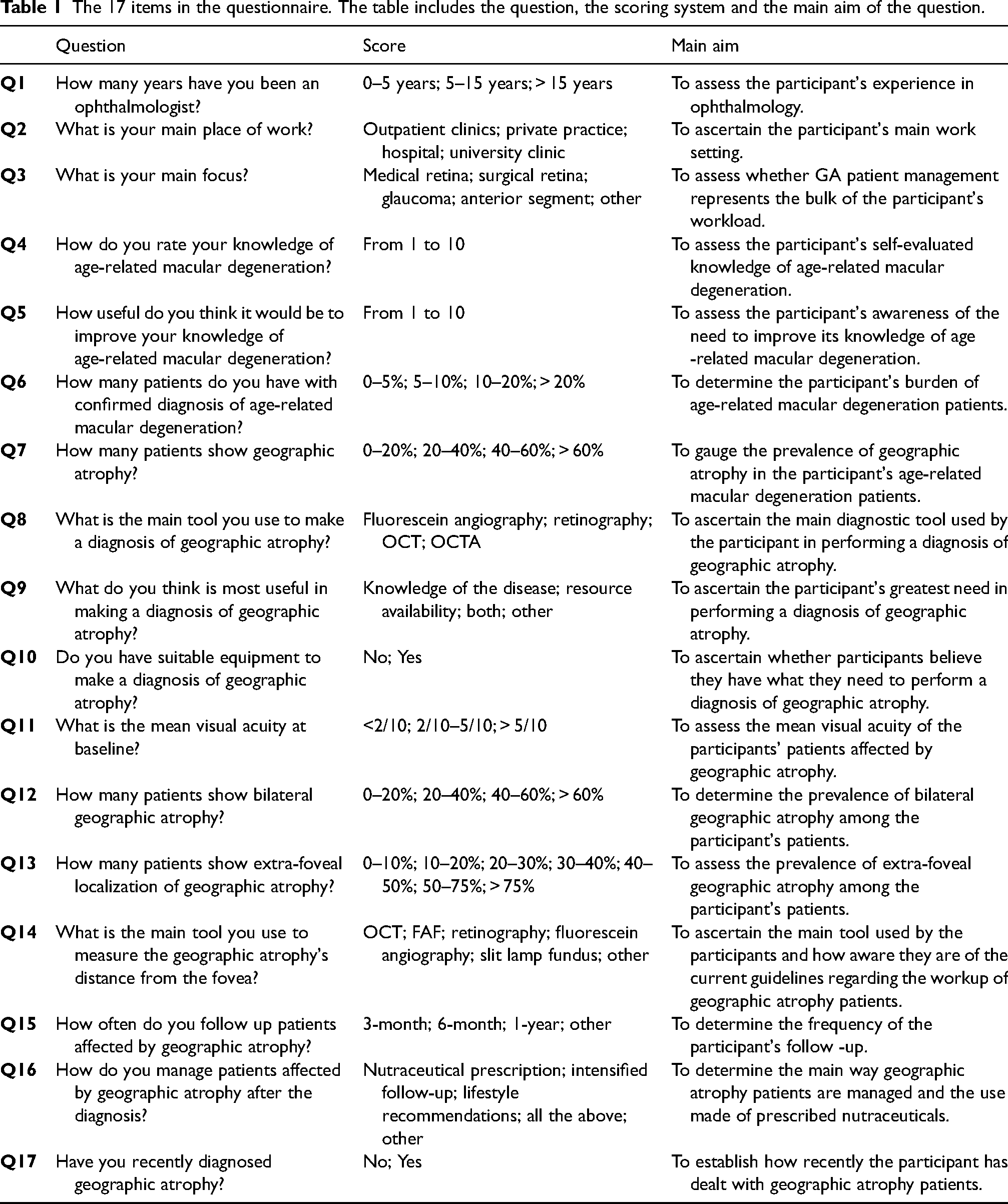
This survey was developed by S.I.S.O. ETS. The questionnaire included seventeen queries, formulated to obtain information regarding the current management of patients affected by GA in Italy (Table 1). The questionnaire, designed to take no more than 10–15 min to complete, was accessible through a web link sent by an official S.I.S.O. ETS email. The list of ophthalmologists was obtained from the association's database, and privacy and anonymity was guaranteed throughout. The results were sent directly to S.I.S.O. ETS and were automatically extracted. They were then analyzed by two expert graders (AA, EA), who also checked the literature to compare the findings with official data regarding the prevalence and clinical characteristics of geographic atrophy. The answers in the questionnaire were also converted into histograms in the interests of readability. Since this was a simple record of the survey's findings, no statistical analysis was needed. For each answer, we calculated the 95% confidence interval by using Wilson score interval with finite population correction adjustment.
The 17 items in the questionnaire. The table includes the question, the scoring system and the main aim of the question.
Results
This questionnaire was sent to more than 1500 ophthalmologists practising in Italy, and we received data from 365 throughout the country. Of these, 195 (54%) stated they had been practising for over 15 years, whereas 110/365 participants (30%) said they had under 5 years’ experience. The remaining 60 participants (16%) declared they had qualified 5 to 15 years before. The survey found the physicians were evenly distributed among hospitals (34%), private practice (29%) and university hospitals (32%). In only 5% of cases did participants cite outpatient clinics as their main place of work. The majority of participants mentioned the medical retina as their main field of interest (45%); the others referred to the surgical retina (21%), glaucoma (15%), anterior segment (16%), and other (3%) ocular features. A large majority of participants (79%) claimed to possess a very good knowledge of AMD (score >7), and fully 87% considered it would be very useful (score >7) to improve their understanding of AMD. Thirty-four percent of all participants stated that at least 10–20% of their patients were affected by AMD, 32% that more than 20% of their patients suffered from AMD, and 28% that 5–10% of their patients were so afflicted. The remaining 6% of participants declared that only 0–5% of their patients were affected by AMD. Fifty-five percent of participants stated that only 0–20% of their AMD patients experienced GA, whereas 32% of participants affirmed that 20–40% of their AMD patients were in this condition. Eleven percent of participants declared that GA was present in 40–60% of cases, while 2% asserted that >60% of their AMD patients were affected by GA. Most of the participants (81%) had recently performed a GA diagnosis. Optical coherence tomography (OCT) proved to be the favored instrument in performing the diagnosis (60% of cases), followed by retinography (25%), OCTA (9%), and fluorescein angiography (6%). Almost all the participants (94%) declared that both a good knowledge of the disease and resource availability were necessary to perform a successful diagnosis of GA, and 90% of participants stated they had suitable equipment to perform such a diagnosis.
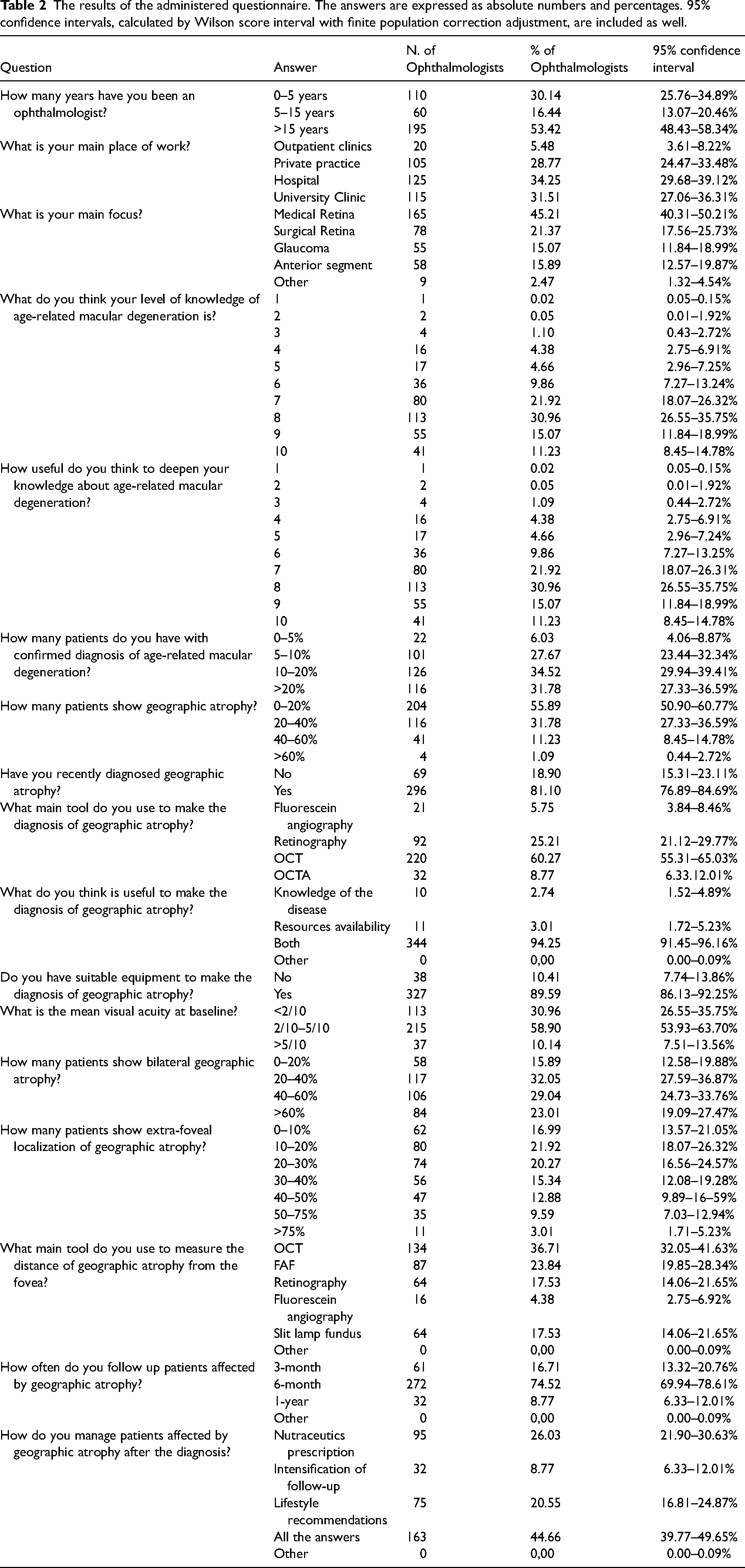
Regarding the visual acuity of GA patients, 59% of participants recorded a visual acuity between 2/10 and 5/10, while 31% registered a visual acuity lower than 2/10. The remaining 10% of participants found a GA visual acuity higher than 5/10. GA bilaterality was reported as follows: 20–40% (32% of participants), 40–60% (29% of participants), > 60% (23% of participants) and 0–20% (16% of participants). The reported extra-foveal localization of GA was quite variable, with the highest prevalences being 10–20% (22% of participants) and 20–30% (20% of participants). OCT is the tool of choice to measure the GA's distance from the fovea for 37% of participants, whereas 24% preferred FAF, 18% opted for slit lamp fundus examination, a further 18% turned to retinography, and only 3% chose fluorescein angiography. A large majority of the participants (75%) included a follow-up of 6 months, 16% deemed a shorter, 3-month follow-up more appropriate, and the remaining 9% were happy with a 1-year follow-up. Lastly, 45% of participants asserted they made use of all current GA management strategies (nutraceutical prescriptions, intensification of follow-up and lifestyle recommendations), whereas 26% of cases were treated with nutraceuticals alone, 21% of participants only provided lifestyle recommendations and 8% restricted themselves to merely intensifying the follow-up. All the answers are extensively reported in Table 2 and are plotted in Figure 1.
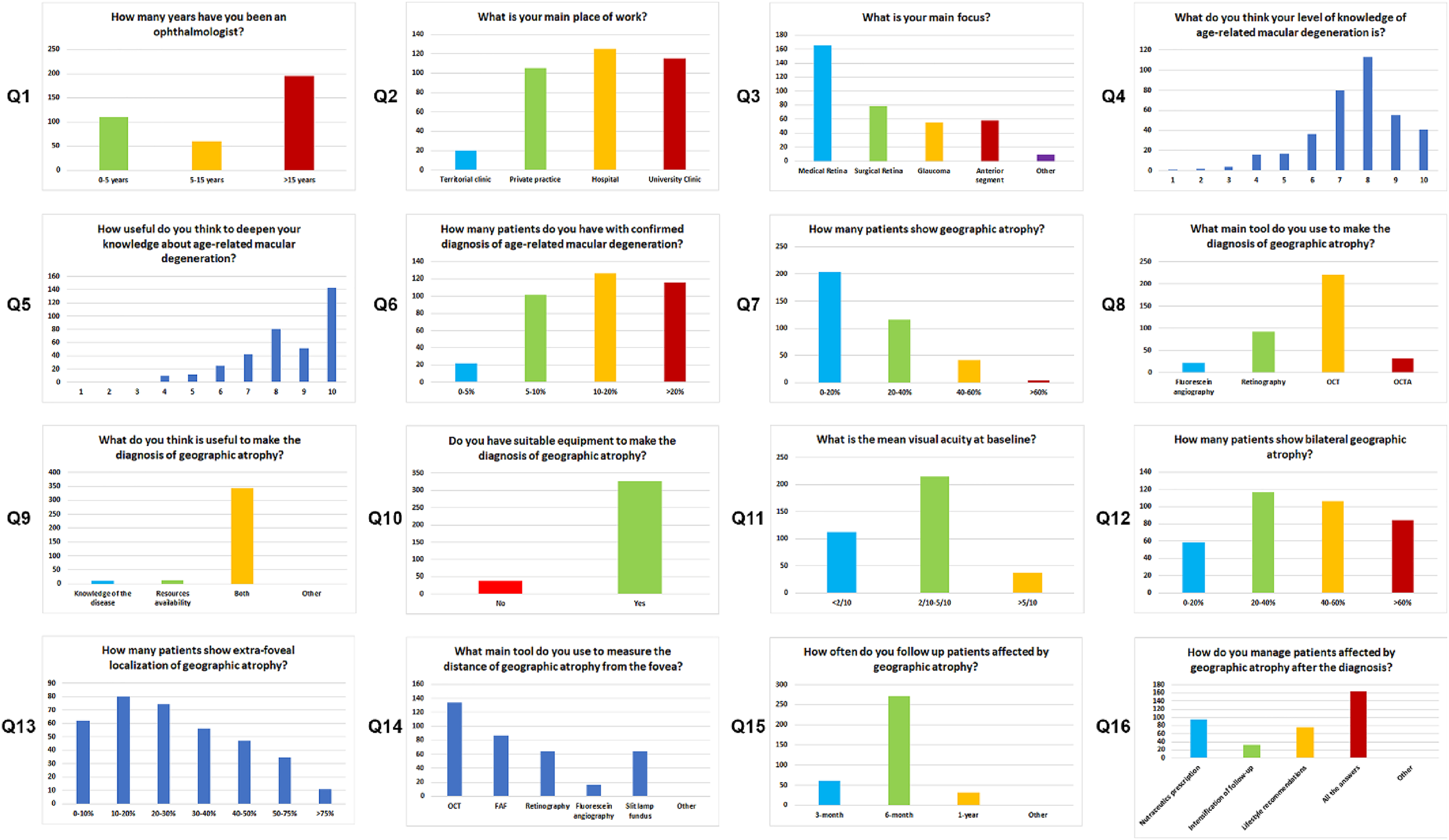
Histograms showing the distribution of the answers for each question.
The results of the administered questionnaire. The answers are expressed as absolute numbers and percentages. 95% confidence intervals, calculated by Wilson score interval with finite population correction adjustment, are included as well.
Discussion
This survey involved 365 Italian ophthalmologists and was successfully able to provide an overall picture of GA awareness and management in Italy. Most of those agreeing to take part were experienced ophthalmologists concentrating mainly on the medical retina subspecialty. The survey showed their place of work to be evenly distributed among private clinics, hospitals and university clinics. Most of the participants claimed to have a good knowledge of GA, in accord with their primary subspecialty. At the same time, the survey revealed they were enthusiastic about improving their understanding of GA. The declared prevalence of patients affected by AMD was 10–20%, and this was quite in line with data for developed countries around the world.8,9 The most commonly reported prevalence of GA was 0–20%, and this also tallied with findings in the literature.8,9 OCT proved to be the favorite instrument in performing the diagnosis of GA, and this agreed with the leading diagnostic consensus guideline prescribed by the Consensus on Atrophy Meeting (CAM) group, which identifies OCT as the main diagnostic means of assessing and defining atrophy. 10 The majority of participants stated they had access to suitable equipment to perform the diagnosis; this suggests a good workup can be obtained throughout Italy. The most prevalent visual acuity range was 2/10–5/10, thus suggesting that at least 59% of patients show mild deterioration of the macula and are therefore potentially optimal candidates for therapies. At least 40–60% of patients appeared to show bilateral GA, agreeing with data in the literature showing that bilateral GA occurs in 48–65% of cases.11–13 The survey revealed high variability when assessing the prevalence of extra-foveal GA localization. This finding may agree with the different patterns of GA phenotypes previously described and associated with different severity and progression rates.14–16 OCT and fundus autofluorescence proved to be the participants’ primary diagnostic tools to measure the distance of GA from the fovea, another finding that closely matched the literature. A 6-month interval was the favored follow-up strategy. This approach perfectly dovetailed with the Delphi GA management consensus (GA-MAC) recommendations. 17 As regards the various management strategies, including prescribing nutraceuticals, recommending lifestyle changes and intensifying the follow-up, 45% of participants considered it useful to adopt all of these, while 26% only prescribed nutraceuticals and 21% of participants only provided lifestyle recommendations. This finding suggests the ophthalmologists involved take a pro-active stance. This choice agreed with the copious evidence of the benefits accruing from the administration of nutraceutical medications, principally in the Age-Related Eye Disease Study (AREDS) 1 and 2, 18 which also recommends lifestyle changes, such as adopting a Mediterranean diet, 19 quitting smoking, losing excess weight, and reducing exposure to sunlight.20–22
This study is limited by several limitations, especially the relatively small number of participants. The questionnaire has not been validated and some useful information is missing, for example infrared imaging for GA evaluation. For all these reasons, further larger studies with validated questionnaires and more robust statistical approaches are warranted to draw definite conclusions on the topic.
Considering the findings of this survey as a whole, Italian ophthalmologists appear to have good knowledge of GA and a great desire to improve it, appropriate clinical settings and equipment to perform the workup, as well as being ready to provide enthusiastic and prompt responses in the management of GA patients. All these findings, together with emerging treatments, offer hope for a better future for Italian patients affected by GA.
Footnotes
Declaration of conflicting interests
The authors declared no potential conflicts of interest with respect to the research, authorship, and/or publication of this article.
Funding
The authors received no financial support for the research, authorship, and/or publication of this article.
