



Abstract
This research analyses Spanish teenagers’ perceptions of political polarization, the role of social media in political debate and the normalization of hate speech in digital environments through four focus groups with 26 participants aged 16–17 from different regions of Spain. The results reveal a paradox: although adolescents recognize the importance of politics, they tend to disengage from political debates due to their association with conflict and social risk. Fear of judgement and exclusion leads them to restrict conversations to trusted circles, reinforcing ideological bubbles. In general, they do not trust schools as places to mitigate polarization. Gender differences in political engagement are modest: some female participants express emotional detachment from politics, fearing potential interpersonal conflicts. In contrast, male participants generally view ideological conflict as an inherent and acceptable part of democratic discourse. Social media, especially TikTok and Instagram, subtly shape their opinions through entertainment, contributing to the normalization of polarized narratives. Regional differences also emerge, with greater political engagement in nationalist contexts such as Catalonia and the Basque Country. This study highlights the importance of taking gender and regional context into account when fostering democratic engagement among young people.
Keywords
Introduction
During adolescence, young people develop their critical and analytical thinking while reflecting on the social, political and cultural norms that surround them. This stage is crucial for shaping their political identity and their participation as citizens (Wachs et al., 2023). Academic research on young people’s political interest has produced mixed results. Some studies highlight their apparent indifference (Dahl et al., 2017), linked to a deep distrust of institutions and the perception of politics as something distant or irrelevant. Other studies indicate that young people engage in non-conventional forms of participation, such as protest, digital activism or collective action around specific causes (Grassi et al., 2024). This form of participation is characterized by its artistic, disruptive or performative dimensions and often takes place through digital social media (Campos & Simões, 2024). Both institutional disaffection and new forms of youth political engagement coexist with phenomena such as ideological polarization and hate speech, which are increasingly present in digital spaces.
This article examines how Spanish adolescents aged 16 and 17—at the stage immediately preceding their eligibility to vote—position themselves in relation to political polarization and hate speech on social media. In Spain, as in other European countries, deep divisions can be observed in the political sphere (Torcal & Thomson, 2023), partly linked to the rise of populist parties (Fuller et al., 2022). Extreme ideology is not a necessary condition for polarization, but its discourses contribute to fuelling divisions and resentment (Mason, 2018). These narratives are amplified in digital media, where adolescents consume and interact with political content.
Various studies highlight parents as the most influential socialization agents during adolescence, even from an early age (Tyler & Iyengar, 2023). If parents are influenced by political polarization, they transmit those perspectives to their children (Okolikj & Hooghe, 2023). Likewise, peer pressure and the school environment contribute to shaping polarized political attitudes (de Haan, 2023), as increasing socio-economic and cultural segregation in educational institutions deepens the divide among youth groups (Damhuis & Wansink, 2024). In this sense, polarization is understood not only as an ideological phenomenon but also as an emotional and social dynamic that has concrete effects on adolescents’ relationships.
The coexistence of these phenomena—institutional disaffection, commitment to specific causes and the rise of polarizing discourse—calls for a revision of traditional interpretive frameworks. This article examines how Spanish adolescents navigate these tensions, focusing on their perceptions of politics, their involvement in digital discourse and the ways polarization manifests among peers in digital environments.
Political Polarization, Hate Speech and Social Media
Political polarization can manifest in at least two distinct ways (Kubin & Sikorski, 2021), although in practice they tend to overlap (Rogowski & Sutherland, 2016). On the one hand, ideological polarization refers to the conflict between opposing ideas and principles in the political arena. On the other hand, affective polarization refers to emotional animosity towards opposing groups, based on subjective perceptions of belonging to opposing social categories. This second form primarily depends on a visceral rejection of the ‘other’ and becomes a form of group identity that reinforces internal cohesion (Iyengar et al., 2018) while also increasing distrust of opposing groups, hindering democratic deliberation (Tyler & Iyengar, 2023).
Affective polarization is particularly relevant among adolescents. In their political formation process, young people not only adopt ideas but also form emotional bonds with groups, symbols or narratives that reinforce their sense of belonging. Among the factors that facilitate these emotional bonds are populist movements, as adolescence is a particularly receptive stage for such messages (Jungkunz & Weiss, 2024). Right-wing and far-left extremist groups exploit this framework to attract discontented youth, offering simplified explanations and direct solutions to their social and personal grievances (Schils & Verhage, 2017).
In recent years, there has been a notable increase in youth support for right-wing populist parties in countries such as France, Italy (2022) and Spain (2023). This phenomenon coincides with a polarized political context that limits adolescents’ ability to learn from disagreement (Silva & Borges, 2024). While Abou-Chadi (2024) suggests that young men are more likely than young women to consider voting for far-right populist parties in the future, Erzeel et al. (2024) argue that anger towards the political system can influence voting patterns towards these parties in both genders. Differences in political engagement appear clearer: young women are more likely to engage in ‘private’ political actions, while young men tend to favour more collective or direct forms of involvement (Coffé & Bolzendahl, 2021).
Overall, as respect for diversity decreases, expressions of symbolic or physical violence, including hate speech, may emerge. However, not all polarization is detrimental to democracy. Some social movements, such as Black Lives Matter, can play a mobilizing role. This does not imply that extreme or offensive speech is also not disseminated from progressive positions (Kreiss & McGregor, 2024). In this context, social media plays a key role in shaping youth political identity, alongside other socialization agents. It is their primary source of information where they build and reinforce their identity (Pérez-Torres, 2024). Social media strengthens their beliefs through echo chambers, ideological filters and information bubbles (Brüggemann et al., 2020). These dynamics vary: while X (formerly Twitter) fosters open and hostile confrontation (Yarchi et al., 2021), TikTok encourages emotional communication within ideologically cohesive groups (Wojcieszak et al., 2022).
These dynamics are exacerbated by the circulation of hate and misinformation. Various studies indicate that young people are the most affected age group by online hate speech (Kansok-Dusche et al., 2023; Pfetsch & Ulucinar, 2023), especially if they are politically engaged or belong to social minorities (Obermaier & Schmuck, 2022). Such content is associated with emotions such as anger, contempt and fear (Vasist et al., 2024), which dehumanize the opponents and exacerbate affective polarization. Finally, recommendation algorithms play a decisive role in amplifying these messages: adolescents consume, share and validate hostile messages that reinforce their worldview and group identity.
Hate speech fuels polarization. Ideologically motivated hate speech presents opposing political ideas as morally inferior or dangerous, stigmatizing those who defend them (Paz-Rebollo & Segado-Boj, 2025). These messages can vary in intensity, ranging from insults to incitements to violence. Both verbal abuse and violence are, in certain contexts, justified as legitimate forms of defending one’s beliefs.
Research on hate speech and its impact on adolescents has primarily focused on the consequences for victims (Obermaier & Schmuck, 2022) and the effects of exposure to such content (Rad & Demeter, 2020). There is concern that frequent contact with these comments not only leads to desensitization (Soral et al., 2018) but also fosters indifference and contributes to the normalization of prejudice (Uyheng & Carley, 2021). Furthermore, it may encourage the spread of similar expressions, as it disinhibits such behaviour among those who share the same ideological perspective (Álvarez-Benjumea, 2023).
Beyond its individual effects, political hate speech has been examined from two complementary perspectives. First, researchers have analysed how certain political actors—especially right-wing populist parties—foster the polarization of public discourse and encourage expressions of hate. Although there are contextual differences between countries such as Spain (Cepeda‐García de León et al., 2022), the United Kingdom (Finlayson, 2022) and Turkey (Peck, 2022), a common use of hostile rhetoric (Prior, 2021) and strategies aimed at discrediting minorities (Matamoros-Fernández & Farkas, 2021) is observed.
Second, hate speech directed at politicians has been addressed, with studies conducted in countries such as Norway (Bjørgo & Silkoset, 2018), Germany (Bauschke & Jäckle, 2023) and the United Kingdom (Gorrell et al., 2020). From this perspective, researchers examine how such expressions—often highlighting the alleged ineptitude or moral depravity of political figures (Paz-Rebollo et al., 2021)—affect young people’s trust in democratic systems.
The Spanish Context
According to Eurostat (2024), 97% of Spanish youth aged 16–29 access the internet daily, and 88% regularly use the social media. In a sample of 1,043 minors aged 12–18, 70.7% used TikTok and 63.8% used Instagram (Virós-Martín et al., 2025). Additionally, one in five young people spends more than 2 hours a day on TikTok, with significantly higher percentages among girls (24.4%) compared to boys (15.5%). These gender differences are also reflected in the type of content consumed: teenage girls lean towards topics such as fashion, beauty and self-expression, while boys prefer video games and sports (Suárez-García & Álvarez-García, 2023). Moreover, a high percentage of young people actively participate in content creation, which increases their exposure to a communicative environment that can be polarized and, at times, toxic.
In fact, a national survey confirms that Spanish youth aged 16–24, along with women and those ideologically positioned on the left, consider themselves the group most affected by hate messages (Cáceres-Zapatero et al., 2023). Ideology is identified as the primary cause of discrimination: 85.6% of young people reported seeing hate messages motivated by ideological reasons (Samy-Tayie et al., 2023). In this sense, political identity functions similarly to other relevant social identities, such as gender, ethnicity or sexual orientation (Lay et al., 2023).
This growing exposure to hostile ideological discourse is amplified by the national political situation, characterized by significant fragmentation and polarization. In the general elections of July 2023, the People’s Party (centre-right) won 137 seats, and the far-right party VOX, although it lost votes, solidified itself as the third most-voted party with 33 seats. The Socialist Party, with 121 seats, assumed the presidency after negotiating with Sumar (a left-wing coalition, partially succeeding Unidas Podemos) and various separatist parties, which enabled the appointment of Pedro Sánchez as prime minister.
The 2024 voting projections (40dB, 2024) suggest that VOX would achieve its best results among the youngest voters (25%). However, this pattern does not repeat in autonomous communities with strong identity cleavages, such as the Basque Country, Catalonia, Galicia or Navarra (Linz, 1993), where the party’s growth is marginal. Therefore, it is especially relevant to explore the political positioning of adolescents in regions with a stronger nationalist tradition, such as Catalonia and the Basque Country. In parallel, data on youth political participation reflect a significant tension: 30% of young people report that they would vote blank or null, and 26% of males in this age group state that, ‘in some circumstances’, they would prefer an authoritarian regime over a democratic one. Additionally, the latest barometers from the CIS (2024) list ‘political issues’ among the top concerns of the Spanish population, reflecting the widespread perception of a society that is increasingly polarized.
Overall, the Spanish case presents a complex landscape where adolescents, active participants in the digital sphere, face significant exposure to hate speech based on ideological reasons, in a polarized political context where both far-right and far-left populisms play a prominent political role.
Methodology
This study aims to analyse the presence of political polarization in the daily lives of Spanish adolescents, as well as to examine their attitudes towards this phenomenon (Research Question 1). Furthermore, it is pertinent to identify the social media platforms they use most frequently and explore whether they are aware of how these platforms may contribute to their political polarization (Research Question 2). Third, regarding political hate speech—linked to polarization and populist dynamics—the study seeks to determine whether Spanish youth can identify such discourse and how they evaluate it (Research Question 3). Finally, the study explores the potential influence of the independence movements in the Basque Country and Catalonia on their political attitudes (Research Question 4).
A qualitative methodology is employed in this study to analyse Spanish adolescents’ perceptions of political polarization, the use of social media in political debates and the normalization of hate speech in digital environments. To achieve this goal, focus groups were conducted as the primary data collection technique, allowing for an in-depth exploration of participants’ experiences, attitudes and discourse on these topics.
Four focus groups were organized with a total of 26 adolescents (14 males and 12 females), aged 16–17 years, from different autonomous communities in Spain (Table 1). A combined recruitment strategy was employed to select participants. For the focus groups consisting of adolescents from the Basque Country and Catalonia, the research team presented the project to the principals or heads of studies of 118 schools in the Basque Country and 31 in Catalonia during November 2024. In addition, 6 parents’ associations (AMPA) and 60 youth organizations in the Basque Country were contacted, as well as 4 AMPA and 72 youth organizations in Catalonia. The same procedure was applied for the remaining two focus groups, with 206 schools and 40 youth organizations contacted in various regions of Spain. These individuals were responsible for disseminating the information to the students. Interested students expressed their willingness to participate by sending an e-mail. In the pre-participation questionnaire, participants were asked to provide basic demographic information (age, gender, municipality of residence, availability, etc.). They were also asked to classify their household’s financial situation as low, medium or high according to their personal perception.
Composition of the Discussion Groups by Number of Participants, Region and Socio-economic Status.
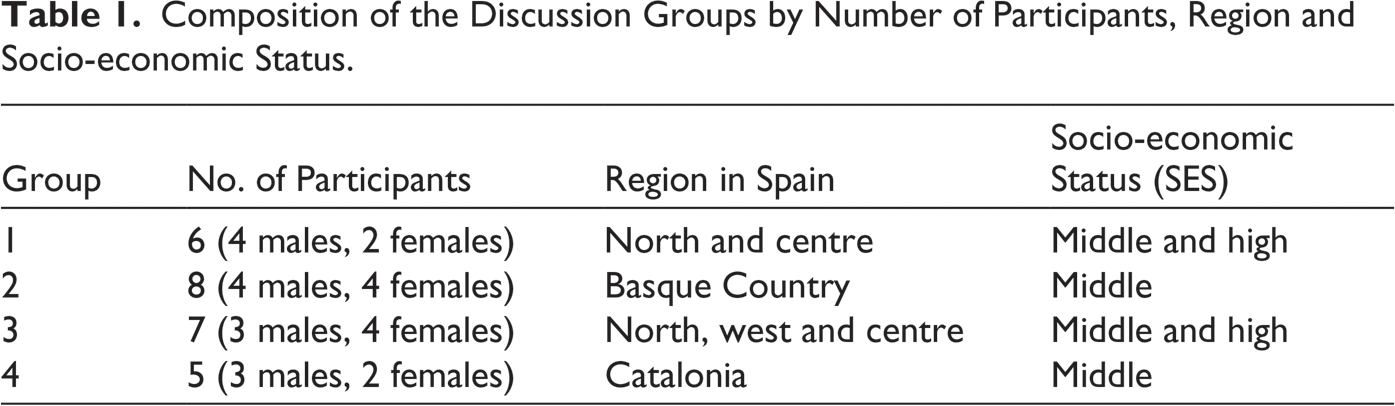
The heterogeneity in the composition of the focus groups allowed for contrasting perceptions of political polarization in autonomous communities with differentiated political contexts, particularly Catalonia and the Basque Country. In these areas, political discourse is framed around notions of identity and collective belonging, making them particularly relevant contexts for analysing political socialization in adolescence.
The focus groups were conducted virtually via Microsoft Teams in December 2024, each lasting approximately 60–90 minutes. The sessions were moderated by a researcher who facilitated the discussion via a semi-structured question guide, which was structured around three main themes aligned with the igurefollowing research questions:
RQ1: Perception of politics and political polarization—The participants discussed their level of interest in politics, their perception of polarization and how political debate affects interpersonal relationships. RQ2: Use of social media and its role in political polarization—This section explores the most frequently used platforms, exposure to political content and influence of algorithms on polarization. RQ3: Identification and evaluation of political hate speech—The participants analysed their ability to recognize political hate speech, the main formats in which it appears—especially memes—and the normalization of aggressive discourse on social media.
The same semi-structured script was used in all cases, with slight adaptations for the groups in the Basque Country and Catalonia to include specific questions related to their geographical and cultural contexts. This structured approach ensured coherence across sessions while allowing the participants to freely express their ideas, fostering a dynamic and spontaneous exchange. All sessions were recorded with participants’ consent and later transcribed verbatim for analysis.
Data Analysis
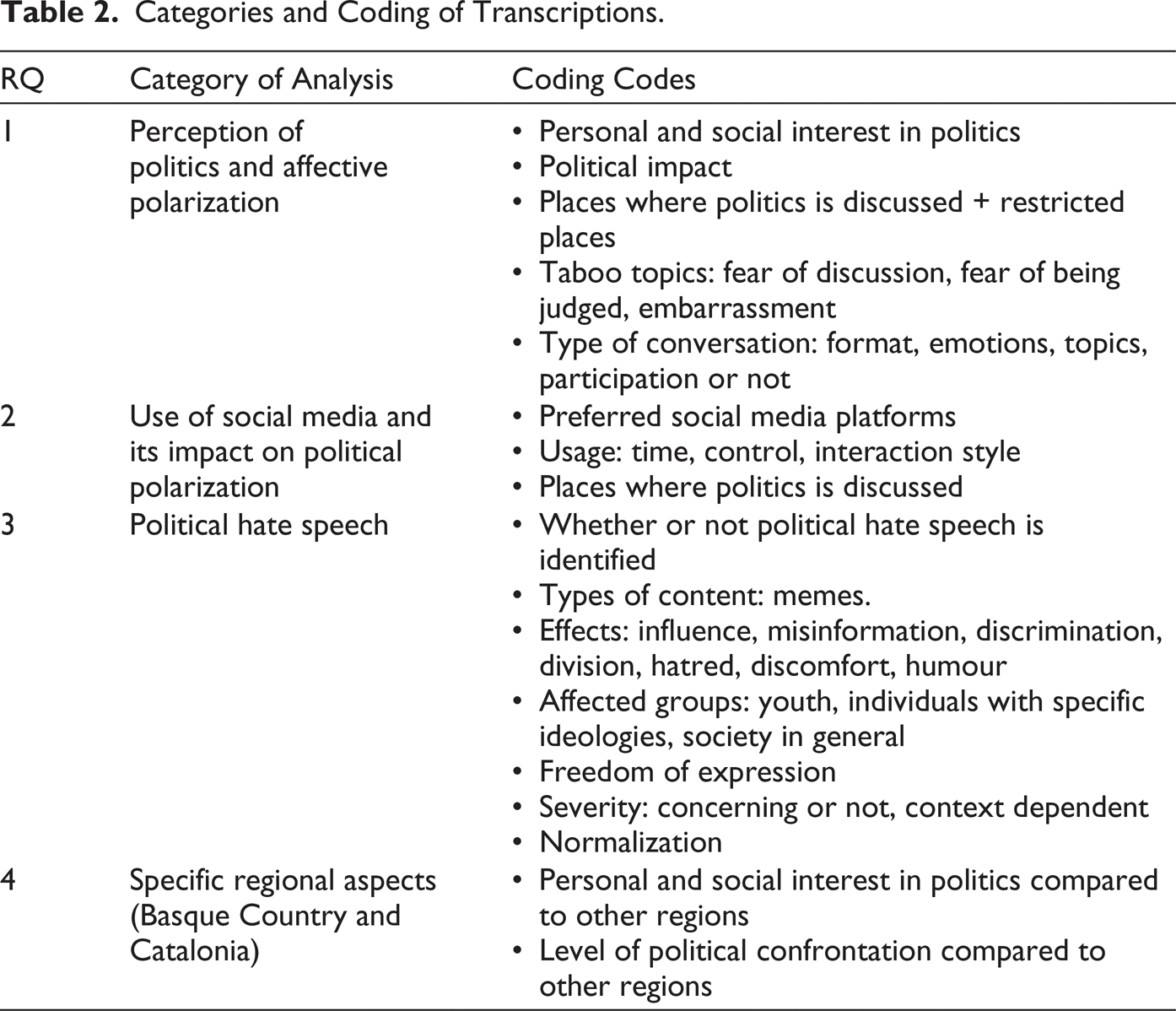
For data analysis, the statistical software MAXQDA was used to organize, systematize and code the transcripts. The coding process combined deductive and inductive approaches. The deductive approach relied on predefined categories on the basis of the study’s objectives and the themes included in the script. Simultaneously, an inductive approach was used to identify emerging codes and subcodes that arose from the group discussions.
The categories of analysis, along with the main codes and subcodes, are detailed in Table 2.
Categories and Coding of Transcriptions.
This study was conducted following ethical principles for research involving minors and adhered to the guidelines of the Declaration of Helsinki. Ethical approval was obtained from the Ethics Committee of Universidad Complutense de Madrid (Spain) University (Ref: CE_20240509_02_SOC). Additionally, we obtained an informed consent from all of the participants and their legal guardians, ensuring voluntary participation and respecting privacy and confidentiality.
Results
Politics, an Uncomfortable Topic
The analysis of the focus groups shows that participants exhibit a medium to low interest in politics, at both individual and social levels. This disinterest is explained by two main reasons: apathy and distrust. First, many young people consider political debate to be complex, tedious and lacking in practical utility. This perception discourages them from informing themselves or participating in discussions on the subject. Second, there is a widespread belief that the political system is ineffective and unrepresentative, which fuels scepticism and a lack of political engagement.
Female P3: Me, more like … interested? Not really. I think it’s a topic that causes me quite a bit of … rejection. (Group 1: 3 December 2024, General)
This low valuation of politics extends to the social sphere: respondents do not find incentives to discuss these topics with others either. This lack of dialogue is reinforced by the idea that politics is a source of division rather than consensus, which they directly associate with affective polarization, described as follows: ‘They argue … without having arguments’ (Male P5, Group 1: 3 December 2024, General). Politics is also a conflictive topic in these teenagers’ everyday lives, where group cohesion plays a highly relevant role in their social development.
The polarizing nature of political discussions leads many participants to avoid the topic, especially in contexts where their opinions may not be respected. Some of them noted that political confrontation often results in a lack of mutual understanding, making them prefer not to discuss political issues at all.
There is a clear fear of social judgement, which plays a crucial role in how adolescents engage (or avoid engaging) with politics in daily interactions. The perception that expressing a political opinion may lead to criticism or stigmatization fosters self-censorship, particularly in public spaces or ideologically diverse settings. As a result, most respondents restrict political discussions to small circles of trust and identify certain environments where politics should not be discussed, such as school or family gatherings, to avoid unnecessary tension.
Male P2: Yes. There are many people who hide it out of fear of what others will say. There are many people whose ideology … even though they strongly agree with it and are very sure of what they think, they’re not confident enough to tell anyone or share their opinion.
Female P6: I agree with what they said …, but it’s also true that even if you express your ideas calmly, if the other person doesn’t take it well and feels attacked—even if you said it politely—there could still be a conflict. (Group 3: 11 December 2024, General)
This behaviour may be related to the third-person effect, a psychological phenomenon in which participants believe that others are more influenced by political discourse than they are themselves. In this sense, informants may perceive society as more intolerant of differing opinions than it actually is, further reinforcing their reluctance to express political views publicly.
Another key finding is the way in which political polarization affects interpersonal relationships. For some respondents, ideological differences have created tensions within their friend groups and, in some cases, even led to friendship break-ups. Some participants reported that political disagreements caused internal conflicts among their friends, reinforcing the idea that polarization is not only a media or institutional issue but also impacts young people’s social and personal lives.
Male P2: I used to have a group of friends … And because of a disagreement—some thought one way and others another—we drifted apart. And I think that’s too much, just over an opinion you might have about something.
Interviewer: So, people are already affected at a relational level, in their social relationships.
Male P8: Yes, yes.
These results show that polarization not only has political and social implications but also shapes adolescents’ immediate social circles. The participants confirmed that they preferred to discuss politics only with people who share their views, reinforcing the filter bubble effect and reducing their exposure to differing opinions. Politics seems to be a taboo subject that is reserved exclusively for private conversations with trusted individuals. This finding reinforces the idea that affective polarization not only shapes how young people perceive politics but also limits where and with whom they are willing to discuss it.
Female P1: For example, in a classroom I think that shouldn’t be talked about.
Male P4: I think it’s a topic that, yes, can be talked about calmly.
Female P1: I mean, I think it’s something you should talk about with people you trust more.
Female P3: I think that as long as opinions are respected, there’s no reason not to talk about it. (Group 4: 19 December 2024, Catalonia)
As noted, most of the respondents acknowledged that while politics is an important topic that affects their daily lives, they prefer not to engage in discussions that could lead to confrontation or social judgement. This stance may also be linked to a lack of trust in the political system and the perception that public debate is unproductive or overly aggressive. In this sense, polarization not only distances young people from political participation but also may contribute to long-term political disengagement.
Social Media Use and Trust in Information
Analysis confirms that TikTok and Instagram are the most popular platforms among the respondents. These social media are primarily used for entertainment, social interaction and accessing information, including news and school-related content. TikTok, in particular, stands out for its versatility, as adolescents use it both for leisure and for staying informed on current affairs. WhatsApp and X (formerly Twitter) play secondary roles in terms of the frequency of use, but they are important channels for political news and debate.
Participants do not tend to set time limits on their digital consumption, which increases the likelihood of them being exposed to polarizing and politically charged content. The algorithmic logic of platforms such as TikTok and X amplifies content with high engagement, making extreme viewpoints more visible. However, most of them are unaware of how this content shapes their political perceptions.
Female P4: I think that, in general, on all social media platforms…. People say what they think without really considering how it might affect them, and yes, there’s definitely much less respect.
Male P2: Yeah, especially on X,… It’s still going to be the platform where people get hit the hardest. (Group 3: 11 December 2024, General)
In addition to being the main channel for political discussions, social media is seen as the primary medium for spreading political hate speech. Informants recognize that these platforms frequently feature insults, ideological attacks and misinformation, contributing to greater political polarization both broadly and within their own age group.
The participants cited X as the platform with the most conflict-heavy discourse, where political debates often become aggressive and polarized. In contrast, TikTok is perceived as less of an open-debate space, which paradoxically increases its influence on adolescent political perceptions through viral videos and opinion content.
I don’t know if the rest of you feel the same, but I’ve also noticed that as soon as you start following certain pages—whether they lean more to the left or the right—you start receiving content that only goes in that direction. And in the end, when you’re bombarded with images from a particular perspective, it’s really easy to be influenced by them. (Female P3, Group 1: 3 December 2024, General)
Although participants declare using social media to stay informed, their consumption tends to be passive, with little critical reflection on the reliability of sources or how algorithms shape their perceptions. Most of them admitted that they do not verify the accuracy of the political information they consume. They rely on the content that appears in their feeds or that they receive via platforms such as WhatsApp. This indicates a low level of critical awareness regarding how digital platforms influence their beliefs and political attitudes.
A lot of people have opinions just because of what pops up on TikTok, not because they actually think that way themselves. (Male P4, Group 4: 19 December 2024, Catalonia)
Identification and Evaluation of Political Hate Speech
The discussion groups revealed that most informants do not have a clear understanding of the concept of political hate speech. Many participants struggled to define it, initially associating it with disputes and confrontations between politicians.
Female P3: Like, they kind of fight among the politicians, right?
Female P1: I wouldn’t really be able to … give you an example, to be honest.
Male P4: It’s discrimination, right? Discriminating against a group of people because of how they dress, how they look, right? (Group 4: 19 December 2024, Catalonia)
This lack of initial awareness suggests that respondents do not explicitly recognize political hate speech in their daily lives. However, after they were introduced to the concept, they were able to identify it and acknowledge its impact on society. Once they gained a clearer understanding, the participants recognized that hate speech affects representatives of various political ideologies, both left-wing and right-wing. They also noted that such discourse has negative consequences for the social and political climate, including greater polarization, negative emotions, misinformation and even violent attitudes.
I think political hate speech is when it incites violence or discrimination against people or groups because of their political beliefs. (Female P3, Group 3: 11 December 2024, General)
From these reflections, some participants recognized that hate speech reinforces divisions in society, creating a constant perception of confrontation between different ideological stances. They related these discourses to racism, sexism, homophobia and other forms of symbolic violence.
Female P4: In current politics, there are times when you hear racist, sexist … and homophobic speeches. So, I think those are the most prominent because they’re the ones you hear the most. But also, for example, on the right they often accuse the left, and the left often accuses the right—just for being right-wing—of being fascists, and that’s not really the case either.
As aforementioned, these adolescents identified social media as the main medium through which political hate speech is disseminated. The conversation was then directed towards a specific type of content that is commonly used to spread such messages on these platforms: memes. Since memes are often delivered through humour, they tend to resonate strongly with young people. According to the participants, memes not only are aimed at politicians but can also target anyone expressing a political opinion. The use of humour makes these messages seem harmless, which dilutes and normalizes the aggressiveness of political discourse. Many of the participants stated that although political memes may contain offensive or derogatory messages, they do not necessarily perceive them as hate speech—especially when they are shared within private circles or with humorous intent.
Male P4: Honestly, my opinion is that that stuff [memes] isn’t going to change anyone’s mind, nor is it meant to. It’s more about humour.
Female P3: Maybe there’s someone who’s not very smart and sees that and changes their mind.
Female P5: I think a video could change your opinion, but a meme—no. (Group 4: 19 December 2024, Catalonia)
For some of them, political satire is a form of entertainment, while others believe that certain memes can be harmful, depending on context and intent.
Female P5: Well … obviously sending it [the meme] thoughtfully, right? It depends on who you send it to.
Interviewer: Why not?
Female P3: Because I don’t know what the other person might think, and whether it could actually upset them. Just like those jokes we make like ‘your mom this, your mom that’. You don’t know if that person has some issue or doesn’t have a mom … I don’t know, I just … no.
Female P1: Exactly. (Group 4: 19 December 2024, Catalonia)
This finding highlights a blurred boundary between freedom of expression and hate speech in adolescents’ perceptions. While some justify humour in political discourse, others acknowledge that certain content contributes to the normalization of verbal violence.
I think everyone is free to post whatever they want. But that freedom has a limit. When the only goal is provocation and confrontation … because honestly, I don’t see another purpose for those memes except to provoke an argument. I don’t think they should be banned, because everyone can post whatever they want, but people should at least reflect on why they are posting or sharing them. (Female P4, Group 3: 11 December 2024, General)
The discussion analysis also revealed a tension between the normalization of aggressive speech and the perception of self-censorship. On the one hand, some adolescents argue that social media has created a space where anyone can freely express their opinions, leading to greater youth political participation. However, others believed that this environment of confrontation has resulted in increased self-censorship, as they fear backlash or criticism if they publicly express their political views.
Male P1: … I don’t think it’s normalized, because that would mean everyone is used to seeing it, but I think it’s mostly consumed by very specific groups of people.
Male P2: I think that, among young people today and in our environment—so to speak— I do think it’s more normalized.
Interviewer: Doesn’t that, in some way, lead to desensitization?
Male P1: Yes, completely.
Compared with those from other communities, adolescents from regions with a strong nationalist tradition show greater interest in and willingness to discuss politics. The Catalan independence referendum and Basque nationalism are key topics in their conversations, generating more intense debate than in the rest of Spain.
There is a stronger perception of political conflict in these communities, which can lead to tensions within friend groups and families. However, unlike other regions, politics is less of a taboo subject in Catalonia and the Basque Country, and adolescents there feel more comfortable discussing these topics, even though conflicts and divisions still exist.
This regional political context influences adolescents’ political socialization, shaping distinct attitudes and predispositions towards political debate and affective polarization.
Yes, I think so. I think here in Catalonia, politics is a big deal. (Male P4, Group 4: 19 December 2024, Catalonia)
Yeah, people talk about politics. People always talk about ETA. (Male P5, Group 2: 10 December 2024, Basque Country)
Ultimately, a strong national identity fosters more active political interest among participants. This is because it strengthens their sense of belonging and creates an emotional and cultural connection (language, traditions, shared history) that they believe affects their personal identity and future. However, this same sense of belonging can deepen polarization, as political views become linked not only to individual opinions but also to the defence of a shared identity.
Discussion
Political polarization significantly influences the daily lives of Spanish adolescents, especially in how they behave and relate to politics. Participants in the focus groups recognize the importance of politics but avoid engaging in concrete actions or publicly expressing their views. This inhibition is related to the association between politics and polarization (RQ1), as politics is perceived as a source of conflict and division. In particular, they fear the social cost of expressing opinions that differ from those of their peer group. This perception is rooted in negative personal experiences in school settings and social circles. As a result, they limit political discussions to family and close friends, who usually share similar views. These dynamics foster distrust towards those who hold opposing positions (Tyler & Iyengar, 2023) and limit the possibility of an open and diverse debate (Silva & Borges, 2024).
In this context, the adolescents do not perceive polarization as stemming from a specific political spectrum (e.g., populism) but rather emphasize a general lack of tolerance for differing opinions. Among some female participants, this emotional perception is accompanied by greater discomfort with explicit ideological confrontation. In contrast, male participants generally view conflict as an inherent part of political debate.
Although political issues are among the main concerns in Spanish society, they are not a priority for these participants. This perception translates, in terms of electoral participation, into a trend towards blank or null voting in the near future, as observed in recent surveys. This may stem from a lack of identification with existing political options, the absence of political engagement (with no clear gender gap, contrary to Coffé & Bolzendahl, 2021) or a perception that politics is secondary to their lives—even though they recognize its importance. It should also be considered that the desire to conform to their immediate social circles (family or friends) may outweigh other factors when voting. In fact, schools are mentioned not as sites of civic learning, contrary to previous work (Kahne & Bowyer, 2017). Instead, adolescents generally preferred to avoid discussing politics in class.
Regarding social media use (RQ2), adolescents primarily use these platforms for entertainment, which—alongside academic purposes—makes up much of their daily online activity. Some participants showed awareness of how algorithms work. But this knowledge does not translate into a critical attitude or an attempt to diversify their information sources. On the contrary, they tend to normalize these effects without questioning their role in spreading polarized discourse (Iyengar et al., 2019). In most cases, the impact of controversial messages is downplayed.
Participants identified X as the platform where the most frequent and intense confrontations occur, in line with other research findings (Oden & Porter, 2023). However, they underestimate the influence of the platforms they use the most for entertainment—especially TikTok, their favourite social media. On this platform, political persuasion is presented more subtly, blended with entertainment, making its impact less noticeable (Paz-Rebollo et al., 2023).
These Spanish teenagers also acknowledged the negative impact of hate speech in political settings (RQ3). Yet they expressed an ambivalent stance. On the one hand, they recognize its harmful effects; on the other, they defend freedom of expression. There is a degree of desensitization towards hate speech (Soral et al., 2018), as the normalization of political hatred in Spain (Brändle et al., 2024) reinforces the perception that it is an inherent part of public debate.
Regarding memes, the perception of harmlessness is reinforced when they are shared within intimate circles, where humour allows people to avoid criticism or self-reflection. This attitude reflects a form of ambivalent tolerance towards polarized discourse: it is accepted as long as it remains framed as entertainment, even if its potential to cause division is acknowledged. In other words, the power of these formats tends to be minimized, interpreted as light-hearted content with no real impact.
Participants believe that hate, like polarization, originates both from the right and from the left. They do not make significant distinctions between ideological groups or specific politicians. This perception suggests a view of politics as a hostile space rather than one of deliberation and consensus, which may have implications for their future political participation.
Finally, it has been confirmed that the immediate political context—local and regional—significantly influences their attitudes (RQ4). In these settings, participants show more active and engaged political involvement in communities with strong nationalist identities, such as the Basque Country and Catalonia. This is because nationalism is not only an ideological phenomenon but also a factor that shapes their sense of belonging to a group with a specific political and cultural identity. The perception that political decisions affect their immediate reality fosters greater political awareness and engagement in these regions. Political polarization among adolescents in these areas is driven not solely by the country’s broader ideological divide but also by local dynamics that strengthen their connection to specific political projects.
Limits and Future Research Directions
This study offers novel findings; however, there are areas that warrant further exploration. One limitation lies in the reduced number of focus groups. Future research should expand the qualitative data with a nationally representative survey. Another limitation concerns participants’ lack of confidence in expressing their political opinions more explicitly. In fact, some responses suggest the presence of the ‘third-person effect’. The online format or the fact that some participants knew each other may have contributed to the concealment of their partisan identity. Future research could also focus on young people’s political knowledge. As suggested by Dalgreen (2000), if individuals do not feel sufficiently informed about politics, they may neither develop interest in it nor feel capable of participating in political life.
Conclusion
Although the relationship between adolescents and politics has been explored, few studies focus specifically on their perceptions of political polarization and hate speech, which are key issues in democratic societies. Through four focus groups, this study shows that polarization pushes young people away from politics, as they reject confrontation and dispute. However, this creates a paradoxical situation: in order to avoid conflict, they surround themselves with ideologically like-minded groups, which indirectly fuels polarization by limiting debate with individuals who hold different viewpoints. At the same time, they perceive polarization and hate as normal elements of the political landscape.
Our findings suggest subtle gender differences. Adolescent girls tend to express more emotional detachment from politics and demonstrate a higher sensitivity to the interpersonal consequences of political disagreement.
Additionally, the study finds that contexts with strong nationalist sentiment lead to greater political engagement among young people. Ultimately, the normalization of these dynamics weakens essential values such as tolerance and pluralism, posing significant challenges for civic education and the formation of critical.
Footnotes
Authors’ Contribution
María Antonia Paz-Rebollo: Writing—review & editing, writing—original draft, supervision, conceptualization, funding acquisition, supervision.
Beatriz Feijoo: Writing—review & editing, writing—original draft, validation, project administration, methodology, data curation.
Ander Rivera-Guerrero: Writing—review & editing, writing—original draft, supervision.
Declaration of Conflicting Interests
The authors declared no potential conflicts of interest with respect to the research, authorship and/or publication of this article.
Data Availability
The data presented in this study are available on request from the corresponding author.
Ethical Approval
The study was conducted according to the guidelines of the Declaration of Helsinki and approved by the Ethics Committee of Universidad Complutense de Madrid, Spain (Ref. CE_20240509_02_SOC).
Funding
The authors disclosed receipt of the following financial support for the research, authorship and/or publication of this article: This research has been conducted within the research project Challenging Online Narratives of Political Hate and Misogyny (ref. PID2023-147506OB-I00), funded by the Spanish Ministry of Science and Innovation. Likewise, this study was conducted under the auspices of the Centre of Excellence Press-Forward: Journalism, European Democracy and the Right to Information: A Step Forward to Recover What Polarization Has Divided (SEP-211122942, ERASMUS-JMO-2025-HEI-TCH-RSCH).
Informed Consent
Informed consent was obtained from all subjects involved in the study.