




Abstract
Leaving the parents’ home has long been seen as a commonly considered indication of adulthood. However, the scientific view on the transition to adulthood in modern society is revised, and the role of relocation from parents is changing. Based on the concepts of autonomy, flourishing and emerging adulthood, the present study examines young adults’ reasons for leaving their family homes using a thematic analysis of 24 interviews with respondents aged 18–25. We identified four types of narratives, which varied by the extent of autonomy and the quality of flourishing: lack of relocation as an impediment, lack of relocation as a personal decision, relocation as a challenge, and relocation as a responsible choice and passing a test. Mostly, the source of flourishing is not in the relocation itself, but in the associated social and career growth, which leads to positive emotions, engagement, relationships, achievement and the formation of personal meaning.
Introduction
Leaving the parental home—the relocation of an adult child to a separate dwelling—has long been seen as a generally accepted marker of growing up (Newman & Newman, 1995). Relocation was usually considered a normative, expected event in the life of a young person, which manifested the transition from adolescence to adulthood, when the pressure of cultural processes was intertwined with the individual’s intentions and desires determined by the need for autonomy (Havighurst, 1974). However, in modern society, the process of growing up has become increasingly prolonged and non-universal (Arnett, 2023). It is now characterized as a more individualized and multifaceted experience, shaped in large part by the complexities of the labour market. Traditional markers of adulthood—such as marriage, parenthood, establishing an independent household and securing stable employment—are often achieved in non-linear ways that diverge from classical models. These milestones are no longer universally regarded as necessary prerequisites for adult identity, but are instead viewed as personal choices. Young people now transition to autonomous adulthood over longer periods, through more diverse trajectories, and sometimes in reversible ways. These contemporary transition patterns do not align with the traditional model of gradual, linear progression (Bertolini et al., 2021; Billari, 2004; Nartova & Fatekhov, 2021).
Leaving the Parental Home as a Complex Decision
Leaving the parental home has traditionally been regarded as a widely accepted marker of adulthood. However, in contemporary contexts, this transition is shaped by various factors, including macroeconomic conditions, cultural norms, social status, family dynamics and individual characteristics. Research highlights the strong influence of a country’s macroeconomic context—particularly employment opportunities and labour market exclusion—on young people’s ability to achieve housing autonomy. A negative correlation between youth unemployment and housing independence has been observed across many European countries (Goglio & Bertolini, 2021).
Unemployment and labour market exclusion significantly shape young people’s life trajectories. Independent living increasingly depends on stable income, mainly from paid employment, making early housing autonomy more feasible for youth from higher-income families. Consequently, returning to the parental home after graduation or job loss has become more frequent (Bertolini et al., 2021).
In addition to labour market factors, legal and policy frameworks—related to education, welfare, taxation, housing and child support—also influence the timing and pathways of leaving home. These often carry implicit or explicit expectations about when and how this transition should occur (Juvonen & Romakkaniemi, 2019; Parola et al., 2023; Seiffge-Krenke, 2013). Cultural and gender differences further contribute to variations in the process (Zorlu & Mulder, 2011; Zorlu & van Gaalen, 2016).
The average age of leaving the parental home varies considerably; for example, it is approximately 18 years in Sweden and 33–35 years in Croatia. This contrast reflects the ‘earliest-early’ pattern in Nordic countries and the ‘latest-late’ pattern in Southern Europe, both of which correspond to broader macro-level conditions and support stable societal equilibria (Billari, 2004).
Relocation may have different meanings; for example, Dutch university students may perceive it as a rite of passage into adulthood, so even if the students fail in college, it is less serious than failing in independent living, so they tend not to return to their parents’ home (Cieraad, 2010). In child-centric, middle-class families promoting educational aspiration and prevention of early parenthood and marriage, having access to extensive parental resources for young adults comes with a price of remaining under their parents’ control in their ‘gilded cage’ or ‘feathered nest’ (Avery et al., 1992; Iacovou, 2010; Scabini et al., 2006). Leaving home may become a ‘joint enterprise’ for a family, where the older generation may create a ‘scaffolding’ or weave a ‘safety net’ for youth to ultimately facilitate the cessation of co-residence (Pustulka et al., 2021). In several countries, gender and the presence of a romantic partner also strongly influence the probability of living independently from the parental family (Bertolini et al., 2021).
Norms and expectations are changing. Leaving home ideally happens at ‘the right time’, when both parents and children understand the value of moving out (Pustulka et al., 2021), and it can happen differently: in the Belgian university student sample, living with parents, semi-independent living, fully independent living (Kins et al., 2009), later leaving and returning after leaving (Seiffge-Krenke, 2010) are described. Among the Polish university students, temporizers, protectors, gymnasts and runaways—based on their subjective fast or slow pace of leaving home and extensive or limited family resources—are revealed (Pustulka et al., 2021). Plans by emerging adults may be changed due to environmental changes: thus, the COVID-19 pandemic led youth to revise their intentions of relocation due to the negative expectations about changes in future income (Luppi et al., 2021).
The parent–child relationships are reciprocally linked with the children’s transition into adulthood and continue to evolve over time. Staying at home for a young adult may indicate a sense of belonging, positive family relations and relief, but it may also be associated with feelings of inferiority, disappointment, dependence and failure (Kins et al., 2009). Young people from rural communities tend to leave them for the large cities, but the choice of the new dwelling close to or far away from the parents is associated with the intention to continue the support exchange and to invest more in family relations or to escape daily parental control and to gain more independence and privacy (Zorlu & van Gaalen, 2016). Autonomy-supportive parenting predicts more autonomous and less controlled motivation in the residential area. In turn, motivational regulations behind one’s residential status are more essential for emerging adults’ well-being than their objective place of residence itself (Kins et al., 2009). Accordingly, the need to move as a sign of growing up is increasingly being questioned, and more and more evidence is emerging that the experience of autonomy for young people is more important than ‘objective’ indicators of adulthood.
Young people from European countries with high levels of poverty and unemployment—such as Italy, Greece and Bulgaria—often perceive themselves as vulnerable and highly dependent on their parents, who are themselves frequently in financially precarious situations. For many young adults, remaining in the parental home is seen as the most feasible solution. However, this choice is often less a preference than a necessity, due to insufficient income, which makes independent housing unattainable. Although independent living is commonly associated with autonomy and adult status—and is perceived by young people as offering the opportunity to make their own life choices—under current conditions, a tension has emerged between achieving financial/housing autonomy and progressing in the transition to adulthood. As a result, young people often prioritize incremental steps towards psychological and economic independence over securing housing autonomy (Bertolini et al., 2021).
In such contexts, leaving the parental home is no longer simply delayed; rather, it is increasingly deferred into an indefinite future. For many, it is seen more as an aspirational goal than a realistic plan. This postponement reflects a coping mechanism in response to high insecurity and uncertainty. As Bertolini et al. (2021, p. 206) note, ‘the suspension of the decision about relocation seems to be the mechanism young people use to manage high insecurity and uncertainty. They tend to shift towards a short-term decision-making horizon because self-binding decisions become problematic’.
Emerging Adulthood as a Time to Design an Individual Life Trajectory and Boost Well-being
At the individual level, achieving autonomy involves taking responsibility for oneself, making independent decisions and attaining financial self-sufficiency (Arnett, 2023). Increasingly, the transition to adulthood is understood as a prolonged and emotionally charged process, in which the capacity to make autonomous choices and the self-perception of autonomy take precedence over establishing an independent household. This ‘new adulthood’ is seen by young people as an alternative—and often preferable—version of the more static and stoic model of adulthood associated with their parents’ generation (Hartmann & Swartz, 2006).
Emerging adulthood is a ‘plugged-in’ life stage between adolescence and full adulthood, typically ranging from ages 18 to 29. It is characterized by identity exploration and diverse behavioural experimentation. Individuals in this period experience greater personal freedom; thus, the central developmental task for today’s youth is to cultivate autonomy to support a healthy and successful transition into adulthood (Arnett, 2023). Ideally, adulthood is marked by independence, autonomy and control over one’s space and agency (Gillies, 2000).
In earlier generations, many young people followed well-defined pathways to adulthood—often shaped by institutions such as education, employment and family—which helped mitigate risk and uncertainty. Today, however, such universal trajectories no longer exist, and young people are increasingly required to navigate complex decisions in areas that were previously more collectively predetermined (Nelson, 2021; Yerofeyeva, 2023).
Choice is considered a manifestation of autonomy, as a person independently builds their life trajectory (Ryan & Deci, 2006). The need for autonomy is considered a fundamental component of personal growth and psychological integration (Ryan & Deci, 2000), and in this context, autonomy can be understood in two distinct ways. First, autonomy as independence, which may be defined as self-reliance—the extent to which one behaves, decides or thinks without relying on others. The opposite is dependence, where people usually rely on others for decisions, solving problems and emotional support. This viewpoint is rooted in separation-individuation theory (Blos, 1979), which implies that a normative developmental task for adolescents is to transform the hierarchical parent–child relation into a more horizontal one and to reduce the psychological dependence on parents’ approval. Second, autonomy as volitional functioning involves acting in a way that is congruent with one’s personal, self-endorsed references, interests and values. The opposite involves controlled functioning, when people feel pressure to think, feel or act in particular ways. Satisfaction of the need for autonomy is associated with well-being and healthy identity development; in contrast, its frustration is related to greater maladjustment and risk for psychopathology, stress, and different internalizing and externalizing problems (Soenens et al., 2018).
Understanding and supporting well-being among youth is increasingly envisioned as an interdisciplinary issue that should be addressed at multiple levels (Butler & Kern, 2016). The COVID-19 pandemic strengthened the concern with the psychological well-being of emerging adults (Brülhart et al., 2021; Frangou et al., 2022); this period was vulnerable to the risks for mental health, especially anxiety and depression (Brito & Soares, 2023; Leontopoulou, 2020). At the same time, emerging adulthood is a period marked by intensive self-care practices, including engaging in sports, reading, self-reflection, pursuing hobbies and artistic activities, and undergoing regular health check-ups (Mikhaylova, 2024). This aligns with the notion that one of the key developmental tasks for individuals in their 20s is to cultivate self-care (Andreeva, 2023).
Currently, the concept of flourishing—defined as a dynamic and optimal state of psychosocial functioning—and its operational expression through the PERMA model (Seligman, 2011, 2018) appear particularly promising for the study of emerging adulthood. The PERMA model outlines five core domains—positive emotions, engagement, relationships, meaning and accomplishment—and has been expanded to include four additional domains: negative emotions, health, happiness and loneliness (Butler & Kern, 2016). This multidimensional framework enables researchers and practitioners to more precisely identify and address the needs of emerging adults and can be effectively used in psychological interventions to promote well-being, resilience and mental health (Brito & Soares, 2023; Heshmati et al., 2020; Leontopoulou, 2020).
Among emerging adults, the most critical well-being indicators tend to be those over which they have a greater degree of control—such as establishing more equal and autonomous relationships with parents (Sharon, 2016). In contrast, indicators that are more difficult to attain, such as being firmly established in a career, are less predictive of well-being during this life phase. Traditionally, leaving the parental home was viewed as a key step towards gaining control over one’s life, establishing autonomy and assuming adult status. However, for today’s emerging adults, relocation is no longer seen as an essential or universal route to autonomy and personal development (Bertolini et al., 2021).
Overall, it can be argued that, in contemporary developmental research, leaving the parental home is no longer viewed as the primary pathway to achieving autonomy and transitioning into adulthood. In this case, the question arises, what meaning does leaving home now play in emerging adults’ life’? On the theoretical level, this is a crucial topic to study because it helps to understand what happens with the social processes that are no longer central to adulthood in the modern world. Therefore, this article’s purpose is to reveal how leaving the parental home is associated with autonomy. Furthermore, we analyse these concepts in the context of individual well-being, because in the self-determination theory that we follow (Ryan & Deci, 2000), autonomy is closely associated with well-being, meaning those who better satisfy the need for autonomy seem to develop healthier identities (Soenens et al., 2018). We seek to contribute to the scientific discussion about enhancing the diversity of individual trajectories of growing up in emerging adulthood by complementing these studies through the application of the concepts of flourishing and autonomy due to leaving the parental home.
We aimed to inductively analyse how Russian emerging adults (18–25) construct narratives about residential autonomy—whether staying with parents or relocating—and how these choices intersect with psychological flourishing, focusing on emergent themes rather than pre-existing theoretical frameworks.
The study is conducted on the Russian youth sample using semi-structured interviews. Despite a large number of sociological studies on transition to adulthood, little is known about young Russian people’s personal experience regarding their relocation from parents, how they describe this process or event, and how it corresponds with the ideas of critical rethinking of the standard of transition into adulthood in modern societies.
For Russian youth, the concept of emerging adulthood as an age perceived as a time full of opportunities is applicable (Mikhaylova & Sivak, 2023). There are social expectations that young people should move away from their parents around the age of 18–20, but a majority of young people perceive 23–25 as a timely departure from their parents’ home (Dolgova & Mitrofanova, 2015; Mitrofanova, 2020). The trend towards prolongation of the transition into adulthood is typical for Russian youth (Nartova & Fatekhov, 2021), and two distinct images of adulthood—traditional and alternative—are represented. Traditional adulthood is interpreted through responsibility and care, which have a negative connotation; alternative (desired) adulthood is also interpreted through responsibility and care, as well as freedom, which have a positive connotation and are associated with youth (Andreeva, 2023). This dichotomy corresponds to the transformation of the understanding of adulthood from the classical and discrete to a more fluid one, where autonomous choices and actions are more important than moving along a previously known social route (Hartmann & Swartz, 2006; Nartova & Fatekhov, 2021). It is important to note that the unemployment rate in Russia has remained exceptionally low in recent years. 1 However, this indicator is measured differently across countries, which complicates direct comparisons and limits the extrapolation of findings from European studies to the Russian context. Additionally, unemployment rates in Russia vary by region and do not fully capture issues related to low income, unsuccessful employment experiences or the persistence of ‘wage scars’ (Goglio & Bertolini, 2021, p. 168).
Methods
This article presents a cross-sectional, semi-structured interview study.
Procedure and Participants
Searching for voluntary participants, we prepared an announcement describing the objectives of the study, ethical principles and the research team and accompanied it with an online form to fill out, asking for help with distributing this announcement to students of our department’s master’s programmes. As a result, a list of 126 potential respondents was obtained. The target sample (Robinson, 2014) was formed according to three criteria—gender, age and place of birth residence—in million-plus cities or smaller settlements. We selected 24 respondents, among whom men and women, aged 18–22 and 23–25 years, and those who were born in million-plus cities/smaller settlements were equally represented to ensure gender and age (Appendix A). Youth aged 26–29 years were purposefully not included in the study because the probability of transition to adulthood is already higher, and we assumed that the issue of moving from parents has already been resolved by them, one way or another.
We did not aim to study representatives of a particular social class, but our sample mainly belongs to the middle class. This is indicated by the higher education of the informants, the level of economic well-being and education in the parental families of the respondents, and other indirect markers. This is important, among other things, because J. Arnett’s theory of emerging adulthood is based on research by a similar group of middle-class youth. The sample is quite homogeneous in terms of socio-economic characteristics, but at the same time, it has a balanced presence of people of different ages and genders from different types of settlements. The study was qualitative and did not claim to be able to generalize the results to large groups at this stage. The purpose of the study was rather to capture the spectrum of trends in a homogeneous group, and for this purpose, this sample seems sufficient. At the same time, the results obtained cannot be reliably extrapolated to representatives of the lower and upper social classes, which is certainly a limitation of the study. We plan to continue this study through sample expansion, incorporating respondents’ socio-economic status and key migration patterns—including temporary return phases to parental homes.
In August–September 2022, semi-structured online interviews about autonomy development and life choices were conducted by four interviewers. All participants agreed to record and were informed of their right not to share sensitive information. Subsequently, all interviews were anonymized. The guide is given in Appendix B. The duration of the interviews was approximately from 45 minutes to 2 hours.
Thematic Analysis
For the analysis of the transcripts, we used a deductive version of the thematic analysis (Boyatzis, 1998) and software for qualitative research MAXQDA 2022. Deductive thematic analysis is a method of qualitative data analysis, which includes introducing the themes, whose names come from our theoretical frame; paraphrasing the initial data to codes of the first level, which describe what topics are contained in the data; and discussing the formed themes which could be further condensed into narrative types, which was carried out in our article (Kluge, 2000). The predefined themes of the analysis were flourishing and autonomy. Flourishing subcodes based on the PERMA conception included the five main domains (positive emotion, engagement, relationships, meaning and accomplishment) and four additional domains (health, negative emotion, happiness and loneliness) (Butler & Kern, 2016). Autonomy subcodes were based on the differentiation of two types of autonomy by Soenens et al. (2018)—independence and volitional functioning, and their opposites, pressure and dependence, accordingly.
The transcripts were coded by three coders, the comparison of quotations was carried out regularly, and controversial cases were discussed until a consensus was reached. The coding of the flourishing domains was pretty unambiguous, while autonomy coding led to many discussions. Predominantly, the volitional functioning code included indicators of activity, personal will, values, overcoming confrontations with parents or based on parental autonomy support, argumentation and defending one’s own opinion (e.g., I was faced with a choice—either I go somewhere to study, or I stay and enrol in a university, or I completely focus on work; I always wanted to do my own project, so I decided that I would not go for higher education). The independence code contains the indicators of the behavioural competencies, trust or detachment from parents in solving problems (e.g., My parents gave me the choice; I studied the options myself; I went everywhere myself, then I told myself where I would go to enrol). Parental role regarding autonomy was coded simple enough. The parental pressure code included decisions made for the child; a lack of dialogue, trust and respect for the child’s opinion; emotional pressure; and insistent demands for certain choices (I had very strong quarrels with my parents; my parents believed that I needed to go to graduate school right after my bachelor’s degree; they said: ‘Do you understand that you don’t have a real higher education now?’). The dependence code assumed the impossibility of a child making decisions without parents, a lack of resources and competencies for separate and independent activity (because I live with my parents, I do not need to pay for living space, and this fact strongly keeps me here).
Results
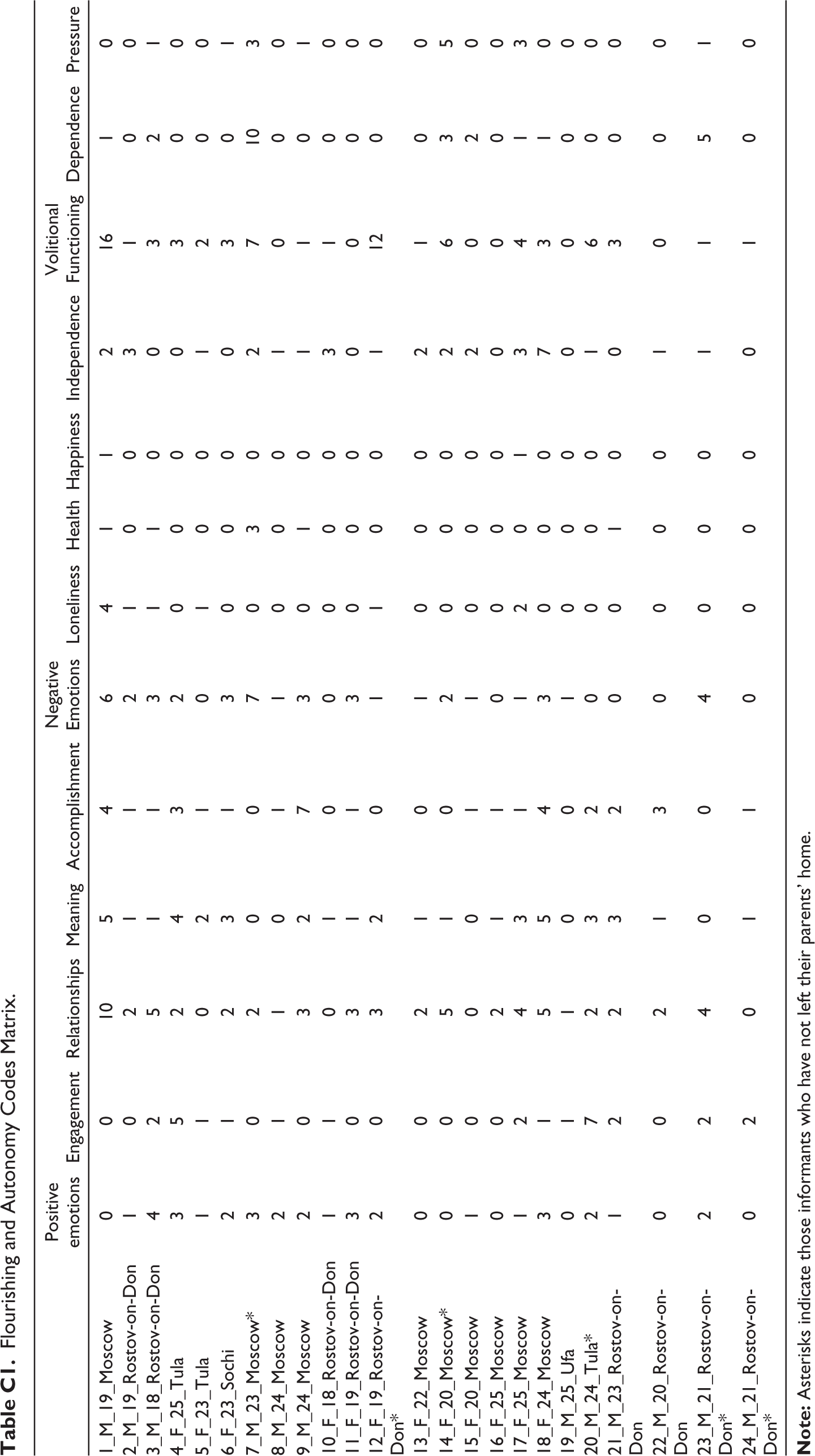
The thematic analysis allowed us to discover different constellations of the indicators of autonomy and well-being due to the respondents’ residential status. There is a code matrix (Appendix C) that shows a remarkable heterogeneity in the diversity and frequencies of the codes among the interviews. The respondents’ experience of relocation in the emerging adulthood differed: 15 moved to another city, 3 moved to separate housing in the same locality, and 6 people at the time of the interview still lived together with their parents.
The general assessment of the narrative as characterized by high autonomy occurred on the basis of the meaningful dominance of one or both autonomy codes, when the respondents generally assessed the current situation as a result of their activity and their decisions and elections, and their consequences as a zone of their responsibility. The narrative was qualified as one with poorly manifested, low autonomy, if the experience of susceptibility and passivity dominated in their assessment of the current situation, and the role and responsibility of parents or other external factors were considered more significant than the respondent’s own. Based on the two binary scales—relocation/no relocation and low autonomy/high autonomy—we described four types of narratives (see Table 1), resulting in the different states of the flourishing domains.
Four States of Flourishing.
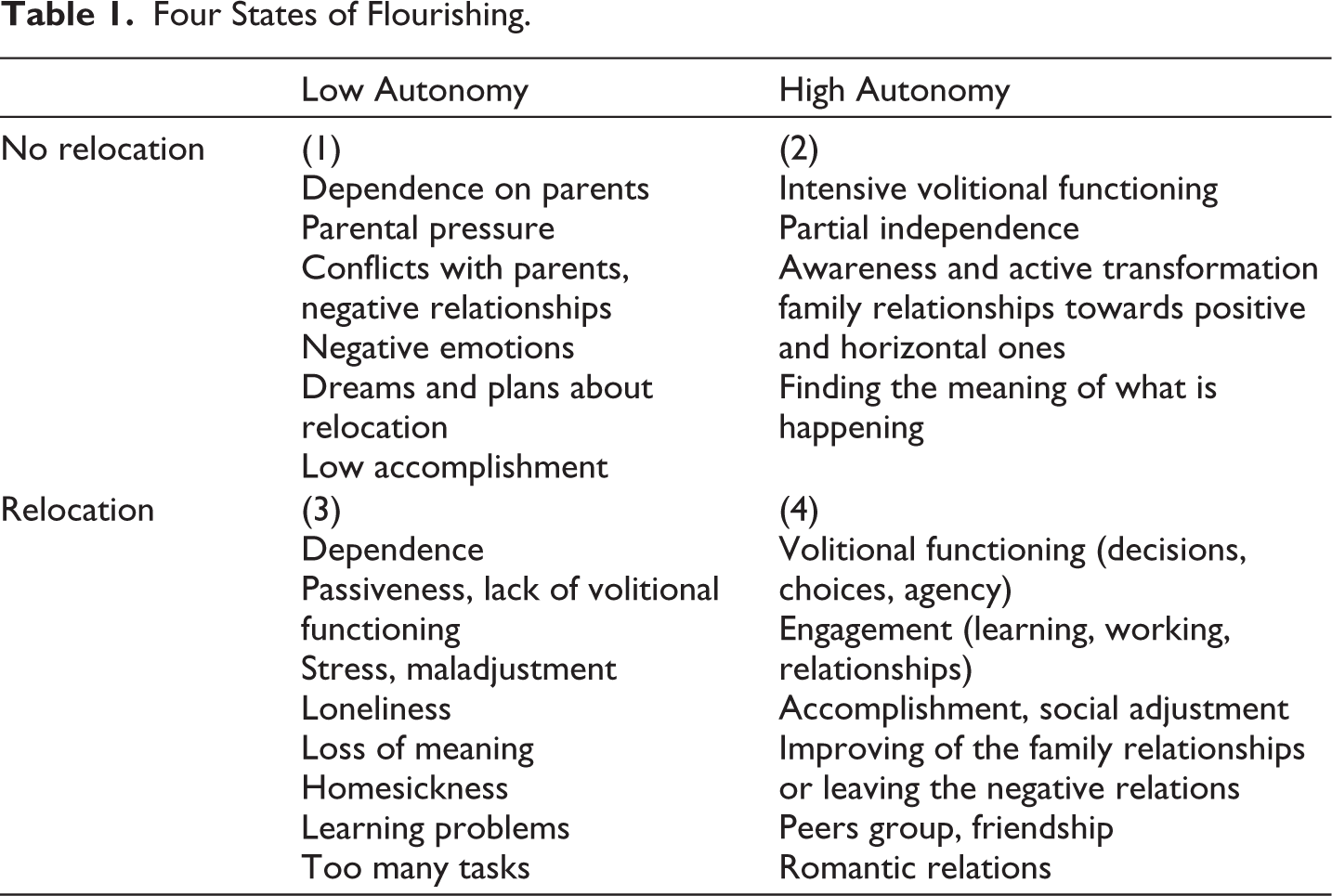
No Relocation, Low Autonomy
Some of the quotes are retrospective. In general, the state of cohabitation with parents and close dependence on them is associated with a high level of negative emotions and pressure from parents, a lack of social support and difficulties with the children’s manifestation of volitional functioning and seems to be an unstable, preparatory stage before territorial and financial separation from parents and increasing autonomy among emerging adults.
They told me: ‘Don’t even think about leaving, I won’t let you go anywhere, look for where you can go here’—and I was a minor, so I couldn’t fight much, I don’t have rights. My mom is incredibly overprotective. Unfortunately, we are living with her at the moment. I still don’t earn enough to move out. But I strive for it. (23_M_21_Rostov-on-Don)
If I didn’t pass [an exam], it was a disaster, hysteria and generally horror [on the mother’s side]. As a result, I also felt bad, and I couldn’t pass anything anymore. (7_M_23_Moscow)
My mother’s brother, my uncle, lived with us at home. We had a conflict: he said to me that my age was allegedly unsuitable to make decisions on my own, there were arguments … Arguments because of his alcohol use every day. Well, in general, I was so tired of seeing them already that I realized that I needed to go somewhere from there. (18_F_24_Moscow)
These narratives contain descriptions of tension, negative emotions and the desire to transform the situation on the part of the respondents. Lack of relocation is perceived as an impediment and relocation as a goal.
No Relocation, High Autonomy
These narratives look much more stable and prosperous compared with the previous ones.
When I had a choice, to leave [for another city to go to university] or not, it was very hard for me. I realized that I was not ready to move and decided to stay. Thanks to this, I had the opportunity to earn extra money, and, it turns out, I was more comfortable. … I still live with my mom and dad, communicate with them every day, go to a psychologist and now try to look at the situation from the side of a more adult person. I try to make it easier to relate to the fact that someone may have a different opinion. (12_F_19_Rostov-on-Don)
At one time, I really wanted to move to St. Petersburg. I thought, ‘I’ll give up everything, move to St. Petersburg, and start developing there’, but I realized that no, I’m very attached to my city, Tula is the best city for me. For me, this is my small homeland. I have such a position that, probably, ‘a local person can fit in there’. (20_M_24_Tula)
Lack of relocation is considered a personal decision: respondents say that they consciously chose not to move and discuss the advantages of such a solution compared to alternatives, and it allows them to develop personally, realize their capabilities and stay in a comfortable environment for themselves. At the same time, the transformation of relationships with parents is being discussed, which is a sign of the movement of respondents towards adulthood.
Relocation, Low Autonomy
In these narratives, various problems with adaptation are described, which are associated with the beginning of a new life period of living separately from parents.
I was unable to communicate with others for about 6 months in the hostel. Everything was very bad with my studies; I performed all my household duties poorly too. I had problems with budget allocation, and I did not have enough time to study. As a result, the first half of the year was disastrous for me. (1_M_19_Moscow)
It was hard for me to enter the first dormitory. The last thing I wanted on my 18th birthday was to stand with a rag and clean the room of age-old dirt. … Then I faced the problems of big cities: it’s dirty here; there were insects in the apartment; it turned out that you can’t drink the tap water. New expenses have appeared—for taxis, for drinking water, and so on. (3_M_18_Rostov-on-Don)
Choosing to move to Moscow is a step into the unknown. It was a very difficult period. I did not insist that I want to live in a hostel, and settled in the place where I now live [with relatives], from where I cannot move out. Now I’m sad that I didn’t insist on living somewhere else earlier. (15_F_20_Moscow)
These narratives cause feelings of anxiety, disappointment, sadness, loneliness and anger; nevertheless, respondents indicate the temporary nature of difficulties, their overcoming and successes, and opportunities that replace the period of maladaptation. Relocation here is experienced as a test, a challenge that is not easy to cope with.
Relocation, High Autonomy
This type of narrative contains descriptions of meaningful, responsible choices made, the transformation of relationships and satisfaction with the present situation.
I’m studying sociology. I came from the city where I was born, and I think it suits me perfectly. And in general, I was not mistaken. … When there is a conflict of interest in the family, I used to very rarely compromise, or very often show aggression. And now I’m trying to manage it, and I’m doing well, so the relationship [with my parents] has become better. (1_M_19_Moscow)
My boyfriend’s parents helped me move to Lipetsk.… My mother, when I told her that I had entered the university, did not react in any way; she only said, ‘How will you study?’ That is, ‘I don’t have the money’. And I say, ‘I don’t need your money, I’ll do it myself’. … It seemed to me that higher education was the way to a better life. That is, we need to develop, we need to go to something more. (18_F_24_Moscow)
I recently moved in and started living with my boyfriend. And, probably, this affects the relationship with my parents, because there is a stronger separation. I am very glad that my parents, especially my mother, have already accepted this in principle, although initially my mother said that she did not understand why to move at all. (13_F_22_Moscow)
Moving here seems like a reasonable choice and an ordeal that has already been experienced, with the adaptation to a new place, transformations of the parent–child relationships and the development of romantic relationships.
Many narratives contain indications of their temporality and processivity, and they can replace one another; for example, go from the first to the fourth or from the third to the fourth narrative.
At that time, I was still living with my parents. I was washing the dishes, and mom says that I did something wrong, and I think: ‘God, I wish I could move out already!’ I understood that it would be most painless if I moved to another apartment in an area in our city, and not to another city or to another country, because in this case, the separation process would be easier. (17_F_25_Moscow)
Moving to a new city and entering university, you are simultaneously burdened with a huge number of responsibilities that you have not encountered before, and you simply do not have the willpower to do all the things that you have to do. At first, all my friends went through a similar path. They procrastinated for 6 months, and after 6 months, they pulled themselves together and solved all the problems. (1_М_19_Moscow)
In general, we identified four types of narratives about leaving or not leaving the parental home by emerging adults regarding their level of autonomy, which can be briefly described as follows:
Lack of relocation as an impediment Lack of relocation as a personal decision Relocation as a challenge Relocation as a responsible choice and a test
They differ in assumptions about flourishing, especially in terms of positive and negative emotions, relationships and engagement. The first type is characterized by negative emotions due to the frustration of the need for autonomy, parental pressure and control; a low level of engagement and achievement; and the impossibility of living separately in the current moment. Nevertheless, the respondents have autonomy experience in the other domains (education, relationships) and hope for relocation in the future. The second type contains conscious reasons for choices made (particularly for engagement and achievement) and descriptions of parent–child relationship transformations. The third type describes many temporal problems in the domains of education and social relations, and adaptation to the new life situation—it is often retrospective and is replaced by the more stable and positive narrative. The fourth type of narrative is full of the positive details associated with the social background around the relocation—romantic relationships, education and career development, and changes in parent–child relations.
Discussion and Conclusions
Relocation—or its absence—is not a universal experience among emerging adults. Some perceive moving out of the parental home as a conscious and responsible choice, weighed with both advantages and disadvantages. Others experience it as a constraint or a source of challenges beyond their control. Our findings align with previous research and affirm the complexity of subjective representations of leaving the parental home, stemming from the evolving nature of the transition to adulthood in contemporary society (Arnett, 2023; Bertolini et al., 2021; Nartova & Fatekhov, 2021).
The narrative types identified in this study offer novel insights and, while not entirely consistent with earlier findings, overlap conceptually with established research. These narratives incorporate perceptions of an optimal or ‘right time’ to leave (Pustulka et al., 2021), the negotiation of egalitarian parent–child relations and personal autonomy (Sharon, 2016), and the strategic consideration of available resources. In many cases, only partial autonomy is achieved, and independent housing is not prioritized (Bertolini et al., 2021; Juvonen & Romakkaniemi, 2019; Luppi et al., 2021; Parola et al., 2023). A diversity of residential trajectories extending beyond the traditional linear path to independence is also acknowledged (Bertolini et al., 2021; Zorlu & Mulder, 2011).
Consistent with Mitrofanova (2020), a majority of our respondents aged 18–25 had either completed this transition or were actively working towards it, while a smaller segment had consciously delayed it. Similar to previous findings from both Western and Eastern contexts, women in our sample tended to leave the parental home earlier than men, often in connection with romantic relationships (Zorlu & van Gaalen, 2016). Our results also support the conclusions of Kins et al. (2009), showing that young people’s well-being is more closely tied to autonomous motivation than to objective living conditions.
The diversity of relocation patterns uncovered in this study may reflect the heterogeneity of Russian society, particularly regarding the strength of family ties and variations in family income (Billari, 2004; Iacovou, 2010).
At the individual level, relocation may be seen as a route to achieving personal autonomy and professional development. However, the decision not to relocate may also reflect a deliberate, autonomous choice. This aligns with contemporary views of the transition to adulthood, which emphasize making independent decisions, assuming responsibility (including self-care) and navigating life in accordance with one’s values—rather than simply following socially prescribed milestones (Andreeva, 2023; Hartmann & Swartz, 2006).
In most cases, the source for flourishing is hidden not in relocation itself, but in the opportunities of educational and career development and friendly and romantic relationships, which give place for positive emotions, engagement, relationships and achievement, as well as meaning generation. The very move is more associated with negative emotions, stress and loneliness. The choice to relocate becomes important in situations when the need for autonomy is frustrated, and the young person remains living with parents, despite the desire to separate. Independence may increase directly when a person relocates, but volitional functioning is often hidden in the social contexts and other choices.
Family background plays an important role in the relocation of emerging adults, which is consistent with previous research (Buhl, 2007). Relocation as a physical distancing may be the simplest available way to promote happiness and autonomy within the child–parent relations; at the same time, leaving the parental home may become a ‘joint enterprise’ with step-by-step child separation and the necessity to prepare this transition from the sides of both generations (Pustulka et al., 2021). A parent’s home may be perceived as a comfortable place, a ‘feathered nest’ or a ‘gilded cage’ full of tension (Avery et al., 1992), and this view largely determines the narrative about relocation (Scabini et al., 2006). The distance to the parental home of our respondents varied greatly; many of them talked about escaping daily parental control and gaining privacy, but none of them mentioned explicitly the practices of support exchange and investing more in family relations and parental everyday life, which contrasts with previous studies (Zorlu & van Gaalen, 2016) and may be explained by the respondents’ age or cultural specifics.
In the analysed narratives, relocation usually seems to be a choice subordinated to achieving education and career development, sometimes in line with the desire to leave an emotionally and economically problematic family. Predominantly, the respondents prefer to describe the social, economic and educational advantages of a new place rather than small parents’ financial resources, weak educational opportunities and problems in the labour market at the place where their parents leave; however, these factors contribute to their decisions about relocation (Luppi et al., 2021; Seiffge-Krenke, 2013). Among the respondents who did not change their place of residence, 8 of 9 people live in the million-plus cities, which indirectly supports the importance of this complex of factors, in line with international studies (Juvonen & Romakkaniemi, 2019; Parola et al., 2023). Limited attention to financial difficulties and challenges related to employment may be partly explained by the respondents’ educational background and middle-class status, which affords them a certain level of privilege and protection from issues that are more prominently discussed in similar interviews with young people in other countries (Bertolini et al., 2021; Billari, 2004).
The general trend in terms of place of residence and well-being corresponds with conceptualizations of the transition to adulthood among modern youth (Arnett, 2023; Hartmann & Swartz, 2006). From the older to the more modern stories, the awareness of respondents grows, and the domains of their flourishing become more vividly represented and multifaceted. The general tone is optimistic: even those interviews, in which there are clear problems in the emotional state and relationships, contain hope, plans, aspirations and an intention to realize respondents’ capabilities and enhance flourishing in the various domains. Predominantly, volitional functioning increase is observed, which is followed by intensive flourishing in different domains. This is in line with the representation of the transition to adulthood and personality growth (Gillies, 2000; Ryan & Deci, 2000).
Thus, the personal meaning of the relocation or its absence may be different and is more important for a young adult’s well-being than an objective resident status. The absence of relocation may frustrate the need for autonomy, cause negative emotions and limit flourishing; however, it may also be a conscious choice bringing a sense of autonomy and satisfaction. Relocation itself may be immediately perceived as a challenge and a collection of social, emotional and household problems; nevertheless, relocation (especially after a while) may be perceived as a personal choice and a test successfully completed, leading to personal growth and flourishing. The novelty of the study lies in the fact that the move traditionally studied by sociologists is considered through psychological optics. The applied lens of autonomy and flourishing enriches existing scholarly understandings of relocation from the parental home, highlights the multiplicity of ways in which this transition is perceived in Russia and contributes to a deeper understanding of the complexity of the transition to adulthood in contemporary society.
Based on the revealed narrative types, it could be suggested that, for the social policymakers who are willing to develop autonomy in youth, not to associate the relocation of youth with their high level of autonomy and well-being, as we identified cases when even the relocated youth were not autonomous. We suppose that it is worth supporting both youth who live without parents and those who live with them by showing, possibly through social marketing, the benefits of being autonomous for life outcomes. It is important to demonstrate to young people that their place of residence does not define whether they can or cannot live a prosperous, successful life and to manage social stereotypes about people who are living with parents (Sassler et al., 2008).
Limitations and Suggestions for Future Research
The reliability of the results may be limited by factors such as social desirability bias, the retrospective nature of the interviews and the absence of data on the socio-economic background of participants’ families. A significant expansion of the sample—taking into account socio-economic status and regional variation—along with a longitudinal design involving periodic interviews focused on narratives of autonomy development, would allow for a more robust examination of the evolving dynamics of housing autonomy and its underlying factors among contemporary Russian youth.
Footnotes
Data Availability
The data sets generated and/or analysed during the current study are available from the corresponding author on reasonable request.
Declaration of Conflicting Interests
The authors declared no potential conflicts of interest with respect to the research, authorship and/or publication of this article.
Ethical Approval
The study was conducted in accordance with the Declaration of Helsinki and approved by the HSE University Committee on Interuniversity Surveys and Ethical Assessment of Empirical Research.
Funding
The authors disclosed receipt of the following financial support for the research, authorship and/or publication of this article: The study was supported by the HSE University Basic Research Program.
Informed Consent
All of the respondents provided their written informed consent to participate in this study and to publish the results anonymously.
Note
Appendix A
Social-demographic Characteristics of the Respondents.
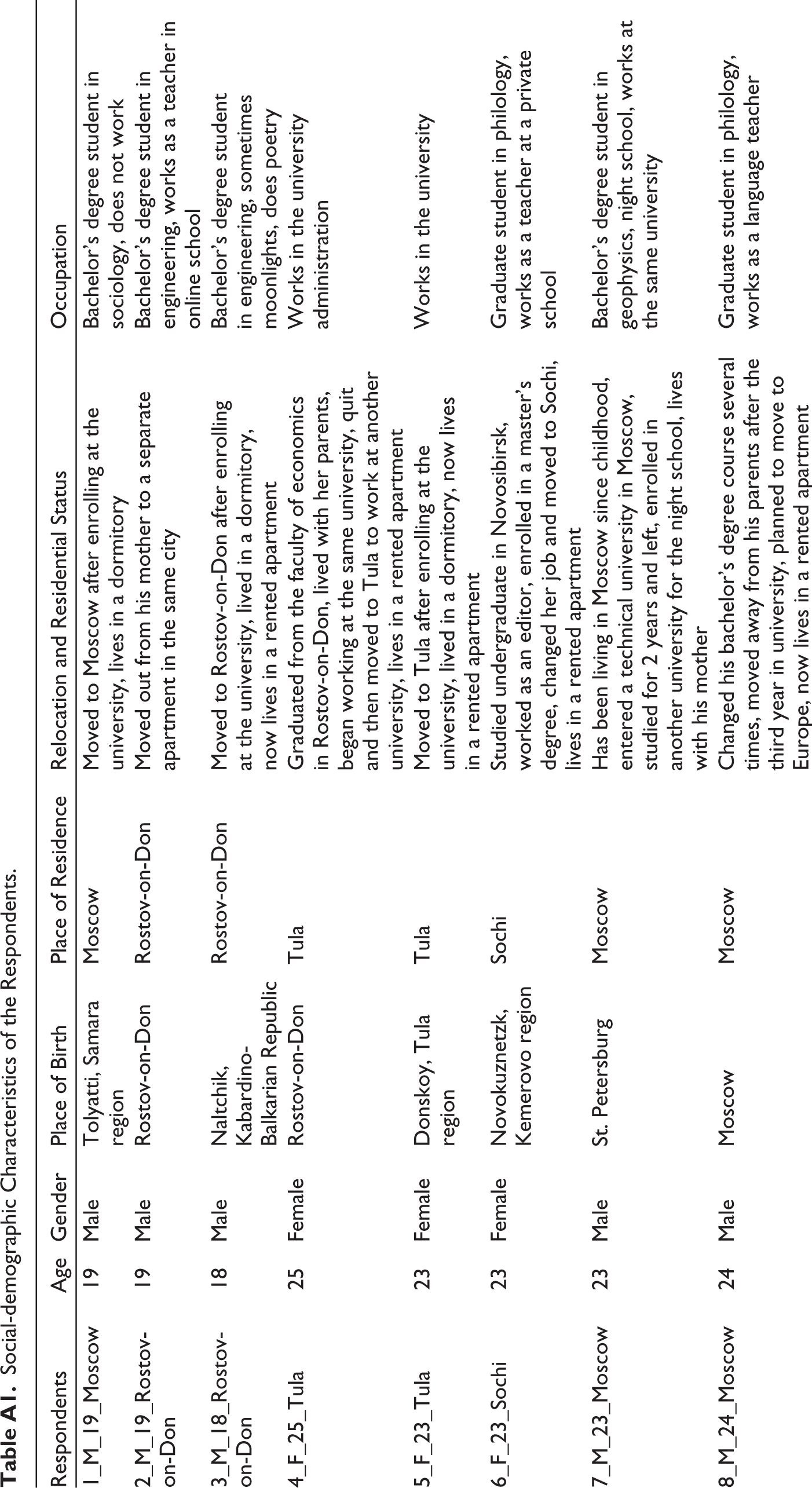
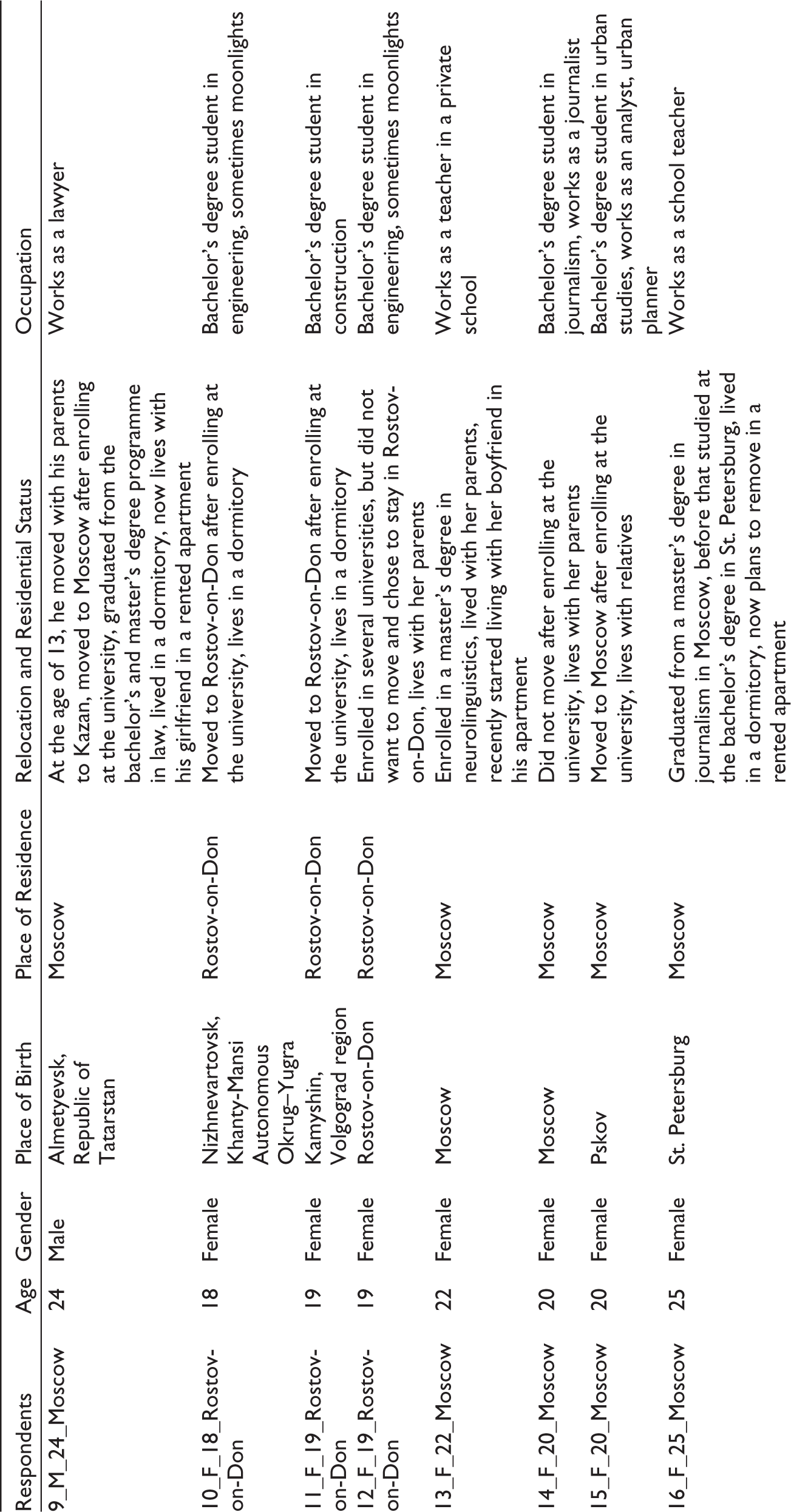
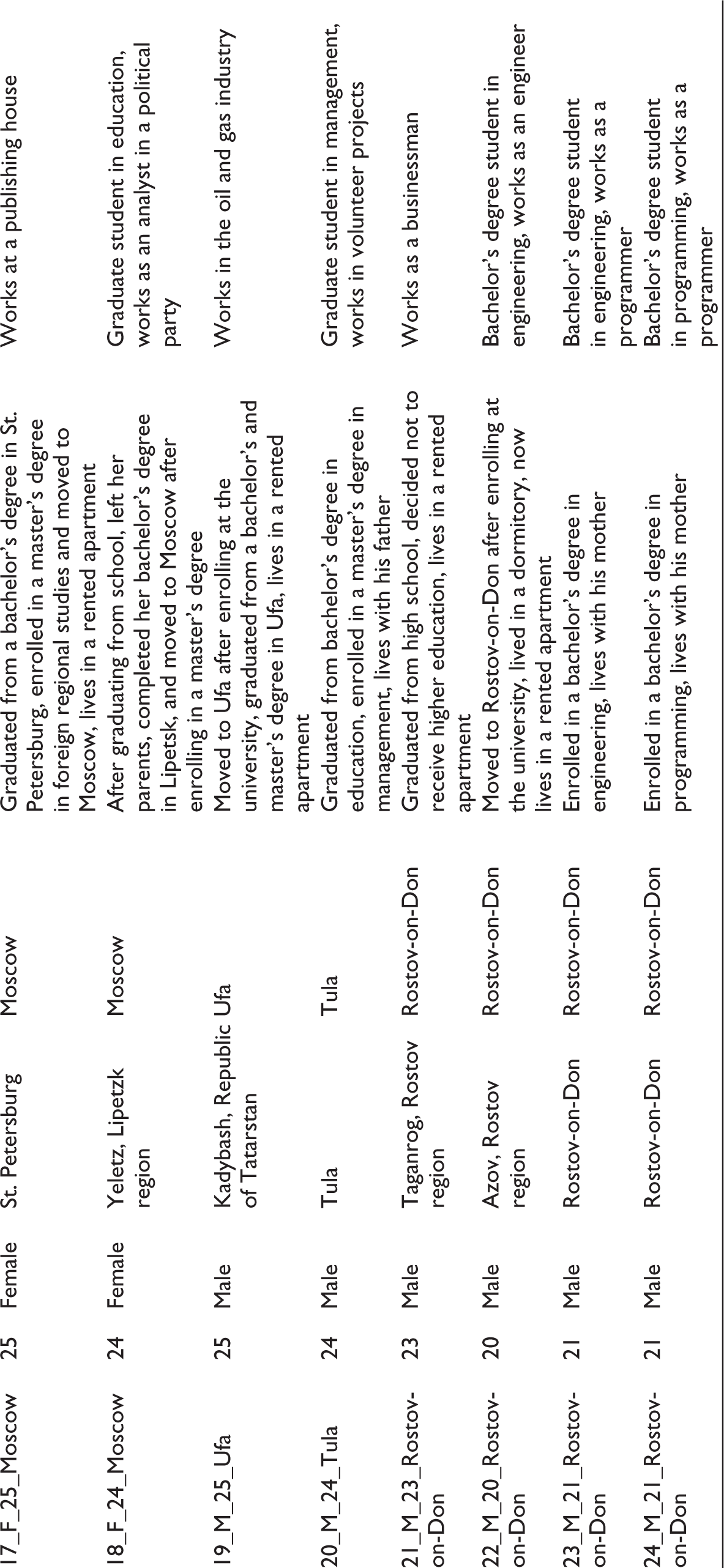
| Respondents | Age | Gender | Place of Birth | Place of Residence | Relocation and Residential Status | Occupation |
| 1_M_19_Moscow | 19 | Male | Tolyatti, Samara region | Moscow | Moved to Moscow after enrolling at the university, lives in a dormitory | Bachelor’s degree student in sociology, does not work |
| 2_M_19_Rostov-on-Don | 19 | Male | Rostov-on-Don | Rostov-on-Don | Moved out from his mother to a separate apartment in the same city | Bachelor’s degree student in engineering, works as a teacher in online school |
| 3_M_18_Rostov-on-Don | 18 | Male | Naltchik, Kabardino-Balkarian Republic | Rostov-on-Don | Moved to Rostov-on-Don after enrolling at the university, lived in a dormitory, now lives in a rented apartment | Bachelor’s degree student in engineering, sometimes moonlights, does poetry |
| 4_F_25_Tula | 25 | Female | Rostov-on-Don | Tula | Graduated from the faculty of economics in Rostov-on-Don, lived with her parents, began working at the same university, quit and then moved to Tula to work at another university, lives in a rented apartment | Works in the university administration |
| 5_F_23_Tula | 23 | Female | Donskoy, Tula region | Tula | Moved to Tula after enrolling at the university, lived in a dormitory, now lives in a rented apartment | Works in the university |
| 6_F_23_Sochi | 23 | Female | Novokuznetzk, Kemerovo region | Sochi | Studied undergraduate in Novosibirsk, worked as an editor, enrolled in a master’s degree, changed her job and moved to Sochi, lives in a rented apartment | Graduate student in philology, works as a teacher at a private school |
| 7_M_23_Moscow | 23 | Male | St. Petersburg | Moscow | Has been living in Moscow since childhood, entered a technical university in Moscow, studied for 2 years and left, enrolled in another university for the night school, lives with his mother | Bachelor’s degree student in geophysics, night school, works at the same university |
| 8_M_24_Moscow | 24 | Male | Moscow | Moscow | Changed his bachelor’s degree course several times, moved away from his parents after the third year in university, planned to move to Europe, now lives in a rented apartment | Graduate student in philology, works as a language teacher |
| 9_M_24_Moscow | 24 | Male | Almetyevsk, Republic of Tatarstan | Moscow | At the age of 13, he moved with his parents to Kazan, moved to Moscow after enrolling at the university, graduated from the bachelor’s and master’s degree programme in law, lived in a dormitory, now lives with his girlfriend in a rented apartment | Works as a lawyer |
| 10_F_18_Rostov-on-Don | 18 | Female | Nizhnevartovsk, Khanty-Mansi Autonomous Okrug–Yugra | Rostov-on-Don | Moved to Rostov-on-Don after enrolling at the university, lives in a dormitory | Bachelor’s degree student in engineering, sometimes moonlights |
| 11_F_19_Rostov-on-Don | 19 | Female | Kamyshin, Volgograd region | Rostov-on-Don | Moved to Rostov-on-Don after enrolling at the university, lives in a dormitory | Bachelor’s degree student in construction |
| 12_F_19_Rostov-on-Don | 19 | Female | Rostov-on-Don | Rostov-on-Don | Enrolled in several universities, but did not want to move and chose to stay in Rostov-on-Don, lives with her parents | Bachelor’s degree student in engineering, sometimes moonlights |
| 13_F_22_Moscow | 22 | Female | Moscow | Moscow | Enrolled in a master’s degree in neurolinguistics, lived with her parents, recently started living with her boyfriend in his apartment | Works as a teacher in a private school |
| 14_F_20_Moscow | 20 | Female | Moscow | Moscow | Did not move after enrolling at the university, lives with her parents | Bachelor’s degree student in journalism, works as a journalist |
| 15_F_20_Moscow | 20 | Female | Pskov | Moscow | Moved to Moscow after enrolling at the university, lives with relatives | Bachelor’s degree student in urban studies, works as an analyst, urban planner |
| 16_F_25_Moscow | 25 | Female | St. Petersburg | Moscow | Graduated from a master’s degree in journalism in Moscow, before that studied at the bachelor’s degree in St. Petersburg, lived in a dormitory, now plans to remove in a rented apartment | Works as a school teacher |
| 17_F_25_Moscow | 25 | Female | St. Petersburg | Moscow | Graduated from a bachelor’s degree in St. Petersburg, enrolled in a master’s degree in foreign regional studies and moved to Moscow, lives in a rented apartment | Works at a publishing house |
| 18_F_24_Moscow | 24 | Female | Yeletz, Lipetzk region | Moscow | After graduating from school, left her parents, completed her bachelor’s degree in Lipetsk, and moved to Moscow after enrolling in a master’s degree | Graduate student in education, works as an analyst in a political party |
| 19_M_25_Ufa | 25 | Male | Kadybash, Republic of Tatarstan | Ufa | Moved to Ufa after enrolling at the university, graduated from a bachelor’s and master’s degree in Ufa, lives in a rented apartment | Works in the oil and gas industry |
| 20_M_24_Tula | 24 | Male | Tula | Tula | Graduated from bachelor’s degree in education, enrolled in a master’s degree in management, lives with his father | Graduate student in management, works in volunteer projects |
| 21_M_23_Rostov-on-Don | 23 | Male | Taganrog, Rostov region | Rostov-on-Don | Graduated from high school, decided not to receive higher education, lives in a rented apartment | Works as a businessman |
| 22_M_20_Rostov-on-Don | 20 | Male | Azov, Rostov region | Rostov-on-Don | Moved to Rostov-on-Don after enrolling at the university, lived in a dormitory, now lives in a rented apartment | Bachelor’s degree student in engineering, works as an engineer |
| 23_M_21_Rostov-on-Don | 21 | Male | Rostov-on-Don | Rostov-on-Don | Enrolled in a bachelor’s degree in engineering, lives with his mother | Bachelor’s degree student in engineering, works as a programmer |
| 24_M_21_Rostov-on-Don | 21 | Male | Rostov-on-Don | Rostov-on-Don | Enrolled in a bachelor’s degree in programming, lives with his mother | Bachelor’s degree student in programming, works as a programmer |
Appendix B
Appendix C
Flourishing and Autonomy Codes Matrix.
| Positive emotions | Engagement | Relationships | Meaning | Accomplishment | Negative Emotions | Loneliness | Health | Happiness | Independence | Volitional Functioning | Dependence | Pressure | |
| 1_M_19_Moscow | 0 | 0 | 10 | 5 | 4 | 6 | 4 | 1 | 1 | 2 | 16 | 1 | 0 |
| 2_M_19_Rostov-on-Don | 1 | 0 | 2 | 1 | 1 | 2 | 1 | 0 | 0 | 3 | 1 | 0 | 0 |
| 3_M_18_Rostov-on-Don | 4 | 2 | 5 | 1 | 1 | 3 | 1 | 1 | 0 | 0 | 3 | 2 | 1 |
| 4_F_25_Tula | 3 | 5 | 2 | 4 | 3 | 2 | 0 | 0 | 0 | 0 | 3 | 0 | 0 |
| 5_F_23_Tula | 1 | 1 | 0 | 2 | 1 | 0 | 1 | 0 | 0 | 1 | 2 | 0 | 0 |
| 6_F_23_Sochi | 2 | 1 | 2 | 3 | 1 | 3 | 0 | 0 | 0 | 0 | 3 | 0 | 1 |
| 7_M_23_Moscow* | 3 | 0 | 2 | 0 | 0 | 7 | 0 | 3 | 0 | 2 | 7 | 10 | 3 |
| 8_M_24_Moscow | 2 | 1 | 1 | 0 | 1 | 1 | 0 | 0 | 0 | 1 | 0 | 0 | 0 |
| 9_M_24_Moscow | 2 | 0 | 3 | 2 | 7 | 3 | 0 | 1 | 0 | 1 | 1 | 0 | 1 |
| 10_F_18_Rostov-on-Don | 1 | 1 | 0 | 1 | 0 | 0 | 0 | 0 | 0 | 3 | 1 | 0 | 0 |
| 11_F_19_Rostov-on-Don | 3 | 0 | 3 | 1 | 1 | 3 | 0 | 0 | 0 | 0 | 0 | 0 | 0 |
| 12_F_19_Rostov-on-Don* | 2 | 0 | 3 | 2 | 0 | 1 | 1 | 0 | 0 | 1 | 12 | 0 | 0 |
| 13_F_22_Moscow | 0 | 0 | 2 | 1 | 0 | 1 | 0 | 0 | 0 | 2 | 1 | 0 | 0 |
| 14_F_20_Moscow* | 0 | 0 | 5 | 1 | 0 | 2 | 0 | 0 | 0 | 2 | 6 | 3 | 5 |
| 15_F_20_Moscow | 1 | 0 | 0 | 0 | 1 | 1 | 0 | 0 | 0 | 2 | 0 | 2 | 0 |
| 16_F_25_Moscow | 0 | 0 | 2 | 1 | 1 | 0 | 0 | 0 | 0 | 0 | 0 | 0 | 0 |
| 17_F_25_Moscow | 1 | 2 | 4 | 3 | 1 | 1 | 2 | 0 | 1 | 3 | 4 | 1 | 3 |
| 18_F_24_Moscow | 3 | 1 | 5 | 5 | 4 | 3 | 0 | 0 | 0 | 7 | 3 | 1 | 0 |
| 19_M_25_Ufa | 0 | 1 | 1 | 0 | 0 | 1 | 0 | 0 | 0 | 0 | 0 | 0 | 0 |
| 20_M_24_Tula* | 2 | 7 | 2 | 3 | 2 | 0 | 0 | 0 | 0 | 1 | 6 | 0 | 0 |
| 21_M_23_Rostov-on-Don | 1 | 2 | 2 | 3 | 2 | 0 | 0 | 1 | 0 | 0 | 3 | 0 | 0 |
| 22_M_20_Rostov-on-Don | 0 | 0 | 2 | 1 | 3 | 0 | 0 | 0 | 0 | 1 | 0 | 0 | 0 |
| 23_M_21_Rostov-on-Don* | 2 | 2 | 4 | 0 | 0 | 4 | 0 | 0 | 0 | 1 | 1 | 5 | 1 |
| 24_M_21_Rostov-on-Don* | 0 | 2 | 0 | 1 | 1 | 0 | 0 | 0 | 0 | 0 | 1 | 0 | 0 |