



Abstract
Belonging is a fundamental human need strongly linked to psychological well-being and social adjustment. This need is particularly salient for ethnic minority adolescents who often face prejudice and other challenges both in school and in broader society. This article investigates the association between the sense of school belonging and societal belonging among ethnic minority adolescents in the Czech Republic. Using multilevel regression models, we analyse data from the minority subsample (age 15–16) of the Czech Education Panel Survey (n = 2,122). Results show a positive association between the two types of belonging, even when perceived support from family, peers and teachers is taken into account. This association is stronger among Ukrainians than among other ethnic minorities. Our findings suggest that fostering societal belonging among ethnic minority youth may strengthen their connection to school. These results highlight the importance of inclusive policies that support social integration and academic adjustment of diverse student populations.
Keywords
Students’ emotional connection with their school is a crucial factor in shaping adolescents’ academic and personal development. Feeling accepted and welcomed at school is particularly important for ethnic minorities, who often encounter negative stereotypes and experience rejection and discrimination (Umaña-Taylor, 2016). These experiences can adversely affect their academic engagement and performance (Smalls et al., 2007; Teney et al., 2013) and pose a threat to their fundamental social identity needs, particularly the need to belong (Vignoles, 2011).
Creating and maintaining a welcoming school environment for ethnic minorities is important for several reasons. First, an equitable and supportive learning environment enhances academic performance (Fallon et al., 2022) and reduces the probability of dropout (Trieu & Jayakody, 2019). Second, it mitigates the feelings of isolation and discrimination, negatively affecting students’ mental health (Shochet et al., 2011) and risk behaviour (McNeely & Falci, 2004). Third, by promoting diversity and fostering cross-cultural cooperation, schools prepare both minority and majority students for life in a multicultural society. Recent immigration trends of European countries show that most countries are becoming increasingly multicultural, which underlines the salience of harmonious inter-ethnic relations.
We built on Bronfenbrenner’s Bioecological Model (1979) to conceptualize how adolescents’ sense of belonging is shaped by both immediate and broader social contexts. Within this framework, we adopt Dewey’s view of the school as a micro-society to understand how school environments can serve as a bridge to broader societal belonging, particularly for ethnic minority youth. According to Dewey (1986), classrooms are not merely spaces for academic learning but are reflective of community life, where democratic values and diverse perspectives are nurtured. In this context, fostering societal belonging may facilitate stronger connections within the school environment, as schools often represent a condensed version of the larger society in terms of ethnic composition and social dynamics. Drawing on this concept, we explore the relationship between school belonging and societal belonging among ethnic minority high-school students in the Czech Republic.
Sense of Belonging in Adolescence
The sense of belonging refers to an individual’s subjective perception of being an integral part of their immediate environment and is closely tied to intrinsic motivations for social connection and positive regard from others (Leary & Gabriel, 2022). At the same time, the lack of belonging can result in social isolation, depression (Dutcher et al., 2022; Shochet et al., 2011) and even suicidal tendencies (Tay et al., 2013). The need to belong becomes particularly salient during early adolescence when young people start exploring their identities separate from their families and rely more on friendships and other types of peer relations (Goodenow, 1993).
Notably, the experience of ethnic minorities often differs from that of their majority peers. Minorities often face stigma, discrimination and the consequences of prejudice and stereotypes held by the majority (Umaña-Taylor, 2016). Furthermore, for minorities with an immigrant background, affection towards their host country may also depend on whether they were born and raised in the host country or immigrated from another country with a different culture, customs and norms. Consequently, ethnic minority adolescents often experience a low sense of identification with the countries they live in (Gharaei et al., 2024), which negatively affects their psychological well-being and social adjustment (Sam, 2000).
Since the concept of belonging is very general, we often use a specific environment where an individual can feel a sense of belonging. Adolescents spend a significant amount of time at school, which makes the school environment one of the most salient arenas of identity formation and social connections (Kreniske et al., 2020). Consequently, the sense of school belonging becomes especially important. In this article, we focus on both senses of belonging—school and societal—as we hypothesize that an individual’s sense of connectedness to the general society may be related to their sense of school belonging.
Sense of School Belonging Among Ethnic Minorities
The concept of school belonging refers to the emotional connection students have with their school, nurtured by feelings of acceptance and appreciation from peers and the school community (Willms, 2003, pp. 1–84). The sense of school belonging is associated with positive psychosocial outcomes such as subjective well-being and decreased mental health problems (Arslan, 2021), happiness (O’Rourke & Cooper, 2010), psychological adjustment (Law et al., 2013) and academic motivation (Arslan, 2021). Conversely, low levels of school belonging among adolescents are related to health risk behaviours, including substance abuse and weapon-related violence (McNeely & Falci, 2004) as well as negative affect (Shochet et al., 2011). The impact of school belonging extends to academic indicators, with strong correlations found between students’ sense of belonging and academic achievement at both individual and school levels (Korpershoek et al., 2020).
The sense of school belonging was identified as a key motivation for ethnic minorities to remain engaged and committed to their education (Slaten et al., 2015). Previous research suggests that ethnic minority students may be at a higher risk of academic disengagement, potentially related to diminished school belonging (e.g., Anderson et al., 2000). Ethnic minority adolescents often face specific challenges and difficulties in the school environment that can negatively impact their academic success and overall life development. One of the key issues is the language barrier. Language difficulties can prevent them from fully understanding more complicated materials and make communication with teachers and classmates more difficult (Kim & Suárez‐Orozco, 2015). Additionally, ethnic minority adolescents may face educational challenges related to cultural differences and stereotypes, which can lead to discrimination (Gonzales-Backen et al., 2018) and other negative school experiences(Marsh & Cornell, 2001). Furthermore, studies suggest that adolescents from ethnic minorities are often more susceptible to negative influences such as bullying, social exclusion or low expectations from educators (Osman et al., 2020). All these factors can lead to feelings of isolation, reduced self-esteem and inadequate educational motivation (Phinney, 1998).
Analyses based on a sample of 193,073 15-year-olds across 41 countries revealed that first-generation immigrants and those who spoke a foreign language at home reported lower levels of school belonging (Chiu et al., 2016). Furthermore, a comprehensive study using PISA data found that immigrant youth had significantly lower school belonging compared to native peers in about one third of the education systems analysed (OECD, 2019). Another recent study involving 151,211 students from 19 countries (PISA database, 2022) also indicated that immigrant youth experience weaker school belonging in certain contexts (Abdulhamed & Beattie, 2024). Additionally, research among Israeli adolescents showed that immigrant youths scored lower on feelings of belonging at school compared to their native-born counterparts (Zilka, 2021).
While the sense of school belonging is important for minority adolescents, the literature suggests that it is especially important for refugees. Several studies relying on qualitative data revealed that refugee adolescents often experience school alienation due to discrimination and challenges in forming peer relationships (Kia-Keating & Ellis, 2007; Osman et al., 2020).
Given the unique challenges that ethnic minority students often face, such as language barriers, cultural differences and experiences of discrimination, the role of external support becomes especially important in fostering a sense of school belonging. While ethnic minority adolescents may experience feelings of isolation and alienation due to these difficulties, previous research underscores the importance of positive relationships in mitigating these adverse effects. Specifically, empirical research shows that supportive parents (Ahmadi et al., 2020), positive teacher– student relationships (Allen et al., 2021) and peer acceptance (Craggs & Kelly, 2018; Hamm & Faircloth, 2005) can provide essential emotional and social resources to counterbalance the negative experiences minority students encounter and in turn contribute to a greater sense of school belonging.
Quality of Family Environment, Teacher and Peer Support, and Sense of School Belonging
The quality of the family environment, peer relationships and teacher support is positively associated with students’ sense of school belonging. Supportive parents provide children with a sense of safety, acceptance and emotional connection, which are essential for fostering a strong sense of belonging (Anderman, 2003). Furthermore, a high degree of parental involvement in their children’s development acts as social capital that boosts students’ academic motivation (Grolnick et al., 2000) and improves students’ feelings of school belonging (Ahmadi et al., 2020). This was found to be particularly vital for ethnic minority adolescents, where parental support can buffer against the negative impacts of discrimination (Liebkind et al., 2004; Ruedas-Gracia et al., 2020).
In addition to parental support, positive peer relationships are also essential for providing both social and academic encouragement, as well as for fostering feelings of care and acceptance among students (Hamm & Faircloth, 2005). Peer support also plays a key role in fostering a sense of school belonging (Smith et al., 2022). At the same time, schools can also be environments in which some adolescents experience social exclusion, which may contribute to heightened stress and social anxiety (Wang & Eccles, 2012). Ethnic minority adolescents, in particular, often face a heightened risk of negative social interactions fuelled by stereotypes and racial prejudice. Experiencing racial slurs or being excluded from social activities can be significant stressors (Jackman et al., 2020). Research indicates that students report lower levels of school belonging when their ethnic minority identity is made salient (Mello et al., 2012). Additionally, peer victimization was found to be related to weaker feelings of school connectedness (O’Brennan & Furlong, 2010).
Finally, the emotional and academic support provided by teachers is also crucial for fostering students’ sense of school belonging (Hallinan, 2008). Studies indicate that emotional support is particularly impactful, enhancing both academic achievement and well-being (Tennant et al., 2015). Conversely, experiences of discrimination from teachers can lower feelings of school belonging and engagement (Heikamp et al., 2020).
Societal Belonging
While supportive relationships with parents, peers and teachers are important for fostering a sense of school belonging among ethnic minority students, they do not fully explain the variations in school belonging across different individuals. In addition to these supportive environments, a broader sense of belonging to society may play a key role in shaping students’ overall school experiences. We argue that understanding why some ethnic minority students hold higher levels of school belonging than others requires considering their sense of societal belonging.
Societal belonging is defined as feeling a connected, affiliated and respected member of the larger society (Özdemir & Bayram Özdemir, 2023) and aligns with the contemporary perspective that establishing a secure attachment to one’s ethnic identity is conducive to fostering positive attitudes towards ethnic outgroups (Whitehead et al., 2009).
Ethnic minority adolescents can experience a low sense of identification with the countries they live in (Fleischmann & Phalet, 2018), which can negatively impact their psychological well-being and social adjustment (Wu et al., 2018). A recent study by Van Vemde and colleagues (2021) found that ethnic minority students in the Netherlands reported significantly lower levels of national belonging compared to their ethnic majority counterparts, possibly influenced by their marginalized societal status.
Experiencing acculturative stress across various contexts can hinder adolescents’ identity development, leaving them feeling caught between cultures and vulnerable to psychological struggles (Bayram Özdemir et al., 2021). Immigrant adolescents facing conflicts between their parents’ values, their own aspirations and peer mistreatment at school may struggle to establish their identity and sense of belonging.
Importantly, societal belonging captures both a person’s subjective perception of the relationship with the majority society and being valued among ethnic minority members (Özdemir & Bayram Özdemir, 2023; Valcke et al., 2020). Societal belonging follows the theory of cultural attachment (Hong et al., 2013), suggesting that individuals’ attachment to their own culture or to the host culture they have migrated to could act as a secure base, akin to the attachment to primary caregivers in childhood. Building upon these earlier findings, individuals with secure attachments will likely be more receptive to exploring new cultural experiences, while those with fearful attachments tend to avoid anything unfamiliar. Therefore, it is likely that ethnic minority students will feel more connected to their schools if they already have a strong connection to the broader society.
Ethnic Minorities in the Czech Context
According to the 2021 Czech national census, 89% of respondents who answered the ethnicity question selected a Czech, Moravian or Silesian identity (Czech Statistical Office, n.d.). In the 2021 census, the largest ethnic minorities were Slovaks (1.3%), Ukrainians (1.1%), Vietnamese (0.4%), Polish (0.4%), Russians (0.4%) and Roma (0.1%) (Czech Statistical Office, n.d.). Following the Russian invasion of Ukraine, the size of the Ukrainian population increased dramatically: by June 2024, over 615,000 Ukrainians were granted temporary protection, and over 370,000 had an active status in the country (UNHCR, n.d.).The increase in the number of Ukrainians is related to recent geopolitical events, but the presence of the Slovak, Vietnamese and Roma minorities has longer historical roots.
Slovaks have historically been the largest ethnic minority, which traces back to the two nations’ shared history as part of Czechoslovakia (1918–1992). Slovaks are generally perceived as culturally similar to Czechs. Nevertheless, Slovaks sometimes encounter prejudice and stereotypes or have a lower social status (Nosková, 2011).
In contrast to Slovaks, a majority of the Roma population face significant challenges, including prejudice, discrimination, widespread social segregation and marginalization in healthcare, education, labour market and housing (Messing, 2017). The Czech Republic has also faced criticism for discriminatory practices, particularly for disproportionately placing Roma children in special education schools (Commissioner for Human Rights, 2020).
The Vietnamese community has been present in the Czech Republic for nearly 70 years, starting with intergovernmental agreements for temporary training programmes in the 1960s, which led to significant migration (Alamgir, 2014). After the fall of communism in 1989, the number of Vietnamese migrating to the Czech Republic increased, but they only received more public attention from the 2000s, in particular in relation to their exploitation as cheap labour and involvement in crime. The Vietnamese community has often been labelled as ‘closed’ or a ‘national threat’ (Beadle & Davison, 2019).
Before the Russian invasion of Ukraine, Ukrainians in the Czech Republic typically worked in low-skilled jobs and faced challenges due to language barriers, which often kept them working in low-income jobs. Despite this, Czech society generally viewed them positively, appreciating their hard work, diligence and cultural contributions (Straková, 2000). However, the prevailing public opinion in 2024 was that ‘the Czech Republic has received more refugees from Ukraine than it can handle (59%), and half of the citizens (52%) considered refugees from Ukraine to be a challenge for the country’ (CVVM, 2024), which creates a complicated situation for Ukrainian adolescents.
Current Study
While prior research has examined the impacts of school belonging (e.g., Heikamp et al., 2020; Slaten et al., 2015) and societal belonging (e.g., Valcke et al., 2020) on various indicators of well-being and school performance, to our knowledge, no studies have investigated the relationship between these two forms of belonging. Additionally, the roles of refugee status and recent migration in shaping these relationships remain underexplored, despite evidence indicating that refugee adolescents often feel less connected to school communities (Kia-Keating & Ellis, 2007). Furthermore, existing research originates mostly in the context of Western democracies, while the Central and Eastern European regions remain understudied.
This study addresses these gaps by investigating the relationship between the sense of school belonging and societal belonging among ethnic minority adolescents (aged 15–16) in the Czech Republic. We analyse data from the first wave of the Czech Education Panel Survey (CZEPS), collected in 2023, which provides a cross-sectional snapshot of adolescents’ experience at the beginning of their high school studies. We hypothesize societal belonging to be positively associated with school belonging, even when accounting for key factors that may influence both types of belonging, such as parental support, peer support and relationships with teachers. Additionally, we examine whether the relationship between school belonging and societal belonging varies across different ethnic minority groups, without any specific expectations about how these effects may differ among the ethnic groups.
Method
Data
Participants
In this article, we make use of a subsample of data from the CZEPS (Kudrnáč et al., 2024) that is based on 249 randomly selected schools. The final sample used in our analysis involves 2,122 students from 813 classrooms and 239 schools who identified with one or more ethnic minority identities. Students filled out online questionnaires during ordinary school hours under the supervision of a trained school coordinator who ensured that students understood the questions and provided informed consent. Participation was voluntary, and students were assured of confidentiality. Informed consent was obtained from all students participating in this study. The study was approved by the institutional ethical board, and ethical guidelines were strictly followed. According to Czech law, parental consent is not required for participants older than 15. The response rate for the first wave of the CZEPS survey was 87%.
Measures
School Belonging.
Respondents completed a 9-item scale measuring school belonging, adapted from the Psychological Sense of School Membership (PSSM) scale developed and validated by Goodenow (1993). This scale is the most widely used measure of school belonging (Korpershoek et al., 2020), and its shortened version has been widely used by previous studies (e.g., Abubakar et al., 2016; Jose et al., 2012). Students rated each statement on a 5-point Likert scale (e.g., ‘I feel like a real part of this school’). Mean scores were calculated for all respondents who had valid answers on the items. Initial analyses have shown that the scale effectively captures the intended constructs and performs similarly to the longer 18-item PSSM scale. Moreover, factor analysis results support the scale’s structural integrity (RMSEA: 0.11, CFI: 0.90, TLI: 0.87), aligning with theoretical expectations (for factor loadings, see Table A1). Internal consistency measure (Cronbach’s α = 0.87) further confirms that the shortened scale yields reliable data, facilitating meaningful insights while minimizing respondent burden.
Societal Belonging
Respondents completed the 5-item Adolescents’ Societal Belongingness Scale introduced and validated by Özdemir and Bayram Özdemir (2023). Students rated each statement on a 5-point Likert scale (e.g., ‘I feel that I belong to Czech society’). The reverse-coded item of the scale (‘I feel that I am an outsider here in Czechia.’) showed a factor loading below the acceptable level (0.31), so we removed this item (for the factor loadings, see Table A1). The remaining 4-item scale showed acceptable structural integrity (RMSEA: 0.20, CFI: 0.97, TLI: 0.91), while its internal consistency was also acceptable (Cronbach’s α = 0.89). The variable was created as an average answer to the items.
Quality of the Family Environment
Respondents completed a 3-item scale on family environment that has been used previously by Kvardova et al. (2021). Two items are related to family support (‘When I talk at home, someone listens to what I say’; ‘My family really tries to help me’) and one to safety (‘I feel safe at home’). Kvardova et al. (2021) adapted the first item from the Health Behavior in School-aged Children (HBSC) Survey, the second item from the Multidimensional Scale of Perceived Social Support (MSPSS; Zimet et al., 1990) and the third item was developed for their own study. Students could rate each statement on a 4-point Likert scale. Factor analysis aligned with theoretical expectations (RMSEA: 0.00, CFI: 1.00, TLI: 1.00; for the factor loadings, see Table A1). The internal consistency was acceptable (Cronbach’s α = 0.79). The variable was created as an average answer to the items.
Friend Support
Respondents completed a 3-item scale on social support of friends by rating each statement on a 4-point Likert scale (e.g., ‘I can talk to my friends about my problems’). The items belong to the friends subscale of the multidimensional scale of perceived social support, developed and validated by Zimet et al. (1990), and have been previously used by Kvardova et al. (2021). Factor analysis aligned with our theoretical expectations (RMSEA: 0.00, CFI: 1.00, TLI: 1.00; for the factor loadings, see Table A1). The internal consistency was acceptable (Cronbach’s α = 0.85). The variable was created as an average answer to the items.
Teacher Support
Respondents completed a 5-item scale on teacher support. Students rated each statement on a 4-point Likert scale (e.g., ‘Most of my teachers treat me fairly’). The scale was developed by a longitudinal Swedish research study, the Political Socialization Program at YeS, and has been previously used by Miklikowska et al. (2023). Factor analysis aligned with our theoretical expectations (RMSEA: 0.08, CFI: 0.98, TLI: 0.97; for the factor loadings, see Table A1). The internal consistency was acceptable (Cronbach’s α =0.85). The variable consists of the average values of the items.
Ethnicity
Respondents were asked, ‘’What describes you best?’ and could select their ethnicity from nine options, with the possibility of multiple choices. We categorized ethnicity as follows: 1—Czech, 2—Slovak, 3—Ukrainian, 4—Roma, 5—Vietnamese, 6—Other (see Table A2). We allowed for multiple choices in the survey to reflect on the realities of modern societies, where people can have diverse backgrounds, which is particularly true for those who have an immigrant or a native minority status in a country. However, due to the large number of possible combinations of ethnic identities and the low case numbers in many of these combinations, for the current analysis, we decided to categorize respondents into the six groups mentioned above. In most cases, respondents selected a Czech and a minority identity. In these cases, we prioritized their minority identity, as it likely shapes their experiences more than a Czech identity. A few respondents selected multiple minority identities. For respondents selecting multiple minority identities, categorization was based on assumed impact on daily experiences. Slovak identity, being linguistically and culturally close to Czech, was considered less distinctive in shaping a minority experience. Therefore, Slovak respondents with another minority identity were categorized under that other minority. Given the significant influence of refugee status, all respondents identifying as Ukrainian were categorized as Ukrainian. For Roma respondents, we assumed that experiences of social marginalization would strongly shape their minority experience. Thus, those selecting Roma, including Roma-Vietnamese individuals, were categorized as Roma—except for Ukrainian-Roma, who were coded as Ukrainian due to the assumed stronger influence of their refugee background. To ensure robustness, we tested alternative categorizations (see Table A3).
Czech Identity
Minorities often feel a lower level of connectedness or identification with the country they live in as compared to members of the majority (e.g., Fleischmann & Phalet, 2018; Gharaei et al., 2024). To account for this, a binary Czech identity variable was created. Respondents who also selected one of the Czech identities (46% of the minority sample) were coded as ‘1’, others received ‘0’.
Ethnic Diversity Index (Inverse Herfindahl/Simpson Index)
Ethnic diversity was calculated for each classroom using the following formula: I = 1 – Σ n i = 1 Mi2 and where M is the proportion of ethnic group i and n is the number of ethnic groups in the classroom. The index takes into account both the proportion and the diversity of minorities in the classroom.
Classroom Size
We also included classroom size in our analysis to test whether students in smaller classrooms report higher levels of school belonging compared to those in larger classrooms, potentially due to increased teacher attention and a more close-knit peer group. In line with conventional definitions in our cultural context, we categorized classrooms as follows: fewer than 20 students as small, 20–30 students as average and more than 30 students as large.
In addition to the dependent variable and independent variables described above, we also included gender and parental education (recoded into three categories) in our models. Exact question wording (Table A2) and descriptive statistics for all used variables (Table A4) can be found in the Appendix. The questionnaire items related to the variables ‘school belonging’, ‘societal belonging’, ‘quality of the family environment’, ‘friend support’ and ‘teacher support’ were translated into Czech and pretested in June 2023 to ensure their validity in the Czech context.
Plan of Analysis
We run multilevel regression models to inspect the relationship between the two types of belonging in our ethnic minority sample. In the first model (M1), we include all the key and control variables described above, while in our second model (M2), we add an interaction term between ethnicity and societal belonging in order to investigate whether the relationship between societal belonging and school belonging is moderated by ethnicity.
We build two-level random intercept models with classrooms being at the second level due to the hierarchical structure of the data. Intra-class correlations (ICC) supported the choice of a multilevel design. In our null model (not presented), including only the control variables, ICC was 0.10. Linear regression models with the same variables with clustered standard errors at the classroom level provided substantially the same results in significance levels and interpretation. All analyses presented in this article were conducted in Stata/SE 18.0. We used listwise deletion to deal with missing data. The proportion of missing values ranges from less than 1% to 4% for all variables except for parental education, where it is 18% (see Table A5). To assess the robustness of our findings, we re-ran our multilevel analysis using multiple imputation. The results were largely consistent with slightly smaller standard errors in some cases due to the larger sample size (see Table A6).
Results
We start by presenting our results with some descriptive statistics. The mean age of our respondents was 15.8 at the time of data collection. Regarding gender, 50% identified as male, 48% as female and 2% as ‘another gender’. In terms of ethnicity, 18% identified as ethnic Slovak, 33% as Ukrainian, 20% as Roma, 8% as Vietnamese and 21% as another ethnic minority. Concerning school type, 12% attended gymnasiums (academic-oriented study track), 51% attended technical schools that offer the Maturita exam (an exit examination required for higher education) and 37% attended technical schools without the Maturita. Classrooms had an average size of 27 students, with an average minority student proportion of 20% (for the descriptive statistics, see Table A4).
We now move to the results of our regression analysis. The first model (M1) shows that societal belonging is positively associated with school belonging ( β = 0.20, p < .001) even after controlling for various factors that could impact both types of belonging (Table 1). Additionally, friend support ( β = 0.19, p < .001) and teacher support ( β = 0.48, p < .001) are positively associated with school belonging, while the quality of the family environment is not associated with school belonging. With regard to parental education, higher levels of parental education are more positively associated with students’ school belonging ( β = 0.06, p < .05) as compared to the lowest level of parental education. Attending smaller than average classrooms (5–19 students) is positively associated with higher school belonging ( β = 0.03, p < .10) compared to being in average size (20–30 students) and large ANOVA models showed ethnic differences in school belonging (see the Appendix), but these differences are no longer present in the multilevel models (the baseline category for ethnicity is Slovak in Table 1). classrooms (31–46 students). The ethnic diversity of the classroom is negatively associated with school belonging ( β = –0.04, p < .05). Initial The R2 value of 0.45) shows that a substantial amount of variance of the dependent variable is explained by the model.
Multilevel Models of School Belonging.

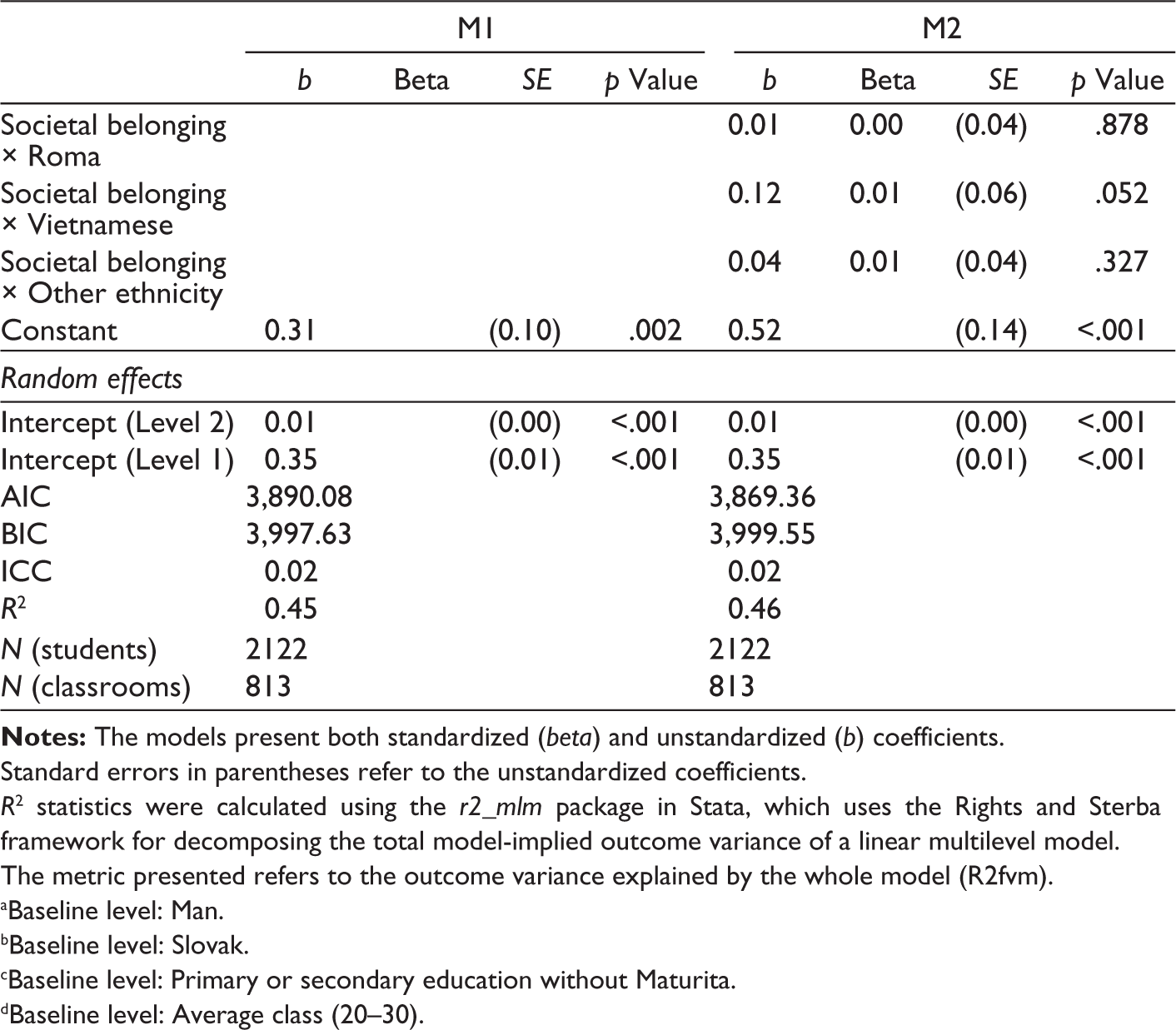
Standard errors in parentheses refer to the unstandardized coefficients.
R2 statistics were calculated using the r2_mlm package in Stata, which uses the Rights and Sterba framework for decomposing the total model-implied outcome variance of a linear multilevel model.
The metric presented refers to the outcome variance explained by the whole model (R2fvm).
aBaseline level: Man.
bBaseline level: Slovak.
cBaseline level: Primary or secondary education without Maturita.
dBaseline level: Average class (20–30).
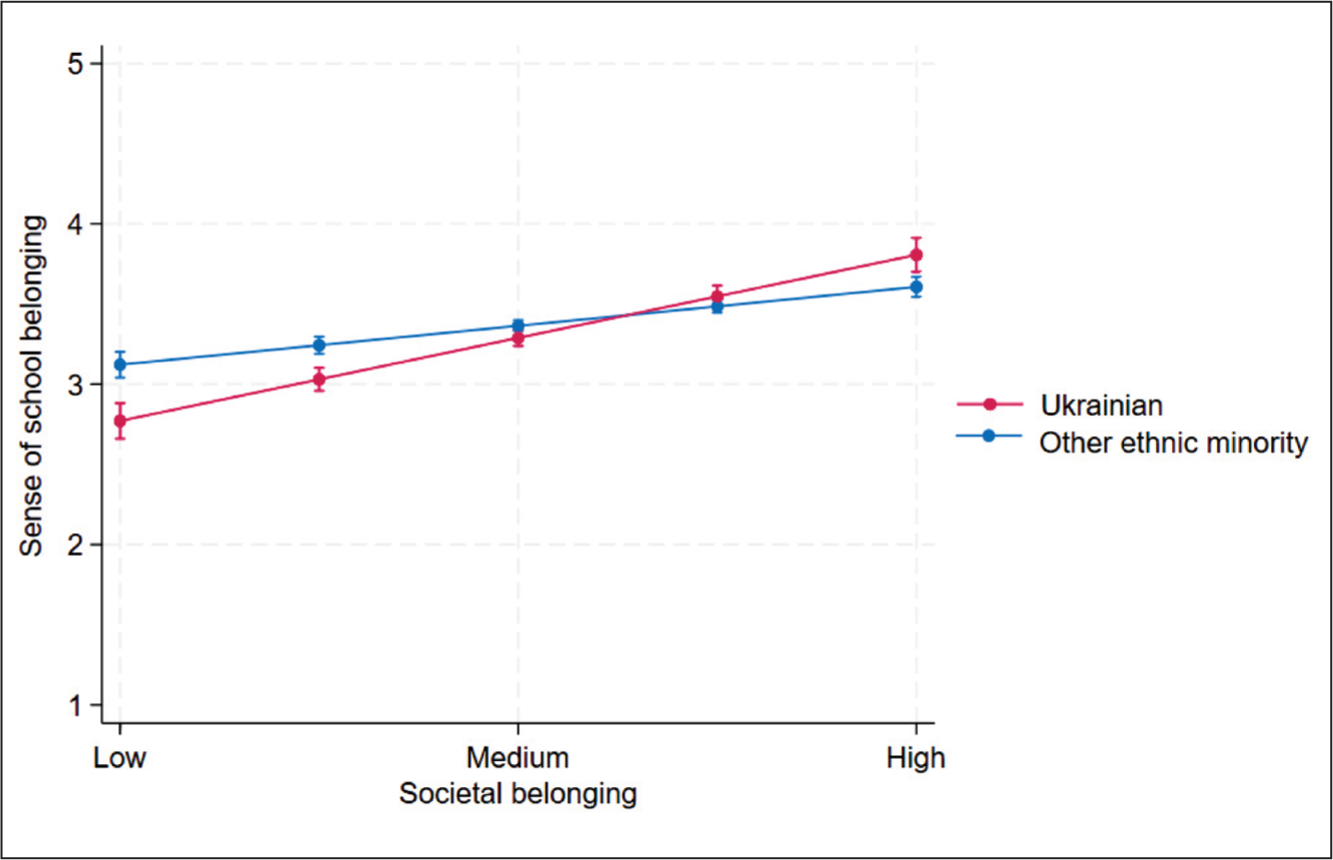
Our interaction model (M2) shows that the association between school belonging and societal belonging is moderated by ethnicity. This association is significantly stronger for Ukrainian students ( β = 0.04, p < .001) than for members of the other ethnic groups. The difference between Ukrainian and other ethnic groups is depicted in Figure 1. Since most Ukrainian students in our sample (71%) arrived to the Czech Republic as war refugees at the age of 13 or older, we examined if recently arrived Ukrainians differed from those who arrived earlier or were already born in the Czech Republic. However, our multilevel models with six ethnic groups (including the two Ukrainian groups not reported here) had the same result: the association between school belonging and societal belonging was stronger for both Ukrainian groups than for the other ethnic groups. We also examined if the way we categorized ethnicity had an impact on our results. We ran our models with alternative coding of respondents selecting multiple ethnicities (see Table A3), but we got substantially the same results, with the exception of Vietnamese students. When all dual-ethnicity respondents who selected Vietnamese as their ethnicity were coded as Vietnamese, the association between school belonging and societal belonging became statistically significantly stronger for them (similarly to Ukrainians) as compared to their Slovak, Roma and ‘other ethnicity’ peers.
Discussion
In this article, we investigated the association between the sense of school belonging and societal belonging among ethnic minority adolescents in the Czech Republic. We hypothesized that ethnic minority adolescents’ sense of school belonging would be associated with their sense of societal belonging even after controlling for factors that may influence both types of belonging, such as parental support, peer support and relationship with teachers. Our results supported this hypothesis; the two types of belonging were associated with ethnic minority students. We also examined whether this association would differ by ethnicity and found that it was stronger among Ukrainian students than among members of the other ethnic groups.
While existing literature extensively discusses the individual impacts of school belonging (Heikamp et al., 2020; Slaten et al., 2015) and societal belonging (Valcke et al., 2020) on ethnic minority adolescents, the connection between these two forms of belonging has not been studied yet. Studies have shown that ethnic minority adolescents often feel a low sense of belonging to their countries (Fleischmann & Phalet, 2018), but the link to other aspects of their lives, such as school belonging, has not been explored. Some studies (e.g., Gharaei et al., 2024) have looked at national identification and school belonging but have not found a connection. However, our findings suggest that when societal belonging is conceptualized in a broader sense, as feeling a connected, affiliated and respected member of the larger society (Özdemir & Bayram Özdemir, 2023), and is not linked to national identification, there is a positive relationship between the two types of belonging among ethnic minority youth. This is in line with research showing that students with immigrant backgrounds may have a low level of national identification but a strong feeling of belonging to the country they live in (Matafora et al., 2021). A sense of belonging to the larger society may consequently facilitate the development of a positive sense of school belonging when minority youth enter a new school environment following the transition from primary to secondary education.
Further, we examined whether the strength of the relationship between societal belonging and school belonging varied by ethnicity. Our findings indicate that this relationship was notably stronger among Ukrainian students compared to the other ethnic groups investigated. One possible explanation is related to the immigrant and refugee background of the Ukrainian participants. In our sample, 71% of Ukrainian adolescents were recent arrivals in the Czech Republic, most of them as war refugees. These findings align with previous literature showing lower school belonging among refugee adolescents (Kia-Keating & Ellis, 2007). Refugee adolescents often feel disconnected at school, and they may face discrimination and challenges in building friendships (Kia-Keating & Ellis, 2007; Osman et al., 2020); thus, their overall position in the school environment is more sensitive compared to more established adolescent groups.
Furthermore, refugees who spent only a short time in their host country have their sense of belonging to the ‘new society’ tied to their experience at school more closely than immigrants who live in the host country for several years. These findings can be understood through the self-stereotyping theory (SST), which suggests that individuals define, describe and evaluate themselves based on their group prototype. Self-stereotyping is more pronounced when a social identity is salient compared to a personal identity (Onorato & Turner, 2004), and ethnic minority or low-status in-group members tend to self-stereotype more strongly than majority or high-status members (Cadinu et al., 2013). For the Ukrainian adolescents in our research, their social identity may become highly salient due to the ongoing conflict in Ukraine and the presence of a significant refugee population. The shared experiences of conflict and displacement could reinforce their identification with the group, aligning their actions and attitudes with the group prototype and creating a cohesive behavioural pattern across different subgroups within the Ukrainian ethnic minority.
Interestingly, when we tested the robustness of our results, we found that if we coded all dual-identity respondents who selected Vietnamese as one of their ethnic identities as Vietnamese, the association between school belonging and societal belonging was also statistically significantly stronger for them than for their Slovak, Roma or ‘other ethnicity’ peers. This indicates that, similarly to Ukrainians, their sense of school belonging may be more sensitive to their perceived social position. Indeed, they are often seen as ‘closed’ by the majority, and some research suggests that second-generation Vietnamese often struggle with their identity, not being fully accepted either by the host society or by the diaspora (Pham & Kraus, 2024).
Finally, our study examined the three variables commonly associated with school belonging: friend support, teacher support, and quality of the family environment. Our results align with previous research showing that school belonging is positively associated with support from friends (Uslu & Gizir, 2017) and teachers (Bayram Özdemir et al., 2021). Similarly to Han et al. (2021) and Ma (2003), we did not find a significant association between school belonging and the quality of the family environment, which is in contrast with studies that reported a positive association between supportive parents and school belonging (Ahmadi et al., 2020; Uslu & Gizir, 2017).
One possible explanation for the unexpected absence of a relationship between parental support and school belonging may lie in differences in operationalization. While prior research often highlights the association between school belonging and parental support in the context of parental involvement in adolescents’ schooling and academic support (e.g., Ahmadi et al., 2020), our measure primarily captures the emotional support provided by parents. This distinction suggests that while parental academic involvement may foster a stronger sense of connection to school, emotional support alone may not be sufficient to enhance students’ feelings of belonging within the school environment.
Our study contributes to the literature on school belonging and societal belonging in multiple ways. First, societal belonging may have a unique contribution to the sense of school belonging at the onset of high school education in a new school environment among ethnic minority students. Second, we focused on a unique combination of ethnic minorities and showed that the positive relationship between the two types of belonging was stronger among Ukrainian pupils than among members of other ethnic groups. Third, we contributed valuable regional insights to the broader understanding of ethnic minority integration in schools by examining belonging in the Central and Eastern European regions.
Admittedly, this study also has several limitations. First, the cross-sectional nature of the data used does not allow for causal claims. While it allows us to explore the previously unexamined relationship between school belonging and societal belonging, future research would benefit from using panel data that would allow for testing the direction between school belonging and societal belonging. Second, the results of this case study would be ideally tested across different countries with adolescents of diverse cultural and immigration backgrounds. Third, although our study includes a unique combination of measures such as three types of social support, there are additional variables that would be useful to add to the models such as academic support received from parents or some indicators of school performance.
Conclusion
This study highlights an important association between societal belonging and the sense of school belonging among minority adolescents, regardless of ethnic background. Our findings suggest that for ethnic minority adolescents, being recognized and respected within society enhances their sense of belonging within the school environment, indicating a potentially reciprocal relationship. This connection is especially evident among recently arrived refugees, who often face greater vulnerability and fewer opportunities for interaction with peers from the majority population. These results underscore the importance of fostering a sense of belonging among ethnic minority adolescents as a means to support their integration into the school community, which in turn may promote better academic outcomes and overall well-being.
Footnotes
Data Availability
The data supporting this study’s findings are available from the corresponding author upon reasonable request.
Declaration of Conflicting Interests
The authors declared no potential conflicts of interest with respect to the research, authorship and/or publication of this article.
Ethical Approval and Informed Consent
The Ethical Committee of the Institute of Sociology of the Czech Academy of Science approved the study. Informed consent was obtained from all individual participants.
Funding
The authors disclosed receipt of the following financial support for the research, authorship and/or publication of this article: This article was supported by the ‘Dynamics of Adolescents’ Attitudes Toward Outgroups’ project, financed by the Czech Science Foundation (Project no. 23-07283M).
Appendix
Multilevel Models Applying Multiple Imputation.

| M1 | M2 | |||
| Societal belonging | 0.17*** | (0.01) | 0.09** | (0.03) |
| Family support | 0.03 | (0.02) | 0.03+ | (0.02) |
| Friend support | 0.19*** | (0.02) | 0.19*** | (0.02) |
| Teacher support | 0.64*** | (0.02) | 0.64*** | (0.02) |
| Czech identity | –0.02 | (0.03) | –0.03 | (0.03) |
| Gender a | ||||
| Woman | –0.05* | (0.03) | –0.05* | (0.03) |
| Other | –0.11 | (0.10) | –0.11 | (0.10) |
| Ethnicity b | ||||
| Ukrainian | –0.06 | (0.04) | –0.63*** | (0.13) |
| Roma | 0.06 | (0.04) | –0.07 | (0.13) |
| Vietnamese | –0.09+ | (0.05) | –0.52** | (0.18) |
| Other ethnicity | 0.00 | (0.04) | –0.18 | (0.14) |
| Parental education c | ||||
| Secondary education with Maturita | 0.08* | (0.03) | 0.08* | (0.03) |
| University degree | 0.09* | (0.03) | 0.10** | (0.03) |
| Classroom size d | ||||
| Small class (5–19) | 0.07 | (0.04) | 0.07+ | (0.04) |
| Large class (31–46) | 0.01 | (0.03) | 0.01 | (0.03) |
| Minority proportion | –0.17+ | (0.09) | –0.17* | (0.09) |
| Interactions b | ||||
| Societal belonging × Ukrainian | 0.17*** | (0.04) | ||
| Societal belonging × Roma | 0.03 | (0.04) | ||
| Societal belonging × Vietnamese | 0.12* | (0.05) | ||
| Societal belonging × Other ethnicity | 0.05 | (0.04) | ||
| Constant | 0.27** | (0.09) | 0.54*** | (0.13) |
| Random effects | Variance components | |||
| Intercept (Level 2) | 0.00 | –0.08 | 0.00 | 0.00 |
| Intercept (Level 1) | 0.36*** | –0.01 | 0.36*** | –0.01 |
| N (students) | 2593 | 2593 | ||
| N (classrooms) | 813 | 813 | ||
Standard errors in parentheses.
+p < .10, *p < .05, **p < .01, ***p < .001.
aBaseline level: Man.
bBaseline level: Slovak.
cBaseline level: Primary or secondary education without Maturita.
dBaseline level: Average class (20–30).