



Abstract
For unaccompanied young people, forced migration and resettlement take place within intersecting life transitions into new social, cultural and environmental conditions. Previous research shows that peer networks provide crucial support for young refugees as they navigate through these transitions. This qualitative study used a practice-theoretical lens to better understand how friendships are made and participated in over time as young refugees build new lives in Finland. Using thematic interviews with young refugees on their past, present and future friendships, this study explores how changing conditions enable or constrain the practices through which friendships are maintained. Findings show that some friendship practices endured or evolved within changed conditions related to safety, gender, language, geography and technology. Findings also show that friendships made in residential care had continuing significance in young refugees’ adulthoods, suggesting that facilitating the development of these friendships has positive long-term implications for young refugees’ resettlement and well-being.
Keywords
Introduction
During the so-called refugee crisis of 2015, over 3,000 unaccompanied minors applied for asylum in Finland. In the years since, an average of 190 applications have been submitted annually (Finnish Immigration Service, 2024). With most of these applications receiving positive decisions, many of these children are now young adults building independent lives in Finland, often still without family support. For these young people, the experiences of forced migration and resettlement take place within multiple, simultaneous and intersecting life transitions (Haswell, 2023; Haswell et al., 2023). In fleeing the dangers of their home countries and navigating the often perilous journey to safer places, they transition between shifting states of physical security. At the same time, the abrupt distancing from their family and friends often leads to increased states of emotional, psychological and relational insecurity. Furthermore, in relocating to a new country, they transition from a site whose social, cultural and environmental conditions are familiar to a site whose conditions are in many ways unfamiliar. Overlapping these transitions is the passage from childhood to adulthood.
Previous research in youth studies and beyond has shown that social networks provide crucial support for unaccompanied minors as they navigate through life transitions. While family may continue to provide them with important material and emotional support from afar (Oppedal & Idsoe, 2015), reuniting with them is often physically, politically and bureaucratically difficult (Kauhanen et al., 2022). With family connections diminished, peer networks take on greater significance, with some friendships developing into family-like relationships (Kallio, 2019; Tiilikainen et al., 2023). Three main types of friendships have been identified significant for unaccompanied minors during resettlement: pre-displacement friendships that have remained intact, post-displacement friendships with peers from the majority culture and post-displacement friendships with peers who share their own or similar culture and ethnicity (Kivijärvi, 2014; Omland & Andenas, 2020; Oppedal & Idsoe, 2015).
While broader scholarship has focused on the significance of young refugees’ social relations and the types of support they offer, gaps remain in understanding how friendships are made and participated in by these young people during and throughout their life transitions. This study approaches friendships from a practice-theoretical perspective (Kemmis, 2019; Schatzki, 2022). Practices oriented towards the maintenance of, and participation in, friendships (hereafter friendship practices) are, like all practices, enabled and constrained by the social-political, cultural-discursive and material-economic arrangements of the sites in which they take place (Kemmis, 2019). When these conditioning elements change, as they do during transitions, social relations become prefigured in new ways (Schatzki, 2019; see also Shove et al., 2012). Given how important friendships are to unaccompanied young people as they build new lives in new places, it is crucial to understand how their resettlement environments prefigure their possibilities to create or maintain these relationships.
Friendships Through Life Transitions
Within broader discussions of life transitions in youth studies (e.g., Brooks, 2002; Bruselius-Jensen & Sørensen, 2021), there is growing interest in the intersecting and often traumatic transitions experienced by young refugees. Particular attention has been given to young refugees’ transitions into new cultural contexts (e.g., Brook & Ottemöller, 2020), from youth to adulthood (e.g., Macaulay, 2021) and from study to work life (e.g., Oppedal et al., 2017). The simultaneity and multiplicity of the transitions experienced by young refugees have also been highlighted (e.g., Selimos, 2018).
Navigating these life transitions is especially challenging for unaccompanied minors due to the absence or distance from familial support networks (e.g., Höhne et al., 2020; Kauhanen et al., 2022). As children resettling in new countries, they face the challenges of learning new languages and cultural norms while holding on to their own cultural identity (Brook & Ottemöller, 2020). While some may continue to receive familial support from a distance, much of the social stability and security they receive is from new relationships formed in the receiving country (Lalander & Herz, 2021). This security, however, may be precarious, depending on conditions such as the receiving country’s immigration laws (Kauhanen et al., 2022).
For both current and former unaccompanied minors, supportive social networks are a vital source of security, providing practical and emotional assistance along with a sense of belonging and security (Beirens et al., 2007; Eriksson et al., 2019; Kaukko & Wernesjö, 2017; Winkens et al., 2023). Some friendships, for example, with home country peers or with those met in countries of first asylum, are maintained remotely through the upheaval of forced migration. Others may be newer, formed during their time as unaccompanied minors in residential care 1 or afterwards in their lives as independent adults. Friendships with co-cultural and co-ethnic peers offer cultural continuity, shared understanding and history, while those with majority culture peers offer support in learning new languages and customs (Eriksson et al., 2019; Kivijärvi, 2014; Oppedal & Idsoe, 2015). Both play a significant role in the nested process of integration by which refugees ‘first integrate by way of consolidating their relationships with family and extended kin groups, then sub-groups and wider ethnic groups, then neighbourhoods and cities, and finally into what we might call national society as a whole’ (Castles et al., 2002, p. 127).
Recent scholarship (e.g., Schwartz et al., 2021) has highlighted continuing gaps in knowledge about the impact of forced migration on young refugees’ peer relationships and about how conditions in their places of resettlement may constrain the making of new friends.
To understand how unaccompanied young people’s friendships are made and participated in across their life transitions, a long-term perspective is needed. Previous studies have, however, mainly investigated particular phases of young refugee resettlement. As Lalander and Herz (2021) point out, there is currently a lack of long-term focus on young refugees’ everyday lives, and ‘on the possible changes and stability that mark their lives over time’ (p. 273). This article contributes to filling this gap.
Investigating Friendship Practices
Like all social relations, the friendships of unaccompanied young people are maintained through a range of practices. These, as Omland and Andenas (2020) note, include relational practices such as working together ‘to connect past, present and future contexts through collective meaning-making practices’, regulating each other’s emotions through ‘emotional care practices’ and widening ‘social networks through practices of social inclusion’ (p. 917). Also, participation with peers in other everyday activities such as cooking or shopping are important elements of constructing, strengthening and negotiating relationships between them (Verdasco, 2020). These studies highlight the influence of social and material conditions on young refugees’ friendships, as well as the situatedness of these practices in localized contexts.
This study contributes to our understanding of young refugee friendships in two ways. First, it applies a practice-theoretical lens (Reckwitz, 2002; Schatzki, 2019), specifically the theory of practice architectures (Kemmis et al., 2014), to draw attention to a broader range of interrelated conditions surrounding young refugees’ everyday lives. Second, it takes a wider temporal view to investigate young refugees’ activities in pre-displacement past, in their present lives and in their imagined futures. Through these perspectives, this study considers how friendship practices change or endure within the changing conditions that young refugees encounter during transitions.
The theory of practice architectures sees practices consisting of what people say (sayings), what they do (doings) and how they relate to one another and the world (relatings). Practices take place within sites whose particular conditions—arrangements—can enable or constrain them. The way people communicate and act in practices is influenced by the cultural-discursive arrangements around them, including language and shared cultural understandings. The material-economic arrangements prefigure what people can do in the site of the practice. Finally, social-political arrangements of power, inclusion and recognition condition how people relate to one another and how they position themselves and are positioned by others within the sites of practices. These can enable or constrain, among other things, the sense of belonging, solidarity and friendship people experience with one another (Kemmis, 2019).
Schatzki (2022), in a related practice-theoretical perspective, conceptualizes practices as ‘the social contexts in which lives proceed and the phases and transitions of life occur’ (p. 27). During the multiple transitions associated with forced migration, young refugees can be seen as constantly adjusting to new circumstances through participation in practices. They carry with them knowledge, skills and experiences related to practices that were formed in their pasts. As they build new lives in new places, they draw on these competencies, as well as learn new ones, to participate in similar or new practices. Some practices that were useful in the past may remain relevant and be brought in more or less intact into their present and future lives. Others may change their form while remaining distinguishable, or they may change or disappear if they become irrelevant or impractical within the new conditions. Practices, in other words, are not static, but they evolve, and they have history (Kemmis, 2019; Shove et al., 2012).
A practice-theoretical perspective brings into view some of the challenges and possibilities faced by young refugees in making and participating in important friendships in new places and conditions. It is used here to answer the following research questions: ‘How do unaccompanied young people participate in close friendships in the past, present and (anticipated) future, and how is their participation enabled or constrained by the changing arrangements they encounter in their transitions to a new life in Finland?’
Methodology
This qualitative study drew on data collected for the refugees in Finland, Norway and Scotland. The study focused on data from 17 participants (8 of whom identified as women, 9 as men) who arrived in Finland as unaccompanied minors. The majority (9/17) arrived in 2015 at an average age of 15, and had lived in Finland an average of 7 years before fieldwork began in 2020. Participants’ countries of origin included Afghanistan, Iran, Pakistan, Somalia and Congo. All participants had received permission to stay in Finland. At the start of fieldwork, participants were all young adults (average age 22) and were living independently in various urban centres in southern and central Finland. Approximately half of the participants were studying in vocational education, while the other half were working.
Recognizing the vulnerable positions that participants, as former unaccompanied minors, were in, special care was taken to conduct the research ethically (Reimer et al., 2019). Ethical approaches included informed consent, flexible fieldwork timetables, respect for privacy and participants’ own voices and contexts and pseudonymizing data, as well as taking care of relational ethics (Kaukko et al., 2017) throughout the fieldwork.
The study utilized individual semi-structured interviews collected for the broader Drawing Together Project. Each participant took part in a series of three semi-structured interviews, each lasting approximately 1 hour and focusing on a different life phase (past, present and future). Interviews were conducted in Finnish or English according to participants’ wishes. Supporting translation services were offered when needed. During each interview, the participants discussed important family, friend, community and formal relationships in their lives, and how these relationships contributed to their well-being. Data relating to friendship relationships was used in this study. The total dataset for this article included 43 interview transcripts (past n = 13, present n = 17, future n = 13). All non-English interviews were translated to English. 2
The first analysis step was to identify all significant friendships in the data. Acknowledging that the concept of friendship varies across culture, age and gender, and at times coincides with family relations, this study focused only on non-familial relations that were characterized by participants themselves as ‘best’ or otherwise close and important friendships. In line with established conceptions of close friendships (e.g., Leenders, 1996), most of those identified by participants were characterized by similarity (of age, gender, cultural background and social circumstances), reciprocity (sharing mutual support and understanding) and proximity (living close together).
The next step was to identify practices the participants engaged in, oriented towards making and maintaining their identified friendships. These practices were defined as routinized activities undertaken with, for or in relation to friends. Guided by the theory of practice architectures (Kemmis, 2019), each selected practice was then analysed through its constituent dimensions: relatings, sayings and doings. Corresponding arrangements were then identified from the data by analysing how participants spoke of the broader conditions surrounding the practices at the time they engaged in them. It was then considered how the arrangements enabled or constrained the practice dimensions, and what influence that had on the participants’ ways of maintaining and building friendship practices. Security and gender norms (social-political), language and cultural understanding (cultural-discursive) and proximity and technology (material-economic) emerged as key types of arrangements prefiguring friendship practices in the three time periods. These, and the connections between them, will be focused on in the findings, with the recognition that many other interlinked arrangements were undoubtedly present, though less visible in the data. The analysis also focused on how the practices (including their respective dimensions) and the arrangements changed, endured, ended or appeared from one time period to the next. Based on this, the results suggest how changes in arrangements present new opportunities or barriers to young refugees’ friendship practices, and how the participants drew on previous skills, knowledge and experience to actively adapt practices to new conditions.
Friendships in the Past: Everyday Relations in Unstable and Unequal Conditions
In participants’ pre-displacement past, ranging from early childhood to mid-teenage years, identified friendship practices included visiting friends, playing games, going to public places, helping with schoolwork or chores and spending leisure time together—activities participants viewed as typical in their home countries. 3 Nadira, 4 for example, recalled spending ‘free time’ with friends ‘playing and talking’, while Abdul recalled that, with his friends, ‘we played something, went somewhere, did what kids usually did’. These seemingly everyday practices, however, all took place in sites whose arrangements enabled and constrained them in different ways, leading to differing opportunities for access to and participation in friendships.
Proximity and Resources Prefiguring Ways of Doing Things Together
A key feature in the formation of participants’ childhood friendships was proximity. Living near others, or otherwise spending time in the same site as others, created opportunities for them to connect and do things together. Most important past friendships were with peers living relatively close, with the nearness of their homes facilitating regular face-to-face social encounters. Sara’s best friend, a neighbour, would frequently visit, sleep over and share meals. Their proximity enabled a strong bond, with Sara noting, ‘we almost lived together’.
Significant sites of childhood friendships included the home, school and other educational sites and public spaces such as sports fields and nature places. The types of sites available to participants, their physical layout and the objects within them, as well as the proximity of these spaces to each other, could all be seen as shaping the range of possibilities for collaborative action within them. Samir, for example, recalled arranging and participating in sports activities using the limited equipment available:
[T]here was a volleyball court at school. I didn’t attend school, but I went there with friends who were, and they reserved the court for us. Sometimes there was a volleyball net there ready, sometimes there wasn’t and then we got one ourselves to use. (Samir)
Participants’ descriptions give the sense of managing with, and in some cases adapting their activities around, whatever spaces and resources were physically available on the site, which in some cases was relatively limited.
Shared Languages Prefiguring Ways of Communicating and Being Understood
Participants’ past friendships were also shaped by language and cultural understandings. Cultural-discursive arrangements of language, ideas and discourses prefigure how people can understand and communicate with each other. In participants’ childhoods, these arrangements included their own language proficiencies as well as the range of languages used in their community and home country. They also included cultural understandings held by participants, their families and communities, including religion, morality, cultural value, belonging and difference.
Cultural-discursive arrangements of the past were seldom explicitly mentioned by participants. The impact of these arrangements, however, was hinted at in the ways that participants communicated with friends. Those who were fluent in the languages of their community, such as Sara, ‘spoke about everything’ with their best friends, including ‘secrets’ and ‘things she’d done’, while Zain, playing football with friends, found it fun to ‘sit and laugh’, suggesting a level of intimacy enabled by mutually understood cultural-discursive arrangements.
Language, ideas and cultural understanding could also be seen as constraining possibilities of developing friendships when they were linked with social-political discrimination. This was particularly apparent in the childhoods of several Afghan participants who were born and/or raised in the differing arrangements of neighbouring countries such as Iran. Lilith, for example, recalled that:
I had one school friend [in Iran], but the others always teased me, so I didn’t have any connection to them or to the teachers or to anyone. Everyone was maybe Iranian, and I was the Afghan. Because of that I was teased a lot. (Lilith)
While her fluency in the language and culture of Iran provided opportunities for participation in friendship practices with peers, the social-political arrangements there included various forms of prejudice that formed barriers to acceptance and belonging.
Gender Norms and Insecurity Prefiguring Access and Ways of Relating
Participation in friendship practices required access to the sites in which they took place. Access was prefigured by proximity to sites, but it was also closely entwined with social-political arrangements, including gender norms and insecurity.
Male participants, as children and youth, had generally more access to sites outside of home or school, thus affording access to a greater range of social activities such as sports and hobbies. For female participants, unequal gender norms restricted their social lives to the home and institutional sites such as schools and places of worship. As such, their friendship practices within those sites were prefigured by the gendered routines and responsibilities expected of them in those sites. As Malalay recalled, ‘I just went to school and back home.… We only had one day off school, and on that day, everyone cleaned, I helped my mother. And then sometimes I went outside’.
While gender norms gave male participants relatively more freedom to socialize outside of home and school, conditions of economic insecurity and normalization of child labour often led to their time for socializing, and access to sites, being restricted by the need to earn money. Masoud, for example:
[D]idn’t have any course or hobbies between the ages of 10 and 14 [because] I went to work, and the work was so hard for me.… In the day I worked a lot, and I became tired and I didn’t enough have the energy to be active in [social activities]’ (Masoud)
While Masoud’s work responsibilities constricted his friendship practices, Samir’s could be seen as sometimes aligning with, or doubling up as, a friendship practice:
‘[My friend and I] had animals to take care of, so we helped each other, co-operative work. One day I would go to help him, the next he would come to help me’. This type of reciprocal support, in the form of helping each other with chores, schoolwork or money, was a visible feature of several past friendships, hinting at a link to broader social-political notions of community and solidarity present in those sites.
Insecurity, experienced by all participants throughout their childhood in forms such as war and social-political instability, created additional barriers to friendships. Conflict was an ever-present reality throughout some participants’ childhoods, like Basam, who ‘since [I was born] the whole time I’ve seen explosions.’ Others, like Nala, experienced a more abrupt onset of conflict with the appearance of Al-Shabaab in her Somali community:
First it started with Islamic thing. Girls shouldn’t go out. We should have a long hijab. It started like that. [And] they used to do a lot of public killings. And then there was the al-Qaida, al-Shabaab trainings, and then everything started. (Nala)
In Mathieu’s case, political insecurity constrained opportunities for leaving the house, meeting and spending time with friends. He was forbidden to ‘open the door or to go out without permission [because] there they just kidnap you and ask for money’. While stressing that ‘it was right for [my parents] to protect us’, Mathieu acknowledged that:
[I]t was hard for us living [this way] because when you are growing up, you need friends. You need friends to come to home, and talk. But I didn’t have that. At school … we used to talk, but they couldn’t come to my place. And I couldn’t go to their place. (Mathieu)
The above examples show how changes in social-political security directly impacted participants in many traumatic ways, including the restriction of access to important sites of friendships such as the home and public spaces, which constrained the possibilities for participation in friendships.
Conflict and other forms of insecurity eventually led to all participants’ forced migration, which brought significant disruptions, and often terminations of existing friendships. As participants transitioned into new sites, they carried imprints of these arrangements through memories and experiences, which, as discussed below, continued to impact them in their post-asylum friendship practices. Yet participants also carried the knowledge, skills and experiences gained through past practices, which they could adapt to the new arrangements they encountered.
Friendships in the Present: Adapting to New Conditions
After arrival in Finland, participants’ friendship practices were oriented towards two main goals. First, participants strove to maintain contact with childhood friends still in their home country or living in other countries. Contact was maintained mainly by phone and social media and, for some participants, through occasional travel. Second, participants strove to make and maintain new friendships in Finland. While some participants spoke of important new friendships with Finnish people, most were with peers of similar cultural and ethnic backgrounds who they had met in residential care and, to a lesser extent, in school or on social media. Typical friendship practices with these friends in the present included spending time in public and commercial spaces such as public saunas, shops and cafes, as well as sharing meals and visiting each other’s homes.
Distance Constraining Ways of Maintaining Friendships
Participants’ friendships in the present continued to be shaped by proximity, in both positive and negative ways. Home country friendships were disrupted by the physical distances that now made face-to-face contact impossible without expensive and sometimes dangerous travel back to their home countries. This necessitated engagement with new kinds of practices related to phone and internet communication. Prior experience with, and access to, this technology enabled some participants to more easily maintain contact with friends in their home country, while others, like Samir, re-established links as he came to ‘know much more about the internet … since I came to Finland’. This example shows how new practices emerged within and in response to the new material arrangements of Finland.
Availability and access to communication technology were key arrangements that not only facilitated communication with friends but also created a virtual site for participation. For Nala, ‘the phone is actually what connects me to where my roots are’, by bridging the ‘long distance’ to her ‘family or friends back home’. Sara could keep in touch with many of her childhood friends at once through social media, where they regularly ‘posted about everyday things’. Lilith, among others, also interacted with friends through online games, through which, she could hear ‘how [her friends] are doing’. These examples show phones and the internet as valuable arrangements enabling participation in friendships.
Reliance on communication technology for maintaining friendships also, however, constrained participation in several ways. When Samir, as a minor, was moved to new residential care accommodation in another city, he kept in touch with former care accommodation friends via social media. All those connections were lost, however, when his social media account was hacked and closed. For Arman, the mediated nature of phone contact constrained how he expressed himself to people in his home country: ‘It’s easy to discuss things when you see the people in person and then cry or be happy. It is really hard on the phone.’ These examples highlight the complex ways that arrangements can, in different situations, enable or constrain friendship practices.
Arman, among others, emphasized the importance of proximity and face-to-face contact in maintaining friendships, stating, ‘I should see the people in order to keep a strong relationship. I can’t keep with the relationship if I don’t see them in real life’. Travelling between Finnish cities and to other countries thus became another important practice for connecting with both old and new friends in different locations. Zain noted how he and his friends made regular intercity trips to visit each other and to Sweden, ‘because Sweden isn’t far’. The proximity of Finland to participants’ friends, as well as access and resources for travel, thus also became key material-economic arrangements enabling friendships.
Some everyday friendship practices participants took part in the past, such as playing football, could be seen to continue in the present with new friends. Basam described past parties with friends, where ‘we did food together and sang and danced and played cards’. In his present parties with friends, practices included ‘play[ing] games and sometimes smok[ing] a waterpipe’. Though the broader circumstances had changed, the availability of familiar games and water pipes in Finland, combined with social-political arrangements that did not constrain participants’ access to them, enabled these practices to be established in the present. Some participants, like Aaqil, also spoke of engaging with friends in new kinds of practices such as avanto, a traditional winter swimming pastime in Finland. Though he ‘didn’t terribly like’ the pastime itself, he participated in it as a way to socialize with friends. Importantly, the sites in which avanto is practiced, typically public saunas on lakeshores, could be seen to contain arrangements that presented few barriers to their participation. It is not known from the data what kinds of interactions, negative or positive, Aaqil or his friends had with other people there, but Aaqil’s description of it as a pastime that all of his friends liked, where one could ‘get peace of mind’ and ‘to grill and have a drink’, hints at the presence of enabling arrangements including proximity to nature, low language threshold and an inclusive social atmosphere. This example is also significant because it hints at how integration into Finnish culture and social life can be accomplished within the safety and sense of belonging provided by co-ethnic social networks.
Shared Languages and Culture Enabling Communication and Belonging
When participants arrived in Finland, they found themselves in cultural-discursive arrangements very different from those of their home countries. Building social connections across these differences required learning new languages and cultural understandings. Aaqil, for example, stated that, to make more friends with Finnish people, he needed to ‘learn more of the language here … so we understand each other. Sometimes one needs to understand Finnish culture well, and I still need to learn a bit about that’.
Participants reported making significant friendships with Finnish people over time. Some evolved from formal care relationships with social workers and nurses from residential care, mainly involving older individuals rather than age-peers. Fazel, for instance, maintained a friendship with a former nurse who ‘supports me a lot. She is like my mother, not biological’. Only a few participants mentioned important peer friendships with Finns, including Arman, who felt that making Finnish friends let ‘you see different aspects of how things could be done, and I learn new things. If you only speak with asylum seekers who come from your country, you only speak your mother tongue and not Finnish’. Some participants also mentioned friendships with peers from still other cultural backgrounds. Like the Finnish friendships, however, these were typically discussed as weaker relations and were mainly situated within broader social networks.
Most present friendships that participants considered their best, or closest, were with peers in residential care with similar cultural and ethnic backgrounds. This may have been partly influenced by exclusion from interactions with Finnish peers or other forms of discrimination; however, these kinds of arrangements were not visible in the data. Nevertheless, participants’ long-term proximity to peers with similar cultural-linguistic backgrounds in the care accommodation could be seen as an arrangement that enabled close friendships with them to form. While they also spoke of friendships and associations with peers from other backgrounds there, the common languages and culture they shared with some made it easier both to communicate with and understand each other. Aaqil saw shared language and cultural understanding as a ‘strength’ by which friends could ‘explain things and understand each other’. With the Finnish language, he ‘didn’t understand it enough to explain the meaning of problems or good things. With my own language I can talk about anything and [my friends] will understand and I will understand them. The same culture, culture is really important’. Cumar also saw this shared communication and understanding as key qualities of friendships: ‘I can talk in my own native language and we can just talk about anything … those friends are my roots back home.’ Cumar’s description of these friendships as connections to his past life also highlights their importance in creating a sense of belonging and continuity in their new lives.
Solidarity and Shared Experiences Enabling Reciprocal Support
Also significant to participants’ friendships was a sense of solidarity arising from their shared experiences of forced migration and their positions as refugees within the new social-political arrangements of Finland. In Finland, participants entered sites with relatively high levels of ontological, social and political security. For Basam, ‘the most important thing has been that I’m alive here in Finland, there are no bombs exploding here. It’s peaceful and Finland has supported me quite a lot’. While safe in Finland, however, some participants still felt the effects of their home country’s conflicts on their friendships. For example, Fazel, trying to reconnect with his best friend through social media, found out ‘that he’s in the grave … killed in a knife fight’, highlighting how young refugees’ friendships can be prefigured simultaneously by old and new, as well as near and far social-political arrangements, including war and peace.
Within residential care institutions made possible by policies of social support and asylum in Finland, participants found opportunities to form new friendships with peers who shared and understood the often traumatic experiences of conflict and forced migration they carried. This shared understanding and the solidarity it created were important sources of emotional support. Lilith, recalling a friend made in her residential care accommodation, noted, ‘We have lots of similar experiences, so we understand each other well.’
For many participants, the solidarity arising from shared understanding and experiences, as well as from shared language and culture, was a key element of reciprocal support practices with friends. Aaqil reflected that ‘no matter however many problems came to my life, [my friends] know what problems really mean. And I know what happens to them and they know what happens to me. That’s our connection, we can solve problems together.’ Aaqil also spoke of reciprocal support practices in terms of developing and maintaining long-term family-like support structures: ‘For me it’s always important that if someone needs help, I can help and if I need help then they help me. We’re like family now because we don’t have anyone here.’ Similarly, Nala received important emotional and informational support from a friend who had ‘been through the same stuff that I have been when I came here. She came a bit earlier, so she knew how the life changed when she moved here. She helped me get through it.’ These qualities of reciprocity and solidarity echo those in some participants’ childhood friendships. In participants’ present circumstances, they can be seen as a typical part of the transition from childhood to adulthood, but they take on new significance for young refugees in overcoming the many challenges and difficulties faced during resettlement.
New Gender Norms Enabling New Possibilities for Friendships
The greater gender equality participants encountered in Finland also broadened the possibilities of making friendships by giving participants more opportunities for inter-gender interaction, yet Malalay, who came to Finland with her brother, described a simultaneous sense of freedom and tension with participation in mixed-gender activities in their residential care accommodation. Her brother disapproved of her participation in these groups, yet Malalay’s view was that:
[T]his is Europe, and [here] boys and girls are the same and I don’t need to be afraid of anything. I want that the tension and the stress goes away, by talking a bit [in the mixed group activities]. Of course I’ve got a barrier, because in Iran we only spoke with girls. But I want to go to that group and speak well. (Malalay)
Malalay’s example shows how the social norms internalized by young refugees in their childhood do not automatically change when entering new social-political arrangements, even when those young people have a strong desire to develop new kinds of friendships. The change can be emotionally and psychologically daunting, and family expectations can remain constraining. The fact that, in the present, most participants continued to make new friendships mainly with same-gender peers highlights how changes in arrangements create new possibilities for changes in practices, but do not determine them.
Friendships in the Future: Towards Peaceful Lives in Settled Relationships
All participants saw themselves continuing to live in Finland in the future. The ways that they envisioned their future friendships could be seen as shaped by an anticipation that prevailing material-economic, social-political and cultural-discursive arrangements in Finland would enable them to lead settled, peaceful lives. Most participants saw their present friendships continuing and remaining important in their future lives, maintained through regular face-to-face and mediated contact. Some envisioned expanding their friend networks by making new connections, while others saw their current networks as sufficient for the future. In several cases, friendships from childhood were anticipated to fade because of the difficulty of maintaining connections over distance.
Shared Language and Solidarity Remaining Important for Future Friendships
It cannot be known from the data how participants’ friendships will evolve in the future in light of their increasing fluency in Finnish languages and culture. What is clear, however, is that participants anticipated their present friendships, with the understanding and sense of belonging that they give, to be significant in their transition towards settled life in the future. Shared language and cultural understanding, as well as a shared sense of solidarity, continued to be seen as key qualities of these friendships. For Aaqil, ‘friends should understand me and I should understand them, and then it will be fine and I can keep on living’. Other forms of mutual support were also seen as key qualities provided by friendships. Samir, for example, envisioned needing ‘those kinds of friends who you can call and ask for help if you need it, and they would say, “of course”’, but also friends with who to ‘spend time together, we can chat, drink, have fun’. Other important friendship qualities included trust, peacefulness, safety and happiness.
Several participants spoke of spouses being significant anticipated friendships in the future. In these relationships as well, solidarity, reciprocal support and trustworthiness were seen as key qualities. Reflecting the new possibilities opened up by the new social-political arrangements of Finland, some male participants spoke of an openness to intercultural marriages, stressing that cultural or ethnic background ‘doesn’t matter’ (Masoud/Samir). In more recent correspondence, 5 however, some of these participants reported becoming engaged in arranged marriages according to the social and cultural traditions of their home countries. This highlights how some participants’ relationships in Finland continue to be influenced at a distance by social-political arrangements of their family, culture and home country, and points to the complex cross-cultural tensions and negotiations that young refugees encounter during resettlement.
Friendships Supporting Broader Life Goals
Most participants described their future friendships as complementing a settled life marked by conventional milestones such as education, career and homeownership. Lilith saw herself ‘going to work every day and sometimes getting in touch with my friends’ and ‘going to see movies and nice things’ with them and her partner. Fazel saw friendships potentially providing support for work-related goals, seeing it as important to ‘know people [to build a career], and as much as you have friends you have more support there’.
Taken together, participants’ discussions about future friendships could be seen as reflecting the changing priorities and responsibilities typical to transitions into adulthood. They also could be seen to reflect the important roles that relationships based on understanding and solidarity played in broader processes of integration into and coming to belong in Finnish society.
Discussion and Conclusion
The findings show how the various dimensions of young refugees’ friendship practices—relating, communicating and spending time together—were enabled and constrained by the new arrangements they encountered in Finland. Some past practices evolved in response to new possibilities and challenges presented by the new conditions in Finland; for example, connecting with peers of other genders, participating in new kinds of social activities and becoming reliant on phones and internet to keep in contact with friends. Other practices aligned with participants’ changing needs during transitions, with present and future relationships taking on more adult-like qualities and social support expanding from immediate settlement challenges to long-term goals. These findings are summarized in Figure 1.
Summary of Past, Present and Future Friendship Practices an the Arrangements That Prefigure Them.
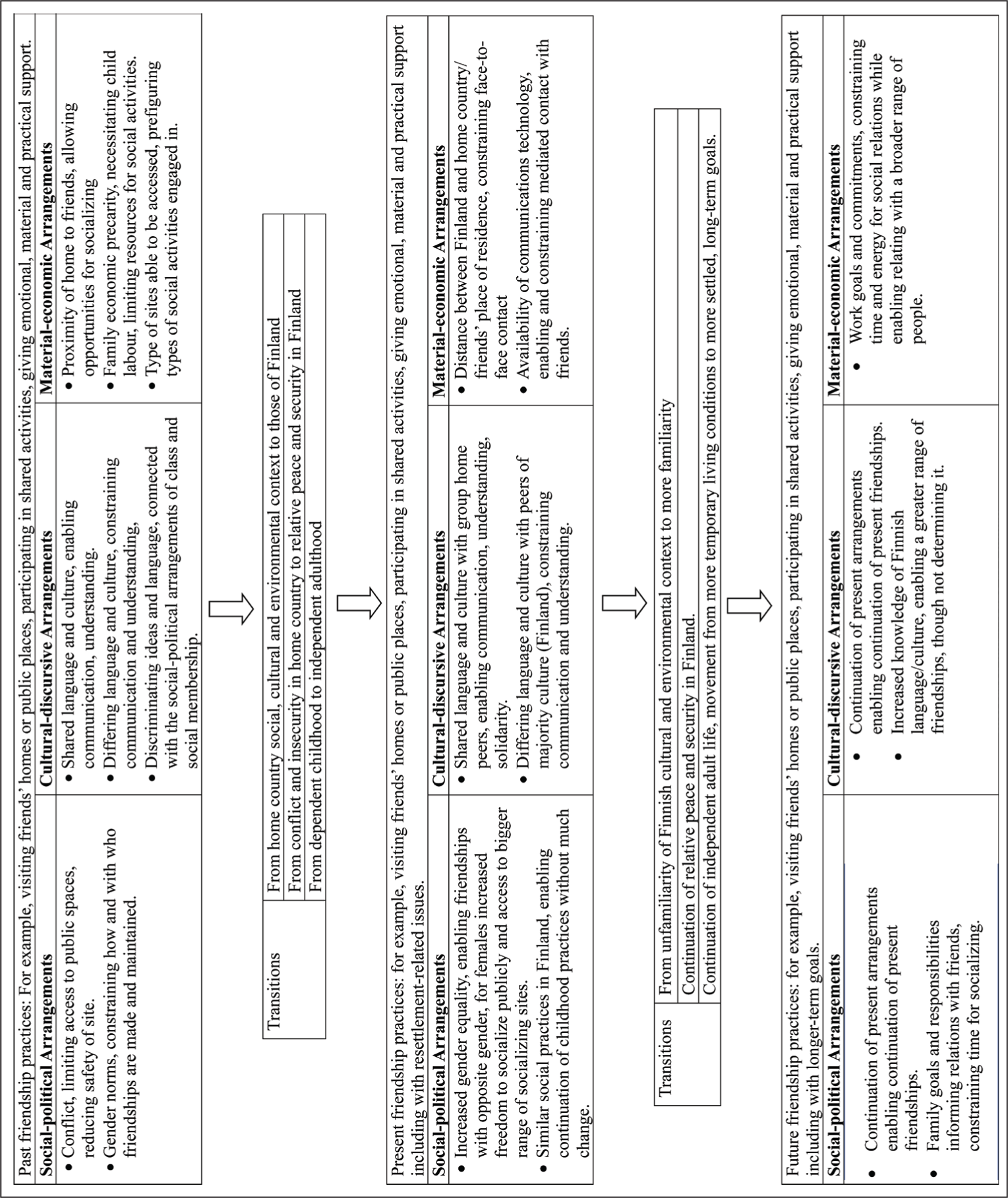
The findings reveal an interconnectedness of young refugees’ friendship practices across the past, present and future, as memories of past practices, as well as knowledge, experience and skills associated with them, were carried by participants into new sites and informed their present practices. At the same time, they showed how some past and distant arrangements can sometimes constrain friendships. Taken together, these highlight the importance, noted by Lalander and Herz (2021), of considering young refugees’ lives and friendships through a long-term perspective, in conjunction with more focused investigations of particular stages of migration and resettlement (e.g., Omland & Andenas, 2020). This knowledge is also relevant to wider scholarship on youth transitions and agency in social relations, as it sheds light on the complex ways that arrangements intersect over space and time to form both barriers and opportunities for participation.
In line with previous research (e.g., Tiilikainen et al., 2023), findings showed that participating in friendships was seen as a crucial part of transitioning into and developing a sense of belonging in new social, cultural and environmental conditions. The finding that most of participants’ important friendships were with peers of similar cultural and ethnic backgrounds also resonates with previous studies (Eriksson et al., 2019; Kivijärvi, 2014; Oppedal et al., 2015), reflecting the intrinsic need, shared by all, to simultaneously understand and be understood by others. Furthermore, the importance of residential care accommodation as important sites of friendship formation and sociality has been recognized previously (e.g., Kauhanen et al., 2022; Omland & Andenas, 2020).
This study found that participants wanted and anticipated their present friendships with peers of similar cultures and ethnicities to continue into their future and form a significant part of a stable and secure life in Finland. While these friendships may have arisen from these young people’s ‘shared position as “others” in Finnish society’ (Kivijärvi, 2014, p. 75), they can be seen as maintained and developed as part of participants’ own goals to create safe, peaceful and understanding communities within Finnish society. This notion adds nuance to broader discussions about refugee integration and segregation (see Kivijärvi, 2014). It shows that co-ethnic friendships are not contradictory to integration when integration is seen as a nested process (Castles et al., 2002) towards a sense of belonging in a new country and society (Kaukko & Wernesjö, 2017). By looking at the friendship practices that they carry with them from the past and into the future, we can better facilitate their goals of creating supportive and inclusive communities. As shown above, the theory of practice architectures (Kemmis et al., 2014) provides a useful lens through which to make visible the barriers to friendship practices and ways that these barriers may be overcome.
One key limitation to this study is its reliance on interviews (what is said) to understand practices (what happened). This meant that many details about participants’ friendship practices and the surrounding arrangements were not visible. It also meant that the participants spoke of their past and future practices through the lens of their present experiences of displacement and resettlement and that, while the practices referred to here are all social in nature and simultaneously connect to other people’s lives and processes, the data relates only to how participants themselves experienced them. Furthermore, in the interviews, participants only discussed friendships that they wished to speak about, leaving the possibility that other significant relationships remained unmentioned. This methodological approach, however, was chosen because it enabled the analysis of multi-sited practices across the broad spans of people’s life transitions, something which would have been difficult to accomplish with other methods. Building upon previous knowledge about the significance of young refugees’ friendship practices during resettlement, this study invites further exploration of the practices through which those friendships are made and maintained through life transitions.
Footnotes
Declaration of Conflicting Interests
The author declared no potential conflicts of interest with respect to the research, authorship and/or publication of this article.
Funding
This research was funded by the NordForsk Joint Nordic-UK research programme on Migration and Integration, grant number [94863] and the Ella and Georg Ehrnrooth Foundation.