



Abstract
Research shows a high prevalence of sexual violations among young people despite widespread agreement on the importance of consent. To understand their perspectives, we conducted focus-group interviews with 63 young Norwegians (aged 16–20) discussing a film about a problematic sexual encounter. Despite the participants’ diverse backgrounds (in terms of gender, ethnicity, geographical location and social class), they mostly described the problem that causes the sexual violation to be miscommunication. Through an analysis of this miscommunication problematization, we show how four heterosexual norms shape their understanding of responsibility for the violation. Two of these norms are well documented: sexual egalitarianism and patriarchy. Additionally, we found norms of sexual market and seductive masculinity. Based on our findings and former research, we suggest that to prevent sexual violations, one needs not only to focus on actions like asking for consent, but also to emphasize gender norms and an ethics of care.
Introduction
Sexual violence has increasingly become a political issue in the Nordic countries, most vividly manifested in the #MeToo campaigns and legal reforms and debates about consent-based rape legislation. Most Nordic countries have implemented (Sweden in 2018; Iceland in 2018; Denmark in 2020), are in the process of implementing (Finland, 2023), or are currently discussing (Greenland, Norway) consent-based rape legislation. This increase in public debate and legal reforms are signs of changing sexual norms. Sexual violence is both a gendered issue and a youth issue; young women have the highest rates of experiencing sexual violations and violence (Dale et al., 2023). Since both sexual experimentation and sexual violence are part of many young people’s lives, it is crucial for researchers and policymakers to comprehend their understandings of the boundaries between sex and rape (Honkatukia et al., 2023). This study contributes to the emerging research on how young people, aged 16 to 20, in Nordic countries understand and navigate sexual interactions in societies where gender-egalitarian ideals and traditional sexual gender norms co-exist (Gunnarsson, 2020; Holmström et al., 2020; Honkatukia et al., 2022; Johansen et al., 2020a; Tokle et al., 2023).
Sexual consent research reviews show that research participants lack a clear definition of sexual consent (Beres, 2007; Muehlenhard et al., 2016), which is also lacking in the research literature (Anyadike-Danes et al., 2024). There are contradictory findings about the preferred way for consent to be expressed; while research participants practise non-verbal expressions in their own sexual relationships, explicit verbal consent is seen as the ideal (Muehlenhard et al., 2016). Melaine Beres (2007, 2018, 2022) has provided a careful critique of consent as a concept, arguing that the increased focus on consent in campaigns to prevent sexual violations leaves the impression that miscommunication is the main problem. This miscommunication hypothesis has been labelled as problematic because it masks power dynamics within relationships, equalizing the responsibility between offender and victim, and because it is empirically questionable (Beres, 2010; Gunnarsson, 2020; Muehlenhard et al., 2016). Nevertheless, miscommunication was also the preferred problem description among the research participants in our study. Our contribution to the field is to unpack the details of the miscommunication discourse and analyse our participants’ different heterosexual gender norms, which shape their understandings of miscommunication as the main problem.
Studies of how young people in Nordic countries understand sexual ethics and practice have revealed ambivalence towards conceptualizing sexual consent. Although they subscribe to norms of gender equality and sexual freedom, they remain influenced by traditional gender norms of female and male heterosexuality, where the female is the gatekeeper of male desire (Fjær et al., 2015; Holmström et al., 2020; Honkatukia et al., 2022; Johansen et al., 2020a, b). When young people engage in intimate relations, they find it challenging to identify when sexual violence is occurring and to find acceptable, legitimate words of protest. This is especially true of young women lacking in sexual experience, who may feel it is mandatory to be a good girlfriend, which can be described as always sexually and emotionally available (Davies, 2019; Gunnarsson, 2018; Korkmaz et al., 2020; Kruse et al., 2023). Young men may also feel pressure to conform to the ideal of male sexual prowess (Aho & Peltola, 2023). This ideal can make it difficult for young men to reject sexual offers (Ford, 2018). Young men struggle to balance the ideal of the masculine sex drive and the ideal of the good guy—a man with the right amount of sexual initiative (Aho & Peltola, 2023; Gottzén, 2019). While there is rarely overt labelling of female sexuality, young people’s statements are understood as a form of boundary work to distance themselves from the figure of the young woman with no self-control (Fjær et al., 2015; Tokle et al., 2023).
This article analyses how young people from different backgrounds and milieus understand sex, rape and that which falls between, against a backdrop of changing and contradictory gender norms by answering three research questions:
RQ1: What do young people describe as the problem that arises when participants in a heterosexual sexual encounter have different understandings of what took place? RQ2: What are the underlying assumptions, understood as heterosexual gender norms, in the participants’ understanding of the problem? RQ3: What are the differences and similarities in the participants’ understandings of the problem in relation to social class, gender, and geography?
Discourse and Interaction Theories
Sexual violations and rape should be understood as both an embodied experience and a discursive social construct, without reducing the first to the second (Beres, 2013; Gunnarsson, 2018). Therefore, we use a combination of sexual scripting theory and discourse analysis to analyse the details of a concrete incident of sexual violence and to explain how that incident is understood. Discourse theory and analysis have been rightfully criticized, in our opinion, for their lack of interest in the social actor’s intention, while symbolic interactionism, as a tradition, has faced criticism for insufficiently understanding the power relations within interactions (Beres, 2013; Jackson & Scott, 2010). Together, they allow us to conduct detailed analyses of participants’ understandings of an interaction and the discourses that form those understandings.
The interactionist approach emphasizes that humans are polite to each other to avoid evoking difficult feelings, and it is especially important to ensure that no one loses face (Goffman, 1959/2022). These factors are particularly important in intimate sexual encounters, which often risk a shameful loss of face. Situational commitment is therefore relevant to young people’s sexual relationships, their experiences of unwanted sex and their unwillingness to reject their partner (Ford, 2018, 2020). Understanding a situation’s sexual script means looking at actors’ shared understandings of what signals sex and how particular actions seem scripted to follow on seamlessly from others (Simon & Gagnon, 1986, 2003). Feminist scholars have further developed sexual scripting theory by showing how traditional (hetero)sexual scripts, in which the female is seen as a gatekeeper for the male sex drive, justify victim blaming (Ryan, 2011), while other scholars have shown how the traditional sexual script can be challenged by egalitarian norms (Gunnarsson, 2020). By combining interactionist and feminist adaptations of scripting theory, we describe how young people understand a concrete case of a sexual encounter gone wrong.
The discourse analytic approach contributes to an exploration of the young people’s sensemaking of a sexual interaction gone wrong. Discourse is understood here as a system for producing a set of practices and statements for what is seen as true (Foucault, 1978, 1982). Discourse informs the institutions that surround young people and determines what they see as normal and common sense, hence constituting how they understand their reality (Foucault, 1978, 1982). Thus, a discourse is a frame that produces certain ways of understanding and describing the world and, in the process, also silences other ways of perceiving and understanding a social problem: in our case, an incident of a sexual encounter gone wrong. Further, the exploration of how young people make sense or produce truth about a particular incident in this study is not primarily about the individual’s attitude and opinion, but about which social repertoires of thinking are available. Several discourses can be available at the same time, even though some repertoires can be more dominant.
Our analytical process is inspired by Carol Bacchi’s (1999) ‘What’s the problem represented to be?’ approach, and we use her first two analytical questions: What’s the problem represented to be?; What are the assumptions, in this study conceptualized as heterosexual gender norms, in the description of the problem?
Methodology
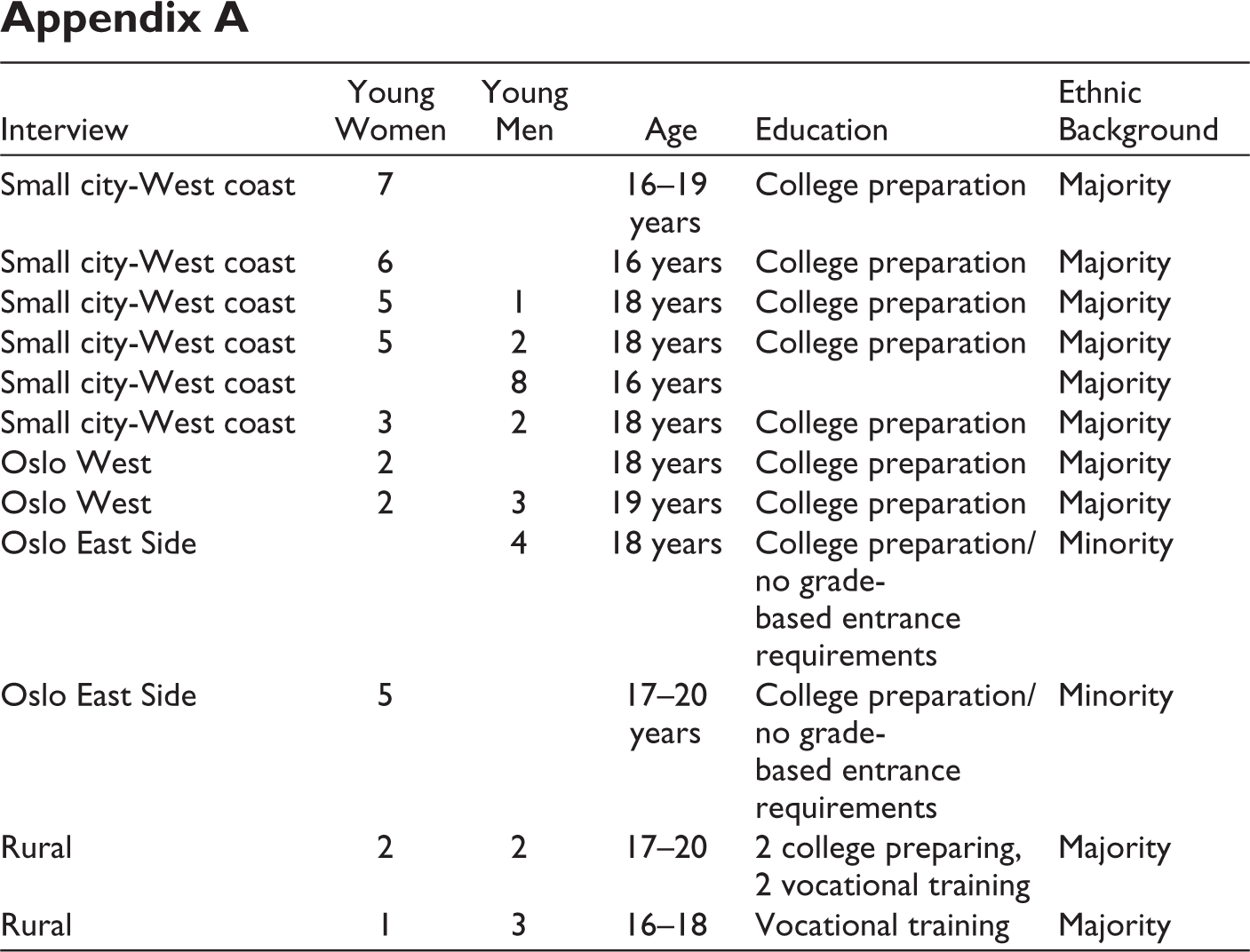
This article draws upon data gathered in 2020 and 2021 as part of the Norwegian research project ‘Drawing the line - Sexual Violence in Young People’s Intimate Relationships – Victims, Perpetrators and Institutional Settings’. 1 During this project, we conducted 12 focus-group interviews with 38 young women and 25 young men aged 16–20 (n = 63). Focus-group interviews were utilized because they enable ‘a carefully planned discussion designed to obtain perceptions on a defined area of interest in a permissive, non-threatening environment’ (Krueger & Casey, 2009, p. 2). They are particularly suited to the study of sensitive topics (Øverlien et al., 2005) because the stimulus material enables the dialogue to focus on the material, rather than on personal experiences, and the participants can choose to be passive and/or silent and leave the talking to their peers. Our focus groups varied in size from two to eight participants, with the majority being between four and seven. Seven of the focus groups were mixed gender, three were all female and two were all male. The gender balance was unequal in seven of the mixed-gender groups. Accordingly, these are denoted as either female-dominated or male-dominated.
We initiated focus-group recruitment by directly contacting high school principals, teachers and social workers. Two of the groups were recruited from sports teams. (See Appendix A for a detailed description of the groups.) Four focus-group interviews were conducted in Oslo, Norway’s capital and largest city (with over one million inhabitants), six in a smaller, west-coast city (26,000 inhabitants), and two in a rural area in North Norway (with fewer than 10,000 inhabitants). In Oslo, we conducted two group interviews at upper-middle-class-dominated high schools, whose students were mainly from the ethnic majority (Norwegian). We also conducted a further pair of interviews at working-class-dominated high schools, in which most students were of ethnic minority backgrounds. Four group interviews were conducted at a high school, and two were conducted with members of a sports team in the smaller, west-coast city, where all attended college preparation programmes. Finally, two interviews were conducted in the rural area; six of these participants were in vocational training programmes and two in college preparation programmes.
In the following, we analyse differences in social class according to two criteria: first, the educational institution attended and, second, the programme of study in which students were enrolled. In Oslo, high schools are markers of both social class and ethnic background (Pedersen & Eriksen, 2021). Most students in schools with high entrance requirements have ethnic majority and upper-middle-class backgrounds, while over 80% of the students in schools with few or no grade-based entrance requirements have ethnic minority and/or working-class backgrounds. In the rural area, we defined social class in accordance with the school programme in which the students were enrolled: vocational training or college preparation programme. This information is sufficient to describe the young people’s social environment; however, we cannot describe their individual backgrounds.
There is a variation in background between the focus groups (gender, ethnicity, geography and social class), which makes an analysis of similarities in the young people’s understandings possible. However the small sample sizes of different sociocultural groups in the study makes it only possible to describe tendencies that needs to be explored further in additional studies.
The Interview Process
The Norwegian Centre for Research Data (NSD) approved the research. The participants were informed in advance about the project and its purpose. Participation was voluntary, and we had resources on hand (e.g., support services) to meet participants’ emotional needs, if necessary. Consent was viewed as ongoing; that is, the focus-group moderator remained attentive to participants’ well-being, alert to signs of anyone wanting to leave the group or not answering questions, and aware of the risk of over-disclosure. Confidentiality was ensured by changing all names and other identifying details.
We presented each focus group with material to stimulate discussion: a film clip entitled Friday Night (DR, 2019). The film focuses on what happens between Rosa and Karl as they play out a heterosexual script. The two are trying to establish a relationship, are in the same group of friends and will meet each other again at school during the following weeks. Both are of the ethnic majority, sexually attractive and middle class.
The film shows the two at a school party, flirting and dancing. They have sex in a unisex toilet cubicle, and she feels violated. There is no force or violence used, but he fails to listen to her protests. Initially, Rosa leads Karl into the toilets. During the ensuing sexual act, however, she tells him that she is too drunk, she wants to go back to the party, and they should not be doing this. Rosa’s and Karl’s versions of events are presented separately, one in each of two clips. The perspectives presented in the film clips are ideal for encouraging reflection about sexual violence in intimate relationships because the events occur in a situation that is familiar to many young people (Korkmaz et al., 2020). However, this analysis of the young people’s understanding cannot capture every aspect of sexual violence as a phenomenon, but in the situation that happens at a party between a young man and young women that are romantically and sexually interested in each other.
We watched both clips together with the participants. In the subsequent group discussion, the moderator led while encouraging interactions to be as free as possible. The young people then discussed both Karl’s and Rosa’s versions of the interaction.
Analysis: A Matter of Miscommunication
There was a striking similarity in the young people’s definitions of the incident, regardless of their genders or ethnic backgrounds, and their geographical or social milieus. Nearly all of them described the problem as caused by miscommunication. As Edvin, a young man from the smaller city (in a female-dominated group) explained: ‘It’s a big misunderstanding, kind of. It’s also rape if she feels that it is. But it’s a big misunderstanding that could have been avoided if both of them had been clear’. There was one exception. Two young women, Lisa and Anna, both from an upper-middle-class Oslo high school, had a victim-centred understanding of the problem.
Lisa: Many talk about such things as a misunderstanding. Which is really quite harmful (…) It makes people who are victims of abuse feel (…) You said something wrong. (…) But it’s simply because the other the person didn’t listen, or didn’t respect (…) You shouldn’t really need to shout out: ‘No’.
Although Lisa’s friend Anna agreed, she also described the incident as ‘very bad communication’.
In short, nearly all the interviewees mentioned miscommunication as key. This conformity was striking, given the young people’s diverse backgrounds. In the following, we answer what the young people described as causing the miscommunication. Then we describe the assumptions around heterosexual gender norms underlying the miscommunication discourse. Finally, we discuss the differences in gender, geography and social class that emerge when explaining the causes of the misunderstanding.
The Miscommunication Discourse in Detail
In the young people’s explanations, some participants argued that Rosa should have been clearer, and many also thought that Karl should have asked. We also describe three contextual conditions the young people described as causing miscommunication: diverging from the sexual script, intoxication and gendered communication barriers.
She could have been clearer: One of the main topics discussed was uncertainty surrounding what exactly indicates a ‘no’ to sexual intercourse. Were Rosa’s statements sufficient to constitute a rejection? In the toilet cubicle, Rosa said, ‘We should go back to the party’, then, ‘I’m too drunk for this’ and finally,: ‘I don’t think we should do this’. In several focus groups, the discussion revolved around how indirect these expressions are, suggesting that Rosa should have said ‘stop’ or ‘no’. Ali, a member of an all-male group from Oslo, at a working-class-dominated school, cited the form of Rosa’s rejection as not sufficiently clear for him to understand:
Ali: (…) she said: ‘We shouldn’t do it, and I’m a bit drunk…too drunk for this’ (…) but he didn’t get it. It was indirect. Because she, she thought he was going to stop, but he didn’t so (…) However, if she had said, ‘Stop’ or ‘I don’t know’ or fought a little more (…). I think she said it a little too, well, a little indirectly, not loud enough, not well enough, for him to understand.
There are many myths surrounding sexual assault, such as the idea that real rape is defined by physical force and physical resistance (Raphael & Logan, 2009), which contributes to the understanding of the sexual script as the woman’s responsibility to reject the man’s advances (Ryan, 2011). Ali’s argument centred on two definitions of rape: the word stop and the use of physical resistance. Ali has an ethnic minority background, but his argument echoes many of the young people’s reflections upon Karl’s misunderstanding, regardless of ethnic background. They agreed that Rosa may have experienced the incident as rape but were reluctant to describe what Karl did as rape.
Other participants, however, pointed out that it is more normal to hint than to say a flat ‘no’. Benjamin, from a small city, in a female-dominated group, thought that sexual intercourse was illegal if one of the participants had not said ‘yes’. For him, indecisiveness was considered a no.
Benjamin: You can see it as illegal because you need a ‘yes’ before you do something like that. He’d never received a ‘yes’ for it to go ahead (…). That it was a matter of course then, that he just did it without asking if it was okay. (…) Then you haven’t got either a ‘yes’ or a ‘no’, and then it’s a ‘no’, really. If you ask me.
In another group, from an upper-middle-class school in Oslo, Lisa voiced the clearest victim-oriented perception:
And I feel it, that, when it comes to sex or assault and things like that, then you shouldn’t have to scream: ‘no’. Then it’s already gone too far. In a way you should listen to the other person, and he was very bad at that.
Both Lisa and Nora discussed Rosa’s ‘no’ according to an ethical standard, where each partner listens to the other, both physically and verbally. They argued that this is the ethical yardstick in sexual encounters.
He should have asked: One typical statement of Karl’s obligation to ask directly came from Julia in a discussion within a rural, female-dominated group.
Julia: (…) Like this, yes, it’s fine that you kiss and, sort of, lead into something, maybe for later. But like that, you can ask before you kind of bend her down and start (…).
The other young women suggested that Karl should have asked: ‘Are you keen?’ and ‘Are you sure?’ Nearly all the young people stated that Rosa’s second statement of rejection: ‘I’m too drunk for this’, was a signal to Karl that he should ask. In the interviews, the researcher–moderator (who was often twice their age) suggested that asking could be awkward. Many of the young people disagreed. Some countered that, in effect, it may be awkward to ask permission before kissing someone, but not before having sex.
Young people in a rural, all-male group also stated that Karl should have asked. The reason given, however, was framed by a desire or need to avoid subsequent accusations of rape.
Arne: Maybe he should have asked…
Petter: Asked if she, if she really wanted…
Albert: Consent…
Many: Mmm…yes.
Albert: Because then she couldn’t have accused him of it [rape] afterwards.
Petter: Yes.
During the discussions, the young people explained Karl’s misunderstanding of Rosa’s consent and his failure to ask for consent in three ways: it was caused by Karl’s sexual inexperience, his wishful thinking and/or the strength of the male sex drive. In the all-male and male-dominated groups, some young men expressed particular concern that Karl seemed to be sexually inexperienced; he was ‘new to the business’ or ‘he’s never been through it before’. One young man linked Karl’s inexperience to his inability to understand his partner. According to Tom, if you are unable to interpret signals, you are too immature to have sex: ‘That’s the reason why he [Karl] should use his dick to pee with and nothing else’.
Several young men in a rural, all-male group attributed Karl’s failure to ask for consent to the male sex drive. ‘He thinks with his dick, right? That’s how guys are. It’s in the body’. However, no interviewees used the male sex drive as the main explanation for the incident. Most referred, instead, to Karl’s wishful thinking—he wanted to have sex so badly that he did not, or did not want to, understand Rosa’s rejection.
Diverging from the sexual script: The young people provided similar descriptions of the sexual script that led to Karl’s misunderstanding. In their understanding of the sexual script, the narrative tends to be fixed: flirtation leads to kissing, intimate touching and, eventually, intercourse. The young people emphasized the fact that Rosa flirted with Karl; she initiated the kiss in the toilets and led him into the private cubicle. This last action is particularly important. When the young people described Rosa’s and Karl’s actions, it was clear that the movement to a private location implied more intimate actions. Differences emerged, however, in the groups’ ways of describing how and why Rosa diverges from the sexual script.
Johannes and Elena, young people from working-class milieus, described Rosa as having a particular obligation because she led Karl into the toilet cubicle. Johannes, in a working-class-dominated, rural, male-dominated group, said, ‘I thought, at first, that she was the one that dragged him into the toilets’. The other group members agreed, and he then elaborated, ‘I think that if I’d been a chick. Fuck, I wouldn’t say anything’. The others then laughed, but there was a seriousness in his statement that implied that, if Rosa took the initiative by kissing Karl and leading him into a toilet cubicle, she diminished her ability to change the course of events. Elena, in an Oslo working-class-dominated, all-female group, said that Rosa gave Karl a ‘green light’ by letting him touch her and then leading him to a private place. The sexual script, as Elena and Johannes understood it, defines a private place as implying intercourse. Johannes put it still more directly: ‘She leads him there of her own accord’.
Middle-class young people, located in a smaller city, agreed that Rosa would have had difficulty changing the way things played out once she had initiated sexual contact, but for different reasons. They focused on Rosa’s feelings of shame. Edvin, speaking in a female-dominated group, argued that one might feel that the consequences of rejecting someone in the moment are worse than the consequences of sexual assault. This fits in with the felt ethical obligation of avoiding both one’s own and others’ ‘loss of face’ (Goffman, 1959/2022). Edvin rated ensuring no one loses face during a sexual interaction more highly than her sexual subjectivity. In an all-female group interview in the small city, Sara explained that Rosa’s own attachment to Karl, and her concern for his feelings, made it difficult for her to reject him:
Sara: So, it seems as if she’s somewhat fond of him, so she doesn’t want to hurt his pride. Because she probably feels that she’s raised his expectations, and that she somehow can’t break those expectations. Then she just had to go with the flow, even if she didn’t want to, and not speak out in a proper way, as she could have done, but she couldn’t.
Sara, like Petra and Edvin, described the sexual scripts and norms of social encounters. She also explicitly mentioned traditional gendered norms of responsibility in assigning the burden of ensuring that no one loses face. According to Sara, Rosa considered Karl’s feelings, but Karl did not return the favour. Sara expressed an awareness of the female responsibility to take male sexual pride seriously.
Nevertheless, Karl also failed to follow a particular sexual script, the romantic script. This was emphasized by the young men who described him as an inexperienced lover because the film presents Karl as having romantic intentions. A man with a romantic interest in a woman should handle his courtship differently. As explained by Eva and Arnie, both from a rural, male-dominated group:
Eva: Went straight for it. Arnie: That was lousy stuff.
When asked how Karl could have avoided the situation, Eva said that, if Karl had started with ‘foreplay’, he would have had more time to understand the ‘no’. Arnie, in turn, answered that foreplay is rare when having sex at a party. Neither the time (a party) nor the place (a toilet cubicle) is romantic, and the fact that Karl turns Rosa around so that he cannot see her face was mentioned as ‘not very romantic’. In short, the young people saw Karl as failing to follow the romantic sexual script of courtship, in which the man gives time and attention to the woman’s needs.
Intoxication muddies communication: The young women participating in Oslo, at a working-class-dominated high school, in an all-female group, ascribed part of the misunderstanding between Karl and Rosa to drunkenness.
Oksana: Yes. But she should have been clearer, but I don’t think she was sober enough to speak up and I don’t think he was sober enough to ask about it.
Nadina: She was so affected by the alcohol that she was unable to speak up, and so was Karl, but the problem is that he was unable to interpret her or what she really meant. So it really went both ways.
This sentiment, expressed by young women from an ethnic minority background, was supported by ethnic majority women in an all-female group from the small city. They said they did not get drunk at parties, thus establishing a boundary between themselves and Rosa. These statements might be linked to boundary work. Boundary-drawing vis-à-vis young women whose excessive drinking puts them at risk of sexual assault has appeared in previous studies of youth drinking culture (Fjær et al., 2015) and in how young people understand the interrelationship between intoxication and sexual assault (Tokle et al., 2023). This boundary work has been related to creating a counter persona that presents themselves according to ideals of respectable femininity (Fjær et al., 2015, Tokle et al., 2023).
Gendered barriers to communication: The interviewees’ discussions of misunderstandings also addressed and reflected gender differences. Several young women pointed out gendered barriers to communication. Tina and Maria (from a rural area) explained that this may have played a part:
Maria: Yes, but like that, the boy must, he didn’t understand. It can be the same for girls, too, from time to time. That, maybe, girls don’t understand what the boys say. Tina: It could also be that, somehow, she didn’t understand, things happened excessively fast for her, so she didn’t understand that that was what he wanted. So, it’s like that, there’s a miscommunication there, between girls not being able to understand what boys are thinking, and boys not being able to understand what girls are thinking.
For Maria and Tina, the misunderstanding derived from gendered forms of communication. Nora, from an Oslo middle-class high school, agreed. ‘Young women, in particular, are good at beating around the bush, on a general level’. Rosa ‘beats around the bush’ when she rejects Karl; he is eager to have sex and moves forward too quickly. The assumption is that men employ a direct form of communication and women employ an indirect one.
Four Heterosexual Norms
Our main finding is that the young people agreed that the problem in the sexual situation arose due to miscommunication. However, they made use of different heterosexual norms to explain the causes of this, and the dominance of these discourses varied according to gender, geographical location, and social milieu, which will be discussed in the following section.
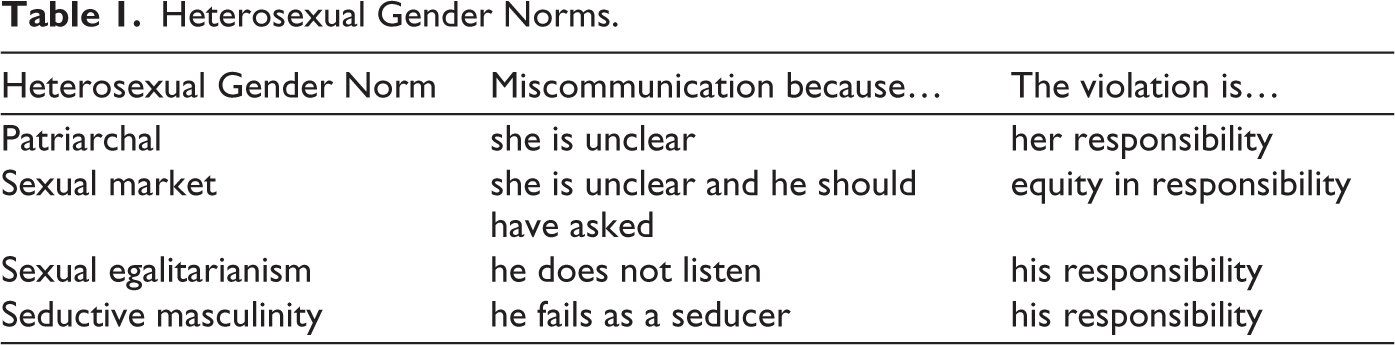
The miscommunication discourse has been interpreted in the research literature as linked to patriarchal, or traditional, heterosexual gender norms. This implies female responsibility as a gatekeeper for the male sex drive and that access to the female body and sexuality is a male privilege (Beres, 2010; Johansen et al., 2020b). This was visible when some young men talked about an untamed male sex drive and when both young women and men said they thought that she should have been clearer.
Still more present in our study is what has been labelled post-feminism (Burkett & Hamilton, 2012) or confidence culture (Orgad & Gil, 2021), a discourse of neoliberal sexual libertarianism. We describe this as the norm of the sexual market. It views sexual engagement as participation, on equal terms, in a market where everyone is competing against everyone else. Under the norm of the sexual market, female assertiveness is crucial for resolving the problem of sexual violence. For example, some of the young people suggested that Rosa should have been more direct in her rejection of Karl’s advances; she should have taken responsibility for her own sexual boundaries, assertively claimed her sexuality and been in control of herself. Equally, they think that Karl should have asked. It is also present in the participants’ dominant understanding of the sexual script, that if you lead someone into a private location, you are partly responsible for how the script then unfolds. Since the sexual situation is perceived as a market, there are no power imbalances between individuals, which leads to a tendency to perceive an equity for the responsibility of the sexual violation. It differs from the patriarchal norm that the female is not perceived of as having any responsibility for male sexuality, only for her individual needs, and that there is an equity of responsibility for the violation, since he should also have taken responsibility to check in on her. A version of the norm of the sexual market is that the sexes are not only in competition but in battle, and that young men need to protect themselves against accusations of rape by asking for explicit consent.
The next heterosexual norm is labelled sexual egalitarian, which has been described as an ethics of care, whereby the young people described how they were ‘sensing’ their sex partner’s desires (Johansen et al., 2020b), or as the right to sexual citizenship, which implies bodily autonomy and gives reflective capacity to take decisions in sexual encounters (Honkatukia et al., 2022), or as an idea of sex as a mutual process (Holmström et al., 2020). When the young people in this study used the verb ‘to listen’ to the other as an ethical yardstick, they were relying on sexual egalitarian norms. Listening, they explained, means far more than just obtaining a ‘yes’ or honouring a ‘no’. Rather, each partner should be attentive to the other during sex. The participants also used the miscommunication discourse to place responsibility on the sexual initiator to ask. When the young man above stated that ambivalence should count as a ‘no’, he was placing the responsibility on the offender.
The last heterosexual norm is seductive masculinity. This is often perceived as part of hegemonic masculinity that idealizes male sexual prowess and the role as the sexual initiator and can be used to legitimize sexual transgressions (Aho & Petola, 2023; Honkatukia et al., 2022). However, in the young people’s discussions, this norm was also used to invoke Karl’s responsibility; if a man is not able to interpret a woman’s signals, ‘he should use his dick to pee with and nothing else’, as one young man put it. This discourse was also present when the young people discussed Karl’s failure to follow the romantic script, his failure to attend to Rosa’s needs. He fails to understand her because he is ‘new in the game’. The problem is still miscommunication, but the responsibility is on him (refer to Table 1).
Heterosexual Gender Norms.
Differences in the Domination of Norms
Rosa’s lack of clarity was attributed to her intoxication and her divergence from the sexual script. The young people shared the concept of a sexual script as well as an understanding of how sexual interactions increase the risk of losing face (Goffman, 1959/2022; Simon & Gagnon, 1986, 2003). They cited both in explaining why Rosa is unclear in her communication and why Karl does not ask for clarification. Class and gender might be factors that influence a dominance of the patriarchal norm when explanations are provided for Rosa’s lack of clarity. Young men from the rural area and both male and female participants from an Oslo working-class high school explained that Rosa felt she had an obligation to continue because she had raised Karl’s expectations. Several of the young men placed an additional responsibility on Rosa; she should have known, they implied, that it is difficult for a man to stop once he is sexually aroused. The young women from a middle-class milieu, in contrast, were more concerned that Rosa feared hurting Karl’s feelings, giving her greater responsibility for the relational aspect. Similar differences in social class milieu are found in a Swedish qualitative study of young people’s understanding of the possibility to diverge from the sexual script (Holmström et al., 2020).
There were also social class differences in this sample in the understanding that Karl should have asked Rosa for consent, where the sexual egalitarian norm was underlying when young women from Oslo upper-middle-class high schools argued for an ethical standard of listening; Karl should have listened to her needs, and when sensing that something was wrong, he should have asked. Young men from upper-middle-class high schools tended to agree when discussing the impropriety of having sex when you are drunk, arguing that partners are not able to listen properly to each other’s needs. Young men from rural areas, in contrast, argued that Karl should have asked for consent to avoid accusations. Studies have shown that rural youth support traditional gender norms, something that young (rural) women find problematic (Eriksen & Stefansen, 2021). The tendencies of differences in the rural/urban divide regarding heterosexual discourses should be explored further. Even though the division of opinion seemed to follow class lines in mitigating Karl’s responsibilities in this sample, there were some exceptions. Tom, a young man from an Oslo working-class high school, uses the norm of seductive masculinity. He attributed sole responsibility for the incident to Karl. His rationale was that Karl’s lack of knowledge leads to failing to seduce Rosa or to correctly interpret her signals.
Even though there are quite striking gender similarities in the young people’s problematization description of miscommunication, there are some gendered differences. None of the male interviewees expressed concern about gendered communication barriers. Differences in gender also appeared in how intoxication was described. Some young women used intoxication levels to draw a line between themselves and victims of sexual violence. Several young men drew a line between themselves and a perpetrator of sexual violence by stating that one should not have sex with an intoxicated woman. This highlights the gendered perceptions of risks in a sexual encounter gone wrong, where young men presume a risk of being accused of sexual violations and young women perceive a risk of being violated.
Nearly all the participants assumed a hierarchy of words over body language, emphasizing the domination of the miscommunication hypothesis. In their discussions of how Rosa could have expressed herself more clearly and whether Karl should have asked her consent, clarity lies in saying or hearing the word ‘no’. Although many of the young people, especially the women, offered a nuanced understanding of the importance of body language, words were still valued more highly. If he had asked, Karl would have understood the words ‘no’ and ‘stop’.
Discussion: Miscommunication Discourse Revised
Our central finding is that the young people described miscommunication as the problem. However, through a detailed analysis of the miscommunication discourse, we found differences in the heterosexual gender norms that underlined the problem description of miscommunication. There is a body of research literature, and in particular attitude surveys, that conveys gender differences in the acceptance of, for example, rape myths, although different research designs lead to different results (Gravelin et al., 2019). The gendered similarities in this study may be caused by the focus group participants tuning into each other’s opinion in the discussion, which may have been reinforced because some of the groups were gender-mixed. Still, the gendered similarities among the young people’s reflections on the sexual script, on an equity approach to responsibility—that she should have been clearer, and he should have asked—point to the study’s main finding, that the dominant problematization is miscommunication. The gendered similarities between the young people from different socio-geographical milieus need to be further explored because our sample is not sufficient to generalize on a broader scale. However, we would argue that our findings support the need for an intersectional approach to studying sexual violence (Hirsch & Khan, 2020) and that it should also include a rural/urban divide.
The miscommunication discourse seems to allow for both victim-blaming and holding the offender accountable. We have shown how young people are reworking this discourse, combining it with several heterosexual gender norms, not just the presumed patriarchal heterosexual gender norm (Johansen et al., 2020b). Previous research on the miscommunication discourse has questioned its empirical reality by showing that young people seem to know when sex is consensual or not, and that the requirement to be verbally explicit only becomes necessary when there are accusations of violations (Beres, 2014; McCaw & Senn, 1998). However, the tendency for participants to emphasize the sexual initiator’s need for an explicit expression of consent could be indicative of a change in the miscommunication discourse, from emphasizing her responsibility to his responsibility to ask. Scholars have been sceptical of the miscommunication discourse, arguing that it masks power imbalances and does not take the ambivalence in sexual situations into account (Beres, 2010, 2014; Gunnarsson, 2020; Johansen et al., 2020b), and our analysis also reveals these tendencies, with the miscommunication discourse tending to create a sense of shared responsibility for the assault. The heterosexual gender norm of the sexual market is clearly present in the data, and this norm allows the young people to show empathy with Rosa while also avoiding taking explicit sides with either Rosa or Karl. Hence, this norm is a catch-all; it avoids placing clear responsibility for sexual violence on either party while allowing empathy towards the victim and makes it possible to support the ideal of consensual sex without placing sole responsibility on the person violating that ideal.
The sexual egalitarian and patriarchal heterosexual gender norms have been well documented in studies of how young people comprehend and understand sexual violations (Fjær et al., 2015; Holmström et al., 2020; Johansen et al., 2020a, b). We argue that seductive masculinity and sexual markets should be employed as two additional heterosexual gender norms to grasp the nuances in young people’s understandings of sexual violations. As previous scholars have argued, the idea of sexual freedom as the lack of shaming of female sexual desire should not be conflated with gender-egalitarian norms (Burkett & Hamilton, 2012). Still, the sexual market should be understood as a unique heterosexual gender norm and not conflated with patriarchal ones since it provides an ideal of universal sexual freedom—even though it is a constraining idea of freedom—as only the right to have sex. Furthermore, to grasp how some of the young men from a working class and rural milieu are combining the ideal of masculine sexual initiative with a caring ethics of understanding the other, we use the norm of seductive masculinity. The hegemonic masculine ideal of sexual prowess and seduction has been described of making the possibility of sexual violations possible, by excusing behaviour as attempts of seduction (Aho & Petola, 2023; Gottzén, 2019). We have shown that the young men in working-class-dominated focus groups used seductive masculinity to argue that sexual violations are caused by a masculine failure and are therefore his responsibility.
Conclusion
The miscommunication discourse is dominant in the data, and the underlying assumption of four heterosexual gender norms provides a complex picture of how young people navigate and combine different ideals of gender equality, patriarchal understandings of male privilege and individualistic neoliberal ideals. Our contribution here is to provide a clearer map of the confusing and contradictory landscape in which, on the one hand, young people condemn non-consensual sex while, on the other, they are blurring the lines of the violator’s accountability. This emerges when they mitigate the sexual offender’s accountability through the heterosexual gender norms of the sexual market and patriarchy. However, most of the young people focused on the importance of checking in on each other; several young women used the verb to listen. Listening, they explained, means far more than just obtaining a ‘yes’ or a ‘no’. Rather, each partner should be attentive to the other during sex. This responsibility was seen as universal; it applies to everyone. Like other scholars, we argue that sex education should focus more on gender norms and an ethics of care, and less on how to achieve consent, and preventive efforts need to better investigate the barriers to an ethics of care (Beres, 2014; Johansen et al., 2020b). Further research should explore how to address these barriers; for example, if, and if so how, the norm of seductive masculinity can be fruitful when addressing young heterosexual men. The task for researchers is to both understand and appreciate how young people are reworking and expanding existing gender norms while remaining critical about how they may shape and maintain existing power relations. This has been the guiding ideal for this article.
Footnotes
Declaration of Conflicting Interests
The authors declared no potential conflicts of interest with respect to the research, authorship and/or publication of this article.
Funding
The authors disclosed receipt of the following financial support for the research, authorship, and/or publication of this article: The article is the result of a research project supported by the Norwegian Ministry of Justice and Public Security and the Norwegian Centre for Violence and Traumatic Stress studies.
Appendix A
| Interview | Young Women | Young Men | Age | Education | Ethnic Background |
| Small city-West coast | 7 | 16–19 years | College preparation | Majority | |
| Small city-West coast | 6 | 16 years | College preparation | Majority | |
| Small city-West coast | 5 | 1 | 18 years | College preparation | Majority |
| Small city-West coast | 5 | 2 | 18 years | College preparation | Majority |
| Small city-West coast | 8 | 16 years | Majority | ||
| Small city-West coast | 3 | 2 | 18 years | College preparation | Majority |
| Oslo West | 2 | 18 years | College preparation | Majority | |
| Oslo West | 2 | 3 | 19 years | College preparation | Majority |
| Oslo East Side | 4 | 18 years | College preparation/ no grade-based entrance requirements | Minority | |
| Oslo East Side | 5 | 17–20 years | College preparation/ no grade-based entrance requirements | Minority | |
| Rural | 2 | 2 | 17–20 | 2 college preparing, 2 vocational training | Majority |
| Rural | 1 | 3 | 16–18 | Vocational training | Majority |