



Abstract
This article delves into the experiences of young people facing social exclusion. By analysing qualitative interviews with key stakeholders and at-risk youth, including those incarcerated, we uncover the nuanced interrelations of trust, autonomy and institutional support. The study emphasizes the role of schools in either exacerbating or alleviating exclusion, noting the impact of educational settings on youth development. It highlights issues like mistrust in institutional support, individualism and the need for autonomy among marginalized youth. The findings reveal complex interplays between trust, individualism, autonomy and institutional support, underscoring the importance of understanding and addressing these dynamics in policy and practice.
Introduction
The discourse on social exclusion in contemporary societies reveals a complex and multifaceted phenomenon. As a deeply relational process, social exclusion involves the erosion of social ties and the gradual marginalization of individuals or groups from meaningful social participation. For youth, this marginalization is not merely a static condition but a dynamic process shaped by intersecting factors such as educational disadvantages, precarious labour market positions and poverty. These obstacles impede young people’s ability to fully engage in society and exacerbate existing social inequalities.
Understanding the mechanisms behind youth exclusion requires a focus on the interplay of structural and relational factors. In this context, this study investigates the following research question: How do trust and autonomy shape the experiences of socially excluded youth in individualized society, and what role do institutional dynamics play in either alleviating or intensifying these exclusions? To address this, we examine the relational processes through which exclusion is constructed, experienced and addressed. Furthermore, we analyse how youth deviance operates as a response to exclusion, uncovering its intricate connections with trust and institutional structures.
The challenge of developing inclusion policies is heightened by the subjective nature of social exclusion and the varied ways in which young people respond to policy initiatives. This article distinguishes itself by including perspectives from both professionals working with at-risk youth and the youth themselves. Traditionally, studies have focused on either stakeholder or youth perspectives, but rarely both. This dual approach captures a more comprehensive understanding of the social exclusion process, focusing on the intricate dynamics between youth experiences and institutional interventions.
Situated within the Estonian context, our study explores the hybrid welfare regime that combines liberal and Nordic features. This backdrop accentuates the pronounced experiences of social exclusion, particularly among ethnic minorities and educational disparities (O’Reilly et al., 2023, p. 136). Through qualitative analysis of interviews with key stakeholders and marginalized youth, this research critically examines the mechanisms that contribute to or alleviate social exclusion.
In the sections that follow, we first outline the theoretical foundations of social exclusion as a multidimensional process, detail the methodology drawing on interviews across four diverse Estonian municipalities, and analyse the findings through the lens of trust, individualism and autonomy. Finally, we offer policy implications aimed at fostering inclusion without undermining young people’s agency.
Theoretical Implications
Social exclusion is a complex relational process, defined as the gradual weakening or loss of social ties between individuals or social groups and the rest of society (Bečević & Dahlstedt 2022, p. 368; Unt et al., 2021). In this article, social exclusion is defined as a multidimensional process of progressive social rupture, encompassing the cumulative disadvantages of educational career and/or labour market exclusion/insecurity, poverty and detachment from social relations and institutions. These dynamics prevent youth from fully participating in normatively prescribed societal activities (Figgou & Unt, 2017; Silver, 2010). Central to this definition is the role of self-sensed alienation, where young people experience exclusion not merely as an external condition but as a deeply internalized state of disconnection. Studying social exclusion provides insights into the structural and relational factors that foster deviance, offering a broader lens for understanding its root causes. Therefore, we draw also from deviance studies literature to understand how deviant behaviour can be a response to systemic and relational failures.
Social Exclusion: Structural and Individual Dynamics
Social exclusion arises from both structural and individual causes (Thompson et al., 2014, p. 64) and should be therefore studied taking into account the moderating role of meso and macro context, next to the individual level (Unt et al., 2021). The consequences of social exclusion can result in many ways, ranging from mental health problems to a vicious circle of unemployment and involvement in criminal activities (Unt et al., 2021). For example, Schwarzenbach et al. (2023) illustrate how youth experiencing institutional mistrust resort to self-justice as a means of addressing perceived injustices, bypassing formal systems that fail to serve them effectively. This highlights the relational and structural roots of exclusion, where systemic failures exacerbate feelings of alienation and reinforce exclusionary cycles.
The NEET (not in employment, education or training) category is widely used to identify youth at risk of exclusion (Mascherini, 2018). While it captures labour market detachment and educational disengagement—key risk factors for exclusion and criminal involvement (Jahnukainen, 2001; Williamson & Cullingford, 2003, p. 310)—it has notable limitations. NEET overlooks the diverse experiences of exclusion, such as systemic barriers affecting employed or enrolled youth, including ethnic or spatial inequalities (Holte, 2018; Kleif, 2021; Täht et al., 2023). Sylwander (2022) further highlights how racialized oppression in digital spaces adds layers of exclusion, emphasizing the need for qualitative approaches to better capture these nuances. These limitations become especially problematic when social exclusion risks are viewed from an individualistic perspective. This perspective places undue pressure on key stakeholders dealing with youth to address systemic inequalities as if they were individual shortcomings (Bečević & Dahlstedt, 2022, p. 376; Cornish, 2023, p. 457). Consequently, professionals often seek solutions to social problems at the individual level, assuming that all young people should be capable of having (and formulating verbally) high aspirations (Kallinen & Häikio, 2021, p. 115). Thus, a lack of qualifications is seen as their own fault (Cornish, 2023, p. 457).
Trust: A Foundational Element of Inclusion
Trust is a critical yet underexplored component in addressing social exclusion. Schools and institutions play pivotal roles in fostering or eroding trust. For marginalized youth, mistrust often begins in familial or educational settings and extends to broader institutional frameworks. Bobakova et al. (2015) highlight the protective role of parental bonding and knowledge in mitigating behaviours like truancy and aggression. When these relationships weaken, youth often seek to belong in different social spaces and groups, reflecting a breakdown in trust and a search for connection.
Schools, as key sites of youth development, can reproduce exclusionary dynamics rather than countering them. Many disadvantaged students enter schools burdened by social, psychological or developmental challenges, yet schools often reinforce barriers through practices like categorization and ability grouping (Cornish, 2023, pp. 462–463). These structures stigmatize marginalized students, contributing to apathy, anger, or resistance (Moensted, 2022; Skourtes, 2016, p. 390; Tarabini et al., 2019). The increasing emphasis on competition and measurable performance exacerbates these inequalities, positioning schools as spaces of humiliation and exclusion for many (Cornish, 2023, pp. 459–460; Tarabini et al., 2019, p. 243).
Beyond schools, trust deficits extend to institutional frameworks where regulations targeting self-expression or peer relationships evoke alienation (Williamson & Cullingford, 2003, p. 314). For example, marginalized youth often feel objectified as “in need of help,” a label that reinforces resentment and rejection of institutional support (Bečević & Dahlstedt 2022, p. 374). This erosion of trust is compounded by professionals who, as Bečević and Dahlstedt (2022) argue, are pressured to treat systemic inequalities as individual shortcomings. Consequently, institutional responses may alienate youth further.
Autonomy and Agency: Resistance in Marginalized Spaces
Autonomy and agency are central to understanding youth responses to exclusion a point also emphasized by self-determination theory, where autonomy is viewed as a fundamental psychological need (Deci & Ryan, 2000). Within the context of neoliberalism, the discourse of a free citizen in a free market suggests a (false) sense of social equality, indicating that those at the margins of society are responsible for their own failures and choices, ignoring the role of social structures (Beck, 1992; Furlong & Cartmel, 1997). This notion of freedom of choice, or ‘choice biography’ (du Bois-Reymond, 1995), is often an illusion. Individualism is socially situated, and what appears to be freedom for some may become a burden for others (Bečević & Dahlstedt, 2022; Côté & Bynner, 2008; Evans, 2002; Kallinen & Häikio, 2021; Nugin, 2013; Skeggs, 2004 ). Social participation is not universally accessible to all youth due to intersecting factors such as spatial, economic, or ethnic inequalities (Bečević & Dahlstedt, 2022, p. 375).
Young people at risk of social exclusion often lack a sense of security that is commonly found at home and cultural capital and continuity which are not equally distributed across different social layers (Thompson et al., 2014, p. 72). Therefore, they may seek alternatives outside of hegemonic norms (Thompson et al., 2014, p. 68). When autonomy is suppressed or denied, marginalized youth may assert control through norm-breaking behaviours, such as truancy or criminal activity. These actions, while stigmatized, can represent deliberate strategies for reclaiming agency by providing young people with a sense of control and the ability to be someone (Thompson et al., 2014, p. 76; Williamson & Cullingford, 2003, pp. 317–318). Bobakova et al. (2015) describe how young people engage in deviant behaviours to assert independence in exclusionary environments. Similarly, Sylwander (2022) demonstrates how racialized girls use confrontational behaviours in online communities to resist oppression and reclaim agency. Pain and anger, often dismissed as deviant, can also serve as productive forms of resistance. As Skourtes (2016) argues, such emotions allow youth to navigate exclusionary systems and reclaim their identities. Often, the punishments employed in different educational and penalty institutions further limit the autonomy of such young people. Henriksen and Refsgaard (2021) describe how periods of isolation or inactivity can exacerbate feelings of frustration and powerlessness, leading to heightened emotional distress.
Alternatively, or in parallel, in individualistic cultures, marginalized youngsters may be led to believe that their misfortunes are their responsibility, and thereby they give up hopes to look for assistance (Furlong & Cartmel, 1997; Honneth, 2004; Wenham, 2020). Internalizing this perspective, they direct their anger towards themselves rather than expressing it towards the staff or the state (Skourtes, 2016, p. 395).
Moving Towards a Balanced Approach
In this article, we adopt sociology’s balanced perspective between individual agency and structural constraints (Nico & Caetano, 2021). This framework challenges the neoliberal narrative of ‘choice biography’ by highlighting the structural determinants of individual actions and the limitations on personal autonomy. Marginalized youth, while capable of making choices, operate within systemic constraints that limit their agencies. Inspired by Archer’s (2003) concept of reflexivity, we argue that enhancing opportunities for youth to critically engage with their circumstances is crucial. Structural interventions should focus on rebuilding trust, fostering autonomy and recognizing resistance behaviours as expressions of agency rather than deviance. Addressing the relational and structural roots of social exclusion requires moving beyond individual-level interventions to create inclusive institutional frameworks.
Estonian Context
Estonia’s welfare regime combines liberal elements, such as low employment protection and strict unemployment benefit criteria, with Nordic features like accessible public childcare and free education (O’Reilly et al., 2023, p. 136). Despite this blend, young Estonians, particularly those from ethnic minorities, face challenges in the labour market, including higher unemployment and reliance on short-term and gig jobs, worsened by the COVID-19 pandemic.
While Estonia ranks among the top globally in educational outcomes (OECD PISA 2022) and is recognized for its inclusive school system, disparities persist. Russian-speaking youth often face limited educational and employment opportunities due to insufficient Estonian language skills, rooted in a parallel Russian-language school system (Saar & Helemäe, 2017). Legislation aims to transition all education to Estonian by 2033 to address integration and marginalization issues.
Spatial and ethnic segregation further exacerbates social exclusion. Regions like Ida-Virumaa, dominated by a Russian-speaking majority, struggle with economic challenges tied to industrial decline and the green transition. A registry-based analysis (Sõstra, 2023) identifies risk factors for NEET status, including migrant background, lack of work experience, early parenthood and low parental education.
Methods and Data
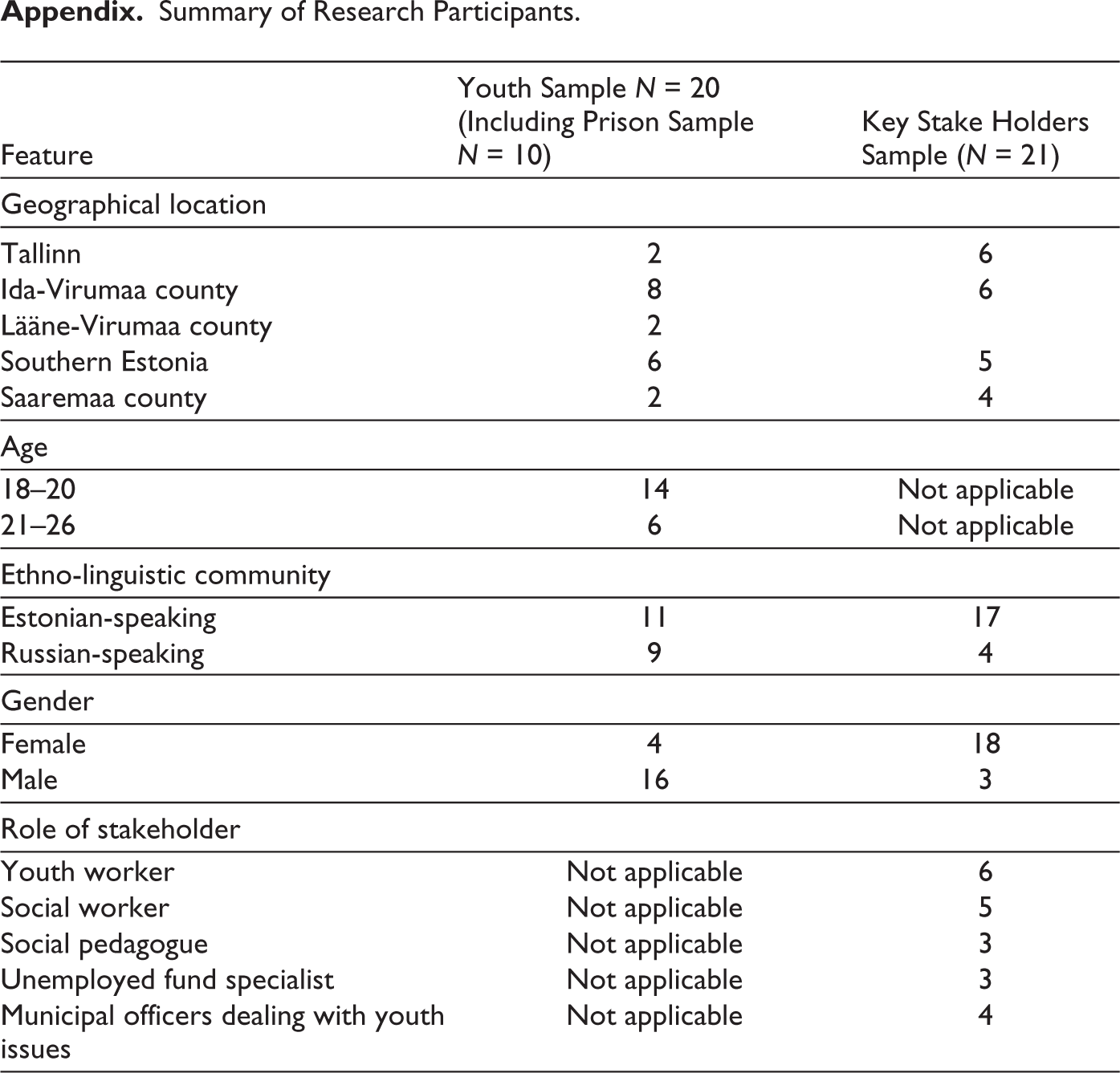
Our research draws from qualitative datasets, including interviews with 21 key stakeholders (18 females and three males), such as youth workers, unemployment fund specialists, social workers and social pedagogues, as well as 20 young individuals at risk of social exclusion (including ten repeat young offenders), collected in 2021 and 2022 (four females and 16 males, for a detailed overview, see the Appendix). This dual perspective uncovers the lived realities of marginalized youth and the viewpoints of those aiding them, highlighting potential discrepancies and misunderstandings. The data originate from two projects focusing on the challenges faced by disadvantaged youth, including the experiences of re-imprisoned young individuals.
To capture variations in social, economic and cultural contexts, we selected four diverse Estonian municipalities—Tallinn, Sillamäe (Ida-Virumaa), Valgamaa and Saaremaa. These regions span from urban to peripheral areas and were chosen based on youth unemployment levels and demographic diversity. The sample was compiled based on public online contacts of municipal key stakeholders. In each county, we interviewed 4–6 specialists who were approached via e-mail, with interviews lasting 1–4 hours.
The stakeholder interviews comprised three thematic blocks: (a) programmes targeting socially excluded youth, (b) narratives of positive and negative experiences in working with youth and (c) institutional cooperation within and beyond municipalities. These semi-structured interviews (N = 17) were conducted primarily online due to COVID-19 (N = 15) and later in person (N = 2). Two additional interviews used a focus group format. Most interviews were conducted in the participants’ native languages (Estonian or Russian), with two exceptions where interviews were conducted in Estonian by preference.
The first sample of young people was compiled through snowballing, with stakeholders contacting potential participants and gaining consent before researchers reached out. The second sample of re-imprisoned young people was coordinated by prison staff, ensuring that researchers did not process detainees’ personal data. The interviews in the prison were conducted by an MA student, employed there without prior or subsequent professional contact with the participants. The project received approval from the Tallinn University Ethics Committee. The interviews with the first youth sample were mainly conducted online due to COVID-19 restrictions.
For youth interviews, a biographical approach was used, encouraging participants to narrate their life stories. Follow-up questions focused on relationships within school or family, peer interactions and employment experiences. The interviews lasted 1–2 hours. Participants were provided with an information sheet outlining the study’s aims, the data management procedures and the rights, including the option to withdraw at any time.
Interviews were recorded and transcribed verbatim (except one four-hour interview, for which a summary was prepared). Transcriptions were pseudonymized and coded in NVivo by one researcher. The analysis employed directed qualitative content analysis (Hsieh & Shannon, 2005; Mayring, 2014), identifying recurring patterns and themes. Through this process, three main categories emerged—trust, autonomy and individualism—under which codes were refined and merged, guided by theories of social exclusion.
Analysis
In the following, we demonstrate that discussions on social exclusion often centre on individual responsibility as a primary factor. We also reveal that this focus on individualism is frequently internalized by marginalized youth, who tend to blame themselves for their disadvantaged circumstances. This internalization arises from complex processes, including a lack of trust and perceptions of injustice towards social structures, institutional systems and legislation. Crucially, our interviews indicate that policies targeting socially excluded young people cannot succeed without building personal trust. A key component of such trust is recognizing young people’s autonomous decision-making and identifying ways to empower them while providing necessary support. Our findings identify three interrelated categories influencing social exclusion: trust, individualism and autonomy. For theoretical clarity, it is essential to distinguish between these categories, which we will examine in detail in the following subchapters.
Trust
Trust is a fundamental element of personal development and societal cohesion, rooted in early secure attachments (Bowlby, 1999). Early relationships significantly shape emotional development and the ability to trust in future social interactions. Among our interviewees, particularly those who were incarcerated, a lack of familial support was a recurring theme. When reflecting on their childhood, many respondents expressed having no meaningful memories or a desire to forget their past entirely (see also Skourtes, 2016, p. 398). For some, the trust and role models absent at home were found elsewhere, as illustrated by the example of Tanel (Estonian [E], male [M], prison sample [PS]:
… my father was an alcoholic and died at one point. And I don’t remember him much and I guess he was not the most normal person. And then came my stepfather, I did not like him much either and so I have always had father problems… and I think I am imprisoned because I got into trouble, because I looked for a father figure /…/ and then I started to communicate with older boys, started to smoke, drink and then indulge into criminal activities.
This lack of support and a secure, trusting network is often absent in schools as well. Several informants reported that their behaviour was not tolerated, and the resulting punishments and labelling discouraged further engagement with their studies. Depending on the educational stage, some began misbehaving, others skipped classes and some contemplated dropping out. Their narratives suggest that, in some cases, school staff may have wanted to provide assistance but lacked the skills or strategies to do so effectively. Mistrust towards potential helpers further exacerbated the situation. Konstantin (Russian-speaking [R], male [M], youth sample [YS]) recounted that when he considered leaving vocational school, he was asked if he needed help but felt he did not receive any. When asked what kind of help he would have needed, he explained:
Well, probably to help with studies as well, to pull something up, somewhere so that interest appears. Didn’t see any of this. /…/ Well, of course they said: ‘Stay, you will fix it, everything will be fine, you’ll finish your studies.’ They were not interested in finding me a profession, but they were interested in me just staying on the course and not leaving, because a person is also money for them, first of all.
He suspected that the school viewed him merely as a means to secure funding, which further undermined his trust in the sincerity of their offer.
Uncoordinated collaboration among various agencies often exacerbates challenges for young people, as illustrated by Vladimir (R/M), a youth worker. He recounted the ordeal of a young man who faced significant difficulties due to missing documents needed for a competition trip:
This is such a very delicate question, he is 14–15 years old, he has no documents. But he used to do break dancing, drove around competitions, but he couldn’t drive out of Estonia because he didn’t have appropriate documents, not even a student card /…/ Father drinks, he is remarried, mother is not there, mother is dead. Father is a drunk, but the girl the father lives with is only a few years older than the boy.
Vladimir’s efforts to secure the necessary paperwork were obstructed by the requirement for parental consent. The boy, however, feared that his father would exploit the situation by taking the money meant for the documents without actually applying for them. Turning to social workers for assistance only worsened the situation, as they arranged an unannounced visit to the boy’s home accompanied by police. The visit occurred at a particularly inconvenient time for his father, which led to the boy being confined to his home for two weeks. When Vladimir later saw him, his face was still bruised from the beating he had endured. Vladimir remarked that the boy would likely never trust social workers again but added: ‘We should be grateful that he didn’t turn away from me at that moment’. This incident highlights the delicate balance of trust between vulnerable individuals and authorities, emphasizing how a single misstep by one agency can undermine trust and impede inter-organizational collaboration.
Paul (E/M/PS) recounted a similar experience: after finally confiding in a social worker about domestic violence, the information was reported to the police, who promptly contacted his parents, worsening the situation. His story underscores the detrimental impact of breached confidences and perceived injustices, tracing a trajectory from childhood adversity to incarceration. This highlights systemic failures that foster institutional mistrust. Attempts to instil responsibility through collective punishments only exacerbate this mistrust, underscoring the profound challenges of supporting youth from troubled backgrounds.
Mistrust of institutional support is particularly pronounced among marginalized individuals, fuelling scepticism about the efficacy of assistance programmes, including psychological and psychiatric services for incarcerated youth. Despite the availability of such programmes, many perceive them as ineffective. Sergei (R/M/PS) dismissed these initiatives as futile, while Mihkel (E/M/PS) expressed no expectation of genuine help from psychologists or psychiatrists. Tanel’s experience of sharing personal struggles with a psychiatrist, only to feel judged, further illustrates the entrenched distrust towards these services. This pervasive mistrust significantly undermines the potential impact of such interventions.
Yet Dimitri (R/M/YS) received valuable support from a psychologist, aiding him through difficult times and helping him overcome addiction. Despite this positive experience, he remained sceptical towards psychology programmes:
As it happens, 80 percent of psychologists, they don’t really know their job… /…/ they took me, to a psychologist, I was such a crazy guy /…/ but these are purely one-off actions, and it never really helps. [The psychologist] came there, did a couple of tests, looked at something… But working with a psychologist is a long-term job, you need to work on it for at least 5 years, to have any kind of effect.
Yelena (R/F/YS) and Yulia (R/F/YS) reflected on their experiences with psychologists, acknowledging that while discussing their problems provided temporary relief, it failed to deliver long-term solutions or guidance for decision-making. Kalle (E/M/PS) found the support programmes he attended in his youth unhelpful, with feelings of alienation fuelling continued misbehaviour and scepticism towards interventions. Despite his previous disappointment, however, his participation in family therapy during incarceration marked a turning point, as he expressed satisfaction with this specific form of support. This highlights the nuanced relationship individuals have with support programmes, where earlier disappointments can coexist with eventual positive outcomes.
The institutional system often inadvertently deepens mistrust towards itself. Marginalized youth typically face multifaceted challenges requiring the involvement of multiple specialists, yet institutional fragmentation can exacerbate their alienation. Tamara (R/F), an official from the Unemployment Insurance Fund, described this phenomenon:
… this target group is generally very difficult somehow to get hold on, so even if they come to you for the first time, then its hard to make him come for the second time /…/ and in our regions /…/ when you come to one department for help /…/ you get ‘footballed’ into another department, this one ‘footballs’ you in the third – but these young clients, /…/ they won’t go any further, he already understood that that’s it, he won’t go any further, and therefore /…/ when such young people come to us, we immediately try to keep them with us, but as I already mentioned, /…/ we are not responsible for everything, and we cannot be responsible for everyone… there are certain boundaries.
When young marginalized people make the effort to seek help but are redirected to another institution, they often become discouraged and give up altogether. She also noted that some officials prioritize meeting efficiency metrics over genuinely addressing individuals’ needs. Building trust is always a long-term process, and regaining it once lost can be exceptionally challenging. Several key stakeholders in our study shared narratives of their approaches to supporting young people. Laura (E/F), a youth worker, reflected:
Show me a young person, who admits that s/he needs help. This works only when you use tricks and stuff… /…/ I have accompanied my youth in courts, I go to bailiffs with them, look for opportunities for therapy… go to psychologists with them. I have feedback from psychiatrists that youth in risk lie to a psychiatrist. So there will be not a good result in this. But I have achieved all this as a result of five-year work.
Laura emphasized the complexity of issues faced by many marginalized young people. She acknowledged their reluctance to engage with multiple institutions and suggested accompanying and supporting them through these processes. In her view, while it may be easy to classify NEET youth as ‘rehabilitated’ for statistical purposes, without sustained support, they are likely to disengage again within a few months. Social worker Ave (E/F) highlighted the importance of persistence, noting that even if young people initially reject assistance, repeated attempts can eventually succeed. However, several stakeholders acknowledged the limitations when young people decline help, as trust—and the lack of it—is often framed as an individual responsibility. Youth worker Meelika (E/F) reflected on this dynamic:
You cannot help everybody. And the door is always open. But there are young people, who close this door. And there is nothing you can do.
Trust issues and individualism significantly shape the interactions between young people and support systems. A pervasive individualistic worldview discourages youth from seeking help, fostering the belief that they must navigate their challenges alone. This perspective also influences the capacity of social workers to provide effective assistance. Often, it leads to a blame-oriented approach, where young people are held solely responsible for their difficulties, with little attention given to the structural causes of social exclusion. As a result, this mindset impedes both the delivery and acceptance of support: young people may avoid seeking institutional aid, while professionals may inadequately address their needs by overlooking systemic factors.
Individualism
The regulatory framework within the institutional system places a strong emphasis on individual initiative and responsibility in seeking assistance. Stakeholders highlighted a critical issue: the abrupt transition at the age of 18, where the approach to supporting at-risk youth undergoes a fundamental shift. Before reaching legal adulthood, a range of interventions and inter-agency collaboration exists to support these individuals. However, after turning 18, the system becomes reliant on the young person’s initiative to access services. This poses significant challenges for those on the social margins, who often face complex, interrelated issues. Even when one institution is aware of a young person’s difficulties, coordinating with other agencies becomes highly constrained without the individual’s explicit consent. Monika (E/F), an official from the Unemployment Insurance Fund, recounted the case of a young man with mild brain damage, speech defects and coordination problems, who struggled with alcohol abuse and was unable to manage on his own. Despite Monika reporting his situation (via an encrypted letter) to the local municipality, the young man refused assistance.
Organizations often find their ability to provide assistance constrained by systemic issues, including shortcomings within the educational system. Laura pointed out that students with learning difficulties are frequently kept in academically oriented schools, despite the potential benefits of learning trade skills better suited for the labour market. A notable challenge in Estonia, she noted, is the insufficient quality of Estonian language instruction in Russian-speaking schools, which hampers these students’ educational and employment opportunities. While Russian-language primary schools exist, secondary schools are required to conduct 60% of their subjects in Estonian. Yulia reasoned her decision to give up secondary school as follows:
I was encouraged… my teacher told me I should continue my studies in secondary school. /…/ But we already had one subject in Estonian, and we didn’t understand anything. If I had gone to secondary school, I wouldn’t have understood the subjects. I was really bad at Estonian.
Although statistics indicate that a lack of Estonian language proficiency often stems from shortcomings in the educational system, school management and the quality of language instruction, many of our informants internalized this issue as their personal failure. Olga (R/F/YS), for example, admitted that Estonian was the only challenging subject in school, which led her to abandon the idea of further studies. When asked whether anyone at school had offered support for improving her Estonian, she replied that help was likely available but believed the problem lay with her. She noted that language courses were accessible through the Unemployment Insurance Fund, but she preferred to study independently.
At the same time, many informants acknowledged that their lives would improve significantly with better Estonian language skills. However, several expressed a kind of trauma, feeling anxious about speaking the language or even struggling to understand simple questions, as Yelena described:
… and I, I don’t know why, I immediately get lost when I communicate with Estonians, I have my own fear, even if they ask me the most elementary, for example, ‘show your document’ when I buy an energy drink, or ‘do you have a client card?’, sometimes I get really lost and I don’t understand what they ask me, sometimes I’m very afraid…
As other researchers have noted, immigrant youth often face pressure to assimilate or integrate into the dominant society. When this process fails, it is frequently framed as a cultural deficit and attributed to personal shortcomings (Bečević & Dahlstedt 2022, p. 368). As a result, many young people feel judged for their struggles with language acquisition, which fosters a sense of uncertainty and insecurity.
Low trust in the ability of institutions or agencies to provide meaningful assistance often leads to feelings of helplessness and anxiety. Key stakeholder Kersti (E/F) explained that the most challenging task when working with youth at risk of social exclusion is overcoming their sense of hopelessness and passivity. She emphasized the importance of convincing these young people that change is possible and helping to build their motivation. However, many stakeholders acknowledged that, at times, this metaphorical wall proves impossible to break through. As youth support worker Velli (E/F) pointed out, a typical reaction of a youngster is:
That’s none of your business, stop poking me! I can cope on my own!’ I cannot control if he manages on his own or does not. I do hope, he does.
While Velli was undeterred by rejection and prepared to keep trying, others adopted a more individualistic approach to supporting young people. Some stakeholders expressed willingness to help whenever possible, but others believed their responsibility extended only to those who actively sought assistance. Tamara, for instance, stated that she does not see it as her role to persuade young adults that they need help:
… why would I explain to a person why he has to go [to ask for social services]? Why would you take an adult and just drag him somewhere and say ‘you must’, I will not do this, and I will not do this for one simple reason – because I don’t understand why should I do this.
Tamara’s stance represents a departure from the earlier perspectives, which emphasized the importance of persistent efforts to build trust with marginalized youth. Tamara described some youth as ‘arrogant and lazy’, admitting she had little patience for such behaviour. She explained that some young individuals struggle with addiction and fail to follow through with arranged support. For example, they might miss psychological counselling appointments or arrive hours late, expecting her or other specialists to accommodate them despite pre-existing schedules. Repeated encounters with such attitudes can foster a tendency to attribute their failures to personal shortcomings.
Social worker Kristiina (E/F) used language that suggested some young people ‘choose’ paths involving crime or substance addiction. Similarly, municipal officer Kerttu (E/F) shared accounts of youth with unrealistic expectations, such as demanding high-paying jobs without the requisite qualifications. Mirel (E/F), an official from the Unemployment Insurance Fund, described young people who failed to show up for work and, after being dismissed, sought her help in regaining their positions. These narratives reflect a perception among key stakeholders that individual traits often hinder the ability to assist marginalized youth effectively.
Youth worker Mihkail (R/M), however, described young people who were too keen on taking their lives into their own hands and ignored the suggestions to study further:
They all had some success stories or examples of a biography, when people had achieved something without any schooling. Some acquaintance or relative, who had 9 grades of education or unfinished primary education, but working in Finland or Sweden and earning three–four or even five times more than people with higher education.
In this instance, Mikhail did not attribute the issue to a lack of individual responsibility in making life decisions. On the contrary, he described young people who were overly eager to take matters into their own hands, despite lacking the skills necessary to adequately assess their life options. This determination to independently manage their lives and reluctance to rely on institutions or pursue formal education was also expressed by several of our young informants. For example, Sergei, who attended (primary) school while in prison, stated that he would not continue his studies after release because he needed to start working immediately. He emphasized the importance of self-reliance, dismissing the unemployment fund as unhelpful. When asked about his employment plans, he remarked that he would likely work in construction in Tallinn: I have two hands, I will manage. Similarly, Joosep (E/M/PS) showed the interviewer a tattoo of a lone wolf, explaining that it symbolized perpetual solitude: A lonely wolf means loneliness at all times. I have done all my criminal deeds alone. His determination to cope independently underscored a broader sentiment of self-reliance among the marginalized youth.
Key stakeholders acknowledged that adverse social conditions often underlie young people’s struggles. Social worker Kristiina observed that some youths are socialized to avoid taking responsibility for their lives, believing they can manage without active engagement in their own affairs:
There is dependence; there is learned helplessness, because unfortunately, we have raised them the wrong way. Some are already third-generation recipients of subsistence allowances. /…/ I am incapable of teaching them.
Kristiina recalled noticing a girl flaunting her new gel nails on social media, a purchase that implied spending beyond her means. When Kristiina addressed the issue, the girl retorted that it was none of her concern. This incident reflects a broader theme: young people’s desire for autonomy often manifests in small, personal acts, such as controlling their appearance. Williamson and Cullingford (2003) argue that adult interference in such choices is frequently perceived as an attack on individuality and autonomy.
Autonomy
In the realm of social support, autonomy emerges as a crucial factor in understanding the challenges faced by marginalized youth. Autonomy, defined as the capacity for self-determination and independent decision-making, often remains out of reach for individuals whose lives have been shaped by early school leaving or difficulty entering a stable labour market. The internal dialogues individuals have about their identities, capabilities and self-worth play a critical role in shaping their sense of autonomy and their ability to navigate life’s challenges. Paradoxically, while society frequently attributes personal failures to individual responsibility, it simultaneously curtails these individuals’ autonomy. For many, restrictions on autonomy begin early, often enforced through harsh punishments at home. Paul, from the prison sample, shared that he had no friends during school because he was not allowed to go out:
Until I was sixteen, I had no friends, because I could not go outside or anything. All I had was school, home, [domestic] work, and then I had to go to bed. If I didn’t do my tasks, I was beaten. During a certain period I started to go to sports club, then I could go to training after school. But I couldn’t go out, anywhere.
Paul’s life was marked by abuse from a violent stepfather and the traumatic loss of his brother, which fuelled unmanaged frustration and aggression. This eventually led to his placement in a reformatory school, where strict rules and a lack of freedom worsened his behaviour. In search of liberty, Paul frequently ran away, only to face harsher punishments that deepened his involvement in alcohol and crime, ultimately resulting in imprisonment. Within this cycle of control and punishment, Paul’s sense of autonomy was crushed, reflecting the experiences of many incarcerated youths who felt stripped of agency, leading to increased defiance and despair. Kalle’s description of prison guards as cruel and punitive further highlights the detrimental impact of such environments on inmates’ sense of autonomy. This treatment often leads to severe issues with self-trust. Key stakeholders frequently observed that many of these young individuals had never had anyone believe in them, leaving them unable to believe in their own capacity to make a difference. Social pedagogue Piret (E/F) described this as follows:
Their self-definition and self-image is very weak. /…/ They don’t believe in themselves, no one has ever believed in them, they have been black sheep in society’s eyes, right? /…/ I would say that some young people are as if driven into a corner. Like… they just aren’t wanted. /…/ one of them also told me: “But I’ve had ‘idiot’ written on my forehead all my life.
According to Piret, delinquent behaviour often represents an attempt to gain attention and achieve recognition, even if only from peers engaged in similar activities. Criminal acts provide a sense of agency and the ability to make a difference—offering a form of autonomy that these young people have been deprived of at home, in school or within institutional settings. Mart (E/M/PS) recalled that the first time he skipped school, he felt that ‘everything was mine’ and believed he could continue doing so without consequence. However, he also admitted that his lack of control over his life in the past left him ill-prepared to manage on his own. After his shock imprisonment, Mart was provided with financial resources to help him restart his life, but he confessed that he did not know how to use them effectively.
Henrik (E/M/PS) from prison sample provides a similar example. According to him, lack of autonomy and limited opportunities to do something are not helpful in terms of their future lives once they get out of prison:
… maybe I would need more opportunities to do something yourself, for example opportunities to cook for example. So that there is like more control over what you do or eat. More or less small things that you will have to come across outside [prison] anyway, and when you cannot cope in these, you will lose the opportunity [to manage on your own outside prison].
Henrik, who actively participated in school while in prison, expressed deep concern about the idleness of school vacations and the risk of relapsing into addiction or reconnecting with criminal circles upon release. His story underscores the immense challenges of reintegrating into society and the labour market, particularly when paired with the struggle to secure meaningful employment.
For young people who deviate from expected norms, regaining trust and autonomy proves particularly difficult. Youth worker Vladimir recounted a case where two stigmatized pupils successfully organized a concert, initially earning praise from the headmaster. However, once she recognized them, she withdrew her commendations, accusing them of ruining the event.
… at the end of the concert the headmaster comes and says to me: ‘Oh, they are so smart, they are so good, they are a box of chocolates! How many people are there?’ I say, ‘There are two.’ ‘Two? And they could do all of it? I’ll praise them, I’ll give them this and that…’. The curtain opens, the boys come out, two brothers, two twins, she looks: ‘Oh, these are these guys…’.
This account highlights the persistent mistrust and societal stigmas faced by young individuals, which often hinder their ability to perceive themselves as capable of making positive contributions. Such experiences point to a broader systemic issue in support programmes that, instead of fostering autonomy, frequently perpetuate feelings of disempowerment and alienation.
Laura noted that while youth work strives to promote partnership and support, some programmes inadvertently place young people in passive roles, treating them as mere recipients of aid. This approach establishes a hierarchical dynamic that undermines their autonomy and discourages them from engaging with the assistance offered. Velli advocated for empowering youth by enabling them to set their own goals, with youth workers serving as guides and supporters in achieving these objectives. This approach prioritizes autonomy and agency, emphasizing the necessity of building trust in young people’s ability to navigate their own paths to success.
Discussion and Conclusion
The development of policies aimed at addressing social exclusion is inherently complex. This complexity arises from the subjective nature of the concept and the unintended consequences of inclusion-focused policies that may inadvertently exacerbate exclusion. Young people experience and interpret these policies in ways that may differ from their intended purpose (Hammarén, 2014, p. 207).
In this article, we analysed social exclusion as a relational and dynamic process from the perspectives of both stakeholders and marginalized youth. We examined the relational processes that shape and address social exclusion within the interactions between institutions and young people. Although deviance is not the primary focus of our study, the concept plays a role in illustrating the broader patterns and mechanisms of social exclusion, which, in extreme cases, can manifest as deviant behaviour. Our findings highlight how disciplinary measures targeting marginalized youth may unintentionally deepen their exclusion, fostering frustration and perpetuating cycles of misbehaviour. Our research confirmed that social exclusion is a complex process (Moensted, 2022, p. 526) that is intertwined with the situation at home, school and social institutions around the youngster.
Trust emerged as a crucial yet fragile component in efforts to mitigate exclusion. Marginalized youth often harbour deep mistrust towards institutions, stemming from prior experiences of blame, labelling and punishment. This mistrust perpetuates exclusion and exacerbates inequalities (Tarabini et al., 2019). Gaining back trust is extremely complicated, as our research vividly pointed out. Youth on the margins are suspicious of the motives of the stakeholders and the latter have to find ways to reach the ones in need.
The overarching belief in individual responsibility can be harmful here in multiple ways: it implies that the socially excluded youth is solely responsible for their troubles and is also the one to seek help. Many youngsters have internalized this discourse and thus do not look for help, being sceptical of institutional help. Stakeholders, however, after getting rejected by young people, often give up on trying. The way the help is offered is also important—the relationship with the helping stakeholder must involve trust, recognition and solidarity, which are vital for self-development (Moensted, 2022, p. 527). Sadly, support is sometimes offered in a way that objectifies young people, depriving them of autonomy and control (Bečević & Dahlstedt 2022, p. 374). This lack of autonomy drives young people to seek recognition and support in environments that may further deepen their social exclusion. Importantly, trust-building requires time and consistent engagement, which should be explicitly accounted for in the working contract and time of professionals working with youth. The institutional system itself often exacerbates exclusion by presuming that support will be sought proactively. Fragmented institutional functions and poor communication among agencies leave marginalized youth lost in the system, being ‘footballed’ between agencies with conflicting approaches. This undermines institutional authority and destroys youth trust in institutional frameworks.
Stemming from this, we would call for an expansion of theoretical frameworks on social exclusion by emphasizing the relational and dynamic nature of trust-building, particularly in contexts where institutional relationships have been strained or broken. Relational, person-centred approaches are more effective than objectifying approaches in addressing exclusion. Theoretical perspectives could be enriched by integrating micro-level relational dynamics with macro-level structural factors. We would encourage researchers of social exclusion to look at how systemic miscommunication and competing institutional agendas can deepen social exclusion and alienation and the ways to overcome it. While studying deviance and exclusion, it is important to assess the policies of neoliberal governance, scrutinizing how institutional structures can reinforce exclusion.
To conclude, the way out of social exclusion lies in finding a balance between trusting and recognizing young people without labelling them, giving them autonomy and individual responsibility without blaming them, and supporting them institutionally without patronizing them. This means fostering cooperation rather than coordination. To fulfil this, it is vital that specialists working at different levels with youth are guided to become key trust persons. Youth workers, social pedagogues, social workers and unemployment fund specialists can act as trust figures for marginalized youth. These professionals can connect young people with different institutional levels, help them to navigate these systems and, if needed, accompany them to visit other officials or seek psychological support and so on (Roosalu et al., 2022). This requires additional training, resources and redesigning job requirements. Also, it is essential to create social trust networks for those less successful in school, pay attention to pupils transitioning between schools, and implement more supportive and innovative language-teaching methods such as language cafes, ‘ambassadors’ or native language contact persons (Roosalu et al., 2022).
Footnotes
Declaration of Conflicting Interests
The authors declared no potential conflicts of interest with respect to the research, authorship and/or publication of this article.
Funding
The authors disclosed receipt of the following financial support for the research, authorship, and/or publication of this article: The article is funded by the Estonian Education and Youth Board grant ‘Social Exclusion of Youth’.
Summary of Research Participants.
| Feature | Youth Sample N = 20 (Including Prison Sample N = 10) | Key Stake Holders Sample (N = 21) |
| Geographical location | ||
| Tallinn | 2 | 6 |
| Ida-Virumaa county | 8 | 6 |
| Lääne-Virumaa county | 2 | |
| Southern Estonia | 6 | 5 |
| Saaremaa county | 2 | 4 |
| Age | ||
| 18–20 | 14 | Not applicable |
| 21–26 | 6 | Not applicable |
| Ethno-linguistic community | ||
| Estonian-speaking | 11 | 17 |
| Russian-speaking | 9 | 4 |
| Gender | ||
| Female | 4 | 18 |
| Male | 16 | 3 |
| Role of stakeholder | ||
| Youth worker | Not applicable | 6 |
| Social worker | Not applicable | 5 |
| Social pedagogue | Not applicable | 3 |
| Unemployed fund specialist | Not applicable | 3 |
| Municipal officers dealing with youth issues | Not applicable | 4 |