




Abstract
The article analyses how online audiences discuss the ‘street gang’ phenomenon in Finland, a topic that has garnered a considerable amount of public attention and concern. The public discussions have been clearly gendered and racialized, and young immigrant men have been constructed as the main culprits. Gangs have been constructed as a threat to Finnish values and national security. The discussions resemble the moral panics emerging in times of societal uncertainty. Consisting of comments on news articles about street gangs, data for the article were collected from three online media news sites (hs.fi, yle.fi and svenska.yle.fi). The analysis combines critical discursive psychology with an intersectional approach to show how intersectional categorisations, such as age, class, gender and ethnicity, are mobilized by the general public to construct accountability for society, the family or the individual.
Keywords
Introduction
In 2021, reports emerged about violent confrontations between youth groups in Finland’s metropolitan areas. The police soon stated that these groups had characteristics of street gangs. By the time of the 2023 parliamentary elections, the right-wing populist party used the gang phenomenon to support their anti-immigration agenda and promote the securitization of racialized 1 ‘others’. It framed gangs as a foreign threat to national security, a recurring theme in recent right-wing political discourse in Finland (Rovamo et al., 2023). The topic quickly dominated both traditional and social media, where gangs were portrayed as a new, foreign problem threatening Finnish society. Sensational headlines often compared the situation to that of Sweden, depicted as a cautionary tale of the consequences of lax immigration policies. This concern was also linked to debates about the state of young people since the COVID-19 pandemic, with fears of increased mental health issues, marginalization and violence among young people due to the lockdown measures; such fears seemingly crystallized in the image of street gangs.
Internationally, youth gangs have been a topic of public outrage and concern for decades, and the phenomenon has been studied extensively from various perspectives, such as the demographics, causes and consequences, interventions and lived experiences of gang members (see, e.g., Feixa et al., 2023; Hallsworth & Young, 2008; Levell et al., 2023). Public representations of youth street crime have been explored since the 1970s (Hall et al., 1978), and currently there is a growing body of research exploring the gang phenomenon in social media environments (Fernández-Planells et al., 2021). Traditionally, the main culprits in such portrayals have been young, working-class men. From the early 2000s onwards, the concept of gangs has been disproportionately applied to racialized youth (Levell et al., 2023). Discourses linking ethnicity, street violence and gang-related crime have been identified in, for example, the United Kingdom (Hallsworth & Young, 2008), Australia (Lee et al., 2021), Sweden (Dahlstedt, 2019) and Finland (Åberg & Tyvelä, 2023). Current public discussions both online and in traditional media resemble a type of moral panic (Cohen, 1972; Hall et al., 1978); they ‘universally stress “sudden and dramatic” increases (in numbers involved or events) and “novelty” above and beyond what a sober, realistic appraisal could sustain’ (Hall et al., 1978, p. 13), in this case painting a picture of the peaceful Finnish nation being under attack from an organized group of ‘others’.
A key element in the public discussions about gangs is the question of accountability: What is to blame, and who can be held responsible? This question has prompted research aiming to identify preventive and punitive measures, as well as interventions to combat the problem (Hallsworth & Young, 2008). The present article focuses on the discursive construction of accountability in the online space, more specifically on the comment sections of three Finnish online news platforms (hs.fi, yle.fi and svenska.yle.fi). The article focuses on online media since online platforms have become an important arena for everyday discursive meaning-making in which opinions and identities are negotiated. Research has shown that opinions—especially related to topics such as immigration—tend to become more extreme and polarized in social media environments (Petterson & Sakki, 2023), which can lead to growing concerns about safety, a trend connected to diminished trust in people and increased ethnic prejudice (Amerio & Roccato, 2005). Moreover, research has shown how prominence of youth crime in the media is connected to more punitive attitudes towards youth and their families; in particular, racialized families are held accountable for the crimes of their children (Lee et al., 2021). Moreover, discourses on the threats posed by gangs are utilized to justify increased control measures, often targeting the outgroup (Åberg & Tyvelä, 2023; Feixa et al., 2023).
The data are analysed using a critical discursive psychological framework combined with an intersectional lens. The article builds on social psychological discursive research on accountability in the context of ethnic relations, where researchers have shown that a moral division between ‘us’ and ‘them’ is accomplished by placing blame and responsibility for societal problems on the ‘other’ (Petterson & Sakki, 2023; Rovamo et al., 2023; Tileaga, 2005). Moreover, it draws on previous research on implicit theories on delinquency (Furnham & Henderson, 1983), showing how lay people make sense of crime by assigning blame to various actors, such as the individual, upbringing and society. By bridging these fields of research, and by applying the combined theoretical and methodological approach of critical discursive psychology (CDP) and intersectionality, the article takes a critical perspective on how youth crime is made sense of and highlights the complexity and multiplicity of lay understanding of youth violence.
Intersectionality in the Construction of Gangs and Accountability
Gangs are not a new phenomenon, not in the streets and not in the media or public discourses, and neither has the phenomenon been left unexplored by researchers. In the Finnish context, gangs have traditionally been seen as consisting of young, working-class men roaming the streets, committing petty crimes and causing mischief (Haapajärvi & Junnilainen, 2014). The phenomenon is not at all new; young, working-class men and their potential for violence have traditionally been seen as opposing the values, interests and norms of a peaceful society. According to Bennett (2008, pp. 464–465), reactions to and proposed policy implications for tackling youth violence can be understood as asserting ‘a particular traditional, middle class, patriarchal and ethno-centric morality based upon the nuclear family’. The problem of youth gangs has also long been constructed as a ‘new’ phenomenon, an unprecedented societal crisis, where the very idea of youth induces fear and anxiety in the public. In recent years, public discourses have tended to label all youth crime committed in public spaces as gang related (Haapajärvi & Junnilainen, 2014).
From the early 2000s onwards, the concept of gangs has been disproportionately associated with ethnicized youth (Åberg & Tyvelä, 2023; Dahlstedt, 2019; Lee et al., 2021; Levell et al., 2023), fuelling threat discourses revolving around young immigrant masculinities. This has led to control and over-policing of minority youth (Levell et al., 2023) and also to more penalizing attitudes towards (immigrant) youth (Åberg & Tyvelä, 2023). Lee et al. (2021) have shown how crime and race have been linked in political and media discourses, feeding the fears of the public, to promote political agendas as well as to exclude racialized groups. The gang phenomenon has been seen as caused by poor integration, inept parenting and weak community leaders, legitimizing control measures targeting the whole family, thus serving as tools for state control (Lee et al., 2021).
In Sweden and Finland, populist right-wing discourses have blamed gang violence on immigration, dangerous individuals and neighbourhoods, bad parenting and a desire for expensive consumer goods (Åberg & Tyvelä, 2023). In the United Kingdom, the conservative political discourse has attributed the problem to weak families, idleness of the youth and the influences of popular culture (Bennett, 2008). These echoes lay implicit explanations of delinquency (Furnham & Henderson, 1983), which range from individual traits to structural and socio-economic factors and a lack of education and proper upbringing, as well as to bad influences in the neighbourhood or media. Furthermore, these lay implicit explanations do bear some similarities to more explicit classic criminological theories, such as social learning theory (Bandura, 1977) and social control theory (Hirschi & Gottfredson, 2001), among others. The question of accountability, that is, who is to blame, can they be held responsible and what it means in terms of likely consequences, is thus central to understanding how gangs as a societal problem is made sense of.
Data and Methods
The data, consisting of comments on news pieces, were collected from three online news platforms: two in Finnish (hs.fi and yle.fi) and one in Swedish (svenska.yle.fi). The platforms were chosen in favour of other online discussion forums because they are the largest, most commonly trusted and widely circulated online news platforms in Finland. Additionally, the comment sections on the platforms are highly moderated, whereas social media platforms have differing degrees of moderation and policies for addressing hate speech. The prevalence of hateful content, as well as mis/disinformation, can vary widely depending on the social media platform and the community involved. What is evident is that social media tends to polarize opinions, particularly when discussing issues like immigration (Petterson & Sakki, 2023). Also, news regarding the street gang phenomenon has been actively shared on social media, both to spark discussion around immigration and to support certain agendas. By choosing to look at the comments posted on news platforms, I was seeking out more moderate comments on texts adhering to journalistic standards, in contrast to sometimes rather graphic comments on social media platforms.
Hs.fi is the digital platform for the largest subscription newspaper in Finland, with the comments only accessible to identified subscribers and the full names of the commentors visible to all those subscribers. The national broadcasting company of Finland, Yle, is state-financed and targets a broad audience across the country. The choice to include Yle in the data collection process was motivated by the importance of analysing data in the minority language (Swedish). On yle.fi and svenska.yle.fi, commentors can use pseudonyms. Thus, it is not possible to determine the identities of the commentors; all that can be inferred is that they presumably are adults with relatively good language proficiency in either Finnish or Swedish.
Search words for the material were ‘street gangs’, ‘youth gangs’ and ‘street violence’ in both Finnish and Swedish. The search included articles from October 2021 to October 2023. This specific time period was chosen because it was in October 2021 that the media started reporting on ‘street gangs’ after a planned attack on a rap concert involving ‘rival gangs’. The data consist of comments to 52 articles in Finnish and 10 in Swedish that explicitly discussed street gangs, ranging from news articles to editorials, columns and opinion pieces, with a total of 1,393 comments in Finnish and 130 in Swedish. The comments were translated into English by the author.
The analytical framework draws on CDP (Edley, 2001). This approach attends both to the poststructuralist question of discursive structures and subjectivities and how they shape the ways in which people make sense of our realities, as well as to the questions of agency and the action orientation of language, which is the focus of a more micro-oriented discursive psychological approach (Locke & Budds, 2020). This dual perspective allows for an analysis of language as social action, while simultaneously attending to the macro-level sociocultural and historical contexts (Edley, 2001; Locke & Budds, 2020; Wetherell, 1998). It sheds light on how people negotiate versions of realities in different interactional contexts, which means that people do not just passively accept or reiterate dominant understanding. Instead, they renegotiate and stretch the boundaries of what is considered the ‘truth’ or ‘reality’ of things (Edley, 2001).
The key analytical tools are interpretative repertoires and subject positions. Interpretative repertoires are the discursive patterns in everyday meaning-making, shaped by the rhetorical resources available in a specific sociocultural context (Edley, 2001). The repertoires construct certain phenomena and their essence, causes and consequences in a certain way, that is, they construct versions of realities that are negotiated collectively with others. Subject positions refer to how subjects are situated within the interpretative repertoires, that is, the identities that the repertoires make available in a specific discursive context (Edley, 2001, pp. 197–202). Moreover, the concept of ideological dilemmas will be discussed. According to Billig et al. (1988), ideological dilemmas are conflicting ways of making sense of phenomena, drawing on everyday talk and understanding circulated in society. Throughout the research process, CDP is accompanied by an intersectional lens. Intersectional theory posits that multiple intersecting identity categorizations, for example, gender, race, ethnicity and class, are intertwined at the level of individual experience, and that they work together to construct systems of ‘penalty and privilege’ on the structural level (Collins & Bilge, 2016). This combined theoretical and methodological approach makes it possible to analyse how accountability and implied consequences are constructed at the intersections of meanings attached to various categorizations (Venäläinen & Menard, 2022).
Following the analytical steps suggested by Locke and Budds (2020), the analysis started with initial coding, followed by the identification of how the topic of gangs was constructed within the data. The analysis proceeded to identifying interpretative repertoires, ideological dilemmas, that is, conflicting everyday ideologies negotiating inclusion and care, on the one hand, and individual responsibility on the other, and subject positions. Then, the analytical focus shifted to micro-level rhetorical manoeuvres. Looking at micro-level interactions facilitated an analysis of how every day, common-sense meanings are negotiated and drawn upon in immediate interactive situations. Lastly, the analysis connected all the different aspects and considered their significance for the subject of investigation: how meaning-making with respect to gangs and accountable actors played out in the comments. The final stage of the analysis connects the interactions in the comments to broader societal discourses and ideologies on youth delinquency. Throughout the analysis, an intersectional perspective was maintained by constantly asking the question of how these intersecting categories of difference work together to construct positions of accountability and what it means in terms of consequences (Yuval-Davis, 1997). In other words, an intersectional lens makes it possible to attend to the interwoven structures of domination and subordination, how they come to shape an understanding of accountable actors and also how such constructions can be resisted.
Analysis
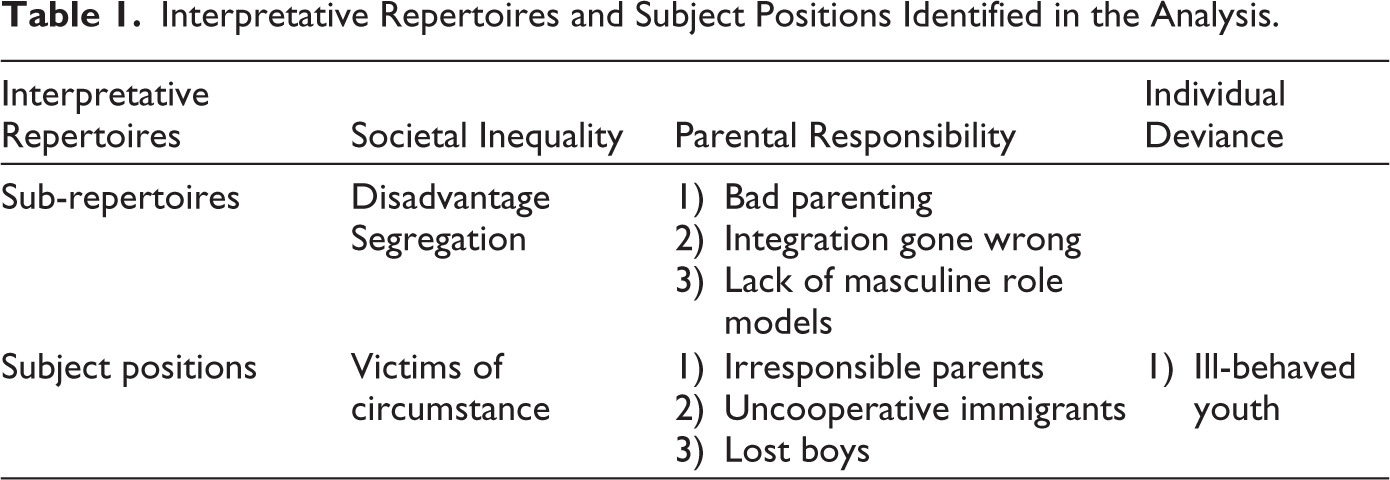
The analysis identified three interpretative repertoires (societal inequality, parental responsibility and individual deviance), and within them five sub-repertoires (disadvantage, segregation, bad parenting, integration gone wrong and lack of masculine role models). Moreover, the analysis also identified five subject positions (victims of circumstance, irresponsible parents and uncooperative immigrants, lost boys and ill-behaved youth). These are presented in Table 1 and will be discussed in detail in the analysis later. The extracts, chosen to illustrate the intersectional meanings mobilized to make sense of the public debate around gangs and to highlight the dilemmatic nature of negotiating accountability, are marked with a code to identify the platform, followed by the month and year the comment was posted. To ensure the poster’s anonymity, names of the platforms or references to online articles are not displayed.
Interpretative Repertoires and Subject Positions Identified in the Analysis.
Societal Inequality
Within this repertoire, society is held accountable for youth delinquency. For example, the disadvantage sub-repertoire attributes youth crime to the socio-economic struggles of families. Problems such as poverty, a lack of resources, instability and substance use are highlighted as the root cause behind gangs, resembling explicit criminological conflict theories on crime. Intergenerational disadvantages are seen as causing a lack of perspective for youth and providing them with fewer opportunities in life, causing them to turn to gangs. It is stated that Finland is not unfamiliar with gang activity, though, as poverty and dysfunctional families have long been a problem before more recent news on gangs emerged. Intersections of class and age are mobilized in the discussions, along with sociohistorical understanding of Finland as a poor country, as exemplified in the extract below, commenting news about a media announcement by the police:
Gang activity, which is of course a bad thing, is a symptom of something. And I need to clarify that gangs existed already in my youth, and those gangs consisted mostly of so-called majority Finns, because 20–30 years ago there was not much immigration. The reactions mean that when you come, for example, from a broken, violent, limited income, big single-parent family, your future prospects are not the same as for a kid from a so-called normal, secure nuclear family, with both parents. (F2/3/2023)
The above comment thus suggests that young people join gangs because of a disadvantaged family background. By invoking a contrast between healthy and broken families by mobilizing meanings attached to class and gender, they construct an idea of what is ‘normal’ and desirable (Berg & Peltola, 2015). A ‘normal’ family protects children from delinquency, providing them with a good future. Yet, by choosing the words ‘so-called’, the commenter also notes that normality, and what constitutes ‘majority Finns’, is debatable. Furthermore, the common portrayal of gangs as a phenomenon of immigrant youth is contested by stating that gangs have existed long before Finland became a country of (increased) immigration.
In the segregation sub-repertoire, the core question revolves around immigration and ethnicity. It suggests that gangs are the result of prejudice both on a policy level and in everyday interactions; with immigrant youth not having the same opportunities as native-born Finnish children, they are seen as being in an underprivileged position due to their ethnicity and class (see Rovamo et al., 2023). This perspective is exemplified in the dialogue below between two commentors commenting on the same article as in the previous extract:
This society has so many threats to young immigrants and their children, so it is natural that they organise into gangs. Why they start committing crimes is another question. The main thing would be to offer children and youth safe options to spend their time: sports, music, different places to make art, and guidance and help with their studies. (F1/12/2022) Yep, and it would help if those that are better off would not take their children away from the schools or move away from the areas where immigrants appear – it only makes it worse. Everyone should help those that come here and not target the better hobbies and teaching to the so-called better schools, which the more well-off kids then line up for. (F1/12/2022)
The first commentor constructs Finnish society as unwelcoming to immigrants and sees gangs as a natural reaction to this problem. They also make a distinction between gangs and criminal activity, contesting common-sense understanding of their essence. Here, gangs are seen as bringing a sense of belonging and safety and are the result of a lack of meaningful activities, which the commenter underlines by listing measures, such as hobbies and sports, that distinguish middle-class families from those less well off (Berg & Peltola, 2015). The second commentor elaborates on this in their reply; along with placing the blame on society, they call for responsibility of those ‘better off’, criticizing the middle class’s ‘school-shopping’, a phenomenon that has been debated in Finland in recent years. They suggest that all Finnish people are responsible for promoting integration, which can be achieved by offering meaningful activities and equal opportunities.
Below, segregation, lack of opportunities and class are further elaborated in a comment responding to an announcement made by the police:
The problem is that the youth, from their starting point, see that their language or cultural background affects their education, and they will face obstacles when looking for good jobs. So, they do not have the means to achieve class mobility as do those children from middle-class families? Of course, it angers those who want to succeed, and a counteraction to tackling these cultural restraints is to form gangs and start making gangsta rap. (F1/11/2022)
Here, gangs are associated with immigrant youth and their assumed lower socio-economic status. Gangs are attributed to an anger stemming from a lack of prospects and the realization that Finnish middle-class children have more opportunities in life. Gang membership is thus a reaction to perceived hardship, echoing such classic criminological perspectives as strain theory (Merton, 1938). Young people are seen as reacting to limiting environments and are thus positioned as victims of circumstance. Here, agency is simultaneously seen as weak, limited by societal structures, yet also strong, when youth claim agency non-normatively via the best means available: forming gangs and making gangsta-rap.
Parental Responsibility
This repertoire holds present-day parenting and families accountable for youth unrest. They attribute delinquency to a lack of values and social control, along with the lack of clear moral rules in families, resembling explicit criminological explanatory models like social control theory (Hirschi & Gottfredson, 2001). For example, according to the bad parenting sub-repertoire, a lack of discipline and a lack of interest by parents are the root cause behind gangs. This perspective is exemplified by the following extract:
Parents should be held accountable for their kids’ criminal sentences until they are grown up. It would increase the interest of the parents in guiding their children onto the right, law-abiding path. (F1/11/2022)
The commentor extends responsibility for criminal behaviour to parents, suggesting that they have neglected their responsibilities to socialize their children as law-abiding citizens, thus positioning them as irresponsible parents.
Socialization and proper values are also connected to the question of immigration. According to the integration gone wrong sub-repertoire, parents should be held accountable for unsuccessful integration, which is seen as a root cause behind gangs. Parents are portrayed as socializing their children into a foreign culture and actively choosing not to integrate (Rovamo et al., 2023; Tileaga, 2005). Parents’ unwillingness to integrate here extends to their children, who exemplify integration gone wrong by posing a threat to Finnish society. Thus, they are positioned as uncooperative immigrants. This is exemplified in the extract below, commenting on a feature article discussing youth crime in the metropolitan area:
Family culture is the problem. In certain cultures, parents are unable to control their children (boys). Gangs and violence have a strong connection to the religion of Islam. The families focus on limiting the lives of girls. Also, the parents do not integrate, do not communicate with Finnish parents, do not take part in activities organised by schools, or hobbies, so they are totally excluded. They do not have any social shame about the actions of their children. They live here in a bubble. (F2/11/2022)
The commenter refers to ‘certain cultures’, later intertwined with the religion of Islam, constructed as patriarchal, inherently violent and controlling, particularly towards young girls. This mobilization works to construct a dichotomy between Finland, being progressive in terms of gender equality and the backward ‘other’ (Venäläinen & Menard, 2022). Moreover, the immigrant community is constructed as living in their own bubble, a metaphor for their self-imposed exclusion. By stating that parents do not have any shame regarding their actions, the commenter implies that they approve of the delinquent behaviour of their children. Parents are to blame for not socializing their children into the proper norms of society, having neglected their responsibilities towards their children and the Finnish community (see Dahlstedt, 2019). This uncooperativeness is emphasized by listing all the ways in which families are not participating in society. Responsibilities of immigrants are elaborated in the exchange below, responding to a feature article about the situation in Sweden:
Why do immigrants want to settle in an area where there are others? A familiar social environment, you can keep your language, your ways and still, at least nominally, be a member of the new society. I myself would not want to live in an area where I would be like an immigrant, especially in my home country. So, no wonder Finnish people aspire to move from immigrant-populated areas. The other question is that of criminality, gangs and parallel cultures. Yes, poverty and unemployment contribute to this, but we should also ask, what is the newcomers’ desire to integrate really? It is not a problem for all, only for some groups. I am not saying we are innocent, but we can also ask how the immigrants contribute to this problem. Without looking at that, we cannot solve the problem. There are many sore spots. They might have a different understanding of women’s place in society, a strong inclination towards tradition, tribe- and family-centred culture, etc. (F1/3/2022)
Above, successful integration, and who bears the responsibility, is discussed. The commenters negotiate an ideological dilemma, where they acknowledge the obstacles of poverty and residential segregation, while simultaneously emphasizing the responsibility of immigrants, stating that integration requires effort and desire and is not achieved by excluding oneself from society (see Dahlstedt, 2019; Tileaga, 2005). The implied blame directed at the Finnish population for moving away from certain areas is managed by drawing on ‘common sense’, that is, that it is only natural not wanting to feel ‘like an immigrant’ in one’s ‘home country’ and likewise for immigrants to choose a ‘familiar social environment’, thus essentializing the differences between native-born Finns and immigrants. Moreover, it is implied that there are differences between immigrant groups and their integration efforts and outcomes. The implied segregated communities as parallel societies with discrepant values evoke a contrast between the ‘backwards others’ and the modern, liberal and equal Finns, as well as the ‘ideal (integrated) immigrants’. Blame for possible political incorrectness of these statements is managed by disclaimers and stake inoculations (Potter & Wetherell, 1988): ‘I am not saying we are innocent, but …’.
Lastly, in the lack of masculine role models, sub-repertoire youth delinquency is seen as the result of bad influences. Responsibility is placed on the family, particularly fathers, while simultaneously holding societal expectations about proper masculinities accountable. The lack of a masculine role model results in children receiving bad influences from present-day (social) media images of masculinities (Dahlstedt, 2019). Moreover, the repertoire mobilizes both cultural and biological explanation models for boys’ deviancy. Within this repertoire, youth are positioned as lost boys in need of guidance (see Lönnroth-Olin & Venäläinen, 2021; Berg & Aaltonen, 2017). This perspective is exemplified in the extracts below, with both commenters responding to an article in which a Finnish imam discussed the gangs:
This problem has nothing to do with nationality, religion, skin colour or origin. Rather, it is a global phenomenon that has to do with how the human psyche has developed growing up: are there functioning problem-solving skills, ability to control impulses, empathy, but also the ability to trust another person and be trustworthy and cooperate? Behind a Finnish white boy showing these symptoms (marginalisation, maladjustment, problems with emotional life) is the same absent father, a lack of fatherhood, an absent adult man. Genetics are not important per se; it is the presence of a secure male adult when children grow up. Children are not stupid; they can sense, hear, and see, but also read the adult tension, aggression and bad behaviour from the media and they mimic that. That is why everyone shares in the responsibility of being a good model of adulthood that does not include brawling, threats and uncontrollable outbursts of emotion. (F2/2/2023)
The above commenter calls for the responsibility of the father figure to socialize young boys into what they deem proper manhood, listing attributes such as trustworthiness, cooperativeness and control of emotions. Children’s behaviour is seen as naturally impulsive and uncontrollable before they are socialized into proper gendered citizenship (Berg & Aaltonen, 2017; see also Hirschi & Gottfredson, 2001). A male role model is prioritized over other distinctions, such as ethnicity and religion, the relevance of which is refuted in building an essentialized image of the human (male) psyche. Impulsivity and violence are deemed as natural to the male sex and shared across cultures and contexts, contesting discourses linking ethnicity, gender and crime. The above quote implies that if a proper role model is lacking, then young people will find influences elsewhere. This point is exemplified in the following extract that provides commentary on the same article as above:
How can you make it as a young man in a capitalist, materialist culture? Possibilities to succeed as an immigrant father in Finland are limited. Young people might then more readily take their role models from social media images. Many young people feel the need to ‘flex’ with designer clothes, for example. Many adults encourage this through their examples and in commercials. No matter the background, toxic masculinity is an unhealthy goal. Boasting as an ‘alpha male’ in the social media bubble would need balancing in real life, a real-life male role model who the young person can and wants to relate to. And let’s add the patriarchal values of the Islamic world to the problem that enhances such toxicity. A young man of immigrant background gets a bad example when seeing the role of the mother and control of the sister in the family and the community. Better starting points for all youth can be achieved when Nordic equality is seen as worth pursuing in all minority groups. (F2/2/2023)
The above commenter more explicitly blames social media, along with the surrounding society, for disseminating the wrong kinds of values and role models (Bandura, 1977 on social learning theory) and undermining the role of real, secure men as father figures. This seems the case especially with immigrant youth, as their fathers have less possibilities to ‘succeed’ in life and cannot serve as positive role models for their children. Furthermore, with respect to ideological dilemmas, the commenter notes that all young men are subjected to the same societal pressure of social media images; yet, the presumably patriarchal values of Islam, contrasted against ‘Nordic equality’ in the families, make immigrant youth more prone to what they call ‘toxic’ masculinity (Venäläinen & Menard, 2022; Venäläinen & Virkki, 2019).
The comment below likewise frames gangs as a problem of masculinity and immigration, understood here through experiences of prejudice and racism. It is implied that youth join gangs to gain respect. The extract, commenting on a news piece about a sentence issued to a ‘gang leader’, also highlights a generational clash:
The first generation, the ‘father’, cleans, drives the bus, etc., to offer a future to their family. He takes on the prejudice, racism, and swallows his anger. The ‘son’ sees this and understandably does not like what he sees. When he grows up, he wants everything others have. He wants it immediately and does not kneel like his father. This often happens at the age where the young man’s testosterone exceeds functioning of the brain. I assume that we all have gone through this phase (sic!). The father, whom some would consider a hero because he sacrificed himself for the family, is not a hero in the son’s eyes. He sees the father as a coward, and now he wants to show that he himself is a ‘real man’, a tough man and not a coward. What is common to this is, regardless of country, a culture that is strongly masculine. (F2/7/2023)
Here, what is considered proper masculinity is negotiated. The commenter constructs an emasculated immigrant father, that is, not a ‘proper’ role model, ‘understandably’ devalued by his son. Masculinity is discussed through oppositional gendered understanding of heroism and cowardice (Venäläinen, 2020), with the younger generation representative of ‘toxic’ masculinity, whereas their parents’ generation exemplifies submissiveness and unglorified strength. The commenter, positioning themself as an expert on young masculinities, questions the devaluation of the ‘normal man’ and blames society and culture for promoting hard masculinity (see Venäläinen & Virkki, 2019). Again, the nature of the male sex is discussed. This gender essentialism seeks to naturalize violent masculinities, downplaying the accountability of young men by implying that they cannot control themselves. Thus, complex negotiation of condemning youth, through the meanings attached to generational differences, gender and ethnicity on the one hand, and assuming a position of understanding young men’s violence through naturalizing it on the other, is visible in this sub-repertoire. What is evident is that these lay understanding mobilize similar intersectional meanings, as proposed by Messerschmidt (2005) in his theorizing about masculinities and crime as structured action.
Individual Deviance
The repertoires presented above are renegotiated. Responsibility is placed on the individual rather than on society. Commenters note that a key element of Finnish society is the welfare state, granting everyone the same opportunities, placing responsibility on the individual to seize them. The extract below commenting on a feature article discussing the causes behind gangs exemplifies this:
I think that these stories discussing gangs overemphasise the role of disadvantages, because there are also hundreds of thousands of disadvantaged youths among the majority population, but they do not start to cook up crime: more to the contrary. So, you can get rid of your disadvantaged position by studying and working hard, no matter what the background. Those who think the shortcut to happiness is found by criminal activity certainly do not belong in this society. A core value of Finnishness is that there is no shame in being poor, as long as you are honest. This is the reason why corruption of authorities is among the lowest in the world, despite low salaries. The point is that admiring criminals or criminal gangs is definitely not a part of Finnish society, it is as despicable as admiring Nazis. (F1/12/2022)
The above commenter states that being less fortunate does not make joining gangs or committing crimes acceptable. They construct Finnishness through such traits as hard work, humility and honesty, which are key values of Finnishness-—particularly Finnish masculinity (Berg & Aaltonen, 2017). They invoke the neoliberal idea that everyone is responsible for their own fortune and that a less favourable background is not an obstacle to success. By using extreme formulations, such as referring to ‘hundreds of thousands of disadvantaged youth’, and resorting to allegory when stating that admiring criminal gangs is ‘as despicable as admiring Nazis’, the commenter constructs a dichotomy between moral Finnishness and those beyond the moral order (Tileaga, 2005). The individual is held accountable for choosing to join a gang, something that conflicts with the idea of Finnishness. Consequently, they are positioned as ill-behaved youth.
Individual responsibility is further discussed below, where the commenter replies to a column discussing the underlying causes for the gang phenomenon:
What should be done in practice if the individual does not adjust and learn that Finland is the host (paid stay by tax money)? And if it does not befit you, then you can move elsewhere. Criminal immigrants should be deported, and if they have permanent residence permits, then you can just tear them up. Those who are well-behaved should not have to worry. If a Finn looks at you sideways, you can just ignore it, or if needed go through the justice system, but in a democracy with freedom of speech, it is acceptable to say things harshly. (F3/11/2022)
The above extract puts the responsibility of integration on the willing, well-behaved, self-guided and humble immigrant individual (Varjonen et al., 2018), who is expected to be grateful for the efforts of society and who pays back these efforts by successful integration. Experiences of prejudice are acknowledged by the commenter, but they expect the individual to rise above them and assume responsibility for their experience; ‘harsh’ words are approved in the name of democracy and freedom of speech, values associated with Finnish progressiveness.
Gratefulness is further discussed in the extract below, with the commenter responding to news about new gangs identified in the metropolitan area:
It is partly because the children of people who come here do not realise they should be grateful. They should compare themselves to those who still live in their parents’ home countries and not expect everything to be as good as the native Finns have it, who have been able to accumulate wealth over generations starting from the last war. On the other hand, Finnish society, with the welfare system, makes immigrants passive, with frustration and rebellion against everything as a result. (F1/11/2022)
The extract distinguishes between the majority and immigrant youth, in which the latter should be grateful, not aspiring same things as the former. Thus, the commenter highlights a difference in the socio-economic conditions between immigrants and ‘native Finns’. An expectation of hard work is implied even here, with references to the accumulation of wealth after the Second World War, drawing on collective national memory (Petterson & Sakki, 2023). However, in terms of ideological dilemmas, they also acknowledge the accountability of society. In the comment, Finnish welfare policy, which is supposedly generous, is partly blamed for making such youth passive, and in their frustration, immigrant youth in particular become uncontrollable. Thus, the understanding of deviancy seems in this repertoire to be linked to questions of immigration and ethnicity.
Conclusions and Discussion
This article has analysed constructions of accountability in online discussions about ‘street gangs’ in Finland. Utilizing a critical discursive psychological approach and an intersectional lens, the analysis distinguished three interpretative repertoires, five sub-repertoires and five subject positions. Accountability was accomplished by using varying discursive manoeuvres, shaped by meanings attached to intersections of age, gender, class, ethnicity and religion. Moreover, ideological dilemmas, namely conflicting everyday ideologies, were identified. These centred around negotiations of who is responsible for youth delinquency, and, by that, what are the proper measures to tackle the issue: state control or support. The online debates reveal how common-sense understanding of who is to blame can be conflicting and ambiguous, thus highlighting the need to try to resolve and negotiate them. The findings align with previous research illuminating the complexity and contrariety of everyday sense-making around violence perpetrated by those traditionally portrayed as vulnerable, such as women and children (see, e.g., Venäläinen, 2020). By highlighting the nuances of everyday discourse, this study shows how the general public can either resist or support hegemonic understanding of vulnerable and threatening actors.
Society was held accountable in the disadvantage, segregation and lack of masculine role models sub-repertoires. Here the root cause behind gangs was structural inequalities associated with class and ethnicity, intertwined with societal expectations on masculinities. However, the lack of masculine role models sub-repertoire also entailed an ideological dilemma, forcing commenters to negotiate their understandings of the accountability of the family, especially fathers. Holding the family accountable was more unambiguously explicated in the bad parenting and integration gone wrong sub-repertoires. However, the integration gone wrong repertoire also held the individual responsible, much like in the repertoire of individual deviance, which draws upon the meanings attached to class and ethnicity in a way that counters repertoires emphasizing the effects of structural inequalities. These meaning-makings shape how ‘the state of the youth’ is understood and how young people and their belonging to society is negotiated; who is labelled a delinquent, a threat or an outsider and who, on the other hand, is included and deserving of support.
The commenters thus negotiated lay implicit theories of delinquency (see Furnham & Henderson, 1983), but their sense-making also mobilized explicit criminological theories. They viewed crime as a reaction to a perceived disconnect between societal goals and the means to achieve them (Merton, 1938), or else they suggested that young people learn criminal behaviour through observation and imitation (Bandura, 1977). Moreover, they attributed crime to weak social bonds to family, school and other institutions, which supposedly increases the likelihood of criminal behaviour (Hirschi & Gottfredson, 2001). Moreover, the explanations also drew on intersectional understandings of race, age and gender and how they shape the resources men have at their disposal to perform various masculinities, in some social settings by resorting to crime (Messerschmidt, 2005).
In terms of the limitations of this study, it should first be noted that it focuses only on comments posted on a few online platforms. Thus, it is likely that other discussions of the phenomenon are more varied. Second, as already mentioned, due to the anonymity of two of the platforms, it is not possible to make definitive claims about the identities of the commenters and neither can the possibility of information influencing be ruled out. The third limitation is that due to a lack of space, the dialogical and interactional aspects of the comments are not discussed. The final potential limitation has to do with the ethics of using online commenting as data. However, aligning with the ethical guidelines for Internet research, I consider the data public and readily available for research purposes without having separately secured informed consent.
Despite the limitations, this article has shed light on the culturally available means of constructing accountability by drawing on intersectional categorizations. Meaning-making that sustains inequalities linked to ethnicity, masculinity, threat and integration are quite familiar and well established in Finnish society (Petterson & Sakki, 2023; Venäläinen & Virkki, 2019). Yet, the complex and contradictory nature of everyday understandings of accountability has been less explored. The article thus advances this line of research by highlighting the complexity and multiplicity of everyday sense-making around deviancy. The construction of accountability identified in this article has implications regarding what can be considered proper Finnishness as well as a proper Finnish family and proper enactments of masculinities. Blaming the ‘other’, that is, the lower class ethnicized/racialized families, allows the ‘good’ middle-class Finnish families to be presented as moral and distanced from non-normative behaviour (Berg & Peltola, 2015).
On a more practical level, the construction of accountable actors also has material implications, as such constructions are used to legitimize securitization, control and exclusion of those that are considered outsiders. Also, in Finland, the gang problem is at least in part fuelled by a media-driven moral panic and the associated ‘gang control industry’, targeting racialized youth and their families (Hallsworth & Young, 2008). The discourses thus legitimate measures that are deemed effective for combatting the gangs, such as harsher sentences, sanctioning the parents and tightening immigration laws. Therefore, it is important to explore the dynamics and highlight the exclusionary discursive practices circulating online. By advancing our knowledge of how crime associated with immigrant youth is made sense of in lay discourses, it is possible to contest the Othering discourses and call for more support measures and policies that promote the inclusion of all young people.
On that note, what should be acknowledged are the counter-positions expressed in the comments, which call out for a shared societal responsibility towards the younger generation and make the argument for inclusion. Although these remained a bit more on the margins, this article still argues that the key element of the discussions is precisely negotiations about whether gangs are a unique and new phenomenon linked to present-day society and immigration, or a universal and timeless phenomenon linked to the restlessness of youth in general. Thus, what is at the core of these discursive battles is the opposing perspectives of exclusion and punishment versus compassion and understanding.
Footnotes
Declaration of Conflicting Interests
The author declared no potential conflicts of interest with respect to the research, authorship and/or publication of this article.
Funding
The author disclosed receipt of the following financial support for the research, authorship and/or publication of this article: The author received funding from Society of Swedish Literature in Finland, Grant number 7528.