



Abstract
High-quality volunteerism experiences in adolescence are associated with higher volunteerism later in life, yet less is understood about contextualized features of these experiences, especially when school-based programmes are mandatory. Relatedly, narrowing ‘bathtub volunteerism’ (i.e., increasing postgraduation youth volunteerism and shortening the period between volunteer disengagement and resumption) remains a research gap. Therefore, using in-depth retrospective qualitative interviews with 50 young Singaporeans, we aimed to understand features of high-quality volunteer experiences in schools (among adolescents) and communities (among young adults). Findings indicated that within a national context of compulsory school-based volunteerism, ‘bathtub volunteerism’ was narrowed efficaciously when adolescents and young adults were exposed to high-quality school- and community-based volunteer experiences, respectively. High-quality school-based experiences granted student autonomy and facilitated empathy development. Community-based ones combined cause selectivity, personal meaning and close interpersonal relationships. Our findings offer insights to raise volunteerism rates by developing and propagating high-quality volunteer experiences.
Introduction
Volunteerism in adolescence is positively associated with future benefits (Celio et al., 2011), and extant research has examined how community service programmes facilitate volunteerism in adolescence and young adulthood longitudinally (Cheng & Sikkink, 2019; Kim & Morgül, 2017). Although high-quality volunteer experiences in adolescence—marked generally by depth, quality, content and context (Flanagan et al., 2015; Hart et al., 2007; Henderson et al., 2014)—are related to higher volunteerism rates later in life (Henderson et al., 2012; Taylor & Pancer, 2007), there is less clarity over contextualized features of these high-quality experiences in schools and communities, especially when school-based programmes are mandatory. Conclusions on the efficacy of these compulsory school programmes are mixed, though there is some agreement that low-quality experiences result from schools and teachers not doing a good job (Kwan & Wray-Lake, 2023).
Most Singaporeans do not volunteer in their 20s and 30s and only resume volunteering in their 40s or 50s. This phenomenon has been metaphorically described as ‘bathtub volunteerism’, wherein young Singaporeans disengage from volunteerism to prioritize their careers and families, only to volunteer again after their mid-40s, and it is not unique to Singapore (Wray-Lake et al., 2017). However, and somewhat puzzlingly, it was expected that Singapore’s compulsory school-based volunteerism—with students completing at least six annual hours of volunteerism over 10 years under the Community Involvement Program (CIP) and Values in Action (VIA) programmes—would have sustained greater postgraduation volunteerism interest. However, only 27% of young adults aged 25–34 volunteer (National Volunteer and Philanthropy Centre, 2019). In 2018, this proportion was not only below the national average (29%) but was also 11-percentage points lower than those aged 15–24. Moreover, since 2000, compared to other age groups, those aged 25–34 have among the lowest volunteerism rates.
Consequently, ‘bathtub volunteerism’ in Singapore and beyond—when school-based volunteerism is compulsory—can potentially be narrowed (i.e., increase youth volunteerism rates postgraduation and shorten the period between volunteer disengagement in adolescence and resumption in adulthood) with a better understanding of contextualized features of high-quality volunteer experiences in schools and communities. Using retrospective reports of volunteerism and guided theoretically (Marta & Pozzi, 2008; Oesterle et al., 2004; Penner, 2002), the present study explores two related questions: First, what are the features of high-quality volunteer experiences in schools (among adolescent volunteers) and communities (among young adult volunteers); and second, how could high-quality volunteer experiences narrow ‘bathtub volunteerism’ more efficaciously when school-based volunteerism is compulsory? Knowledge of how high-quality experiences facilitate transitions from school-based volunteerism in adolescence, when compulsory, into community-based volunteerism in young adulthood, when voluntary, allows for the understanding of effective volunteerism programme features.
Literature Review
The Life-course Perspective and Model of Sustained Volunteerism
The life-course theoretical perspective centres on the study of human development in context (Oesterle et al., 2004). Contextually, volunteerism patterns in adolescence and young adulthood are connected. In the adolescence-to-young adulthood transition, civic engagement, including volunteerism, could follow three different trajectories (Wray-Lake et al., 2017): first, civic engagement increases as adolescents assume adult responsibilities and enjoy greater independence; second, it could decrease because of competing work, education, romantic relationships, parenthood and independent living responsibilities; and third, it could be delayed or postponed after marriage and parenthood. The second and third trajectories appear consistent with ‘bathtub volunteerism’, that youth prefer to volunteer after getting their personal lives in order.
Penner’s (2002) interactionist model of sustained volunteerism, which details the interaction of individual factors and organizational or programme factors, could be used to understand how volunteerism programmes in adolescence influence volunteerism in young adulthood. The model proposes interactions between dispositional (e.g., personal beliefs and values, personality traits and motives) and organizational variables (e.g., perceptions of treatment by an organization, organizational reputation and personnel practices). Distinguishing between individuals who continued volunteering in adulthood and those who did not (Marta & Pozzi, 2008), dispositional and organizational variables can potentially illustrate features of school-based volunteerism in adolescence and continued community-based volunteerism in young adulthood when it is no longer compulsory.
Volunteerism Links Between Adolescence and Young Adulthood
Volunteerism in adolescence is associated with later gains in young adulthood, including socio-political engagement, social skills and social capital (Celio et al., 2011; Flanagan et al., 2015). An Australian adolescent sample who volunteered frequently were more likely to volunteer as young adults (Moorfoot et al., 2015). Similarly, a UK adolescent sample who engaged in civic activities, sports, hobbies and religious services were most likely to be civically engaged adults (Finlay & Flanagan, 2013), while adolescent volunteer involvement among some US urban schoolers predicted volunteerism in adulthood (Obradović & Masten, 2007). Another study of urban racial minorities found positive relationships between adolescent and adult civic engagement (Chan et al., 2014). Collectively, these studies stressed the importance of describing the processes and features involved in the adolescence-to-young adulthood transition, including the role of youth volunteer programmes.
Related studies have considered adolescent contexts which promote volunteerism in young adulthood (e.g., schools) by determining the nature of volunteer activities and values to which youth are exposed (Wilson, 2012). A supportive civic context—with positive peer influence, parent modelling of civic behaviours, and familial ethnic socialization—predicted greater civic involvement in young adulthood (Zaff et al., 2008). Comparing US public, Catholic, Protestant and non-religious schools, Cheng and Sikkink (2019) concluded that the schools’ organizational networks and civic values shaped student volunteer activities, organizations, causes and volunteering patterns. In Singapore, schools’ volunteerism culture and practices (i.e., intrinsically motivated, extrinsically motivated or minimally focused on volunteerism) intersected with and influenced youth volunteer motivations (Kwan & Wray-Lake, 2023).
Additionally, studies on whether school-based volunteerism should be mandatory have reached different conclusions. Overall, compulsory school-based volunteerism is not unique to Singapore. About a quarter to a third of US high schools mandated some community service in the early 2000s, though the proportion may have decreased since (Kim & Morgül, 2017; Metz & Youniss, 2005). Every secondary school student in Ontario, Canada has been mandated to 40 hours of community involvement since 1999 (Henderson et al., 2012, 2014), and the International Baccalaureate programme also has a creativity, arts and service requirement. Kim and Morgül (2017) found that volunteerism in adolescence only led to volunteerism in young adulthood if it was voluntary. Voluntary and non-voluntary participants reported higher educational attainment and earnings compared to non-participants, but only voluntary participants benefited psychologically (Kim & Morgül, 2017). Conversely, another study found that long-term community engagement was predicted by adolescent participation in voluntary and required civic activities (Barber et al., 2013). Others have shown that mandatory service can have positive long-term gains (Metz & Youniss, 2005).
High-quality Volunteer Programmes and Experiences
Compulsory school-based volunteerism programmes are most effective when service is sustained over time and offer high-quality experiences. Whether programmes are mandatory appears less important than the depth, quality, content and context of the volunteer experience. Earlier studies highlighted the importance of experience quality. For instance, Riedel (2002) found that volunteer programmes increased later political engagement only when service was framed within a wide socio-political context. Others stressed the importance of continued commitment to develop stronger attachments to causes and organizations (Henderson et al., 2012, 2014; Taylor & Pancer, 2007). Adolescent and young adult volunteers may also perceive the same school- and community-based volunteer experiences differently (Hustinx et al., 2022).
Some researchers have used the Inventory of Service Experience instrument to measure the quality of volunteer experiences across seven subscales: relations with others, family and friends, organizational support, making a difference, learning skills, exposure to career possibilities and enjoyment. Later studies have corroborated Taylor and Pancer’s (2007) finding that high-quality volunteer experiences were associated with intentions to volunteer and future volunteer behaviour. Henderson et al. (2012) reported that the impact of high-school volunteerism on a student’s subsequent civic and political engagement depended on sustained commitment to one’s placement and a positively evaluated volunteer experience from students’ perspectives (e.g., friendships gained, perception of worth, skills gained, career possibilities explored).
The same researchers, using a different sample, highlighted the variety and breadth of volunteer experiences. Henderson et al. (2014) found that volunteers who assessed their experiences positively saw themselves making a difference and derived emotional and personal benefits. Relatedly, the service-learning literature has highlighted the importance of pedagogical reflection service (Hustinx & Lammertyn, 2003; Weiler et al., 2013). Specifically, Celio et al.’s (2011) meta-analysis identified correlates of positive youth volunteer outcomes, including youth involvement in programme planning, implementation or evaluation, community involvement beyond just providing a location for students, and reflection activity.
Method
As part of a larger study exploring school- and community-based volunteerism among young Singaporeans (Kwan, 2023; Kwan & Wray-Lake, 2023), we conducted 50 in-depth interviews (December 2018–June 2019). We explore two related questions, regarding the features of high-quality volunteer experiences in schools (among adolescent volunteers) and communities (among young adult volunteers) and how high-quality volunteer experiences could narrow ‘bathtub volunteerism’ more efficaciously when school-based volunteerism is compulsory. The study was approved by the University of California, Los Angeles Institutional Review Board. Constructivist grounded theory (CGT) was employed (Charmaz, 2014; Corbin & Strauss, 2014), which guides us to prioritize understanding over explanation when documenting descriptions of personal actions, decisions and experiences from the participants’ perspectives. Theory is systematically developed and generated from the data collected. That the study was theoretically guided is not incompatible with CGT. While classic grounded theorists stressed non-engagement with existing theoretical frameworks and theory development through pure induction, the constructivist grounded-theory tradition allows extant theoretical insights to be deepened. Given our interest in features of high-quality youth volunteer experiences, CGT is useful with its focus on context-related processes.
Data Collection
Initial sampling was purposive to sample for diverse volunteerism exposure, ranging from those with minimal experience to those who were very active volunteers. The main recruitment method at this stage was open social media calls through Facebook, Twitter, Instagram and LinkedIn. Respondents who fit the inclusion criteria (i.e., 25–34 years old, graduated from an institute of higher learning and did school-based volunteerism) and who were interested then contacted the first author to express interest. Thereafter, we used theoretical sampling to recruit those with experiences needing clarifications, fill out emerging categories or confirm conclusions. Examples of emerging categories included self-initiated programmes, negative experiences and those choosing not to volunteer. Other recruitment methods included emails to social service agencies and snowball sampling.
Using a semi-structured interview guide, respondents were asked about their school- and community-based volunteerism in adolescence and young adulthood (e.g., ‘How did you decide your volunteer activities in school?’). Other questions focused on the links between these life stages (e.g., ‘How have your school-based volunteerism influenced your community-based ones?’) and volunteerism’s perceived benefits and costs (e.g., ‘How have you gained from volunteerism?’). Interviews were audio-recorded and transcribed verbatim. The average interview lasted 65 minutes (range = 50–101). The average respondent age was 28.02 years, 29 were male, 40 were Chinese, 22 had a religion, 11 were married and 45 were working.
Data Analysis
Guided systematically by CGT, data analysis was concurrent with data collection using a constant comparison approach. From initial to focused to theoretical coding, process codes were used, involving the use of gerunds in short phrases to denote action with minimal analytic interpretation (Charmaz, 2014). With initial coding, the transcribed interviews were coded line-by-line for actions and processes described by the respondents to focus on data comparison within the same interview. Initial codes included school compulsion and autonomy, empathy and reflection and motivations for postgraduation volunteerism. With focused coding, constant comparison was extended across different interviews to triangulate frequent and significant codes (Charmaz, 2014). Focused codes were then sorted to form clusters. Categories and sub-categories with properties were developed from these clusters. New data from subsequent interviews were checked for alignment with existing categories and sub-categories (Corbin & Strauss, 2014). Finally, with theoretical coding, categories were developed into concepts focused on features of youth volunteer experiences in schools and communities. Constant comparison continued until no new properties emerged.
We worked to ensure data analysis quality, including multiple readings of all transcribed interviews, line-by-line coding and re-coding of some interviews. Upon saturation (Morgan, 1993), potential themes were expanded and sorted using thematic maps. Frequent and significant themes and sub-themes were reviewed against the raw interview data, as we checked for recurrence, repetition and forcefulness (Owen, 1984). We met the standard of referential adequacy through constant comparison across the interviews, and the audit trail included notes and memos (Lincoln & Guba, 1985).
Results
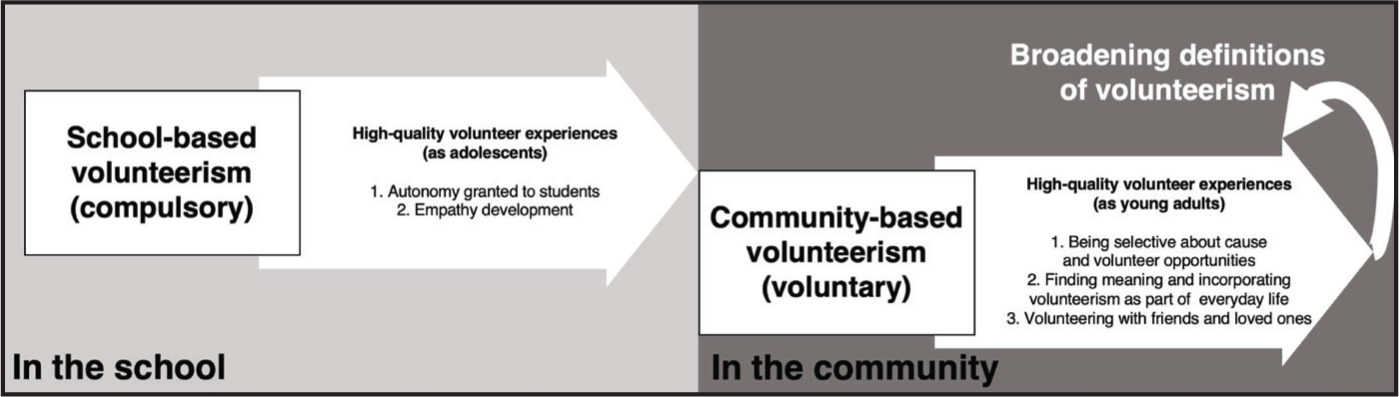
As perceived by the Singaporean respondents in this study, within a national context of compulsory school-based volunteerism, compulsory programmes were often of low quality. Conversely, in schools, high-quality volunteer experiences were characterized by (i) autonomy granted to students and (ii) empathy development. Consequently, adolescents who enjoyed high-quality school-based experiences were more likely to continue community-based volunteerism as young adults, when volunteerism is not mandated. In the community, those who enjoyed high-quality school-based experiences similarly sought out high-quality experiences to continue volunteering. These experiences were the combination of young adult volunteers (i) being selective about cause and volunteer opportunities, (ii) finding meaning and incorporating volunteerism as part of their everyday lives and (iii) volunteering with friends and loved ones. Through their continued community-based volunteerism, some respondents broadened their definitions of volunteerism to include activism and advocacy. Overall, ‘bathtub volunteerism’ was narrowed when youth—who were able to describe and determine which experiences were meaningful (or not)—were exposed to high-quality volunteer experiences in the school as adolescents and continued enjoying high-quality experiences in the community as young adults.
In this section, before detailing the contextualized features of high-quality school- and community-based volunteer experiences, we first explain how these experiences were identified in the sample, and briefly describe compulsory and structured school-based programmes in Singapore (i.e., CIP/VIA) as perceived by the respondents. Generally, these experiences were deemed to be of lower quality. Thereafter, consistent with the summary presented in Figure 1, we will detail features associated with high-quality school-based volunteer experiences (i.e., autonomy granted to students, empathy development) and high-quality community-based volunteer experiences (i.e., being selective about cause and volunteer opportunities, finding meaning and incorporating volunteerism as part of their everyday lives, volunteering with friends and loved ones), before describing how some respondents went on to broaden their definitions of volunteerism.
Transitioning from School- to Community-based Volunteerism and Narrowing ‘Bathtub Volunteerism’ Through High-quality Volunteer Experiences.
Identifying High-quality Volunteer Experiences
High-quality volunteer experiences were identified when respondents mentioned memorable or meaningful experiences, which were characterized as turning points or contrasted with lower-quality experiences. A respondent compared two separate rental flat visits, stating his preference for the second because he got to ‘actually interact on a very deep level’ with the residents while cleaning and listening to stories. The 27-year-old later volunteered for a youth club as a young adult. Similarly, another respondent who still volunteers as a young adult explained how a school-based nursing home trip felt different from her past volunteerism, because it was not a chore and that ‘I can see that I am making a difference, that I meet the elderly and they are happy by my presence.’ A respondent active in youth development and climate change advocacy as a young adult also explained her formative experience of volunteering as an adolescent:
You know what you want to do or you’re starting to get to know what you want to do. And so I think that was a turning point, instead of people telling me these are the options to do CIP. I joined the society on my own accord. And we got to decide. I was on the committee of the [volunteer] society.
High-quality experiences were especially beneficial for those volunteering for the first time. A respondent explained how a high-quality school-based experience led to future volunteerism as a young adult: ‘Because it is implemented in school, it becomes more likely for you as an adult to think that it’s actually important to be involved in the community, and so then it becomes part of your life.’ Similarly, another respondent who remains an active community volunteer recounted his journey of becoming more conscious of volunteerism’s significance over time:
In primary school, I didn’t even know what volunteering was. At that age, you are not really that mature. And then in secondary school you’re just doing CIP, just following the school. And along the way in polytechnic you start to realize that, oh, actually it’s quite meaningful. So, you progress to a point where now I started to see that volunteering is actually an important aspect of society. And it’s important for people to volunteer if they have the time and capacity.
Compulsory and Structured School-based Programmes: ‘Everyone Does the Same Thing’
Compulsory school-based volunteer programmes were evaluated by their implementation and the experiences of respondents, as most did the same things. With implementation, schools prioritized efficiency and expedience and relied on standardized and templatized programmes, with the goal of helping students fulfil requirements. This resulted in low-quality volunteer experiences because students had no choice in whether to volunteer and how to volunteer. Prioritizing efficiency and expedience resulted in top-down approaches. Students just followed instructions as schools and teachers decided en masse through classes or co-curricular activities to maximize homogeneity. A teacher respondent said:
When you do it as a school, it’s easier to coordinate. Everyone does the same thing. If you have every class doing a different project, working with different beneficiaries, doing different things, it’s not very efficient. To make things easier… Sometimes you may take a shortcut. So, they start with one beneficiary, and everyone does the same thing. Or everyone does the same cause with different beneficiaries.
Such standardization and templatization resulted in repetitive volunteer programmes, described as ‘part of the programming’ or as ritualistic. The activities were similar, with minimal beneficiary contact and little consideration for community impact. A social worker respondent highlighted the shortcomings of templatized, repetitive and mass-organized school-based volunteer activities:
The activities are very clichéd. There was one school which said, ‘Okay, let’s play chess with the elderly’. And that’s also very presumptuous, you see. Because only maybe three people in a group of 20 seniors play chess. And it’s still always Teresa Teng’s songs. It’s never moved on.
By helping students fulfil CIP/VIA requirements, students and teachers saw volunteerism as transactional. Consequently, students were unmotivated, and teachers had little pride. A civil servant said: ‘When you force people to clock a certain number of hours… People just create things that resemble volunteering or community service.’ Another respondent’s unfulfilling experiences resulted in ‘begrudging’ participation.
Respondents characterized compulsory and structured programmes as chores, superficial, or free labour, with student volunteers going through the motions, getting school-based programmes done and over with. A teacher respondent described volunteer activities like beach cleaning as ‘compulsory manual labor’ because they were boring, monotonous and mechanical for the students. ‘It’s more of just like let’s get this done and over with’, a respondent echoed. Specifically, many recounted their frustrations with Flag Day, or street collections of charitable donations. Teachers rarely explained why students were volunteering. In turn, dissatisfied and bored respondents knew little about Flag Day’s purpose and the beneficiaries for whom they were raising money. A respondent reflected:
When I did Flag Day, I didn’t know who my beneficiaries were. I didn’t have many interactions with my beneficiaries, so, it was very superficial. I just went out to get money, but I didn’t know for whom the money is and for what the money is.
Another added:
It was hard, it was tiring… I just remember being really tired and looking at my watch the entire time. I was like, ‘When is this going to be done? Can I stop?’. Like I rang the can, ‘Oh, it’s loud enough right? I don’t have to collect any more money, right? Do we have to really stand the entire time? Can we just like, sit down for a while?’
High-quality School-based Volunteer Experiences
Autonomy granted to students: ‘Plant some seeds of consciousness’.
As opposed to low-quality volunteer programmes, high-quality ones granted students some autonomy. Respondents guided their own volunteer experiences—with teachers providing some guardrails—and consequently enjoyed meaningful community engagement through direct and deep interpersonal interactions. Overall, volunteer experiences were perceived as less functional and more participatory. A respondent shared: ‘The junior college gave me, gave us a lot of space to experiment with the kind of outreach that you wanted to do. They didn’t dictate, look, these are your options, hospital or whatever.’
Students granted with autonomy chose their preferred volunteer causes, organizations or activities. They put in more effort because they volunteered in areas in which they were interested. Progressively, by gaining experience and confidence, these respondents led other students or ran programmes themselves, further building leadership skills through volunteerism. Teachers also appointed class representatives or older students who organized students to work collaboratively. A respondent who remains active in civil society as a young adult previously saw compulsory school-based volunteerism as ‘just providing your body and your time to do whatever you are told.’ But he got more interested when he was able to decide ‘exactly how I want to contribute and how I want to participate’.
Despite having no choice but to volunteer in Singaporean schools, students who were granted autonomy had choice and received guidance on how to volunteer effectively. Schools and teachers provided some guardrails to help students get started, including guidance to identify and shortlist causes of interest, exposure and organizations, learning from older students and allowing students to learn from mistakes. A teacher respondent explained how she designed guardrails based on her students’ age and readiness:
Getting students to go through a process on their own as opposed to the school guiding them. I mean, the school can guide them maybe when they are in lower secondary. But when they move to upper secondary, because the students have matured to a certain extent, they can do things on their own, which I think will be more meaningful to them. And valuable to them as well.
Additionally, respondents reported meaningful volunteer engagement when they understood the purpose and impact of their volunteer participation, which, as one respondent reflected, allowed for some ‘seeds of consciousness’ to be planted. Through meaningful and sustained participation, students developed empathy. A respondent prepared for CIP/VIA by putting himself in the beneficiaries’ shoes to understand the assistance required. Others also identified their own activities ‘instead of just taking whatever has been given to you’, thereby improving personal and community contributions.
Empathy development: ‘They can’t just go back thinking that Singapore is like a perfect place’.
High-quality school-based volunteer experiences were also marked by empathy development, prompting volunteers to think more deeply about Singapore. Exposure provided the first spark. When exposed to the realities of disadvantage (e.g., poverty, homelessness, discrimination), many adolescent volunteers first realized that social problems existed. Having witnessed the problems, a respondent noted that students cannot ‘just go back thinking that Singapore is like a perfect place’. Another added that without volunteer exposure, it may not have crossed students’ minds that ‘they should help people’. When volunteering at the Special Olympics, a respondent learnt more about those with physical disabilities. All three respondents have continued volunteering as young adults.
Following exposure, respondents experienced dissonance. Experiencing culture shocks or witnessing diverse Singaporean lives resulted in respondents seeing society differently. When visiting elderly or nursing homes, some witnessed physical and psychological frailty. Students volunteering in rental flats or low-income households expressed shock at squalid living conditions. A respondent witnessed poverty for the first time when visiting one-room rental flats: ‘This is a place that I cannot imagine living in, yeah.’ Another respondent shared about her volunteer experience with low-income adolescents:
During the break, one of them passed me his journal and he introduced his name, his age. And he then said, ‘I’m very happy because next week my mother coming out of jail’… And I was like, I didn’t know how to react then. I mean, he’s so candid about it. When I asked him about that, he said, ‘Oh yeah. My mother in jail. My father also in jail’. And I’m just like -- okay.
Following exposure and dissonance, students learnt more about community needs and endeavoured to change mindsets or correct stereotypes. A respondent challenged his personal assumptions that migrant workers were poor and uneducated, another changed preconceived notions he had of the elderly and questioned whether it was fairly to label youth as ‘at-risk’, and another revised unfair perceptions of the poor ‘leeching off’ the system. Another also thought about challenges faced by a wheelchair user living in a small flat without a doorway ramp. Through school-based volunteerism, all four respondents juxtaposed their volunteer observations with their own lived experiences and acknowledged personal privilege or disadvantage. The privileged became more cognizant of their advantages, while the disadvantaged expressed solidarity. Challenged by what he witnessed, one respondent described his mindset as metaphorically ‘shattered’. Another learnt to put himself in the shoes of others.
As respondents volunteered again, they introspectively evaluated their past contributions while acknowledging the limits of their volunteerism. Retrospectively, respondents evaluated their past volunteerism by unpacking experiences, considering issues and re-examining personal motivations. Many evaluated their long-term impact, and some were concerned that their volunteerism had limited impact. A respondent who volunteers as a young adult reflected on whether his school-based volunteerism as an adolescent had actually made a difference. Another reflected: ‘Along the way, you will realize that if you want to help someone, it has to be about what they want and what they need and not what you think you can do for them.’ Similarly, a teacher respondent who worked to make CIP/VIA meaningful for his students said:
When you volunteer, what is the impact? I think that’s very important. People tend to volunteer without thinking about the impact of their actions. It can be positive and negative. Especially, when you have this mentality of, ‘Oh, I come here as a savior and I’m here to save you now’. I think that mentality is wrong.
Overall, respondents experienced changes to their belief systems and re-evaluated Singapore’s public policies. A respondent who now volunteers actively as a young adult in church benefited from empathy development. His volunteer experiences:
Helped me to interact better, like I try not to make too many presuppositions. Like I don’t always assume that every kid I meet would automatically have two parents or have parents who are working or have the resources to buy them like smartphones and things like that… It makes me feel more confident about dealing with people from unfamiliar backgrounds.
High-quality Community-based Volunteer Experiences
Over time, respondents with high-quality school-based volunteer experiences as adolescents were more likely to continue volunteering as young adults. Personal knowledge of and references to these high-quality school-based experiences in adolescence resulted in later participation in high-quality community-based volunteer experiences in young adulthood. These community-based experiences sustained by cause selectivity, personal meaning and close interpersonal relationships.
Being selective about cause and volunteer opportunities: ‘Why am I doing this and why should I do this?’.
As young adults, respondents involved in high-quality community-based volunteer experiences were cognizant of who and what to help (e.g., causes), how to volunteer (e.g., skills), and where to contribute (e.g., organizations), processing their motivations and the ‘why’ of their volunteerism. They established criteria for themselves or committed to familiar causes, skills and organizations over time. Guided by his past school-based volunteer experiences, a respondent researched different non-profits before choosing one.
Being selective also meant being more critical. A respondent observed instances when organizations deviated from their mission or were being ‘very kumbaya’ (i.e., too focused on feel-good initiatives), because he did not want to volunteer for low-quality, coercive activities as he previously did in school. Another respondent who benefited from many positive school-based volunteer experiences, who now ran her own social initiative as a young adult, explained her choice of causes and opportunities:
I guess when you were in schooling there was no choice about the activities that you undertook, right? This is just part of the programming of school life that you have to go for these things, so you just go for them. Whereas when I was in university, all these things I attended were out of my own choice because there was just no more programming of how to spend your time… It was my responsibility to attend all these different engagement sessions which unexpectedly gave me the exposure to the breadth of Singaporean society.
Cause selectivity also meant constant evaluation of respondents’ own volunteer motivations. They asked themselves why they were involved, reflected on their work and sought to understand why and how they were spending ‘precious hours of their time’. A respondent who was looking to volunteer again as a young adult said she would only do so if she worked within a small team creating a positive impact and the organization focused on long-term sustainability.
Finding meaning and incorporating volunteerism as part of their everyday lives: ‘Extension of who I am and the things I value’.
When respondents were a part of high-quality community-based volunteer experiences, many saw volunteerism as an extension of or complement to their everyday lives. Volunteerism was about living a life larger than oneself. Respondents balanced different commitments, even rearranging their schedules to accommodate volunteer activities, as a respondent did, ‘prioritizing different things at different times and communicating those priorities to my friends, my family’.
When they volunteered through work, respondents focused on the personal benefits. One mused: ‘How impactful volunteerism has been to me, to my life, to my career, to my education, and even to my wife. I got to know my wife [through volunteerism].’ Upon reflection, having been shaped by her school- and community-based volunteer experiences, another respondent saw volunteerism as ‘a part of who you are’. Similarly, two other respondents remarked that volunteerism ‘has been a part of me’. Because respondents still volunteered for high-quality experiences despite the unpredictability of life or work commitments and their busy schedules, some reported feeling emotionally drained or burnt out when they were involved in meaningful but challenging volunteer activities.
Conversely, as a contrast to respondents who found meaning and incorporated volunteerism as part of their everyday lives, those not volunteering as young adults instead saw volunteerism as separate from their lives, and many were waiting for their lives to ‘stabilize’ before they volunteered again. A respondent said: ‘The whole week—The whole day is exhausting. And even during a non-busy period, you get to go home at eight… Saturdays are really family/girlfriend day, and Sundays are just destressing and decompressing.’ Even if companies offered time off from work to volunteer, some were hesitant. Annually, a respondent could take two days off work to volunteer, but he said: ‘I think my boss will kill me if I do it, because like, I’m taking away my time at work.’
Volunteering with friends and loved ones: ‘They really keep you going’.
A final feature of high-quality community-based volunteer experiences was volunteering with friends and loved ones, who complemented respondents’ volunteer experiences. Respondents sought out people they knew or made friends through volunteering, many of whom shared similar interests or causes. Many close interpersonal relationships were sustained over time. A respondent, previously active as a student volunteer, only worked with friends on community-based volunteer projects, while another continued her volunteerism in the community with acquaintances from past volunteer experiences. Another respondent shared that he developed camaraderie with activists and social workers he met through volunteerism, while another benefited from interacting with folks from different walks of life when volunteering: ‘I can’t verbalize it but seeing that quietened my ego a lot. Like, “Oh, maybe the purpose of life is not to just accumulate all these things but maybe it’s to deepen relationships.”’
Some respondents were influenced to volunteer and care about social issues through their romantic partners. A respondent met his former partner through volunteerism and got more involved because the initial interpersonal relationships he gained begat even more connections. Another respondent who started community-based volunteering to spend more time with his partner shared his experience:
My long-term goal is to really encourage people to use less waste. [My girlfriend] is the one who introduced this concept to me. Before, I didn’t know about this, but now I’ve changed totally. I bring my recyclable bottle inside my bag. I don’t take any disposable stuff. I would bring my own cup and everything. I would like to raise awareness on this, for people to do more to take care of the environment.
Broadening Definitions of Volunteerism: “Volunteerism Is a Way of Life”
Some respondents involved in a multitude of high-quality school- and community-based volunteer experiences broadened their definitions of volunteerism to include activism and advocacy, including their everyday lives. Common activities included research for non-profits, penning op-eds or letters to government agencies, as well as raising awareness of or building capacity around social issues such as LGBTQ rights and climate change in Singapore. These respondents situated their volunteerism within a broader socio-political landscape to address structural and systemic changes. A respondent saw himself as part of a larger ecosystem, ‘working towards changing society into what I think it should look like’. Another imagined a more mature Singaporean civil society hosting a more ‘participative democracy’. Similarly, a respondent rejected ‘sparkly’ mental health volunteer initiatives which did not address underlying problems, because ‘What’s the point of feeling good but nothing gets changed or the things you do don’t actually make a difference?’ Recognizing volunteerism’s potential limits, another respondent explained:
If I do not understand how government policies are assisting these individuals, my intervention via whatever route might backfire. Right? To me, it’s best if I understand where the government is coming from, what the strategies of this [voluntary welfare organization] are, and then I can go in and provide assistance that would be essential and necessary to these families.
Upon her introduction to the human rights-based approach, a respondent became more selective about how she volunteered. Similarly, others did not think that volunteerism had to be structured through activities or programmes. A respondent characterized volunteerism as ‘a way of life’, like ‘being a human or being a friend’, which did not require formal structures. Another respondent did not think of volunteerism as something for which one had to set aside time, but as something one did every day. The perception that volunteerism was the accumulation of consistent acts of service was shared by many. They also spoke to aspirations of making society kinder through ‘the little things’. A respondent added:
I think it could be just as simple as providing assistance to people around you. I really think it could be just simple as that. It doesn’t have to be a large-scale initiative that you are undertaking. But even just within your neighborhood if you can provide assistance, that to me is community service.
Discussion
Within a country where school-based volunteerism is compulsory, this study has demonstrated that school-based volunteer experiences in adolescence—even when mandatory—are likely linked to community-based volunteer experiences in young adulthood. In Singapore and similar contexts, to increase postgraduation youth volunteerism rates and shorten the period between volunteer disengagement in adolescence and resumption in young adulthood (i.e., narrow ‘bathtub volunteerism’), adolescents and young adults should be exposed to high-quality school- and community- based volunteer experiences. That high-quality experiences are important when transitioning from adolescence to young adulthood confirms extant research that volunteer programmes, even when mandatory, are most effective when they are sustained and of high quality (Henderson et al., 2012; Metz & Youniss, 2005; Taylor & Pancer, 2007).
However, we go further to identify contextualized features of these high-quality experiences, beyond volunteer programme types and the variety or depth of volunteer experiences (Flanagan et al., 2015; Hart et al., 2007; Henderson et al., 2014), including when school-based volunteerism is mandatory nationwide. With school-based volunteerism, high-quality volunteer experiences result from the autonomy granted to students—balanced against compulsory and structured programmes—and empathy development. These two features are not limited to country-wide contexts, like Singapore, which mandate school-based volunteerism (Kwan, 2023). Individual schools with an interest to promote youth volunteerism may also choose to incentivize students to volunteer for intrinsic or extrinsic motivations (Kwan & Wray-Lake, 2023), and, if so, adolescent volunteers should be able to guide their own experiences, with teachers and schools providing some guardrails. Additionally, a key feature of high-quality school-based experiences was empathy development. Adolescent respondents in this study were exposed, realized the existence of social problems, learnt more about issues, and became more willing to contribute again through long-term action, and most carried these experiences with them through community-based volunteerism in young adulthood. In the community too, high-quality volunteer experiences combined young adult volunteers being selective about cause and volunteer opportunities, finding meaning and incorporating volunteerism as part of their lives, and volunteering with friends and loved ones.
In schools and communities, across adolescence and young adulthood, contextualized features of high-quality volunteer experiences share overlaps with the interaction of dispositional and organizational variables in Penner’s (2002) model of sustained volunteerism, thereby suggesting how the features work concomitantly to maintain youth volunteer interest and involvement. In this instance, we were able to study Singaporean young adults who chose to continue volunteering in the community (i.e., dispositional variables) even those it was no longer compulsory, as it was in their schools when they were adolescents (i.e., organizational variables). Moreover, the findings are also consistent with the life-course perspective (Oesterle et al., 2004), because high-quality school-based volunteer experiences in adolescence determined whether levels of community-based volunteerism in young adulthood increased, decreased or delayed over time. In this study, in schools, adolescents who were granted autonomy and who developed empathy reported being able to guide their own volunteer experiences, were granted opportunities to feel efficacious, and enjoyed direct and deep interpersonal interactions with others. In the community, while some young adult respondents reduced or postponed their volunteerism because of life events such as marriage and parenthood—as Wray-Lake et al. (2017) previously posited—those who continued or increased their volunteer involvement worked around these commitments and obligations through continued participation in high-quality volunteer experiences. In fact, many saw volunteerism as critical to their everyday lives or as something that they could not live without and thus worked to maximize their volunteer activity and impact while reducing disruptions to their lives.
Overall, contextualizing and framing high-quality experiences as the glue which sustains continued volunteerism longitudinally adds to current research gaps seeking to explain volunteerism links from adolescence to adulthood (Barber et al., 2013; Cheng & Sikkink, 2019; Kim & Morgül, 2017; Zaff et al., 2008). In the longer term, we found that multiple high-quality community-based volunteer experiences—built upon high-quality school-based experiences—not only sustained volunteer participation but also facilitated broadened definitions of volunteerism to include activism and advocacy, or even challenge dexisting norms surrounding volunteerism. This is especially significant when considering how definitions and understandings of youth volunteerism, vis-à-vis the broader concepts of youth civic engagement and political participation (Kwan, 2022a, 2022b), expand and evolve over time. Relatedly, broader considerations about how volunteerism is situated within socio-political contexts and inequality in volunteering should be further explored (Hustinx et al., 2022).
There are limitations to the study. Our analysis is exploratory and descriptive, and our preliminary findings linking high-quality volunteer experiences to the narrowing of ‘bathtub volunteerism’ can be further tested. The findings are from a small, situation-specific research project and may not be transferrable to other Singaporean youth or other countries where school-based volunteerism is compulsory. As a qualitative study premised upon retrospective respondent perceptions, we observed how ‘bathtub volunteerism’ was narrowed when adolescents and young adults were exposed to high-quality school- and community-based volunteer experiences respectively, and that school-based volunteer experiences in adolescence are likely linked to community-based volunteer experiences in young adulthood. Nevertheless, the centrality and importance of high-quality experiences can be tested quantitatively in the future. In terms of sampling, in the community, postgraduation, it is also likely that respondents who are more likely to develop empathy self-select into volunteerism. Additionally, for respondents, recall, social desirability and self-report biases may feature in their retrospective recollections and perceptions of their school- and community-based volunteer experiences.
Future studies can take a few directions. Longitudinal studies tracking transitions of volunteer experiences from adolescence to young adulthood should test the interacting features of high-quality volunteer experiences in the school and community. For instance, quantitative constructs of adolescent autonomy and empathy development can be operationalized and tested by asking respondents about their school-based volunteer experiences. Subsequently, in young adulthood, respondents could be asked about volunteerism’s importance in their lives and how they chose from experiences, including examining Singaporean youth who chose not to volunteer postgraduation. The likely variables, consistent with the life-course perspective (Oesterle et al., 2004), could include gender, work and income, and parenting and caregiving. Similarly, since empathy development was a contextualized feature of high-quality school-based volunteer experiences, future research could also examine how respondents processed their experiences, perhaps mapping to collective and reflexive volunteering styles (Hustinx & Lammertyn, 2003). Finally, future studies can compare if features of high-quality school-based volunteer experiences are similar in contexts without mandatory school-based volunteerism, with further distinctions based on Penner’s (2002) framework of dispositional and organizational variables. When adolescents are not mandated to volunteer in school, their volunteerism patterns in the community, as young adults, may differ. Mandated service may be especially productive for youth who have no knowledge of volunteerism.
In conclusion, this study indicated that within a national context of compulsory school-based volunteerism, ‘bathtub volunteerism’ was narrowed when adolescents and young adults were exposed to high-quality school- and community-based volunteer experiences, respectively. High-quality school-based experiences granted student autonomy and facilitated empathy development. Community-based ones combined cause selectivity, personal meaning and close interpersonal relationships. Our findings offer insights to raise volunteerism rates by developing and propagating high-quality volunteer experiences.
Footnotes
Declaration of Conflicting Interests
The authors report there are no competing interests to declare.
Funding
The authors disclosed receipt of the following financial support for the research, authorship, and/or publication of this article: This work was supported by the National Youth Council of Singapore under the National Youth Fund (NYF/Jun18/03).