



Abstract
This article focuses on young people’s digital picture-making and the role of digital illustration applications in this process. It is based on 10 in-depth interviews with young people aged 11–20 years living in Sweden. Using the concept of visual-digital literacy, we analyse young people’s talk about how they accomplish picture-making and use different tools, techniques and devices. The analysis shows that pictures are seen as never fully finished but something that could be modified, revisited, remade and re-evaluated. While differentiating between and contrasting analogue and digital picture-making, young people often see them as complementary. They also see digital tools as generating flexibility and freedom to experiment with techniques, colours and motifs. The article contributes to understanding young people’s self-initiated leisure practices such as digital picture-making from their own perspectives.
Keywords
Introduction
Penny shows the researcher her early digital picture, a portrait made in the application Procreate, and compares it to a pencil portrait in her sketchbook. How to draw on a screen using a stylus pen was initially neither obvious nor simple. This digital picture did not turn out as Penny had expected and now she thinks it is ‘very ugly’. ‘I tried drawing like this’, Penny says, pointing to the picture in the sketchbook. ‘But it became something else. And yeah it’s, it’s two completely different things, you almost have to learn how to draw all over again in a way. If you draw digitally or because of what I’m used to […]’. (Interview with 13-year-old Penny)
This vignette offers a glimpse into the process of making digital pictures, a leisure activity that many young people pursue. As picture-making is often an informal, self-initiated and interest-driven leisure activity, young people have the freedom to choose what to depict and how. Penny’s story, above, demonstrates, not so much a transition from analogue supplies to drawing on a tablet, an oscillation between a variety of tools. She continues to draw digitally, on paper, and on other materials using pens, pencils and watercolours. The experience of exploring a new digital tool that Penny describes also shows that tools and digital devices cannot be taken for granted—using them requires practice and particular skills. A variety of digital tools for creating pictures are available online, and each application usually offers a wide range of functions. This makes it even less self-evident how young people use these tools to make pictures. Besides competence in handling these tools, digital picture-making also requires visual competence, displaying how one considers what the picture could or should look like. In the vignette above, Penny refers to her digital picture as ‘very ugly’, which suggests competences in identifying, verbalizing and highlighting strengths and weaknesses in her picture-making. The combination of visual and digital competences is what we call visual-digital literacy.
Using a sociocultural approach, the notions of visual-digital literacy and artefact, this article explores how young people use digital tools and technology in their everyday leisure practices of making pictures. How do they talk about and describe this process? What possibilities and limitations of using digital illustration applications and devices do young people discuss? These are the central questions guiding this study of digital picture-making from young people’s perspectives.
Situating Young People’s Digital Picture-making
Leisure studies, digital leisure studies and sociology of leisure have studied people’s engagement with visual and digital media cultures and do-it-yourself (DIY) cultures. Digital leisure studies are concerned with the use of digital and online media as a pastime and investigate issues that arise due to its proliferation (Schultz & McKeown, 2018; Silk et al., 2016). Digital leisure is complex, mixed and happening across multiple platforms at the same time (Valtchanov & Parry, 2017). Digital and online connections do not replace analogue and offline but usually complement them (Valtchanov & Parry, 2017). Yet, leisure studies, and the sociology of leisure in particular, have been criticized for largely subscribed to the idea of technological determinism (Mukherjee, 2020). Further on, children’s and young people’s leisure has been marginalized in leisure studies (Mukherjee, 2020) and in the emerging field of digital leisure studies. By positioning young people as active users of technology instead, and discussing their agency in relation to the media, a more nuanced understanding of leisure today could be gained (Mukherjee, 2020). In short, more in-depth research on young people’s day-to-day lives is needed (Valtchanov & Parry, 2017, p. 340).
Picture-making as a leisure activity can be seen as part of the larger DIY culture in which young people engage. DIY is used to refer to making a wide variety of cultural products: digital media such as music, programming, game design and film, as well as tangible media and objects, for example, self-printed zines and hand-made robots (e.g., Grimes & Fields, 2015; Hannell, 2021; Kafai & Peppler, 2011; Landwehr Sydow, 2019; Martin-Iverson, 2011). DIY cultures are often informal, interest- and passion-driven and initiated by children and young people themselves (Kafai & Peppler, 2011). There is a strong emphasis on making, exploring materials and tools, having fun and enjoying the making process (e.g., Landwehr Sydow, 2019) and informal learning (e.g., Lim & Toh, 2020). A facilitator for young people’s participation and engagement in DIY cultures in recent years has been the availability and affordability of materials (Landwehr Sydow, 2019) and digital media tools for sharing media productions (Grimes & Fields, 2015).
In other words, the focus on production and young people’s participation as producers are crucial for various DIY cultures. While it is the making, tinkering and inventing that young people themselves appreciate about maker communities (Landwehr Sydow, 2019), creative production processes remain rather overlooked in research. The focus has been directed towards issues of participation, and on skills and learning as outcomes of digital media and content creation, the production of digital content itself has been relatively overlooked (Drotner, 2020). Yet, examining production as a process is equally important because it centres young people’s own practices and activities, in which they engage together (Drotner, 2020). Crucially, the production process matters to the young makers themselves (Landwehr Sydow, 2019). Thus, this article contributes to filling this gap and complementing earlier studies, which focused on implications for learning (e.g., Lim & Toh, 2020) and on children’s practices of sharing and distributing DIY media (e.g., Grimes & Fields, 2015).
Children’s and young people’s pictures and picture-making have been discussed as a sociocultural phenomenon (e.g., Anning & Ring, 2004; Aronsson, 2022; Bendroth Karlsson, 2014; Ivashkevich, 2009; Trafí-Prats & Schulte, 2022). Some of the key questions in this body of literature concern how children’s drawings have been conceptualized historically and today, their links to art and different methodological approaches to interpreting these drawings. Research on drawings has played an important role in directing attention towards children’s and young people’s pictures in their own right. Yet, it has largely situated picture-making in educational settings (e.g. Änggård, 2005; Anning & Ring, 2004; Bendroth Karlsson, 1998; Melker et al., 2022; Sakr et al., 2016, 2018). Making pictures in educational settings often takes place in groups, is overseen by an adult professional and guided by assigned topics or prompts and could be part of graded assignments. Digital picture- and video-making as unstructured leisure activities taking place at home have been studied to a lesser extent (e.g. Drotner, 2020; Ivashkevich, 2009; Ivashkevich & Shoppell, 2012; Sakr & Kucirkova, 2017). This research makes an important contribution by examining how young people use popular culture and other tropes in their pictures and videos and thus situate these practices within the wider context of young people’s cultures.
Examining young people’s talk about how they make digital pictures and use digital tools in the process fills in several gaps in existing research about young people’s leisure and day-to-day use of media and technology. The present study contributes to the growing body of research in which young people are considered as both social actors and cultural producers (Ivashkevich, 2009; Sparrman, 2019). Producing and consuming media is interconnected because young people use and reuse other visual media such as games, art and TV series when creating their own (Kafai & Peppler, 2011, p. 113; cf. Cannon et al., 2018). Yet, the process of production often remains in the background of the artefacts made by young people (Drotner, 2020). By drawing attention to young people and their perspectives, we seek to highlight an overlooked part of their lives, and their leisure more specifically, which could also help to ‘widen our understanding of leisure forms and practices’ (Mukherjee, 2020, p. 220).
Visual-digital Literacy
Young people are social and cultural actors who participate in visual (cf. Rose, 2016; Immonen, 2023) and digital practices (Dmitrow-Devold, 2017; Drotner, 2008; Poveda & Morgade, 2018). Approaching young people as social and cultural actors means that we see them as consumers and producers of visual and digital media. Making digital pictures can be seen as a visual-digital practice, understood as the practical achievement of situated activities. The notion of visual practice in particular encompasses the subject, process and object engaged in activities where the visual, affective and material relationships are made relevant (cf. Immonen, 2023). Visual-digital practices may take place on-screen, off-screen, alone, together with friends and family, at school, or during leisure time (Marsh, 2014).
Through visual-digital practices, what we call visual-digital literacy is displayed. Visual-digital literacy involves competences in reading, understanding and creating visual expressions, often in combination with text and audio (cf. Jewitt & Kress, 2003). To become visually digitally literate, one can participate in visual-digital activities, such as watching others make digital pictures, making digital pictures oneself, or together with others, looking at pictures and talking and reading about pictures. Participating in visual-digital practices may be seen as becoming or ‘being a member of a community where one is able to read and produce relevant action in line with what is expected from the position one occupies’ (Aarsand & Melander Bowden, 2020, pp. 377–378). This means that to display knowledge and oneself as knowledgeable, one has to demonstrate the ability to talk about creating pictures in a way that novices cannot. Talking from the position of being visually literate gives the person certain rights to display what counts as, for instance, a good picture (cf. Heritage & Raymond, 2005).
Analytically, visual-digital literacy practices can be studied by directing attention to how young people narrate stories about making digital pictures (cf. Aarsand & Melander Bowden, 2020). As we understand literacy practices as situated in time and space, attention is directed to how these stories are socially organized and designed. Our analytical framework also considers participation and the various ways in which young people are involved in visual literacy activities. The present article concerns how young people display their knowledge by talking and demonstrating how they and others use digital tools when creating pictures. Finally, we approach visual-digital literacy activities as multimodal in the sense that attention is directed towards how meaning is created using resources such as talk, pointing, gaze, intonation and other embodied actions.
The analysis also draws attention to the sociomaterial conditions of the practices that are discussed. Visual-digital practices require specific artefacts, such as devices and digital illustration applications, which digital tools are available to young people and influence how they describe and talk about their picture-making. From a sociocultural perspective, artefacts have been explained as objects created to produce and reproduce, for instance, languages, sociocultural practices and the handling of other artefacts (Wartofsky, 1979). Artefacts are part of existing practices, made to sustain, change or create new practices (Wenger, 1998). Artefacts can be seen as a precondition for social practices; for instance, creating digital drawings would have been completely different without computers and drawing applications (e.g. Latour, 1995).
Artefacts are objects created to perform a particular function within a sociomaterial practice and thereby can be seen as the objectivization of experiences and knowledge (Ingold, 2000). A good example is digital illustration applications that offer a variety of functions to those who know how to use them to create, modify and edit pictures. In some cases, creating digital pictures could be seen as an epistemic practice whereby the person uses artefacts (e.g. pens, digital applications, pictures) to create another artefact (e.g. a new picture). Visual-digital literacy is required not only to draw a picture but also to talk about, redraw and draw new pictures. Thus, the notion of the artefact directs our analytical attention towards the use of digital applications in young people’s talk about creating pictures, including both digital technical skills and knowledge regarding what young people want to achieve by using certain tools.
Methodology
The analysis presented here uses data from individual semi-structured interviews conducted with 10 participants aged 11–20 years across Sweden. 1 The main purpose of the interviews was to learn more about young people’s own visual expressions and the process of creating digital pictures. Young people who self-identify as producers of digital pictures and videos in their spare time were recruited via social media and poster announcements at local schools and leisure centres. This resulted in a group of self-selected participants who all have interest and knowledge in the topic, and resources to pursue picture-making as leisure (e.g., time, access to devices, cf. Intenetstiftelsen, 2023).
The interviews were conducted in the participants’ homes and lasted between 1 and 2 h. Interviewing at home helped to position the interviews in a leisure context and ensured easy access to digital tools, devices and collections of pictures that the young people demonstrated. Two cameras were used to film the interviews: one was focused on the participant, while the other filmed the screen of the device on which the pictures were shown. Ethics approval was granted by the Regional Research Ethics Committee (reg. no. 2021-07-12). Participants’ written consent was obtained, as well as parents’ or guardians’ consent for those under 15 years old. In the study, participants’ names are replaced by pseudonyms. Anonymizing the participants was prioritized although it is at odds with their intellectual rights to the pictures. The pictures in the article are screenshots of the video recordings, meaning that they are seen and presented primarily as part of the interview data (e.g. visible background in Figures 1, 3, 4).
The interviews were structured as participant-led image elicitation (cf. Rose, 2016). The participants were asked to show digital pictures they had already created and talk about their experiences of making, displaying and sharing these pictures. Using this method provided an insight into young people’s digital picture-making, while creating space for them to guide the conversation and choose which pictures to share, rather than being asked to create new pictures specifically for the study (e.g., Bagnoli, 2009; Sønderggard & Reventlow, 2019). The interviews were conducted in Swedish and transcribed verbatim inspired by a transcript convention developed within the field of conversation analysis (see Appendix A). The three selected excerpts analysed in depth for this article were translated into English. The reasons for choosing these excerpts are first, they are extended examples in which the participants develop their talk about their use of digital tools in picture-making. Second, they are examples of the variations in talk about the use of digital tools in the data, and, third, the examples represent a pattern in talk about the use of digital tools across the interviews.
Taking a narrative approach, we directed attention towards social interaction and how the participants used linguistic, embodied, material and cultural resources to tell their stories (Aarsand & Melander Bowden, 2020). The analyses address how, while talking about making digital pictures, the participants display themselves as visually and digitally literate. Hence, the focus is on both what the stories tell us about the teller’s identity and their competence and use of digital tools when making digital pictures (cf. Bamberg & Georgakopoulou, 2008).
Digital Picture-making Practices
Digital picture-making practices involve using different devices and applications. Across the 10 interviews, young people mentioned and showed a number of devices and applications that they use for various purposes when creating pictures. In our data, young people primarily use tablets, which they sometimes connect to a computer screen, and desktop or laptop computers. Some of the participants used smartphones to show pictures initially made on other devices or photos taken of pictures drawn on paper. In fact, smartphones were used for storing rather than making pictures. The participants used a wide range of photo editing, digital illustration and digital drawing applications, both free and subscription-based (e.g. Clip Studio Paint, PaintTool SAI, Photoshop, Procreate). These all have a wide range of features and functions that, among other things, allow users to choose between different effects, colours, pens and brushes as well as to duplicate, move and remove parts of a digital picture. Social media were mentioned as tools for sharing and displaying pictures but not for making them.
In the analysis, we direct our focus towards how young people display pictures that they have made and how they talk about creating pictures. We highlight how digital tools are used in different phases of picture-making. First, how digital and analogue picture-making tools are used during the preparatory stage for experimenting and testing ideas. Second, how digital tools are presented as offering flexibility in modifying pictures. Finally, how digital tools are used to display visual-digital literacy in young people’s talk about improving their drawing skills.
Displaying Preparation
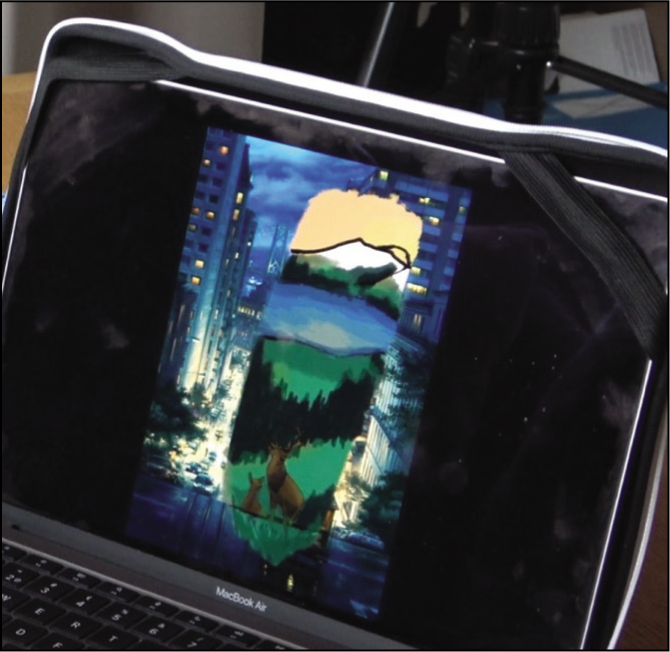
Digital drawing applications are used to make digital pictures and drawings but can also be involved in painting on canvas or paper. In the first interview extract, 16-year-old Maria shows the interviewer two pictures, one on her laptop and one painting on canvas. The digital picture (Figure 1) depicts a city with a contrasting nature vignette in the middle. The vignette depicts a couple of deer and greenery in the foreground and mountains in the background, while in the far background is a busy cityscape filled with buildings and traffic. Maria explains the connection between the two pictures and the order of making them.
Maria shows the digital picture on her laptop (Figure 1) and tells the interviewer that this is preparatory work, it is a sketch preceding the painting on canvas (Figure 2). She explains that she used the digital picture to test an idea because experimenting directly on the painting would risk damaging it. Maria explains that she first drew a city, but then got an idea to place a brushstroke in the middle which would show the nature that had been there before the city was built. Explaining why she did not make the same brushstroke on the painting, Maria says that she was very pleased with the painting and intends to keep it unchanged for a few years, or at least a few months (line 8). These timespans strengthen the impression that she is really satisfied with the painting. However, Maria also says that she may get tired of it and adjust and repaint it. It could be argued that, to Maria, picture-making is a process in which the pictures are not necessarily seen as finished and finalized, but are rather an ongoing process, as pictures can be changed and adjusted in the future (Excerpt 1).
Participants: Maria (16) and Interviewer (Int).
Maria’s Digital Picture on the Computer. Copyright Maria.
Maria’s Painting on Canvas. Copyright Maria (Excerpt 1).
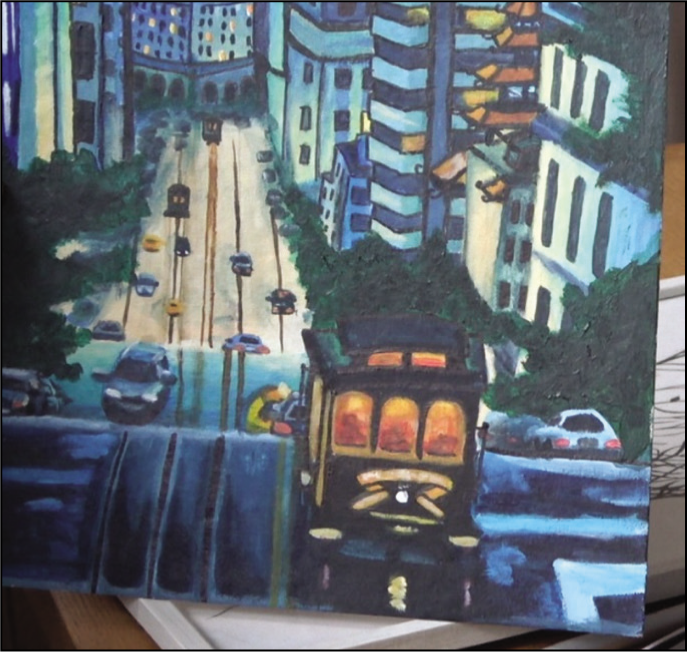
This example illustrates that digital applications make it possible to significantly alter pictures by adding or removing layers, while making changes to a painting may damage it, and they are not easy to reset (lines 3–4, line 30). When the interviewer asks what she meant by damaging the picture, Maria replies that the risk is that the painting would look flat, lacking contrast, details and depth. She points to the green part of the digital drawing (Figure 1) and says that it should not look as flat as it does and that she would have to work more on the details to reduce the contrast between the brushstroke and the background. She concludes by saying that one day she may add the nature vignette to the painting, but that she is really pleased with the painting as it is and will not make any changes now.
Maria positions herself as visually literate through her use of art concepts (e.g., depth) and displays an awareness of the challenges involved in achieving an idea in different formats. It could be argued that she displays herself as competent in making both digital and analogue pictures. She does this by making a clear distinction between experimental, preparatory work (digital picture) and the more finished piece (analogue painting), and by identifying weaknesses in her pictures and ways of amending them. This example demonstrates the opportunities to experiment, test and visualize ideas that digital tools make accessible. It also shows that digital and analogue tools are intertwined in practice—in this case, they complement each other. Here, the digital picture functions as a rough draft that can be easily moulded and changed, whereas the painting is seen as a more permanent outcome. When Maria talks about creating pictures, she displays competence in both creating pictures and using digital technologies as a resource.
Displaying Adjustment
The young people in our data use digital drawing tools in different ways and for different purposes. The previous example illustrated using digital tools to experiment with ideas, and in Excerpt 2, we focus on how 13-year-old Penny talks about the advantages of digital applications. In this interview excerpt, Penny plays a time-lapse video of her making a digital portrait of her grandmother. The digital illustration application makes it possible to create a screen recording of the actions and changes taking place. In the transcript, the interviewer and Penny are seated at a writing desk, when Penny directs attention to the tablet and starts the recording of the drawing process, condensed into an approximately 1-min video clip.
Immediately before the start of Excerpt 2, Penny’s mother suggests that she shows the interviewer how she used the application procreate to draw a portrait of her grandmother. 2 Penny immediately orients to the tablet, where she has a photograph of her grandmother, before opening the digital drawing file. The screen becomes split in two, one half showing the photograph, and the other Penny’s drawing, made in red pencil. Then, the drawing disappears, and the recording of the drawing process starts. On the screen, no pencil tip or pointer is visible, just the lines as they appear and disappear.
Participants: Penny (13), Interviewer (Int) and Penny’s Mother.
Penny tells the interviewer that this application makes it possible to see how the sketching was accomplished (line 5). It should be noticed that Penny uses the word sketch, indicating that the drawing is not yet finalized. However, the first reaction from the interviewer is to suggest the potential for fun and learning (line 7). Penny does not comment on the suggestion that recording is a pedagogical tool that may improve her drawing, but she aligns with the interviewer about the function being fun. She then positions herself as a competent user by underlining that the main advantage of the application is the ability to adjust everything (lines 9–10). In this turn, Penny switches from talking about her own drawing to talking about how ‘man’, here translated as ‘you’, meaning people in general, may experience the application. She directs attention to the screen and shows how ‘you’ can adjust parts of the drawing instead of erasing them: as the recording is playing, she makes a movement above the screen with the stylus, showing how one can ‘push up this line’. As she points at the tablet, the nose in the recording moves up slightly (line 12), which Penny directs attention to by saying ‘as you see, here I moved the nose’ (line 13). This underlines how the tool is used, as well as her competence in relation to composition, human anatomy and proportions. In short, being able to make adjustments is first presented as good (line 9), then Penny demonstrates how she used this function, and finally, she concludes by using a superlative and saying that the function in general is ‘very positive’ (line 13).
The correction of the nose in this picture, as well as moving and hiding parts of a picture, is possible thanks to drawing in layers. Penny explicitly points this out and says that drawing in layers makes it possible to easily take several steps back when a picture is ‘overworked’ (lines 14–16). She says this while pointing at the recording, where the bright red colour of the shirt quickly appears and disappears several times and is then replaced by a more translucent hue (line 16). Thus, Penny highlights what could be called flexibility as an advantage of digital tools. Flexibility means being able to undo and redo the previous action, as well as to move an entire section of the picture. Penny compares this to drawing an analogue picture, where ‘going back’ and erasing would have been ‘difficult’. The flexibility and malleability of digital pictures partially rely on the functions offered in the application—moving a nose in an analogue portrait would be difficult or impossible without damaging the rest of the picture. But even more so, it relies on making ubiquitous actions and adjustments easier and faster. In the application, actions such as erasing and removing, undoing and redoing can often be achieved with a few clicks. It could thus be argued that digital tools enable flexibility in the drawing process.
Displaying Improvement
Digital tools make it possible to adjust, improve and redo parts of or the entire picture. Despite this, it can be seen in the data that the young people also chose to redraw the same image from scratch. The Excerpt 3 is from the interview with 16-year-old Tina, who demonstrates two versions of the same portrait that were made one year apart. Rather than reworking the older version of the digital portrait, Tina made a new digital drawing from scratch. Displaying visual-digital literacy, Tina identifies weaknesses in her previous drawing, pointing out and naming the aspects and techniques that she has improved on in the recent version. Before this part of the interview begins, the interviewer has just asked Tina how she organizes pictures on her computer.
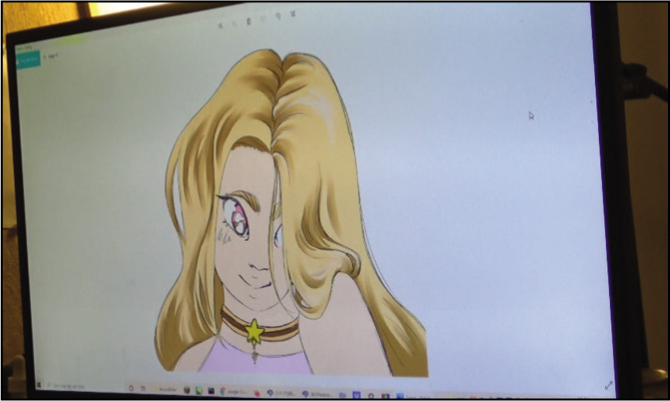
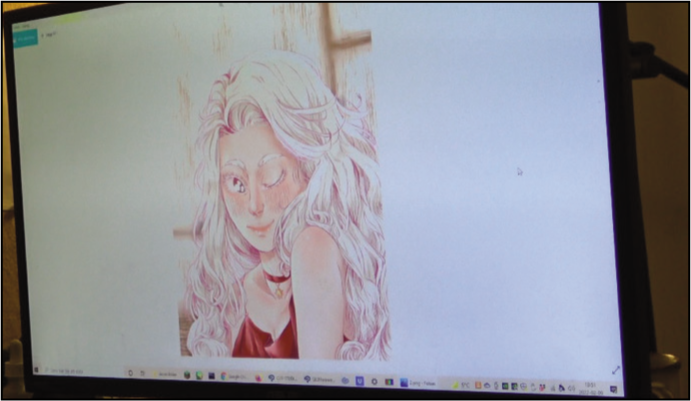
Tina has just opened a folder containing many different pictures. She tells the interviewer that it is fun to look at older pictures and that most of the pictures in the folder are indeed older. Thus, she tells the interviewer that creating digital pictures is an activity she has been pursuing for a long time, which may indicate that she knows how to do it (lines 1–2). Then, she opens a file and shows a picture (line 3, Figure 3), explaining that she made it some time ago, but is unsure when, which also strengthens the impression that she has been working with digital pictures for a long time. However, Tina tells the interviewer that, at some point, she noticed this particular drawing and decided to redraw it the following year. She points to Figure 4 (line 9) and says that it is fun to see how she has improved (line 8).
The interviewer asks Tina to say something about what she considers to be the biggest improvements. Tina places the two pictures (Figures 3 and 4) next to each other on the screen, comparing them. Here, she uses the side-by-side comparison as a tool to visualize change and the development of her drawing skills. Tina starts the comparison by highlighting weaknesses in the first picture. She points to the anatomy and shadows, specifically mentioning the hair, facial features and necklace (lines 15–25). Strengthening the impression of improvement, she stresses that it is possible to see that a child drew the necklace (lines 16–17). This may suggest that Tina sees herself as a child when she draws the picture, which she is not anymore. But it could also be a way to name a lack of drawing skills or visual competence. Then, Tina lists features in the second picture that she considers to be improvements (Figure 4; Excerpt 3). The anatomy of the girl in the picture ‘works’, meaning that it is closer to realistic human proportions, and Tina singles out the proportions of the shoulder and neck, and the placement of the facial features to illustrate this. She specifically names these as ‘skills’ (line 29) that help her to achieve realistic proportions and make the recent drawing more accomplished than the older one. Talking about and highlighting weaknesses and improvements, she simultaneously displays visual competence by using terminology such as ‘anatomy’, ‘lines’, and ‘shading’.
Participants: Tina (16) and Interviewer (Int).
Tina’s Earlier Digital Portrait. Copyright Tina.
Tina’s Later Digital Portrait. Copyright Tina.
Redrawing is a different activity from improving and adjusting already-existing pictures, as illustrated in Excerpt 3. For example, it produces at least two pictures that can be placed side-by-side for comparing and contrasting. Tina displays herself as visually and digitally competent through her way of highlighting and talking about the improvements in her pictures, skills and drawing style. She uses the side-by-side comparison as a tool to make the differences visible and identifiable and employs vocabulary that is common in visual art practice but also tries to put into words features that are more elusive and difficult to pinpoint.
Discussion
Scrutinizing young people’s use of digital technologies in the creation of digital pictures gives a more nuanced understanding both of how this picture-making process looks like (e.g. Drotner 2020; Sakr et al., 2016) and the visual-digital literacies that are required (e.g. Cannon et al., 2018; Jewitt & Kress, 2003). Picture-making is a leisure activity that occupies much of young people’s time: the young people interviewed in this study draw before and after school, at home and during vacations. Completing a digital picture can take anything from a few hours to several days. Picture-making emerges as an ongoing process, and pictures are seen as never fully finished but something that can be modified, revisited and re-evaluated at a later date. A considerable amount of the time spent making and remaking digital pictures goes into practising one’s visual perception and competences in handling digital tools, which we have explored in this study as visual-digital literacy.
Young people continuously relate digital to analogue picture-making, drawing parallels and comparing the tools used and the skills necessary to make pictures in these different formats. This suggests a complex relationality between how digital and analogue tools are used in young people’s visual-digital practices, which helps us to problematize the boundaries between the two. Digital tools do not necessarily replace analogue ones; rather, the participants seem to use both to differing extents. Digital and analogue tools are used in complementary ways; for example, when a digital picture serves as a rough sketch for a later painting on canvas (Excerpt 1). However, the participants emphasize that digital tools require different competences and skills than analogue ones. As Penny’s story, quoted at the beginning, shows, the skills of drawing on paper are not directly transferable to making digital pictures (see also Excerpt 1). It is a recurring theme in these young people’s talk that acquiring competences to make digital pictures requires hours of practice, experimenting with the tools on one’s own and sometimes learning from others, including friends, family members and online resources.
A central aspect of visual-digital literacy is becoming familiar with the digital applications, and the functions and possibilities that they offer (Aarsand & Melander Bowden, 2020; Jewitt & Kress, 2003). Freedom to experiment, low stakes when the experiments do not go as planned, and subsequently being able to teach oneself to draw are the key advantages that digital tools provide, according to these young people. Digital illustration applications offer a variety of functions that enable flexibility. Mixing and replicating colours, zooming in and out, cutting and pasting, moving parts of the picture and undoing are functions that were repeatedly mentioned in the interviews. When describing these functions as advantages, the participants further display visual-digital literacy by contrasting them with analogue picture-making. There, removing a layer, for example, may require time and effort and is sometimes not possible at all (Excerpt 2). At the same time, the young people also mention rarely using or being unfamiliar with most of the wide variety of functions provided by the applications. Instead, they talk about using several selected functions; for example, a few brushes from the entire range of shapes and sizes available. In this way, they set their own boundaries among the possibilities provided by the applications and make these tools their own.
Another aspect of displaying visual-digital literacy can also be pointing out the limitations of digital applications. Young people accomplish this by, for example, comparing two versions of the same motif or the final picture with an earlier sketch. As seen in Excerpt 1, Maria explains what her idea of placing a nature vignette in the middle of the picture could look like in the painting, compared to the digital picture. Competence and skill are required to be able to identify and verbalize what is and is not possible to accomplish using digital tools, and the visual effects this could produce; for instance, knowledge about the proportions of the human body, light and shade, line effects and perspectives, and how these can be achieved in a particular application (Excerpt 3).
At this point, it is worth reflecting that the data collection method has shaped our approach to visual-digital literacy as being displayed primarily verbally, together with some embodied actions, such as gaze, pointing or zooming in on a section of a picture. Thus, it is important to note that those young people who are studying an arts major at school and fluently use art terms verbally display greater visual-digital literacy. In contrast, young people who do not have such a background, or are neurodivergent, may display visual-digital competence in non-verbal ways. Other methods that rely less on talk could be used to gain an insight into this.
This study aimed to examine how young people use digital illustration applications in their everyday leisure practices of making digital pictures. We have focused on young people’s picture-making in their spare time, a kind of unstructured solitary leisure that is sometimes referred to as casual leisure (Mukherjee, 2020). This leisure is often self-initiated and free-form, and young people have a say in what pictures they create, when, how and with whom. These pictures may be influenced by visual cultures such as other pictures, film and TV that young people consume, music and computer games and in this way are a clear part of their wider leisure cultures. Thus, the current study makes an important contribution to the research on young people’s DIY cultures, leisure and digital leisure specifically (e.g. Bruselius-Jensen & Sørensen, 2021; Deshbandhu et al., 2022; Valtchanov & Parry, 2017; Sparrman, 2019) and visual and digital literacy (e.g. Aarsand & Melander Bowden, 2020; Dmitrow-Devold, 2017).
Footnotes
Declaration of Conflicting Interests
The authors declared no potential conflicts of interest with respect to the research, authorship and/or publication of this article.
Funding
The authors disclosed receipt of the following financial support for the research, authorship, and/or publication of this article: This work was supported by the Swedish Research Council, Riksbankens Jubileumsfond and Kungliga Vitterhetsakademin, (grant number 2020-03095).
Appendix
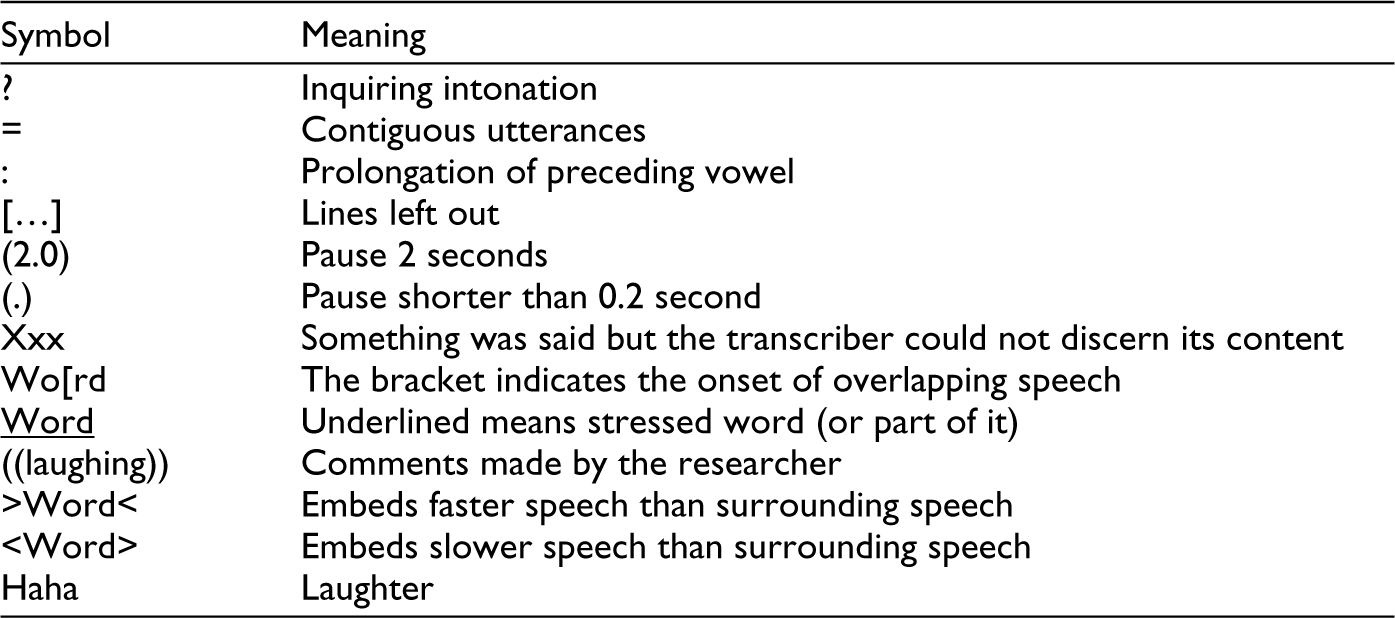
| Symbol | Meaning |
| ? = : […] (2.0) (.) Xxx Wo[rd Word ((laughing)) >Word< <Word> Haha |
Inquiring intonation Contiguous utterances Prolongation of preceding vowel Lines left out Pause 2 seconds Pause shorter than 0.2 second Something was said but the transcriber could not discern its content The bracket indicates the onset of overlapping speech Underlined means stressed word (or part of it) Comments made by the researcher Embeds faster speech than surrounding speech Embeds slower speech than surrounding speech Laughter |