




Abstract
In this article, the research aim was to reconstruct the political characteristics of the discourses of four youth organizations operating in Poland in three intertwined dimensions: content, structure and time. In the content dimension, by using the analysis of the discursive strategies, the focus was on political goals and political features of collective identities. In the structure dimension, by using the analytical tool provided by discursive institutionalism, the internal dynamics of discourses were explored. In the dimensions of structure and time, an attempt was made to capture the discursive change as a reaction to the war in Ukraine. Over 700 texts posted by the organizations’ websites or Facebook pages were analysed. Three types of discourses were identified, which show various ways of representing political objectives and collective identities. Furthermore, all of the discourses reacted to the war in Ukraine. The results show the scope and dynamics of such changes.
Keywords
Introduction
The question about the political character of youth organizations primarily requires the identification of what is considered political and what is not. Studies attempting to capture the youth perspective identify two basic ways of understanding it: (a) Narrow (dominant) – limited to being a member of a party, working for/being involved in it; or (b) Broad –covering all actions that result from a critical assessment of the political and social reality, aimed at changing the prevailing situation (Mascheroni, 2017; Pirk & Nugin 2016; Sveningsson, 2016; Vromen et al., 2015). The self-identification of political actions can also be linked to a negative attitude towards political involvement which is understood narrowly, apart from the way in which such actions are defined (Mascheroni, 2017). The characteristics of such involvement include dogmatism, fanaticism (Sveningsson, 2016), insincerity and opportunism (Pirk & Nugin, 2016). The studies by Sveningsson (2016) revealed that even persons who belong to or work for the cause of a political party or organization can also consider themselves as not politically involved. The question of what is considered political and what is not from the perspective of youth is complicated. In this research, I try to capture the political dimensions of selected youth organizations based on their websites and Facebook pages. I focus on two related discourse categories closely linked to a concept of citizenship: the organizations’ objectives (OOs) and the collective identity (CI) constructed by them. I therefore pose the questions: What political characteristics are present in the discursive construction of the OOs and CIs? How does this construction of OOs and CIs change at different levels of discourse? What are the dynamics and scope of change in a situation of increased levels of threat since the outbreak of the war in Ukraine? Empirically, I address these questions by looking at what political objectives are articulated on the programmatic level and the relationship between these objectives and the OOs, as well as the CIs constructed on the ‘policy solutions’ level. Additionally, I examine whether these discourses have changed on the ‘policy solutions’ level since the outbreak of the war. I presume that the response to the last question will enable one to discern the links between this change and the nature of the organization, as well as the corresponding discursive concept of citizenship.
Focusing on the political character of youth organizations operating in Poland is interesting because of the very context in which they function. The article contributes to the discussion about the discourse construction of citizenship of young people in the context of the challenges and the changing political situation in Europe and worldwide.
Basic Assumptions
The political dimensions of discourse referred to in this article are composed of: (a) content, (b) structure and (c) time.
The content aspect is formed by two selected discursive categories that provide the basis for assessing the political characteristics of youth organizations: OOs and CI. Both categories are closely linked to a concept of citizenship represented in the discourse of organizations. It is worth emphasizing at this point that citizenship is understood here as a construct created largely by norms and standards, practices, meanings and identities rather than one that has a formal and legal dimension (Isin & Turner, 2002; Isin et al., 2008). Citizenship has a political character and is differentiated by identity, social positioning, cultural assumptions, institutional practices and a sense of belonging (Werbner & Yuval-Davis, 1999). Specific concepts of citizenship result from defined policies that distinctly perceive the role of an individual in the state, the supranational or post-national community, or in a global society. In any case, the concept of citizenship results from the needs of the socio-political order that is to be reproduced (Biesta, 2009, p. 150). This pertains to ‘fabricating identities’ (Popkewitz & Lindblad, 2000) and ‘making loyal citizens’ (Tröhler, 2016).
CI as a key category of citizenship signifies a common awareness and recognition of the fact that the members of a group share the same social identity (Ashmore et al., 2004).
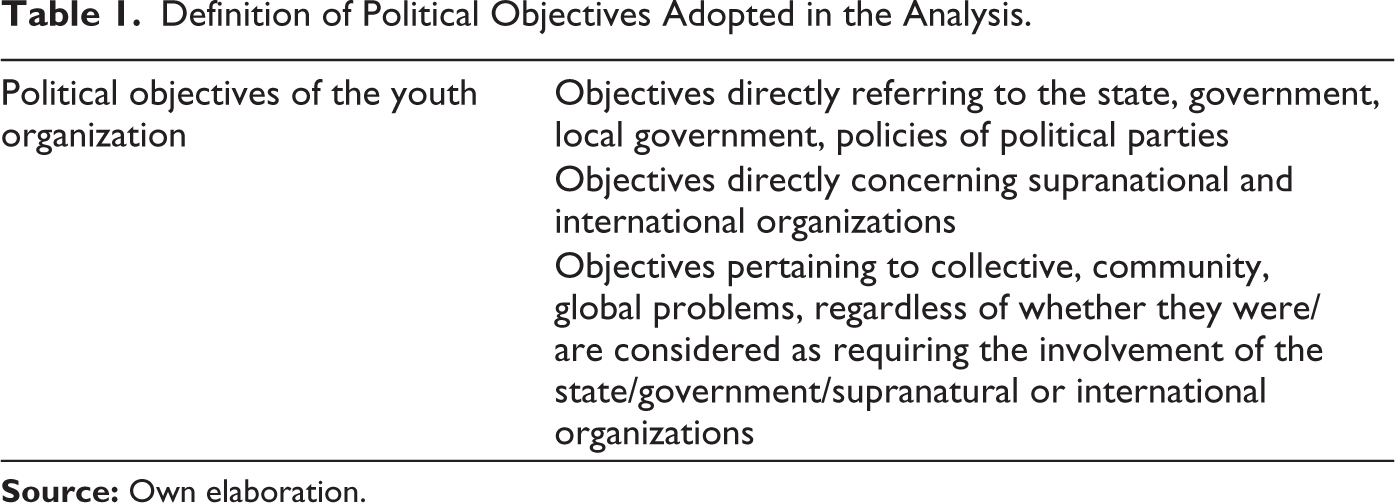
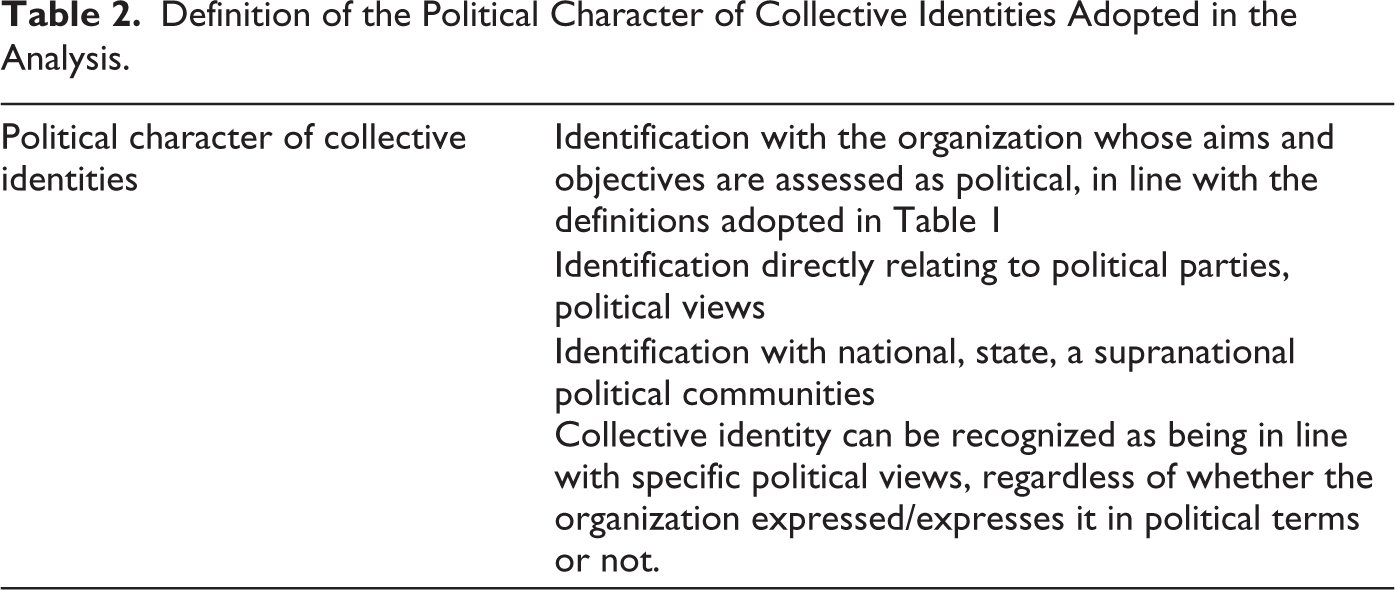
In this research, I adopt a broad definition of the political characteristics of OOs and CI. The inspiration behind it was the definition of political participation presented by Van Deth (2014). Based on ‘targeted definitions’ of political participation (Van Deth, 2014, pp. 355, 357–358), it can be inferred that political objectives are those related to government, the state and politics, as well as those related to solving collective and community problems. Taking into account Hooghe’s (2014, pp. 340–341) critique of Van Deth’s conception, I recognize that many contemporary collective problems go beyond the level of a particular state and government, are global in nature and require the involvement of multiple governments to solve them. For this reason, political goals are also linked to the activities of supranational and international organizations. It is not necessary for these objectives to be defined as political by the organization (Hooghe, 2014, pp. 339–340). The question of intention and the articulation of this intention is sometimes complicated and does not determine whether certain objectives will be considered political or not. As a result, it is more relevant that a given goal is collective in nature and that state or supra-state engagement is needed to solve it rather than whether an organization articulates it (Table 1). The definition of the political character of CI is also defined while taking into account the above comments. It is therefore about identification with certain political views, regardless of whether these views are held by the organization as political. Furthermore, the political character of CI is also about identification with political communities, both at the national, state and international levels. Finally, the political character of CI is built through identification with an organization whose goals are considered political (Table 2).
Definition of Political Objectives Adopted in the Analysis.
Definition of the Political Character of Collective Identities Adopted in the Analysis.
I am conjecturing that youth organizations are an example of groups that, on the one hand, give a sense of belonging and produce intra-group CIs and, on the other, have specific objectives, adopt defined values, take specific actions and go beyond the CI of the in-group, reproducing defined constructs of citizenship. I am premising that a discursive approach will help explain what assumptions are represented in discourse, what meaning is attributed to them and how they are being changed. According to Schmidt (2008), this approach allows insight into the dynamics of institutional changes, revealing how the concepts produced in discourse are represented and explained and how they change on various levels. And this is the second aspect of analysis contributing to the political dimensions of youth organizations’ discourse – the structure dimension aspect. Schmidt (2008) identified three levels of forming political ideas: philosophies, programmes and policy solutions (pp. 306–308). The ‘public philosophy’ is a level of background ideas that are often not articulated, taken for granted and rarely questioned (Schmidt, 2008, pp. 306–307). The programmatic level concerns ‘programmatic beliefs’ that operate in the space between worldviews and specific policy solutions (Schmidt, 2008, p. 306). This is the level of foreground ideas that create the legitimizing framework or indicate the ways of solving various problems (Schmidt, 2008, p. 307). The last level encompasses the ‘policy solutions’ proposed by policymakers (Schmidt, 2008, p. 306). In my view, the differentiation between these levels has analytical potential. I focus on two of them: the programmatic level and that of ‘policy solutions’. In the case of my research, the programmatic level includes OOs officially declared in statutes and ideological statements, which provide a legitimizing framework for the organization’s activities. On the ‘policy solutions’ level, on the other hand, the OOs and CIs are reconstructed from the everyday discourse of organizations. The aims set at the programmatic level can be modified at the level of ‘policy solutions’.
The third aspect that constitutes the ‘political dimensions’ in the study is that of time. However, this is not just about the passage of time but the occurrence of some critical event that has the potential to alter the political characteristics of the discourse. According to Yuval-Davis (2006, p. 202), the emotional components of identity as a rule become more central the more threatened and unsafe people feel. Therefore, situations interpreted as threats may be reflected in the discourses forming CIs. War, but also a sense of threat of war as well as experiencing its direct effects, are emotionally charged. Russia’s invasion of Ukraine on 24 February 2022 gave rise to an elevated sense of threat among Poles. In March, an opinion poll revealed that 85 per cent of Polish respondents think that the war in Ukraine is a threat to Poland’s security (CBOS, 2022a); this sense of threat dropped slightly in April, but even so, was still high (79 per cent) (CBOS, 2022b). During the first month, 2 million people had already crossed the Ukrainian-Polish border (KGSG, 2022). Many Poles had and still have direct contact with crisis-afflicted people coming from Ukraine who fear for the safety of their loved ones, often having gone through traumatic events themselves. According to March 2022 data, 68 per cent of the respondents declared that they had helped Ukrainians in one form or another (in kind or financially) (CBOS, 2022a). I assume, therefore, that the outbreak of war in neighbouring Ukraine is a situation that could potentially modify the discourse of youth organizations, especially on the ‘policy solutions’ level. I conjecture that an emotional reaction will not result in an immediate change in OOs at the programmatic level (this kind of change probably takes time). It may lead, however, to the exposure of specific OOs and, above all, modify to a greater or lesser extent the everyday discourse of an organization.
The three political dimensions of analysis (content, structure and time) identified above are intertwined. The content dimension is central to inferring the political features of the organizations’ discourse. The structure dimension provides an insight into the internal dynamics of a discourse, allowing a fuller reconstruction of its features. And the time dimension, together with that of structure, allows one to perceive a possible change caused by a critical event.
Materials and Methods
The research material constituted the entire content (646 texts) produced in 2018 by four youth organizations in Poland and posted on the organizations’ websites and Facebook (statutes, ideological declarations, declarations, newsletters, annual statements as well as information and entries posted). In order to capture the possible change in the discourse of an organization after the outbreak of the war in Ukraine, all the Facebook posts within two months of the start of the war (from 24 February to 24 April 2022), which referred in any way to Ukraine and to the war, were analysed. In the case of one organization (NRC), all its posts on their website were analysed since it was banned from Facebook in 2018. A total of 67 texts were thoroughly analysed in this part.
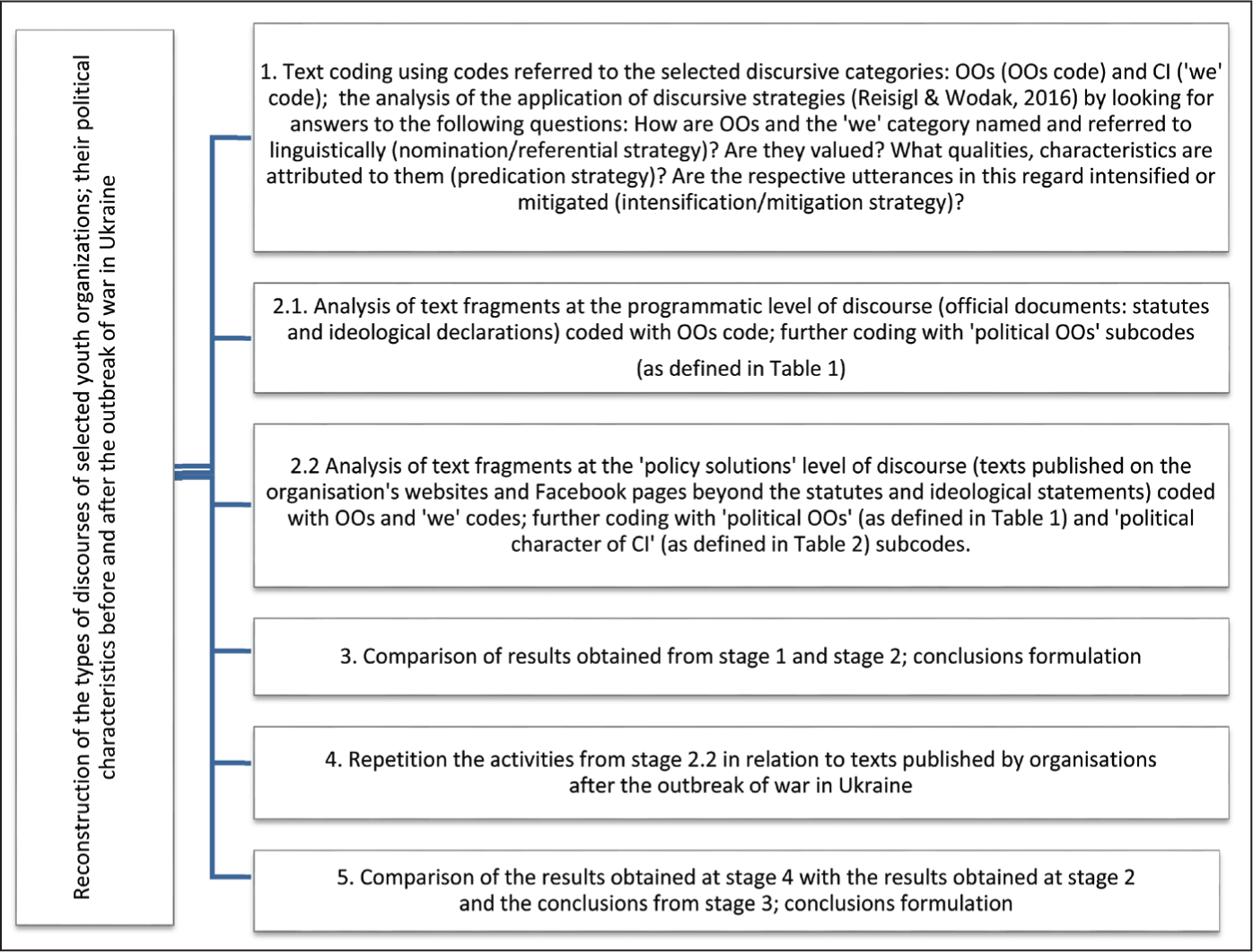
The applied method of analysis is critical discourse analysis, specifically the approach by Wodak and Reisigl. I researched the application of discursive strategies, that are ‘[…] a more or less intentional plan of practices including discursive practices adopted to achieve a particular social, political, psychological and linguistic aim’ (Reisigl & Wodak, 2016, p. 33). The procedure to be followed during the analysis is shown in Figure 1.
Steps of Analysis.
The selection of the youth organization was purposeful. Two criteria were applied: status and visibility in the press. The first stage involved the selection of two organizations belonging to the Polish Council of Youth Organizations that were also NGOs. There were: AIESEC Poland (AIESEC) and ATD Fourth World Poland (ATD). In stage two, the criterion of the visibility of the organization in the press was applied. An analysis of five national dailies and three weeklies revealed that the most commonly appearing youth organizations in 2018 were the All-Polish Youth (in Polish: Młodzież Wszechpolska – MW) (APY) and the National Radical Camp (in Polish: Obóz Narodowo-Radykalny – ONR) (NRC). As a result, the selected organizations are very diverse. APY and NRC are nationalistic Polish organizations strongly oriented towards the construction of a national identity, while AIESEC and ATD are branches of large functionally oriented international organizations. This variety of organizations also makes it possible to expect differences in terms of discourse regarding OOs as well as CIs. In the case of the first two organizations, for example, one can expect state-related objectives, while in the case of the other two, one can expect globally oriented ones.
Findings
An analysis of the texts published by the four youth organizations allowed three types of discourse to be identified, differing in all three dimensions: in the scope of political objectives articulated on the programmatic level, their translation on the ‘policy solutions’ level (content + structure dimensions) as well as the scope and dynamics of changes in reaction to the war in Ukraine (content + structure + time dimensions).
From Serving the Nation to Universal Militarization
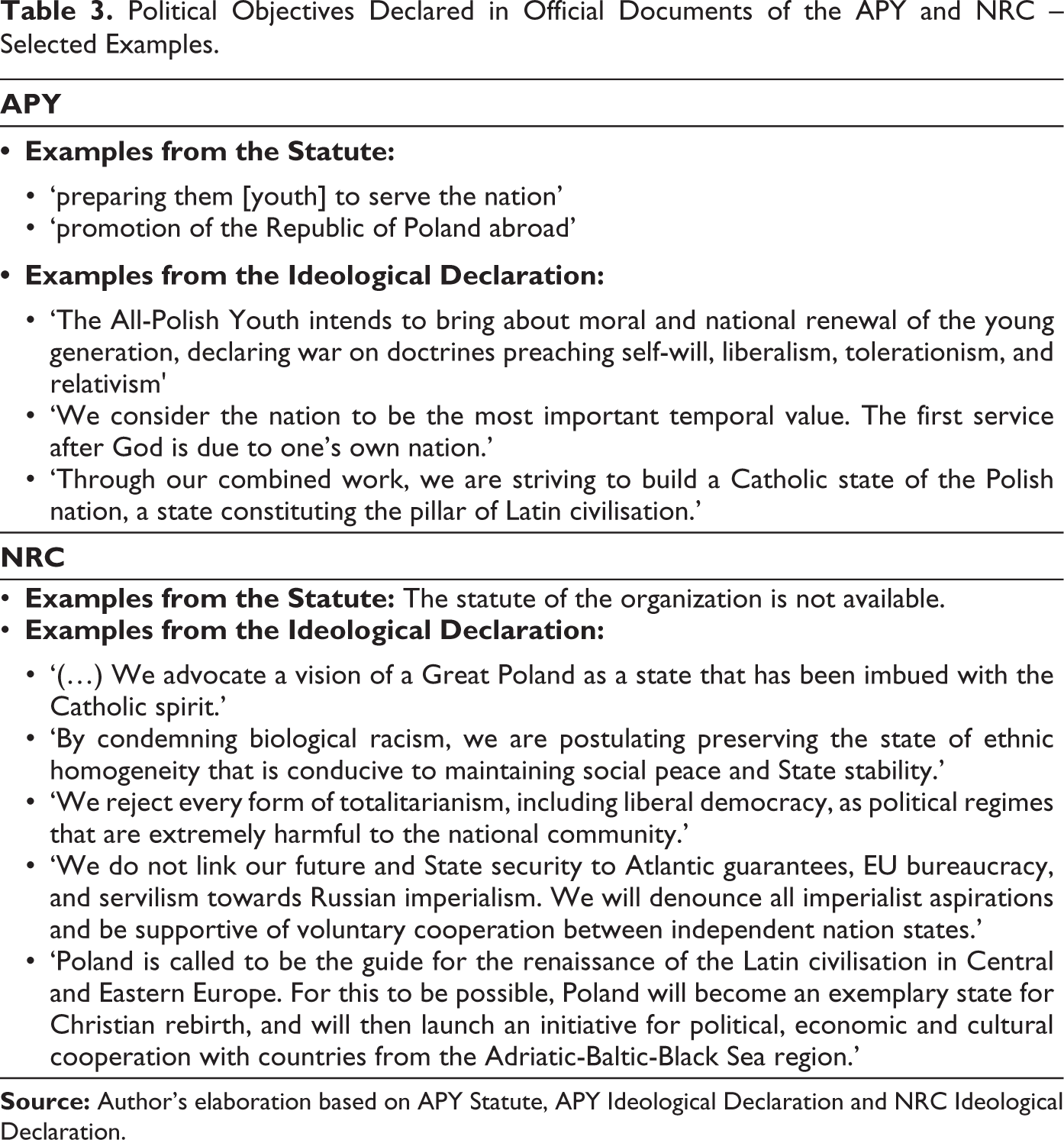
On the programmatic level, two of the four studied organizations construct objectives directly referring to the state, political party policies, state foreign policy and supranational organizations. This applies to two Polish nationalist organizations: the APY and the NRC. Membership in the APY is open to persons from 16 to 30 years of age who have Polish nationality and who accept national and Catholic values (26:9_APY_Statute_APY 1 ). The APY considers itself to be the continuator of an organization that was established in Poland in 1922: the All-Polish Youth Student’s Union (in Polish: Młodzież Wszechpolska – Związek Akademicki), the largest nationalistically-oriented student organization in Poland during the interwar period. The NRC refers to the pre-war fascist political grouping which was banned on 10 July 1934 after three months of operations. Both organizations are known in Poland, mostly because of the Independence Day March that is held annually in Warsaw on 11 November (Reuters, 2021, November 11). None of these organizations consider themselves to be a party or a party youth wing, but both have ideological declarations. Table 3 shows a few examples of the objectives of the organizations that refer directly to both the internal and foreign policy of the state, indicating a hostile attitude to different political views and to supranational alliances.
Political Objectives Declared in Official Documents of the APY and NRC – Selected Examples.
How is this discourse constructed on the programmatic level translated on the ‘policy solutions’ level? Memory discourse, shaping national identity and patriotic attitudes definitely dominate here. The discourse is dominated by accounts of actions connected with celebrations of different kinds of historical event anniversaries, commemoration of victims, looking after places of historical memory and cultivating heroes, especially those linked to national movements or even referred to as the ‘Fathers of Ideas’. This is a discourse that is perfectly in line with the political objectives that, on the programmatic level, are referred to as ‘preparing young people to serve the nation’ (26:4_APY_Statute), an education that has been ‘imbued with the national spirit’ (149:46_NRC_Ideological_Declaration). References to the Polish state, the Polish nation and its history and traditions are characteristic of this discourse. This type of discourse matches the way that CI is constructed. Apart from a strong identification with the organizations themselves built discursively using the clearly dominant representation of social actors as a homogeneous group, an identification with the state and national community is visible here (e.g. Poles, our nation), with groups with specific political views (e.g. ‘nationalists’, ‘catholic and national youth environments’), but also with non-existent communities (e.g. we-‘true Europe’, we-‘the wardens of the foundations of our civilisation’), discursively created to expose their own value exceeding beyond the boundaries of the country, constructing self-glorification and uniqueness. It is precisely uniqueness, understood as exceptionalism and exclusivity, that constitutes the most important predicate for constructing the CI of these organizations. In addition, there is strength, understood as physical strength, as well as striving persistently to achieve objectives and also defending ideologies. CI constructed in this way is intensified by a negative image of others or out-groups. Thus, not only is the organization’s exceptionalism and uniqueness important here, but also the fact that this exceptionalism is constructed using negative predication and even a hostile image of others. Hence, the point is not to expose the organization’s own strength or power but to construct it as a key weapon in the fight against ‘harmful’ ideologies, in fighting against ‘barbarianism’ and ‘cultural Marxism’. The enemy comprises Jews, Ukrainians, the United States, the EU, various political parties, the Polish government, but also the ‘progressive’ West. The nomination of enemies and hostile ideologies is present not only in the discourse that constitutes CI but also in the texts referring to the actions of the organizations underpinning the reconstruction of their aims and objectives. This particularly applies to anti-abortion, anti-LGBT and anti-immigration pickets.
In the case of both organizations, the analysis of the discourse in response to the outbreak of the war in Ukraine is particularly interesting, as both organizations repeatedly negatively predicate Ukraine, Ukrainians, the Ukrainian government and its policies in the analysed texts from 2018 (excerpt 1).
(1)
The Ukrainian authorities have yielded up their historic policy to the complete control of neo-Banderovite circles that use all the right-wing and institutional powers to glorify persons and movements of a genocidal, anti-Polish nature (10:13_APY_NRC_Change_the_policy_towards_Ukraine_–_declaration_of_national_organisations_07-03-2018).
This is an example of the implementation of one of the regular points on nationalist organizations’ agenda, which is the resolution of contentious historical issues. Unfortunately, it also occurs in the case of Polish-Ukrainian relations. This makes the way these organizations respond to the war even more interesting.
The level of activity of both organizations in producing texts in reaction to the arising political situation varies. In the analysed period, the NRC posted five texts in reaction to the war, the APY-41. There are topics common to both organizations: (a) the postulate of the militarization of Poland and (b) the protection of borders against unwelcome immigrants who will want to ‘abuse’ the fact that the borders are open to the Ukrainian population.
The war on the other side of Poland’s eastern border is referred to as a threat by both organizations. Not only is this in reference to the proximity of the conflict but also to ‘Russian imperialism’, it is about treating sovereign states by great powers as ‘pawns on a geopolitical chess board’ (NRC_Declaration_on_Russia’s_attack_on_Ukraine_25-02-2022). The policy of the US and Ukraine’s former foreign policy (1994 Budapest Memorandum) are also criticized. Consequently, by induction, all these issues lead to the necessity of militarizing the Polish state (excerpt 2).
(2)
[…] We postulate a marked intensification of the military potential of the Republic, among others by increasing the staffing level of combat units, initiating compulsory military cadet training, including training in handling firearms in all schools at secondary level that are run by decommissioned soldiers, increasing the amount of modern military equipment designed for tasks related to the possible defence of the territory of Poland, and stricter actions in relation to environments that have for months been trying to destabilize and ignite our north-eastern border (NRC_ Declaration_re._Russia’s_attack_on_Ukraine_25-02-2022).
The last sentence of excerpt 2 refers to the second of the above-mentioned common topics of discourse produced by the discussed organizations. The outbreak of the war and the opening of the borders to people fleeing the war led to both of these organizations starting to postulate that a ‘precise verification’ of persons should be undertaken to firmly oppose letting into Poland ‘aggressive migrants from outside of Europe’, ‘the princes of the Orient attacking helpless Ukrainian and Polish women’ and ‘taking advantage of the catastrophe of the Ukrainian nation to cause unrest and commit crimes’ (APY_FB_01-03-2022). It is worth noting here that these xenophobic and racist statements are part of the anti-immigrant discourse in Poland (related to the humanitarian crisis on the Polish-Belarusian border) that had been building up for several months at the time in Poland (Umbrasko, 2022).
Apart from similarities, differences can also be seen in the discourses of both organizations. They do not concern with the topics themselves but with their scope, what is intensified and what is weakened in them, as well as the dynamics of their appearance over a certain period of time.
The first such difference can be seen in relation to offering direct help and support to Ukraine. The NRC clearly mitigates this issue. It does not indicate that it is ‘on Ukraine’s side’ but that ‘all the nations of the Intermarum have the right to live in their own sovereign states’ and that it is against Russia (NRC_Declaration_re._Russia’s_attack_on_Ukraine_25-02-2022). The situation is different in the case of the APY, which is clearly ‘taking Ukraine’s side’, ‘supports Ukraine in the war with the Russian Federation’ (e.g. APY_FB_24-02-2022; 01-03-2022; 2-03-2022), but the reasoning refers mostly to the fact that an armed attack against Ukraine is contrary to Poland’s national interests.
The other difference concerns help extend to persons affected by the war. The NRC points to the necessity of extending such help and reports such activities, clearly indicating help and assistance for Poles living in Ukraine (NRC_SubCarpathian_Brigade:_Helping_compatriots_during_the_war_in_Ukraine_2-03-2022). The APY, on the other hand, in its first posts postulates the state taking action to ensure the safety of Poles living in the territory of Belarus and Ukraine (APY_FB,_24-02-2022). However, in subsequent posts, helping Ukrainians is also positively predicated, although helping Poles is discursively intensified (excerpt 3).
(3)
[…] The All-Polish Youth supports the reaction of Polish society and is actively engaging in help provided to refugees immediately affected by the consequences of acts of war. The impressive scale of involvement is proof of the moral strength lying dormant in the Polish nation. […] Let us not forget that our compatriots are an abundant minority living in Ukraine. The assistance of the Polish state should first be directed at them (APY_FB_2-03-2022).
There is a change in the dynamics of the discourse after mid-March, when criticism of the government policy in relation to refugees appears, particularly of the inactivity of the government on the international arena in terms of securing their ‘reasonable relocation’ and, as a result, would protect Poles from such problems as declining numbers of apartments for rent and growing apartment rent prices (APY_FB_20-03-2022). The very legitimacy of the assistance is not being questioned here, but a significant change can be seen in the discourse in the form of discussing the scope and forms of assistance provided to Ukrainian people.
From Individual Development to Striving for Peace
AIESEC is one of the largest student organizations. It operates in over 120 countries worldwide. AIESEC Polska operates at over 50 higher education institutions (491:9-11_AIESEC_About_us). Its membership is open to both students and graduates (up to one year from their graduation or interruption of studies) who are actively involved in AIESEC (28:2_AIESEC_Statute). AIESEC is an organization that declares itself to be apolitical in its statute. However, considering the definition of the political characteristics of the OOs, AIESEC has two objectives of a political nature in its statute: (a) strengthening cooperation and understanding between countries, and (b) broadening knowledge and raising awareness of socio-economic problems. There are no direct references to the state, government, political parties or international organizations in the organization’s statute. The objectives have been phrased in a very general way, are global and undoubtedly require involvement both on the state and international levels. The first of the above-mentioned objectives should be combined with the arguments put forward regarding the establishment of AIESEC around the world. The following statement can be found on its website:
AIESEC was established in the world in 1948 in response to the conflicts present at the time, which were triggered by the Second World War. […] the world needed leaders and the responsibility for a better tomorrow rested with the youth. Since then, AIESEC’s mission has been striving for peace and the fulfilment of humankind’s potential (491:11_AIESEC_ About_us).
Thus, the foundation of AIESEC is clearly linked to the political situation at the time. The mission of ‘striving for peace’ translates into the first of the statutory objectives mentioned above. How do these officially constructed objectives translate into the organization’s discourse on the ‘policy solutions’ level? What political characteristics can be found there? The objectives related to striving for peace are not accentuated in the discourse of the organization. Only three posts that contain direct references to peace can be found among all its texts published in 2018. All of them are related to special days: World Science Day for Peace and Development, International Holocaust Remembrance Day and National Independence Day, which is an important day in the history of Poland.
It is also noteworthy that the ‘pursuit of peace’ is mentioned in AIESEC’s mission alongside ‘the fulfilment of humankind’s potential’, and this is key to understanding AIESEC’s operations. The argumentation can be seen in excerpt 5.
(5)
The mission accompanies us to this day, which is why we pursue it by developing leadership characteristics in young people through practical experiences gained through projects supporting the fulfilment of international exchanges. We believe that the global perspective allows us to gain a much deeper understanding of the world surrounding us, develops communication skills in us with diverse environments, and helps us find solutions regardless of the challenges (491:12_AIESEC_About_us).
Here, personal development is key, whereas the fact that the development of individual competences occurs in conditions of international exchange should, in principle, lead to reaching an agreement in a diversified environment.
The second statutory political objective of the organization is translated in the discourse into promoting the global sustainable development objectives (SDG) (‘AIESEC successively supporting the sustainable development objectives of the UN’ - 42:50_AIESEC_FB_18-01-2018). This can also be assessed in political categories because these objectives were set under the General Assembly Resolution of 25 September 2015 (UN, 2015). It is therefore a political document that responds to important global social and economic problems. It is worth noting that goal 16 of the SDG concerns peace; hence, a relationship with the political objective discussed earlier is evident here.
Based on an analysis of the organization’s discourse referring to the construction of CI, it is possible to conclude that this discourse does not create identification with political and national communities, or supranational or international organizations. However, a direct identification with a ‘citizen of the world’ does appear several times here, and the ‘global’ adjective is primarily referred to both the organization (global organization, global network and global voice of youth) and to all the programmes run by AIESEC. The construction of identification with the organization is visible in the discourse. AIESEC as an organization is predicated positively above all by referring to the scope of actions. However, this discourse is dominated by constructing CI through the aggregation of individuals. This effect is achieved through numerous texts that specify the various actors referred to as AIESECers and/or volunteers. The specifications do not, however, refer to the role alone but often to the names and surnames of the social actors. They are constructed in first- or third-person singular (excerpt 6).
(6)
‘Volunteering in South Korea was the most beautiful adventure of my life’, Martyna Michno (39:56_AIESEC_FB_25-03-2018).
This type of discourse that dominates in the organization’s CI construction not only lacks any references to identifying with state and national communities or supranational or international organizations but also fails to expose the organization’s political objectives. It does not in any way refer to ‘the pursuit of peace’ or ‘strengthening cooperation and understanding between countries’. Social and economic problems appear only as the backdrop of the statements. They are not a central point in CI construction. What is exposed is youth, readiness to act, curiosity about the world, the longing for adventure, the desire to develop, gaining self-knowledge and broadening horizons.
The political characteristics of an organization mentioned earlier are lost in the discourse constructing CI. On the other hand, the way the CI was constructed is clearly in line with an individual, neoliberal, aggregate and consumerist dimension of citizenship (Biesta, 2009).
How has the organization’s discourse changed over the course of the first two months since Russia’s aggression against Ukraine? On the day the war broke out, the organization posted the following content on its Facebook profile:
We stand together in solidarity with our members, friends, families and all those impacted by the recent Russian invasion in Ukraine. AIESEC was created 74 years ago after the Second World War to prevent similar conflicts and foster peace in the world. It saddens us to see the reality we are in today and we are reminded of the importance of young people striving together for a better world, a harmonious world. We stand for peace and so do the leaders that we create (AIESEC_FB_24-02-2022).
Overall, in the analysed period, AIESEC published six posts that can be assessed as a reaction to the war in Ukraine. Only two of these posts refer directly to Ukraine. The remaining refer to peace in general. In my assessment, in view of the time of their publication and the fact that such content did not appear at all in the analysed corpus, they are a reaction to Russia’s invasion of Ukraine. The nature of the first of the analysed posts (excerpt 7) is directly political. It clearly demonstrates the stance of AIESEC in relation to the serious political situation. The second sentence of the post refers to the OO, which, as I indicated earlier, was not strongly exposed in the discourse. This is intensified by subsequent posts. Each of them refers to peace. Peace is positively predicated, and the argumentation is built on the basis of deduction, and referring to such standards as the protection of human rights and economic development. The statements are also intensified by figures. Apart from that, a pattern appears here that allows for a positive predication of peace based on a contrario inferences. This signifies a negative predication of war using arguments that refer to its effects. In this series of posts, there are also references to the United Nations (UN) as an international organization that strives ‘to promote peaceful and inclusive societies’ and to #16 SDG, also emphasizing, through the use of figures, what has already been achieved (AIESEC_FB_04-03-2022). Thus, the threatening situation led to the accentuation of this OO, which, in peaceful conditions, is relegated to the background.
From Access to Rights for the Most Impoverished Persons to the Integration of Refugees
ATD is an international organization that was established in France, and its founder was Józef Wrzesiński, a Catholic priest of Polish descent. ATD operates in over 30 countries, including Poland. Members can be persons who have come of age and must provide a written recommendation of two members of the organization and submit a membership declaration. (506:2_506:29_ATD_Who_we_are). The operations of the ATD are focused on one main objective: overcoming extreme poverty and social exclusion. This is a political objective, as it refers to social and global problems and is discussed at various political levels, from local to international. The organization itself, articulating its statutory objectives, does not refer to the state, government, local government, or policies of political parties, supranational and international organizations. However, through the phrasing of the ways of executing these objectives in the statute, it also points to cooperation with government and local government institutions. How is this generally phrased statutory objective translated into the OOs in the discourse that extends beyond the statute? The political characteristics of this organization can be clearly identified. First, the ATD emphasizes the importance of the problem that it is dealing with by referring to a standard, specifically the protection of human rights. Second, the presentation of the actions undertaken by the organization entails a criticism of the current political and legal solutions, accentuating the importance of a multidimensional analysis of the situation (excerpt 8).
(8)
Despite our knowledge and experience, we are still overlooked in social dialogue and in policy creation. […] We know this system from the inside and we know which practices help us out in our work and which make it more difficult, which provisions of the law are outdated and absurd. […] We carry out research, develop scientific studies; we know which solutions are being implemented in Poland and in the world (63:30_ATD_Main_assumptions).
Thirdly, the organization is aware that specific actions require political changes (excerpt 9).
(9)
The Wrzesiński workshops are a series of meetings where we try and discuss the problems of poverty and social exclusion, drawing from knowledge and experience entailed in the texts of the founder of the ATD Movement, Rev. Józef Wrzesiński. […] The discussions are often about current events, planned changes in social policy, and an understanding of the situation that the poorest people find themselves in (63:9_ATD_Main_actions).
Fourthly, the organization is also planning specific actions aimed to bring about system changes. Such actions include the initiative of appointing a Social Rights Ombudsman who would also be tasked with protecting the interests of the most impoverished (excerpt 10).
(10)
A draft of a petition to the Senate informing of the idea of introducing an ombudsman in the scope of social assistance was prepared as early as in 2018. In 2019, together, we are planning on analysing the results of the poll, specifying the profile of the ombudsman, setting out the lobbying strategy, and working on the wording of the petition to the Senate Committee and the local governments (64:51_ATD_2018_Report).
As for the discourse constructing the CI of the organization, it is highly consistent with the objectives of the organization. There is no identification here with political or national communities and supranational or international organizations. However, what is present is identification with ‘a community of people experiencing various dimensions of poverty’. Apart from that, the construction of identification with the organization, also built through the presentation of social actors as a group, is also visible in the discourse. Such a manner of discursive identification is consistent with its objectives, retaining the political characteristics mentioned above. Although internal categorizations resulting from the role are present here, there are also specifications for the social actors, but what dominates is the community orientation of the organization. The discursive ‘we’ is positively predicated. Professionalism and stability of action are brought to the forefront.
What are the dynamics of the discourse after the outbreak of the war in Ukraine? Does the discourse change? In the analysed period, the organization published 16 posts on its Facebook profile referring directly to Ukraine in relation to the armed aggression of Russia. Interestingly, the word ‘Russia’ does not appear in any of them. The first post from 24th February 2022, is an expression of solidarity with Ukraine (‘Our thoughts are with Ukraine’), but immediately after this declaration, information about collections for Ukraine organized by other organizations was shared. The following post shared by them included information about the most important aspects of the evacuation from Ukraine. But the third post points to the organization’s own desire to plan and take action (excerpt 11).
(11)
ATD for Ukraine. We all want to help refugees from Ukraine. Many people are reaching out to us and we are getting a multitude of ideas from you. Let’s meet up to discuss them and choose the best mode of action (ATD_FB_4-03-2022).
Subsequent posts included information about collections organized by the ATD and accounts from the initiative, consisting of preparing sandwiches for refugees, which were handed out at train stations. A change is visible after about a month. A post appears announcing a meeting at the end of April within the Wrzesiński Workshop (about the aims of such types of activities; see excerpt 9) concerning the integration of refugees. From that time on, all the posts relating to this event include various figures e.g., the demographic structure of the persons arriving in Poland from Ukraine, unequal access to help and assistance for various refugee groups in Poland and data about the number of Ukrainian children already registered in Polish schools. Summing up, the discourse of the organization after the outbreak of the war in Ukraine changes on the ‘policy solutions’ level in terms of the beneficiaries of the organization’s actions. The attention is turned to persons seeking refuge in Poland from the war, or in other words, to a specific (very large) group of disadvantaged people in need of help and assistance. Nevertheless, this is consistent with the objective of the organization. The dynamics of the discourse over the first two months of war also reflect the nature of the organization: from an instantaneous declaration of support through ad hoc aid up to progressing towards a discussion about integration based on a data analysis and criticism of certain political and legal solutions.
Conclusions
The three types of discourse that were identified on the basis of the analysis reveal a varying scope and manner of representation of political objectives on the programmatic level, as well as differences in the way they are translated on the ‘policy solutions’ level. None of the analysed youth organizations directly declare themselves to be political organizations. However, the APY does point to a ‘proactive involvement in political and social life’ (17:9_APY_Ideological_declaration), whereas the NRC, emphasizing its ‘non-party’ nature, also phrases many postulates of a political nature (NRC_Ideological_declaration). This means that only these two organizations construct objectives that can be considered political in a narrow meaning. The remaining two organizations point to objectives that refer to social problems, the resolution of which requires political engagement both on the state and international level, which, in line with Table 1, classifies them also as political. Thus, the way in which political objectives are constructed is linked to the type of organization. Nationalist organizations focus on the state and its foreign policy. International organizations aim at cross-national, global issues. Consistency can be seen between discourse constructed on different levels only in the case of the organization whose discourse is in line with the critical concept of citizenship (ATD). It may, in my opinion, result from the fact that this organization concentrates on one main objective. The discourse of the other organizations declaring to have many objectives that were assessed as political is modified when it moves to the ‘policy solutions’ level. The modification consists of focusing on one or two objectives. This is evident while reconstructing both the discursive OOs as well as the CI. In the case of the APY and NRC, on the ‘policy solutions’ level, one fundamental objective can be reconstructed: preparing the members of the organization to serve the nation. This objective is to be facilitated by an appropriate construction of CI: strong identification with the organization but also with other communities; emphasis on exceptionalism, exclusivity and strength intensification by the discursive construction of ‘others’ or ‘out-groups’ that are clearly negatively predicated, are worse ‘than us’, constitute ‘a threat’ and are ‘enemies’. In the case of AIESEC, one fundamental objective can be reconstructed on the ‘policy solutions’ level: individual development. Striving to fulfil the SGD is, in a sense, the backdrop of individual actions. It can be said that, in the case of this type of discourse, the translation of objectives from the programmatic level to the ‘policy solutions’ level leads to a reversal of the emphasis. The programmatic level indicates that social problems are of the essence, and individual development, although declared in the mission of the organization, turns out to be more of a means than an end in itself on the statutory objective level. When analysing discourse from this perspective, one can come to the conclusion that what is important here is functionalism in the construction of citizenship (Biesta, 2009). The translation to the ‘policy solutions’ level completely changes these emphases, revealing an individualistic and also consumerist dimension of citizenship (Biesta, 2009).
How do the studied discourses react to the war in neighbouring Ukraine? The situation of the war in Ukraine was certainly read as an important event as all the organizations reacted to this event by publishing appropriate posts. The very fact of the reaction can be assessed as political, regardless of whether it is a clear expression of solidarity with Ukraine, of ‘being on Ukraine’s side’, or also of a more mitigated expression of their stance. These reactions reveal that politically significant events have given a voice to the political characteristics of organizations (in the narrow meaning), regardless of how a given organization constructs its objectives and builds its CI and irrespective of what its self-identification is like. On the other hand, the way of reacting is linked to the type of organization and the concept of citizenship represented in the organization discourse.
An analysis of the studied discourses of organizations reveals that nationalist organizations considered Russia’s invasion of Ukraine as a direct threat to the Polish state, which led to the discourse of militarization. Thus, the threat had an intensifying effect on the dimension of CI that was connected with belonging to a national community, and the reaction was in line with the construct of citizenship represented by these organizations. And since this discourse is of a strongly exclusive nature, it was accompanied by nomination strategies for other threats and associated exclusions, intensifications and mitigations. What is interesting is how this discourse of nationalistic organizations – normally negatively predicating Russia as well as Ukraine, the Ukrainian government and Ukrainians themselves—reacted to the Russo-Ukrainian war and what the dynamics of the discourse over the two months was like: from strong support or at least a toned-down reaction of opposition to ‘Russian imperialism’, through humanitarian support motivated by ‘Christian morality’, discursively mitigated by the priority of providing support and assistance to ‘compatriots’ in Ukraine, while also being intensified by a negative and racist predication of ‘other than Ukrainian’ immigrants, right up to criticism of the government in terms of the lack of a ‘reasonable relocation policy’ and the scope of help and assistance for refugees. The discourse dynamics are therefore closely linked to the nationalist nature of these organizations and their hostile attitude towards Ukraine as constructed in the pre-war discourse.
Based on the AIESEC and ATD discourse analyses, we can also reconstruct the threats seen in relation to the outbreak of the war, given that they concern humanitarian threats in these cases. Here, AIESEC assumes a global perspective, referring to situations of war in general and to the human rights violations related thereto. The ATD, on the other hand, takes a local perspective, focusing on the situation of refugees in Poland. The global perspective to the organization constructing its discursive CI in a more individualistic and consumerist manner gives rise to a short-term but intense return to a rhetoric of declarations, resembling the mission of ‘pursuit of peace’. The local perspective of an organization whose objectives and discursive CI are in line with the critical concept of citizenship leads to a redirection of its attention to refugees from Ukraine and the following discourse dynamics: from a jointly agreed-upon form of ad hoc aid and assistance up to systematically progressing towards workshops taking up the discussion about refugee rights and their integration in Poland.
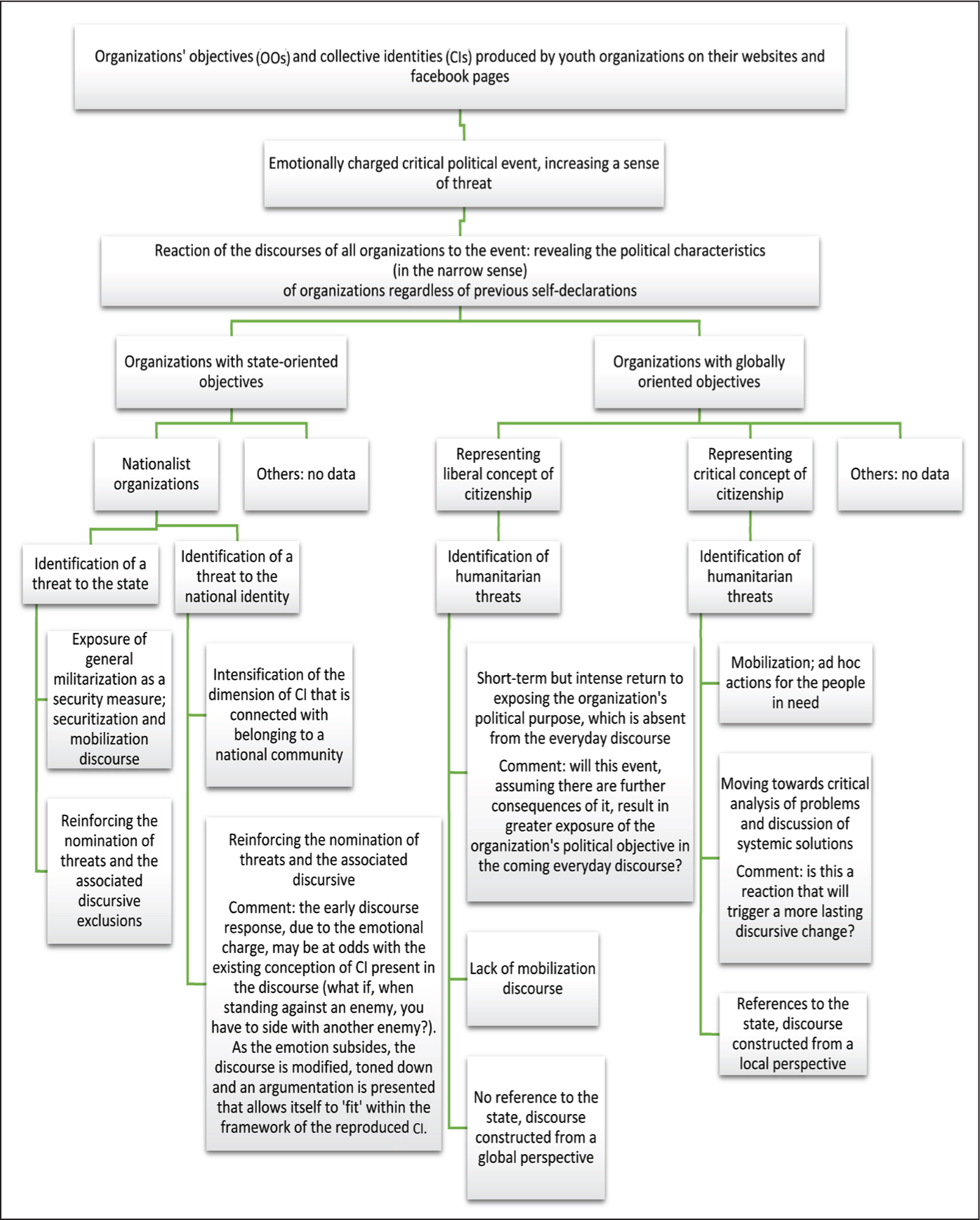
The findings and conclusions presented in this article cannot be easily generalized. Nevertheless, they show the contribution to understanding the process of discursive construction of citizenship in youth organizations resulting from combining the categories of OOs and CI and analysing them on different levels of discourse. Moreover, the inclusion of an emotionally charged, critical political event in the analyses makes it possible to capture early reactions and subsequent discursive shifts that point to a probable relationship between the type of organization and the scope and dynamics of changes in OO and CI in youth organizations. A discursive response model, which was constructed on the basis to analysis presented in this article, is shown in Figure 2. This model can be developed and revised with further research.
Model of Early Discursive Response of Youth Organizations to a Serious Political Event Resulting in Increased Sense of Threat Based on Discourse Analyses of Polish Youth Organizations.
Subsequent research on early reactions to emotionally charged critical political events is very important, not only because of the possibility of predicting these reactions but also because it is an integral part of understanding the process of change or resilience to change in the discursive construction of collective identities (or, more broadly, of citizenship) by youth organizations.
Footnotes
Declaration of Conflicting Interests
The author declared no potential conflicts of interest with respect to the research, authorship and/or publication of this article.
Funding
This work was supported by the National Science Centre in Poland under Grant Number 2019/35/B/HS6/01365.