




Abstract
During the COVID-19 pandemic, mitigating behaviour moved into the moral domain, and compliance with restrictions became tied to issues of intergenerational solidarity. Little is known about young people’s experiences with and attitudes towards coping with COVID-19 restrictions or about the role of intergenerational solidarity and conflict in their compliance. An analysis of 20 in-depth interviews with young adults (aged 18–24) in Dutch cities revealed a profound impact of the restrictions on their lives. Most tried to comply on moral grounds, particularly care and loyalty. But they felt that the impact on their own lives was not taken seriously and that young people were stereotyped as inconsiderate and perceived as flouting regulations. However, when the restrictions were prolonged, some participants renegotiated the ways in which they complied.
Keywords
Introduction
The COVID-19 outbreak impacted people’s daily lives in unprecedented ways. To manage transmission, governments implemented distancing policies and imposed lockdowns. Since the onset of the pandemic, researchers have examined the impacts on, and experience of, different age groups (e.g. old people: Ayalon et al., 2021; Swift & Chasteen, 2021; or young people: see the YOUNG special issue by Bengtsson et al., 2021, and the studies below). Studies on young people have highlighted the impact on physical and mental health (Niedzwiedz et al., 2021; Shaikh et al., 2021; Suarez-Lopez, 2021) and future orientations (Henkens et al., 2022; Kelly et al., 2022; Timonen et al., 2021). Several have also included compliance with COVID-19 restrictions (Jaureguizar et al., 2021; Nearchou et al., 2022; Nivette et al., 2021; Oosterhoff et al., 2020; Padrosa & Bolíbar, 2022; Shaikh et al., 2021). But to our knowledge, research on intergenerational solidarity and conflict from the perspective of young people is limited (with the exception of Nouwen & Duflos, 2022; Timonen et al., 2021). Studies examining intergenerational solidarity and conflict, such as the experience of ageism, mainly do so from the perspective of older people (Ayalon et al., 2021; Swift & Chasteen, 2021). This is a major shortcoming, given the impact of the COVID-19 restrictions on young people’s daily activities. Their position is interesting: adherence to the restrictions might not be strictly out of self-interest, as most of them do not experience a direct health risk. At the same time, this group is often stereotyped as entitled, impatient, lazy and overly social (Gharzai et al., 2020). Scientific papers often point out a lack of solidarity among younger generations with the older. For example, Ayalon et al. (2021, p. 49–50) noted that
As older adults are portrayed as susceptible to the negative effects of the COVID-19 outbreak, younger people tend to view themselves as immune to the virus and, thus, engage in risk behaviors with consequences that ultimately will need to be addressed by an already stressed health care system. The growing division between young and old also allows younger people to direct their anger and resentment about the situation towards older adults, who are clearly portrayed as the out group.
This conflictual stance is also found in the media (Bengtsson et al., 2021), in news reports of young people breaking ordinances or finding loopholes related to social distancing, captured in headlines such as ‘Buses full of young people from Brabant go to Belgium to party: “this is not good”’ (Omroep Brabant, 2021), ‘With 500 young people under a flyover: at this illegal party all Corona-rules went overboard’ (EenVandaag, 2020) and ‘WHO warns young people are emerging as main spreaders of the coronavirus’ (Washington Post, 2020). However, this narrative disregards the breadth of experiences with and attitudes towards coping with COVID-19 restrictions among young people. This article therefore sheds light on their varied experiences by answering the following research question: How do young adults experience intergenerational solidarity and conflict in complying with the COVID-19 restrictions?
Our research draws upon theories on moral decision-making, as compliance has increasingly been moved into the moral domain (Prosser et al., 2020). The moralization of the COVID-19 response means that compliance could lead to interpersonal or intergroup difficulties with age as a divisive factor, which links it to intergenerational solidarity and conflict. We specifically focus on the affectual and normative dimensions of intergenerational solidarity and conflict (Bengtson & Oyama, 2010; Bengtson et al., 2002). These dimensions concern positive (resp. negative) sentiments and a sense of responsibility.
Understanding young people’s experiences, behaviours and perceptions of others’ reactions to these behaviours helps governments plan a response to future pandemics but also sheds light on young people’s perspectives in situations requiring intergenerational solidarity. Interventions could be improved by taking the positions of different age groups into account. It is crucial to understand intergenerational conflict because it can negatively impact social cohesion (Hagestad & Uhlenberg, 2005; Levy & Macdonald, 2016; Stuckelberger et al., 2012).
Generational Inequality
The notion of social generation has gained traction in discussions about youth, society and inequality (France & Roberts, 2015; Furlong et al., 2011; Woodman & Wyn, 2015). It situates young people within the specific economic, social, cultural and political contexts that shape their opportunities and challenges (Mannheim, 1952; Woodman & Wyn, 2015). This generational perspective also elucidates how social disparities impact young people’s lives. The current generation of youth faces declining prospects in critical areas that profoundly affect their life chances, notably education, employment, housing, wealth, welfare distribution and political power (Green 2017; MacDonald et al., 2023). Côté (2014) contends that young people can be considered a distinct and marginalized ‘class’ due to material differences between younger and older generations, an accepted ideological justification for wealth discrepancies and a consciousness of these distinctions. Public perceptions of youth-adult contrasts often include descriptors like immature/mature, inferior/superior, dependent/independent, rebellious/responsible and so on (Wyn & White, 1997). While the concept of social generations provides a useful framework to understand the opportunities and risks that young people must navigate, it is important to note that outcomes for each individual can still be very different. Inequalities based on gender, class, race, sexuality and ability continue to be pertinent factors (Woodman & Wyn, 2015).
Intergenerational Solidarity and Conflict
Intergenerational solidarity can be described as the social cohesion between generations (Bengtson & Oyama, 2010). Solidarity refers to a tendency to do or mean something for each other and for the collective while avoiding the pursuit of pure self-interest that would lead to the disintegration of the group. Two levels of analysis can be distinguished: the societal (e.g. among age cohorts) and family levels. In this article, we focus on the former by investigating solidarity and conflict between young adults and older generations.
We follow Bengtson and Oyama (2010), who distinguish six dimensions of intergenerational solidarity: associational (contact), functional (support-giving), structural (opportunities for contact), affectual (positive feelings for each other), consensual (agreement on values) and normative solidarity (value-based obligations to support each other). The first three are behavioural dimensions, whereas the last three deal with mental and cognitive aspects of intergenerational relationships. Because this study focuses on how young adults experienced complying with COVID-19 regulations, we address the affectual and normative dimensions. According to Bengtson and colleagues (2002), the dimensions represent a dialectic; the two relevant dimensions of intergenerational conflict are therefore defined as negative feelings for each other (affectual conflict) and the absence of obligations to support each other (normative conflict). Consensual solidarity and conflict are not considered here, as studying agreement on values would require investigating the perspectives of both younger and older people.
Intergenerational conflict may be caused by stereotypes, dissimilar interests and issues of distribution and equity, and may include negative feelings, apprehensions, tensions and even open conflicts (Bengtson & Oyama, 2010). The pandemic might have impacted intergenerational solidarity and conflict in different ways. First, it might have affected stereotyping of both the old and the young. The context of COVID-19 strengthens negative stereotypes of need and dependency among older people, while young people are increasingly portrayed as reckless and irresponsible (Ayalon et al., 2021; Chasteen et al., 2021; Gharzai et al., 2020; Werner et al., 2022). Conversely, the narrative that ‘we are all in it together’ might have encouraged mutual understanding and solidarity between young and old. Second, intergenerational conflict might have been exacerbated by discussions on the fair allocation of resources and burdens; for instance, the consumption of health care by older people may be seen as excessive (Ellerich-Groppe et al., 2021). In addition, discussions on an equal division of burdens – related to giving up one’s own liberties for the protection of others – might be a source of conflict. Third, restrictive measures to mitigate transmission of COVID-19 hamper encounters between old and young, leading young people to avoid meeting with older people to protect them from infection. In turn, these limited encounters may have negatively affected the affectual, consensual and normative dimensions of solidarity. Work by Uhlenberg and colleagues (e.g. Hagestad & Uhlenberg, 2005; Uhlenberg & De Jong Gierveld, 2004), for example, shows that patterns of age segregation are closely linked to the formation of ageist attitudes. Therefore, conflict might increase as older and younger people have less opportunity to share their experiences.
Moral Decision-making
Central to the concept of intergenerational solidarity is a sense of moral responsibility. Moral Foundations Theory (Graham et al., 2013; Haidt & Joseph, 2004) addresses how people make judgements about ‘right versus wrong’. The theory poses five central foundations on which judgements and behaviours are intuitively evaluated: caring involves preventing harm and caring for others; fairness relates to reciprocity, fair practices and equality; loyalty relates to sacrificing for one’s in-group; authority concerns respect for and obedience to authority figures, social traditions and hierarchies; and sanctity emphasizes bodily and moral purity in contrast to degradation (Chan, 2021; Ekici et al., 2023). In addition, liberty, which was later proposed as a sixth foundation (Iyer et al., 2012), deals with the resentment people feel towards those who dominate them and restrict their liberty; there is often tension between liberty and authority.
During the COVID-19 pandemic, previously neutral behaviours, such as visiting grandparents or holding a party, moved into the moral domain, leading to the development of social norms related to COVID-19 mitigation (Francis & McNabb, 2022). Moral foundations are relevant in this context in several ways. Caring about others might amount to protecting others from harm, such as infection. Fairness relates to the idea that people should comply with the rules because they are only effective when everyone plays their part (Chan, 2021; Díaz & Cova, 2022; Qian & Yahara, 2020). Furthermore, fairness implies spreading burdens equally. When interventions impact social groups unequally, the issue of fairness surfaces (Stott & Radburn, 2020). Loyalty involves putting the group’s concerns above one’s own. Accordingly, many governments promoted the idea that ‘we are all in it together’, stressing the need to comply with the rules to protect the community and restore the economy. Regarding authority, individuals who value authority may be more willing to adopt behaviours that governments mandate. At the same time, liberty is at stake; violations of personal freedom are core issues in discussions on COVID-19 regulations such as wearing face masks, entrance restrictions and vaccinations (Perry et al., 2021). Finally, sanctity resonates with people’s avoidance of pathogens, stimulating behaviours to prevent their spread, including hand washing, physical distancing and wearing a face mask. The other way around, sanctity might be reflected in a person’s desire to maintain the body’s integrity and ‘naturalness’; for that reason, some may not want to wear masks or get vaccinated (Reimer et al., 2022).
While moral foundations are generally rather stable, contextual conditions can influence moral behaviours (Cieciuch, 2017; Francis & McNabb, 2022; Van den Berg et al., 2022). In the context of COVID-19, social interactions between individuals or within communities can influence social norms and, by extension, affect how moral foundations are translated into behaviour, often through social pressure (Prosser et al., 2020). Moreover, communication by government or other parties can promote new moral norms (Prosser et al., 2020; Rozin, 1999); government campaigns, for example, made wearing a face mask and keeping distance (temporarily) ‘the right thing to do’. Finally, situational demands (e.g. not having a mask with you) might create a discrepancy between moral foundations and actual behaviour. We therefore approach young people’s moral choices and behaviours as relational and flexible. That is, they are formed through interactions with others and influenced by the public discourse; they can also change over time through personal experiences or shifting discourses.
Methods
Between May and July 2021, we conducted semi-structured interviews with 20 Dutch young adults between 18 and 24 years old, living in the four largest cities in the Netherlands. The interviews were presented to the participants as being on ‘intergenerational solidarity in times of COVID-19’ and covered a range of topics: their experiences during the pandemic, specifically with the COVID-19 regulations; intergenerational relationships and mutual understanding; and solidarity in general and between older and younger generations. Interviews were conducted either digitally using Microsoft Teams or in person at the participants’ homes or in public places, while adhering to the social distancing rules in force at that time. Each interview lasted 40–60 minutes. Ethical approval was obtained from the Ethics Assessment Committee of the Faculty of Social and Behavioural Sciences of Utrecht University.
Participants
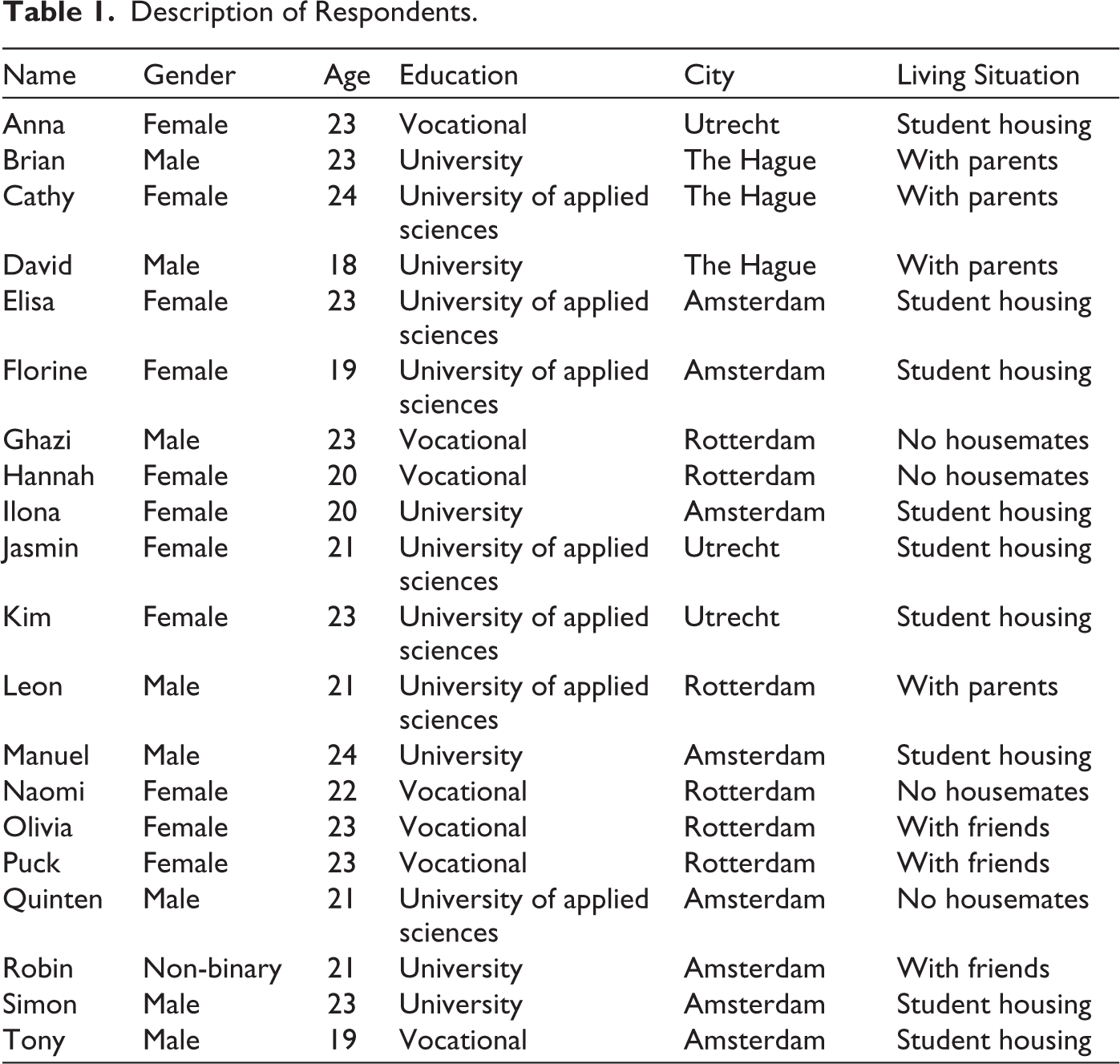
Participants (see Table 1) were recruited through community centres and youth organizations and by distributing flyers at places where young people meet. Snowball sampling was used to find additional participants, aiming for diversity in age (between 18 and 24 years), gender, education level and migration background. At the same time, to ensure homogeneity in terms of socio-spatial context, the sample only included young adults living in one of the four largest cities in the Netherlands. Participants were assigned pseudonyms, which are used throughout this article.
Description of Respondents.
Timing
Interviews were conducted between May and July 2021 (please see ‘period of study’ in Figure 1). In the Netherlands, the first lockdown was imposed between March and June 2020, entailing the closure of schools, cafés, restaurants and sports and cultural facilities (while shops remained open); restrictions on meeting with social contacts and keeping a 1.5 metre distance; and a strong recommendation to work from home. After June 2020, measures were relaxed gradually until October 2020, when the country went into a second lockdown. At this stage, cafés and restaurants were closed, followed by a full lockdown in December 2020, when the same measures as in spring 2020 were implemented, and, in addition, all non-essential shops were closed. Moreover, a face mask became compulsory in all public indoor facilities. In January 2021, an evening curfew was introduced, and violent protests erupted in reaction. The Netherlands remained in lockdown until the end of April 2021, when shops and outdoor terraces were allowed to partially open. Also, higher education partially reopened, allowing students to attend classes on location approximately one day a week. More restrictions were lifted by the end of June 2021; however, transmission rates increased in early July.
Timeline of COVID-19 Infections and Mitigating Measures in the Netherlands.
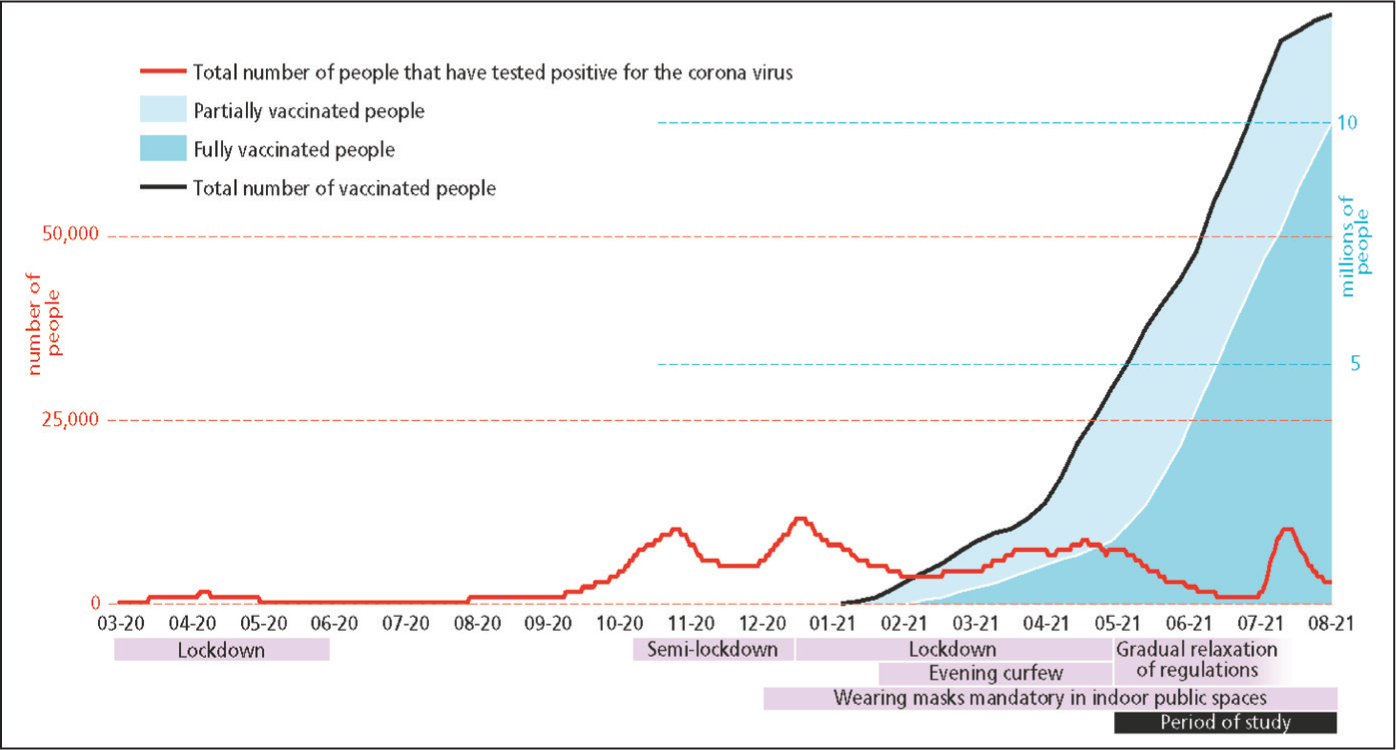
The COVID-19 vaccination campaign started in January 2021. At first, priority was given to older persons, people with health issues and health-care workers. By early May, 12 per cent of people born between 1996 and 2004 were vaccinated, and 64 per cent by the end of July (RIVM, 2021). So, during the period of study, young adults were the target group for vaccination. Noteworthy is that the minister of public health encouraged young people to get vaccinated with the catchphrase ‘dansen met Janssen’ (dancing with Johnson) by the beginning of July 2021. Young people would get a QR code upon receiving the Johnson & Johnson vaccine, allowing them to ‘go out dancing’ the same day. While this may have accelerated vaccination among young people, in hindsight, this statement was considered inopportune as the vaccine would only be effective after 14 days. By mid-July, bars and clubs had closed again.
Analysis
The interviews were recorded and transcribed by the fourth author and then coded by the first author of this article using NVivo 12. The thematic approach of Braun and Clarke (2006) was used for data analysis. First, explicit themes were identified and translated into initial codes and sub-codes. Underlying themes that might shape the semantic content of the data emerging from the first coding round were discussed, specified and then coded in a second round.
Results
The Impact of the Pandemic on Young Adults’ Lives
The interviews revealed a profound impact of the COVID-19 pandemic and restrictions on young adults, as their daily activities and structure had been disrupted. Some could no longer work because restaurants or non-essential shops were closed. Many classes were cancelled or shifted online, which negatively affected their motivation and grades and, for some, meant not graduating on time. On a positive note, some saw benefits as taking a step back allowed them to evaluate their daily lives. As participants with busy schedules explained, the lockdown lowered stress by reducing travel time and suddenly slowing down their lives (see also Henkens et al., 2022). As Leon (aged 21, a student at the University of Applied Sciences, living with parents) explained about online classes, ‘On the one hand it was easier. You didn’t have to travel that much […] On the other hand you really miss the physical contact with people, and the inspiring environment. … It’s just less fun and you learn less’.
A second theme was the impact on social contacts. The majority indicated that the lockdowns, including restrictions on the number of people you could meet at the same time, resulted in them missing social connections. Social relationships are important for health and well-being, particularly during the formative years of adolescence and young adulthood (Loades et al., 2020). In particular, young adults who were living alone, compared to those living with their parents or in student housing, said they often felt lonely. When asked about the impact of the pandemic, Robin (aged 21, a university student living with friends) said:
It was tough… I lived in Rotterdam and when it started I lived on my own. […] And then I lost many social contacts suddenly, because I couldn’t go to Amsterdam anymore. I did have contacts through Facetime every day, but it really became less. And going out to clubs really was an important part of my leisure time and my social life, and that all disappeared.
All in all, for the majority of the participants, staying at home and being unable to meet with friends negatively impacted their mental health. The impact was particularly strong as the pandemic persisted without any sign of returning to normal life and during the recurrent periods of stricter lockdowns.
Compliance with COVID-19 Restrictions as an Act of Intergenerational Solidarity
When asked about complying with COVID-19 restrictions, most participants said that they aimed to adhere to these restrictions as much as possible, in particular in the early stages of the pandemic. When talking about later stages, and as the interview progressed, it emerged that young adults increasingly found it harder to comply with the regulations. In the early stages, however, compliance was considered important in view of the moral foundation of care; first and foremost, they wanted to prevent harm to others. As Brian (aged 23, a university student living with parents) remarked, ‘you don’t want to be that person that has COVID and you infect someone, and then they die. …’ The young adults recounted making efforts to protect people in their own personal networks as a form of (indirect) affectual solidarity. Naomi (aged 22, a vocational education student, living on her own) explained:
Well, the father of a friend of mine is very sick and when she joined us somewhere everybody got tested beforehand. For her. And of course my grandma, I didn’t see her that often during the pandemic, but if I went I would wear the mask and keep my distance. But fortunately I do not have many vulnerable people in my surroundings.
In addition, the participants referred to protecting the vulnerable in society in a general sense, also in light of the moral foundation of loyalty – the idea that ‘we are all in it together’ and that we need to comply with the rules to protect our community. This primarily aligns with the normative dimension of solidarity, that is, feeling obliged to support each other (Bengtson & Oyama, 2010). When asked why they complied, Robin (aged 21, a university student living with friends) explained, ‘to make sure that the infection rate is within control and that the vulnerable and old people won’t get sick. […] I don’t worry about getting it myself’. The last point – not worrying about getting COVID-19 themselves – was mentioned by several participants (see also Nearchou et al., 2022). It suggests that the decisions made by the young people were often not out of self-interest but could be seen as a form of solidarity with older people and those in poor health.
The same rationale influenced the decision to get vaccinated. While several were unsure about the benefits for themselves, most decided to get vaccinated to protect others. Florine (aged 19, a student at the University of Applied Sciences living in student housing) explained:
Next to the fact that it allows me to do everything again, it also gives me a good feeling […] I don’t do it for myself, because I know I won’t get very sick, but for other people it gives a better feeling. I can transmit it less easily and it gives protection for others.
Another reason was that access to certain venues or activities required proof of vaccination, which aligns with the moral foundation of authority. It allowed young adults to engage in more activities, such as going to bars, restaurants or clubs. Some also felt pressured to accept the vaccine. As Ghazi (aged 23, a student at a vocational school living on his own) put it, ‘Yes, in the end you have to, that’s what I noticed. You are being backed into a corner […] otherwise you can’t go on holiday, or… [do other things]’.
In sum, we see that young people predominantly referred to the care and loyalty foundations when discussing adherence to COVID-19 restrictions. Compliance was mostly motivated by wanting to protect older and vulnerable people, either in their own networks or in society in general. The sanctity foundation was less central, which reflects the fact that younger adults were less concerned about the impact of COVID-19 on their own health. Complying with the rules could thus largely be seen as acting out of solidarity rather than out of self-interest. Moreover, authority foundations – in the form of agreements with government regulations – were less prominent among young adults. While Timonen and colleagues (2021) describe how in Ireland ‘following the government-described rules’ was almost reflexive (unquestioningly obliging as a social and community duty), this moral foundation was not that central in the accounts of our participants.
Negotiating the Restrictions Through Personal Risk Assessments
While most participants understood the reasons behind the restrictions and aimed to comply, at some point negotiation and flexibility came into play, particularly later in the pandemic. Some recalled ending up in situations that were officially prohibited, such as meeting up with too many people or not keeping 1.5 metres of distance, and they made their own assessment of what was acceptable. As Brian (aged 23, a university student living with parents) said:
When the Corona measures were a bit more relaxed, you were only allowed to have two guests. […] But then someone invited other people without us knowing, and we ended up with seven people or so. I didn’t like it, but I didn’t want to be the only one wearing a mask and keeping distance, so I decided to just have fun.
Puck (aged 23, a student at a vocational school living with friends) told the following story, illustrating that her personal assessment was not always understood by others:
One time I went to meet with a friend, and I hadn’t seen her for a long time. And apart from my housemates, I really wasn’t meeting with anybody, I really adhered to the rules. That evening we went to sit on a terrace, and I just gave my friend a hug. […] I really had missed her so much, so I didn’t think about it. And then someone made a remark about that and I remember that I had to cry really hard […] I was like: I have been taking other people into account the entire time, but right now I need this hug. And then people react like I did something terrible.
Social pressure also played a role in negotiation, reflecting the moral foundation of loyalty. Interestingly, loyalty to others influences young adults in opposing ways. Sometimes their peers convinced them to loosen up – to meet with more people than allowed or attend a party. On other occasions, their friends or housemates convinced them to adhere to the rules more strictly. Jasmin (aged 21, a student at the University of Applied Sciences living in student housing) said:
My housemates and I set certain rules. Personally I didn’t bother that much, I liked to see people. But I really kept distance and stuck to the rules because my housemates wanted that. […] If I hadn’t lived with so many housemates, or if they all didn’t care that much, I would have been more lenient as well, I think.
Young adults were influenced by the actions of their peers. Indeed, according to the literature, the perception that other people are engaging in specific behaviour will increase compliance (Miller & Prentice, 1996) and the impact is stronger when individuals share a common identity (Abrams et al., 1990).
For particular activities, young adults seemed to make a cost-benefit analysis, comparing the costs of adherence (e.g. decreased mental health) with its benefits (e.g. reduced risk of catching and spreading the virus) (see also Ekici et al., 2023; Zimmermann et al., 2022). Later, many became less strict, encouraged by higher vaccination rates and less anxiety about the course of the pandemic. Importantly, they increasingly made trade-offs, weighing their preexisting moral foundations of care and loyalty against their own mental health, a calculation linked to the fairness foundation. They felt there were limits to solidarity when their own well-being was at stake, especially because there seemed to be no end to the pandemic. As Simon (aged 23, a university student living in student housing) recounted:
I have to admit that I didn’t adhere to the rules very strictly all the time. It was somewhat of a trade-off between ‘will I meet with my friends?’ or ‘won’t I see them at all for the health of the people around me?’ The latter would make me very unhappy.
Similarly, Kim (aged 23, a student at the University of Applied Sciences living in student housing) said that she adhered to the rules most of the time but ‘attended an illegal party once, because I was feeling really down […] but after that I quarantined’.
The narratives reveal a discrepancy between moral foundations and actual behaviour, a tendency also noted by Van den Berg et al. (2022). While the young adults considered adherence to the regulations important in light of their moral foundations, sometimes their situations or choices were partly in conflict with these foundations. The social context played a role: social situations, pressures or situational demands influenced how they behaved when COVID-19 regulations were foregrounded.
Experiences of Intergenerational Conflict
While most participants understood the importance of complying with the COVID-19 regulations, they also mentioned the unequal distribution of the burdens and how they experienced age as a divisive factor in this context. They experienced a tension between the moral foundations of care and loyalty on the one hand and fairness and liberty on the other. Hannah (aged 20, a student at a vocational education living on her own) put it frankly:
It went too far. Maybe we didn’t have to put the entire world in lockdown. I do understand why they do it, but I’m 20 years old now, and I can’t do anything. That person of 90 years old, I’m sorry, but they can stay inside for a while. That’s very selfish, but yeah …
Many felt that the worries and efforts of young people were not taken seriously by the government, public opinion or the media. Cathy (aged 24, a student at the University of Applied Sciences living with parents) said:
It was needed [the restrictions], but you have winners and you have losers. But it was not equally distributed during the Corona crisis. You see that entrepreneurs are hit really hard, but also ordinary people and young people in particular. In many cases you see their health deteriorating, young people feeling very lonely, also many stories about for example the suicide phone line, many calls from young people. So in many cases that what you want to achieve [with the restrictions] does not outweigh that what you lose […] Maybe it sounds a bit dramatic, but there are many distressing stories of young people that really experienced problems during the Corona crisis.
Many participants felt they were being stereotyped, citing media portrayals of young people only wanting to party and the prevailing opinion that it was a minor sacrifice to stay at home for a while. The impact on young people’s mental health was underestimated, and it was ignored that most of them adhered to the rules rather strictly, keeping solidarity with older and vulnerable groups in mind. Anna (aged 23, a student at a vocational school living in student housing) said:
I found it very annoying to read on social media or in newspaper articles that young people only want to party and things like that. That simply isn’t true. We want to go to school normally and graduate. It is super difficult to study like this, and when I’m graduated more than half of my education has been online, that’s really a pity. […] I found that young people and students were portrayed very negatively, while at our house we were really strictly adhering to the rules.
David (aged 18, a university student living with parents) asserted that communication by the government and the media could have been better; it should have highlighted the diverse experiences and behaviours of young people:
I understand where it is coming from, there is a group of young people that did that a lot [partying, not complying with the rules], but now we are all tarred with the same brush. It would have been better to show both sides. Like ‘ok there is a group of young people that does not stick to the rules, but luckily there is also a group that does’.
The young adults’ narratives illustrate concerns related to the moral foundation of fairness. They agreed that everybody should play their part in combating the virus but wanted an equal division of the burden. Experiences of stereotyping and feelings of not being taken seriously led them to question the fairness of the regulations and seek acknowledgement of their impact on their lives. Central to their stories was the need for mutual understanding and reciprocity: understanding and respect have to come from both sides as a part of affectual solidarity. Most felt they had to give up a lot to comply – as a form of normative solidarity with older or vulnerable people – but saw that some older people were not doing the same, which frustrated them. As Jasmin (aged 21, a student at the University of Applied Sciences living in student housing) observed, ‘a lot of adults and older people do not keep their distance. I’m like: we’re doing this for you! If you could do the same for us that would be really chill. These kind of things I found very frustrating’.
Discussion
This study investigated the role of intergenerational solidarity and conflict in the context of young adults’ compliance with the COVID-19 regulations. It showed the profound impact the restrictions have had on young people, affecting their daily activity patterns, social contacts and mental health. Nonetheless, most participants said they tried to adhere to the regulations as much as they could, particularly early in the pandemic. Underlying their behaviour were primarily the moral foundations of care and loyalty. Many participants felt that compliance was not out of self-interest but rather an act of solidarity towards those who were older or in poor health, either within their own networks or beyond. This strongly relates to the normative and affectual dimensions of solidarity specified by Bengtson and Oyama (2010).
When the restrictions were prolonged, however, the participants occasionally renegotiated the ways in which they complied. Experiencing a strong impact on their own mental health created tension between the moral foundations of care and loyalty on the one hand and fairness and liberty on the other. The longer the regulations lasted, the wearier many became, and some loosened the reins. Holding certain moral values, thus, did not always lead to corresponding behaviour (see also Van den Berg et al., 2022). This finding calls into question moral foundations as a static concept in a rapidly changing context. Social situations, pressures or situational demands influenced how young people behaved when COVID-19 regulations were front and centre. A study in Germany (Kaup et al., 2022) among the general adult population supports this image, finding that interpersonal solidarity decreased from the first to the second lockdown. They also found that adults between 35 and 64 demonstrated more solidarity compared to younger and older adults. Future research could investigate contextual and situational factors – and the changes therein – that might influence the relationship between moral values and actual behaviour for different age groups.
Many participants in our study experienced some intergenerational conflict, or at least tensions between younger and older groups. They were frustrated with the negative stereotyping of their group on social media and in public discourse. They felt that not enough attention was given to the impact of restrictions on their daily lives and mental health. It bothered them that young people were too often portrayed as flouting the regulations, while most tried to comply, and some were even stimulated to comply by their peers. Against the backdrop of existing literature on the current generation of young people, it is evident that they were already grappling with uncertainty and unpredictability even before the pandemic struck (MacDonald et al., 2023). The onset of the COVID-19 crisis, coupled with a lack of acknowledgment of their concerns, potentially accelerated disruptions and exacerbated the economic and social pressures they were already facing. Additionally, the worries of young people may be linked to individualization: having to cope with personal failures and unexpected events on their own (Beck & Beck-Gernsheim, 2002). Consequently, the COVID-19 restrictions could have led to heightened stress among the young. Simultaneously, this generation tends to engage in shared cultural expressions of pleasure, such as clubbing, as a form of resistance against the notion of the responsible, self-managing individual (Riley et al., 2010). However, with the COVID-19 restrictions in place, opportunities for participating in these cultural expressions were severely limited, leading to intergenerational tensions when young people attempted to engage in such behaviours.
Furthermore, our participants mentioned occasions when their physical distancing and mask-wearing behaviours were not reciprocated by older people. This is corroborated by Hangel and colleagues (2022), who found young people in Germany and Switzerland complaining about the elderly’s lack of solidarity. Moreover, it was found that both young and old mentioned tensions regarding differential interpretations of and adherence to government regulations (Schneiders et al., 2022). Clearly, our participants’ foundation of fairness was under pressure, demonstrating the relational nature of intergenerational solidarity and how mutual understanding and reciprocity are central to it. In the context of the pandemic, or other events in which intergenerational tensions might arise, this means that taking into account the worries and mental health of different age groups and the role of the media in discussing group behaviour is important (see also Werner et al., 2022). Unbalanced reporting undermines mutual understanding and solidarity and affects the mental health of both young and old people (Drury et al., 2022).
This study presents a case for focusing research and policy on intergenerational understanding. Future research could reveal differences in norms, values, and moral foundations and how these affect understanding across age groups. In a broader sense, research could further elucidate how interactions facilitate intergenerational connections and understanding, expanding into ‘generational intelligence’, which is about becoming critically self-aware of age as a factor in social relations. Biggs and colleagues (2011) identified four steps towards developing generational intelligence: recognizing generational distinctiveness; understanding the relationship between generational positions; increasing awareness of the value stance being taken towards generational positions; and acting in a way that is generationally aware. Furthermore, it is crucial to recognize that even before the COVID-19 pandemic, young people were confronting numerous uncertainties, and these challenges persist in the post-COVID world. The challenges and stereotyping experienced by youth during the pandemic should be viewed from the wider perspective of ongoing economic and climate crises, as well as the interconnected generational inequalities and tensions that exist presently and may endure into the future (Kelly et al., 2022; MacDonald et al., 2023).
Limitations
This study is, to our knowledge, one of the few in-depth inquiries into how young people experienced complying with restrictions during the COVID-19 pandemic and how intergenerational solidarity and conflict play a role in this. The findings should be interpreted in light of some limitations.
First, this study emphasized the relationship between moral decision-making, intergenerational solidarity and compliance. This by no means implies that moral foundations and solidarity are the only factors. For example, one’s particular situation (socioeconomic status, personal health, health of family members, living situation, etc.), knowledge and social networks are likely to affect compliance as well. In fact, some of the participants’ narratives underscore the role of this broader framework in the sense that following the regulations is affected by household members and others present in their social contexts.
Second, despite efforts to include a diverse sample of participants, young people who are more engaged in societal issues may have been more likely to participate in our study and also more likely to comply with COVID-19 regulations. Nevertheless, we believe that their narratives are valuable and contribute to an understanding of young adults’ experiences of the COVID-19 pandemic and intergenerational solidarity.
Finally, given that the study was conducted in urban areas in the Netherlands, we believe that our findings apply to urban areas in other Western countries that have implemented similar COVID-19 restrictions. The experiences of young adults in rural areas, however, might be different due to the nature of the social contacts and meeting opportunities there (Lannoo et al., 2012; Roth et al., 2022). Moreover, studies in the context of COVID-19 tentatively point to urban-rural differences in mitigating behaviours (Vehkalahti et al., 2021). Compared to urbanites, rural residents were less likely to stay at home (for the USA: Burford et al., 2020; Schaul et al., 2020) or engage in preventive behaviours (Burford et al., 2020; Callaghan et al., 2021; Chen & Chen, 2020). Additionally, it is essential to acknowledge that the experiences of young adults in the Global South might vary from those presented in this article. MacDonald and King (2021) highlight that in the Global South, there exist distinct dominant representations of ‘youth’, along with different interpretations of insecurity. Research that foregrounds the setting in which young people experience and negotiate COVID-19 restrictions could be relevant for understanding solidarity and social cohesion in times of pandemic.
Footnotes
Declaration of Conflicting Interests
The authors declared no potential conflicts of interest with respect to the research, authorship and/or publication of this article.
Funding
The data on which this research article is based were collected within the research project ‘Youth networks, social divides and solidarity - Before Covid-19, during the lock down, and in the aftermath of the epidemic’ that was conducted with financial support of a Dynamics of Youth (DoY) Invigoration Grant from Utrecht University.