




Abstract
This article examines some of the conditions that can explain the rise in young workers’ mental health and well-being problems in early work life. Based on 30 qualitative interviews with Danish workers under 30, who all had experienced different kinds of mental health and well-being problems in early work life, it shows how poor working environment and employment conditions often are triggering factors for young workers’ mental health and well-being problems. Mental health and well-being in early work life seem to be linked to the conditions through which young workers’ cultivate themselves as valuable working subjects in a time where work is a crucial arena for self-formation and self-realization. It is concluded that the combination of performance-oriented workplace cultures, temporary employment, and young workers’ aiming to achieve success in their work life, is a toxic combination for mental health and well-being.
Keywords
Introduction
The mental health of Danish youth has been in decline over a number of years. This corresponds to a growing number of Danish young workers who are experiencing mental health problems when they enter the labour market. In this article, we seek to explain the declining mental health during their early working lives. The increasing focus on performance and competition in youth culture is a key perspective in Nordic sociological youth research. For several years, sociological youth research has focused on how neoliberal tendencies manifest in society and contribute to creating a youth life that is increasingly shaped by performance, competition, and intensified mechanisms of marginalization. At the same time, temporary and precarious employment is pointed out as a primary structural condition that reshapes the lives of young people and impacts on their mental health.
The empirical basis for this article is an interview study with 30 Danish young workers between the ages of 22 and 31, conducted in connection with the start of their first job as a recent graduate. It is a life situation, where many of the interviewed workers were intensively invested in their future and went to great lengths to gain a foothold in the labour market. Most of the young workers had completed internships, student jobs, and other activities that in various ways sought to increase their value in the labour market. Many held notions that work life should be filled with passion, success, and engagement. The combination of the struggle to achieve success in work life, performance-oriented work cultures, and the ever-increasing number of temporary positions is described in an article on BBC Worklife (Lufkin, 2021) as a ‘toxic combination’.
In this study, we, therefore, focus on the social framing of well-being and mental health in early work life. To be able to include all forms and degrees of work-related mental health and well-being, we refer to mental health and well-being problems among young workers in a broad sense.
The article examines some of the work-related psychosocial and structural factors in early work life that potentially can undermine the well-being or mental health among young workers. We include all the forms and degrees of symptoms that the young workers in the research material perceive as symptoms related to different forms and degrees of well-being or mental health, for example, sleep problems and symptoms of anxiety, depression, or stress. The article explores how performance orientation is expressed by young workers in temporary working positions. Through a focus on the practices that young people mobilize to cultivate themselves as valuable workers in these contexts, we examine how this can be linked to the decline in mental health and well-being among young workers in early work life.
To examine the relationship between young people’s cultivation of themselves as valuable workers and problems of well-being and mental health, we draw on Skeggs and Loveday’s (2012) theory on how subjects fight to win value through ‘struggles for value’ and Farrugia’s (2018, 2019, 2020, 2021) analyses of how young people cultivate themselves as workers within a ‘post-Fordist work ethic’.
Background
Problems with Mental Health and Well-being in Youth
In the ‘Western’ world, the rise in mental health problems has long been a source of concern (Bakken, 2018; Bakken et al., 2018; Landstedt et al., 2017; NHS, 2018; Skovlund et al., 2017; Twenge et al., 2019; WHO, 2017). The same applies in a Danish context, where there has been a rise in the number of people who experience poor mental health and qualify for a psychiatric diagnosis (Jensen et al., 2018; Ottosen et al., 2018). Younger people between the ages of 18 and 24 in employment have seen an especially large increase in problems related to mental health or well-being in the form of sleep disorders, depression, anxiety, or stress symptoms (Dyreborg et al., 2018; NFA, 2017), and a recent study document, that stress at ages 15–21 is associated with reduced labour market participation in early work life (Winding et al., 2023).
The explanations for the decline in mental health problems in youth life are multifaceted and discussed at length. In a Scandinavian context, Brinkmann (2016) has understood this decline within the framework of the emergence of a ‘diagnostic culture’. Petersen (2016) has described the development of a ‘performance society’, while Madsen (2018) has labelled today’s youth as ‘Generation Performance’, whose experience of worth and identity is increasingly about performing optimally and being positioned as a winner. Common to the latter two is that they describe a development whereby the individual is increasingly pitted against other individuals in a competitive relationship, where it is important to avoid being a loser and where there are intensified demands for performance and self-optimization. These perspectives can also be found in Landstedt et al. (2017) and Woodman and Wyn (2015). The research also points to a youth life in which young people increasingly experience demands and pressure, as well as a fear of falling outside the norm among young people (Johansson & Herz, 2019; Sørensen et al., 2017). This pressure is experienced and dealt in different ways, among most young people, it does not necessarily lead to problems with mental health or well-being (Katznelson et al., 2021).
Eriksen and Seland (2021) argue that there is a lack of conceptualization of the term well-being, despite its proliferation in research and youth policy. This also seems to be the case with ‘mental health’ (Landstedt et al., 2017). Also, McLeod and Wright (2016) ask for a ‘critical engagement with the concept well-being … so that it is not simply mobilized as a self-evident, benignly good, or neutral construct’ (p. 778). We find inspiration in WHO (2022) that defines mental health ‘as a state of mental well-being which enables people to cope with the stresses of life, realize their abilities, learn well and work well, and contribute to their community…’. In a recent study, Eriksen and Seland (2021) conceptualize well-being. The authors suggest ‘that a fruitful way to operationalize well-being for a sociological investigation may be to shift the focus from psychology’s subjective elements of well-being to assessing contextual prerequisites for well-being in youth’ (p. 178). This is in line with Landstedt et al. (2017) who show that ‘complex socio-material conditions’ impact on youth mental health. Following these arguments, we focus on the social framing on mental health and well-being. As, opposed to medical or diagnostic perspectives or definitions on mental health and well-being, the social framing on mental health can enhance our understanding of the broader societal contexts in which poor mental health and well-being emerges and is understood.
Despite the strong and extensive interest in understanding and preventing mental health problems among young people, there is a lack of knowledge about the dynamics between the above-mentioned societal tendencies and the increase in mental health problems that we currently see among young workers in the labour market. The existing research has predominantly focused on understanding problems with mental health and well-being among young people before they enter the labour market (Bakken et al., 2018; Görlich et al., 2019; Landstedt et al., 2017; Ottosen et al., 2018; Sørensen et al., 2017), whereas there is a lack of research on mental health problems among young workers in early work life.
Temporary Employment and the Fight for Value
As in the rest of Europe, part-time employment, temporary positions, and various forms of temporary employment are also growing in Denmark, with particular prevalence among young people (Gleerup et al., 2018; Nielsen et al., 2017, 2019a). Numerous scholars point out that many young people can no longer look forward to the type of adult life that their parents had and that young people’s transition into the labour market is increasingly uncertain and fragmented (Furlong, 2015; Woodman & Wyn, 2015; Woodman, 2012). Shildrick and MacDonald’s concept of ‘poor transitions’ (2007) describes how precarious work can have significant negative consequences for young people’s transition into the labour market. This is further detailed in a Danish study (Nielsen et al., 2019b) showing that young people in education often have student jobs where they are loosely attached to the workplace, but this does not necessarily impact their transition into the labour market negatively, as Danish young people often educate themselves out of the precarious work situation. As such, precarious work primarily has negative consequences for young people who do not have the opportunity to develop their qualifications through education (Roberts, 2011, 2013). A Danish study of academics’ experiences while in precarious employment highlights a lack of meaning and recognition in the work and that it can be perceived as difficult to become an integrated part of a community of colleagues (Gleerup et al., 2018). Another study of unskilled Danish young people in temporary positions shows that some young people experience that, as workers, they are perceived and valued as ‘goods’; therefore, they assess and shape themselves to increase their market value in the labour market (Nielsen et al., 2017).
Theoretical Lens
According to Farrugia (2021), work has gained a new meaning—including for young people—as a source of personal fulfilment. In the Western world, the importance of work has changed as traditional ties to family, community, and religion have dissipated. Farrugia outlines a historical movement in which work was previously associated with a promise of religious salvation (Weber’s Protestant work ethic), later becoming a lever for social mobility and material prosperity (Fordism), to today’s promise of self-realization through work (post-Fordism). In the post-Fordist work ethic, all aspects of life should preferably be translated into value for the work, as work in itself holds the promise of being a source of meaning, satisfaction, and self-realization (Farrugia, 2021). The ideal young employee in a post-Fordist society is thereby the person who exhibits dedication, passion, autonomy, creativity, and joy at work. The ability to mobilize these qualities, particularly passion, is a key parameter for becoming a successful work subject that is personally and authentically invested in their work. In this regard, the incentive to work not only springs from material necessity but also about proving one’s worth as a person. Farrugia (2019) argues that across divergent aspirations and family histories of employment, work has become the primary arena for the cultivation of the self as a subject of value to the contemporary labour force. However, the ‘increased level of structural insecurity’ means that for some young workers ‘work becomes a risky, unpredictable, and contingent basis for the bare fact of living’ (Farrugia, 2020, p. 3). Young workers in precarious working situations must therefore renegotiate the meaning of labour, when it becomes impossible to understand labour as a process that attributes value to the self (Farrugia, 2020, p. 3).
Skeggs and Loveday’s (2012) theoretical lens conceptualizes how those positioned beyond value fight to win value through ‘struggles for value’. This lens enables us to understand the many narratives in the interview study about the various ways in which young workers prove and legitimize their worth in the labour market and strive to obtain and retain an interesting job. We are thus inspired by Skeggs and Loveday’s performative perspective on subject formation: ‘This public performance of oneself as a “subject of value” or an “exchange-value” self becomes the means by which a person makes a stake for value and legitimacy’ (2012, p. 475). In the analysis, we use the term ‘struggle for value’ to understand early work life as a series of struggles through which the individual subject fight to win recognition as a subject of value, while also fighting to avoid being positioned as a subject without value to society. Skeggs and Loveday’s concepts thus compliment Farrugia’s overall theoretical framework with a more subject-oriented analytical concept.
Method
The empirical basis for this article is an interview study with 30 Danish young people (26 women and 4 men) aged between 22 and 31, who were interviewed in connection with the start of their first job after completing their education. The interviews were conducted in connection with the research project entitled: ‘Young people’s well-being in the first job. The importance of performance, working environment and temporary employment’. The average age of the informants was 27.3 years. The criteria for selection of the informants were as follows: being under the age of 30, having graduated within the past 2 years, employment in one of the selected industries (see below), and having experienced some form of problems related to well-being or mental health in their first job.
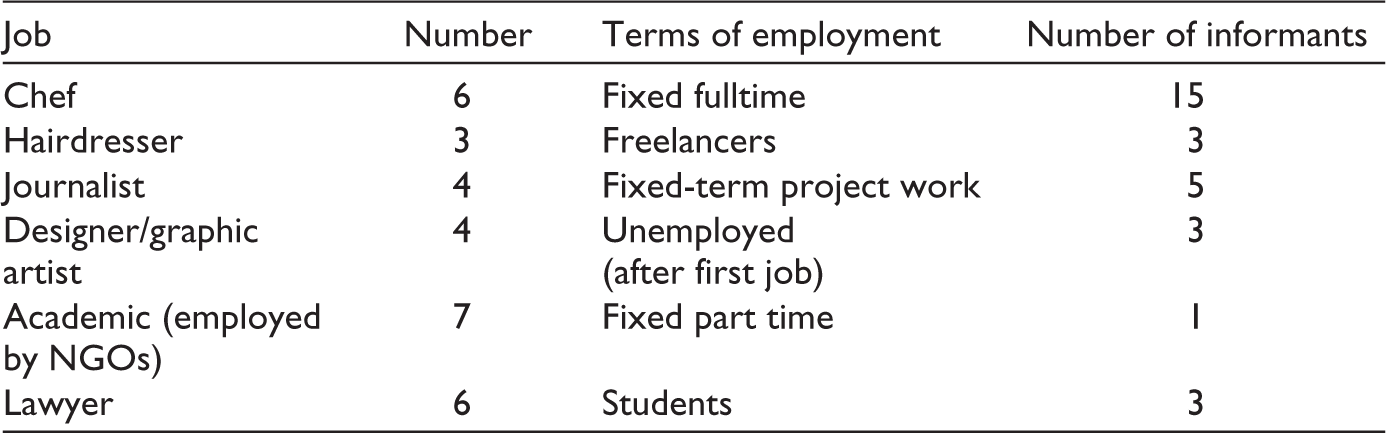
All the interviewees worked in the private sector in branches with performance-oriented work cultures: hairdressers, chefs, designers/graphic artists, journalists, lawyers, and academics employed by NGOs. This selection means that we did not include public sector employees, nor informants without a vocational or higher educational degree. There are major differences in the work performed in the selected industries, but they are all characterized by high self-reporting of mental health problems (NFA, 2017). To examine how performance-oriented work cultures are linked to problems related to mental health and well-being, the selected branches are also associated with a certain societal prestige and opportunity for social recognition. These industries were also selected because they are characterized by a high number of temporary positions, with the highest rate of such positions among journalists, designers/graphic artists, and academics (Danish Master’s Association, 2018). Among chefs and hairdressers, temporary positions are often linked to internships and trainee periods, while lawyers typically have temporary student jobs during their education and then tend to obtain permanent employment after graduation.
The interviewees were recruited via digital social platforms, trade organizations, or networks, where it was likely that the target group would see the invitation to participate in an interview. In addition, we directly contacted people, for example, through alumni networks or people in our personal networks, which proved to be the most effective method of recruitment. These people referred us to others in their networks (Pedersen, 1998). The primary reason for informants to decline the interview invitation was that they had not experienced mental health problems.
All the informants apart from two had an ethnic Danish background, and all of the interviews were conducted in Danish. Based on the informants’ own descriptions of their family backgrounds and their own level of education, the study has an overweight of informants from the middle class and upper middle class. Sixteen of the informants have a three to four-year vocational education and 14 have a five-year academic education.
As shown in Table 1, five of the informants at the time of the interview were employed in temporary positions. Several had previously been in a temporary position but had since gained a permanent position. We did not specifically search for women in the recruitment process, but many more women responded in the recruitment process and thus are significantly overrepresented. This corresponds with the fact that younger women in particular report mental health problems in the beginning of work life (NFA, 2017), and in Denmark, there are more younger women with extended higher education degrees who involuntarily find themselves employed in fixed-term positions. Furthermore, a predominance of young hairdressers, lawyers, graphic artists/designers, and academics employed in NGOs are women. We assess that the combination of these factors has contributed to the fact that the large majority of respondents were women.
Informants by Branches and Terms of Employment.
The interviews ranged from 30 to 115 minutes in duration. Most of the interviews were conducted online during 2020–2021. Twenty of the 30 young workers were interviewed twice, with approximately 6 months between interviews. This article primarily includes interviews from the first round, as these interviews were more in-depth and concentrated mostly on working conditions and problems related to mental health and well-being, which is the focus of the article. In this round of interviews, we asked open and exploratory questions (Järvinen & Mik-Meyer, 2005) such as ‘What does it mean for your well-being that you are employed in a temporary position?’ and ‘What is important for you in a job?’ The second round of interviews focused more on what had transpired in the informants’ lives since the last time, including their reflections on the general importance of work for their mental health and well-being specifically in relation to the future.
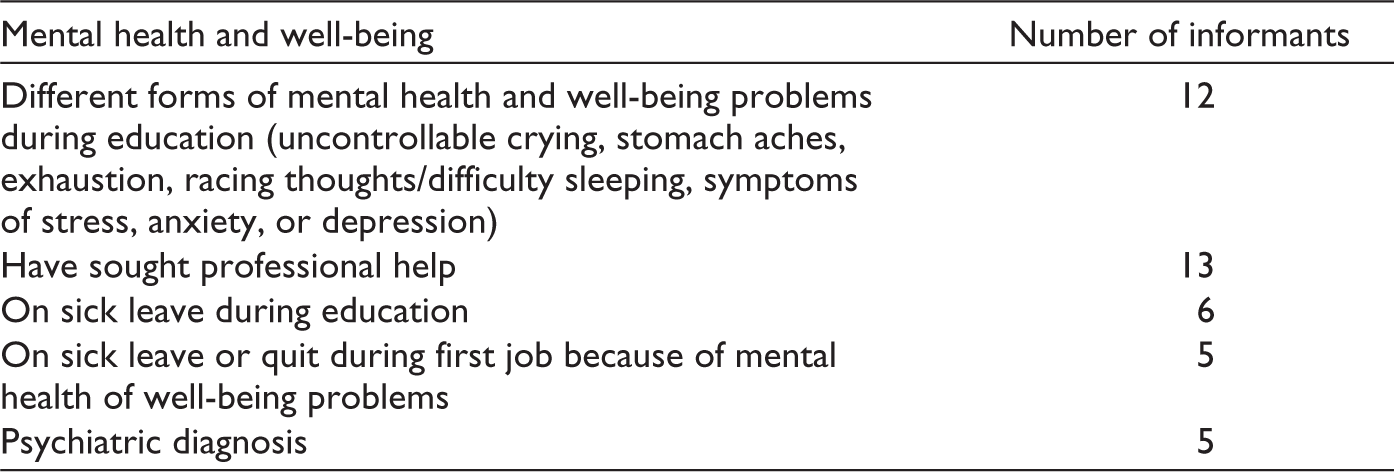
As shown in Table 2, there is variation in the degree of mental health problems among the informants, as well as in the informants’ explanations of the causes. Overall, the informants’ narratives on problems related to mental health and well-being in relation to work are expressed in different ways: from uncontrollable crying, stomach aches, exhaustion, racing thoughts, and difficulty sleeping, to tangible symptoms of stress and anxiety attacks.
Informants by Degree of Mental Health Problems.
As part of the analysis process, all interviews were transcribed and systematically coded in NVivo. The quotes appearing in this article were coded under the themes: ‘type of employment’, ‘physical and mental health reactions’, ‘a particularly bad period/situation’, ‘handling of challenges’, and ‘work identity and professional understanding’. These themes were selected because they contain quotes about the themes on which the article focuses: temporary work, performance, and mental health problems. To protect the informants’ privacy, all interviewees have been pseudonymized. The names appearing in the analysis are thus fictitious. The research follows the Danish codex for research integrity, and the informants and the interview materials have been handled in accordance with Danish data processing law. All the informants signed a declaration on consent that allowed us to use anonymized quotations from the interviews. In addition to fictitious names of persons and organizations, we deleted personal details in the quotations that potentially could be recognized. In the analysis process, we searched for patterns and variations in the informants’ experiences and narratives in a mutually dynamic and exploratory process (Haavind, 2000). This process was informed by theoretical concepts offered by Skeggs and Loveday (2012) and Farrugia (2018, 2020, 2021). The analysis is thematically divided into three sections, each of which focuses on two or three interviewees. The interviewees were selected with the aim of making it possible to ‘saturate’ the analysis with maximum biographical detail that can support and contextualize the analyses, while establishing the points of the analysis across the individual interviewees. To enable a nuanced analysis of the individual interview quotes, eight interviewees appear in this article. The quotes were selected based on a comprehensive analysis of the full material. The patterns established through the analysis appear in numerous individual variations in parts of the data material that does not appear in this article. The logic behind the selection and scope of quotes is described by Hennink et al. (2017) as ‘meaning saturation’. We have thus chosen to include as many quotes in the analysis as required to support and ‘saturate’ the points of the analysis.
Analysis
Passion, Performance Culture, and Mental Health
For the vast majority of the young people in the study, work has been of central importance to their self-representation. They say, for example, that they ‘like working’, it is ‘fun’, it ‘means a lot to them’, and that they ‘talk a lot about their work in their free time’. In the following, a young chef who works at a prestigious restaurant describes how work and hobby merge for him:
It is just as much my hobby. Yesterday, I was lying there until two in the morning watching a new show about ‘the best open-fire chefs in the world’, even though I’d been at work for 10 hours. I don’t stop thinking about it when I’m off work … I live it and breathe it. And I think that’s what you must do if you want to be happy in this industry . (Richard, 30 years old, chef)
Another young chef similarly describes his passion for his work:
I loved what I was doing. I was totally obsessed with the food I was making. I got this kick from making good food for guests and you can just feel … that it tastes good. I mean, it gave me this really wild kick inside. (Tom, 22 years old, chef)
Lisa, who is an academic and works in an NGO, says that she was driven to make a difference for vulnerable children. She had just been hired in a permanent position as project worker after a series of temporary project positions:
This is work with a ton of meaning for me … I can see the children who receive our various services and how it helps them grow … And it is always really moving. I think it’s just so amazing to work with children like this. (Lisa, 29 years old, academic)
Richard, Tom, and Lisa narrate themselves as deeply passionate about their work (Duffy, 2015). They say that they ‘live and breathe’ for their work. They use a range of affective terms when describing the importance of their work to them: they ‘love’ it, it gives them ‘a kick’, and they are ‘moved’. Through these narratives, they position themselves as passionate people to whom work is an extremely important part of their lives.
In the quotes, passion is expressed as a prerequisite for making it in the job. This passion goes hand in hand with various forms of work pressure: many unpaid overtime hours, high-work intensity, and a hard tone—where it is presented as completely normal, for example, to be harshly scolded by the head chef if you make mistakes. For many of them, the feeling of passion, meaning, and success is also the explanation as to why they are willing to compromise regarding their working conditions and working environment. Tom says:
Sometimes, when I went to bed and tried to sleep, I just keep thinking about work-related things. It got really bad in the end because you were thinking about all these little things … Did you remember to make the bread dough for the next day? Did you remember to put yeast in it?… So you just lay there thinking about what your head chef said to you during the day. If you got chewed out for something, you’d just lay there and couldn’t really sleep. (Tom, 22 years old, chef)
Tom’s strong passion for the profession and his desire to become a successful chef in a tough industry contribute to him accepting so much from an unpleasant boss. But at night, he lays sleepless in bed. He says that he is becoming increasingly unsure about himself and afraid of making mistakes that lead to a scolding. After a long period of pressure, he breaks down, and ultimately, he has to give up this work.
Lisa has very long workdays in the NGO where she struggled to get her foot in the door. She works hard and experiences that she is ‘rewarded’ for her efforts with a permanent position. But the hard work also comes with a price. Lisa gives up her sports activities because she does not have time for them due to the work pressures. Her partner complains that she works too much, and she sees her friends increasingly rarely. Sometimes Lisa experiences a kind of physical collapse, which according to her comes after periods of high-work intensity:
Sometimes, if it gets really late, I can practically turn into a ‘baby’ (laughs). Then I can barely even take off my own pants. I just want somebody to help me. But I snap out of it quickly. It takes half an hour where everything is too much … Or it’s like you’re sitting up and go completely cold. If you work until really late, you can almost sit there trembling because your body is tired.… It’s physical, where you almost get this feverish feeling. But then you just keep working through it. And then I just get up insanely early and go to bed super late. Because I am going to get everything done on time. (Lisa, 29 years old, academic)
In Lisa’s case, there is a working environment problem in relation to workload and tempo. There is a discrepancy between the volume of her work tasks and the time she has to perform them. Her strategy for handling these situations is to work her way out of the pressure. She says that it calms her to complete the tasks. She keeps working until it all repeats again. Lisa has an experience that the work intensity ‘pays off’, but she also reflects on her difficulty staying in touch with her boundaries as to when she has ‘had her fill’.
Common to Richard, Lisa, and Tom is that their strong subjective attachment to and passion for their work means that all three will go to great lengths to meet the demands that they and others place on them at work. They all narrate themselves through a strong passion for work, which becomes a legitimizing factor for them to go to great lengths before resisting a working environment in which they experience mental health or well-being problems. At the same time, they view the unhealthy working environment as something that comes with the territory in their profession. Their passionate relationship to their work means that they experience it as threatening to their raison d’être as human beings if they do not work, or if they are not successful in what they do. This pattern can also be found in Andersen (2013). According to Farrugia (2021), this can be explained by the fact that succeeding in work life is equivalent to succeeding as a human being: it gives a feeling of social acceptance and of having value as a human being. The analysis also shows that a post-Fordist work ethic in a performance-oriented work culture leads to the risk of working far beyond the limit that appears to be healthy. In our materials, there are many examples of young people who, like Lisa, develop what we call a transgressive work ethic, where they violate their own physical boundaries and work until they reach a breaking point. In all three examples above, the combination of the young people’s passion and expectations of their own performance, a poor working environment, and performance-oriented work cultures produces various negative impacts on the young people’s mental health.
The Struggle for Success: Boundless Investment
In the interviews, the young people talk about a broad spectrum of working environment issues. In addition to excessive work intensity, they also point to poor management and cooperation (e.g., ‘unpredictable bosses’ and ‘scolding’), a lack of introduction and training, and a lack of social support and feedback. There are also narratives about a lack of control at work and a lack of predictability in the performance of tasks. Some speak of experiences of harassment related to gender and pregnancy, and about exhaustion due to physically demanding tasks. One of the stories about a working environment that is both physically and psychologically taxing is Mia’s.
Mia started as a hairdresser apprentice at the age of 17. Her apprenticeship was difficult and impacted by the fact that she was on sick leave for a long period of time due to depression. But after a hard fight to complete her training, she succeeded and obtained permanent employment at the salon where she had been an apprentice. She views this as a victory in itself, as the hairdressing profession is marked by stiff competition, and this salon is the town’s largest, most expensive, and most attractive. Her training as a hairdresser does not equate to good working conditions, but Mia gains access to something else, which she describes at length in the interview: passion and pride in her work, and a feeling of success and value as a person.
I had built up a clientele. And colleagues, and it was a big salon. And there was a cool dynamic, and we had a ton of fun.… In any case, it was also a huge win because things didn’t go great for me in primary school. And when I went on sick leave [during the apprenticeship] I thought that this was never going to work out for me. So, turning it all around and coming back and being able to say that I fucking made it, that was fantastic.… It just so awesome to say that I actually am something. (Mia, 24 years old, hairdresser)
Mia’s narrative is ambiguous in the sense that, on one hand, it comprises examples of an uncertain and psychologically/physically toxic working environment that she relates to very critically. On the other hand, Mia narrates herself as specially chosen and employed at the city’s best salon. This gives her access to a self-representation with a touch of glamor and a feeling of having succeeded as a human being: ‘I actually am something’. It is not a better life in the form of job security or good working conditions, but access to a work life described through hope for a glamorous, fun, and interesting life (McRobbie, 2016, p. 15). But as time goes on, Mia feels the physical wear and tear in the form of arthritis and a water allergy so serious that she must find a different job:
It took almost a year before I finally said that now I must quit. … It was really, hard, and having to say goodbye to that and the idea of being a hairdresser.… It was really hard to say the words out loud and having to tell my boss that I just don’t think that I can keep doing this work. It was just fuck, shit, damn, you know (Mia, 24 years old, hairdresser)
The physically hard work meant that she could not maintain the idea of building a career in the hairdressing profession. She experienced this as a great loss. Mia’s need to maintain the image of herself as a successful work subject caused her to stay in the profession until she was physically unable to continue. It took tremendous working environment impacts, where she surpassed her own physical limits before she ultimately called it quits and left the job and the profession because the negative working conditions exceeded the pride and status that the profession gives access to.
Like Mia, Randi, who is a trained graphic designer, had an internship in a very prestigious and ‘Insta-worthy’ workplace. She completed the internship, but along the way, her mental health continued to decline, and she was on sick leave for a year with depression and anxiety. Nonetheless, Randi continued her studies and as a recent graduate, she obtained a position funded by public wage subsidy (a Danish program to combat unemployment by providing subsidized labour for private sector companies) in what she calls a ‘glamorous design company’. She says:
So, I start there in May and totally kick ass.… I get to decorate her [the designer’s] entire stand and her studio. So things are taking off. But I was also putting 110 percent of my energy into it. (Randi, 30 years old, graphic designer)
It is a pattern in our material that the young workers, like Randi explain, that they invest so much into their work that they willingly sacrifice their free time, friends, and family in favour of a job that is often performed under poor working conditions. ‘I put 110% of my energy into it,’ says Randi. In our material, we repeatedly see this pattern in industries where the opportunities for creative expression are not as prevalent as in the graphic design or fashion industry as described by McRobbie (2016). Here, young women invest themselves in the work: ‘As they say, “we were working crazy hours”’ (p. 109). This is described as emblematic of ‘a romantic ethic of production’ (p. 108). With inspiration from McRobbie, we can understand Randi and Mia’s investment in work as a work ethic characterized by a romanticization of an individual and boundless investment in the work, without regard for working environment legislation or workers’ rights. A pattern in our material is that through the individual transgressive work ethic, the young people gain access to positioning themselves as passionate and thereby as successful labouring subjects (Farrugia, 2019). We see this among hairdressers, chefs, graphic artists, journalists, academics, and in a slightly different form among lawyers. Among the lawyers, the ambition is not access to a better life through creative expression and glamor, but the passionate approach is present, nonetheless.
Going forward in her work life, Randi says that it is important to her that she ‘puts 80% and not 110% of herself’ into a job to avoid getting sick again. Randi thus must renegotiate the representation of herself as a work subject who, in the context of the post-Fordist work ethic, gives 110% of herself (Farrugia, 2020). As with Mia’s decision to leave the profession, it is a demanding process and Randi talks of it feeling like ‘a declaration of surrender’ and a feeling of having ‘wasted time’. Mia and Randi’s mental problems in early work life can be understood as a consequence of the pressure that arises in the combination of a performance-oriented work culture, an unhealthy working environment, and a transgressive work ethic.
Temporary Employment Conditions and Performance
Temporary employment is a condition in most of the industries where the young people interviewed work. Many described a feeling of their performance constantly being assessed. Sandra, who is a journalist, says that this creates a feeling of insecurity for her:
I can feel extremely insecure about myself and my abilities … because you’re constantly being checked and evaluated: ‘Should we keep her here, or should we get rid of her?’ So, it’s all about being the best all the time. (Sandra, 28 years old, journalist)
Sandra doubts whether she can meet her workplace’s expectations of her performance, and this doubt exists within the framework of her temporary position and limited time to demonstrate her worth. This creates high-work intensity for many of the young people we have interviewed. As Sandra says: ‘It’s all about being the best all the time.’ Many talk about how they say yes to all work tasks in the aspiration to prove their worth and being rewarded for their efforts in the form of a permanent position. Sandra speaks of insomnia, restlessness, and stress, as well as worries and nervousness about the future.
Louise, who works as a lawyer, similarly finds that in her first job as a lawyer—a temporary position to replace a person on leave—she must fight to ‘show her worth’, which she describes as ‘stressful’. Louise manages to obtain a permanent position, and she goes on to talk about the transition from temporary to permanent employee:
Now I feel like I’m one of the gang. That is, I’m a part of the team with the others, now I’m a permanent employee, now I’m just as valuable as all the others. (Louise, 26 years old, lawyer)
The struggle to obtain a permanent position is narrated as a fight to obtain value as an employee and that being included as part of the workplace community is a sign that she has gained access to this value. This gives her access to position herself as a valuable work subject (Farrugia, 2021; Skeggs & Loveday, 2012) on an equal footing with the others.
Gleerup et al. (2018) point out that a characteristic of precarious work is the difficulty in becoming integrated in the workplace and in the collegial community and that temporary employees take on more tasks and responsibilities than they are obliged to. In efforts to prove their worth, they are often focused on exhibiting dedication and a willingness to work hard (Gleerup et al., 2018; Nielsen et al., 2019b). The pressure to perform thus not only comes from the young people themselves or from performance-oriented work cultures but can also be amplified by temporary employment conditions. These individual factors often intertwine. Take, for example, the case of Trish, who recently graduated with a degree in journalism and obtained achieved a prestigious, one-year project position as a journalist at one of the major Danish newspapers:
The culture is that you have to be almost deathly ill before you call in sick … You don’t call in sick. At least not in the young generation.… It’s a culture that makes you think that I am really, really, really lucky and privileged to have this job, and that I was even offered the job in the first place. There are 200 journalists waiting in the wings to take this job if I fuck up … and if I don’t work 20% more than I should. (Trish, 29 years old, journalist)
Trish feels that she has been given a unique chance to perform and show her worth, a chance that she must not miss at any cost. Therefore, she works a lot and does not call in sick—not even when she has major surgery:
Things got really bad with my neck, so I had surgery, and I took sick leave for a few weeks. I definitely should have been on sick leave for a much longer time. In fact, I ended up going to work on morphine for months. That shows how much I didn’t feel like I was in a position where I could call in sick…. So, I actually ended up becoming extremely addicted to morphine. It ended up being a nightmare of a process, where I went to an addiction treatment centre and everything.
Trish is focused on showing her worth in a situation where she experiences that she has been given a unique opportunity to get her foot in the door at a prestigious workplace. She describes herself as passionate (Duffy, 2015), focused, and ambitious, and she does not want to call in sick at any cost, which would be wasting the unique opportunity she has been given. So she ignores her sick body, and it is signalling the need for rest, instead continuing to labour on. This quote also illustrates the relationship between age, temporary positions, and the distribution of privileges. Sick leave is described as a privilege to which Trish does not have access (Gleerup et al., 2018). We can understand Trish’s reluctance to call in sick as an attempt to maintain the value (Skeggs & Loveday, 2012) that the prestigious job has given her access to. Trish is also an example of a young person who works according to the notion that she will be rewarded in the future for working such long hours (Duffy, 2015). Trish is in an industry with an intensely performance-oriented work culture, and she is focused on living up to her own and others’ expectations. She clearly exceeds her physical limits to such a degree that she ends up with an addiction to painkilling medicine that requires professional treatment. As previously described, this can be called a ‘transgressive work ethic’. Trish’s case is one of the most extreme cases among the interviewed young people. Nonetheless, it illustrates how much is at stake for young people who work in performance-oriented work cultures marked by intense competition to obtain and retain a job in industries where temporary employment is widespread. Sandra is also a journalist, and at the time of the interview, she was employed on a 6-month contract at a TV station:
I haven’t ever had permanent employment, so I don’t know if it would change if I wasn’t in a temporary position. But as things stand now, I can get really hysterical if I make a mistake. Sometimes I sit there and hit myself over the head because of it … I’m not the type that obsesses about perfection at all! But in journalism, I’m the most psychopathic perfectionist there is. That’s not actually what I’m like, but that’s how I am in this industry … So, I just get a little like: ‘Okay, but I just want to fucking be number one at everything!’ (Sandra, 29 years old, journalist)
Sandra describes herself as a person who is very ambitious and ‘loves her work’ (Duffy, 2015). She describes how the industry, the competition, the scarcity of positions, and the performance-oriented work culture have shaped her. But it is not an unambiguous self-representation, as she talks about the contradiction between the work subject and the person she is ‘in reality’. She describes a feeling that work has corrupted her to such an extent that she finds it difficult to recognize herself. In reflecting on her own process of becoming a work subject, Sandra negotiates with herself about what actually has value for her, and how this harmonizes with the value she is fighting to achieve in the labour market (Skeggs & Loveday, 2012). The examples illustrate that temporary employment contributes to strengthening performance-oriented work cultures.
Discussion
In this article, we have examined how performance-oriented work cultures and temporary employment impact mental health and well-being for workers who are new to the labour market. We recruited interviewees who are in work situations that can shed light on this subject, and in this selection of interviewees there is a clear predominance of women. In the article, we have not chosen to analyse the significance of gender to the subject of focus. Krusborg et al. (2021) argues that gender has an impact on graduates’ narratives on early work life experiences. In their study, young female employees were more likely to talk about work-related dissatisfaction compared with male interviewees. Since participants in our study were recruited on the basis of having experiences with mental health problems, both the male and the female participants talked about work-related dissatisfaction and mental health issues, and thus, we did not find this gender difference. However, Krusborg et al. (2021) suggest that reporting dissatisfaction in early working life might be more legitimate for women, wherefore it may be easier for researchers to recruit women for interviews. This might explain why more female than male young workers signed up for participation in our study. In general, the analyses in this article cannot be taken as representative of how all young people regardless of gender and other social, material, and individual factors.
What characterizes the young people who form the empirical basis for this article is that they have all experienced different forms of mental health and well-being problems at work, while at the same time their work has been of crucial importance to their self-representation. We chose to interview employees from businesses with performance-oriented working cultures in the private sectors. With this selection, our results do not cover all the welfare professionals in the public sector who also is suffering from different forms of work-related mental health and well-being problems (NFA, 2018). Our study does not cover unskilled workers, either.
The combination of temporary and precarious employment conditions and performance-oriented work cultures means that it will be difficult for many of them to become the successful work subject they aim to be. As this group of newly graduated young people also work in stressful working environments, they are more prone to experience mental health problems in their first job. The analysis thus illustrates how the struggle of young workers to become successful labouring subjects (Farrugia, 2019) becomes a contributing factor to mental health problems in early work life. This is similar to Andersen’s (2013) analysis, which describes how not succeeding in a work task can be experienced as ‘threatening to one’s self-understanding’. This is also in line with the study by Bakken et al. (2018), who describe how a critical factor in young people’s psychosocial health problems is how young people ‘interpret’ the pressure they experience. The extent to which something in the young person’s life is experienced as pressure ‘is shaped by [their] values and goals—how important it is to them to succeed’ (Bakken et al., 2018, p. 52). When the young workers in this article experience different forms of defeat and mental health problems, the very goal of succeeding will amplify the pressure they experience. The struggle for and the goal of maintaining a self-understanding as a valuable and successful work subject amplifies the existing pressure from an already stressful working environment. The negative effect of a stressful working environment is amplified, so to speak, through the struggle to avoid losing positive value as a work subject. The preoccupation with succeeding in the job means that instead of saying stop, they continue despite physical and mental signals that they are exceeding the limits of what they can withstand. As is the case in the study by Nielsen et al. (2019b), the young people in this article are acting strategically as an attempt to maintain their value as workers. In this process, they are prepared to put their own physical and mental condition at risk. The same applies in this article. But unlike the group of young people in the study by Nielsen et al. (2019b), the young people in this article are driven by their passion and need to be recognized as a valuable human being. With this often follows a high-work intensity. The article thereby shows that young people’s transition from education to work life can be understood as a struggle for value (Skeggs & Loveday, 2012), where the individual struggles to win recognition as an individual with value and thereby struggles to avoid becoming positioned as a person without any value for society and the work life of which the young person is part. Workplaces or industries with performance-oriented work cultures can thereby appear very attractive to some young people, yet the combination of a competitive environment and many temporary positions can be highly detrimental to their mental health. They are so preoccupied with succeeding and appearing as successful graduates that they develop a transgressive work ethic that contributes to making them sick. Farrugia expresses harsh criticism of the post-Fordist work ethic and calls it ‘a fantasy of self-realization’ (2021, p. 138). The analyses in this article provide support for Farrugia’s critique of today’s labour market. The article shows that self-realization through work can be fragile—particularly when the work is positioned at a crossroads of temporary employment and performance-oriented work cultures with heightened separation mechanisms. In other words, the analysis shows that it can have negative impacts on mental health and well-being when young people must navigate in an uncertain labour market while continuously evaluating and assessing themselves according to dominant political and economic rationales about what market value they constitute.
Conclusion
The transition to work can be a difficult life period for young people and an increasing number of experiencing mental health problems in early work life. Therefore, in this article, we focus on some of the conditions that can explain the rise in young worker’s mental health problems in early work life. The combination of the struggle to achieve success in work life, performance-oriented work cultures, and the ever-increasing number of temporary positions is described in an article on BBC Worklife (Lufkin, 2021) as a ‘toxic combination’. We find that it is precisely the combination of the above factors in these young people’s work life that appears to be detrimental to their mental health and well-being. Furthermore, this combination appears to be even more harmful in connection with early work life. Thus, the title of this article: ‘A Toxic Combination: Performance, Temporariness, and Struggling for Success in Early Work Life.’ The article shows how young people’s mental health problems in early work life are linked with the struggle to become a successful and valuable worker in a time, where work is a crucial arena for self-realization. We have more specifically shown how young people are formed as labouring subjects within uncertain and temporary employment contexts and performance-oriented work cultures. The transition to the labour market thus constitutes a period of intensified performance-oriented norms and ideals. The first years in the labour market appear as a gruelling test of whether the young people succeed in establishing a foothold as a successful work subject. At the same time, the young people view their early work life experiences as a signal of what work life will hold for them in the future. This can create enormous pressure on the individual, as the opportunities to pursue career ambitions are limited in many of the jobs, they obtain early in their work lives. In the temporary jobs, they often have limited opportunities to show their worth, make long-term plans, or advance. The article shows that the poor working environment and employment conditions are often triggering factors for mental health and well-being problems, which thereby makes it very difficult to maintain their self- representation as successful and ambitious. If the individual young person does not obtain permanent employment, the position as valuable work subject and thus the opportunity for self-realization through work is at risk. The article thereby shows that young people’s transition from education to work life can be understood as a struggle for value (Skeggs & Loveday, 2012). This struggle for value must be considered as an important factor in young people’s mental health problems in early work life.
Footnotes
Declaration of Conflicting Interests
The authors declared no potential conflicts of interest with respect to the research, authorship, and/or publication of this article.
Funding
The authors received no financial support for the research, authorship, and/or publication of this article.