




Abstract
This article examines the spatial dynamics of youth educational subjectivity formation. Drawing on qualitative interviews conducted in sparsely habited northern Finland, the article focuses on the experiences of 15–16-year-old young people making choices regarding post compulsory education. Employing a sociospatial-relational framework, the paper explores how youth educational subjectivities are constructed in relation to educational policy discourses and structural opportunities, as well as young people’s own imaginaries of life and education in specific places. In attending to spatiality in a regional context, the analysis brings into view multiple spatialities that are present when young people are making choices regarding education and mobility. The article concludes that the formation of young people’s educational subjectivity is best understood as a relational process that is inherently a sociospatial one.
Introduction
Within the past few decades, many countries, including Finland, have witnessed a gradual transformation toward a knowledge-intensive and high-technology-dominated economy. Scholars have shown that this transition is of great significance for young people’s citizenship and subjectivity formation (Mitchell, 2018; Moisio & Kangas, 2016). Educational policies often construct young people as ‘mobile’ and ‘flexible’ individuals who are capable of and willing to take part in the global economy (Mitchell, 2006). Previous research has also illustrated how the transforming economy and concomitant processes of regional and educational restructuring have created structurally and spatially unequal opportunities for young people’s participation and educational paths (Corbett, 2013; Farrugia, 2016; Kiilakoski, 2016). Depending on one’s place of residence, local educational opportunities, family background, and ties to the local community, for example, some youth are in more favorable positions to make decisions that are in line with the dominant educational imperatives (Armila et al., 2018; Rönnlund, 2020).
The present article contributes to the ongoing discussions within the fields of geographies of young people, educational studies, and youth studies on the complex relationship between young people’s educational subjectivity, mobility, and spatial transformation, specifically extending the ongoing discussions on spatiality as a critical dimension of young people’s lives (see Farrugia & Wood, 2017). The present article seeks to further explore the linkages between spatiality and youth educational subjectivity formation in a regional context. Although previous research has focused on topics such as student mobility (Smith et al., 2014) and the production of specific educational subjects in transnational and national contexts (Mitchell, 2018; Moisio & Kangas, 2016), especially in the context of higher education (Waters, 2017), less attention has been paid to the spatiality of educational subjectivity formation. Furthermore, less attention has been paid to the regional differences in earlier phases of the educational path of an individual before higher education.
Subjectivity is understood here in a Foucauldian manner as a double-sided concept referring to ‘both being subjected to and coming into social existence as a subject’ (Wells, 2014, p. 263). From the Foucauldian perspective, educational policies as tools of governance aim at shaping the conduct of young people and constitute educational subjects, yet those being subjected also actively take part in the subjectification processes (e.g., Davies, 2004). Therefore, subjectivity formation is an ongoing process of being subjected and actively becoming a subject in relation to other people, as well as to the wider political, societal (Williams, 2016) and spatial (Pile, 2008) conditions. In line with this literature on youth subjectivity, I approach young people’s educational subjectivity formation as a situated and relational process that is affected by spatiality and relationships between different places and people (cf. Massey, 2005). In conceptualizing spatiality, I draw on Massey’s (2005) understanding of space as relational, being produced through connections and relations. To sum up, I specifically look at the process of subjectivity formation from the perspective of spatiality, which is understood as relationally constructed.
Drawing on interviews that were conducted in northern Finland, the current article focuses on the construction of youth educational subjectivity and experiences of 15–16-year-old youths in their final year of comprehensive school. The approach resonates with Mitchell’s (2006) call for more work on education and governmentality, which entails not only the top-down but also bottom-up realm. Thus, the bottom-up realm is approached through what could be called grassroots-level practices and experiences (Paju et al., 2020), to grasp ‘the processes and forms of subjectivity formation of the – individual over time’ (Mitchell, 2006, p. 390).
I focus on the ways in which young people, living in specific regions, negotiate their educational subjectivity in relation to educational policy discourses and structural opportunities. In examining how young people talk about their educational choices and related issues of geographical mobility, I consider their negotiations as ‘spatial practices’ (Pile, 2008) that both contribute to and allow making visible the formation of youth educational subjectivity. These spatial practices are viewed here as the discursive production of educational selves. Specifically, I attend to the instabilities and tensions brought about by educational policies in young people’s lives in a specific regional context. In doing so, the present study brings into view how educational policy and structural inequalities may be negotiated with and discourses resisted, subverted and changed, consequently examining how educational subjectivity is constituted through such discursive work (Davies, 2004).
Moreover, approaching youth educational paths in a regional context allows for paying attention to the spatialities that affect young people’s negotiations in terms of both urban and rural and something in between: it allows attending to multiple spatialities that have mostly been overlooked in previous studies focusing either on national-level analyses or that categorize young people as rural or urban based merely on their place of birth or residence, for example. A regional focus on northern and sparsely habited parts of a Nordic welfare state provides an interesting case. First, although social and spatial equity have been regarded as key principles of the Finnish education system, the role of spatial disparities and family background as underlying factors of educational attainment have increased (Bernelius & Huilla, 2021). Second, statistics show that the geographical accessibility of post comprehensive education is especially low in rural northern areas of the country (Ministry of Finance [MOF], 2020) that are sparsely habited and far removed from the capital city and from many institutions providing upper secondary and higher education.
The next section discusses the intersection of spatiality and youth educational paths from the perspective of educational subjectivity formation, highlighting how the educational and mobility imperative has become central in understanding the subjectivity formation of young people. Second, to contextualize the empirical analysis, Finnish educational policy and young people’s post comprehensive education are discussed. Third, in the regional context, the material and methods of the study are introduced. In the analysis, I explore the multiple spatialities that are present in young people’s educational negotiations and how they entwine with the processes of educational subjectivity formation. I conclude by arguing that young people’s educational subjectivity formation can be understood as a relational process that is inherently a sociospatial one.
Educational and Mobility Imperatives Entwined
Previous research on young people has dealt with two intertwined imperatives that are present in young people’s lives. On the one hand, political and societal pressure combine in a strong educational ethos steering young people to secondary education. In the restructuring processes of the state, education now takes a key role in fostering skilled and mobile citizens to suit the needs of the national economy and competitiveness, as well as personal well-being in times of global competition (Johannesson et al., 2002). On the other hand, there is the imperative of being mobile (e.g., Corbett, 2013; Farrugia, 2016; Forsberg, 2019). Research findings from the Global North have underlined that structural inequalities such as the centralization of educational institutions and lacking educational opportunities frame young people’s lives and educational choices, especially in regions that are considered rural and peripheral (Forsberg, 2019; Kiilakoski, 2016). Often, the lack of suitable educational possibilities compels young people to relocate or reconsider their educational aspirations (see Armila et al., 2018).
Besides structures and perceived possibilities, researchers have pointed out the cultural and symbolic hierarchies that underpin young people’s mobility and educational choices (Armila et al., 2018; Farrugia, 2016). That is, besides a young person’s attempt to overcome structural inequalities, being mobile has been argued as having become a cultural expectation and normative assumption that contributes to forging mobile subjectivities (Adams & Komu, 2021; Farrugia, 2016). The mobility imperative can be perceived as manifested in ideas and imaginaries that being mobile and moving away from one’s rural or ‘remote’ hometown equals ‘getting on in life’ (Sørensen & Pless, 2017). In other words, moving away is moving forward (also Pedersen & Gram, 2018). Previous studies in the field of youth studies have underscored how young people describe the city and urban areas as ‘the place to be young’ (Farrugia, 2016), suggesting that these places offer a more diverse range of attractive positions and subjectivities for young people than their rural hometowns (Sørensen & Pless, 2017).
Wider societal discourses around places and mobility, too, have been shown to play a key role in young people’s educational decision making. Drawing on Massey’s (2005) notion of relational space, Rönnlund (2020) claims that educational and spatial discourses affect young people’s educational choices. These discourses not only form, but also make visible the relations between people and places. The discourses can have local manifestations and differences between and within regions, based on local structural conditions such as educational or employment opportunities, for example (Rönnlund, 2020, p. 11). Similarly, Forsberg’s (2019) study, in which she analyzes young people’s educational transitions in a regional context in rural northern Sweden, demonstrates the importance of sociospatial discourses for young people’s educational decision making. Forsberg argues that ‘the proximity to certain labour markets or educational institutions is an important element in individuals’ rationalization of valid alternatives’ and claims that youth educational choices are to be ‘understood in relation to “what counts in society”, where higher education and certain professions are associated with a competitive advantage’ (Forsberg, 2019, p. 18). Forsberg clarifies that, while working in the local mines, for example, might be imagined as a good job in one place, it is not equally valued in Swedish society as a whole. Thus, constructing subjectivity in relation to the idea of staying in place might require youth to take an alternative stand on the cultural expectation of leaving and national educational policies intended for fostering highly educated and skilled workers.
With the relational understanding of space in mind, one should consider the relationships and connections between people and places in young people’s lives that are entangled in youth subjectivity formation (cf. Massey, 2005). Besides wider political and societal conditions, young people’s family, peers, and other relationships inform young people’s educational choices (Tolonen & Aapola-Kari, 2022), as well as the ways in which young people come to think of education through the values, expectations, and perceptions of what is possible or desirable (Williams, 2016). As Holloway et al. suggest, ‘young people are not simply independent social actors; young people’s ability to exercise agency emerges in the context of inter and intragenerational dependencies which, depending on the context, can open or foreclose possibilities for meeting their current and future needs’ (Holloway et al., 2019, p. 463).
From a relational perspective, it is important to note that young people form connections not only within their localities, but also with their localities (Juvonen & Romakkaniemi, 2019) and places elsewhere as well. Relationships, therefore, contribute to informed choices regarding education or mobility, in the end shaping what is recognized as acceptable or desirable forms of educational subjectivity (also Williams, 2016). Therefore, the present article maintains that the relational understanding of space allows for studying young people’s educational subjectivity formation in relation to both wider educational policy discourses and structures and the young people’s relationships and imaginaries of life and futures in a specific place and time.
Upper Secondary Education and Youth Educational Paths in Finland
In Finland, the ninth grade is the final year of comprehensive school and moment when 15–16-year-old youth must make certain choices regarding life and their further studies. The upper secondary education consists of two-to-three-year long tracks: the general upper secondary track and vocational education and training track. General upper secondary is generally understood as the academic path, which is connected to success in earlier studies and leads to higher education, whereas vocational is often considered to prepare young people for working life (Ågren, 2021; Tolonen & Aapola-Kari, 2022). Spots for studying in upper secondary education are applied for in a joint application that is a national procedure taking place at the end of the academic year.
The goal set by the Finnish Government is that, by the year 2030, 50% of young adults will have acquired higher education (Government Programme, 2019). Moreover, a recent government reform raised the school-leaving age from 16 to 18 to cover upper secondary education from 2021 onwards. The decision was done in the name of enhancing educational equality and social inclusion and increasing educational attainment levels and employment rates (Government Programme, 2019).
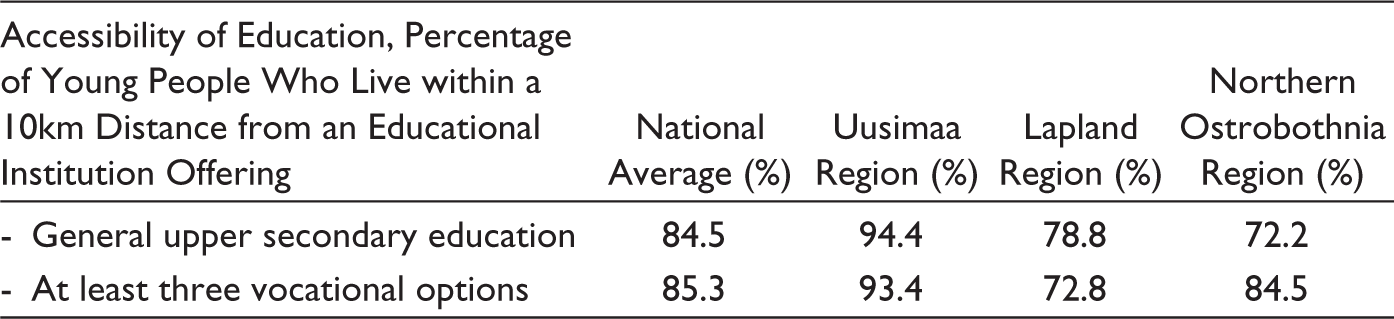
Thus, the societal and political relevance of upper secondary education in Finnish society has increased. Attending formal education has become an important indicator of young people’s social inclusion (Isopahkala-Bouret et al., 2014). In Finland and other Nordic countries, there has been a tendency toward cutting down the number of educational institutions and centralizing educational institutions in urban areas and city regions (Beach et al., 2018). In Finland, this has resulted in decreased accessibility of upper secondary education, especially in the sparsely habited eastern and northern parts of the country (Bernelius & Huilla, 2021, pp. 89–95). Statistics show that there are regional differences in geographical accessibility of upper secondary education, with general upper secondary education still being more accessible than vocational throughout the country (Table 1). Educational opportunities are more plentiful in the urban areas, whereas, in the rural municipalities, there is often only one general upper secondary and often a very limited number of vocational possibilities in the upper secondary level. There are, however, some municipalities with neither vocational nor general upper-secondary institutions available (MOF, 2020).
The Accessibility of Education in the Study Area of This Article in Northern Finland (administrative regions of Lapland and Northern Ostrobothnia) is Lower Compared with National Average and the Capital City Region in Southern Finland (Uusimaa).
Moreover, with the educational network being cut down, the ideals of social mobility and acquiring higher education underpinning recent government reforms have become increasingly intertwined with geographic mobility and the various economic and social resources that enable it. Especially for the young people residing outside the urban growth centers, the centralized educational network and weaker transportation services together with the educational demands of the knowledge-based society have set up both structural and cultural expectations for outmigration (Adams & Komu, 2021; Armila et al., 2018). Supported by policies and structural mechanisms such as student allowances and youth housing, Finnish youth tend to move out of their parental homes 10–12 years earlier than the youth in Southern Europe, at the age of 22 on average (Karlsdóttir et al., 2020, p. 34).
From a regional perspective, the restructuring of the educational network, economy, and population has led to considerably higher educational attainment levels in the bigger cities that are more concentrated in southern Finland, which is where the higher education institutions and labor markets for the highly educated are also located (Kettunen & Prokkola, 2022). Also, the Finnish population is heavily concentrated in the southern centres and city regions. The two northernmost regions, Lapland and Northern Ostrobothnia, where the fieldwork for the present study was conducted, are among those regions where youth outmigration has been the strongest. Differences within regions exist, and the rural municipalities have especially experienced population decline (Karlsdóttir et al., 2020, p. 36).
Material and Methods
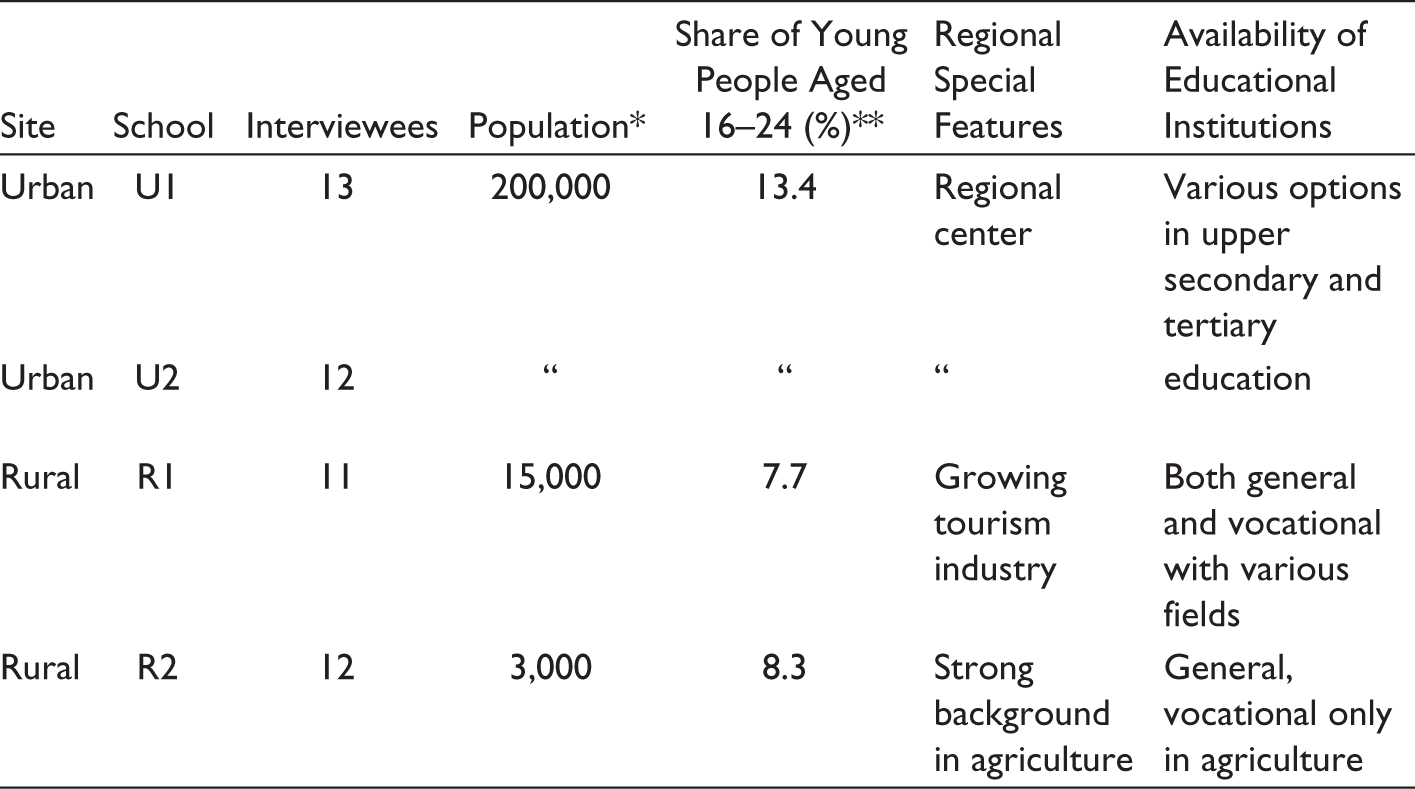
The research material utilized in the current article consists of 48 qualitative interviews with youth in northern Finland, through which I approach young people’s educational negotiations and subjectivity formation. To study the multiple spatialities of youth educational subjectivity formation, the fieldwork was conducted in three research municipalities in sparsely habited and northern parts of the country in the spring of 2019. One urban and two rural municipalities with differing demographic, livelihood, and geographical structures were selected for the study (Table 2).
Summary of Interviewees and Research Municipalities.
Following ethical research principles of the Finnish National Board on Research Integrity (TENK, 2019), institutional research permissions and informed consent from the youth and their parents were obtained. The research participants were informed about the study and interview themes beforehand. Qualitative interviews with 48 youth (28 girls and 20 boys) constitute the core of the research material. Participation was voluntary, and the interviewees were recruited with the help of local teachers, with the aim to get a diverse spread of students according to different educational aspirations and gender 1 . The interviews were conducted individually as semi structured interviews (Heath et al., 2009) during school days. The interviews lasted between 30 minutes and 1 hour and covered a wide set of thematic questions related to family background, lifestyle, educational aspirations, and future visions, with an emphasis on the role of place within these trajectories. All names mentioned are pseudonyms to protect the anonymity of the research participants.
The material utilized in the present article allows for an analysis of youth subjectivities in ways that are necessarily partial (see Thiem, 2009). First, the interviews as a method and as a research setting are a specific site in and through which young people voice their opinions and discursively produce their subjectivities (Jackson & Mazzei, 2008). Second, it is important to bear in mind that formal education is not the only, yet central, institutions in relation to which contemporary young people build their sense of self and educational subjectivity. Although partial, the interview material can show the processes and specificities of youth educational subjectivity formation and intertwined spatial and educational negotiations.
Negotiating Educational Paths and Mobility Between Rural and Urban and Beyond
This section looks at how young people’s educational and spatial negotiations are constructed and simultaneously shaped in and through social and spatial connections. Here, categories like urban and rural, North and South, and academic and vocational are not to be taken as empirical categories but to conceptually organize the complexity of educational and spatial discourses that emerged through the interviews. Thus, the analytical focus is on the ways in which space and mobility are entangled in the ways in which young people plan and speak of their educational paths and, by doing so, construct their educational subjectivity in a regional context.
Education in Places ‘Big’ and ‘Small’
Spatiality appeared as a central aspect in relation to which the interviewees in northern Finland spoke of their educational paths already at the ages of 15 and 16. Although the national educational policies state that ‘young people choose their educational pathways based on their interests, skills and success in previous studies’ (Finnish National Agency for Education, 2019), the analysis of the interview material shows that young people make educated choices as part of wider negotiation processes related to their perceived possibilities and different educational opportunities. For example, the interviews can be seen as manifesting the educational imperative that steers young people to acquire education yet bringing to the fore the question of suitable educational opportunities:
If you live in a city, there are a lot more options and different fields, and you don’t have to move somewhere else. If someone here is interested in a specific field offered elsewhere but don’t want to move away, they might easily end up staying here and studying something that doesn’t interest them. / Katariina R1
2
In the excerpt above, Katariina’s comment makes visible the experienced lack of educational opportunities in rural regions and smaller towns and how it complicates young people’s decision making processes. The comment also conveys how young people acknowledge the structural inequalities affecting their educational decisions and mobility. Whereas young people in the urban municipality perceived more options for upper secondary education and put more weight on their own grades and success in their studies in relation to their educational path, for young people in rural areas and small towns, it was more about what kind of options were considered available in the first place. Some of the interviewed youths spoke how they felt that they were obliged to choose from the narrow educational options in their hometown because they did not want to or have the resources to move elsewhere (see also Armila et al., 2018) and how this might lead to a situation of choosing a field that was not the first choice but simply an available one. Choosing among the local educational options, however, was not always a straightforward choice either:
I’m going to the local general upper secondary school. But I have to see if I want to stay there and go through it. – I always thought I don’t want to go to general upper secondary because I don’t want study so long. – It is the easiest option; I don’t have to move out of home. / Vilja R2
Vilja’s comment brings to the fore the hesitation of whether the chosen educational path is something that they want to pursue in the end. Nevertheless, the local option might be chosen because it is considered the easiest or safest and does not require moving away.
The experienced lack of educational opportunities was often reflected on in the young people’s ideas regarding mobility. There were also those young people who wanted to continue their studies elsewhere. Staying in northern Finland, either in urban or rural regions, was not always considered an especially attractive option because of the lack of suitable educational possibilities (see also Rönnlund, 2020). Indeed, the youth seemed to construct mobile subjectivities to respond to the educational imperative and lacking opportunities. Although some of the interviewed youth did consider local options at least for post comprehensive education, most conveyed the understanding that geographical mobility is, ultimately, a prerequisite for accessing more diverse educational possibilities and entering the spatially centralized labor markets. Therefore, mobility was a way to overcome structural disadvantages. Thus, the young people’s insights also brought to the fore the connection between geographical and social mobility in their educational negotiations (see also Tolonen, 2005) because bigger cities offer more structural opportunities for the highly educated. Moreover, especially for the interviewees in the urban municipality, the youth’s educational paths were not bound to the Finnish state, but they could also imagine their educational paths beyond the Finnish state territory and abroad as well.
The interview material, therefore, suggests that young people think about their educational paths not only in relation to wider educational and societal discourses and local possibilities, but also with respect to the specific imaginaries of life and education in specific places (also Kiilakoski, 2016, p. 2) and what it means for them in the future. Many interviewees brought to the fore the cultural aspects and the ‘real and imagined social and economic differences’ (see Eriksson, 2008, p. 369) that they appeared to connect to different places and mobility. Furthermore, what surfaced in the interviews was how, in northern Finland, it is not only the young people living in rural areas who experience a lack of opportunities in their hometowns. The interview with Tuukka implies that also some of the young people in the urban municipality, which can be considered on a Finnish scale a big city with a university and more than 200,000 inhabitants, considered their options narrow in relation to southern Finland:
All the events are closer there, and there are more people in southern Finland and more like everything, services and such, and maybe there might be more workplaces, too. / Tuukka U2
The interviews conveyed the understanding that the urban environments in the North were not considered sufficiently ‘big’ or ‘urban’ by some of the youth. This could be seen in the ways in which they spoke of their educational choices and future visions as well. The young people often emphasized the differences between the North and South in ways that mirror the processes of urbanization and centralization of population and services in southern Finland. Although there are urban areas in northern Finland as well, for the youth in the present study, it was especially the southern urban areas that seemed to provide a more diverse range of educational subjectivities compared with the northern parts of the country (cf. Sørensen & Pless, 2017). In some of their accounts, it seemed that the preconditions for a ‘youthful’ and ‘good’ life were also located mostly in urban southern areas and bigger cities:
Well, I was hoping I could go to upper secondary school in Helsinki, like a year ago I thought so. I have lots of friends there, and maybe, I got like megalomaniac as I thought I am here in a small city and I’d like to be in a bigger (city). But then, I have learnt to think that it wouldn’t be any better; you always want to go elsewhere. / Alina U1
Alina’s comment conveys a culturally compelling idea that educational opportunities and life itself would be better in a place that she considered a ‘bigger’ city (also Adams & Komu, 2021). For the young people, it was often the big cities like the capital city of Helsinki in southern Finland that would provide more structural possibilities but also related imaginaries of youthful urban life rather than the northern or more rural regions. Alina’s usage of the word ‘megalomaniac’, however, can be seen as reflecting and contesting the symbolic hierarchies of different places. Thus, her comment also exemplifies how young people’s educational decision making processes involve a continuous negotiation of being here and being elsewhere and sometimes questioning one’s expectations and imagination of being a young person in a specific place.
Academic and Vocational Options ‘Here’ and ‘There’
Choosing between the vocational and the academic track appeared as a central conjuncture when young people spoke of their educational paths and mobility. If one is to follow the ideal, straightforward path from secondary to higher education described in educational policies, in the urban areas, where also tertiary educational institutions are located, choosing the general upper secondary track does not necessarily mean moving elsewhere:
I am going to the international high school; I’ve heard it has an emphasis on the natural sciences. – Well, there were no other options. I was thinking about all the general upper secondaries close by. – There are many options in vocational, and in general upper secondary, there is much to choose from, whether you are interested in something special or not. There’s always something for everyone, and that’s quite nice. / Toni U2
The interview excerpt above illustrates how young people living in the urban municipality considered that there are more diverse options both in vocational and academic paths, including general upper secondary schools with a special emphasis on and wider range of courses. In rural municipalities, however, there is often only one option, if any. Furthermore, in rural municipalities, taking up the academic path might enable only a short-term stay for three years of general upper secondary education, after which the youth would need to move elsewhere for further studies. Often, the interviewed young people with academic endeavours seemed to comply with the mobility imperative as a part of their educational negotiations. Acquiring education was considered ‘an investment that made sense if one were to leave the community’ (Corbett, 2013, p. 277), as Oona in one of the rural municipalities explains:
It is mostly those vocational fields that you will find a workplace in here. If you go to the general upper secondary, you’ll probably move elsewhere to continue studies after that. / Oona R1
The excerpt above exemplifies how the general upper secondary was treated as the academic track after which young people were expected to and often themselves expected to, head to tertiary education in the city instead of finding a study place or workplace in the rural ‘here’. However, there were also those young people who were thinking that they would first go to the local general upper secondary education and then continue their studies in the local or nearby vocational school because these are not mutually exclusive paths. Furthermore, especially the young people in rural areas brought to the fore an understanding that some educational paths and following careers might not enable them to stay in the rural ‘here’ but in fact would require them to be mobile (also Forsberg, 2019). This was visible when young people contemplated the connections between their educational choices and place of residence:
I wouldn’t stay here in the end. And the job that I want, there are no jobs in that field here. / Aili R2
Aili was thinking of continuing her studies in the general upper secondary in a neighboring town and then becoming a building engineer, and she did not think that it would be possible to stay in the rural region if she chose that career path. Being mobile does not always mean moving far away, and in Aili’s case, she thought that a bigger city nearby her rural hometown would be the best option.
Young people’s educational and spatial negotiations were entangled with ideas of certain spatialized paths: whether particular ways of living or certain job opportunities were considered possible in the local area. Some youth in the present study spoke about their educational paths in relation to the local place and local labor markets as well. Correspondingly, Rönnlund et al. (2018) show in a Swedish context how young people residing in regions where educational attainment levels were lower and the local employment opportunities were primarily based on unskilled manual and service work had the tendency to choose the vocational track more often than in places where educational attainment levels were higher and labour market opportunities more diverse. Similarly, in the present study, the young people in rural areas chose fields like forestry or the service sector, which have traditionally been strong employers in the region:
I applied to study places here in northern Finland, first is vocational qualifications in forestry in a neighboring town, then electricity and mining. – Well, I’m interested in forestry. My cousin is in that field, and he said it’s a nice job. I have relatives there [in that field] as well. And the forest, I’m really like a boy of the forest, I like to be there by myself. – It is possible to study that field elsewhere, too, but I haven’t checked the places further away. / Mikko R1
As the excerpt above shows, educational decision making and choosing the field is based not only on structural opportunities and labor markets, but it also entwined with young people’s own experiences and the local environment—what they consider is available or suitable for them and where. Mikko, for example, listed only vocational options in the educational institutions nearby rather than elsewhere. Furthermore, for him, choosing an educational path in forestry would enable him to do what he likes and is used to doing in the local area, that is, being in the forest.
Connections: ‘Home’ and ‘Away’
The young people referred to various social and spatial connections when they spoke of their educational decision making processes. Social connections seemed to be important in the construction of what kind of educational paths the youth considered acceptable or possible to undertake. For the interviewees, social connections within the place also appeared important, especially those interviewed youth who were to stay in their hometowns for post comprehensive education and in the future as well (also Adams & Komu, 2021, Rönnlund, 2020). Olavi’s interview exemplifies the critical role of social connections, family members, and friends in decisions regarding mobility and staying home:
If I went somewhere like Helsinki, I wouldn’t know anyone there. I’m not scared, but it makes me anxious; of course, it would be new and interesting, looking for new friends. – It’s the friends and family that keep me here. / Olavi U1
The excerpt above also conveys how moving to a new place to pursue education raises many questions that are, besides the educational field or available opportunities, connected to changes in everyday life and leaving behind one’s familiar surroundings. Many young people’s decision making processes, like Olavi’s here, were related to thinking about the role and location of their social connections. Thus, for the interviewed young people, educational decision making processes are about pondering not only the structural, but also emotional aspects of mobility (e.g., Farrugia, 2016).
Furthermore, the young people’s interviews suggest that, sometimes, social connections outside the home region were at least equally important in negotiating mobility and planning educational paths elsewhere. Family and relatives living elsewhere appeared as important connections for the ones who wanted to move to pursue their educational aspirations:
I applied to the vocational school, vocational qualifications in forestry – or second options is logistics. – Rovaniemi is where I want, nowhere else. – All my old friends are there and so on. – I would go and live with my dad. From where he lives, there is a bus connection to the school. / Veli R2
The excerpt above exemplifies how the multifaceted role of parents or friends may be important when young people negotiate interrelated questions of mobility and education. In Veli’s case, for example, his father and brother lived in a slightly bigger city in northern Finland, where Veli was planning to move to pursue vocational education that was lacking in his current hometown. Such arrangements in the interview material also imply that the youths utilized social connections in ways that could be understood as relational responses to the structural inequalities and mobility imperative they faced in negotiating their educational choices. Social connections, therefore, helped the youth who were to make big decisions at a relatively young age.
Not all young people, however, had equal opportunities to utilize such connections. Those young people who had given up the idea of moving elsewhere for secondary education often referred to conversations with parents who either did not have the financial resources or simply did not want to let their 15–16-year-olds move to another city to pursue education if there were no interesting local options available:
I’m going to the local general upper secondary, but it’s not what I wanted. – I would have wanted to go to a general upper secondary in central Finland. But this was my parents’ wish. It’s about money; it costs a lot, and then, I have younger siblings whose education should be paid as well. – So if I go to the local upper secondary education, and then, they [parents] can help in funding my studies after that. / Suvi R2
In the excerpt above, Suvi highlights how the local general upper secondary school was not what she wanted in the first place; for her, the general upper secondary in the medium-sized city several hundred kilometers away appeared more interesting but not possible financially. She also emphasized that, after the general upper secondary school, her parents would be able and willing to support her studies financially. Although upper secondary education was free of charge in Finland already before the decision to raise the school leaving age to 18, young people were reliant on their parents to cover their living costs, transportation, and materials associated with upper secondary education. Young people like Suvi had to, at least at this point, reconsider their educational aspirations and find an option among the more or less diverse range of local possibilities.
Besides social connections, the interviewed youth frequently described their educational decision making processes in relation to spatial connections and attachment to specific places—be they here or away. For Alina, although once dreaming of moving to a bigger city in southern Finland, it was now clear that she would stay at least for the upper secondary education:
But I don’t know, now I’m happy to stay here with my mom and dad; I can stay home and everything is ready for me. I don’t want to give it up. / Alina U1
Alina seems to recognize her privileged position: in the urban regions where the educational options are more plentiful, giving up the comfort and emotional security of living with one’s parents does not necessarily mean giving up one’s own educational aspirations. For now, she considered staying home as a good and easy option. In places with fewer possibilities or places that were not considered interesting for one’s future, however, connections to other places seemed important:
With my mom, we flew to Helsinki to see that school. – I don’t want to get stuck here and that’s why I don’t want to go to the local general upper secondary school. – I wouldn’t meet people. I wouldn’t have the opportunity to take so interesting courses. And I would like to meet people, make friends. It’s always the same around here. / Salli R2
In the interview, Salli described how the rural represented something where she did not want to stay (also Kettunen, 2022). For her, continuing studies elsewhere represented a way to move out as well: Salli had been waiting for the comprehensive school to end so that she could finally move out of her hometown. She had visited the school and been in contact with students there and claimed to be very well prepared to move there. Her first choice was to apply for a study place in a general upper secondary school with a special emphasis on art in Helsinki. Thus, the results of the analysis suggest that the connections within and beyond young people’s place of residence, along with their attachment to different places, were in many ways entwined with young people’s educational decision making processes.
Conclusion
The present article has studied the spatial dynamics of youth educational subjectivity formation as young people make their choices regarding post comprehensive education. Specifically, I have explored the ways in which young people in a regional context negotiated with educational policy discourses and structural opportunities and how educational subjectivity was being constituted through discursive negotiations. The sociospatial-relational framework utilized in the present article attends to the social and spatial conditions of youth subjectivity formation and has helped shed light on the complex negotiations taking place in young people’s educational paths. Thus, the present article has shown how studying young people’s educational subjectivity formation as a relational process that is inherently sociospatial helps bring into view the multiple spatialities that are present in young people’s educational negotiations. The findings also suggest that negotiating educational policy discourses in specific places is not a straightforward process. Depending on the social and spatial conditions, young people can be in unequal positions to take part in the contemporary knowledge-based society.
The current article has also illustrated how spatiality and the focus on spatial practices (Pile, 2008) can be used as an analytical tool to make visible how young people negotiate with and alter the discourses through which they are constituted as educational subjects. As Davies (2004) reminds us, although one is never free from the discursive constitution of the self and cannot step outside the so-called top–down (Mitchell, 2006), the subject has the capacity to recognize such constitution and resist, subvert, or change the discourses themselves. The analysis conveys how young people’s spatial practices complicate, blend, and challenge the dominant educational and spatial discourses. First, although the educational policies foster straightforward educational transitions and foster highly educated subjects (Kettunen & Prokkola, 2022), the young people’s educational negotiations were inherently linked with the local opportunities and imaginaries of life and education in different places that do not necessarily match with the policy ideal. Second, spatial discourses regarding north and south and rural and urban were negotiated as well: for instance, northern urban was not considered the same as southern urban,so negotiating these imaginaries further complicates educational negotiations.
Moreover, in the young people’s plans and dreams, educational paths were not always smooth but could include being and living in multiple places at the same time, in many ways being in-between different places. For example, to negotiate with the spatial inequality of educational opportunity, the young people often brought to the fore that being able to stay in one’s rural hometown would require either a temporary move, usually to a neighbouring town, or daily commuting. The youth were willing to make compromises regarding their educational or career options if they considered that staying in place would offer them alternative paths to a more ‘successful’ and personally meaningful life (Adams & Komu, 2021). Such ideas and decisions cannot be seen as reflecting the ideal of straightforward path to higher education but can adhere to the local discourses regarding education (Rönnlund, 2020). The young people negotiated their educational choices with respect to what they perceived that the region had to offer if they took up a specific educational path or wanted to stay near their family members, for example.
Understanding space in a relational manner (Massey, 2005) and attending to social and spatial connections helped to illuminate the importance of the young people’s connections with other people and places for youth educational subjectivity formation. Paying attention to social and spatial connections enabled us to shed light on how the young people negotiated educational subjectivity not only in relation to educational policy discourses, but also structural possibilities and imaginaries of life and futures ‘here’ or ‘there’. These structural and symbolic dimensions can also strengthen one another—places with more diverse educational and working life opportunities often contributed to the young people’s more positive imaginaries and ideas of youthful life in urban centres and ‘big’ cities. Based on young people’s views, being and staying in the rural north, on the contrary, was mostly constructed through vocational choices; however, at the policy level, there might be a need for highly educated workers in northern and rural regions as well.
To conclude, attending to a regional context, in particular, has made it possible to examine such multiple spatialities rather than more narrowly defined contexts like rural or urban. That is, studying spatiality through a sociospatial-relational perspective in a regional context enables studying something that is more complex and that cannot be captured by just looking at only rural or urban. Young people’s multiple negotiations in terms of rural and urban, as well as north and south, highlight the multifaceted ways in which spatiality is embedded in youth’s educational paths: the analysis has shown how young people’s negotiations are not only educational (academic-vocational) but inherently spatial and concern negotiating being ‘here’ or ‘there’ as well. The focus on spatiality in a regional context, therefore, enables a more nuanced analysis that takes into account intersecting and interlinked dimensions regarding spatiality, mobility, and educational choices.
Footnotes
Acknowledgements
I wish to thank all the young people and schools who took part in my research. I would also like to thank Johanna Sitomaniemi-San and Eeva-Kaisa Prokkola for their support and comments throughout the writing process and the anonymous referees for their valuable comments and suggestions.
Declaration of Conflicting Interests
The author declares no potential conflicts of interest with respect to the research, authorship, and/or publication of this article.
Funding
This work was supported by the Finnish Cultural Foundation’s North Karelia Regional Fund, Kyösti Haataja Foundation, Olvi Foundation, and the University of Oulu Graduate School.