



Abstract
In this article, we engage with the emerging literature that studies the increased enrolment of first-generation college students (FGCS), that is, students from households where neither parent has obtained a bachelor’s /master’s degree. Our article answers two research questions. First, data from 2,338 first-year students are used to investigate the extent to which FGCS differ from continuing-generation college students (CGCS) concerning the reason why one enrols in university education. Second, to what degree do these motives explain differences in study choice? Our results show that FCGS, compared to CGCS, more strongly endorsed the economic investment motive and what we call the social investment motive, that is, the motivation to become a role model for one’s community. In addition, our findings reveal that the choice for more economically rewarding fields of study is related to these motives to start a university education. In the conclusion, we discuss the implications of our findings.
Introduction
All economically advanced countries have experienced an expansion of higher education throughout the second half of the 20th century (Schofer & Meyer, 2005). This expansion has been possible because larger proportions of students of all social strata started participating in higher education (Arum et al., 2007). One of the consequences of expansion of higher education is increased enrolment in absolute numbers of so-called first-generation college students (FGCS)—that is, students from households where neither parent has obtained a bachelor’s degree (Spiegler & Bednarek, 2013; Toutkoushian et al., 2021; U.S. Department of Education, 1998)—and students with a migration background. This specific group of students has received considerable scholarly attention since the turn of the century (Morton, 2019; Wildhagen, 2015). That focus is informed by research demonstrating that FGCS are at a disadvantage with regard to their chances of success in higher education in comparison with continuing-generation college students (CGCS)—students who have at least one parent who obtained a bachelor’s degree (Ishitani, 2003, 2006; Pascarella et al., 2004). Moreover, several studies suggest that first-generation college students tend to choose other fields of study than continuing-generation college students (Mullen, 2014; Munk & Thomsen, 2018). The former would be more inclined to choose more economically rewarding fields of study like business economics and less inclined to choose arts and humanities programmes than the latter. In this article, we aim to advance our understanding of these observed disparities and differences between FGCS and CGCS by investigating their motives to start a bachelor’s programme at a university (which in the remainder of this article is referred to as ‘university education’). More specifically, we seek to answer two questions:
To what extent do first-generation college students differ from continuing generation college students in their motives concerning the reason why one enrols in university education? And if we observe these differences in motives, to what degree do they explain the differences in study choice between first-generation college students and continuing generation college students?
Our focus on motives towards university education among FGCS and CGCS and the possible role these motives might play in explaining differences in study choice is informed by three considerations. First, research investigating students’ motives to enrol in higher education has shown that these motives are important predictors of academic achievement (Sellami et al., 2020; Stephens et al., 2012). Second, most investigations into first-generation college students’ motives tend to be small-scale, qualitative studies that ask students to retrospectively report on their motives towards higher education (e.g., Morton, 2019). Most of these studies also have not used comparison groups, making it impossible to ascertain whether the observations made are typical for first-generation college students only (for notable exceptions, see Stephens et al., 2012). Moreover, many of these studies lack a thorough investigation into how first-generation college status intersects with a more specific social background characteristics (e.g., parents’ educational attainment, ethnicity or cultural capital). Scholars have observed considerable social variation within the FGCS population, making it important to grasp how FGCS’ specific social background characteristics and identities shape their decisions and relationships at higher education institutions (Beattie, 2018; Nguyen & Nguyen, 2018). The present study aims to fill these gaps by examining first- and continuing-generation college students’ motives to study at university among 2,338 students from a large university in Brussels (the capital of Belgium) during the second week of their first year at the university. In particular, we investigate how differences in motives to study at university among FGCS and CGCS are related to students’ migration background, parental education and cultural capital. Third, besides two more commonly studied motives—attending higher education as (a) an investment for a successful career and material wealth and/or (b) a means of self-accomplishment—this article draws attention to a less studied third motive, namely, (3) attending higher education to serve as a role model for one’s community.
Theoretical Background
First-Generation College Students Versus Continuing-Generation College Students
Research over the past two decades has repeatedly shown that first-generation college students in economically advanced countries are at a disadvantage with regard to study success rates in higher education in comparison with continuing-generation college students (Ishitani, 2003, 2006; Pascarella et al., 2004). Using large, nationwide longitudinal studies in the United States, Ishitani (2003) and Pascarella et al. (2004) found that first-generation college students on average complete fewer credit hours, have lower grades, are less likely to graduate in time and are at greater risk of dropping out than continuing-generation college students. Moreover, these studies suggest that FGCS experience more difficult transitions to higher education and have lower levels of higher education degree attainment, persistence and engagement (Choy, 2001; Ishitani, 2006; Terenzini et al., 1996; Warburton et al., 2001). FGCS and CGCS also tend to choose different fields of study (Mullen, 2014; Munk & Thomsen, 2018).
Scholars of higher education usually explain these disparities between first-generation and continuing-generation college students by referring to a cultural mismatch between students’ cultural background and the tastes, preferences and practices that are valued in higher education (Beattie, 2018; Covarrubias et al., 2019; Lehmann, 2009; Stephens et al., 2012). Stephens et al. (2012), for example, demonstrate that disparities between FGCS and CGCS can be explained because FGCS adhere to more interdependence norms (like connecting with others and appreciating the opinions of others) stemming from their mostly working-class backgrounds. These interdependent norms in turn constitute a mismatch with middle-class independence norms prevalent at higher education institutions (such as to express yourself, find your passion and develop personal opinions) (Stephens et al., 2012). Due to this mismatch, FGCS experience less psychological well-being, are less academically engaged and consequently perform worse. These findings dovetail with the more general idea that social inequality in (higher) education is not so much related to whether young people value education per se, 1 but rather for what they value it and whether a mismatch exists between the attitudes and motives towards higher education of certain students and the tastes and preferences that are valued among teachers at these institutions (Spruyt et al., 2016). This makes it very relevant to study whether FGCS and CGCS value motives for university education differently.
Different Attitudes Towards University Education
In this study, we study students’ attitudes at the start of their university education by inquiring into their motives for starting a university study. Attitudes are generally defined as orientations towards situations, institutions or persons that are suggestive of latent beliefs (Ajzen, 2005). Studying college students’ attitudes towards higher education can therefore teach us something about students’ beliefs regarding participation in higher education. In the literature on students’ attitudes, a distinction is often made between utilitarian and non-utilitarian attitudes towards education (Lehmann, 2009; Mullen, 2014; Thomsen et al., 2013). Put simply, the former refers to a view of education as a means to an end, while the latter refers to a view of education as an end in itself (Spruyt et al., 2016). Students with a more utilitarian outlook will consider their study in higher education as an investment in their economic future; a degree in higher education is then seen primarily as a pathway to a secure and well-paying job (Lehmann, 2009). Those with a more non-utilitarian outlook will, on the contrary, view their time in higher education mainly as an opportunity for self-actualization and development (Thomsen et al., 2013). Motives centred around the benefits in terms of the life chances a higher education degree offers might therefore be regarded as indicative of a utilitarian attitude towards a higher education study, while motives centred around self-actualization might be regarded as suggestive of a non-utilitarian attitude towards a higher education study.
Furthermore, research suggests that students’ attitudes towards higher education—and the motives related to them—can be linked to a student’s social background (Lehmann, 2009; Mullen, 2014; O’Shea et al., 2018; Thomsen et al., 2013). Several qualitative studies show that first-generation college students, students with a working-class background and students with a migration background have a rather utilitarian outlook on their studies in higher education (Francis & Archer, 2005; Lehmann, 2009; O’Shea et al., 2018; Thomsen et al., 2013). A higher education study is first and foremost seen by those groups of students as a path to a secure job, leading Lehmann (2009, p. 146) to conclude that ‘[…] working class students [to] approach university with an ethos of vocational education […]’. In their study on the attitudes towards education of Danish second-year university students from professional and working-class backgrounds, Thomsen et al. (2013) found that the former displayed a more nonutilitarian attitude towards education, emphasizing its potential for self-actualization, while the latter more often stressed the vocational value of a university study. Similarly, in her study on the major choice of college students at a highly selective university in the US, Mullen (2014) found that students from privileged backgrounds viewed college mainly as a chance for self-development, whereas first-generation college students chose their fields of study with a clear career perspective in mind.
Besides these two more commonly studied attitudes towards higher education—and the differences in students’ social backgrounds that are related to them—we argue that it is important to distinguish a third attitude in which being successful at higher education has a more social function. Indeed, recent studies suggest that besides the motive towards a secure and well-paying job, a utilitarian attitude towards education can also be driven by motives to act as a role model for parents, close relatives and the community (Mitchall & Jaeger, 2018; Morton, 2019; Rezai, 2017; Stephens et al., 2012). Based on interviews with seven low-income first-generation college students and their parents, Mitchall and Jaeger (2018) found that in addition to attending higher education ‘to better themselves’, aspirations to succeed in higher education were influenced by having siblings—either by following in their footsteps or because they wanted to be an example to them. Similar observations were made by Rezai (2017) who illustrated how successful second-generation people of Turkish and Moroccan background in the Netherlands set an example in the community with their achievements and served as role models for future college students. These authors note that attending higher education for many children of immigrant descent is embedded in a joint intergenerational mobility project and is thus always linked to a certain degree of relatedness to the family or close relatives in the community (refer also Morton, 2019; Tepecik, 2009). This element of relatedness with the community is an understudied aspect in the quantitative literature on attitudes toward higher education. As far as we know, it has only been studied by Stephens et al. (2012), who found that, compared to traditional students, first-generation college students are more inclined to view college as a place to realize interdependence (e.g., by being a role model for people in the community, bringing honour to the family or giving something back to their community). In this study, we build on these findings by assessing the prevalence of this more ‘interdependent’ motive towards higher education in a European context and among a large and ethnically diverse sample of students from a university in Brussels (the capital of Belgium). Moreover, we extend the study of Stephens et al. (2012) by examining three possible motives towards higher education: (a) attending higher education as an investment in terms of a successful career and material wealth, (b) attending higher education to serve as a role model for the community and (c) attending higher education as a means of self-accomplishment. Based upon previous findings, we expect that the latter motive is more prevalent among CGCS, while support for the first two motives is more present among FGCS. Moreover, we expect that the support for these motives might explain differences in study choice between first-generation college students and continuing-generation college students.
Materials and Methods
Study Context, Sample and Procedure
In this study, we rely on data gathered among students at a large university in Brussels (Belgium). Brussels is an interesting case for studying motives towards higher education among FGCS and CGCS. Indeed, more than 6 in 10 Brussels residents were not born in Belgium. Brussels is, after Dubai, the city with the highest percentage of residents of foreign origin (International Organization for Migration, 2015). This diversity is particularly prevalent among the younger population: more than half of the pupils in compulsory education in Brussels have migrant backgrounds (Jacobs & Rea, 2007; Siongers, 2019). Furthermore, in Belgium, the discourse on equity in higher education, traditionally, has been very strong. Compared to other European countries, tuition fees are relatively low, and (except for studies in medicine) there are almost no restrictive criteria to undertake studies in a specific field. A consequence of this discourse on equity is that there are practically no special admission procedures that could hold back first-generation college students, working-class students or students with a migration background, 2 resulting in a high degree of socio-economic heterogeneity among first-year students in higher education (Glorieux et al., 2012; Schwarz & Rehburg, 2004; Triventi, 2013).
Data have been gathered by means of a paper-and-pencil questionnaire that was filled out in class by new students in the sociology course in the second week of the academic year. At that time, no important socialization effect from pursuing higher education in general or in the field of study could have occurred. This renders our data suitable to test the effects of the motives on the actual study choice. All students of the first bachelor’s year of social and behavioural science programmes (law, economics, psychology, philosophy, education, pedagogy, social pedagogy, political science, history, geography, media studies, urban studies, criminology and computer sciences) are required to take this introductory course. About 600–700 students fill out this questionnaire each year. We used all the data in which information about study motivations was available, but as we aimed to examine study choice, we only selected respondents who were enrolled for the first time at university (N = 2338). More specifically, we used the data on the incoming cohorts from 2013 (N = 466), 2014 (N = 411), 2015 (N = 456), 2017 (N = 522) and 2018 (N = 483) (no survey was organized in 2016). The data were pooled, and year of the survey was used as a control variable. To test the robustness of our results, we also re-estimated all models on each separate dataset (results available upon request). This did not lead to substantially different conclusions.
Variables
To determine whether students were first-generation college students or continuing-generation college students, we used both parents’ educational attainment. If neither of the students’ parents had obtained a bachelor’s degree, the student was considered a FGCS. When at least one of the students’ parents had earned a bachelor’s degree, the student was considered a CGCS (Spiegler & Bednarek, 2013; Toutkoushian et al., 2021; U.S. Department of Education, 1998). Almost a third of the students in the sample were FGCS (28.8%). Migration background was determined by asking students in which country their parents were born. If students had one parent who was not born in Belgium, they were considered as having a migration background. As is common practice and in line with the official Belgian definition of non-native groups, parents born in north-western European countries were considered as not having a migration background (Agirdag et al., 2012). Approximately one third of the students in the sample had a migration background (30.7%). The fields of study were categorized according to their expected salary. Although in a sense all fields of study are economically rewarding, the balance in terms of capital composition (economic vs. cultural) clearly varies between fields of study. Law, economics and applied economics typically are studies that lead to higher wages and can be considered more economically rewarding compared to political sciences, sociology, communication sciences, psychology, educational sciences, literature studies, linguistics, philosophy, history, geography and criminology. Our own calculations on Belgian social security data (available upon request) confirm that graduates of the former fields of study, on average, earn higher wages two and a half year after graduation than graduates of the latter fields of study. In addition, the same data show that graduates of the more economically rewarding fields of study accumulate fewer unemployment spells than graduates of the less economically rewarding fields of study in the two and a half years after graduating. In our sample, 35.3% of the students were enrolled in a more economically rewarding field of study. Furthermore, FGCS and students with a migrant background were more inclined to opt for more economically rewarding fields of study. 49.7% of students with a migrant background in our sample opted for more economically rewarding fields of study compared to 30.5% of students without a migrant background (Cramer’s V = 0.183; p < 0.001); 41.0% of FGCS opted for more economically rewarding fields of study compared to 34.4% of CGCS (Cramer’s V = 0.062; p < 0.010). In addition, previous research shows that students’ sociopolitical attitudes also clearly differ between these groups of studies (Elchardus & Spruyt, 2009). Finally, the cultural environment in which students grew up was measured by means of cultural capital (Bourdieu, 1984). In order to capture cultural capital, we rely on five items referring to activities that respondents did in their spare time when growing up (DiMaggio, 2005; Kraaykamp & van Eijck 2010; Sullivan, 2001). Respondents were asked to rate on a four-point scale (from 1 = never or seldom to 4 = frequently) how often as children they participated in cultural activities (visiting museums or libraries, going to the theatre) or read a book with their parents for pleasure (α = 0.707).
Data Analysis
In a first step of the analysis, we assessed the scale properties of the study motivation question items by performing a confirmatory factor analysis (CFA) as implemented by Stata (StataCorp, 2019), and descriptives of the three dimensions are presented. The goodness-of-fit of the models was evaluated by fit indices such as the chi² statistic, root mean square error of approximation (RMSEA), comparative fit index (CFI) and standardized root mean square residual (SRMR). For the RMSEA and SRMR indices, values less than 0.05 indicate a good fit, and values as high as 0.08 represent an acceptable fit (Browne & Cudeck, 1993).
Second, (a) linear regression analysis was used to assess social variation in study motivations and (b) logistic regression analysis was used to assess the relationship between study motivations and young people’s subject choice (reference group: a less economically rewarding field of study).
Results
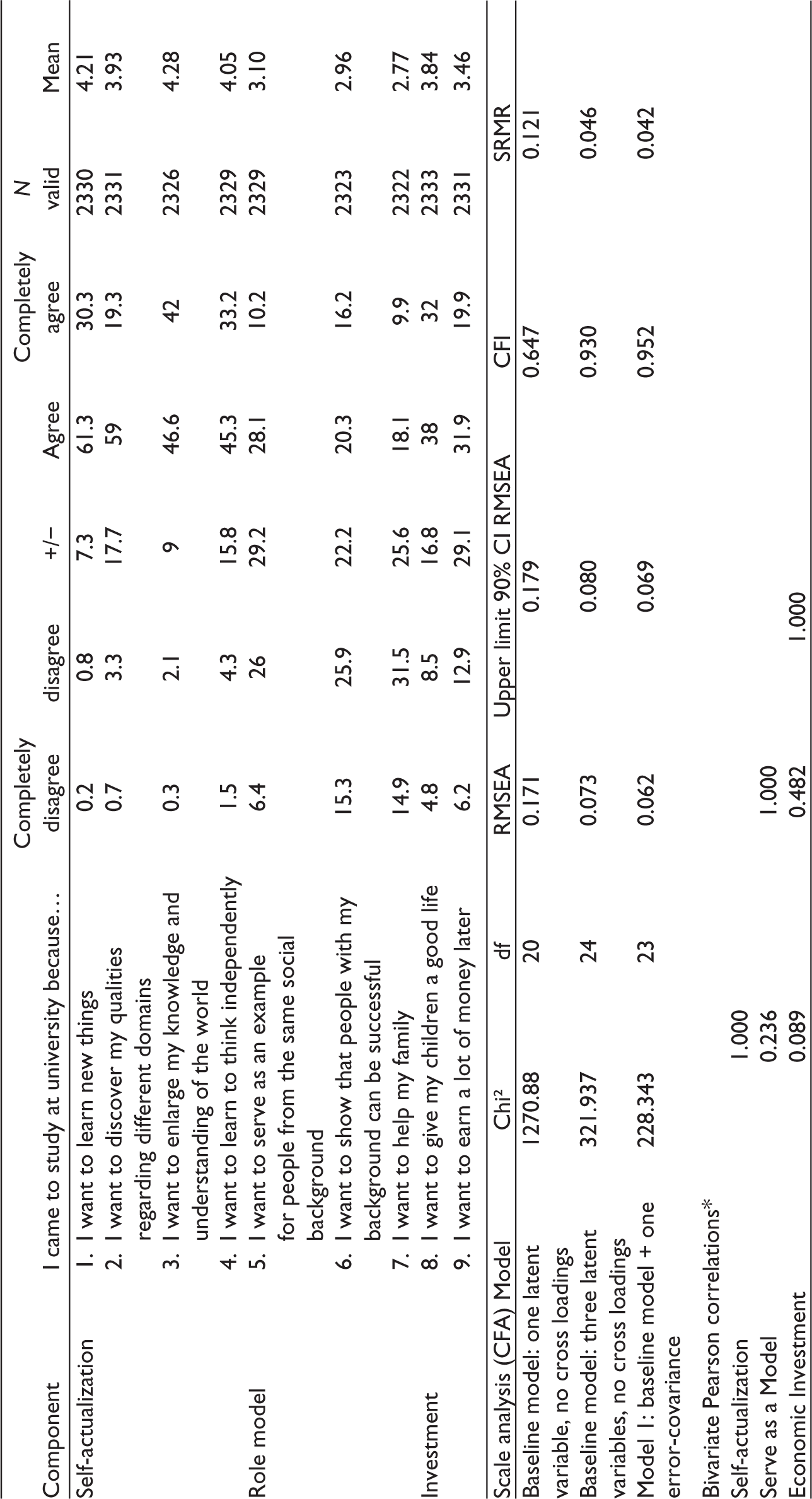
Table 1 presents the frequency distributions for the nine items referring to the three different motives to enrol in a university study. There seems to be a large consensus among first year students that self-actualization is an important reason for engaging in university study. 61.3% of the students indicate that they came to study at the university to learn new things, while 59% came to study at the university to discover their qualities regarding different domains. Support for the items referring to a university study as a means to function as a model for people with a similar (social) background is clearly more mixed, with a comparable number of students agreeing and disagreeing with the items: 28.1% of the students indicate that they came to university to serve as an example for people with the same social background, while 20.3 of the students came to university to prove that people with their background can be successful.
Frequency distribution items tapping into different reasons for starting a university study.
*all correlations are significant at p<0.001
Finally, the items referring to the motive to start a university study as an economic investment received quite some support, with the motive referring to earning a lot of money receiving somewhat less support than the motive revolving around giving children a good life. 38% of the students indicate that they came to university to give their children a good life, while 31.9% of the students indicate that they came to university to earn a lot of money later. An essential next step before examining differences in support for the three motives is to ascertain that these motives can be empirically separated in a measurement model. The CFA allowed us to test whether the three motives could indeed be distinguished from each other (Table 1). The baseline model, which specifies that each item loads onto its theoretical factor without cross-loadings or error covariances, did not fit the data. The modification indexes suggested that an acceptable fit could be reached by specifying a single-error covariance between items 5 and 7. Model 1 indicates that the three motives for starting a university study can be empirically distinguished in a measurement model, justifying further analyses.
The correlations between the self-actualization motive on the one hand and the motive to serve as a model and the motive of education as an economic investment on the other hand, were very weak (r = 0.236; p < 0.001 and r = 0.089; p < 0.001 respectively). This provides further support for the idea that these motives are clearly distinct from each other. The correlation between the motive to serve as an example and the economic investment motive was moderate (r = 0.482; p < 0.001). This makes sense, as both motivations consider education as a means to an external end (as different from being an end in itself).
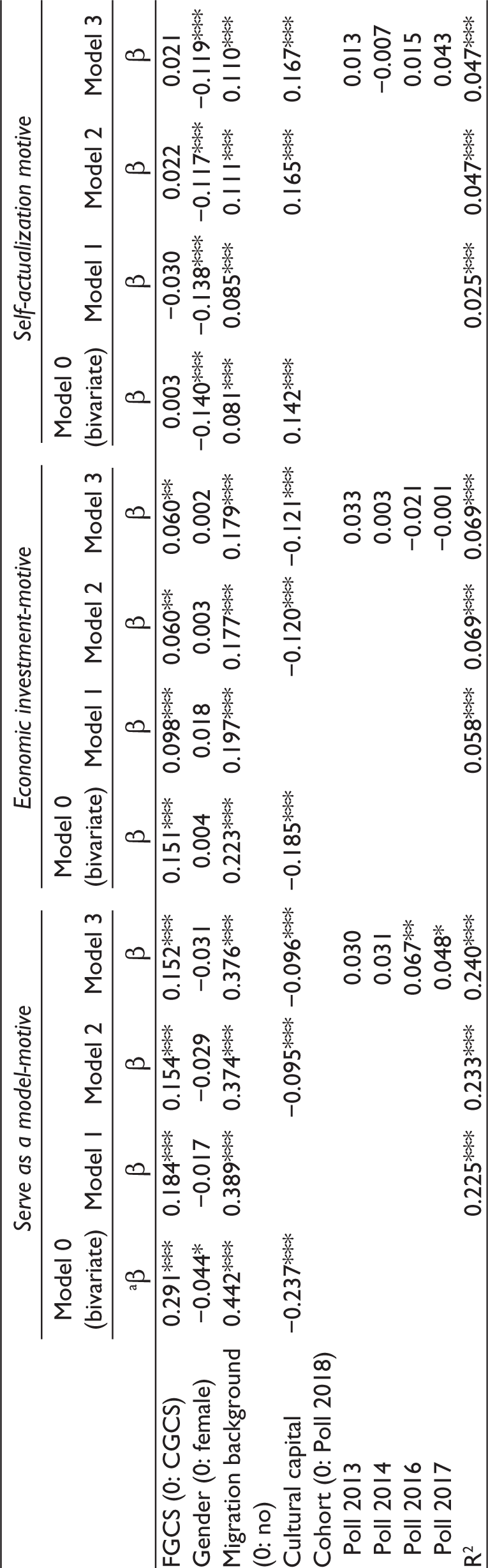
The first question we aim to address concerns whether FGCS differ from CGCS regarding the three distinct motives to start a university study. The first column of Table 2 (model 0) shows the unadjusted standardized regression coefficients (beta’s) for generation, gender, migration background and cultural capital. The uncontrolled coefficients reveal that FGCS score higher on the scale for the motive of serving as an example for one’s community. Furthermore, we find that students with a migration background score higher on this scale and that the more cultural capital students possess the lower they score on this scale. Model 1 (second column) shows that the coefficient for college generation decreases once we control for gender and migration background, suggesting that part of the college generation effect is due to the fact that FGCS are often students with a migration background. However, irrespective of migration background, FGCS score higher on the scale gauging the motive to serve as an example. In the second model, we added cultural capital to the equation, which leads to a small decrease in the coefficients for college generation and migration background.
Regression analyses for three motives for studying at university (N = 2151).
a Standardized regression coefficient.
With regard to the scale referring to an economic investment motive for enrolling in university education, we find a similar pattern, but the effect sizes are smaller. Unadjusted betas show that FGCS and students with a migration background score higher on the scale gauging an economic investment motive than CGCS. Cultural capital is negatively related to the economic investment motive. Model 1 includes the variables college generation, gender and migration background and shows that part of the association between college generation and economic investment motive is due to the fact that FGCS are more often students with a migration background. Nevertheless, we find that irrespective of migration background, FGCS are slightly more instrumentally motivated than CGCS. Model 2 additionally shows that the more cultural capital students possess, the less they are driven by an economic investment motive. After having entered cultural capital into the model, the coefficients for college generation and migration background slightly decrease, suggesting that part of the association between these variables and the economic investment motive can be explained by differences in cultural capital.
Finally, regarding the scale gauging the motive towards a university study as a means to self-actualization, we do not find a difference between FGCS and CGCS. Rather, first-year students’ gender, migration background and cultural capital seem to determine to what degree students are driven by a self-actualization motive to study at university. Women, students with a migrant background and students who possess a lot of cultural capital are guided more by a self-actualization motive to study at university when compared to men, students without migration background and students who possess smaller amounts of cultural capital.
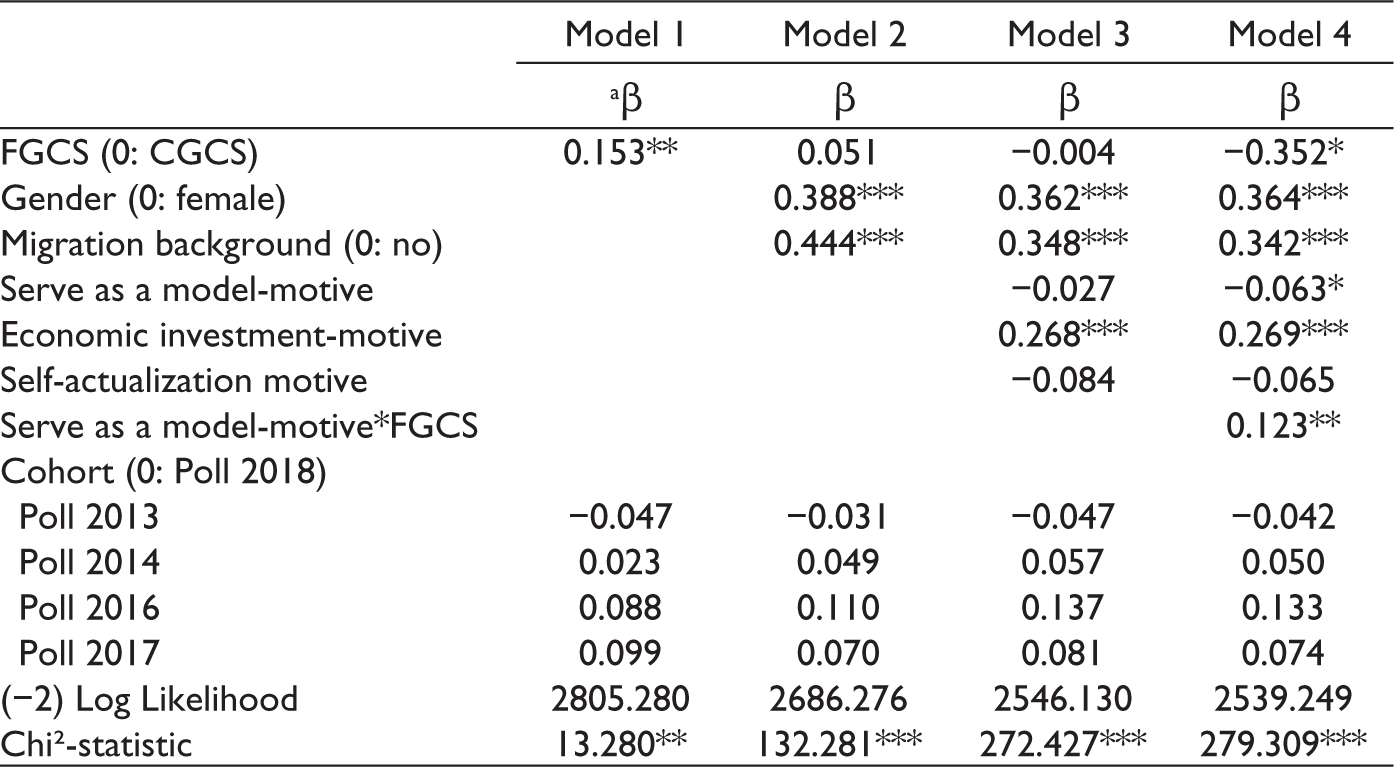
A second goal of this article is to examine whether differences in choice of field of study according to students’ college generational status can be explained by differences in students’ motivations (Table 3). Model 1, including only the college generation variable and control variables for the year of the survey, shows that FGCS are more likely to choose one of the more economically rewarding fields of study than CGCS. However, when we control for gender and migration status in Model 2, this difference disappears altogether, suggesting that the differences found in Model 1 result from the fact that students with a migrant background are overrepresented among FGCS and that the former are more inclined to choose a more economically rewarding field of study. Indeed, students with a migrant background are more likely to choose one of the more economically rewarding fields of study than students without a migrant background. In addition, men are more inclined to choose a more economically rewarding field of study than women.
Logistic regression analysis for choice of an economically rewarding field of study (1) rather than a less economically rewarding field of study (0) (N = 2151).
a Y-standardized logits computed with spost13 in Stata (Long & Freese, 2005).
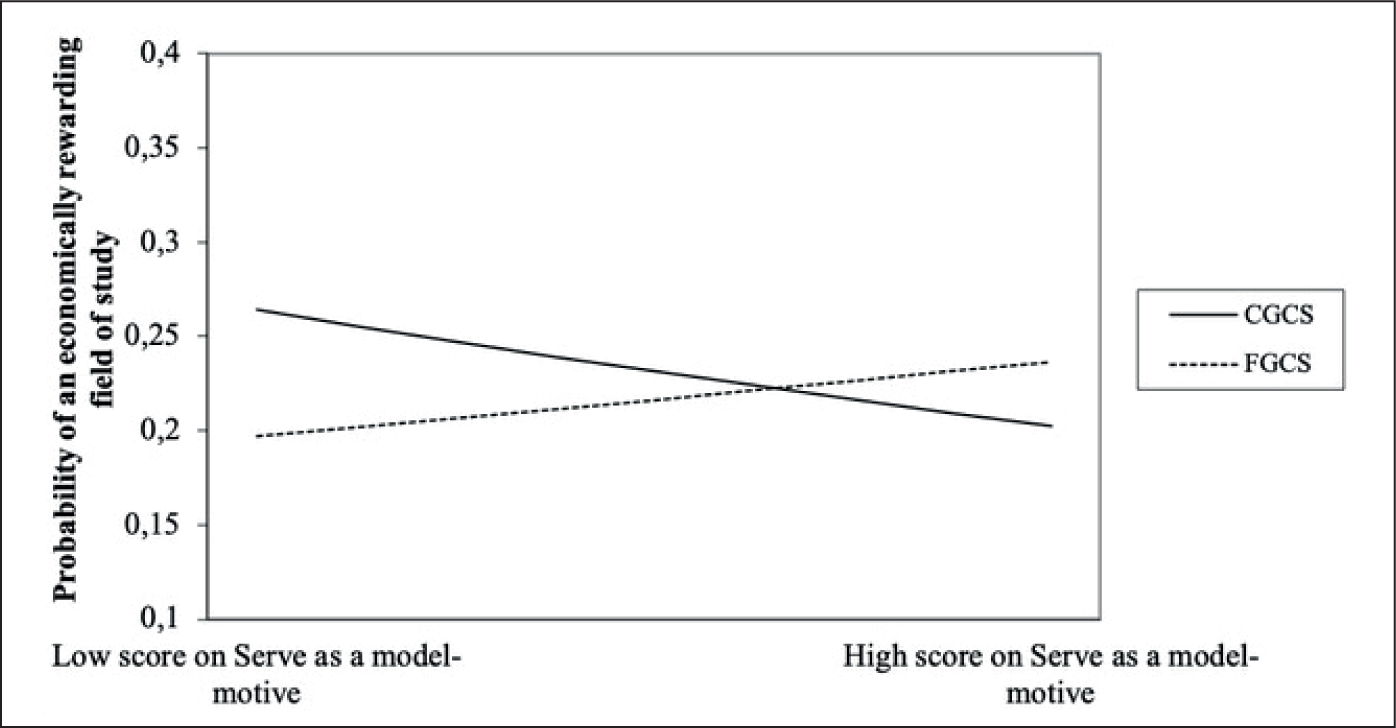
In the third model, we add the three motives leading to a decrease in the coefficient for migration background, indicating that the choice of students with a migrant background for more economically rewarding fields of study can at least partly be explained by differences in students’ motives to study at university. The economic investment motive seems to be the determining factor. The more students display this motive, the more likely they are to choose more economically rewarding fields of study. In the fourth model, we additionally tested an interaction term between college generational status and the motive to serve as a role model for the community. The interaction term is positive and statistically significant (Figure 1), indicating that students’ motive to be an example for the community positively relates to the likelihood of choosing more economically rewarding fields of study among FGCS.3 In contrast, for CGCS, the motive to be an example for the community seems to be related to a higher likelihood of choosing less economically rewarding fields of study.
Discussion and Conclusion
In this article, we studied the support for three distinct motives to follow university education—an economic investment for a successful career and material wealth, an investment towards self-development and an investment towards one’s community or people from the same social background—among first year students at the start of their first academic year in university education. We studied the measurement and dispersion of these motives and their relationship with students’ actual study choices.
Our findings replicate earlier research demonstrating that self-actualization is an important reason for enrolling in higher education (Mullen, 2014; Stephens et al., 2012; Thomsen et al., 2013). In that view, attending higher education is not primarily seen as being relevant for ‘everyday needs’ but is instead considered a source for personal perfection, self-realization and self-actualization (Prange, 2004). However, besides this more intrinsic motive to engage in a university education, our results show systematic differences with regard to the two extrinsic motives to start a university study. Compared to CGCS, FGCS more strongly endorsed the economic investment motive and what we call the social investment motive, that is, the motivation to become a role model for one’s community. Our results also indicate that for FGCS, the choice of more economically rewarding fields of study is related to the social investment motive. In this discussion, we elaborate on the implications of these findings.
Building on Stephens et al. (2012) and more qualitative research, this article draws attention to the social investment motive as an independent motive for pursuing higher education. As this motive values education for ‘extrinsic’ (social) reasons, this motivation is more strongly related to the economic investment perspective when compared to the view of education as a means towards self-development and self-actualization. At the same time, the social investment perspective differs from the two other views in that, rather than presenting education as an investment in one’s (strictly) personal future, it draws attention to the social role of education. In this way, the social investment motive is related but clearly different from the two more commonly studied motivations to pursue higher education and deserves more scholarly attention. Our observation that both first-generation college students and students with a migrant background support this social investment motive stronger raises new questions. Indeed, the motivation to become a role model rest on the explicit awareness of the stereotypes and difficulties that people ‘like them’ (e.g., friends and family) are confronted with regarding the entrance and success in higher education. Although such awareness may act as a motivating factor, qualitative research shows that it also leads to feelings of tension, ambivalence, alienation, displacement and ultimately frustration (Morton, 2019). Indeed, the line between feeling motivated to become a role model and negative effects (e.g., reluctance to ask for feedback) of so called ‘stigma consciousness’ is thin (Pinel, 1999). Being in between worlds, these young people are often confronted with competing pressures and rely on ‘code shifting’ to maintain the ties to their community while trying to adapt to the expectations and norms of higher education. In this way, being motivated to become a role model may put additional responsibility on these upwardly mobile young people. Research suggests that in order to be successful, these young people (so called ‘strivers’, cf. Morton, 2019) should distance themselves from relations with their community. This not only implies a high ethical cost but also suggests that, to the extent that they succeed in higher education, their intention to become role models is likely to become frustrated. It is clear that after having shown that the motivation to become a role model for one’s community can be empirically distinguished from other motivations, further longitudinal research should study the educational trajectory and indicators of subjective well-being of the young people that score highly on this motivation. The foregoing argument suggests that precisely because the social investment motive refers to an ethical dimension—that is, it refers to what one values—this motivation may act as a mediating factor in the reciprocal relationship between educational success or failure and subjective well-being. If so, this would have important practical implications for student guidance practices.
In this article, we also engaged with the literature on First-Generation College Students. One question that pervades this literature concerns how the concept of FGCS relates to other dimensions of identity and experience (ethnicity, gender, social class …) (Beattie, 2018; Nguyen & Nguyen, 2018). Is the ‘first-generation’ college student term useful for understanding social reproduction and equality in education, in particular in times when, due to the democratization of university education, the heterogeneity among the student population is increasing?
Our results showed that the relationship between FGCS and student motives to enrol in university education is mitigated by the student’s migration background. Indeed, FGCS support for the economic investment motive and the social investment motive can, to a great extent, be explained because many FGCS students are also students with a migration background. Furthermore, our results showed that the relationship between college generational status and the choice for more economically rewarding fields of study can be entirely explained through the student’s migration background. Indeed, the main advantage of the university we selected for our study was that it allowed to empirically disentangle the relevance of the educational and migration background of students’ parents. Our findings strongly suggest that in order to capture social inequality in higher education, the explanatory power of the FGCS term is limited when researchers do not account for the heterogeneity within this population. The finding that students with a migration background are more inclined to opt for more economically rewarding fields of study may be linked with findings among students with a migration background in compulsory education, indicating that many of these students are primarily engaged to achieve in education to counteract prevailing negative stereotypes about their particular immigrant group (D’hondt et al., 2016). As explained earlier, it is well known that most ethnic minority students believe in the instrumental value of education to achieve success in society. At the same time, however, research also indicates that the actual definitions of success in education among minority students are reflected by the expectation of racism and ethnic discrimination in school, in the labour market or throughout daily lives (D’hondt et al., 2016; Van Praag et al., 2015). As explained earlier, calculations based on Belgian social security data show that graduates of the more economically rewarding fields of study have more job security and higher wages. It is possible that the choice for more economically rewarding fields of study among students with a migration background is driven by the prospect of labour market discrimination. This question redirects the focus from the consequences of these motives to their origins. Research in secondary education has repeatedly drawn attention to the presence and consequences of so-called feelings of futility, that is, a negative view on one’s personal (educational) future coupled with a group awareness (‘it is not for people like me’) (Spruyt et al., 2015; Van Houtte, 2016). Such feelings are typically found among pupils in the lower educational tracks and with a migration and/or working-class background. The group awareness and associated stereotypes present in feelings of futility suggest a connection with the social investment motive we studied here. This raises the question whether both originate in experiences of racism and/or classicism.
Our findings raise new questions but also lead to a very clear core message. Over the past decades, an increasing number of students have enrolled in higher education. The accompanying increased social diversity in the student population draws attention to other than strictly individualistic motivations to pursue higher education. For first-generation college students and students with a migration background, becoming a role model for their own community is an important motive that is relevant regarding their subject choice and other educational outcomes.
Footnotes
Declaration of Conflicting Interests
The authors declared no potential conflicts of interest with respect to the research, authorship and/or publication of this article.
Funding
The authors disclosed receipt of the following financial support for the research, authorship and/or publication of this article: This research has received funding from the Vrije Universiteit Brussel under the ASP 2030 grant agreement.