



Abstract
Existing research addresses violence in youth activism from two directions, broader societal violence or specific violence targeting political action. Nonetheless, these are explored separately according to type of activism, suggesting that this is the most relevant factor shaping violence in youth activism. This article captures other crucial factors by exploring both directions together and bringing in the concept of everyday violence. Grounded theory method and situational maps were used to collect and analyse qualitative interviews with young adult activists in three Swedish cities. Three conditions were found that crosscut youth activism to shape meanings and actions of unsafety: temporal, spatial and organizational. Across the three cities, temporal conditions produced shared experiences among young adult activists with social dimensions of unsafety, which corresponded to broader societal violence. In the third city, spatial and organizational conditions produced different experiences with political dimensions of unsafety, which corresponded to specific violence targeting political action.
Keywords
Introduction
Violence enters young adults’ activism in different ways, for example, as a deterrent, as an incentive and as a tactic. Existing research addresses these ways from two directions: broader societal violence that potentially affects any young adult regardless of whether or not they take part in activism (Ginwright, 2010; Hope et al., 2017; Richards et al., 2016), and specific violence targeted to political action that may affect young adults when they engage in activism (della Porta, 2008a; Mac-Ikemenjim, 2017; Matthies-Boon, 2017; Ting, 2017). However, these two directions are researched separately by distinct fields on different types of youth activism: youth civic engagement, youth protest movements and youth electoral participation. This division suggests that the type of activism is the most relevant factor affecting violence in youth activism.
This article seeks to analyse other crucial factors by bringing together the two directions on violence above and by approaching youth activism as a single, unified phenomenon. I do this through three concrete strategies, one theoretical and two methodological. First, I add everyday violence to the current focus on explicit violence found in existing research on youth activism. Everyday violence refers to violence that has become normalized within routine actions and interactions (Hlavka, 2014; Stanko, 1990). Second, I empirically locate three conditions that crosscut youth activism to shape meanings and actions of unsafety. Third, I develop an empirical understanding of the meanings of unsafety among young adult activists, ages 18–25, and the actions they pursue based on these meanings (Blumer, 1969). These methodological strategies are grounded in two research questions:
Existing Research
Depending on the research field, the role of violence for youth activism is addressed from two different directions. Research on youth civic engagement examines broader societal violence that may impact any young adult at any time regardless of whether or not they participate in activism. This research field shows that exposure to interpersonal and collective violence, such as acts of theft and assault, police violence, racism or poverty, can deter young adults from participating in civic activities. A large, longitudinal study in the USA found not only that adolescents exposed to community violence were less likely to volunteer in local services as a young adult, but also that supportive parent–child relationships did not provide a buffer against this negative effect (Chen et al., 2015). Community and collective violence may incentivize young adults to participate in civic activities. The incidents of racialized police violence in the US cities of Ferguson and Baltimore ignited young people to form the Black Lives Matter movement (Cobbina, 2019).
Additionally, this research field shows that youth civic engagement is a means for coping with trauma that results from exposure to community violence, racism and poverty. Ginwright (2010, p. 81), drawing upon Garabino, defines these forms of violence as ‘social toxins’ and proposes youth civic engagement as a means for ‘radical healing’ in predominantly Black, urban communities in the USA. Radical healing entails building the capacity of young adults to create the type of communities in which they want to live and emphasizes ‘hope, optimism and vision to create justice in the midst of oppression’ (Ginwright, 2010, p. 85). Researchers have since developed and tested a civic engagement curriculum that enables low-income urban and ethnic minority young adults to deal with exposure to violence by improving their leadership, life satisfaction and ability to cope with community conditions and ethnic relations (Richards et al., 2016). For racialized youth, the positive effects of civic engagement apply even to violence they experience in well-off, predominantly White settings. Hope et al. (2017) found that activism among Black and Latinx first-year students at predominantly White universities helped them to deal with the effects of racism, including stress, anxiety and depression.
Research on youth protest movements and youth electoral participation examines specific violence targeted to political action that may impact young adults when they participate in activism. Research on youth protest movements initially focused on the use of violence as a tactic, especially because young adults are generally seen as more open to violent behaviour (Loukakis & Portos, 2020; Rasmussen, 2010). Violent tactics can both deter participation through its negative consequences, particularly exposure to state repression and police violence, and incentivize participation through its positive consequences, such as strengthening movement networks, collective identities and affective bonds (della Porta, 2008a). Nonetheless, the use of violent tactics has declined significantly over the last half-century, in part because various movements demonstrated the effectiveness of non-violence tactics for achieving goals, for example the Student Nonviolent Coordinating Committing in the US civil rights movement (della Porta, 2008b). Contemporary youth protest movements rarely embrace violent tactics exclusively or promote their widespread use, instead integrating them alongside other non-violence tactics (Loukakis & Portos, 2020). This is shown by Zackariasson (2009) in the 2001 Global Justice protests in Gothenburg, Schierup et al., (2014) in the 2013 Stockholm riots in the Husby neighbourhood and Sandoval (2020) in the most recent student protests in Chile.
Even if the use of violence as a tactic has declined, research finds that participants in youth protest movements are still exposed to violence from counter-protests, state repression and bystanders, which can either deter or incentivize further participation. Counter-protesting is not widespread, but when it does occur, it results mainly from the threat posed by, and strength of, the initial movement (Reynolds-Stenson & Earl, 2018). Moreover, Reynolds-Stenson and Earl (2018) found that counter-protesting was more likely to occur after recent police repression, and police repression was more likely to occur when counter-protesting was underway. The negative consequences of police repression for youth protest movements occur both during protests, such as participants sustaining injuries and having to alter tactics in the moment (Grimm & Harders, 2018), and after protests. Matthies-Boon (2017) found that young participants in the Arab Spring protests in Egypt experienced political trauma afterwards from the violence they had experienced during protests from police and bystanders that included sexual violence, gun violence and torture. Police repression has positive consequences, as Ting (2017) found in the Umbrella Movement, where young adults joined the protests because they saw police violence as an urgent threat against the future of Hong Kong society. Although state repression is mainly associated with police or military violence (Grimm & Harders, 2018), it additionally involves imposing legal measures upon movement participants (Ellefsen, 2016), shutting down or censuring digital channels used to organize protests (Kaun & Treré, 2020) and intensifying crime control over social groups linked to protests (Oliver, 2008).
Research on youth electoral participation is particularly concerned with the negative effects of violence that young adults are exposed to or perpetrate in conjunction with electoral campaigns. Using nationally representative survey data from 20 countries in sub-Saharan Africa, Mac-Ikemenjim (2017) found that fear of violence was negatively correlated with young people’s participation in electoral campaigns. Fear of violence was used as a proxy for actual violence, measured with the question: ‘During election campaigns in this country, how much do you personally fear becoming a victim of political intimidation or violence?’ Young adults are also more vulnerable than adults to be recruited into perpetrating electoral violence, as Bob-Milliar (2014) showed in his study among youth activists affiliated to political parties in Ghana. Political parties employed young rank-and-file members, so-called foot soldiers, to carry out low-intensity electoral violence.
Existing research explores in depth the role of violence for youth activism from two directions: broader societal violence and specific violence targeted to political action. Nonetheless, these two directions are currently researched separately by distinct fields on the different types of youth activism, i.e. civic engagement, protest movements and electoral participation. As such, the type of activism appears to be the most relevant factor affecting violence in youth activism. I argue that other factors are equally or more relevant to analyse. One of these is the impact of everyday violence, in contrast to the focus on explicit violence in current research.
According to feminist scholars, everyday violence is violence that spans a continuum of social spaces (including the home, work, leisure and public settings); that occurs on a routine basis, accumulates overtime and becomes normalized; and that takes subtle forms less visible or recognized by society (Hlavka, 2014; Kelly, 1987; Stanko, 1990, 1995). As Stanko (1995, p. 50) explains: ‘the reality of sexual violence—whether from known or unknown men—is a core component of being female and is experienced through a wide range of everyday, mundane situations’. A similar approach is currently found in studies of young people, especially young women (Araüna et al., 2020; Willing, 2020).
Several studies suggest that everyday violence occurs in activism, including that of young adults. While the use of violent protest tactics has clearly declined offline, their use has become more common in social media activism, as O’Donnell (2020) shows with the militaristic tactics of the Men’s Rights Activism against feminism. Compared with offline violence tactics, online violent tactics are used routinely in daily practices. Similarly, new forms of state repression criminalize young adults’ political action before it occurs through expanded securitization and crime prevention (Calvo & Portos, 2019), and stigmatize youth activists and their groups with labels such as ‘radical extremist’ or ‘violent affirming extremism’ (Gordon & Taft, 2011; Jämte & Ellefsen, 2020; Kimari et al., 2020). Bystanders in the general population use hate speech and threats to act directly against activists of opposing viewpoints in everyday life, as Sager and Mulinari (2018) found in the experiences of self-identifying Muslim, Afro-Swedish and/or racialized feminist activists. Adding attention on the impact of everyday violence to the current focus on explicit violence is needed to better understand the role of violence in youth activism.
Methods
The study presented here was part of a larger research project on safe public space in Sweden. This specific study sought to locate crosscutting conditions in youth activism that shape meanings and actions of unsafety (RQ1). It further sought to empirically understand the meanings of unsafety among young adult activists, ages 18–25 and the actions they pursue based on these meanings within their activism (RQ2) (Blumer, 1969).
Recruitment and Participants
Data were collected in three smaller cities at least 250 km from one of Sweden’s main metropolitan centres (Stockholm, Gothenburg and Malmo). In each city, internet searches and existing contacts were used to identify a wide range of volunteer, non-profit civic associations working on social change issues. Different civic associations addressed different social change issues: children’s welfare, sobriety, girls’ empowerment, migrants’ solidarity and community safety. In two cities, City A and B, I easily found civic associations led by young adults, identifiable by groups’ name, including local chapters of nationwide organizations, high school groups as well as local initiatives. In the third city, City C, I was unable to find civic associations led by young adults. After several attempt to find them, I contacted mixed-generational civic associations working on similar social change issues to the first two cities and invited young adult members from these associations to participate in the study. I further contacted the Democracy Coordinator of the municipal government, who put me in contact with young adult civic leaders currently participating in a municipal democracy programme. The young adult activists recruited through these first two strategies helped me to identify leaders of youth church groups and youth political party federations.
Data Collection Techniques
Data collection was conducted in three stages using in-depth individual and group interviews. In spring 2016, interviews were conducted in City A with 12 young adult activists from five youth-led civic associations. In autumn 2017, interviews were conducted in City B with 12 young adult activists from five youth-led civic associations. In autumn 2018, interviews were conducted in City C with 15 young adults from seven groups: three mixed-generational civic associations, one municipal initiative, one youth church group and two youth political party federations (referred to as A and B, respectively).
A general interview guide was followed comprised of three main themes. First, participants were asked to describe in their own words their group’s social change efforts, e.g. objectives, strategies and activities. Thereafter, they were asked to discuss how they understood safety according to their own interpretations of this term. Finally, participants were asked to reflect upon how they saw their group’s social change efforts as contributing to safety according to their own interpretations, if at all. With each additional interview, specific follow-up questions were asked to explore ideas and concepts emerging in the data. Before each interview, participants were informed about the research project, the main purpose and content of the interview, and the intended use of the information generated from it. Participants gave oral consent to participate in the interview. In order to maintain participants’ identity confidential, I use generic pseudonyms for the names of civic associations in the presentation of the results.
Grounded Theory Analysis
Once each interview was transcribed verbatim, I loaded it into a software program and began coding following the steps of constructivist grounded theory method (Charmaz 2014). During initial coding, I studied each line of data and labelled it with a word or phrase to capture meanings and actions in the interview text. Initial codes were then sorted into clusters by grouping together those that related to one another, and each cluster was studied and named. In focused coding, clusters were developed into categories. In theoretical coding, the connections between categories were examined and synthesized into a whole.
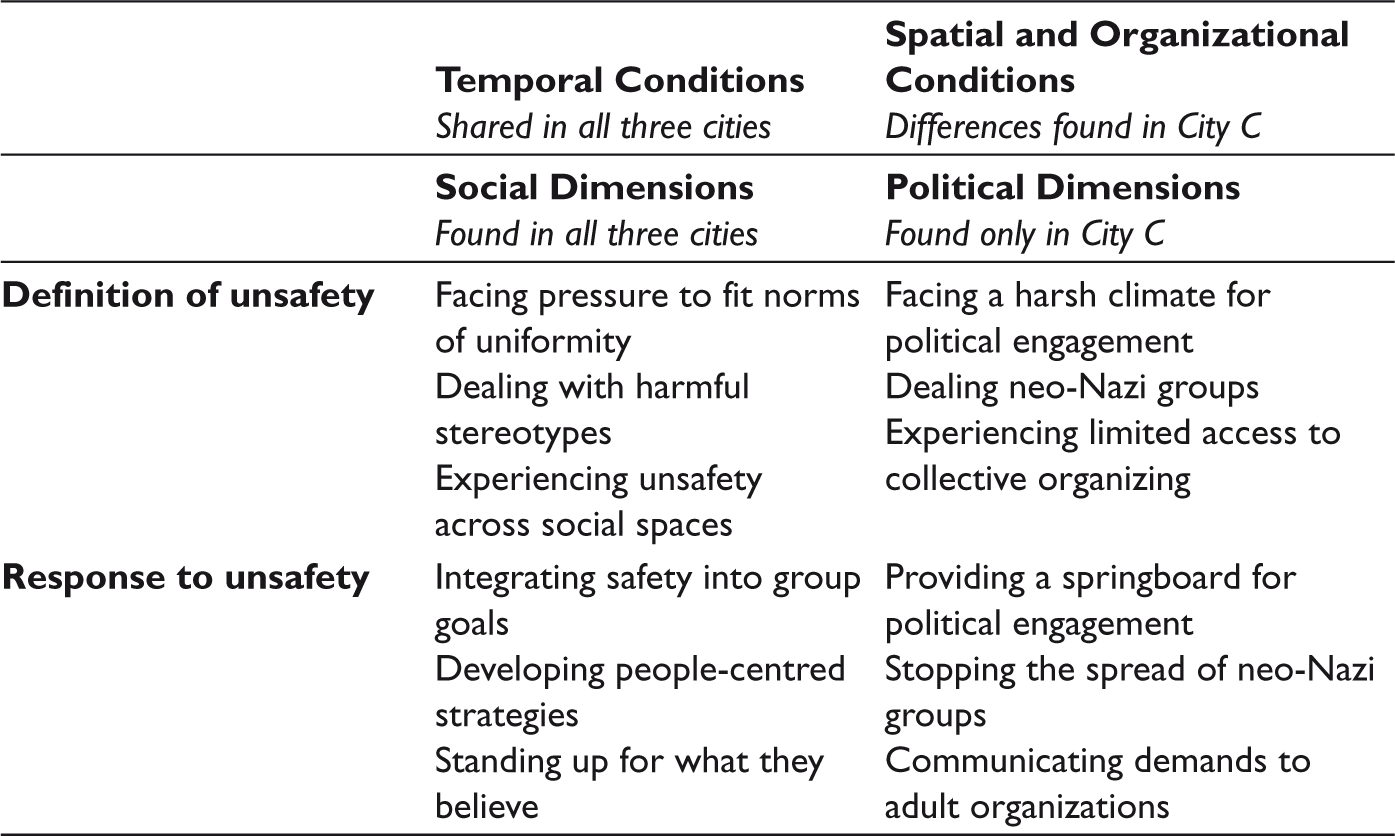
From the data analysis on cities A and B, my colleague and I constructed a robust model (Coe & Rönnblom, 2019). I then conducted the fieldwork in City C, which allowed me to see how well our model held up in another setting and, if needed, modify it. The data analysis from City C showed not only clear similarities with the first two cities but also crucial differences. In all three cities, young adult activists defined and responded to social dimensions of unsafety within their activism. In City C, young adult activists further defined and responded to political dimensions of unsafety. See Table 1. I present the social and political dimensions below using the findings from City C, given that results from the first two cities are published elsewhere.
Dimensions of Unsafety in Youth Activism and Crosscutting Conditions
Situational Analysis
After completing the fieldwork in each city, I created a situational map following Clarke (2005) to locate all of the elements in the situation of youth activism in that city. This entailed drawing upon the interview data along with key informant conversations and observations in each city as well as discussions with my colleagues in the larger research project. Data were categorized according to the different elements specified by Clarke (2005, p. 90). From relating the situational maps to the grounded theory analysis above, I located three conditions that crosscut youth activism to shape meanings and actions of unsafety: temporal, spatial and organizational. I present these findings first before turning to the social and political dimensions of unsafety.
Temporal, Spatial and Organizational Conditions Shaping Meanings and Actions of Unsafety
Temporal elements consist of historical, seasonal, crisis and/or trajectory aspects (Clarke, 2005). Time is a central condition of young adulthood because, as youth researchers show, it is socially constructed through start- and end-points. Even if these start- and end-points vary across settings, they affect what young adults are able to do and not do, and thus their experience of unsafety (Moore, 2017; Moore & McArthur, 2017). All of the participants in this study identified as young. While they spanned between still being in high school and high school graduates, and among the latter, between university students and fulltime employed, they all conveyed a deep awareness of how violence entered youths’ lives.
Time is further a central condition because young adulthood is a period during which long-standing values, attitudes and identities are formed, and these are shaped by social and political conditions that exist or emerge at the point in time when young adults come of age (Woodman & Wyn, 2015). In this study, sociopolitical crises and historical shifts at the global and national levels crosscut youth activism to shape meanings and actions of unsafety similarly across the three cities. In particular, young adult activists understood two historical shifts in Sweden as causing unsafety in society: the downsizing of the welfare system alongside the growth of the nationalist Swedish Democrats party. The young adult activists further pointed to two global sociopolitical crisis, and their national expression, as linked to unsafety. The first was the international migration crisis that occurred during 2015 followed by the unprecedented border closing in Sweden on 1 January 2016, which contradicted most political parties’ endorsement of a humanitarian refugee policy. The second was the MeToo movement, which confirmed study participants’ own understandings of sexual harassment as a specific form of violence in youths’ lives.
Spatial elements consist of spaces in the situation and geographical aspects (Clarke, 2005). Youth research suggests that spatial elements are crucial not only for young adults’ lives but also their activism (Skelton, 2010, 2013). In this study, city size, characteristics and cultures crosscut youth activism to shape meanings and actions of unsafety differently across the three cities. Cities A and B had between 60,000 and 90,000 inhabitants, with about the same area, 30 square kilometres. Both cities had large public universities (all universities in Sweden are public) that not only created a critical mass of young adults who were high school graduates not in the workforce fulltime but also promoted a city culture of mobility and anonymity. Young adults distinguished themselves as a unique group from the rest of the population, fostering a strong peer-centred youth culture in both cities, and they engaged in activism separately from adult-centred politics, namely municipal government. This appears to have buffered study participants in these two cities from exposure to or participation in specific violence targeted to political action. It also seems to be a reason why the municipal governments in cities A and B did not make promoting young adults’ political engagement a priority and even actively excluded them.
In contrast, City C was a smaller city of only 30,000 inhabitants with almost the same area (24 square kilometres), and primarily an industrial town without a university. Study participants described a city culture where everyone knew each other, anonymity was impossible and gossip was a form of social control. High school graduates typically worked fulltime, commuted to other cities for university studies, or moved away for both. There was no critical mass of young adults outside the workforce or distinct peer-centred youth culture. As such, young adult did not engage in activism separately from adult-controlled politics, and this appears to have left them exposed to specific violence targeted to political action. It also seems to be a reason why the municipal government could not actively exclude young adults (because they were not an identifiable group) and even purposively sought to include them (to ensure sustainable local institutions).
Organizational elements are particular groups and specific organizations found in the situation (Clarke, 2005). Youth research shows that diverse voluntary non-profit organizations are central for young adults’ participation in activism (Oosterhoff et al., 2020; Ødegård & Fladmoe, 2020). In this study, the type and availability of civic associations crosscut youth activism to shape meanings and actions of unsafety differently across the three cities. Cities A and B had vibrant youth-led civic organizing. There were various well-functioning youth-led civic associations dedicated to social change, both home grown as well as local chapters of national associations. Alongside these groups were youth political party federations and university student unions. The spatial characteristics that produced a critical mass of young adults not in the fulltime workforce and fostered a peer-centred youth culture appeared to sustain this youth-led civic organizing. Meanwhile, there were no neo-Nazi organizations based in either of these two cities. In contrast, as described in the methods section, youth-led civic organizing was difficult to find in City C. Civic associations oriented to social change were all mixed-generational either developed by adults with young adult participation or driven by young adults with close support from adults. Local religious associations were prominent while local chapters of national associations were non-existent. The only youth-led organizing was two youth political party federations and a few youth church groups. The spatial elements that inhibited a peer-centred youth culture also prevented vibrant youth-led civic organizing. Different manifestations of neo-Nazi organizations, made up largely of young adults, had been based in City C since 2014.
In sum, temporal, spatial and organizational conditions crosscut youth activism to shape meanings and actions of unsafety. In this study, temporal conditions led to shared meanings and actions across the three study sites, whereas spatial and organizational conditions led to different ones between cities A and B on the one hand, and City C on the other.
Social and Political Dimensions of Unsafety Within Youth Activism
Social Dimensions of Unsafety
In all three cities, young adult activists defined and responded to social dimensions of unsafety within their activism in a similar way. They developed this definition and response through face-to-face interactions with other young adults, adolescents and even children (I refer to all three as ‘youth’ in continuation). Their meanings and actions of social dimensions of unsafety were shaped by temporal conditions discussed above. Social dimensions captured unsafety that could affect any young adult at any time regardless of whether or not they were civically engaged, thereby corresponding to the broader societal violence addressed by research on youth civic engagement (Chen et al., 2015; Ginwright, 2010; Hope et al., 2017;Richards et al., 2016).
The young adult activists critiqued adult understandings of unsafety as merely having to do with discrete acts of violent crime, e.g. assault or robbery, to which youth were rarely exposed. In its place, they had developed their own definition of unsafety based upon the violence that youth actually were exposed to, consisting of three social dimensions. According to the young adult activists, youth were exposed to constant subtle pressures to fit norms of uniformity that only on occasion were reinforced by explicit acts of aggression, such as bullying and sexual harassment. Second, youth dealt with harmful stereotypes assigned to social categories that did not fit the norm of being White, heterosexual and masculine. Examples of such categories were racialized youth, unaccompanied immigrant youth, young women and LGBT teenagers. Third, youth experienced unsafety across a range of social spaces, including school, after school centres, home, online, public spaces/transport and nightlife.
Similar to youth civic engagement research (Chen et al., 2015; Ginwright, 2010; Hope et al., 2017; Richards et al., 2016), the young adult activists in all three cities were acutely aware of a wide variety of violence to which youth were exposed and perpetrated, including physical, psychological, sexual and deprivation expressed both interpersonally and collectively (Rutherford et al., 2007). Yet, in contrast to the very explicit violence explored in research on youth in low-income, racialized communities in the USA, the young adult activists in this study highlighted subtler violence that occurred during youths’ daily routines in social spaces allocated for them and typically segregated from adult society. Their accounts described youth as having a shared societal vulnerability, making their definition of unsafety akin to that of everyday violence developed by feminist scholars (Hlavka, 2014; Kelly, 1987; Stanko, 1990, 1995).
In all three cities, young adult activists responded to unsafety as a collective problem rather than an individual one. Specifically, they developed actions that allowed them to move to where other youth were, not only physically but also cognitively and emotionally. The following quote from one of the two young women involved in the church youth group in City C depicted this:
It is so important for youth ages 12 and upward … to have a place where they can get a little support and still find their own self. Especially for youth who don’t have any other place to go, have it tough at home, and need to get away from home, to meet other youth, reliable older youth, and to have a safe and reliable place. We want to show them that there are people they can count on, that there is another type of everyday.
As this quote illustrates, the young adult activists responded to unsafety by intervening in youths’ daily life and providing them with ‘another type of everyday’. Similar to the first two cities, the young adult activists in City C described integrating alternative notions of safety into the goals of their activist groups, even when this was not an explicit goal of the group, and putting these notions of safety into practice through youth-centred strategies. For example, a civic association organized non-alcoholic live concerts especially for young adults and the church youth group held a youth hangout every Friday evenings. Across all three cities, the young adult activists sought to offer youth an alternative to unsafety through their collective activism. In this way, the broader societal violence that any youth could experience motivated the young adults in this study to participate in activism. This finding aligns with the way in which civic engagement has been shown to help youth to deal with broader societal violence and imagine an alternative society (Chen et al., 2015; Ginwright, 2010; Hope et al., 2017; Richards et al., 2016). It adds to this research by showing how activism helps young adults to deal with everyday aspects of broader societal violence.
Political Dimensions
In City C, young adult activists further defined and responded to political dimensions of violence (see Table 1). They developed this definition and response through face-to-face interactions with adults whom they interacted with during their activism. Political dimensions of unsafety were shaped particularly by the spatial and organizational conditions discussed above. Political dimensions captured unsafety that young adults faced in conjunction with activism, thereby corresponding to the specific violence targeted to political action addressed by research on youth protest movements and youth electoral participation.
Three political dimensions were found in the definition of unsafety among young adult activists in City C. The first dimension was facing a harsh climate for political engagement. This climate was in part due to what participants described as a generalized resistance in their city to social change activism. A young woman involved in the civic association that produced live concerts especially for young adults stated: ‘There is a lot of prejudice towards different [activist] associations. Because we stand up against racism, sexism, and so forth, it is easy for others to label us as “extreme leftists’.” Yet, the harsh climate went beyond their city’s local political culture. Regardless of the form of activism, the young adult activists depicted how they and others they knew had been attacked verbally for their political views, identities and actions. ‘I mean, I have been exposed [to verbal attacks] on-line a lot…There have been a lot of comments on Facebook’, stated a young woman involved in the municipal youth democracy programme. These depictions were raised repeatedly across all interviews and differed notability from the social dimensions described above. In contrast to sexual harassment or racial slurs that occurred in school or leisure activities (i.e. social dimensions of violence), these attacks were related directly to their activism. Moreover, they depicted not merely being ridiculed by peers in youth spaces, such as the school corridor, but also being threatened by unfamiliar/unknown persons of all ages in public forums, online and offline. Perpetrators were identified as both inhabitants of City C as well as anonymous persons from other places in Sweden. Finally, the young adult activists described a harsh climate for political engagement as going beyond personal attacks to encompass a general breakdown in public debate and the rise of explicit denial of the rights of certain groups, such as racialized immigrants or LGBTQ persons. A young trans person involved in both a mixed-generation LGBTQ group and youth political party federation A stated:
Everyone has the right to freedom of expression and it is important to protect, but sometimes we have to consider whether one’s views are appropriate to express in the moment. For example, if you see a gay man with make-up on in the city center, and you don’t like it, you think it is wrong, is it really worth expressing your view then and there to that man or should you keep it too yourself?
As this quote illustrates, while the young adult activists valued different political views being conveyed and contested, they were critical of what they termed the ‘absence of filters’ in public debate, face-to-face interactions and social media. Study participants noted that this in turn led many teenagers to hide their political views, identities and actions from the public, and they understood the problem as going well beyond their city.
The second dimension of political unsafety was dealing with neo-Nazi groups. The young adult activists in City C described the presence of various iterations of neo-Nazi groups, such as the Nordic Resistance Movement, Nordfront and Alternative for Sweden, in the city’s social and political life as far back as 2014, that is, four years before data collection. According to their accounts, the neo-Nazi presence was strategic because it mobilized public marches and flyer distribution, and it was organizational since it created local chapters and recruited members from city inhabitants, especially young adults. Neo-Nazi groups directed threats and attacks towards participants in social change-oriented associations, such as the anti-racist action group that developed in response to the local presence of these groups. A young woman involved in the anti-racist action group explained:
They are rather unpleasant persons to deal with. I have experienced threats from them. Already when I began to get involved in 2014, there was this group, Nordic Youth, a youth party, that had some members who lived nearby me and they spray-painted my driveway.
Whereas the first political dimension of unsafety stemmed from a mainly anonymous general public or bystanders, this second political dimension originated from a collectively organized and identifiable countermovement, such as those studied by Reynolds-Stenson and Earl (2018). The young adult activists in City C were concerned that neo-Nazi groups not only promoted racism, anti-Semitism, anti-immigration and islamophobia but also advanced anti-democratic goals.
The third dimension of political unsafety consisted of experiencing limited access to collective organizing. Despite strong civic associations for organizing sports, cultural and religious activities, social change-oriented organizations in general and youth-led organizations in particular were scarce in City C. The scarcity of social change-oriented organizing made it difficult for young adults to mobilize around political issues about which they were concerned. The young women from the civic association that produced live concerts explained, ‘It is difficult to be a feminist or an activist on gender equality in City C because we do not have many spaces. There are not a lot of women’s groups. And these are small and discrete.’ Other participants raised the difficultly of addressing specific issues related to sexism, such as sexual harassment, despite that it was a year after the MeToo movement had exploded globally. Youth-led organizations were observable only in the two functioning local chapters of youth political party federations. ‘There aren’t many youth-led political associations in City C, it is frustrating’, stated one young man from youth political party federation B. Mixed-generation groups provided the main form of political organizing in City C. In fact, the young adult activists in City C described simultaneously participating in a formal political party as well as in one of the few informal social change-oriented associations, where at least one of these two forms was mix-generational. Thus, adults controlled most political organizing whether these were informal civic associations or formal political parties. Young adult activists did not identify age hierarchies as a barrier when participating in mixed-generation organizing spaces. Yet, when they organized as youth, as in the case of the youth political party federations, age hierarchies came into play more clearly. Three young women from youth political party federation A described several instances when municipal authorities did not take them seriously, including the following incident from when they served on student government during secondary school:
We went to the municipal authorities to convey our concern for the problem [mildew in the classrooms], they didn’t listen, they were like, ‘Oh, take it easy, have a seat, we will fix this, we know what we are doing’… but we knew that it was a serious problem.
As this quote depicts, young adult activists felt patronized and unheard by municipal officials.
The young adult activists in City C did not depict being exposed to the direct state repression as found by research on youth protest movements (Ellefsen, 2016; Grimm & Harders, 2018; Kaun & Treré, 2020; Matthies-Boon, 2017). Instead, they portrayed facing reoccurring hate speech, threats, labelling and stigmatization by bystanders, a discernible counter movement and adult political leaders, which is in line with the results found by Sager and Mulinari (2018), Jämte and Ellefsen (2020) and Gordon and Taft (2011), respectively. Nonetheless, even though this everyday repression did not have negative physical consequences for the young adults who participated in activism, they described experiencing psychological ones, as Matthies-Boon (2017) found in the aftermath of the Arab Spring protests. Another negative consequence of this everyday repression identified by the young adult activists was deterring young adults’ participation in activism, a result similar to that found by Mac-Ikemenjim (2017), where fear of violence prevented young adults from voting in electoral politics. The political dimensions of unsafety add to this by capturing the everyday challenges of doing politics as a young adult, such as collectively organizing and interacting with adult organizations. The political dimensions of unsafety had positive consequences in that they motivated the young adult activists in City C to respond, as Ting (2017) found in the case of the Hong Kong demonstrations, which I present next.
The young adult activists in City C responded to the political dimensions of unsafety in three ways, firstly by providing youth with a springboard for political engagement. Striking in the accounts of the young adult activists was that they wanted all youth to get involved politically irrespective of the orientation or type of action, with the exception of joining neo-Nazi groups. A young man from the youth political party federation B openly acknowledged that they had recruited members with right-leaning views despite being a centre-left party. Being a springboard was not just about reaching those who subscribed to the same political views. One of the young women from youth political party federation A described how they put this into practice:
Youth come here and say, ‘This is what I think needs to change, can you help me? Do you have an idea?’ In the end, they feel that they can come here and brainstorm ideas. If they have a problem with no solution, they get help.
Another young man from the youth political party federation B explained: ‘As a political issue, we believe that equality provides safety, but as a democratic process, we need to work so that young people feel safe enough to influence their situation. Therefore, it is necessary to get more young people engaged.’ Increasing political engagement especially among young adults was the main objective of the municipal democracy-building programme, as a young man described:
Our goal is to make Sweden more democratic. So, how can this be achieved? A good first step is to vote. Our goal was to increase electoral participation by 5 percent during the recent election and we actually achieved 6 percent. Nobody believed in us but we did it!
A second response was stopping the spread of neo-Nazi groups in their city. Regardless of their own political position on the Left–Right scale or on social change issues, participants in our study described organizing and attending counter-demonstrations against neo-Nazi groups, including rapid response actions. The young woman from the music association explained: ‘Just a few months ago, Alternative for Sweden had a demonstration in the city square. We went there and counter-demonstrated. I enjoy doing that as well. It feels good because it is needed.’ The young woman from the anti-racist action group shared her experiences: ‘We have had a lot of problems with Nordfront, for example, and we are always holding counter-demonstrations against them. We are always the ones who go up against them so that they are not able to take over public space.’ Moreover, participants described removing stickers and getting rid of flyers that they found. This second response sought to address the neo-Nazi groups that youth dealt with not merely by countering groups’ actions but also by mitigating their negative impact on political engagement.
The third way that young adult activists responded to the political dimensions of unsafety was by communicating youths’ viewpoints to adult-controlled organizations. Because there were so few groups exclusively dedicated to youth, all of the young adult activists in this study described interacting regularly with adults through their political engagement. They did so through two channels. They collaborated with adults in mixed-generational associations, which allowed them not only to learn about political organizing from these adults but also to get these adults to support young adults’ viewpoints on issues. Moreover, they interacted with adults by participating in policy processes run by adult-run political parties and civil servants. In some cases, these two channels went hand in hand. For example, study participants worked on anti-racism and LGBT issues with adult activists in two respective mixed-generational associations, which in turn collaborated with civil servants to carry out public awareness events, such as anti-racism panel discussions and Pride Week.
In the case of youth political party federations, participants portrayed mobilizing young adults to convey their viewpoints to municipal officials and to convince municipal officials to adopt specific policies favouring young adults. A young woman from youth political party federation A described organizing a widespread school strike with support from secondary students across the political spectrum:
We decided on Monday afternoon that the next day we would go on strike. So, on Tuesday, we stroke. On Wednesday, we stroke. It was very big deal here locally. The media contacted the municipal leadership, the school leadership, and the organizers, which at the time were both youth political party federations [A & B]. We had joined forces, it did not matter which party youth belonged to because this was for [all] youth and therefore we stood on the same side, we wanted what was best for youth.
This quote further illustrates how the young adult activists were less interested in promoting specific party goals and more concerns with communicating young adults’ viewpoints to adult-controlled organizations. As one Trans youth from an LGBTQ activist group stated:
Safety in politics should be the starting point—that politics itself is safe. Different groups might have different policy stances regarding safety because each one wants to achieve safety through different paths. Just as the path to equality is different for each party.
The findings here show how the political dimensions of unsafety had positive consequences for young adult activists in City C by getting them to collaborate with one another’s groups in recruiting other youth, in mobilizing against Neo-Nazis and in communicating with adult authorities. Such collaboration appeared to strengthen their collective identity, affective bonds and associational networks (as della Porta, 2008b). The young adult activists described using only nonviolent tactics, in line with della Porta’s (2008a) and Jämte and Ellefsen’s (2020) respective scholarship, rather than combining it with other tactics, as some studies found (Sandoval, 2020; Schierup et al., 2014; Zackariasson, 2009). Nonetheless, they did describe friends using violence to respond to neo-Nazis (Reynolds-Stenson & Earl, 2018), but this was mainly during everyday activities, such as outside a pub at night instead of during a demonstration. Our findings further add to the existing research by capturing a counter-protest scenario where neither side is anonymous to the other: Young adult activists and their activist friends knew participants in the neo-Nazi groups, they had grown up together and/or lived near one another, and neo-Nazi groups had a permanent not temporary presence in their city.
Conclusions
Several conclusions can be drawn from the study presented here. First, both broader societal violence and specific violence targeted to political action are crucial for understanding the role of violence in youth activism, what I conceptualize as social and political dimensions of unsafety respectively. Second, the type of activism is not necessarily the most relevant factor affecting social and political dimensions of unsafety. Instead, other relevant factors that crosscut youth activism appear to be relevant. One is the impact of everyday violence, which occurs on a routine basis in young adults’ lives and activism, while explicit violence occurs only occasionally. Temporal, spatial and organizational conditions further affect social and political dimensions. In this study, temporal conditions led to shared experiences among young adult activists with social dimensions of unsafety, yet spatial and organizational conditions led to their different experiences with political dimensions. To better understand these experiences, empirical exploration of the meanings and action of unsafety among young adult activists themselves is a sound starting point.
Footnotes
Acknowledgements
I want to thank the two anonymous reviewers from Young and colleagues at the Sociology Department, Umeå University for their insightful comments on earlier versions. I am grateful for the input from participants in the “Fear and Safety” research project: Malin Rönnblom, Linda Sandberg, Chris Hudson and Jennie Brandén.
Declaration of Conflicting Interests
The author declared no potential conflicts of interest with respect to the research, authorship and/or publication of this article.
Funding
This work was supported by the Marianne and Marcus Wallenberg Foundation under grant 2012.0211 for the project ‘Fear and Safety in Policy and Practice: Overcoming Paradoxes in Local Planning’ managed by the Umeå Center for Gender Studies.