



Abstract
The process of life design in contemporary adolescence is of increasing interest in times of lifelong learning and the knowledge society. The aim of this article was to increase the comprehension of career designs by analysing the two-phase interviews of 31 young people at the ages of 15 and 18. Drawing on actantial analysis, we modelled the plurality of the career designs, analysed who the main actors are in those career designs, and how young people express, exercise, and adjust their designs. We conclude that both the subjects and the objects of the young people’s career designs included multiple actors. People, issues, and circumstances are integral components of the narratives on the career designs of young people. These components bound their agency and are integrated with their orientations to education and work.
Introduction: Adjusting Career Designs
The premise of this article lies in the biographical narratives of urban Finnish youths. The teasing questions of the article are ‘do young people recognize and adjust to a one-size career design, or do they contest and modify individual career designs’? The novelty of our article comes from the idea of combining the actantial analysis with the holistic view on the educational and occupational career designs (later career designs, see, for example, Savickas, 2012). The actantial analysis is set to examine the intersectionality of structural and individual factors, for example, the actantial power of class, ethnicity, gender, as well as time and space. By analysing the two-phase narratives of young people, we sought to model the plurality of career designs and to analyse (a) how young people express, exercise, and adjust their career designs; (b) who are the main actors in their career designs.
The research frame binds together some contemporary discussion on careers and life courses. They approach the career designs from several perspectives regarding the forms and boundaries of it. By forms, we refer to the discussions on the phases, the length, and the breadth of the career designs. We analysed the ‘phases’ of the design with the discussion on destandardization and linearity, the ‘length’ of it as the question of emerging adulthood, and the ‘breadth’ related to the concept of lifelong learning. By analysing the actors involved in career designs, we sought to comprehend the bounding agency of the young people in their future perceptions.
The Phases of Career Design
Our first analytical viewpoint is the contested question of whether young people’s life courses generally and career designs specifically are plural and contingent today. The idea of life course destandardization concerns the overall life courses, strict and homogenous sequences of life’s transitions, and their timing. Individualization seems to increase the plurality of life courses, for example, open spaces for heterogeneous and de-standardized life phases and spaces. Nevertheless, a plethora of researchers has argued for investigation that is more empirical. With a quantitative approach, Nico (2014) claimed that there is no clear evidence of a strong and widespread destandardization of the life courses in Europe. Elchardus and Smits (2006) came to the conclusion that the young people’s life cycles are still persistently standardized. Yet there can be variations in patterns within smaller contexts or between genders, generations, population groups, and contexts (Aboim & Vasconcelos, 2019; Nico, 2014).
Destandardization overlaps conceptually and sometimes empirically with the processes of (de)institutionalization, (de)individualization, (un)differentiation or pluralization versus homogenization, as reviewed by Aboim and Vasconcelos (2019). For the young people, there are more options for re-education or family formations, leading to the plurality of life courses. Nevertheless, due to the strong influence of institutions, it is also possible that the transitions to adulthood have both become standardized and diversified. The hold of the institutions (schools, for instance) on the young people is strong and might have got stronger (Aboim & Vasconcelos, 2019; Shanahan 2000). Hence, we analysed the ‘chronologicalization’ of individual lives through the (almost) obligatory stages of educational choices, paying attention to the formal institutional mechanisms driving the life course envisioning (see Aboim & Vasconcelos 2019; Giddens 1991).
Destandardization of careers enhances the non-linearity of the career designs. This has been conceptualized with ‘elective’ and ‘normal’ biographies (Beck 1992; Beck & Beck-Gernsheim 2002). Young people considering all possible options for their careers and seeking justifications for their choices exemplify the ‘elective biography’. They envision their life courses with constant and conscious choices, pondering all options in multiple life phases. Young people expressing ‘normal biographies’ envision their life courses as linear and predictable continuums, as ‘natural’ phases following one another. They are expressed as natural models or paths, in which constant choices are not necessary (Varjo et al., 2020). The impression of the linear, ‘normal’ pathway has often been criticized for being the underlying premise of youth and career guidance policies (Kalalahti et al., 2020; Taylor, 2005). Instead of steady and progressive career paths, young peoples’ career designs include multiple streams and processes (for example, ‘job shopping’ or gap years). Indeed, biographies do not always progress linearly (Taylor, 2005).
Career designs are a set of pivotal educational and occupational choices, taking place in complex and long-lasting processes, often aiming at a pragmatic decision on ‘how to make the transition and step into a largely unknown realm’ (Taylor, 2005, p. 496). When adjusting their career designs, young people are not always rational decision-makers, but their decisions are driven by pragmatic rationality (Taylor, 2005; see also Ball et al., 1999). Following Cieslik and Simpson, our understanding is that the actors tend to rationalize their life course envisioning by ‘constant monitoring and negotiations over their aspirations and available opportunities’ (2006, p. 216). Within these processes, multiple actors are involved, including friends, families, and workplaces.
Building Up the Career of a Lifelong Learner
The second viewpoint framing our analysis concerns the comprehension of educational and occupational careers and lifelong learning, turning the career designs into unfixed and continuous processes. Young people are expected to commit themselves to the ideal of lifelong learning and follow a certain comprehension of career, including flexibility, job mobility, and constant upskilling (Taylor, 2005). The knowledge-based economy demands up-to-date qualified workers, destandardization of labour, constant development of individuals and lifelong maintenance of specific skills. As Diepstraten et al. (2006, p. 176) explain, contemporary discussion concerns learning as an integrated part of biography: ‘a life story in which learning experiences from all life domains and life phases are integrated and attain meaning’. Understood as an integral part of the life course (see Evans et al., 2013), engagement in lifelong learning has the potential to give individuals security against the uncertainty of the labour market.
The scholarly and political discourses on lifelong learning have related to the novel comprehension of learning serving the needs of the knowledge-based economy. As Diepstraten et al. (2006) argue, the non-economic values of lifelong learning have not gained as much voice. They also question whether it is evident that a developmental-oriented learning attitude leads to success in education. In their study, much of the learning was informal and took place in informal networks, which leads to wondering if non-formal learning is overrated in the idea of lifelong learning (Diepstraten et al., 2006). It is also reasonable to ask if there is still a place for young people seeking long-term security with career-related decisions aimed at steady and stable career designs ‘for the rest of your life’ (Taylor, 2005, p. 500).
Emerging Adulthood
Scholars of youth studies have been trying to solve the question of ‘emerging adulthood’ (Arnett, 2000, 2015) or the ‘prolonged transition to adulthood’ (Côté & Bynner, 2008). Researchers commonly share the argument about general prolonged transition to adulthood (including occupation and conjugal relationships) of young people aged 18 to 25, but the nature and meaning of this postponement is open to dispute. Emerging adulthood (Arnett, 2000) takes the postponement as a novel life stage, emphasizing the increased options for future paths exploration—longer and more widespread education, later entry to marriage and parenthood, and a prolonged and erratic transition to stable work (Arnett, 2015). Nevertheless, it is not evident if the emerging adulthood is a distinct developmental stage and/or freely chosen option to postpone the entry into adulthood (Côté & Bynner, 2008).
The prolongation of the individualized youth phases extends the places of learning beyond schooling to all fields of life, but it also creates ambivalence and risks, when the responsibility of the learner and choices are put on the individualized youth (Diepstraten et al., 2006). Côté and Bynner (2008) emphasize the structural barriers and individual differences in agentic capacities to overcome those barriers. For instance, the constantly emerging labour-market uncertainty has an effect on the lack of opportunity of entering and completing higher education. Economic and social changes introduce risks and opportunities to career prospects, emphasizing the need for young people to strengthen their own agency, but it also means additional time in the transition to adulthood (Côté & Bynner, 2008). Often their agency is yet bounced in a way in which they design their individual life trajectories bounded by economic, social, and demographic factors.
Research Setting
The empirical focus of this article is the career designs of 31 young people. By analysing the two-phase narratives of young people, we sought to model the plurality of career designs and to analyse (1) how young people express, exercise, and adjust their career designs, and (2) who the actors are in their career designs.
Methodological Premise
The career designs were constructed from the follow-up interviews in which these young people talked about their life course envisioning as ‘perceptions of possible futures’ (Evans, 2002, p. 262). Besides emphasizing the socially situated agency of young people, our life course approach addresses especially the timing and sequencing of transition markers and their adjustment to interpersonal and organizational expectations. As Evans et al. (2013) suggest, a life course approach enables us to look at the perceptions of possible futures as a product of interrelationships between individuals and society. To analyse the nature of the career designs, we approached them as being open to non-linearities and multi-layered processes (see, for example, Aaltonen, 2013). Our aim was to portray the agency within and outside the assumed, fixed, and linear trajectories from one education level to another and further to work.
While trying to comprehend how young people navigate between their aspirations, opportunities, reactions, and responses to these opportunities, we turned our analytical focus to agency. By agency we followed Rudd and Evans (1998; see also Evans, 2002) and considered young people as having the capability to react and respond to structural influences including social class, gender and ethnicity. We used the concept of bounded agency to analyse how the life course agency is shaped by different contexts and structures (Evans, 2002, 2007; Tomanović, 2019). We analysed the career designs as biographical negotiations, where ‘bounded agency is exercised over time with actions and decision-making consequential upon previous actions and decisions’ (Evans et al., 2013, p. 29). We considered the structures enabling or disabling several opportunities for young people, but also analysed how and when they grasp these opportunities. We used qualitative follow-up data to analyse the change in the career designs during upper secondary education, and hence contribute to the thinking of Cieslik and Simpson (2006, p. 216), by analysing how the ‘patterns of engagement with education in several areas of life (such as the family, leisure, school)’ change during the upper secondary years.
The Finnish education system consists of nine years of non-tracking and non-streaming comprehensive school. After comprehensive education, students apply for entry to upper-secondary education, which is a dual system. The two types of upper-secondary institutions are general upper-secondary schools (lukio) and vocational upper-secondary institutions (ammatillinen oppilaitos). Students apply for entry to upper-secondary schools during the ninth grade via a general joint application (yhteisvalinta) (MoEC, 2020). The first interviews are conducted during the general joint application and the second interviews when the young people are making their choices about tertiary education or entering the workforce after upper secondary education.
Method of Analysis
This article draws from the actantial analysis, which follows the Greimas’ semiotic theory on the actantial structures as a theoretical tool to approach educational trajectories. In the actantial model, an action may be broken down into six components, actants (Greimas, 1983). Six actants form three oppositions: sender vs receiver, subject vs object, and helper vs opponent. The actants can be represented by multiple actors in the manifested discourse. The sender is the element requesting the establishment of the junction between subject and object, whereas the receiver is the element for which the quest is being undertaken. The subject is what is directed towards an object. The subject–object relation produces the doing, the narrative programs that constitute the discourse through the trajectories. The helper assists in achieving the desired junction between the subject and object; the opponent hinders the same (Greimas, 1983).
We analysed the variety of actors and generated actants from them, which makes visible the idea that actants are a variety of combinations of different actors, and that actors can be integrated in several actants of the model. For instance, family as an actor can be an integral part of the subject-actant at the 9th grade but act also or only as an object–actant during the later stages of the life course. This helps us to pinpoint the actors with whom the young people negotiate their biographies and career designs.
Research Data
Data comprised 31 pairs of interviews. Of the informants, 18 were of immigrant origin (girls = 11, boys = 7), whereas 13 were of Finnish origin (girls = 8, boys = 5). By immigrant origin youths, we refer to (a) immigrants born abroad, (b) youth with both parents born abroad and (c) youth from mixed-origin or multicultural families, that is, a family consisting of a union between a person with immigrant origins and a native Finn (Rumbaut, 2004). The first round of interviews was conducted during the final year of comprehensive school (15 years of age), when the interviewees had already set their options in general joint selection but did not yet know the results of the admission process. The second round of interviews was conducted during the final year of the upper secondary education (17–18 years of age). The interviews were held at school during the school day. They lasted from 30 to 60 minutes. Participation was voluntary, and the students were told that they could stop the interview at any time. Written consent was received from the young and their guardian(s). The interviews were openly advancing interviews, covering the themes of schooling, decision-making processes, life courses, and future envisioning. To protect the anonymity of the students and schools, we have not revealed their name or specific location. We also aimed to avoid any unnecessary categorizations between genders, social classes, or immigrant groups. Both sets of interview data were analysed independently and the actantial structure for each case was constructed twice. The talk was thematically coded following the actantial structure using the concepts central to career designs.
Empirical Results: Five Career Designs
Our multi-dimensional conceptual framework enabled the outcomes to be structured in many ways. Out of the 31 young career designs, five typically emerged, which expressed variations in each of our analytical concepts. Nevertheless, the ‘rationality’–’pragmatic rationality’ dimension was the most distinguishing one, so we divided the career designs into two compositions by this dimension. The first includes two career design patterns, which we labelled as ‘standardized “tidy” educational pathways’ (n = 8) and ‘reflexive assembly for work’ (n = 6). The second includes three patterns, which were ‘pragmatic short-term educational choices’ (n = 5), ‘workable transitions to work’ (n = 7) and ‘living here and now without a career design’ (n = 5). We provide the empirical results with 12 cases (see Table 1).
Backgrounds and Career Designs of the Exemplifying Cases (n = 12)
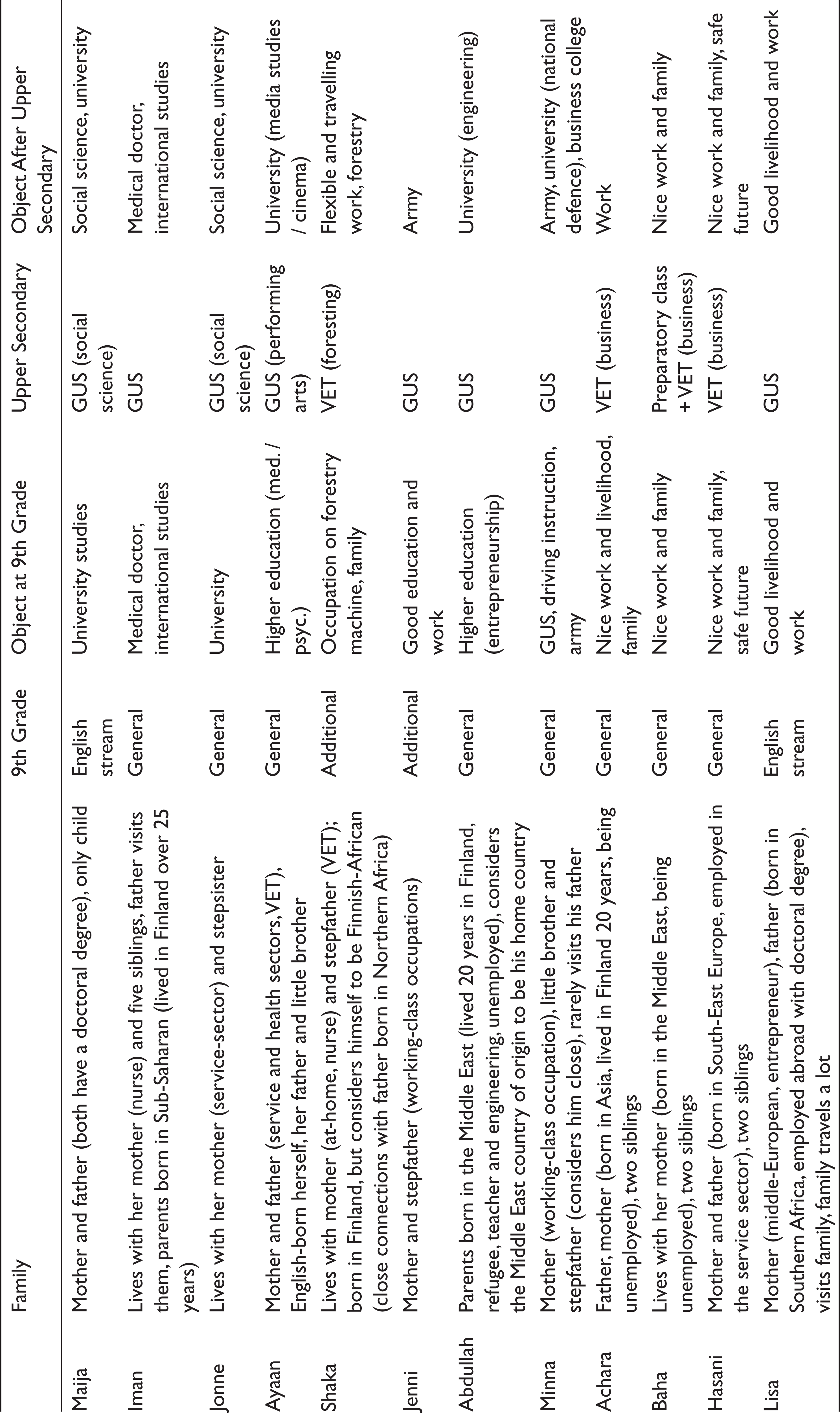
Rational Choice Designs
Standardized ‘Tidy’ Educational Pathways
Our first career design exemplifies the narrow choice-based pathway from comprehensive education to higher education, for which the object-actant is already set at the end of the upper secondary education. The career design is linear and seamlessly constructed from consistent choices, as with Maija.
Maija was a Finnish-born student in the English-stream class in the comprehensive school and was aiming to continue studying towards higher education in the English stream at the upper secondary education. She talked about her highly educated parents and well-performing peers, but she clarified that she was following her own aspirations, making her educational pathway individualistic, and putting her as the subject of her career design. Several helper-actors involved supported her educational pathways and there were few opponents. Maija possessed cultural capital, formed within the family and among schoolmates, who shared similar aspirations and information on the means to achieve them. Maija was not accepted for her first upper secondary choice (English stream) but she took another special stream in her school (social science) and adjusted her study intentions accordingly. She was also considering options abroad and was well-informed about them: entrance exams, preparatory courses, faculties, and study options in the social sciences.
We labelled this pattern ‘narrow’, emphasising the meaning of formal education and educational choices for the career design. Maija’s career design had a couple of options, but they were narrowly focused on educational transitions from one educational level to another and to work. She did not mention gap years or hobbies, and she was working only occasionally with children (babysitting or as a hobby instructor). The design followed the standard linear trajectory, based on formal learning, exams, and degrees. This linearity was almost unchangeable in both interviews, although Maija adjusted her design with her selection into social science class, instead of the English stream.
Following the idea of an elective biography, the previous educational choices were the sender-actor of Maija’s design. Besides the upcoming joint applications at the age of 15 and 18, she was driven by the choices she (or her family) had made prior to comprehensive school. Therefore, choices not only acted as helper-actors they even drove the career designs. The career design was nevertheless sometimes missing all the reflections, because the elective biography was automatically stacked by previous choices.
Even though not all career designs included such a rich set of helpers as Maija’s, the young people aiming at narrow education-led paths did typically have multiple helper-actors that compensated for the lack of some. For instance, Iman, whose family was of immigrant origin, was feeling her family lacked the knowledge to support her in their high educational aims. Nevertheless, her narrative included multiple other helper-actors, such as her teachers and peers. Jonne, who emphasized the working-class position of his family, reasoned his higher education aspirations with his talent and ‘smart headedness’, almost like he should give a reason for his prospects, becoming the first highly educated family member. Commonly, the family was included within the sender- and receiver-actors, especially if the family was of immigrant origin and/or from less educated. Yet the subject-actants of the career designs was typically the youths themselves.
Reflexive Assembly for Work
Our second pattern of standardized career designs was traditional in the sense that the objects were education and work-related, the first object-actor (at age of 15) usually being upper secondary education, and the second (at age of 18), occupation and work following the education undertaken. Nevertheless, the ultimate object of the design was work following education.
We used Shaka as an exemplifier of this design. At the end of basic education, he applied for vocational education (forest machinery). He mentioned his hobby, scouting, as one source of his decision and had worked hard to achieve the grades needed for entrance. He was willing to accept a study place at a geographically distant institution and was in many ways highly motivated for his studying. In his career design, the drive for the particular occupation was the sender-actor and his motivation the helper-actor. The helpers of his narrative were numerous: scouting, hiking, nature and the encouragement from his relatives. He was also studying in additional education, through which pupils can attain more on on-the-job training. He described this as being more interesting than ‘sitting behind a school desk for seven hours’.
Shaka picked his actors helping him from multiple fields of life. His design was standardized and linear, but he reflected on multiple fields of life. This was even more evident at the end of the vocational education, when Shaka was also training abroad and was willing to follow compelling job options abroad. His design was built on systematic progress from education to work, but the design was open to non-standardized life designs and emerging adulthood, combining formal, non-formal, and informal learning, and postponing the idea of steady adulthood to the future. The sender-actor was evidently the young person himself.
Reflexive assembly for work can also be academically oriented, as Ayaan illustrates. Ayaan was planning to apply for general upper secondary school with a special emphasis on media studies. She did not have any specific occupation in mind but was following the idea of her abilities and aspirations in photography. She was supported by her teachers, peers, and family, and was accepted into a school with a special emphasis on media. During the upper secondary study years, she focused on arts and languages, and was vivid in her discussions about studying theatre, scriptwriting, and language. During the upper secondary education, the object-actor had focused on cinematographic art and directing in higher education and she was setting her target on England, where she was born and lived for 10 years before her family moved to Finland. Like Shaka, her career design was transnational, and she was willing to travel abroad to enter the highly competitive field.
Both Ayaan and Shaka included multiple non-formal and informal learning options in their career design. They assembled a variety of learning options to include in their designs, which opened their design to constant learning. They acknowledge the importance of formal learning but were not bounded by the formal qualifications and occupations (Diepstraten et al., 2006). It is notable that they were both oriented towards work, although Ayaan’s design included higher education. The fact that their parents were not included in the subject-actor left the design open for their own aspirations, but they were supported by their transnational capital (immigrant-origin family and relatives). The lower socio-economic background of their families was not driving them towards the conventional and focused trajectories, as Diepstraten et al. (2006) concluded.
Although Shaka did not became vocationally oriented until later during the basic education and Ayaan focused her aspirations throughout upper secondary education, they ability to combine the competence from different platforms of learning was a helper-actor for them. As Taylor (2005, p. 473) has written, the competencies required and goal-articulated prior to leaving school, will probably have more unproblematic entry into and pathway through the labour market, as well as a ‘competitive edge’ without these competencies and goals. Nevertheless, the object was not narrowly expressed work, but they were also open for flexible life designs if plans were to change. As in the case of Shaka, the vocationally oriented career design was evidently leading to a middle-class position. This class-position was expressed in the narratives of the young people, but the sender was more clearly in the occupation.
Pragmatic-Rational Choices
The latter set of career designs can be seen as young people making pragmatic-rational choices. Their career designs included choices, but they were typically short-term choices, aimed at the next life-phase transition. The sender-actor was most typically the fact that current education was ending, and it was time to find the next place. Nevertheless, these designs varied according to their objects, some aiming at education, some for work, and some lacking the career-design objects. What was common for the two first designs was that the individual and structural factors together forced the young people to adjust their career designs so they were flexible and constantly open to changes needed to find the workable solution to the next phase of life. Therefore, their negotiations were not life course negotiations (see Evans, 2002), but pragmatically oriented choices for education or work. Therefore, the past and the future choices were not linear, but were mismatched.
Pragmatic Short-Term Educational Choices
We categorized the first of the three latter designs as short-term educational choices. Two of the seven young people illustrating this design were Jenni and Abdullah. At the end of basic education, Jenni was receiving additional teaching, taking an extra year of basic education. Jenni was applying for general upper secondary education and the sender-actor of her career design was the upcoming joint application. She did not have any specific goals for her choices but seemed to advance on a choice-by-choice basis. She was talented in music and handicrafts but struggled to achieve the required grades in the subjects needed for the (academic) general upper secondary study. She picked and dropped subjects during upper secondary education. Following the idea of ‘pragmatic rationality’ (Ball et al., 1999; Cieslik & Simpson, 2006; Taylor, 2005), she was negotiating her aspirations and scanning the available options while studying. At the end of upper secondary education, she became interested in undertaking military service and her personal capabilities (management skills, preciseness) became the helper-actants in her story. She did not seem to be worried about when to make occupational decisions and was willing to stay in the army for further education.
Whereas Jenni did not express that there were many obstacles in her story, it was also typical for this design to include multiple actors who were interpreted as opponents. Abdullah’s family was of migrant origin and his highly educated parents were mainly unable to find job in Finland. The subject-actor, as well as the sender-actor of his career designs was he and his family: Abdullah emphasized how he had been sharing his educational expectations with his family. At the end of compulsory education, the career design reached the general upper secondary education, and at the end of upper secondary education, the forthcoming matriculation examination. He portrayed how he had recently been interested in engineering. Abdullah’s design reflected his highly educated family’s educational aspirations, but also the disappointment in their employment opportunities in Finland. He had not been able to find support and guidance in what to study that would lead to the education he aspired to, and he was hesitant and worried about his education. He expressed how he would like to return to his parents’ country of origin after studying, since he felt misplaced in Finland. This follows the thinking of Selimos (2017) about the intergenerational—and sometimes problematic—links which young people of migrant origin face when constructing their career designs in their family’s new country of residence (see also Mäkelä & Kalalahti 2020), but also the structural barriers migrant families face in the Finnish occupational and educational structures. At the end of the upper secondary education, Abdullah had decided to stay in Finland, for now.
Workable Transitions to Work
The second set of pragmatic-rational career designs was expressed by young people trying to find ‘workable’ transitions to work. Achara was one of these young people. She had had positive experiences from the on-the-job training at the customer service both during the comprehensive school and vocational upper secondary education. She mentioned often the fear of unemployment and emphasized the urge to find a job through which she could earn a living in the near future. She felt she had some learning difficulties but had also had support for her studying during both comprehensive school and in vocational education. She had discussed her aspirations with her parents and tried to find the best option for safe transition to work.
Although Achara was positive about her future and was studying, the underlying sender-actor was different from the others. The sender and object was the urge to achieve education to avoid unemployment and an uncertain future. Achara and our two other cases within this design, Minna and Baha, had not freely chosen the career they felt was interesting or befitting their talent, but they adjusted their aspirations to the best options available. Minna was not attached to education, although she completed her matriculation examination and she sought routes to education through the army. Baha was also completing his vocational education but was not sure whether his qualification would be adequate in the job market.
They all talked about learning difficulties and/or discrimination and bullying, which bounded their agency, but also some external boundaries: discrimination against young people with an immigrant origin, fear of losing the traditional working-class occupations, immigrant parents unable to find permanent jobs in Finland, living arrangements and the need to work at the same time as studying. The short-term aspirations shifted frequently, but the object-actor was steadily set for a safe life in the workforce. All three of them had acknowledged the overall need to attain education for the full membership of the society, but they did not seem to fit within the images of learning society. Education was seen as a way to ensure an independent life, especially in the narratives of some of the immigrant-origin young women.
Living ‘Here and Now’
Our final assembly of young people’s narratives was four young people who did not configure a specific career design. Hasani and Lisa were both undertaking and completing education (Hasani vocational business and Lisa general upper secondary), but education was not included in their career designs. Lisa had followed her friends and parents’ wishes in her educational choices and did not know where to apply next. The sender in her first design was the fact that comprehensive school was ending, and at the age of 18, she was mainly describing her parents as the actors of her career design. Her upper secondary education studying had been fragmented and she dropped some subjects due to negative experiences with the teacher. She describes herself as both talented and untalented in many subjects, such as in languages. Her social life was vibrant, and she had multiple hobbies, although during upper secondary education, she has started to work at a petrol station, which took a lot of her time. She did not want to have a gap year, so one option for her was to apply for voluntary work abroad. She was not ready to move on her own, but neither was she seeking jobs or a study place. She also negotiated her future aspirations with her family. Her family was of immigrant origin and she expressed some vague hopes about living abroad in the future.
Hasani was also from a migrant-origin family, but his narrative was local. One reason for his upper secondary education choice was the locality of the school. He was seeking permanent job opportunities from the local surroundings and was spending much time with his friends. Like Lisa, his life was full of ideas (combining bodybuilding and a welfare business), multiple hobbies and two jobs. He was keen on his friends, but had faced discrimination, racism, and bullying at comprehensive school. At the vocational training institution, he said the atmosphere was open to all, relaxed, and equitable. Nevertheless, he had had some disappointments, especially with the training options, and he felt mistreated.
Lisa’s and Hasani’s object-actors was generally ‘adulthood’ without any specific goals. Their narratives on career designs shifted between the living-here-and-now attitudes and finding a safe and secure adulthood. Both were able to complete their education but did not consider their education to be a resource for the future. Their narratives included ‘repeated disappointments’ (with teachers, choices, and peers) and did not pursue the educational and occupational opportunities that were visible to them (Cieslik & Simpson, 2006, pp. 216, 225). The ‘living-here-and-now’ attitude seemed to affect their life designs; since they easily changed their study subjects and engaged in work and social life (see also Hadjar & Niedermoser, 2019). They were attached to many life domains but the actants of their career designs were constantly changing. Following some thinking of the emerging adulthood theory, they were pondering who they were and ‘testing’ various life options. Nevertheless, they were worried since their detachment from education and career made their life designs uncertain (see Arnett, 2015).
Conclusions
The core idea of this article was to adjust the actantial analysis to research on the career designs. By analysing the actors of young people’s career designs, we were able to portray the multi-dimensionality of agency of young people designing educational and occupational careers. Before concluding, we would like to address some limitations in the conclusions. First, our follow-up data covers only 31 young people living in Finnish urban neighbourhoods with an above average population of migrant families. Our data do not offer generalisable outcomes for the population. We also selected the exemplifying cases (n = 12) to highlight the richness of the data. As such, they are not representatives of typicalities within the data. The follow-up timeline (three years, at ages 15 and 18 years) is also short and a longer follow-up period would enable us to strengthen our conclusions. However, we think our data are rich with two in-depth thematic follow-up interviews and the actantial analysis offers us novel outcomes and additional comprehension on educational choices and career designs.
The first conclusion we want to address is the stability of the actantial structures of the career designs. Those whose object was set to education and/or work at the age of 15, were expressing them as objects in both interviews, although the specific fields or study places changed. ‘Missing’ or vague objects (‘secure life’ or ‘work’) were still missing or vague after secondary education. This conclusion emphasizes the role of the career guidance throughout the upper secondary education. ‘Buying time’ at the general upper secondary education does not radically change the career designs without other sender-actants than the obligatory joint application.
Although the actant models were commonly quite stable, the reflexivity involved varied during the follow-up. For some young people with the standardized ‘tidy’ pathways, the career design became almost automatically built into the course of their life. The choices they made themselves or with their parents became the actors of their career designs, as the previous choices diminished the reflectiveness of the next one. For some the already-built chain of choices became actively reflected at the lower secondary and for some, at the upper secondary education. In our analytical frame, the so-called ‘elective biographies’ became ‘normal biographies’, natural models of paths without reflexive choices, and vice versa. This is important notion for Finnish curricula-based career guidance, in which career guidance is emphasized at the lower level, and study guidance is emphasized in the upper secondary education (Kalalahti et al., 2020). The shifting reflexivity of the career designs means that pupils may need different support in different phases of their studies.
Second, the actantial analysis portrayed how both the subjects and the objects of the young people’s career designs can include multiple actors. It reveals the ways in which the people, issues and circumstances are integral components of the narratives on career designs. According to our analysis, subjects have a personal history and an imagined future, which guide and formulate their agency within the negotiations they take between their own conceptions and societal structures (see Evans, 2007). Consequently, actants and their interrelationships become the integral structural elements around which the narratives on career designs revolve.
Young people of migrant families often involved the families as actants on their career designs. In some cases, the family together was the helper or sender, in some cases even the subject or receiver of the designs. Parents’ life course transitions and unemployment or underemployment had an impact on their career designs (see also Taylor & Krahn, 2013). Some young people with a migrant origin actively integrated their parents’ biographies into their own career designs, as in the case of Ayaan. For Abdullah and Lisa, the overall agency of the family almost left themselves on the margins of their narratives. In all, being in the position of ‘immigrant origin’ typically came with a plurality of actants but the position empowered the young people differently. Whereas Ayaan and Shaka recognized and integrated transnationality and/or multilingualism as a resource in their career designs, Iman and Abdullah experienced their immigrant background as bounding their agency (lack of knowledge, discrimination, inadequate support for learning and guidance, for instance).
Third, although the young people acknowledged multiple actors in their career designs, the hold of the institutions was strong, as we suggested (see, for example, Aboim & Vasconcelos, 2019; Shanahan, 2000). The upcoming joint selection was the prevailing sender-actor of the career designs, and almost all the young people acknowledged the urge to complete an educational qualification. Other options like gap years, early family formation, travelling, au pair years or seeking permanent employment directly after compulsory education were rarely mentioned. Even those young people living ‘here and now’ were restless about their career designs, or at least felt pressured to include education and indecisive careers in their life narratives.
Nevertheless, educational choices opened different opportunity structures for the young people. Whereas some designs emphasized the ‘pragmatic’ power of the upcoming educational choice, the first two designs expressed educational trajectories leading to education or work as their main objects, involving rational choices with long-term chains of choices. Instead, pragmatic yet rational choices were often reasonable for the young people, but they typically led to short-term and incoherent designs. For instance, picking and dropping courses fragmented the career designs and disabled the options needed for their objects for Abdullah, Achara, and Minna. In this respect, the young people making educational choices rationally with a long-term vision in sight gain an advantage in their life designs.
The last two designs ‘workable transition to work’ and ‘living here and now’ were also interesting in light of the emerging adulthood. Since they were constructed ‘choice by choice’, they did not reach adulthood. Yet the future expectations of these young people were not light-hearted. They were work-oriented and worried about how to achieve the aspired occupational position with adequate wealth. This was an evident contrast with the designs for the ‘reflexive assembly for work’, in which the young people were constructing their skills determinately and by combining multiple life spheres and non-formal learning with formal education.
In this way, the three work-oriented career designs (reflexive assembly for work, workable transition to work and living ‘here and now’) were leading to quite different working-class positions and they involved different sets of helpers- and opponent-actors (see, for example, Cieslik & Simpson, 2006). Ayaan and Shaka with their reflexive assembly for work were ‘later modern learners’ in the knowledge-based society. They developed transnational competence and broke the standardized linear pathways from education to work and family formation. They extended learning to ‘life-broad’ careers, connecting and stacking of formal, non-formal, and informal learning capital and learning by doing (Diepstraten et al., 2006), when describing their hobbies, interests, abilities, and competences.
Instead, Achara, Minna, Baha, Hasani, and Lisa expressed awareness of the constraints of their agency, both institutional and non-institutional (see also, Aaltonen, 2013). They did not express real opportunities for ‘choosing’ the design with safely emerging adulthood and lifelong learning (see also Côté & Bynner, 2008). Launching self-made trajectories requires skills to do that, having the personal competence of reflexivity and coping strategies (Diepstraten et al., 2006; Giddens, 1991). Young people following continuous learning and careers would make rational choices related to their careers. But as stated, not all young are able or willing to design their careers by rational choices and not all positions enable young people to do so.
Discussion
This research has added knowledge on the ways in which young people position themselves in the opportunity structures visible for them. We also concluded that what was ‘visible’ for the young people was not always ‘reachable’, or ‘desirable’ for them. They acknowledged the power of the institutional phases as they were expected to follow the timeframes of joint selection. If they contested the institutional phases (for example, concentrated on hobbies), they were worried about their careers or future prospects. Hence, we conclude that the institutional influence of education on career designs is persistent in the early adolescence, and there is not much space for young people to design their careers without standardized educational phases.
Furthermore, only some of them were able to follow the idea of lifelong learning and to integrate different life domains on their career designs. ‘Helpers’ and ‘opponents’ formed combinations, where accumulating actors eased or prevented the designs. Schooling difficulties, experiences of otherness or lacking opportunities for anticipated education made the young people feel unsure and insecure with their designs. However, the actors also compensated for each other. Decisive career designs were mainly prevailing, if the different interests were compatible with the institutional opportunities, for example, if they were able to reach and/or get support for their desire to study in the desired field of education. Institutional support was apparent especially within the additional teaching, through which the pupils were highly supported and the educational trajectories were phase-flexible including introductions to life in the workforce. To conclude, in our data, the inflexibility and exclusiveness of the education system and the prevailing idea of the one-size career design did not always recognize and support the individual career designs.
Footnotes
Declaration of Conflicting Interests
The authors declared no potential conflicts of interest with respect to the research, authorship and/or publication of this article.
Funding
The authors disclosed receipt of the following financial support for the research, authorship and/or publication of this article: This work was supported by the Academy of Finland (grant numbers 275324 and 277814).