




Abstract
Skateboarding has been thought to possess a certain alternative ‘potential’ to challenge prevalent inequalities in sport. However, skateboarding remains a largely hetero-masculine domain. As such, queer identities have been marginalized and relegated to a peripheral space. Nevertheless, radical scenes of young queer skateboarders are offering alternative definitions and possibilities for what it means to be a skateboarder and do skateboarding. Through Jack Halberstam’s concept of queer failure and José Esteban Muñoz’s queer futurity and utopianism, I investigate how queer skateboarders are tapping into a queer potential that persists in the practice and aesthetic of skateboarding through the symbolism of the child and camp. They use this potential to affirm their identities as simultaneously queer and skaters. In so doing, today’s young queer skateboarders are changing the landscape of skateboarding by queering and claiming space for themselves within the largely heteronormative dominant industry and culture.
Keywords
Skateboarding and other ‘lifestyle sports’ are often presented as ‘an “alternative,” and potential challenge to traditional ways of “seeing,” “doing” and understanding sport’ (Wheaton, 2004, p. 3). Not only does skateboarding have the potential to ‘see’ and ‘do’ sport differently but it may also be a way to ‘see’ and ‘do’ the world differently. The way skateboarding perceives, performs in and interacts with space can rewrite its surroundings, both physical and social. This is the queer potential of skateboarding—a capacity to imagine and enact alternatives outside of the expectations and pressures of the dominant social order. Just as skateboarding is about doing and seeing the world differently, queerness is about conceiving counter-hegemonic ways of ‘being in the world’ (Halberstam, 2011, pp. 2–3). Yet queerness ‘is not simply a being but a doing’ (Muñoz, 2009, p. 1). It is not enough to just receive the world and experience it differently, but the radical queer subject must also act back on the world and actively engage it in transformative ways. Queerness as a potential vision/action beyond convention has often been theorized as distinctively childish and childishness is frequently discussed as curiously queer (Bond Stockton, 2009; Bruhm & Hurley, 2004; Fawaz, 2016; Halberstam, 2011; Kosofsky Sedgwick, 1993). I employ the concept of queer failure proposed by Jack Halberstam in conjunction with José Esteban Muñoz’s theorizing of queer futurity to examine how a queer youthfulness is deployed through the symbolism of the child that provides a resource of queer failure in skateboarding. Childish failure can contribute to a certain ‘camp’ ethic or aesthetic from which queer futures can be imagined and enacted. The current generation of young queer skateboarders is tapping into the queer potential of skateboarding and mobilizing it more than ever before in order to do skateboarding in ways that redefine what it means to be a skateboarder and broadens the possibilities of queerness in a largely heteronormative industry and culture (Beal, 1995; Beal & Weidman, 2003; Beal & Wilson, 2004; Booth, 2004; Thornton, 2004; Wheaton & Beal, 2003). As such, I conclude with an analysis of several people and projects that are using failure to reclaim the queer potential of skateboarding and generating progress towards a queerer version of skateboarding for the future.
Evaluating the developments and divergences within the subcultural/post-subcultural debate, Bennett (2011, p. 502) calls for ‘a refined strand of youth cultural studies in which elements of post-subcultural and subcultural theory are combined.’ To resolve the tensions between subcultural theory’s focus on structuring forces shaping group formation and post-subcultural theory’s concern with cultural consumption and individual identity formation, research needs to address ‘structural experience itself as reflexively managed through the creative appropriation of cultural resources’ (Bennett, 2011, p. 501). Given the on-going debates and developments between subcultural and post-subcultural theories regarding cohesion versus individuality and protest versus distinction, the examples presented in this article illustrate how elements of both subcultural and post-subcultural perspectives are useful and necessary to understanding youth cultures (Arielli, 2019; Bennett, 2011; Blackman, 2005, 2014). As such, I offer a novel perspective on skateboarding performance and aesthetic using queer theory as an alternative to the subcultural and post-subcultural work that has been prevalent in skateboarding and youth studies (Beal, 1995; Dupont, 2014, 2020; Lombard, 2010; Snyder, 2017; Wheaton, 2007; Wheaton & Beal, 2003). This interpretation of queer skateboarding styles acknowledges the influence of structural forces like gender/sexuality on group formation akin to subcultural theory. But I also emphasize the customization and hybridity of such styles which emphasize a more post-subculturally informed fluid and multiple expression of identity. I highlight the potential of style to be applied as both a transformative form of resistance as well as a superficial claim to difference. Approaching style through the concepts of queer failure and queer futurity allows these multiple and at times contradictory conditions and functions to coexist and can preserve the nuance and complexity of youth, style, belonging, individuality, politics and aesthetics. Taking up Bennett’s provocation of a ‘refined’ approach to youth cultures, this article illustrates how queer theory can demonstrate the ways queer subjects negotiate their structural positions through the construction and expression of new skater identities.
Queer failure and futurity go beyond the standard definitions of ‘failure’ and ‘future’. They are political projects that actively defy convention. Thus, queer failure is not a lack of success as much as it is an unwillingness to adhere to the hegemonic terms of success defined by a heteronormative, capitalist society as ‘reproductive maturity combined with wealth accumulation’ (Halberstam, 2011, p. 2). Deliberately failing can be ‘a way of refusing to acquiesce to the dominant logics of power and discipline as a form of critique’ (Halberstam, 2011, p. 88). By refusing and critiquing dominant logics, failure also proffers alternative ways of existing and operating in society. It can be thought of as ‘opting out’ of the restrictive conventions of normative society in order to forge a new path (Ruti, 2017, p. 18). Failure, therefore, is not necessarily a punishment or shortcoming, but can be a productive and transformative political practice that exposes other ways of being and doing. Rather than following a typical developmental trajectory, ‘failure allows us to escape the punishing norms that discipline behavior and manage human development with the goal of delivering us from unruly childhoods to orderly and predictable adulthoods’ (Halberstam, 2011, p. 3). In this way ‘failure preserves some of the wondrous anarchy of childhood and disturbs the supposedly clean boundaries between adults and children, winners and losers’ (Halberstam, 2011, p. 3). Through queer failure, interpretations of youth, childhood and childishness are not necessarily tied to a specific age or developmental stage but are symbolic of a ‘propensity to incompetence, a clumsy inability to make sense, a desire for independence from the tyranny of the adult, and a total indifference to adult conceptions of success and failure’ (Halberstam, 2011, p. 120). This type of failure is, thus, a technique for imagining and enacting alternative futures that reach beyond the normative practices of the present and is at the centre of queer futurity.
Futurity indicates a dissatisfaction with the way things are that demands a ‘critical and utopian hope’, promising something beyond the ‘impasse’ of the present (Muñoz, 2009, p. 83). Rather than resigning to the conventional social order, queer acts of futurity are about ‘doing something else’ when it feels like there is ‘something missing’ (Muñoz, 2009, pp. 153–154). These acts defy the conventions of the present in order to escape it, even if just for a moment, and inspire other possible ways of doing and being in the future. Futurity is a belief that things can be different and things can change. It is a hopeful act of imagining, inspiring and building alternative futures rather than reproducing the present. Failure in the present is one way to discover those alternatives and lay a foundation for the future. Consider the countercultural movements of the 1960s and the youth whose ‘alternative lifestyles’ are considered integral to many of the origin stories of surfing, skateboarding and other ‘lifestyle’ sports (Wheaton, 2004, p. 3). These alternative lifestyles were also a practice of queer failure that refused normative measures of success like the white picket fence and nuclear family, favouring instead what was widely considered to be hedonistic degeneracy. In turn, the ‘failure’ of countercultures to assimilate and aspire to convention produced politics and practices that imagined and generated a new future. Even if the cultural moment was short-lived and unsustainable, the refusal of the radical youth to fall in line was a turning point in civil, women’s and gay rights movements that redefined the future.
By undermining figurations of success, queerness creates a positive space of failure that imagines new ways of being and doing for the future. These other ways of being and doing challenge the dominant heteronormativity of the present and position queerness as the oppositional ‘other’ against which acceptability is defined. Through failure and futurity, queerness competes with heteronormativity in a constant negotiation of power. Thus, queerness in skateboarding resists and is resisted by heteronormativity. As such, I examine how queer skateboarding is negotiating the heteronormative standard of skateboarding. Though skateboarding possesses a powerful queer potential, it has not fully escaped the pressures and expectations of the dominant hetero-masculine order of sport and society. The heteronormative standard of skateboarding has largely straightened out its queer potential.
In the following sections I discuss how Halberstam and Muñoz provide insights that help interpret and preserve the potential or promise of skateboarding to offer ‘other ways’ to negotiate the power and presence of queerness and heteronormativity. I then examine how skateboarding calls upon failure in different ways while wrestling with its heteronormativity. I propose rewriting spatial significance, the stylistic repetition of falling, immaturity and identification with social failure as examples of how skateboarding ‘fails’. Ultimately, however, skateboarding’s performance of failure generally loses its radical potential when delivered through its predominantly hetero-masculine perspective. Ironically, skateboarding’s queer relationship with failure often ends up reinforcing heterosexual masculinity and privileging straight men. To counter, I conclude with an analysis of several queer skateboarders and media projects that are ‘failing’ to ascribe to normative skateboarding. They present other ways of doing skateboarding and being a skateboarder that promise a burgeoning queer future. By queering their skateboarding, they are beginning to queer the larger skateboarding industry and culture.
Potential
The idea that skateboarding and other lifestyle sports possess a disruptive potential is not new. However, I offer a reinterpretation of this potential through queer theory. The possibility that lifestyle sports could provide an ‘alternative’ to typical sporting values, hierarchies and inequalities has been a long-standing and well-documented interest throughout the literature on these activities (Birrell & Theberge, 1994; Midol & Broyer, 1995; Rinehart, 1998; Rinehart & Sydnor, 2012; Wheaton, 2000, 2004, 2013). Several authors identify the flexible regulations, lack of formalized competition, option of co-ed play, emphasis on fluidity, grace and expression and less masculinized physiques as areas that could challenge the hetero-masculine stronghold on sport. These non-traditional characteristics could create a new, more inclusive value system that is less gender coded (Messner, 1992; Wheaton, 2004). Yet the potential to offer an alternative is largely undermined by an adherence to normative values and dominant power structures. A common theme in studies of lifestyle sports outlines how in many cases what practitioners say or believe about lifestyle sports and inclusivity in ‘theory’ or ‘discourse’ is commonly contradicted in practice (Booth, 2004, p. 100; Thornton, 2004, p. 175). Ultimately, the potential of these new forms of sport has largely taken the form of superficial claims of difference and transgression. In their investigation of skateboarding, Becky Beal and Charlene Wilson (2004, p. 32) make the point that ‘skateboarders try to distinguish themselves from “mainstream” sport…but simultaneously their claims to distinctiveness obscure their mainstream forms, including social inequity.’ They specifically refer to the gendered order of skateboarding by explaining that ‘skaters will claim that their activity is open to all…yet simultaneously the informal male networks tend to restrict and control female participation’ (Beal & Wilson, 2004, p. 32). I argue the same can be said regarding queer participation in skateboarding. However, in this article I contend that there is another, distinctly queer way to interpret this potential so that it is not lost to the above critiques and is critical to the development of queer skateboarding.
Maintaining the disruptive potential of skateboarding comes from a shift in perspective. Instead of looking at how the dominant group impedes or contradicts skateboarding’s queer potential, I look at how this potential is being utilized by marginalized groups and how they, in turn, inform the dominant group. Despite the hetero-masculine hegemony of skateboarding, the mere existence of this queer potential has been enough for today’s young queer skateboarders to latch onto and successfully initiate the project of queering skateboarding. My argument is decidedly hopeful and optimistic. However, it is neither meant to be naively idealistic nor to minimize the heteronormativity and inequalities that persist in skateboarding. Rather, I wish to invoke the politics of Muñoz and Halberstam. Muñoz insists on utopian thinking despite the reigning heteronormative order. He does not believe queerness should be condemned to oppression in the ‘here and now’; the very power of utopian thinking lies in its ability to imagine other realities that project forward toward the ‘not-yet-here’ future (Muñoz, 2009, p. 1). Halberstam (2011, p. 118) agrees: while negativity may pervade queerness, queerness should not resign to negativity. All is not lost when heteronormativity destines queerness to fail, rather, queerness can access a transformative political potential through failure. The transformative power of queer failure and imaginative power of queer futurity are precisely what I am advocating for. By not following a prescribed heteronormative framework or course, queer failure and futurity create different routes to other ways of being and doing in the world. Examining instances of queer skateboarders ‘failing to belong’ ultimately provides a map of new possibilities; these can only be seized through their acts of utopian longing for other futures.
This is the value of potential, to imagine the way things could be when the way they are is unbearable. Failure provides the foundation for acts of futurity as they work in tandem to formulate ‘more creative, more cooperative, more surprising ways of being in the world’ (Halberstam, 2011, p. 2). In this sense, failure and futurity are not lost to superficial claims of difference as outlined above or in the case of heteronormative failure explored in the next section. It can be a useful and productive tool for critique as it is applied by the queer skateboarders discussed at the end of this chapter. Queer acts that defy convention, such as queer skateboarding, perform and inspire future ways of doing and being. In this way, failure provides a glimpse of possible queer realities while futurity imagines, longs for and motivates the production a future world based on those realities.
Failure
Skateboarders can rewrite the meaning of space by ‘failing’ its intended functions and symbolism. In one of skateboarding’s most iconized quotes, Craig Stecyk labels skateboarders ‘urban guerillas’ that ‘make everyday use of the useless artefacts of the technological burden, and employ the handiwork of the government/corporate structure in a thousand ways that the original architects could never dream of” (Peralta, 2001). Stecyk’s celebration of skateboarding’s subversive and innovative use of space introduces the queer nature of skateboarding. Stecyk elaborates on skateboarders’ use of space claiming, ‘two hundred years of American technology has unwittingly created a massive cement playground of unlimited potential, but it was the minds of 11 year olds that could see that potential’, introducing the childish nature of queer failure in skateboarding (Stecyck & Friedman, 2000, p. 2) Urban design generally favours conventional material, economic and social success. It represents ‘authoritarian preferences for hierarchies and despises the complex and messy forms of organic profusion and improvised creativity’ (Halberstam, 2011, p. 10). But the youthful imagination of skateboarders can see landscapes meant to foster mature, responsible, adult duties of industry and productivity as venues for whimsical and childish play. The way skateboarders interact with space through a childish queer failure can challenge and revise its normative significance and produce new meanings outside of authoritarian norms.
Skateboarders fail in many other senses as well. Most literally they fall and fall often. The clumsiness and shameless non-mastery of falling also connotes a certain childish failure. Children ‘do not fear failure, they do not favor success’ and, like children, skateboarders demonstrate a queer ‘propensity to incompetence’ indicative of a comfort with or embrace of failure (Halberstam, 2011, p. 120). While repeatedly falling may tow a fine line between failure and perseverance in pursuit of success, I am looking specifically at the way this repetitive failure has become part of the ‘style’ and aesthetic of skateboarding. Halberstam celebrates a quote from queer performer Quentin Crisp, ‘If at first you don’t succeed, failure may be your style’ as a ‘witty refusal of the dogged Protestant work ethic’ (Halberstam, 2011, p. 96). Halberstam expounds on this quote explaining that to work with, rather than against, failure is ‘true camp’ and that failure’s camp is a ‘crucial part of the queer aesthetic’ (Halberstam, 2011, p. 96). Likewise, falling is much more than just a common practice of persistence in skateboarding. The performed repetition of failure stylizes skateboarding with a childish and campy queer aesthetic. Skateboarders derive a perverse pleasure from failure and encourage it independent of success by watching ‘slam reels’ that compile footage of dramatic falls and immortalize the grandest failures in the ‘Hall of Meat’ (Hall of Meat, n.d.). However, while this celebration of failure hosts a queer potential, it all too often slips back into the ‘straight’ values of macho bodily sacrifice and toughness that contributes to the skateboarders’ eventual success. Queer failure is not meant to be softened, recovered, or salvaged as perseverance in pursuit of triumph. It is failure for the sake of failure, unredeemed by success. Still, skateboarding provides other ways of maintaining a queer practice of failure.
Skateboarders also escape adulthood through immaturity. They are adults who never outgrew their favourite toy and who probably still use a shoelace to hold up their pants instead of just buying a belt. ‘Aren’t you too old to play on that toy?’ asked professional skateboarder Lance Mountain’s parents—at least until he started winning contests. ‘But they were still worried about how I’d make a living’, Mountain explains (Mortimer, 2008, p. 31). Relief only came when his parents could fit skateboarding into conventional terms of success like competitive victory. However, Mountain was famously average. His victories were inconsistent and his progression or innovation was less profound than his peers. Yet Mountain is celebrated in skateboarding because he represented fun, not skill (Mortimer, 2008, p. 30). ‘That was the point of skateboarding: to stay young and have fun’ professes Mountain, ‘it was what you did to…screw around and be immature’ (Mortimer, 2008, p. 32). He describes now lacking the necessary skills to function as an adult and blames skateboarding, claiming ‘skateboarding totally stunts you. It keeps you immature. There was a fear of growing up. Still is’ (Mortimer, 2008, pp. 31–32). According to Mountain, he has failed adulthood and preserved a queer childishness because of skateboarding. This idea of symbolic social failure, in many cases, is internalized by skateboarders to the point of identification.
The failure, reject, outcast, deadbeat and so on represent failed adults. Those who never quite ‘made something of themselves’ according to the standards of a heteronormative capitalist society that demands ‘advancement, capital accumulation, family, ethical conduct, and hope’ (Halberstam, 2011, p. 89). They are also proud and popular identity markers for many skateboarders. In the video series Loveletters to Skateboarding, professional skateboarder Jeff Grosso confidently declares: ‘We were a bunch of fuckin’ nerds. We were weirdos. We were fucking social outcasts. We were the fuckin’ people that nobody wanted to be, doing things that nobody wanted to do, and that nobody understood! … That’s what drew us to skateboarding’ (Vans, 2015).
The episode titled Freaks and Geeks celebrates skateboarding as a community of misfits and oddballs. ‘I think skateboarding definitely attracts weirdos’, admits professional skateboarder Omar Salazar. “Weirdos don’t like to have rules. They don’t like to be confined in place. They don’t like to be told what to do. And skateboarding is the complete opposite of anything else’, he adds, happily positioning skateboarders as self-proclaimed oppositional social others. Grosso echoes this sentiment, stating, ‘The heart and soul of skateboarding is the freaks and geeks…Those are my people. Those are the norm to me. And the truth of the matter is, there is no fuckin’ normal’ (Vans, 2015). This is a decidedly queer declaration that challenges and devalues the notion of normalcy. The essence of queer failure is embracing an outsider status and taking on the burden of living out ‘other formulations of this world’ (Halberstam, 2011, p. 181). It ‘prompts us to discover our inner dweeb, to be underachievers, to fall short, to get distracted, to take a detour, to find a limit, to lose our way, to forget, to avoid mastery’ (Halberstam, 2011, pp. 120–121). In this way, skateboarding’s identification with failure and rejection is a very queer practice offering the potential for a queer future without an oppressive ‘normal’. However, only one type of freak or geek is ever represented in the video and it is the same that is typically reinforced throughout the dominant skateboarding industry: The heterosexual, cisgender male.
Futurity
The hetero-masculine standpoint of the prior discussion made it difficult for these failures to be transformative. They offered a glimpse at a queer potential that would often revert to convention, ultimately reinforcing straightness and masculinity. Thus, the identifiers ‘queer’ and ‘skater’ have typically been perceived as mutually exclusive by mainstream skateboarding and public audiences. Hence, older generations of queer skateboarders such as Brian Anderson, Forest Kirby, Tim von Werne and Jarret Berry remained closeted, left skateboarding, or were treated as a novelty or oddity (Browning, 2016; Coughlin-Bogue, 2019; Dubler, 2016; Welch, 2016). Today’s generation of young queer skateboarders, however, are generating a different understanding, experience and representation of queerness in skateboarding. They are engaging futurity through practices of failure that generate new ways of doing, being and belonging that are reshaping the future of skateboarding and providing hope of deconstructing its dominant heteronormativity. The futurity of queer skateboarding takes the form of new spaces, practices and identities. Communities of queer skateboarders are constructing and mobilizing hybrid ‘queer-skater’ identities by ‘failing’ to comply with the typical (hetero-masculine) expectation of a skateboarder. The queer-skater is not a qualification against a ‘normal’ skater, but a way of merging queer identities with skateboarding identities without assimilating to, or perpetuating, the limited heteronormative representation of a skateboarder. As Wheaton (2004, p. 10) explains of many lifestyle sport practitioners, ‘subcultural statuses and identities were seen to be more important than other spheres of their lives, or identities, including in some cases paid work and national, gendered, or racialized identities.’ This mode of singular identification can be a barrier for identities that do not fit the straight male assumption of skateboarders and may contribute to hetero-masculine hegemony.
When faced with the task of singular identification, queer-skaters are dealt with a difficult decision. They are presented the option of negating their queer identities in order to be a skater or being relegated to the margins of their skater identities by virtue of being queer. This antirelational way of presenting identity is the target of Muñoz’s critique of extreme apolitical negation and his proposition of utopian futurity. Muñoz condemns antirelational queer politics that would privilege queerness at the expense of its connections to race and gender. He reminds antirelational thinkers that ‘imagining a queer subject who is abstracted from the sensuous intersectionalities that mark our experience is an ineffectual way out. Such an escape via singularity is a ticket whose price most cannot afford’ (Muñoz, 2009, p. 96). Likewise, the singular skater identity is simply not as accessible to intersectional subjects like queer skaters. Those who identify as queer skaters are always both queer and skaters. Their identities are paradoxically independent and coexistent. Muñoz employs Jean-Luc Nancy’s ‘post-phenomenological category of being singular plural’ to address intersectional identification. Muñoz explains that queerness must always be thought of as ‘both antirelational and relational’. That ‘a singular existence is always conterminously plural—which is to say that an entity registers as both particular in its difference but at the same time always relational to other singularities’ (Muñoz, 2009, pp. 10–11). Hence, through a failure or refusal to assimilate to the singular skater identity today’s queer skateboarders are producing an alternative identity as singular plural queer skaters.
In this contradictory way, queer failure is a mode of producing a queer future. According to Muñoz (2009, p. 1), ‘queerness is essentially about the rejection of the here and now and an insistence on potentiality or concrete possibility for another world.’ Queer failure refuses heteronormativity and dominant conventions while presenting alternatives that guide the shaping of the future. In fact, ‘we can glimpse the worlds proposed and promised by queerness in the realm of the aesthetic. The aesthetic, especially the queer aesthetic, frequently contains blueprints and schemata of a forward-dawning futurity’ (Muñoz, 2009, p. 1). Muñoz’s concepts of futurity and utopianism broadly locate potential in queer aesthetic, but he places a specific focus on performance and gesture. Muñoz looks at the minute or fleeting movements of drag performers and queer dancers such as Kevin Aviance and Fred Herko. He reads utopian possibilities into gestures like Aviance’s ankle as it buckles under him while he stomps across the stage in heels. Aviance is not interested in imitating a woman, rather he is ‘approximating a notion of femininity’ onto and through his masculine body (Muñoz, 2009, p. 76). He fails at being womanly enough, but he also fails at being manly. For his audience of ‘gym queens’ that have ‘become their own fetish of masculinity’, Aviance’s gender failure provides ‘relief’ and ‘recodifies’ queer gesture for an audience which had suppressed it (Muñoz, 2009, p. 79).
Herko’s gestures also fail the rules of movement. Muñoz describes Herko’s dancing as ‘camp’ and ‘surplus’ (Muñoz, 2009, pp. 147–148). Reviewers chastised his choreography for being ‘childish and infantile’. He was described as ‘the enfant terrible’ whose ‘Little Gym Dance…shouted “look at me, look at me”’ in a way that was not necessarily tasteful. Normative logics of taste often resort to ‘dismissals of queerness as childish’ and ‘Herko’s deliberate childishness interrupted the protocols of straight time’ (Muñoz, 2009, p. 159). As such, queerness, childishness and camp generally align along a shared failure of ‘grown-up’ taste, refinement and trajectory. Following Susan Sontag’s Notes on Camp (1964), his choreography was ‘good taste of bad taste’ (Sontag, 1964). Herko’s dance failed normative tastes and in doing so inspired new forms that ‘ushered in postmodern dance’ (Muñoz, 2009, p. 159). But his performances also represent an ‘interruption in the coercive choreography of…dominant cultural logics’ such as adulthood and the taste, refinement, development and conformity it demands (Muñoz, 2009, p. 162). Like Aviance and Herko, queer skating is a campy surplus that works with failure to relieve skateboarding of its fetishized conventions and interrupt its normative choreographies to recodify it as a vision of future utopia.
Queer skateboarding is a refreshing interruption that sidesteps the normative pressures of style. In skateboarding, style would be analogous to taste. Stylish skaters generally avoid ‘circus tricks’, ‘dork tricks’, or ‘gay shit,’ which refer to quirky, overly technical or complicated tricks. This is exactly the style of skateboarding that many queer skaters emphasize or embody. Like their queer-skater identities, the camp aesthetic is based on a singular plural good–bad taste and queer skateboarding has good–bad style. Tricks that may be derided as ‘gay’ are re-appropriated and made ‘queer’ in a way that reconciles the perceived incongruence between skateboarding and queer identities. A skater’s style is also evident in their dress. The unofficial uniform of skateboarding in largely based on simple, loose-fitting menswear. It is overtly masculine and tries hard not to try too hard. As with their skating, many queer-skaters oppose this norm by wearing flamboyant, feminized and campy attire that tries ‘too hard’ in a way that is not necessarily ‘cool’, but queer. This queer vision of skateboarding is visible through sources such as Ross Landenberger’s Queer Skateboarding photography project and Skateism magazine’s Strauberry Peach (2018) video. They demonstrate a queer failure of skateboarding’s system of taste. Queer/femme companies and clothing lines like Doyenne, on the other hand, appropriate the normative tastes of skateboarding and remake them in queer ways.
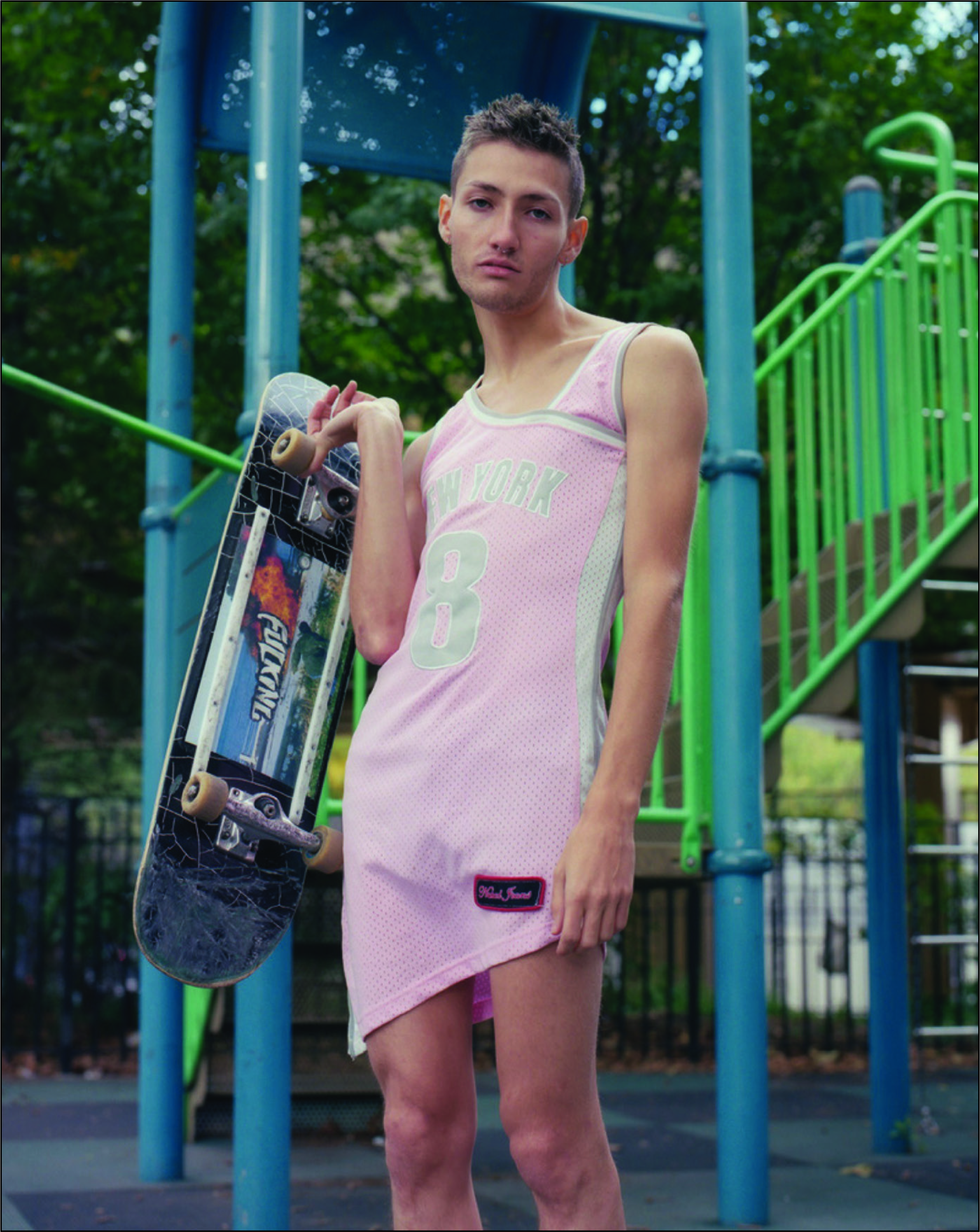
Landenberger photographs queer-skaters to show how these communities are expressing the hybridity of their identities and forging a new space to accommodate this expression. One of Landenberger’s subjects, Jason Bard (see Figure 1) poses modelesque, skateboard draped over shoulder and dangling by a finger with the aloof expression of a disinterested 1990s supermodel à la Kate Moss or Naomi Campbell. Wearing cropped hair and faint five o’clock shadow in a pink dress designed to resemble a feminized basketball jersey, Bard’s masculine body and presentation as a skateboarder is in balance with a queer femininity (Landenberger, 2018). Bard observes ‘how people self-invent their own way of “queering skating” in terms of how they skate, dress, interact and use skateboarding in their lives’ (Truong, 2019). Landenberger shares a similar sentiment watching his subjects ‘taking these objects like skateboards and clothing … and subverting them and queering them into their own thing.’ Through this process, Landenberder insists queer-skaters are ‘differentiating themselves from skaters while still being skaters’ (Truong, 2019). For Landenberger, it is important to emphasize that these representations of queer-skaters are not just superficial, they are productive and transformative. Queering skateboarding is about making space. He encourages his audience that ‘there can be things that already exist and may not be inclusive to you or your community but you can make that space…You can make a space for you and how you identify and all the intersections of your identity’ (Truong, 2019). His subjects do not choose between identifying as queer or as a skater but have created communities based on the intersections and relations between these identities. The skateboarding in Strauberry Peach demonstrates a similar queering of skateboarding that extends the stylistic differentiation found in Landernberger’s posed, still images to the performance of skateboarding captured in the motion of the act itself.
Strauberry Peach (2018) 1 is a skateboarding video released by Skateism, which promotes itself as ‘the diversity skateboarding magazine’ for its focus on queer, women and non-western skateboarding (‘Platforming Diversity’, n.d.). The video itself possesses a campy childish aesthetic. The editing is confidently unpolished, amateur and youthful. There are flashes of bright pink cartoon strawberries, glimpses of dolls and stuffed toys and references to the Mario video games. The title ‘Strauberry Peach’ refers to two of the most visible transwomen in skateboarding, Cher Strauberry and Peach Sørenson, whose footage it features. Strauberry and Sørenson are each notable for their unique styles and unconventional tricks. If skateboarders see and use the world differently than most people, Strauberry and Sørenson see and use it differently than most skaters. The ‘3-Up-3-Down’ stair set of the San Francisco Amory is a popular skateboarding spot. Most skateboarders approach it with same general formula: Jump up the stairs on one end, roll across the flat surface, then jump down when they’ve reached the other end. 2 Instead, Cher Strauberry directly collides with the top step during her initial ascent (00:00:45 of Strauberry Peach). She pauses at the top on two wheels and rolls just enough to emphasize her crooked positioning. She does not bother holding a smooth, clean motion over the length of the flat surface. Rather, she quickly diverts back down the stairs, making sure to hit and jerk with every step of the descent. She makes every effort to involve the cumbersome and stuttering steps. She insists on interrupting the straight motion of skateboarding as much as possible. The approach of most skaters represents a masculine dominance over the space. Their skill is demonstrating command and avoiding any unnecessary difficulty. Strauberry, in contrast, leans head on into the campy surplus of added difficulty.
Sørenson, like Strauberry, differentiates herself through her queer style of skateboarding. Good style is usually fast, smooth and flowing. Sørenson, though, tinkers and jerks (00:02:32). Her movements are awkward and gangly, but her tricks are original, creative, playful and gratuitously complex. She demonstrates virtuosity without tasteful refinement. All of this makes her tricks difficult to identify and name. They test skateboarding’s nomenclature in a way that challenges the practice of labelling. The queerness of her tricks exposes the limits of insisting on strict categorization and clear definition as a measure of validity, illustrating that classification is not always effective or even necessary. Rather than polishing away all the imperfections and idiosyncrasies of her skating to make it easier to standardize, she embraces the rough edges that give her style personality and originality. For Sørenson ‘skateboarding is a great platform for expressing myself, my identity and feelings… I want to show that there is room for femininity and sensitivity in skateboarding…’ (‘Peach’, 2018). Her skating is a conscious challenge to skateboarding’s hetero-masculine norms. She relieves skateboarding of its aesthetic pressures for good, ‘cool’ style through her queered and femininized style of skating. As a queer-skater she makes room for other ways of doing, being and identifying as a skater. Both Strauberry and Sørenson prefer tricks with a bad reputation; the ones that are difficult to make look good—like ollie norths, firecrackers, no-comply/foot-plant variations, and caveman grabs and fingerflips. These are all tricks characterized by ‘surplus’—excess motion and physical involvement (Muñoz, 2009, p. 147). Contrary to most modern skateboarding, their feet leave the board while their hands reach for it far more than is usually acceptable. Strauberry and Sørenson have their own styles, but it is not conventional ‘good style’. Their tricks are in bad taste, but they perform them convincingly. They have good–bad style that distinguishes their skating as camp and queer.
Even when Strauberry and Sørenson simplify their tricks, they still differentiate themselves through their style of dress. Certainly, many skateboarders have heelflipped down the stairs at Harry Bridges plaza in San Francisco, but most likely Strauberry is the only one to do it in a skirt and fishnet stockings while carrying a stuffed pink rabbit (00:01:43). Similarly, Sørenson appears skating in heels, dresses, skirts and stockings to accompany her signature blonde mohawk throughout her footage. She is sponsored by Doyenne Skateboards, ‘a woman-run skateboarding brand that produces genderless clothing’ (Doyenne Skateboards, n.d.). The brand’s 2019 spring/summer line appropriates and recodifies the hetero-masculine workwear of the normative skater style. The items apply soft pastel colour schemes to designs based on mechanics’ uniforms as a ‘reminder that any space can become a place to be and that women and queer people are capable of each and every stunt’ (‘Lookbook SS019’, n.d.). This queer style and sense of design has also reached the mainstream skateboarding industry. In Fall 2019, Adidas debuted an intentionally unisex skateboarding line marketed as a step toward genderless fashion, claiming the line is ‘breaking the barrier of saying “this is for a man” or “this is for a woman”’ (Sawyer, 2019). Though financially motivated and commercially driven, this move is symbolic of queer-skaters effectively capturing the attention of the dominant industry. Major brands have been forced to acknowledge and adapt to a growing non-hetero-masculine demand. Queer-skaters are forcing their entry and forging space in a predominantly heteronormative industry in a way that indicates the possibility of a queerer future for skateboarding.
Queer skateboarding reminds core skateboarding of its capacity to challenge heteronormativity and prompts it to act on its queer potential. In the process today’s young queer-skaters are staking their claim to, and broadening, the skateboarder identity while securing a place in skateboarding that was not available to previous generations. A Skateism article points to a new iteration of skateboarding being born by this generation of queer-skaters that is redefining what it means to be ‘core’ or authentic. Positioned against the camp skating outlined above are the ‘gatekeepers’ of core—described as ‘aesthetic conservatives’ (Harrison-Caldwell, 2019). They enforce an image of core based on skateboarding’s nostalgic past while today’s queer-skaters use their image to project toward the future (Harrison-Caldwell, 2019). This ‘taste-based’ notion of core is useful for filtering out unwanted commercial involvement in order to preserve the skater-controlled nature of skateboarding. But it can become problematic ‘when conventional skate bros use “core” as a device to cast other dedicated skaters, who may not care about what is considered tasteful within skateboarding, as inauthentic’ (Harrison-Caldwell, 2019). This use of core would obviously exclude the camp queer aesthetic. However, it is also what makes queer skateboarding so compatible with core skateboarding. Ultimately, ‘the traditional model of core is all about defining and protecting a rebellious community’ and ‘today, no one embodies the ideals of rebellion and community more than non-cishet-male skaters—the people behind the “new core”’ (Harrison-Caldwell, 2019). The author clarifies that he is not trying to lambast ‘core’ skateboarding but reminds skaters not to ‘conflate taste with authenticity’, that ‘skaters are skaters by virtue of skating and caring about skating, regardless of apparel or trick selection’ (Harrison-Caldwell, 2019). Camp, after all, ‘doesn’t propose that it is in bad taste to be serious…What it does is to find the success in certain passionate failures’. The queer failure characteristic of queer skateboarding may be unconventional but is increasingly being recognized as legitimate.
Queer skateboarding is gradually being integrated into the core industry without having to assimilate or straighten itself. The Strauberry Peach video was shared by The Berrics, one of the most significant skate media outlets, in a post that specifically praised the video for ‘eschewing the standard skate fodder and focusing on some truly unique individuals who are forging a new path in this overwhelming macho culture’ (Gomez, 2018). The Berrics is also an elite private skatepark but opened its doors to the public to host a queer skate session as well as a premiere screening of Carving Space, an independent documentary about queer skateboarding (Dean-Ganek, 2019). Cher Strauberry also appeared in the November 2019 issue of Thrasher magazine in a feature about the video Candyland (2019) from the taste-making skateboarding brand Supreme (Stroebeck, 2019). Editor Michael Burnett gave her picture a special shout out on Instagram, as did premier skate brand Independent Trucks who sponsor Strauberry along with fellow core brands like Spitfire Wheels (Spitfire Wheels, 2019). 3 Strauberry’s photograph was shot by Atiba Jefferson, one of the most highly regarded photographers in skateboarding and the video was produced by William Stroebeck whose affiliation with trendsetting brands such as Supreme and Fucking Awesome has made him ‘one of skateboarding’s anointed arbiters of cool’ (‘We Read’, 2019). Essentially, some of the elite representatives of core skateboarding have given a very queer trans skateboarder (and the difference she represents) an official welcome. Thrasher has also shared videos of queer-skaters in drag, as well as co-sponsored and promoted trans and non-binary inclusive contests/showcases with the Skate Like a Girl Fundation (White, 2019). Additionally, major brand REAL Skateboards’ has hosted a queer skate meetup with grassroots queer skateboarding company Unity Skateboards. Together, the two brands produced a collaborative product line to fundraise for the Transgender Law Center (Unity Skateboarding, 2019). REAL’s distributor has also helped Skateism reach skate shops by sending limited runs of complimentary copies for shops to share with their patrons (Deluxe Distribution, 2019). By refusing to submit to the heteronormative order through their embrace of failure and camp, young queer-skaters performed alternative ways of being and doing skateboarding and produced their own identities, their own spaces, and are producing a queerer, more inclusive skateboarding for the future.
Conclusion
Skateboarding has a unique relationship with ‘the childish, the transformative, and the queer’ that bears with it a strong potential to disrupt the oppressive and exclusionary expectations of heteronormativity (Halberstam, 2011, p. 186). It can preserve symbolic elements of youth and childhood that encourage failure as a means of living outside of normative restrictions. This gives skateboarding a certain queer potential to present alternative experiences and formations of the world that project forward with a promise of queer futurity. Despite the heteronormative pressures of normative society, traditional sport and dominant skateboarding, groups of young queer-skaters are recovering the queer potential in skateboarding and calling upon it to construct and affirm their identities as simultaneously queer and skaters. The queer potential of skateboarding provides an entry point for queer identities. By enacting that potential, the queer-skaters discussed earlier have expanded this theoretical ‘space’ of queer potential and created a more literal queer space within skateboarding by establishing more inclusive practices, projects and communities. Queer spaces and practices in skateboarding are being recognized and mobilized to a greater extent than in previous generations, which not only disrupts skateboarding’s heteronormative status quo but is redefining it from grassroots to professional levels. Of course, queer utopia is always ‘not yet here’ (Muñoz, 2009, p. 1). This has not been to say that heteronormativity and homophobia are a thing of past. Rather, I hope to have shown how, through the powerful political failures and gestures of futurity from today’s young queer-skaters, skateboarding is beginning to engage its queer potential in a way that does seem to indicate the possibility of a queerer future.
Footnotes
Declaration of Conflicting Interests
The authors declared no potential conflicts of interest with respect to the research, authorship and/or publication of this article.
Funding
The authors received no financial support for the research, authorship and/or publication of this article.