




Abstract
Girls are increasingly visible as activists demanding social change, equity and justice. Yet communication between girls and policymakers is fraught with challenges over how to translate young people’s knowledge into policy change. This article traces the history of the manifesto as a form for the marginalized to articulate new social visions, drawing on the Riot grrrl manifestos as examples of this genre. It describes the creation of the first Girlfesto at the 2018 Circles Within Circles event that brought together girls, young people, activists, researchers, and policymakers from six countries in the Global North and South to consider the role of community art-based activism by girls and young people in challenging gender-based violence, concentrating on colonial systems of violence against indigenous women and girls in Canada and South Africa. We analyse the Montebello Girlfesto and the opportunities and challenges in using the Girlfesto model, with reflections from girl participants.
Introduction
‘Young people hold the wisdom and the knowledge and the solutions. A lot of times in the outside world we don’t value their contributions, their advice and their voice. So through this process, it is extremely important that we hear from them, that they provide solutions and guide us on the calls to action’ (Lozinski, 2018). This statement made by a staff member with the National Inquiry on Missing and Murdered Indigenous Women and Girls (MMIWG) at a two-day consultation organized by the Prince Albert Grand Council in Saskatchewan, Canada with young people in April, 2018 draws attention to the critical role that young people—in this case Indigenous young women—can play in bringing attention to the issue of sexual and gender-based violence, much of it perpetuated by the State through on-going colonial relations. A pathway to supporting young people as knowers, as actors, and as community leaders in tackling sexual and gender-based violence calls for ensuring that they have the tools that allow them to speak and ‘speak back’ on the issues as they see them. The use of these tools can be located in the rich body of work on the uses of storytelling through digital media (photovoice, participatory video and cellphilming, and digital stories) and through other forms of storytelling such as collage, drawing, and land-based art. Recognizing the breadth of terms to describe the tools and methods which use the visual and the arts in community engagement, in this article we refer to these approaches interchangeably as participatory visual and arts-based methodologies. Phrases and terms such as ‘girl-led’, ‘girl-driven’ and ‘youth-led’, ‘from the ground up policy dialogue’ and ‘grass roots policy-making’ are often used to describe the potential of this work to bring about social change. However, an understudied (and under-utilized) area is the question of how the voices of girls and young women can be heard in policy contexts. What does it mean to do ‘from the ground up’ policy work with girls and young women? What are the tensions and contradictions between the aspirations of the projects and on-the-ground realities?
Too often, consultations with girls and young women are merely symbolic. As Thomas (2007) notes, often the solicitation of children’s viewpoints have educational or social objectives, and rarely intend for the exercise to have a serious political impact. Not surprisingly, it is frustrating for young people when their participation is premised upon the idea of creating change in their own lives and the lives of their peers, but does not lead to any real changes (Tisdall & Davis, 2004). The lack of uptake can result from young people’s limited access to adult-centred political and policy spaces and lack of access to political intelligibility. Rather than being seen as citizens in their own right, young people in Western contexts are seen merely as citizens-in-the-making, without legitimacy as political actors. Moreover, young people from marginalized communities, including Indigenous girls are even less likely to be able to access modalities of political engagement (Kennelly, 2011). As Kennelly argues, in the Canadian context, Indigenous people have historically been positioned as outside the redemptive status of citizenship. They gained enfranchisement if they went to university or attained a profession, but then they would lose government recognition of their status as Indigenous (2011, p. 38). Emily Bent argues, that even when girls are invited to participate in organizational meetings and sessions, this doesn’t guarantee access to power or their political empowerment (2016, p. 113). Rather, Bent suggests girls’ presence in these forums are often rooted in a logic of ‘exceptionality’, which promote a Western narrative of exceptional individual girl empowerment. Exceptionality is a narrative often picked up by the media which adores singular success stories over stories of collective coalition-building efforts (Edell et al., 2016). In practice this model of girls’ empowerment can constrain girls’ voices to suit the interests of institutions and organizations. A focus on exceptional individuals effaces the fact that many girls, with adequate support and training, can engage in successful activist work (Edell et al., 2016). Thus, collaborations between girl activists and adult-run organizations can be messy and contradictory. A dialogic approach to young people’s participation is proposed by Graham and Fitzgerald (2010), who recommend a series of complex conversations that facilitate and support the development of young people’s agency, while always recognizing the complex power dynamics that characterize these conversations. They observe that preparation for young people’s participatory processes often involves analysis of risk and opportunities for the young participants, but rarely examines the values and assumptions of the adult researchers or organizers and how they are prepared to respond to young people’s perspectives that could ‘place a stutter’ in adults’ expectations (Graham & Fitzgerald, 2010).
In this article we take a reflexive ‘step back’ (Akesson et al., 2014) as a team of adult researchers working with girls and young women to explore the voices of young people in policy contexts. To carry out our ‘stepping back’ exercise on policy dialogue, we draw on Moletsane’s (2018) reflexive ‘biography’, as she calls it, of a march, an approach she uses to analyse a community march in rural South Africa. In our biography of a Girlfesto, we, as organizers, facilitators, and participants focus on a specific event entitled Circles Within Circles that took place in July 2018 in Montebello, Quebec, Canada. The event brought together Indigenous young women, from Canada and South Africa, who were part of a six-year international project entitled Networks for Change and Well-being: Girl-led ‘From the Ground up’ Policy Making to Address Sexual Violence in Canada and South Africa’ (hereafter Networks for Change), along with participants from Sweden, Russia, Ethiopia and, Kenya (including researchers and other stakeholders working with girls and young women).
At the heart of the Networks for Change project is the recognition that Canada and South Africa share ‘shameful legacies’ when it comes to colonial violence, as evident in the high rates of sexual violence experienced by Indigenous girls and women in both countries. As Mitchell & Moletsane note: ‘Across the two countries, history, legislation, and the lived experiences of (Indigenous) young people, and especially girls and young women, point to deeply rooted marginalization. And as we are seeing in both countries, violence on women’s bodies also reflects violence on the land; both are issues of dispossession’ (2018, p. 5). In both contexts, Indigenous girls and young women are over-represented as victims/survivors of gender violence. The work across the various Networks for Change fieldsites in Canada and South Africa involving Indigenous girls and young women highlights the use of participatory visual and other arts-based approaches. It draws attention to the ways that these approaches can support an action -oriented or activist agenda through, for example, the idea of ‘speaking back’ media-making, policy dialogue through youth participant-produced action briefs and policy posters (Mitchell et al., 2017), face-to-face meetings with policymakers (De Lange et al., 2015), and through adult-facilitated girl-led community marches (Moletsane, 2018).
The idea of girl-led policy dialogue and policy making builds on an emerging body of work on young women as activists (MacKay, 2011; Renold, 2018; Taft, 2011; Trigg, 2010). Taft’s work in particular is central to raising questions about the political identity of girls and young women. As she observes, ‘Girls’ activism is an extremely underexplored scholarly topic, largely invisible in the academic literatures on girlhoods and on social movements’ (p. 4). She goes on to comment that, while the field of girlhood studies is growing, ‘these works often describe girls’ acts of resistance to dominant gender norms, or address girls’ consumption of commodified versions of feminism, but very few have made girls’ politics or political identities the central focus of study’ (2011, p. 8). In comparing activist strategies of girls and young women in North America and Latin America, she finds that North American girls struggled to find the political language to voice their views. Following Taft and others, it is clear that there are various ways to think about political language and political strategies. In this article we seek to expand on the idea of girl-led dialogue, placing at the centre the production of what is termed here a ‘Girlfesto’ as a particular type of political language. In so doing we consider both the politics and practices of girl-produced manifestos as a strategic tool in youth activism.
Youth Manifestos: A Brief History
The Montebello Girlfesto was created at a time of revival and renewed feminist interest in the manifesto as a genre. From Julia Serano’s Trans Woman Manifesto (2007) to Sara Ahmed’s Manifesto for the Feminist Killjoy (2017) to Miriam David’s Feminist Manifesto for Education (2016), to Anna Hickey-Moody’s (2016) ‘femifesta’ feminist manifesto for arts education and the plethora of manifestos produced in the Riot grrrl zines of the 1990s, the genre has proven to be a malleable and important form of politicized speech for reconfiguring the terms of feminist agency and revolutionary politics of (young) women. The abundant production of these documents at this particular juncture in time is not coincidental. As Janet Lyon suggests, historically manifestoes and related forms appear most often in clusters around political crises that involve definitions of citizenship and political subject-hood (1999, p. 16). It can be argued that the last 15–20 years has been such a time for young women, and particularly Indigenous young women, who are working to re-define and expand notions of girlhood, to gain social and political recognition as Indigenous people as well as democratic rights, long afforded to others (DeFinney et al., 2018). It is therefore important to take a brief look at the manifesto as a political document to understand more about how the Girlfesto may be used. How have other young women made use of the manifesto as a genre? And what kinds of statements and demands have been made by young women using this form of political speech?
The term manifesto has been used in reference to a wide range of texts that may take many different forms, and yet there is also a familial relation amongst them. In prefacing her Feminist Killjoy Manifesto, Sara Ahmed writes that a manifesto is ‘a statement of principle, a mission statement. Manifesto: a declaration of an individual or organization or group … A manifesto: to make manifest …’ (2017, p. 251). As a form, the manifesto as we know it appeared during the French Revolution as a response to the emergence of modernity and a new ‘universal’ subject with universal rights based on the concepts of equality and rational autonomy (Lyon, 1999, p. 3). As Lyon outlines, the manifesto arose as a public genre to expose the broken promises of modernity. That is, if modern democratic forms claim to honour the sovereignty of universal political subjecthood, the manifesto is a testimony to the partiality of that claim. Manifestos chronicle the exclusions and deferrals experienced by those outside the ‘legitimate’ bourgeois spheres of public exchange; the manifesto marks the gap between democratic ideals and modern political practice (Lyon, 1999, p. 3). A study of manifestos throughout the 18th and 19th centuries reveals a long-standing diachronic narrative of exclusion and oppression serving as a rebuke to modernity’s narratives of progress, universal freedom, autonomy, equality, and inclusion (Lyon, 1999). Manifestos do so by using a particular style that includes rhetorical directness, a declarative and passionate voice and transparent address to other citizens (Ibid.). It is a genre that gives the appearance of being at once both word and deed, both promise and incipient action. As Natalya Lusty (2017) argues about manifestos generally, it is through its fervid declarative force that this genre takes on its peculiarly performative charge, converting mere words into action-oriented resolutions.
Both the rhetorical strategies of the manifesto as well as its exposure to the failures of modern democratic ideals are evident in the zines of the Riot grrrl movement. Conceived from the beginning as a DIY revolution, Riot grrrl was a response to the male-dominated punk music scene (Gottleib & Wald, 1994). Many of the most visible participants were white and queer identified. Zines are small, home-made booklets produced and exchanged by individual as well as girl collectives participating in the scene. They became one of the primary tools of young feminist activism in the 1990s and facilitated radical forms of speech and new political subjectivities for girls. The many manifestos produced within zines became part of an everyday political sensibility tied to the ordinary and not so ordinary lives of the girls and women who produced them, contributed to them and read them (Lusty, 2017). Instead of insisting on the right to be called ‘women’ as mainstream feminism had long been advocating, Riot grrrls foregrounded girl identity, in its simultaneous audacity and awkwardness—and not just girl but a defiant ‘grrrl’ identity that roars back at the dominant culture (Gottleib & Wald, 1994). However, Riot grrrl also linked itself to previous generations of feminist activism through their manifestos which often used inter-textual references to earlier feminist manifestos such as the SCUM and the Bitch Manifestos and drew on some of the imagery, fonts and typographic styles of these older documents (Eichhorn, 2013). Far from forming a site of rupture from older forms of feminist radicalism, the Riot grrrl movement celebrated, borrowed from and extended earlier feminist manifestos, reviving the genre in the context of their own vernacular forms of mediated activism (Lusty, 2017).
According to Lusty, Riot grrrl manifestos often insist on ‘the multiple and heterogeneous temporalities of resistance and solidarity, reconfigured as ordinary, everyday acts that defy the self-regulating scripts for girls and women’ (2017, p. 228). While Riot grrrl manifestos replicate the anger, determination and contrariness of earlier feminist manifestos, there is also an openness to process that makes the route to resistance more porous and fluid. Lusty convincingly argues that by foregrounding the volatility of feminine youth and the erasure of the girl subject as a radical political agent from historical representation, Riot grrrl manifestos contested the universalist foundation underpinning the category of ‘woman’ under broader feminist paradigms.
In redefining the gendered (and ageist) exclusionary practices of the radical public sphere, the movement promoted unified forms of resistance, often symbolized as a personal, albeit contagious, awakening to the realities of harassment, repression, violence and ridicule, whilst emphasizing the importance of autonomous speaking positions and the lived experience of difference (2017, p. 222).
The declarative impulse of the manifesto makes it an intrinsically future-oriented genre. As Lyon states: ‘In shifting the cultural position of a marginalized group, the manifesto yields an alternative historical narrative, one that foregrounds the group’s grievances and thereby struggles squarely within but also in opposition to a culture’s foundational narratives. Our history is the un-thought chapters in your history’, declares the typical manifesto to its opponents, ‘and now your history will be justly superseded by our unfolding future’ (1999, p. 15).
It is the unfolding future of young Indigenous women and girls that the Montebello Girlfesto takes up. In a time where the need for real reconciliation between Indigenous and white settler communities is gaining ground on the public national agenda in Canada and South Africa, and when Indigenous peoples are countering what the dominant order considers the ‘real’, the ‘natural’, the ‘thinkable’, with their own versions of the ‘possible, the ‘imaginable’, and the ‘necessary’, the Montebello Girlfesto both generates and marks a break in history: it is both a trace and a tool of change. It is, as Lyon writes of Manifestos more generally, ‘a palimpsest—a decoding and recoding of inherited discourse, a creation of collective and transitory political subject-hood’ (1999, p. 202). This reflection on the manifesto as a protest text, allows us to contextualize the production of the Montebello Girlfesto and the time we spent together considering the question of violence in the lives of Indigenous women and girls. In the words of Sara Ahmed, ‘in the labor of making manifest we make a manifesto’ (2017, p. 252).
Producing the Montebello Girlfesto
The Montebello Girlfesto brings together art-making and knowledge-building from communities in Canada, South Africa, and beyond. The idea of a manifesto was conceptualized by the adult organizers of the Circles Within Circles event for the final morning of the event as a space where the girls and young women participants could pull together their thoughts after a several days of story-telling, discussion and art-making. However, the interpretation of what a manifesto could contain was left open. The stages of production for the Girlfesto described below can be categorized as: production of the participatory visual arts-based work; joining together; reflecting on what was learned; drafting the Girlfesto; and validation of the final product.
Participatory Visual Arts-based Work
The Girlfesto originated with the different groups of girls and young women who were using arts-based methods to conduct research, activism and knowledge building in their own communities. Each group did this work differently, reflecting their local context, participants’ age, and the skill sets and experiences of the facilitators. Their work was brought together at the Circles within Circles event in two ways: (a) it was visually displayed through an art exhibition entitled Speaking Back: Youth-led Perspectives on Combating Sexual Violence; (b) participants presented their work to the rest of the group on the first day of the conference. 1 The first morning provided space to learn from each other about the work that was taking place throughout the Networks for Change project in Canada and South Africa and at sites in the other countries represented at the event. Some presentations took an evidence-based approach using research and statistics, while others emphasized the culture that infused the work, featuring dancing, drumming and singing. That evening, the Speaking Back Art Exhibition was officially launched, providing an opportunity for the participants to spend time celebrating the visual recording of their art work that was created prior to the event. In this way, we worked to collectively create the ‘transformative space’ (Silver, 2019) necessary for envisioning community justice.
Joining Together
After the first day’s initial presentations of the participatory work carried out in the months and years leading up to Circles Within Circles at the various sites, the next day and a half used a variety of arts-based knowledge-building activities to stimulate reflection on the presentations. The activities sought to connect the groups together in building new knowledge that reflected their similarities and differences across contexts in the Global North and South. These included direct prompts that separated girl participants and adult participants in different activities that reflected on what the knowledge sharing from the initial presentations meant to them. It then led to intergenerational work that combined adult and girl participants in story-telling, cellphilming, photo-voice and sharing circles that sought to connect their narratives (Vanner et al., 2019). The ‘media message’ cellphilms produced by the groups were particularly powerful, covering subjects including violence against women, micro-aggressions, cyberbullying, and shared experiences of colonialism by Indigenous women in Canada and South Africa.
Reflecting on What Was Learned
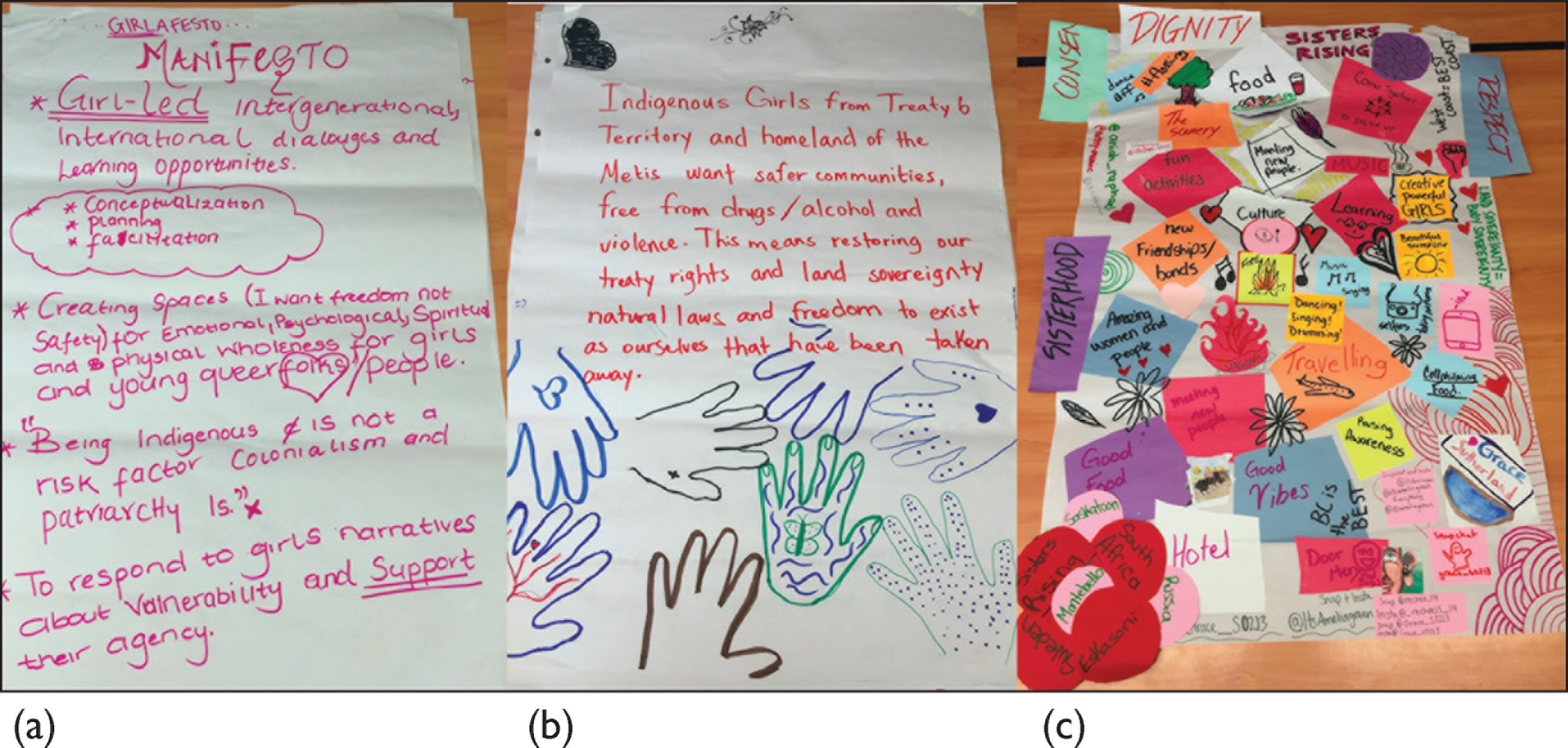
The final morning of Circles within Circles was devoted to ‘Imagining a Future’ in which homes, schools, communities, universities and digital spaces could be spaces free from violence. Participants worked in small groups to create ‘manifestos’ that would build upon the work conducted over the previous days and in the Art Exhibition. They were asked to reflect on the event’s collective art-making and knowledge sharing and respond to the question, ‘What stood out for you?’ before coming together to draft a manifesto for their group. Their discussions were also guided by open-end questions like: How do the materials or art pieces produced add to your knowledge of girls’ and young women’s experiences of gender-based violence? In looking at these materials, what are some things you think need to change? What are some ways you may take action to address gender-based violence? The resulting manifestos took various forms depending on the makeup of the group. Some were action-oriented, critical and decolonizing works (see Figures 1a and 1b), while others were infused with art and joy reflecting on the sense of solidarity built throughout the event (see Figure 1c).
Both the adult and girl participants contributed to this activity, and all of the small groups’ manifestos were combined in the final work. It was an explosive moment when during the reporting-back session one group eagerly stood by their table and presented what they called a ‘Girlfesto.’ Their enthusiasm quickly spread around the room and the idea of the Montebello Girlfesto was born. After each group’s demands were presented and compiled together, policymakers from organizations including the United Nations Girls Education Initiative and the Canadian Women’s Foundation shared their commitment to promote the Girlfesto and to circulate the girl participants’ calls for change.
Validating and Finalizing the Girlfesto
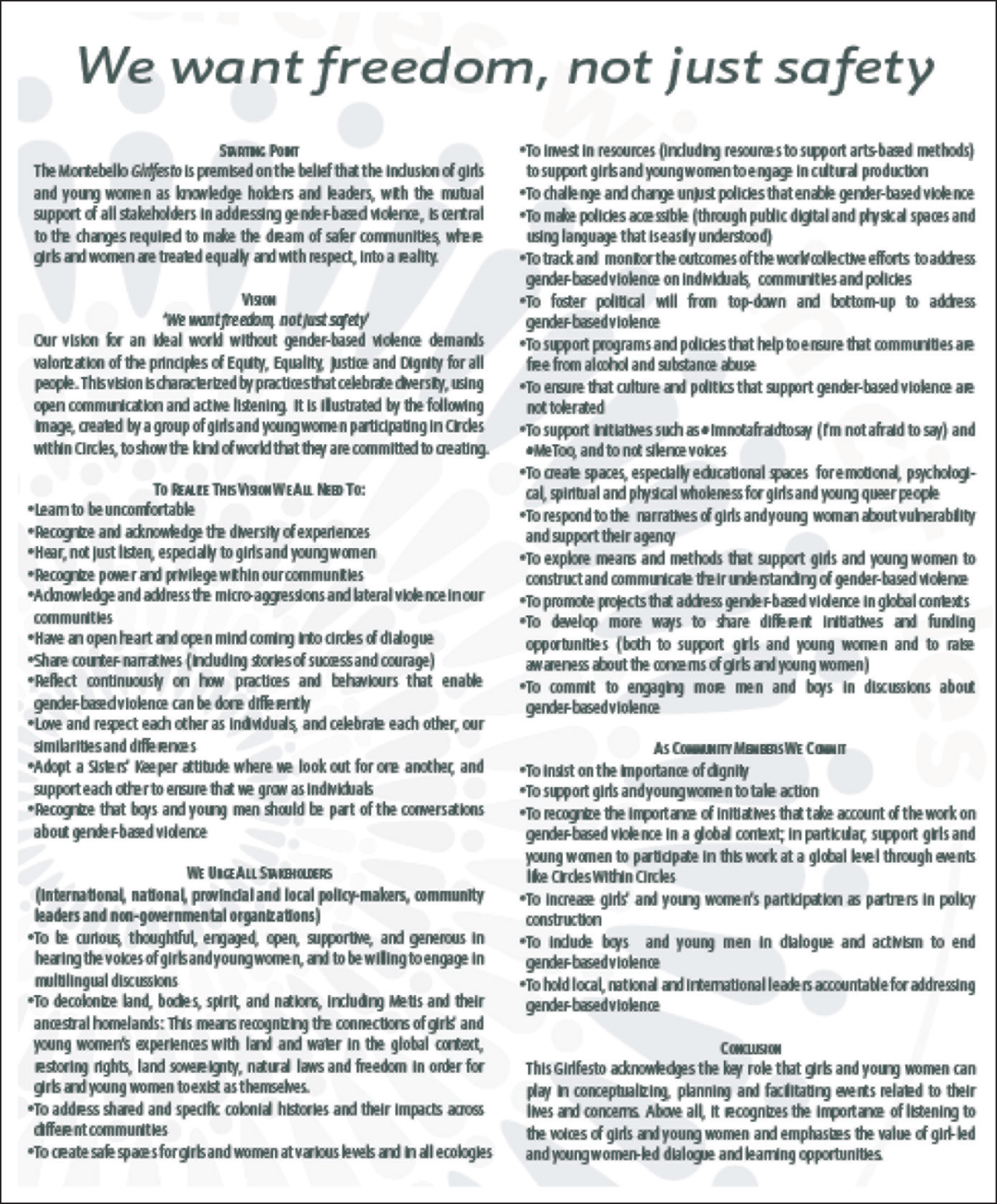
Immediately after the event, members of the Networks for Change team set to work crafting all the small group manifestos into a cohesive Montebello Girlfesto draft document that contained a vision and the concrete recommendations for change offered by all the groups. The transcriptions taken during the ‘Imagining a Future’ session were also reviewed and organized into themes and sections, maintaining the participants’ original language as much as possible. Over the weeks immediately following Circles within Circles, the resulting draft was shared for validation with a range of stakeholders from the event, including the girl participants who had been present and those who had not been present but who were involved in the larger project. These groups made edits and highlighted critical areas that had been overlooked but which, from their perspective, were essential. A notable example of an addition by a girl group in South Africa included a clause on the importance of multilingualism as a value that underpins the dialogue about sexual violence, as well as in relation to the dissemination of the Girlfesto. Thus the validation process returned to girls’ and young women’s voices and indeed continues to engage various girl groups almost a year later. The final product coming out of Montebello has been widely presented at community and academic events, through social media during the 2018 ‘16 Days of Activism to End Gender-Based Violence’ campaign, with policymakers who were present at the Circles Within Circles event, and with all the collaborators and stakeholders officially attached to Networks for Change including Status of Women Canada (now WAGE) and the Commission on Gender Equality in South Africa. The Girlfesto is displayed in Figure 2.
The Girlfesto—‘We Want Freedom, Not Just Safety’
In this section, we reflect on what we see as some critical features of the Girlfesto, recognizing that we offer these reflections through our adult interpretation of its meanings and that the participating girl groups or policymakers could have different interpretations. For example, with the words ‘We want freedom, not just safety’ written across the top, the Girlfesto begins with the rhetorical directness, declarative and passionate voice typical of the manifesto genre described earlier (Lyon, 1999). The words are an interruption and rebuke of what have become the dominant renderings of the issue of sexualized violence. That is, girls and young women are often positioned as accountable for the violence they experience as a result of the clothing they are wearing, being in the wrong places at the wrong times, how they use social media, engaging in sex work, or their consumption of alcohol (Altenberg et al., 2018; Egan, 2013). Workshops at schools and universities on the issue of sexualized violence regularly focus on how young women can protect themselves through precautionary practices of safety. This approach is refused by the Girlfesto as too limited: they see themselves as agents, not objects of change. There is something more than safety—there is freedom. The Girlfesto does not provide a precise definition of freedom—instead it leaves the idea open to invention, the unforeseen and perhaps what does not yet currently exist. In this regard, like the manifesto genre more generally, is oriented to the future, to a time of collective creation of a new form of political subject-hood for young women and girls. The future pulsates with expansion and unknown potentiality. It is always in the process rather than a specific destination. What the Girlfesto does is outline a series of steps or principles necessary to initiate this as yet un-defined future. Under headings such as ‘to realize this vision we all need to’, ‘We urge all stakeholders’ and ‘as community members we commit’, the Girlfesto lays out a wide-ranging call to re-imagine our world. Unlike the Riot grrrl manifestos which were usually meant to be read by other girls, the Girlfesto is addressed to policymakers, organizations, community members, as well as other girls.
We highlight only some of the key points made in the Girlfesto as there is not space to attend to the document in its entirety. There are 10 opening statements under the heading ‘To realize this vision we all need to … ’ These statements establish both the desired affective and behavioural practices to end gender-based violence and to make girls and young women central in this process. This includes the need to ‘learn to be uncomfortable’, to ‘have an open heart and open mind coming into circles of dialogue’ and to ‘love and respect each other as individuals, and celebrate each other, our similarities and differences’. This section also outlines an approach to doing this work which involves ‘recognizing power and privilege’, ‘adopting a Sisters’ Keeper attitude where we look out for one another, and support each other … ’ and ‘recognizing and acknowledging the diversity of experiences.’ The combination of challenging the status quo while celebrating the capacity for change and transformation is powerful and opens the way for serious consideration of what it means to work with/as Indigenous girls and young women, across national lines, to step out of existing paradigms of power and social difference and to enact girls’ agency.
Under the second heading, ‘We urge all stakeholders’, (identified as international, national, provincial and local policymakers, community leaders and non-governmental organizations) the Girlfesto recognizes decolonization as an essential step to addressing sexualized violence. It reads, ‘to decolonize land, bodies, spirit, and nations, including Metis and their ancestral homelands: This means recognizing the connections to girls’ and young women’s experiences with land and water in a global context, restoring rights, land sovereignty, natural laws and freedom in order for girls and young women to exist as themselves.’ The Girlfesto creates linkages between land sovereignty, respect for air and water, and sexualized violence. It connects colonial state violence with violence that is racialized and gendered. These are connections that have been made by Indigenous scholars/activists such as Leanne Betasamosake Simpson (2017) and Audra Simpson (2014). As Simpson (2017, p. 115) writes, ‘the bodies of Indigenous women are legal targets for death, disappearance, and elimination because we are signifiers of a political order that is a direct threat to the political legitimacy of settlement’.
The Girlfesto outlines the need to develop interaction and solidarity within and among Indigenous girls and peoples across geographic boundaries, to ‘address shared and specific colonial histories and their impacts across different communities.’ It stipulates that this requires the creation of ‘safe spaces for girls and women’, ‘investment in resources’ and ‘engaging men and boys in discussions about gender-based violence.’ Under the final heading, ‘As community members we commit’, the Girlfesto urges collective action to address gender-based violence. Girls are enjoined to ‘insist on the importance of dignity’, to see themselves as ‘partners in policy construction’, and to ‘hold local, national and international leaders accountable for addressing gender-based violence.’ The Girlfesto underscores and celebrates girls’ autonomy, agency, and knowledge. It calls for the adult world of policymakers, government officials and community leaders to be attentive to girls’ wishes girls for a future without gender-based violence. It asks all of us to envision a future that is about not just safety, but also freedom.
Limits and Possibilities of the Girlfesto Model
Girl Policy Continuum
An intended outcome of the Girlfesto was increased political vocabulary and methodology to support girls’ ongoing analysis and activism. With the focus on girls’ activism goals, the Girlfesto was not immediately informed by the existing standardized policy context, but rather by the girl participants’ lived experiences. It is thus not presented in a way that directly answers questions policymakers ask. In fact, it poses questions that policymakers do not ask, and so opens up new policy ground. The result is a document that presents a sharply defined vision for how policy stakeholders can respond to what girls want and need. It defines parameters for decolonizing work to prevent gender-based violence, reflects on the current ways that we continue to devalue and exclude girls and women, and refers to historical contexts of oppression that remain unaddressed. It is a statement of principles to guide work to end gender-based violence, as well as a call to action that can have many more applications than solely addressing policymakers. That is, it offers a pathway for transforming lives, logics and structures (Silver, 2019, p. 13).
But because the Girlfesto was not created with a specific policy goal (e.g., to respond to a government standing committee or to inform an active consultation process), the direct policy applications from the Girlfesto may appear limited. As members of the organizing team we are asking ourselves, as reflexive feminist practitioners and scholars, what is the meaningful action we can take based on this new knowledge. At Circles Within Circles, several international and national policymakers who themselves were part of the process of creating the Girlfesto committed to sharing it with their communities and in so doing to circulate the girls’ voices, but did not concretely commit to changes in response to the Girlfesto’s calls to action beyond communication of the production. Genuinely participatory work may be engaging, exciting and dynamic for all involved, but may not hold sway with ‘real’ politics (Thomas, 2007). Spaces for girls to engage in political conversations are essential both so they can develop their political voice and so they have the opportunity to express their needs and concerns, but these spaces for girls are often lacking (Taft, 2011). The creation of the Girlfesto provided this space, but could be taken further through securing commitment to act upon the Girlfesto’s demands, which would position the document not only as something to be seen and heard, but something to be acted upon. The girls and young women involved ask for stakeholders ‘to foster political will from top-down and bottom-up’ and their statements and concerns show that is important to focus on the embodied knowledge and understanding of Indigenous girls. They want to see policies that are ‘accessible (through public digital and physical spaces and using language that is easily understood).’ So the call to policymakers and decision makers is not only to develop clear policies that will end gender-based violence, but also to increase understanding and application of these policies on a community level. This in itself is a step toward increasing how girls and young women as part of an intergenerational group can interact with and participate more actively in policymaking. It is a pathway to justice elucidated by young Indigenous girls (Silver, 2019).
Keeping Girls’ Voices in Policy Communication
The Circles Within Circles event was initiated because girls’ voices often remain sidelined in public policy conversations that directly affect them and because the evidence from the various girl-led arts-based projects underway in several countries pointed to the importance of mobilizing young people, policy makers, and researchers already invested in participatory methodologies as an intergenerational initiative. Keeping girls’ voices in policy communication is not without challenges even in an initiative that aimed to have girls at the helm. As noted earlier, after the ‘imagining the future’ session, several of the adult organizers from the Networks for Change team brought all the manifestos together to find shared learning’s and to develop the collective Girlfesto. It is possible that the girls themselves, had they had the time, space, and funding to come together multiple times to continue to develop a shared vision, may have picked different themes and prioritized different aspects of their calls to action.
There have been various steps along the way to ‘check in’, and to make sure that the Girlfesto reflected the intentions of the girls who participated in creating it. All the participants who developed this vision should be able to refer to this document and see their words, their realties, and their vision reflected in the final document. Shortly after Circles Within Circles, for example, participants were invited to share reflections about the experience, either in relation to the event overall or in relation to specific activities about which they had strong feelings about. As well, and as highlighted earlier in several of the sites in South Africa, girls and young women have participated in workshops where they reviewed and critiqued the content of the Girlfesto. The feedback from adult and girl participants was positive, reflecting the sense of community, pride and energy in their experiences of being together (Vanner et al., 2019). It spoke to a sense of solidarity experienced in which they repositioned acts of everyday resistance to become a global movement of defiance for and by Indigenous girls and young women. As Gabby Daniels, a girl participant, subsequently wrote,
I think the girlfesto we wrote with all the other girls/women is super important .… In Canada, Indigenous women are more likely to go missing, in Africa, the girls cannot walk around their campus without being attacked… In my family, my aunties, uncles and cousins have gone through sexual violence (Daniels, 2019b, p. 43),
illustrating the connections she observed between the girls’ experiences around the world and the violence in her own family and community. They also provided constructive suggestions for future initiatives, including having more activities led by girls themselves, noting that they could be leaders and facilitators as well as participants in the construction and sharing of knowledge (Vanner et al., 2019). A girl-led approach to the design, organization and facilitation of knowledge-building activities, in addition to their continued engagement as participants in those activities, would require significant advanced preparation and close communication between the girl leaders and the organizers of the event or consultation. The suggestion prompted reflection about how the dialogue with participants could extend to enhance recognition of girls’ agency at multiple levels of the event, creating new opportunities for future participatory initiatives as we revisit the question of what it means to be girl-led.
Sharing the Girlfesto
The Girlfesto is a mechanism by which arts-based and youth-friendly processes can be translated into clear and actionable policy items, co-produced as Flicker and Nixon (2014) note by girls and supporting adults. The document captures the declarative force and action-oriented resolutions that Lusty (2017) characterizes as typical of the manifesto genre, but the degree to which action will emerge as a response to the Girlfesto remains to be seen. The document has been shared by email with all the event participants, in the Networks for Change Newsletter, in a handbook describing the arts-based methods used at Circles within Circles (Vanner et al., 2019), and in several follow-up events, including a 2018 International Day of the Girl session at John Abbott College in Montreal, the Engaging Youth and Community Responses to Sexualized Violence gathering, held at the First Peoples House, University of Victoria in October, 2018, at the 2019 International Girls Studies Association conference, and as part of the 2019 launch event for the book Young Indigenous Women’s Utopia produced by the girl group of the same name. The Girlfesto has so far been translated into Russian, French, Xhosa, isiZulu, Mohawk and Inuktitut and, both in its small flyer format and as a large size portable ‘pull-up’, accompanies the other works of art displayed at Circles Within Circles in a travelling art exhibition that has journeyed across three countries to date. The visibility and accessibility of the document are important for its ability to be widely shared, necessary for it to shift the position of these narratives as alternative and marginalized in a way that will challenge the foundational narratives of mainstream cultures (Lyon, 1999).
Although the spread of the document through social media and virtual networks is exciting, girls’ in-person presentation of the work can extend their own engagement with it and develops their skills in oral communication and advocacy. It can be more compelling for adult stakeholders to hear about the Girlfesto directly from the girls involved in creating it, possibly crafting moments during which to publicly ask for commitments to make changes and/or support similar work in future. Girls’ presentation of the work also highlights their own engagement with the work and its personal meaning for them. For example, at the International Girls Studies Association Conference, two girl participants shared the calls to action that most spoke to them. Jessica McNab identified the call, ‘To commit to engaging more men and boys in discussions about gender-based violence’, explaining that she thought that her brother should have the opportunity to feel the same way she does when participating in her girls’ group. Cindy Moccasin spoke to the call, ‘To create safe spaces for girls and women at various levels and in all ecologies’, as she said that her girls’ group had taught her that sexual harassment was something she could challenge, not something she had to accept and expect in her life as a girl or a woman (Altenberg et al., 2019). Through their messages, the girl participants communicate how the demands resonate with them, demonstrating the extent to which violence has real life implications in the lives of Indigenous girls, and their hopes for something different.
Conclusion
In this reflexive ‘biography’ of a Girlfesto we have highlighted the development of the Girlfesto as an intergenerational participatory process contributing to developing girls political subjectivities (Bent, 2016; Taft, 2014). Our ‘biography’ considers both the possibilities and paradoxes of doing this work. As Bent notes, feminist partnering with girls, requires us to step fully into the contradictions of our work (2016, p. 114). On the one hand, the activity of creating the Girlfesto helps to generate compelling conversations about the very real issues of sexualized violence and the patriarchal, colonial structures that sustain it. It is a process which like other manifestos, makes previously unintelligible political subjectivities, intelligible. However, in an intergenerational project there is also tension in finding the right balance between adult and girl-led initiatives (Edell, et al., 2016). There is also no guarantee that the Girlfesto will be taken up by policymakers and other stakeholders who are in positions to create the changes demanded by girls. Keller (2012) observes that girls live in societies that continue to exclude them from formal political and citizenship rights. This is particularly true for Indigenous girls. The Girlfesto and the artwork that preceded its creation might therefore be considered proto political spaces allowing for new collectivities to emerge, and the enunciation of new political subjectivities to surface and form out of fragmentary ventures and imperfect initiatives. As Andraya Daniels, a girl participant in Circles Within Circles, says: ‘This document is important because it’s an actual vision of what women and girls want to happen in our lives. It’s important because we need equity and justice, and we’re showing what we want to happen … People need to read this, I feel, to really understand’ (Daniels, 2019a, p. 33).
Footnotes
Acknowledgements
This work was supported through an International Development Research Centre (IDRC) grant (award number 107777-001), a Social Sciences and Humanities Research Council of Canada (SSHRC) grant (award number 895-2013-3007) and the Pierre Elliott Trudeau Foundation-funded project Circles within circles: Transnational perspectives on youth-led approaches to combating gender violence.
The authors declared no potential conflicts of interest with respect to the research, authorship and/or publication of this article.
Funding
The authors received no financial support for the research, authorship and/or publication of this article.