




Abstract
This article problematizes the assumption that national policies have a direct impact on youth participation at the local level and analyses the relationships between local forms of youth participation and local and national policies. Relying on data from a EU project funded under the HORIZON 2020 programme, the article focuses on formally institutionalized settings of youth participation and elaborates local constellations of youth participation in six European cities. These constellations may be referred to as regimes of youth participation as they reflect wider structures of power and knowledge that influence the way in which young people’s practices in public spaces and their claims of being part of society are recognized. However, the analysis reveals that rather deducing it from the model of welfare regimes, such a typology needs to be developed starting from the local level and should consider the ways in which different relationships between local youth policies and national welfare states affect youth participation.
Keywords
Introduction
Recent debates in both youth research and youth politics at the European level have been concerned with the question of how to ensure young people’s political, social and civic participation (Brooks, 2009; Spannring et al., 2008). When the European Union (EU) started promoting youth participation almost two decades ago, it addressed national governments as the main youth policy actors capable of facilitating young people’s participation (EC, 2001). However, rather than strengthening youth participation, these efforts seem to have contributed to ‘strong discourses’, while respective policies have remained rather ‘weak’ (Loncle et al., 2012; Williamson, 2011). At the same time, international research is struggling with producing comparative knowledge of how youth policies address youth participation, especially as youth participation evolves mainly at the local level initiated by local authorities, youth work associations or youth-led groups. Thus, it remains unclear how top-down policy approaches actually influence youth participation.
This article problematizes the assumption that national policies have a direct impact on youth participation. It aims to analyse the role and the relationship of local and national youth policies in the specific ways in which youth participation evolves at the local level, thus addressing a need for research to explore the relationship between policies and the various forms of youth participation (Brooks, 2009; Gordon & Taft, 2011). In order to contribute to an overview over local variations of youth participation whereby existing across different European cities, our analysis starts from local expressions of youth participation at the local level. It then focuses on the relationship between national and local youth policies in general and with regard to youth participation in particular. Rather than searching for a typology at the national level, the aim is to reconstruct local constellations and the ways in which they reflect principles and structures of local and national youth policies. The analysis is limited to forms of formal or ‘adult-led’ youth participation because they can be taken as more or less direct attempts of public policy actors to foster youth participation in terms of representation and involvement in decision-making.
The article focuses on six European cities which were studied in the framework of the HORIZON 2020 project ‘Spaces and Styles of Participation’ (PARTISPACE): Bologna (IT), Gothenburg (SE), Manchester (UK), Frankfurt (DE), Rennes (FR) and Eskişehir (TK). It starts with a discussion of understandings of youth policy and youth participation, and a reference to the limited international research on this subject. This includes questioning the appropriateness and feasibility of regime typologies, similar to approaches with regard to welfare or youth transitions, with regard to the analysis of youth participation. The research context and the multilevel methodology used to generate data is then briefly described. Subsequently, the article provides a descriptive analysis of youth participation in the six cities, drawing on one formalized setting for each case, followed by the structure of local youth policies and the organization of welfare and youth transitions at the national level. Accordingly, the typical elements of these constellations are elaborated. In the discussion, the characteristics of these constellations are juxtaposed and the role of national and local contextual factors is discussed. The article concludes by reflecting on the potential of applying the regime concept to the comparative analysis of youth participation.
Comparative Research on Youth Policy and Youth Participation
Youth participation is a rather fuzzy concept. Due to its political relevance in democratic societies, even scholars struggle to separate its analytical aspects from its normative aspects. There is also a lack of overarching definitions across different disciplines. Philosophy emphasizes the relationship between self- and co-determination, which can also be conflicting (Gerhardt, 2007; Laclau & Mouffe, 1985). Political science stresses decision-making in political institutions, such as voting or being a member of a political party (Almond & Verba, 1963). In sociology, this is extended to belonging and membership (for example involvement in organizations; Spannring et al., 2008). Due to young people’s scepticism and distrust of traditional political institutions (Pickard, 2019), attention has been recently extended to include forms of civic participation—like youth councils, the primary focus of this article—which often aim at introducing young people to and preparing them for institutionalized mechanisms of citizenship (Matthews, 2001). This also applies to education and social work, where participation is both an aim and a principle of working with young people (Arnstein, 1969; Batsleer et al., 2020).
The EU project PARTISPACE began questioning existing definitions of participation because of their institutional and hegemonic character which excludes, neglects, stigmatizes or even criminalizes many expressions and practices of young people in public spaces (Walther et al., 2020). The findings of this study suggest that in principle all practices of young people in public space can be potentially located on a continuum between informal and formal, and between every day and political participation (Harris et al., 2010). Thereby, we understand youth participation as the relation between young people’s practices in public spaces and the ways in which adults and institutional actors’ recognize their implicit and explicit claims of being a part of the respective society (Batsleer et al., 2020).
Such differentiation is helpful in analysing the relation between youth participation and youth policy because it reveals that the forms of participation on which policymakers generally focus are only marginal among the many different forms of young people’s involvement in society (Matthews, 2001; Spannring et al., 2008). This makes it necessary to clarify what is meant by youth policy. Following Williamson’s (2007, p. 100) statement, ‘every country has a youth policy, by intent, by default or by neglect’, youth policies stand for a set of public measures addressing young people, the forms and contents of which vary considerably. In some contexts, they primarily include the provision of leisure activities, while in others they also cover the fields of social inclusion versus exclusion, education, health, or transitions to work. There is a widely shared distinction between a cross-sectoral understanding of youth policies, including all policies affecting young people’s lives, and specialized youth policies that focus on youth work and youth participation. However, the relationship between these two policy approaches varies across local and national contexts. Youth policy targets also differ regarding age or whether all young people or only the disadvantaged are addressed (Loncle, 2012).
Despite European institutions’ efforts to influence member states to consolidate their youth policies and to develop youth participation, it seems that only very limited progress have been made (Brooks, 2009; Perovic, 2017; Șerban & Barber, 2018). In fact, political references to youth participation has been interpreted as the symptom of a structural youth policy deficit in which addressing young people as ‘citizens in the making’ (Hall et al., 1999) and inviting them to volunteer and engage in decision-making are interpreted as acts of securing legitimation and governance (Akiva et al., 2014; Flanagan et al., 2017; Kennelly, 2011; Loncle et al., 2012). However, there is little research on youth policies, especially in an international comparative perspective and with regard to youth participation (Brooks, 2009; Loncle, 2017; Nico & Taru, 2017; Planas et al., 2014).
The few existing comparative studies tend to conceive youth policy as an element of the welfare state referring to Esping-Andersen’s (1990) model of welfare regimes (Wallace & Bendit, 2009). This model compares welfare states according to access and levels of social security and relationships between the state, the market and the family. It allows to distinguish constellations where all citizens have access to high levels of benefits (like in the social democratic regime type in Scandinavian countries) from welfare states securing broad access but low benefits (like the liberal regime type in the Anglo-Saxon countries) or others characterized by differential access to and level of benefits according to employment and family status (the conservative type in continental Europe, see Gallie and Paugam [2000] or Ferrera [2005] for modifications with regard to Southern and Eastern European countries or in terms of gender).
However, welfare regimes not only represent a comparative typology of welfare states but also a theoretical concept of how modern societies organize welfare (Chevalier, 2016). The concept of ‘regime’ implies that welfare not only involves state institutions but also other actors and mechanisms of social integration. This ‘governance beyond government’ relies on particular discourses—constellations of power and knowledge—on the relationship between the individual and society, and on assumptions of what is seen as ‘normal’ in this respect. In a wider sense, regimes stand for different modes of integrating individuals and society in modern capitalist democracies (Walther, 2017) and thus may also apply to the analysis of youth participation.
While the theoretical concept of (welfare) regime seems fruitful for conceptualizing the powerful interplay of aspects involved in youth participation, there are nonetheless two challenges in applying Esping-Andersen’s comparative model in this respect: First, it has neither addressed youth policies nor youth participation in its comparative analysis. Thus, it remains unclear if they share the same logic and institutional structures like monetary security schemes. In fact, typologies departing from the welfare regime model seem to be more applicable to the so-called ‘hard’ policies like education or labour market policies governed by standardized regulations and large budgets at the national level (Loncle et al., 2012). Also Salamon et al. (1998) who have applied it to conceptualize the ‘social origins’ and developments of civil societies had to limit their analysis to the structural aspects of the non-profit sector. The model has been also used as a framework for analysing young people’s transitions to the labour market (Walther, 2006), combining institutional factors such as access to welfare, education, training or the labour market with cultural aspects. Youth transition regimes reflect different discursive representations of youth on a continuum between youth ‘as a resource’ and ‘as a problem’ (EC, 2001; Kennelly, 2011): personal development like in Sweden (universalistic regime), economic independence like in the UK (liberal), family dependency for example in Italy (under-institutionalized) or occupational socialization like in Germany or France (employment-centred). This comes much closer to the purpose of this article, however, so far references to youth participation have been marginal. Walther (2012) argues that comprehensive education systems reflect the higher degrees of choice that young people have in terms of life planning rather than in systems based on early selection. The same applies to integrative versus compensatory schemes in school-to-work transitions. Chevalier (2016) shows that differences in young people’s access to social benefits affect their dependency on their parents or unfair working conditions and their recognition as a person with individual rights. Similarly, Soler-i-Martí and Ferrer Fons (2015) found statistical correlations between institutional expressions of young people’s citizenship status and different ways of regulating their transitions to work.
Second, in most European countries, youth policies (like many other sectoral policies) tend to be framed by national legislations but implemented at the local level where socio-economic conditions, local traditions and actor networks may dilute or override national policy directions (Loncle et al., 2012). As youth policies are less regulated by law than other sectoral policies, they sometimes depend on the good will of public authorities or even individual policymakers. This ‘softness’ and particularities make cross-country comparative analysis difficult. Andreotti et al. (2012) have shown and convincingly argued that comparing social policies at the local levels—different from national welfare states—faces difficulties in developing typologies due to the complexity of relationships between single policy decision processes, actor relationships, organizational cultures and users of youth policies (Arvidson et al., 2018; Jensen & Lolle, 2013; Mingione et al., 2002). If we still refer to regimes, we first of all refer to the theoretical way in which they conceptualize the complex constellations of governing the relationship between individuals and society. Rather than aiming at developing a systematic regime typology, we provide analytical descriptions of local constellations which are understood as a first tentative step towards a model of youth participation regimes, that is, different expressions of youth participation at the local level and their relationships with local youth policies and national welfare states.
Methodology
The analysis presented in this article draws on data and findings of the research project named ‘Spaces and Styles of Participation. Formal, non-formal and informal possibilities of young people’s participation in European cities’ (PARTISPACE) funded by the European Commission’s Horizon 2020 programme. This project aimed to look behind the surface of youth participation which often tends to be equated with institutionalized settings of representation that seek to provide young people ‘participation competences’ (EC, 2009). In the project, such formal settings addressing youth participation in an explicit and organized way were contrasted with non-formal ones and informal practices of young people in public spaces in order to show the extreme diversity in how young people participate in society. Settings were conceptualized as non-formal where youth participation is not addressed in explicit ways but activities evolve from young people’s interests such as in youth work. Informal participation refers to all practices of young people in public spaces which can be understood as expressions of claims of being part of society. While the main aim was to broaden the perspective towards youth participation and to extend the concept to non-formal and informal practices in public spaces, this also contributed to a more explicit insight into formal youth participation. In this article, we focus on the formal settings of participation that local and national authorities recognize as youth participation. As they can be interpreted as explicit youth policy choices made to facilitate youth participation at the local level, they allow for an analysis of the relationship between youth policy and youth participation.
The project studied participation across eight cities from which six were selected for this article applying the model of youth transition regimes as a heuristic rationale for a diversity of contexts: Bologna (IT) for the sub-protective or under-institutionalized model, Gothenburg (SE) for the universalistic one, Manchester (UK) for the liberal one, while Eskişehir (TK) has been included as a case of system of youth transitions in transformation. Frankfurt (DE) and Rennes (FR) have been selected both for the employment-centred regime to assess if and how similar national contexts affect youth policies and youth participation at the local level. All cities are major cities but not capitals of their respective countries. 1
The article draws on three types of data: First, in processes of mapping the cities with regard to youth participation, 20 expert interviews and 12 group discussions with young people were conducted on representations of youth and participation in each city. Sampling ensured a diversity of perspectives by interviewing experts with different functions and from different institutions (e.g., local authorities, youth work, youth organizations, or research) and young people in different school types and levels as well as in youth work and other out-of-school contexts relevant for the respective contexts. Second, six contrasting settings of young people’s practice in public spaces characterized as formal, non-formal and informal were selected based on the findings of the mapping. Ethnographic case studies of each of these settings included participant observation, group discussions and biographical interviews with young people active in the settings. Observations were documented by extensive field notes and interviews, and group discussions were audio recorded and fully transcribed. Selected data sets were translated to facilitate in-depth comparative analysis. For this article, data from one formal setting of youth participation per city were analysed. These case studies are neither positioned as being representative for the respective local contexts nor do they compose a homogeneous sample. Instead, they offer exemplary insight into the variations in formal youth participation policies at the local level. Finally, reports on national youth policies and discourses on youth as well as on European discourses on youth participation were also a date source (Andersson et al., 2016; Becquet et al., 2020).
Variations of Youth Participation in European Cities
While focusing on cities, this analysis addresses the potential link between local youth policies and forms of youth participation initiatives, and the wider contexts of national welfare states and youth transition regimes in which they are embedded. Here, the cities are considered both as a level of policymaking and as young people’s life worlds with youth participation being one of the expressions of their relationship. In the following paragraphs, we will briefly describe formal youth participation in the six cities. These descriptions necessarily are not complete but offer insight into selected key aspects that have emerged from the analysis. As an ‘entry point’, we have chosen one formal setting of youth participation per city which are interpreted as explicit expressions of how local youth policies aim at facilitating youth participation. The descriptions of these settings reveal, first, differences in whether cities have formally established youth representations or what other formalized mechanisms are referred to in terms of youth participation. A second aspect is that formal settings of participation differ according to their mandate, target groups and the resources they are equipped with. Third, they also show different roles of adults and different rules through which recognition and power are conditioned (see Lüküslü et al., 2020). This is then related to the structures, approaches and achievements of specialized youth policies at the local level. Therefore as a fourth aspect, local youth policy contexts are considered with regard to their institutionalization and coordination, and the way in which they recognize young people as members of the local society. Do they provide an infrastructure such as youth work premises that young people can use according to their interests and (how) do they respond to young people’s newly arising needs or practices? Fifth, the local case studies also reveal that both youth policy in general and formal participation in particular do not meet the needs and interests of most young people. This is reflected by critical perspectives of both young people—either in terms of reactions to the policies or of involvement in practices outside formal institutions—and of experts such as youth work practitioners. Finally, these local structures are contextualized with regard to national structures of welfare and youth transitions. Analysis shows that these make a difference in how young people are represented, addressed and endowed with influence regarding their own lives, while not necessarily affecting local youth policies and the ways they foster youth participation directly. Thus, the perspective is widened towards a cross-sectoral perspective understanding of youth policy (Andersson et al., 2016). The descriptions conclude with highlighting the specific logics and power relationships of local constellations of youth policy and youth participation by which young people are addressed as ‘citizens (in the making)’ (Hall et al., 1999).
The Youth Representation Forum 2 in Gothenburg (Sweden) is a municipal structure for young people’s co-decision-making, consultation and initiatives. It is elected by all young people aged 12–17 years, based on district councils, and disposes of a significant budget to organize projects and support young people’s initiatives. The young people involved in the core group experience empowerment in making their interests and views public and have managed to develop an informal atmosphere in the core group. However, they also criticize adult interference and the lack of real power. Thus, they assess youth participation as ‘lap-dog of politics’ (group discussion Youth Representation Forum Gothenburg). The Forum is part of a well-developed youth policy structure coordinated by a specialized department, while the youth sector is organized at the district level and secures significant youth work infrastructure across the city. All institutions addressing young people are endowed with participatory mechanisms that reflect a high responsiveness to young peoples’ changing needs and initiatives, and contribute to young people’s trust. However, youth policies struggle with compensating effects of the sharp social segregation in the city and, apart from this, youth policy may also contribute to silencing young people’s informal practices, which in the research appeared to be less visible in Gothenburg than in other contexts. Youth policies at the local level stand in a dynamic dialogue with the national policy level. The way in which youth transitions are organized has been classified as a universalistic transition regime in which youth is seen ‘as a resource’ and therefore addressed in terms of comprehensive individual development and provided individualized access to resources and services. Nevertheless, in this context as well, youth work has a legitimation function undermining its sustainability. In a group discussion, youth workers criticize: ‘Burn a car, get a job. It’s a classic thing, you throw money at the problem. As soon as it is gone, no money.’ At the same time, the youth workers reveal a moralizing and deficit-oriented view towards young people who do not actively engage in institutionalized forms of participation: ‘They don’t understand that participation comes from yourself as well. It’s about always doing the best you can with the prerequisites you have.’ In sum, responsive youth policy and youth work infrastructure ensure youth participation. However, this potentially also silences informal practices and counter-initiatives while being not sufficient in balancing the effects of segregation. In sum, youth participation reflects a responsive youth policy and infrastructure characterized by not only supporting young people to be responsible co-citizens but also by normative expectations to participate in the ‘right’ way. This local constellation can be referred to as ‘conditional recognition’.
A Youth Representation Forum also exists in Manchester (United Kingdom) as a municipal structure with elected members, yet without systematic links with youth work in the city. The Forum was established in 2011, in the aftermath of the austerity measures and the ‘riots’ in several cities in the UK ascribed mainly to young people (Cooper, 2012). The space is intended to offer young people an opportunity to get involved in the city life and to prevent alienation and distrust. This history is reflected in how adult youth workers guide the group activities towards consensus and pre-defined agendas. The modus operandi of this setting follows a top-down, adult-led and pre-determined structure, noticeable in the choice of themes and activities as well as in how the sessions function. Most of its activities are structured around educational campaigns (like ‘Don’t hate, educate!’) defined by regional or national youth councils or by local or national government structures. It also reflects recent developments in youth policy in Manchester characterized by the outsourcing of youth services to the voluntary sector. Youth work is thereby being increasingly replaced by measures of social inclusion for at-risk groups in response to young people’s high levels of precarious living conditions in the city (e.g., homelessness), while at the same time it also reproduces young people’s marginalization in the city. In a group discussion, youth workers characterized their work as ‘trying to do a difficult dance’ and ‘making sure things don’t explode’. The situation in the city is partly the result of austerity policies and the (neo-)liberal approach to welfare and youth transitions at the national level, which prioritizes private investment or communitarian engagement over state activity. The way in which young people engage in the Forum to develop their skills and competences aligns with a rhetoric of social change. While some young people see this approach as being ‘all too sugar coated’ (group discussion Youth Representation Forum Manchester), others say: ‘It’s still under the same umbrella, wanting to change the world, but in terms of long term what I believe is that essentially it will be my qualifications’ (biographical interview member Youth Representation Forum Manchester). The local constellation is characterized by a strong emphasis on precarious living conditions and social inclusion, while at the same time austerity policies have caused dramatic cuts and a shift from youth work. The concomitant paternalistic and ‘pedagogized’ approach to youth participation can be labelled, ‘leading the process from above’ and characterizes the neoliberal logic informing also youth policies at the national level.
The mandate of the city-wide Youth and Student Representation (YSR) in Frankfurt (Germany) is limited to school-related issues such as campaigns and consultation regarding school policy and management. The assembly comprises two delegates per school and meets two to three times a year. It is organized and prepared by an elected board and president as well as thematic committees under the assistance of a voluntary youth worker. They also represent school youth in the city councils’ various committees. The budget for their activities has recently increased, reflecting the recognition they receive from the city council. However, the board members are aware that ‘70, 80% (of young people) do not even know about the YSR’ (biographical interview, member Youth and Student Representation Frankfurt). This was confirmed in many group discussions in schools and youth centres. Many young people also criticized the forum’s lack of power and effectiveness and that members ‘think they are someone special’. To mitigate this tension, the board has sought to stretch its mandate to include youth cultural issues beyond school. However, to avoid conflict with the authorities and to prevent the young people from getting frustrated, the youth worker often tries to talk them out of such activities. At first sight, such limitations seem contradictory as in Frankfurt, local youth policy is coordinated by a specialized department responsible for a wide and diversified infrastructure of youth centres across the city. However, both at the city level and national level, youth policies are rather institutionalized as ‘youth welfare’ aimed at the social integration of at-risk young people which reflects the simultaneity of economic wealth and social segregation in the city. Against the backdrop of an employment-centred transition regime characterized by selective education and training allocating youth to different occupational and social positions, the national Child and Youth Welfare Act is characterized by a dominant deficit-oriented view and a protective approach towards young people. Both access to support and participation rights are conditional. Additionally, youth welfare has been marked by a shift towards activation coinciding with a prioritized focus on childhood and school-related support services in recent years. Young people are addressed primarily as students which affects youth work inasmuch as it narrows its scope for participation (Meuth et al., 2014). Under the surface of a discourse of ‘youth-as-a-resource’ representations of ‘youth-as-a-problem’ prevail. Many experts are ambiguous about participation and complain about young people’s lack of motivation: ‘I don’t know what they want. They have criticised everything…although the centre offers so many opportunities’ (expert interview, youth worker, Frankfurt). A gap of mutual distrust seems to have emerged between youth welfare actors aiming at education for participation in the ‘right’ way and young people’s emphasis on ‘chilling’ as the most important activity in public spaces. While experts refer to ‘chilling’ as doing ‘nothing’, the following account of a group of young men in a disadvantaged district shows the fluid boundaries between ‘everyday life participation’ (Batsleer et al., 2017, p. 183) and political participation: ‘We want to have more influence in our neighbourhood cos we’re a part of it. For example, removing the benches used by young people who chill outside means interfering with a territory of young people that is used 24 hours a day’ (group discussion, young people, Frankfurt). In sum, interpretation of youth policy as youth welfare and a shift towards activation undermine possibilities of youth participation. Summarizing, young people’s needs and interests are increasingly subject to a normalizing approach of local youth welfare, while their distrust towards institutions increases. Inasmuch as young people are addressed primarily as students and participation is limited to school, this constellation may be referred to as ‘assigning them a role’.
In contrast to the first three cities, in Rennes (France) there is no youth representation at the local level. There is, however, a Youth and Information Centre, which combines the assets of a youth centre and a regional youth policy agency with the legal form of ‘association of associations’. The centre’s mission, organization and building have been modernized in the recent decade contributing to raising its importance in the city and the region. Young people can use the premises for their own projects and youth workers provide support to external groups. It is funded by the city, the region and the state, which creates recurrent problems of coordination and leadership. Recently, initiatives have been aiming at including young people more systematically in decision-making processes like involving them in the managing board on the condition they have internalized the organizational rules and routines. Nevertheless, some youth leaders and volunteers express feelings of not being completely heard by adults. This reflects that in Rennes, youth policy is structured around complex relationships between public actors and associations. Youth participation initiatives often appear to be too demanding and not always accessible to those not involved in the respective associations. Youth and social workers express the dilemma that if they should send young people to public events of youth participation, which they expect to be tokenistic, they would thus eventually lose their credibility with these young people. This means, in whatever way they act, they function as gatekeepers of participatory arenas of limited power and resources. At the same time, engaged young people reproduce these barriers by distinguishing themselves from those young people who do not participate in the activities but are ‘passive’ (group discussion, young people, Rennes). As the city is primarily referred to as a ‘student city’, 3 youth policy is centralized in the city centre, privileging the student population and marginalizing youth in the suburbs. At the same time, similar to Frankfurt, political protest—a common form of student mobilization—like the NDE social movement that emerged spontaneously in several French cities as a response to a liberalization of labour law, is rarely recognized as a form of participation. At the national level, youth policies used to be organized in a centralized way concentrating on limited areas such as engagement and fighting against early school leaving. These policies are thus organized according to the employment-centred regime type. Recent decentralization processes have increased the competency of regions and municipalities regarding youth policy, yet, without allocating them the corresponding resources due to austerity policies. Altogether, weak local policies and strong associations make young people’s influence conditional on the will to engage in organizational structures. This structure reproduces social divisions not only between students and other young people but also between members of associations and the rest. Insofar as individual young people take roles within associations, the constellation coincides with ‘assigning them a role’, while for the majority youth participation takes the pattern of ‘leading the process from above’.
Although sharing a lack in formal youth representation and the image of a city dominated by students, the case of Bologna (Italy) appears quite different. Here, a group of high school students who had to fulfil a compulsory extracurricular citizenship education activity was studied. The Anti-Corruption Group aims at raising awareness about issues of corruption and citizenship. Contrary to other such groups, it is self-organized and run by a group of older students sharing a middle class social and political habitus. Although adults are not co-present, activities seem to follow adult agendas as the group is supervised by the head teacher and is a member of a national anti-corruption association. Paradoxically, in Bologna the local youth policy discourse refers back to a time when proactive local social policies and diverse initiatives with and for young people inspired by left-wing activism were celebrated with the slogan ‘la dotta, la rossa, la grassa’ (‘the educated, the red and the fat one’). In an expert interview a representative of the governing party states: ‘Bologna has never been deaf to claims of its younger population. Since the 1970s, politicized groups of young people have occupied buildings. Local institutions have generally opted for a dialogical solution even when actions were non-democratic’. Therefore, to some extent political protest is recognized as a form of participation. Self-managed centri sociali (social centres) that emerged from protest and have been answering to (not only) young people’s needs for spaces and social services have been tolerated. However, recently ‘local institutions (university and municipality) are moving towards a more repressive approach’ (expert interview youth policy expert, Bologna) and a rather tokenistic attitude: ‘Over the last few years, we have observed an increasing use of the word “participation” but we have rarely noticed real participatory decision-making processes without pre-defined dynamics and outcomes’ (expert interview political activist, Bologna). Thus, responsiveness to youth initiatives has never materialized in terms of sustainable youth work offers. Nowadays, school is the only public institution that addresses all young people also in terms of non-formal citizenship education. This structural deficit applies also to the national level of youth policies and welfare representative of the under-institutionalized transition regime. Young people lack an institutionalized status but are addressed in terms of dependency (based on family of origin) which in the recent crisis has turned into an image of ‘victims’. In fact, the structural deficit of youth policies has contributed to the politicization of youth participation, yet without materializing in the development of a youth work infrastructure. Therefore, the key characteristic of the constellation is ‘leaving young people alone without power’.
The same applies to Eskişehir (Turkey). Also here, no formal youth representation exists. The Youth Centre, funded and implemented by the national Ministry for Youth and Sports, has been sampled as a formal setting because similar to the centre in Rennes it is more formal than youth centres elsewhere. Its programme and staff are elected by the Ministry in accordance with central youth policy guidelines and their activities include formal education like language classes. In this top-down constellation, young people are considered ‘users’ incapable of engaging in activities on their own and even adult youth workers have limited power and autonomy. They have an authoritarian and hierarchical relationship with their superiors: age, status and power matter. They are constrained to position themselves clearly as adults and reproduce a sharp distinction towards young people. The latter is expressed for example in the dress code: ‘We are dressed casual but still good.… I won’t wear a ragged jeans or have long hair’ (biographical interview, youth worker, Eskişehir). One factor for this situation is that both locally and nationally, youth policy, youth work and the notion of youth participation have only recently been introduced in the context of the EU integration process. Another factor is the antagonistic political situation in the country which also affects the youth sector. In Eskişehir, two youth centres have been established: apart from the Ministry also the local authority led by representatives of the opposition party has implemented a youth centre. Thus, the development of youth policy and youth work seem to be torn between a process of liberalization towards western consumer culture and re-traditionalization with the rise of an authoritarian policy regime. Affiliation with different political milieus (conservative and social democratic) is reflected in the (self-)selection of young people using the centres. Corresponding to the image of Eskişehir as a ‘student city’, these are mainly students from high schools and the university while other young people are not explicitly addressed. At the same time, experts ascribe the lack of formal youth representation and the weakness of student councils to young people’s disinterest as well. The largely normative, if not moralistic and authoritarian way in which young people are addressed is reflected by experts and professionals referring in interviews to young people exclusively in terms of needing to be ‘saved’, ‘protected’, ‘oriented’, ‘emancipated’ and ‘empowered’ and reveals a dominant deficit-orientation of policymakers and many (not all) professionals towards young people. Overall, in a context in which youth participation and youth work depend on European influence while being politicized, youth citizenship keeps being denied (Lüküslü & Osmanoğlu, 2018; Yılmaz, 2017). The local constellation therefore combines aspects of ‘leading the process form above’ and ‘leaving young people alone without power’.
Altogether, these—albeit not comprehensive but exemplary and selective—descriptions and outlines of local constellations of youth policy and youth participation reveal some convergence but also diversity in terms of local constellations of youth participation across European cities.
From Local Constellations to Regimes of Youth Participation?
The earlier descriptions have revealed that existing forms of formal youth participation differ with regard to their mandate, target group, resources and rules as well as with regard to the role of adults. It has also been shown that these differences reflect certain aspects of local youth policies as well as of national structures of welfare and youth transitions. The constellations stand for different forms in which youth policies establish formal youth participation at the local level which however must neither be mistaken as full expressions of youth participation in the respective cities nor as representative for national patterns. Nevertheless, the six local constellations can be reconstructed as ideal-typical relationships of youth policy and youth participation which involves different relationship of knowledge and power—or better, normalities—in the social integration of young people: ‘conditional recognition’, ‘assigning a role’, ‘leading the process from above’ and ‘leaving young people alone without power’ (see also Table 1).
Patterns of Participation, Local Youth Policies and National Welfare Regimes
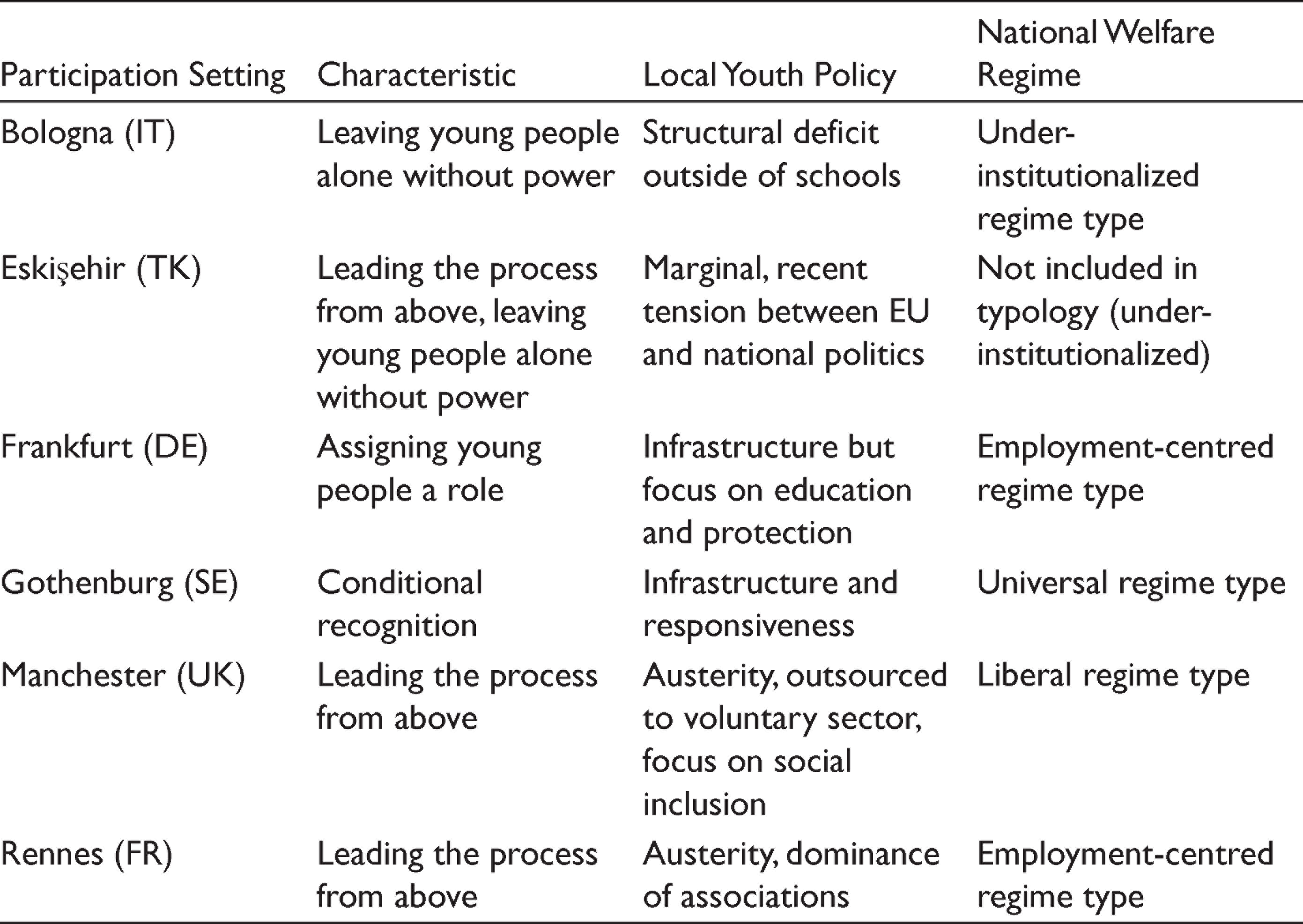
The variations among these constellations cannot be explained one dimensionally with regard to local or national policies, but require taking more complex relationships into account (Jensen & Lolle, 2013; Loncle, 2011). The analysed cases represent possible constellations that emerge as complex relationships between the structural characteristics of cities, specialized youth policies at the local level, the wider context of welfare and youth transitions at the national level, cultural representations and how young people deal with these conditions in diverse ways. Although it should be noted that the formal settings only reflect a marginal component of youth participation at the local level, they nonetheless represent and reproduce powerful discourses regarding the legitimacy of young people’s needs, interests and practices. In the following paragraphs, we want to discuss if and in what sense they may be referred to as—not national but local—regimes of youth participation.
At first sight, these settings may be assessed following Arnstein’s (1969) ‘ladder of participation’ distinguishing between effective and tokenistic participation. Such a continuum, however, not only suggests that participation should be measured in a quasi-quantitative way but also neglects that ‘more’ participation does not come without conditions, including such expectations of using power and resources in the ‘right’ way. At the same time, it seems obvious that where formal representation coincides with a solid infrastructure of youth work, it is not the only expression of recognizing young people as members of the local society but provides spaces for individual and collective expressions of being young. This is even more the case where this infrastructure is managed in a way which is responsive to young people’s changing needs and practices. Infrastructure and responsiveness depend on the way in which youth policies are institutionalized at the local level and on the resources they command. Here the national level comes into play and this is especially visible with regard to the extremes in our sample, Gothenburg (SE) versus Eskişehir (TR) and Bologna (IT). The strength or weakness of national policies pre-define larger or narrower scopes of action for local youth policies and are also reflected in the different cultural representations of youth. The other cases, although they do also reflect national policy structures and discourses such as protective ‘youth welfare’ (Germany), corporatism and de/centralization (France), and controlling youth as a problem under conditions of austerity (UK), reveal the manifold ways in which national policies are interpreted and implemented differently at the local level. These depend upon local constellations of governance and governmentality (Arvidson et al., 2018; Stenson, 2008).
Apart from the influence and power of formal settings of youth participation, the resources, the different role of adults involved and the rules through which recognition and power are conditioned also contribute to different processes of young people’s subjectivation (Butler, 2015). In this respect, however, due to the global process of shifting welfare states and youth policies towards activation, the commonalities across the different constellations, seem to prevail. Activation implies an increasing role of self-responsibility for social integration in terms of involvement in lifelong learning and of conditions of access to social benefits and social services. The new discourse of youth participation has evolved in parallel with and is more or less directly linked to this development. It contributes by providing positive connotations of individual responsibility in contrast to dependency from the solidarity of others (Masschelein & Quaghebeur, 2005). Obviously, this has different repercussions in different local and national contexts. Yet, even in the Swedish case, youth participation seems to serve as a powerful means to subject young people to norms of recognition and present them as ‘good citizens’. The difference lies in the modus operandi of how good citizens are being made—by empowering them through the self-responsible appropriation of resources and recognition (Gothenburg) or by ‘forcing’ them to develop self-responsible ways of coping with the lack of resources and recognition (Bologna) (Hall et al., 1999; Lüküslü et al., 2018; Raby, 2014; Walther, 2012).
Conclusion
In this article, we have analysed the role of local and national youth policies on the institutionalization of youth participation. We have introduced exemplary settings in formal youth participation and analysed how they are related with local youth policies and structures of national welfare states. We have found clear analogies between local constellations of youth participation and youth policies at the local and national levels even if national welfare states’ effects on local youth policies and youth participation are not direct. The local constellations we have elaborated rely on the analysis of single cases. They therefore do not represent the complete spectrum of youth participation in the respective cities. Instead, they detail the aspects of youth participation that emerged as ‘typical’ during our analysis. They may be seen as the first steps towards a typology of youth participation regimes. Referring to ‘regimes’ is justified by the fact that different patterns of youth participation—albeit elaborated from single cases—reflect general structures of social integration and reproduction—or wider social contexts that have evolved over time (Salamon et al., 1998). The regime types include both the governance of youth beyond public institutions and constellations of power and knowledge in addressing youth. While they empower young people, they also, at the same time, limit their agency and how they might articulate their claims to be a part of and take part in society which are inherent to their everyday life practices in public spaces. This is even more noteworthy in the context of the shift towards activation in youth policies. Facilitating youth participation may be understood as serving as a ‘showcase’ of young people’s responsibility and involvement in the process of formation, subjectivation and young people’s empowerment as ‘good citizens’ (Butler, 2015; Kennelly, 2011). But this, also, takes different forms.
The core of such an understanding of youth participation regimes is the relationship between governance, power and knowledge. We suggest that—different from transition regimes or welfare regimes—youth participation regimes do not coincide with national contexts. While national welfare states obviously play a role in addressing young people as ‘citizens in the making’ in different ways, it seems more appropriate to start from conceptualizing regimes of youth participation at the local level (see Arvidson et al., 2018 for local civil society regimes). In sum, developing a typology of youth participation regimes cannot simply mean clustering different countries but needs to be sensitive of the relationships between local youth policies and national welfare states with regard to the ways in which young people are represented and addressed—whether it is as a resource or a problem or as ‘citizens in the making’.
Footnotes
Acknowledgements
The views expressed in this book are the sole responsibility of the authors and do not necessarily reflect the views of the European Commission.
The authors declared no potential conflicts of interest with respect to the research, authorship and/or publication of this article.
Funding
The research project ‘Styles and Spaces of Participation. Formal, non-formal and informal possibilities of young people’s participation in European cities’ (PARTISPACE) received funding from the European Union’s Horizon 2020 research and innovation programme under grant agreement No 649416.