



Abstract
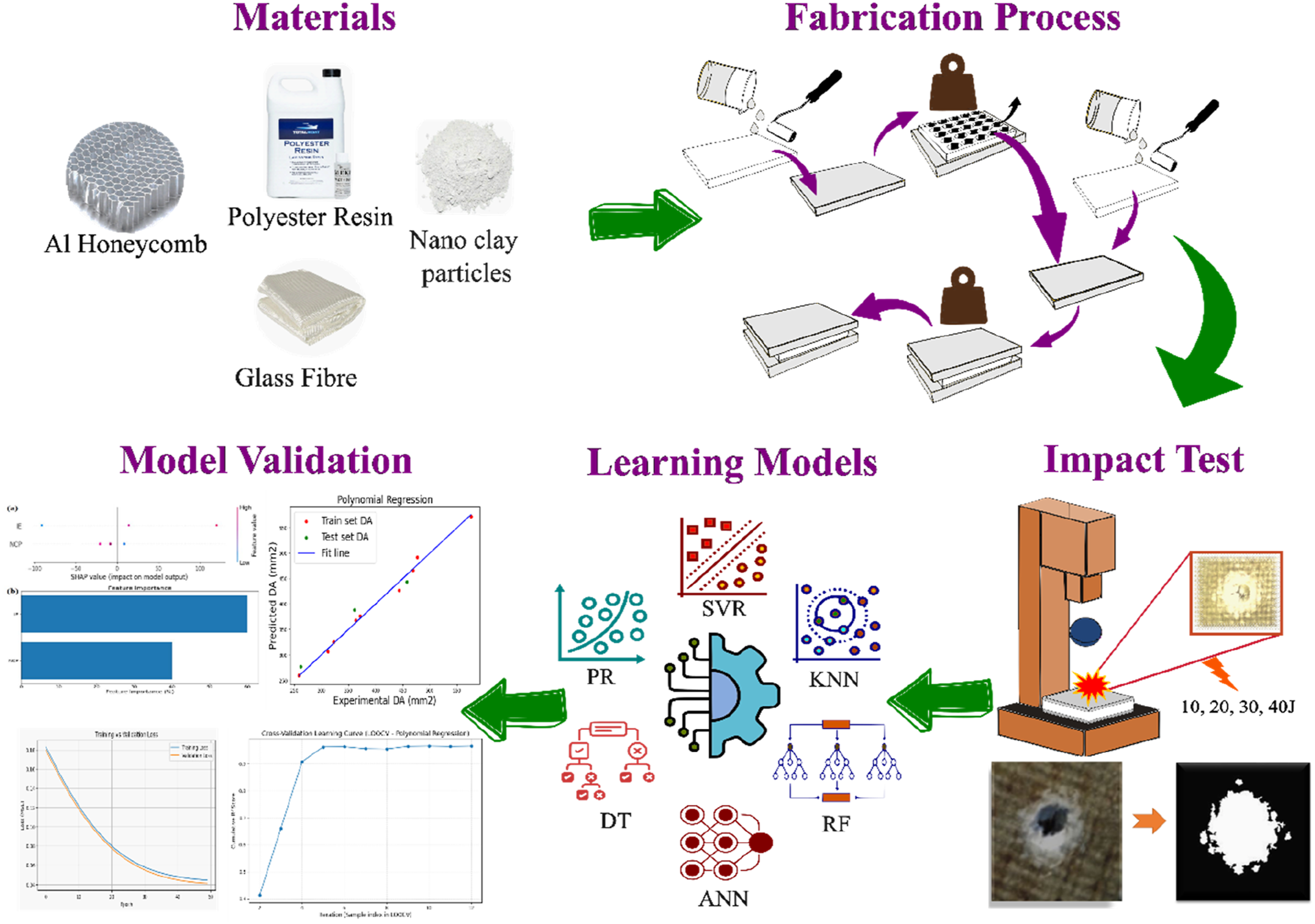
Low-density materials, for example, aluminium honeycomb sandwich panels, are gaining extensive usage in structural applications due to their high strength-to-weight ratio and energy absorption capability. This paper presents the investigations on the low-velocity impact behavior of panels reinforced with nano-clay particles at different contents (0%, 2%, and 4% by weight), fabricated by the hand layup method. Panels were tested under impact energies of 10, 20, 30, and 40 J, and surface damage was quantified using MATLAB image processing to obtain numerical damage area (DA). Five machine learning (ML) models were developed to predict DA, with the Polynomial Regression (PR) model (R2 = 0.94) provided a better balance between prediction accuracy and generalization, supported by Cρ (0.90) and LOOCV (R2 ≈ 0.95) analyses. SHAP, Feature importance and Partial dependence analysis confirmed impact energy (IE) as the most influential factor, followed by nano-clay percentage (NCP). Experimentally, 2% NCP was identified as the optimal reinforcement level, achieving maximum damage reduction 41% at 10 J, decreasing to 23% at 40 J while 4% NCP yielded marginal additional benefits. Within the 2% NCP, the damage reduction decreased from 41% at 10 J to 23% at 40 J, which further confirms that impact energy is the most dominant factor, as derived from SHAP, feature importance, and Partial dependence analysis. The ANN model presented moderate success regarding the reconstruction of damage features with PSNR values in the range of 13.30–14.81 dB and SSIM scores between 0.62 and 0.64. Overall, integrating experimental analysis with ML modeling offers a robust route to predicting and understanding the impact-induced damage in composite structures.
Get full access to this article
View all access options for this article.