




Abstract
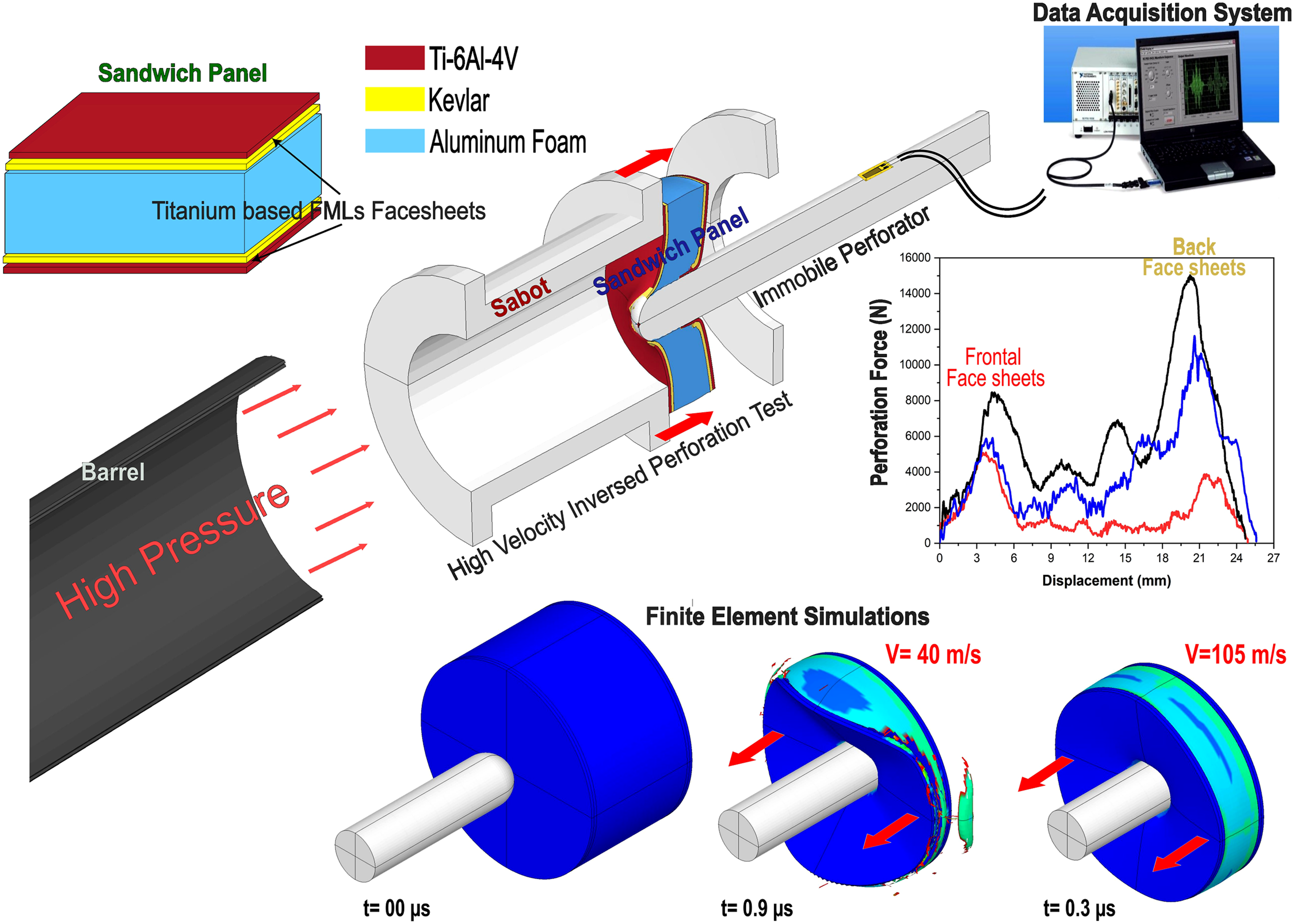
In response to the growing demand for lightweight and high-performance protective systems, sandwich panels combining thin, rigid facesheets with lightweight cores have attracted significant attention. This study investigates the impact response of such sandwich structures, specifically those incorporating titanium/Kevlar fiber metal laminate (FML) facesheets with an aluminum foam core, under intermediate- and high-velocity impact regimes. Special emphasis is placed on the role of FML facesheets in enhancing energy absorption and impact resistance compared to selected metallic facesheets. The tests were conducted using an inverse perforation technique at velocities exceeding 100 m/s, employing a high-speed gas launcher and an instrumented perforator to record the impact-to-perforation force and displacement. Complementary three-dimensional numerical simulations were performed using the LS-DYNA explicit finite element code with appropriate constitutive material models to predict the material response. Experimental impact force–displacement curves were used to validate the numerical results, which were subsequently leveraged to better understand the complex behavior and failure mechanisms of the sandwich configurations at increasing penetration velocities. The findings reveal that both the panel response and failure mechanisms strongly depend on the penetration velocity and facesheet materials, with the FML-skinned configurations exhibiting superior performance, particularly in applications where a high strength-to-weight ratio is critical.
Keywords
Get full access to this article
View all access options for this article.