



Abstract
Objectives
In cats affected by severe thoracolumbar spinal cord pathologies, paraplegia and paraparesis, often accompanied by urinary retention, pose significant challenges, impacting both the cats’ welfare and owners’ lives. This study aimed to assess the quality of life (QoL) of cats affected by these conditions, and to evaluate the social and familial implications for caregivers.
Methods
The study was structured into two parts. The first part comprised direct observations of aspects of QoL in cats both in household and shelter settings, while the second part involved the distribution of questionnaires to cat owners and shelter operators.
Results
Cats with paraplegia/paraparesis and urinary retention can maintain a good QoL, with hindlimb mobility significantly influencing QoL scores. Shelter cats showed a comparable QoL to household cats, challenging the anecdotal beliefs that shelter cats with severe neurological impairments are destined to lead substandard lives. Operator surveys highlighted the feasibility of managing these cats in shelter environments, emphasising the importance of collaboration between caregivers and veterinary professionals. Likewise, owner surveys revealed a manageable time commitment for care, with most owners achieving proficiency in manual bladder expression within 1 month. Despite challenges, most of the owners reported positive experiences and did not contemplate euthanasia for their cats. Regular veterinary visits and occasional physiotherapy were common practices among caregivers.
Conclusions and relevance
Owners who respond to the questionnaire and shelter operators have a high commitment to cats with paraplegia/paraparesis. Although the study acknowledges this potential bias, it suggests that dedicated care can ensure a good QoL for cats with severe spinal injuries, both in shelter and household settings. Effective communication between caregivers and veterinary professionals is essential for accurate information dissemination and optimal care provision. This research contributes to raising awareness of managing these conditions and emphasises the importance of collaborative care approaches in veterinary medicine.
Introduction
Feline paraplegia and paraparesis, along with urinary retention, are challenging medical conditions that can significantly affect a cat’s mobility and overall wellbeing. Paraplegia and paraparesis can result from severe thoracolumbar spinal cord pathologies, causing motor deficits that compromise the cat’s ability to move independently.1,2 In addition, urinary retention, a common coexisting issue, poses further challenges for affected cats. The inability to empty the bladder properly can lead to discomfort, increased risk of urinary tract infections, smooth muscle tight junction disruption due to overdistension and potential urinary-related complications.2,3
As previously reported for dog owners,4,5 caring for a cat with paraplegia/paraparesis and urinary retention can have a profound impact on owners’ daily lives. It requires attentive caregiving and monitoring, which may involve assisting the cat with defecating and emptying the bladder, and providing physical support to help the cat move around. These responsibilities can take time and effort, affecting the owner’s routine and social commitments.
The concept of quality of life (QoL) is defined by the World Health Organization as ‘an individual’s perception of their position in life, in the context of the culture and value systems in which they live, and in relation to their goals, expectations, standards and concerns’. 6 It represents an accurate self-assessment that individuals make by responding to a specific pre-compiled questionnaire to understand their wellbeing about a particular health condition or issue. Different evaluation systems can be found depending on the identified health condition or issue, focusing on specific areas of interest to assess QoL; 7 each aspect of life considered is assigned a score, with lower scores indicating worse conditions compared with higher scores. 8
It is evident that directly applying the same concept in the field of veterinary medicine poses considerable challenges, where an evaluation by third parties (eg, owners, veterinarians, veterinary technicians) is necessarily involved. 9 However, it is possible to overlay some areas of QoL assessment used in human medicine into the veterinary sector, such as physical and psychological health, level of independence, both for the pet and the owner, and social relationships, particularly for the owners. 10 Therefore, it is crucial to identify a scale that allows for the best assessment of animal QoL by interpreting manifested behaviours and evaluating the absence of physical pain. 11 In a recent systematic review regarding a QoL assessment tool for cats, it was highlighted that the total number of scientific articles that evaluated various aspects of cat life and behaviour in a well-structured manner was 16, all of which included vital and behavioural parameters in their evaluation methods. 12 Despite these common elements, the studies showed systematic differences, considering that a QoL evaluation is carried out for different specific conditions, such as tumours, diabetes mellitus, renal failure, obesity or heart diseases. 13
Regarding QoL in veterinary patients affected by severe spinal cord injuries, Budke et al 14 designed a questionnaire for the owners in which five areas or activities of the animal’s life were analysed and classified as the most influential for the dog’s QoL. However, to the best of the authors’ knowledge, no QoL evaluation system has been designed and published in the literature for feline patients affected by paraparesis/paraplegia and urinary retention due to severe spinal cord injuries.
Despite this gap in the literature, there is the anecdotal belief that these cats have a low QoL and that shelter cats with severe neurological impairments are destined to lead substandard lives. To check this hypothesis, this study aims to analyse the QoL of cats affected by paraparesis/paraplegia and urinary retention, both in a shelter environment and in household settings. The secondary aim was to assess how these conditions affect the owners’ QoL in terms of caring for their cats.
Materials and methods
The study was structured into two distinct parts. The first part comprised direct observations of aspects of feline QoL in shelter and domestic settings, while the second part involved the distribution of questionnaires to cat owners and shelter operators. All the cats included in the study were affected by paraparesis/paraplegia and urinary retention with a duration of more than 6 months.
This work was performed with full informed consent of the owners or legal guardian of all animals. All the information derived from direct observations of routine activities or questionnaires and the project followed the requirements of Italian law.
The data from questionnaires were obtained anonymously, following the provisions of European Regulation 2016/679 (General Data Protection Regulation) concerning the protection of personal data, after the participants consented to processing their personal and sensitive data for this research.
All responses were considered valid only after the participants accepted the consent to process sensitive data and correctly completed the questionnaire.
Observational study
Considering the absence of a validated model in existing literature, a QoL assessment framework was developed, inspired by two earlier studies on veterinary patients. The first study, by Bijsmans et al, 15 focused on comprehensively evaluating the QoL of cats, serving as a comparative framework for cats affected by nephropathy. That study employed an evaluation system encompassing four domains: health status, nutritional status, behaviour and management. The second study, by Villalobos, 16 utilised an assessment tool considering pain, hunger, hydration, hygiene, happiness, mobility and stress to gauge the QoL of canine and feline oncology patients, particularly for which euthanasia was considered (see Table 1 in the supplementary material).
Observations were carried out on private-owned cats in a household setting and on shelter cats from three different shelters located in central (‘Melampo’ Fano, Marche and ‘Oasi Felina’, Pesaro, Marche) and northern (‘Balzoo Disabilandia’, Milan, Lombardia) Italy to assess the following parameters: the absence of pain and hunger, hydration status, hygiene, happiness, mobility and stress. Each observation session lasted approximately 1 h per cat and was conducted by a veterinary nurse properly trained by the clinical staff (LG).
Pain assessment was scored using the Feline Grimace Scale (FGS). 17 In cases where cats had skin sores, the surrounding area was palpated to confirm the absence of pain. The FGS assigns a score from 0 to 10, in which the highest score means that the cat is likely to be in severe pain. For the purpose of this study, the values were modified, with a score of 0 indicating severe pain and a score of 10 indicating a lack of pain.
Hunger was evaluated observing whether the cats ate autonomously and exhibited appetite. A score of 0 indicated the cat did not eat and was underweight, and a score of 10 indicated independent eating with a healthy appetite. Furthermore, body condition score (BCS) and muscle condition score (MCS) were employed to ensure assessment objectivity.
The hydration status section evaluated the cat’s ability to drink autonomously, and whether any dehydration signs were displayed. A score of 0 meant the cat did not drink autonomously and was dehydrated, while a score of 10 indicated regular autonomous drinking and normal hydration.
In the hygiene section, the cat’s typical grooming behaviour was observed and distinguished from pathological behaviours, such as excessive grooming. 18 A score of 0 indicated that the cat did not groom, while a score of 10 signified that the cat engaged in daily grooming.
For the happiness section, the cat’s interest in external stimuli, including interactions with family members/shelter operators, play engagement and interactions with other animals, was assessed. Signs of anxiety, depression, boredom, fear or isolation were also observed. A score of 0 indicated a depressed demeanour, while a score of 10 indicated a cheerful and responsive disposition.
The mobility section evaluated the extent of mobility associated with paraplegia/paraparesis, with a score of 0 assigned to cats unable to move independently and a score of 10 given to ambulatory cats capable of independent movement and climbing.
Finally, for the stress category, the tranquillity of the cats was assessed, and it was determined whether their condition negatively impacted their overall wellbeing. A score of 0 indicated that the cat seems stiff or fearful, while 10 indicated that the cat seemed fully relaxed.
A score higher than 35 points was considered acceptable for a good QoL. 16
Questionnaires
Two distinct questionnaires were used for distribution. One was intended for operators working in animal shelters (Table 1), while the other was designed for owners of cats in a household setting (Table 2). The first questionnaire, adapted from a questionnaire designed by Budke et al, 14 was designed to collect information about time requirements, bladder voiding techniques and urinary retention complication monitoring in shelter settings.
Questionnaire for shelter operators, adapted from Budke et al 14

Questionnaire administered to cat owners, adapted from a questionnaire by Freeman et al 4 in 2013

The questionnaire administered to cat owners, adapted from a questionnaire for owners of canine patients with severe spinal injuries published by Freeman et al 4 in 2013, encompassed 35 questions that were organised into three sections: the first section addresses time-related aspects involved in managing these animals; the second one delves into social factors and how this commitment may affect an owner’s life; and the third comprises questions aimed at gaining a deeper understanding of the cat’s health status.
The anonymous questionnaires consisted of multiple choice and open questions; the former was preferred because of the ease of reply. The questionnaires, created using ‘Google Forms’, were distributed online through the social media platform, Facebook. They were directed towards specific groups of cat owners and shelter operators and were accessible online between April and October 2023.
Statistical analysis
The computer software GraphPad Prism version 6.01 (GraphPad Software) was utilised to perform the statistical analysis. Normality was checked using the D’Agostino Pearson test. Based on their distribution, all data were reported as mean ± SD or as median (range). According to distribution, the unpaired t-test or Mann–Whitney U-test was used for comparison between two groups. Open field responses were analysed using content analysis as a ’qualitative data reduction and sense-making effort that takes a volume of qualitative material and attempts to identify core consistencies and meanings’ 19 and then reported as percentages. The threshold of statistical significance was set at P <0.05.
Results
Observational study
The observational part of the study evaluated a total of 45 domestic cats (21 castrated males, 20 spayed and four intact females). Eight cats were household private-owned, while 37 were shelter cats. The median age of the cats was 4 years (range 1–13). Within this cohort, 18 cats exhibited paraplegia, while 27 cats had paraparesis, further categorised into four with non-ambulatory paraparesis and 23 with ambulatory paraparesis (see Table 2 in the supplementary material).
All 45 cats experienced a traumatic spinal cord injury, including falling from heights, vehicular accidents, firearm-related injuries and canine attacks. Notably, 15/45 (33.3%) cats experienced these traumatic events within their first year of life, while the remaining 30 (66.7%) were older than 1 year.
The median QoL score among the observed cats was 64/70 (range 50–70). Male cats achieved a median score of 65/70 (range 50–70), while female cats had a median score of 64/70 (range 57–70; P = 0.5669). Cats that were injured in adulthood had a median score of 64/70 (range 50–70), whereas those that were injured before their first year of age had a median score of 66/70 (range 57–70; P = 0.527). Considering mobility, cats with ambulatory paraparesis had a higher score (median 67/70, range 58–70) compared with non-ambulatory cats (ie, non-ambulatory paraparesis and paraplegia: median 64/70, range 50–67, P = 0.0026).
No differences were observed in the median QoL score of private-owned cats (median 65, range 62–68) and shelter cats (median 64, range 50–70, P = 0.6130).
Questionnaires
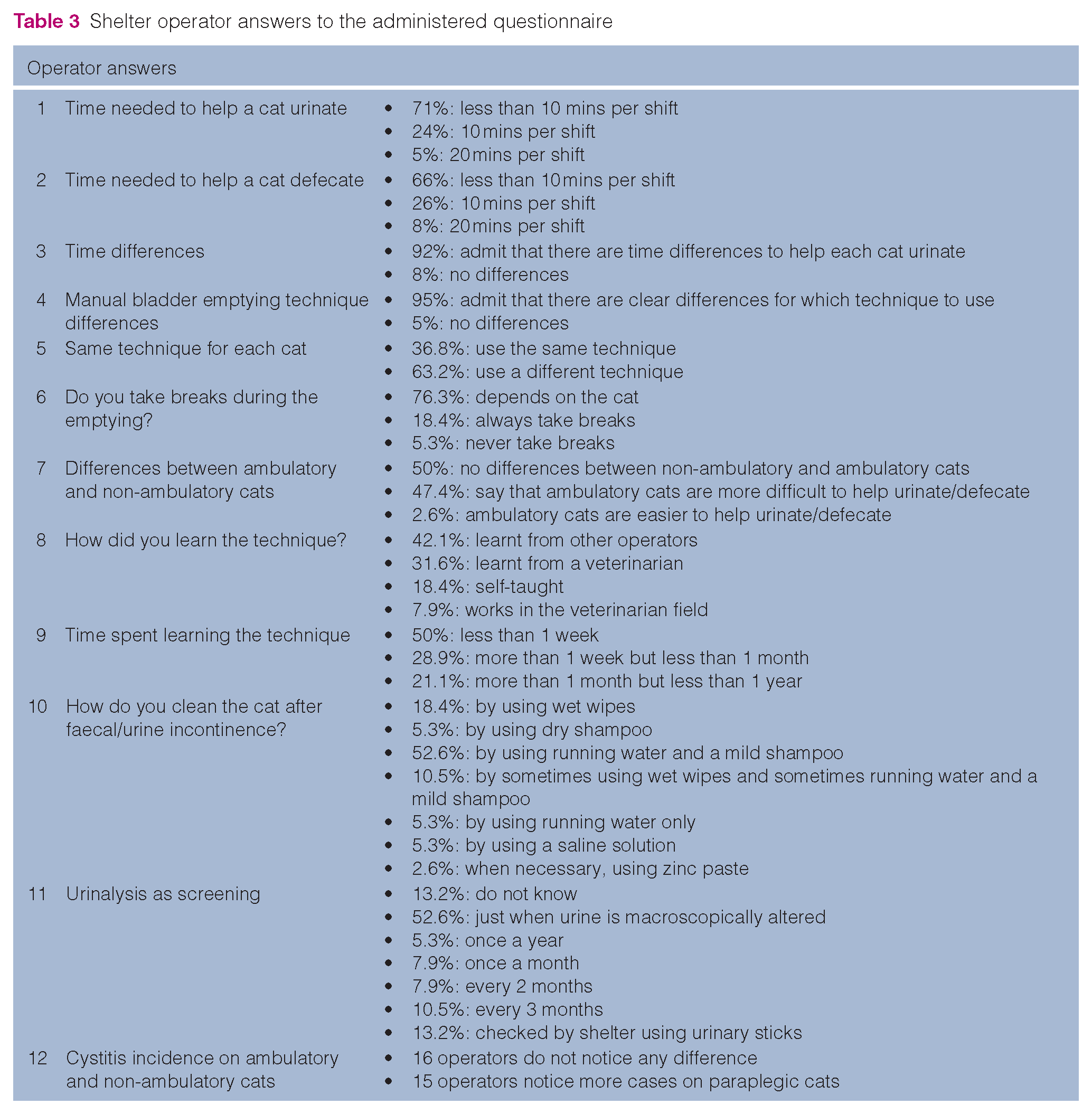
The questionnaires yielded 38 responses from shelter operators and 40 from owners. The results are summarised in Tables 3 and 4.
Shelter operator answers to the administered questionnaire
Cat owners’ answers to the administered questionnaire

Discussion
The evaluation of QoL in the observational study has yielded remarkably positive assessments of the wellbeing of the cats under observation. Indeed, a QoL score of 35/70 or higher indicates an acceptable QoL for cats 16 facing the challenges of paraplegia/paraparesis and urinary retention. The median QoL score obtained from the present observations was 64/70, and the lowest score was 50/70. This implies that all the observed cats enjoy an excellent QoL with appropriate management and care, which can consistently surpass the minimum acceptable threshold. This finding diverges from anecdotal assessments made by some veterinarians, challenging the notion that a cat with paraplegia/paraparesis and urinary retention necessarily faces a life incompatible with a good QoL.
Both ambulatory and non-ambulatory cats showed satisfactory scores; however, the findings of the present study further revealed a significant difference in QoL scores between cats maintaining hindlimb mobility, even if involuntary, and their non-ambulatory counterparts. Thus, it is crucial, whenever feasible, to maximise hindlimb mobility and spinal walking, preserving the cat’s freedom of movement without compromising its overall wellbeing.
Contrary to the initial hypothesis, the QoL scores of shelter cats do not significantly differ from those of household cats. In the authors’ opinion, this is a remarkable finding and is contrary to the common perception that shelter cats have a poorer QoL than household cats. This result also highlights the possibility of managing paraparetic/paraplegic cats with urinary retention, ensuring an adequate QoL, even in a shelter environment if it is adequately organised and employs experienced staff. Although there remains much debate on the QoL of cats with a severe spinal injury and further studies are needed to address this topic, these preliminary results not only suggest that these cats can have a good life, but that they can be managed adequately, even in a shelter environment.
Nevertheless, it is necessary to acknowledge as a limitation that the present study involved modifications to the original questionnaire to better suit the specific research needs. These modifications may have altered the scoring distribution. Indeed, in the present findings, many cats scored significantly higher than the 35/70 threshold, with numerous scores exceeding 50 or even 60. This raises concerns about the appropriateness of the 35/70 cut-off in the study context and highlights the need to develop dedicated tools for cats affected by paraparesis/paraplegia.
Manual bladder expression is a commonly used technique to induce voiding, and it is associated with a lower incidence of complications (eg, urinary infection) than indwelling or intermittent catheters. 3 However, it takes time to perform and properly master this procedure daily. The insights gleaned from the shelter operator survey shed light on the commitments involved in managing paraplegic/paraparetic shelter cats with urinary retention. Notably, most respondents (95%) indicated that it typically takes no more than 10 mins per cat for tasks such as manual bladder expression, defecation assistance and perineal cleaning, with only a small fraction (5%) dedicating approximately 20 mins per cat. Concerning the time required to master these techniques, most operators (78.9%) accomplished this within 1 month, with 50% achieving proficiency within less than 1 week. As revealed by operators’ statements, the effort required for a single shelter cat to be managed is noteworthy, although not prohibitive. To provide context for the shelter environments in this study, it is worth noting that one cattery has operators present for approximately 9 h each day, divided into roughly 5 h in the morning and 4 h in the afternoon and evening, and operators express cats’ bladders twice daily. This facility houses 120 cats, with 10.9% requiring neurological bladder care, which takes approximately 2 h daily. The second cattery has operators present for approximately 6 h daily, split between morning and evening, housing 110 cats, with 1.8% requiring specialised bladder expression, which takes 20 mins daily. The third cattery was initially a shelter for disabled cats, and it holds 28 cats, with 96.4% requiring neurological bladder care. The operators spend approximately 10 h each day (again split between morning and afternoon) in the shelter to take care of the disabled cats, including managing their bladder.
Proper acquisition and mastering of the manual technique of bladder voiding is crucial to the optimal management of these feline patients. Given that only 31.6% of operators acquired the correct technique through guidance from a veterinarian and most (60.5%) of the operators were self-taught or were taught by other operators, this study underlines the need for close collaboration between veterinary professionals and caregivers. This allowed for the hypothesis that veterinarians or nurses can positively influence and speed up the learning curve of this manual technique.
The importance of managing conditions such as bacterial cystitis or bladder inflammation associated with urinary retention cannot be overstated, as effective prevention plays a pivotal role in maintaining a cat’s excellent QoL. The questionnaire data reveal the feasibility of self-monitoring using simple tools such as litmus paper or urine test strips to detect alterations in urinary pH and other parameters. These cost-effective monitoring methods are highly applicable in veterinary shelters, enabling consistent surveillance of subtle urinary alterations that might not be macroscopically evident. In the authors’ opinion, combining self-monitoring and correct manual bladder expression techniques should contribute significantly to reducing urinary retention complications and sustaining the cat’s QoL.
The owners’ survey results offer insights into the time commitment required to manage household cats with paraplegia/paraparesis and urinary retention. Most respondents (80%) spend no more than 30 mins per day assisting their cats with urination and defecation. On average, respondents dedicate approximately 1 h daily to comprehensive cat care. Notably, owners tend to require less time than operators to learn the bladder expression technique. Approximately 95% acquired proficiency in less than 1 month, with 65% mastering it in under 1 week. This discrepancy could be explained by a sort of ‘specialisation’ for each owner’s cat, with repeated procedures expediting the learning curve. Approximately 55% of owners received guidance from a veterinarian, compared with only 31.6% of operators, supporting our earlier assertion that veterinary guidance could expedite learning of bladder expression.
Our survey encompassed various owner demographics, including couples, individuals living alone, those residing with parents and family households. Approximately 65% of respondents had no children, while the rest had children with an average age of 18.9 years. Although most respondents did not perceive the care of a cat with a severe spinal injury as interfering with family dynamics (70%), a portion contemplated this impact (25%) and a minority (5%) considered it regularly. Despite this commitment, 65% of respondents took holidays, seeking aid from trusted individuals to care for their cats or even bringing the cats with them on holiday. Only 10% abstained from holidays because of the cat’s care needs.
One notable response revealed that approximately 77.5% of respondents adopted their cats fully aware of their condition, with 62.5% already displaying signs of paralysis. This information highlights a potential bias in interpreting the questionnaire results, as a subset of respondents possesses a particular affinity for caring for these cats. In addition, the fact that many cats had suffered the injury before becoming part of the family eliminates emotional bonds or ‘moral obligations’ as factors influencing the owners’ decision to provide care. A substantial subset of respondents (42.5%) reported receiving unfavourable prognoses from attending veterinarians who deemed paraplegia and urinary retention incompatible with life, despite a lack of critical literature. Nevertheless, our questionnaire underscores that, although being time-intensive and socially demanding, cats with severe spinal injuries can be effectively managed within family environments while maintaining a good QoL. Most (92.5%) owners never contemplated euthanasia for their cats because of these conditions.
Concerning medical care, a significant percentage of owners (65%) reported periodic visits to specialists for their cats, while only 2.5% never sought veterinary care. Notably, 47.5% of respondents indicated that they had never taken their cats to the veterinarian for issues related to their condition, while 27.5% did so once a year, and 20% sought veterinary care 2–3 times annually. Although 65% stated that their cats did not undergo physiotherapy exercises, 32.5% engaged in such practices through sessions with a physiotherapist or home exercises recommended by veterinarians. Regular check-ups to monitor potential complications arising from neurological deficits are advisable, with more than half of the household caregivers actively monitoring their cats’ clinical conditions.
The lack of a validated model in the existing literature for assessing QoL may represent a limitation of this study, potentially impacting the accuracy of the results due to the lack of demonstrated validity and reliability.
The FGS is a tool for the assessment of acute pain in cats based on changes in facial expression; however, it has been demonstrated that the Rat Grimace Scale and Mouse Grimace Scale provide accurate, standardised behavioural coding, with high accuracy and reliability, of ongoing pain. Moreover, it has also been demonstrated that these scales can be useful tools in the assessment of pain in chronic pain models, including neuropathic pain and spinal cord injury pain.20 –22 Nevertheless, the lack of evidence for the use of FGS in cats with chronic pain should be taken into consideration as a potential limitation.
The owners’ responses collectively affirm that managing cats with paraplegia/paraparesis and urinary retention is manageable and not overly demanding. However, there could be a population bias, and this could be a significant limitation. Owners who decided to respond to the questionnaire have a high commitment to their pets because they decided to care for them at home rather than choose euthanasia, and some decided to adopt the cat after the spinal cord injury had occurred. Nevertheless, all these results could help practitioners fully understand the impact a paralysed cat with micturition problems can have on shelters and household caregivers.
These findings closely align with a study conducted on dogs with severe chronic spinal cord injuries, where similar questionnaires were distributed to dog owners facing analogous challenges. The comparative analysis of the two studies reveals strikingly similar results. 4
Conclusions
Our study underscores how cats experiencing paraplegia/paraparesis and urinary retention can attain an exceptional QoL when supported by dedicated caregivers. It is crucial to empasise that the caregiver’s role is pivotal in ensuring the wellbeing and even survival of the animal with such a condition. Effective communication between caregivers and veterinary professionals is of paramount importance. Precise and comprehensive information about the animal’s care and the potential commitments must be imparted by veterinarians or veterinary technicians. This ensures the avoidance of disseminating inaccurate information by individuals lacking the requisite expertise, thus preventing erroneous decisions.
Throughout this study, a thorough assessment of the optimal conditions for the animal’s welfare and the various influences, both positive and negative, on the lives of caregivers was conducted. The objective was to shed light on a topic that has been relatively overlooked, striving to increase awareness. By presenting original data, it has been reaffirmed that this condition should not be hastily deemed ‘incompatible with life’ and that it does not inherently lead to suffering.
Although it is possible that the presence of an animal with this condition could impact family dynamics to some extent, the present research opens up possibilities involving other professional roles that can assist owners in caring for a paraplegic/paraparetic cat with urinary retention without detrimentally affecting their social and familial lives and assuring a good QoL for the cat.
Supplemental Material
sj-docx-1-jfm-10.1177_1098612X241275253 – Supplemental material for Assessment of the quality of life of cats affected by paraparesis/paraplegia and urinary retention, and their impact on caregivers
Table 1: Quality of life scoring system. Adapted from Villalobos A.23
Table 2: Characteristics of the observational study cats.
Footnotes
Conflict of interest
The authors declared no potential conflicts of interest with respect to the research, authorship, and/or publication of this article.
Funding
The authors received no financial support for the research, authorship, and/or publication of this article.
Supplementary material
The following files are available as supplementary material:
Table 1: Quality of life scoring system. Adapted from Villalobos A. 23
Table 2: Characteristics of the observational study cats.
Ethical approval
The work described in this manuscript involved the use of non-experimental (owned or unowned) animals. Established internationally recognised high standards (‘best practice’) of veterinary clinical care for the individual patient were always followed and/or this work involved the use of cadavers. Ethical approval from a committee was therefore not specifically required for publication in JFMS. Although not required, where ethical approval was still obtained, it is stated in the manuscript.
Informed consent
Informed consent (verbal or written) was obtained from the owner or legal custodian of all animal(s) described in this work (experimental or non-experimental animals, including cadavers, tissues and samples) for all procedure(s) undertaken (prospective or retrospective studies). No animals or people are identifiable within this publication, and therefore additional informed consent for publication was not required.

References
Supplementary Material
Please find the following supplemental material available below.
For Open Access articles published under a Creative Commons License, all supplemental material carries the same license as the article it is associated with.
For non-Open Access articles published, all supplemental material carries a non-exclusive license, and permission requests for re-use of supplemental material or any part of supplemental material shall be sent directly to the copyright owner as specified in the copyright notice associated with the article.
