




Abstract
Objective
The purpose of this study was to identify knowledge gaps in the global prevalence of feline immunodeficiency virus (FIV) and to obtain professional opinions and experiences regarding FIV in selected countries. We conducted a literature review of abstracts that reported the prevalence of FIV and interviewed experts in feline medicine and retroviruses from different countries to determine regional perspectives.
Methods
A total of 90 articles reporting FIV prevalence as a primary unbiased population-level analysis between 1980 and 2017 were indexed. FIV prevalence, demographics, year and location were analyzed. Statistics were evaluated and compared. In total, 10 experts were interviewed. Results were analyzed for congruence with the findings of the literature review.
Results
FIV prevalence was typically in the range of 5–8%, with a global prevalence of 4.7%, and remained largely constant over the reporting period (1980–2017). Over 90% of articles reported greater prevalence in older male cats. More studies were conducted in North America and Europe and reported the lowest prevalence. Expert-estimated prevalence approximated literature review prevalence. Attitudes and recommendations for management were consistent among experts. The limitations of the present review include varying inclusion criteria of cats tested in different studies, variation in testing modalities and the inability to conduct summary statistics across dissimilar cohorts.
Conclusions and relevance
The global prevalence of FIV has not changed since its discovery 40 years ago. Prevalence is higher in older male cats and is lower in North America and Europe than other continents. Experts agree that FIV is not typically a disease of high concern and is often associated with infections of the oral cavity. Vaccination is not typically recommended and has been discontinued in North America. The evaluation of risk factors for FIV progression is useful in managing infections. Recommendations for future research include analyses to determine copathogen and environmental factors that impact progression, assessment of life span impacts and investigations of treatment efficacy and side effects.
Introduction
Feline immunodeficiency virus (FIV) was first reported in 1986 in a cat colony in California with a high rate of morbidity and immunodeficiency-related clinical signs. 1 FIV is a lentivirus that has similar biological and pathological characteristics to human immunodeficiency virus (HIV) and therefore serves as an animal model for HIV research.1,2 FIV infects immunocytes, results in CD4/CD8 inversion and has been associated with progressive immunosuppression.1,3,4 The first phase is the primary infection with FIV characterized by viremia and malaise. 5 The second phase is a long infection without clinical signs, where viral replication is limited and the cat appears healthy. 5 This phase may be followed by a third phase where clinical signs of immunodeficiency, lymphomas or other chronic diseases occur.1,5 The clinical course of FIV, while similar to HIV, is not as predictable or well-defined as acquired immunodeficiency syndrome (AIDS) in humans. 6
Common clinical signs of FIV infection include weight loss, fever, inappetence, leukopenia, anemia, gingivitis, stomatitis, secondary infections, opportunistic infections, neoplasia, upper respiratory infections, dermatitis, lymphadenopathy, chronic gastrointestinal issues and persistent wounds.4,7 –9 Some infected cats remain without clinical signs and survive to a normal life expectancy. 6 The American Academy of Feline Practitioners (AAFP) and Association of Shelter Veterinarians (ASV) do not recommend euthanasia of cats solely based on FIV status. 10
FIV infects domestic cats worldwide and transmission is primarily through bite wounds. 4 The prevalence of FIV varies greatly geographically, which is thought to be based upon associated risk factors of different cat populations and cat management worldwide. 11 Known risk factors for FIV are outdoor access, ownership status, age, sex, breed and population density.12 –14 Free-roaming cats with outdoor access are likely to encounter cats that are FIV-positive. 14 Aggressive male cats might be at higher risk than female cats as they are more likely to engage in aggressive behaviors that result in bites. 14
The AAFP’s 2008 feline retrovirus management guidelines 15 were updated in 2020 10 and represent knowledge on pathogenesis, diagnosis, prevention and treatment of retrovirus infections in cats. 10 This guidance recommends that FIV-positive cats be housed separately from FIV-negative animals, while noting that most cats in stable homes pose little risk for FIV transmission to other cats in the home.5,10,16 This document notes that the Fel-O-Vax FIV vaccine (Boehringer Ingelheim) is not recommended, and production was discontinued in 2017 in North America.5,17 The AAFP guidelines also include recommendations for frequent examination of FIV-positive cats to detect any health issues, deworming and parasite prevention treatments. 10 In addition, core vaccine boosters for common feline infectious diseases should be considered in FIV-positive animals; however, at the present time, targeted therapies, such as zidovudine (AZT) and interferon, tend to have a low efficacy with high costs, as well as potential toxic side effects. 10
We reviewed 90 published works1 –4,6 –9,11 –14,18 –95 to evaluate the worldwide prevalence of FIV over time. In addition, we interviewed 10 specialists in feline medicine from different countries to obtain their expert opinion on FIV, the unique perspective in their region, and to identify areas of consensus and variation in opinion and perspective.
FIV continues to be a commonly diagnosed disease across the world since its initial discovery more than 40 years ago. Originally thought to be analogous to HIV and a cause of high morbidity and mortality in cats, in more recent times, the prevailing sentiment among feline practitioners is that FIV is a manageable disease in most settings. 10 Many unanswered questions about FIV remain, including the length of time it has been in existence, whether it is a cofactor for other infections, how it results in neoplasia and whether vaccines can protect against natural infections. We thus conducted this literature review to assess the reported worldwide prevalence of FIV since its original discovery, and to determine whether the opinions of expert feline practitioners mirrored observations from the literature.
Materials and methods
Literature review
The literature review was conducted by means of PubMed and Google Scholar searches using the keywords ‘feline immunodeficiency virus’ and ‘prevalence’ or ‘rate’ or ‘seroprevalence’ or ‘seroepidemiology’ or ‘epidemiology’ or ‘incidence’. Articles were chosen for the study if the abstracts included reported FIV prevalence that was not associated with other specific disease status or infections that could bias our analysis and conclusions. A total of 90 articles were indexed between 1980 and 2017 from North America, South America, Europe, Asia, Africa and Oceania, which represented information from 104 cat populations. An Excel (Microsoft) spreadsheet was used to record and analyze information from each article to include the geographic area the study was conducted in, time frame, population size tested and prevalence. When available, an analysis of age, sex, neuter status, breed, health status, ownership status and access to the outdoors was recorded.
Prevalence in geographic regions was assessed by computing weighted arithmetic means and ranges reported across comparable geographic areas by multiple authors. The weighted arithmetic mean was calculated to account for the variations in different population sizes between groups, testing methods and demographics. To calculate this number, we added the total number of FIV-positive cats and divided it by the total number of animals tested across referenced studies. To assess changes in reported prevalence of FIV over time, linear regression models were performed using Excel with prevalence as variable 1 and time as variable 2.
Interviews
We defined ‘relative experts’ as veterinarians with a primary interest in feline practice and feline infectious diseases, including retroviral infections. Potential survey participants were identified through personal and professional contacts, via officers in the AAFP and the International Society of Companion Animal Infectious Diseases (ISCAID), and prior participants of the International Feline Retrovirus Research Symposium (IFRRS). A total of 28 individuals who met the relative expert criteria were emailed to determine their interest in participating in the study. Interviews were conducted between 2019 and 2020.
Interview protocols and questions (see Tables 1–12 in the supplementary material) were developed based on the purpose of the research and through consultation with FIV experts at Colorado State University. Approval from the institutional review board at Colorado State University was obtained, and interviews were scheduled and conducted via telephone or video conferencing. After participants provided consent for audio recordings, each was asked a series of questions relating to their professional opinion and experiences regarding FIV. Topics included regional cat ownership practices, prevalence, signs and risk factors, best practices for management and prevention, perception about attitudes and recommendations for further research. Finally, open-ended questions were analyzed using a constant-comparative method to determine common themes in responses.
Results
Literature review
Prevalence of FIV by country
The prevalence of FIV ranged from 0% in some studies from Australia, Ethiopia and Vietnam to 33.9% in Egypt (Figure 1).13,60,69,88
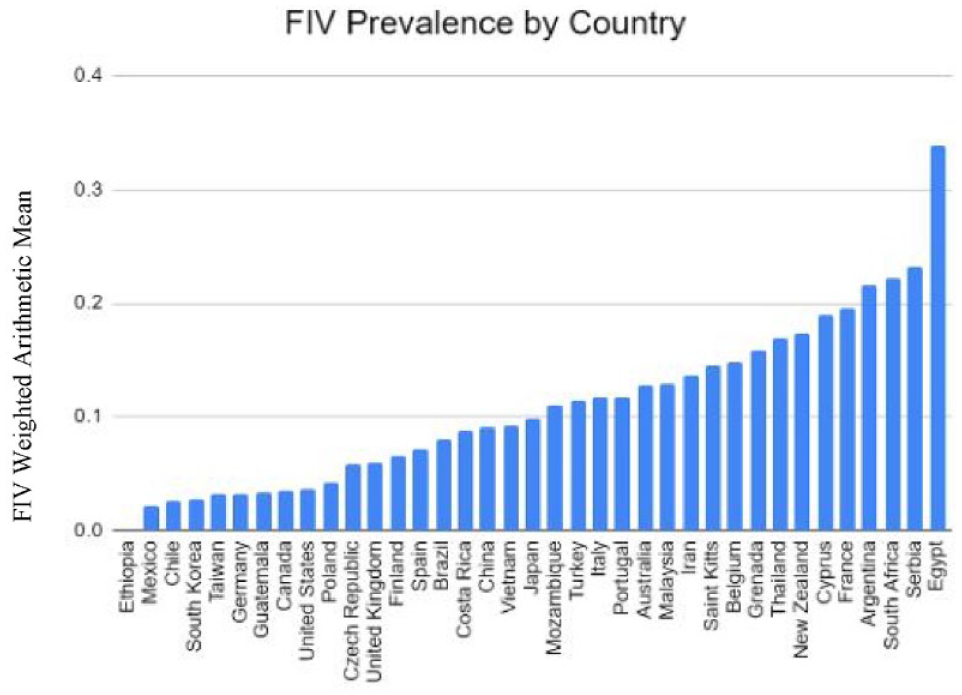
Prevalence of feline immunodeficiency virus (FIV) by country. This was a retrospective study based on the review of 90 articles reporting FIV prevalence.1 –4,6 –9,11 –14,18 –95 In countries where more than one study was reported, we calculated the weighted arithmetic mean to account for differences in population size between groups, testing methods and demographics

A prevalence map showing the weighted arithmetic mean of the reported feline immunodeficiency virus (FIV) rates in any country where a study was conducted.1 –4,6 –9,11 –14,18 –95 Countries with the lowest rates of FIV are shown in blue, countries with moderate rates of FIV are shown in green and those with the highest rates of FIV are shown in yellow
Prevalence by continent
The 90 studies identified in the literature review were conducted in countries from North America, South America, Europe, Asia, Africa and Oceania (Figure 2). Countries defined by region of study are provided in Table 13 in the supplementary material. North America (the USA and Canada) reported a total study population of 101,716 cats, with a relatively low prevalence of FIV with a weighted arithmetic mean of 3.8% (range 2.19–23%) (Figure 3).9,23,24,27,30,31,35,37 –39,44,46 –48,51,55,66,70,72,74,77,81,92,95 The island nations of Grenada and St Kitts reported a total sample size of 347 cats and found a prevalence range of 8–22% with a weighted arithmetic mean of 15.3%.30,44 In Central American countries (Mexico, Guatemala and Costa Rica), a total sample size of 359 cats was evaluated and reported FIV positivity in the range of 2.2–8.8% with a weighted arithmetic mean of 4.2%.23,48,70 For this study, Mexico was categorized as Central America due to limited non-USA and non-Canadian studies.
Europe had a total of 34,537 cats tested and a weighted arithmetic mean of 5.3% (range 3.1–27%) (Figure 3).1,3,12,14,18,20,21,26,28,29,34,36,40,45,53,61,64,67,71,73,75,76,80,81,84,85 Studies from countries in Western Europe (Belgium, the UK, Finland, France, Germany, Italy, Portugal and Spain) reported a total sample size of 32,743 cats with a weighted arithmetic mean of 5.1% (range 3–24%).1,3,14,18,20,21,26,28,29,34,36,40,53,61,64,67,71,73,80,81,84,85 In contrast, studies from three Eastern European countries (Czech Republic, Poland and Serbia) had a higher prevalence of FIV with a weighted arithmetic mean of 9.0% (range 4–24%) from 1794 cats.12,45,75,76 Studies in Cyprus, Iran and Turkey had a total sample size of 946 cats and a weighted arithmetic mean of 13.6% (range 3–22%).8,19,63,87,93,94

The weighted arithmetic mean for all South American countries was reported as 10.3% (range 3–22%) (Figure 3).22,33,56,58,62,65,79 A small study in Chile found an FIV positivity of 2.6%, while a study in Argentina reported an FIV prevalence of 21.6%.33,62 Several studies in Brazil, reporting a total sample size of 1046 cats, found a weighted arithmetic mean of 8.1% (range 5–22%).22,56,58,65,79 Studies in China, Japan, Malaysia, South Korea, Taiwan, Thailand and Vietnam, with a total sample size of 5393 cats, found a weighted arithmetic mean of 12.3% (range 0–31%).2,11,25,41,50,59,60,68,83 The lowest prevalence of FIV was 0% in one population in Vietnam, with a sample size of 69 cats. 60 The highest prevalence was in Malaysia, with a rate of 31.3% from a sample size of 368 cats. 11
Africa was the continent with the highest FIV prevalence, although there was a wide range of reported prevalence between countries (Figure 3). For example, no cases were detected in Ethiopia, while 33.9% of cats tested in Egypt were reported as seropositive for FIV.13,88 The prevalence of FIV in Oceania was moderately high, with a weighted arithmetic mean of 14% (range 0–25%) in a sample size of 12,028 cats (Figure 3).4 –7,32,42,54,57,69,89,91 In Australia, the total sample size was 8743 cats, with a weighted arithmetic mean of 12.8% (range 0–26%),4 –6,32,57,69,89,91 while New Zealand reported a weighted arithmetic mean of 17.3% (range 10–18.5%) from a sample size of 3285 cats.7,42,54
Global prevalence over time
The 90 evaluated studies took place between 1980 and 2017.1 –4,6 –9,11 –14,18 –95 There was no observed change in the global prevalence of FIV over this time (Figure 4). Fourteen studies were reported from Australia between 1980 and 2013, providing the opportunity to evaluate temporal changes in prevalence (Figure 5). A linear regression analysis of Australia’s FIV prevalence over time was negative with a goodness of fit (R 2 ) of 0.197, suggesting that the prevalence of FIV has decreased in Australia.4,6,32,57,69,89–91 Of note, some studies conducted in Australia tested healthy cats and others unhealthy cats, which may contribute to the difference in reported prevalence.4 ,6,32,57,69,89–91 For example, Australian studies evaluating the prevalence of FIV in 1995 and 2012 were about cats presenting for illness, and reported a higher FIV prevalence (20.8% and 14.2%, respectively).5,57 A study conducted on Australian stray cats in 2003–2004 found an FIV positivity of 22%. 69 In contrast, five Australian reports studied cats without clinical disease and reported an FIV prevalence in the range of 0–14.6%.4 –6,57,69,89,91 Thus, cats with disease or strays tended to have a higher reported FIV prevalence than that of owned cats.


Risk factors for FIV
Consistent with the age and sex generally associated with FIV prevalence, 90% of studies concluded that older cats had a higher prevalence of FIV than younger cats. Furthermore, nearly 90% of the studies that reported sex and FIV prevalence found that male cats had a higher prevalence of FIV than female cats.
Of the 17 studies that looked at an association between FIV and breed, nine found that mixed breeds were at higher risk for FIV, while the other eight found that there was no statistical difference between crossbred and purebred cats.6,11,14,15,24,36,38,39,45,54,57,64,71,75,76,78,89 Approximately three-quarters (76.3%) of the studies found that cats with clinical signs and a history of fighting had a higher prevalence of FIV.
Of the studies examining cat ownership, 70% found that the prevalence of FIV was higher in stray or shelter cats than in owned cats,7,11,19,21,50,51,67,71,92,95 while 85% of the studies reporting housing conditions associated a higher prevalence of FIV with outdoor access.4,9,14,22,24,26,31,36 –38,45,51,59,63,76,77,95
Expert opinions mirror literature review conclusions
Of the 10 experts interviewed, three were from Australia, two from the UK, three from the USA, one from Canada and one from Brazil. Interview questions and individual coded responses are provided in Tables 1–12 in the supplementary material. Most of the experts primarily evaluated owned cats, though several occasionally worked with shelter or stray cats. The expert from Brazil reported that typical cat ownership in the area primarily consisted of feeding outdoor cats. Half of the experts said that most of the cats they saw were indoor-only, while the other half reported that more than half their feline patients had outdoor access. Several of those interviewed noted that the proportion of indoor-only, cats was increasing in their area. Most experts believed that at least half of the cats in their area did not receive veterinary care, with some noting that they primarily served owners presenting cats with medical problems vs owners seeking preventive care. This was attributed to the fact that we interviewed experts working in specialty practices vs general practice clinics. All the specialists, except for the expert in Brazil, reported that nearly all the owned cats in their region were spayed or castrated. The Brazilian expert identified that the cost of neutering was often prohibitive; therefore, many cats in the region were intact.
The estimated prevalence of FIV varied greatly by region and was similar to the reported prevalence summarized from the literature review. The USA- and Canada-based specialists estimated a prevalence of FIV of <3%, whereas those in Australia estimated a prevalence of FIV in the range of 6–15%, consistent with the literature reports. UK specialists estimated a prevalence of FIV of approximately 4–5%, also consistent with reported studies in this region.14,64,67,81 In Brazil, the FIV prevalence was estimated to be in the range of 2–37%, with large regional variation. Most experts thought that FIV prevalence was approximately the same as it had been 10 years ago, though two experts (from Australia and the USA) thought FIV prevalence had declined. The decrease in FIV prevalence was attributed to more cats being indoor-only and fewer dense populations of roaming cats.
Specialists emphasized that many FIV-seropositive cats do not present with any disease. Dental disease was the most common and the primary sign of FIV reported. Nearly all the experts identified outdoor access as a risk factor for FIV infection and many identified male cats, aggressive cats and stray cats as being at higher risk for infection.
To prevent the spread of FIV, most experts recommended keeping cats indoors or in an enclosure to prevent contact with other cats. Nearly all the experts did not recommend the commercial FIV vaccine due to concerns about its efficacy, the possible risk of false positives when testing vaccinated cats and the cost-effectiveness of the vaccine in areas with a low prevalence of FIV. The expert who did recommend the vaccine reported using it in high-risk populations as prophylaxis within 24 h of possible exposure.
Most of the experts recommended some form of targeted testing for high-risk populations (free-roaming cats or those with a history of aggressive interactions with other cats). About half of those interviewed tested for FIV as part of a clinical workup for cats with illness of unknown origin; several emphasized that they would usually only test if the cat was sick and was part of a higher-risk population with possible exposure. Six of the experts recommended routine point-of-care ELISA testing at the first examination to reveal FIV status to provide appropriate preventive care. Several experts identified the low prevalence of FIV in their area as a reason for not routinely testing. Several experts used confirmatory tests such as Western blot for antigen detection or PCR to determine the proviral load for better management.
Nearly all of the experts interviewed recommended ways to prevent transmission, such as indoor housing and maintaining a stable multi-cat household where the risk of transmission is low. Nearly all emphasized that FIV-positive cats can live a normal and full life but recommended more vigilant health screening for those cats, such as annual examinations and routine bloodwork. Other recommendations included reducing stressors and exposure to pathogens and ensuring a healthy and balanced diet. Half of the experts specifically emphasized that cats should not be euthanized based on FIV status alone and that decisions about euthanasia should be based on quality of life. Several discussed the risk of coinfections and the higher incidence of neoplasia in FIV-positive animals. AZT had been used in FIV-positive cats with clinical signs but was not considered widely effective and noted to be cost-prohibitive for most clients.
Five of the experts felt that their perception of the severity of FIV as a disease issue in cats had decreased over time, as they observed that most cats manifest mild or no specific clinical signs.
When asked what research should be conducted to improve the management of FIV-seropositive cats, several experts suggested research was FIV disease progression could assist in better advising clients and managing patients. Two of the experts noted that research on co-pathogens and comorbidities associated with FIV would be beneficial for assisting with treatment options. Four experts said more research was needed to assess antiretroviral and other FIV treatments, as published studies were limited. Treatments that could improve quality of life without causing adverse effects would be beneficial. In addition, research investigating the association between FIV and dental disease would be helpful, especially if management options to prevent severe dental disease and full mouth extractions could be identified.
Discussion
The lowest prevalence of FIV was in North America and Europe, with the highest prevalence in Africa and Oceania. The studies in the USA, Canada, Western Europe and Oceania were conducted over time and included the largest populations, providing more confidence in prevalence in these areas. Studies conducted in other regions were much smaller and a large variance was noted;22,33,56,58,62,65,79 for example, only 800 cats have been tested across Africa, making conclusions about prevalence on this continent difficult.13,43,86,88 It is important to note that in similar study populations within a country, there may be a wide range of variation in prevalence rates. 69 Studies of FIV prevalence outside of North America, Australia and Europe are needed to test larger populations of cats to avoid bias and to increase the number of areas studied as there might be significant regional variation.
We documented that most published studies associate FIV prevalence with age (being older) and sex (being male). Older cats have potentially more cumulative exposure to and risk of infection with FIV. 14 The long latent phase of FIV may also contribute to diagnosis at a later age since the subclinical phase may last for years. 14 The higher risk for male cats may be explained by behavioral factors. For example, since male cats are more likely to be involved in cat fights, this may increase their risk of infection. 14 It would be beneficial for more large sample size studies to be performed to test for an association between neuter status and prevalence of FIV infection to determine if hormonal factors predispose male cats to a lower or higher incidence of infection.
The association between crossbreed cats and higher incidence of FIV may be related to crossbreed cats tending to have more outdoor access, which was also independently noted to be associated with a higher prevalence.6,11,14,24,36,39,45,54,57,64,71,75,76,78,89,95 It is possible that the high density of animals in a shelter might predispose them to increased transmission, or coinfection with other viruses commonly identified in shelter settings might predispose them to FIV infection. Finally, cats relinquished to shelters may be more likely to be infected with FIV. More research is needed to determine the true association and pathogenesis of health status and FIV prevalence.
Though we included 90 published reports in this study, there are likely other manuscripts in journals not indexed in PubMed and Google Scholar that were not identified. However, the geographic and temporal scope of the 90 studies provided a significant data set for this comparison. Other limitations of this study include the lack of consistent FIV testing in the reported studies. Many point-of-care test kits that detect FIV antibodies are not considered accurate for vaccinated cats as the vaccine induces production of similar antibodies to those produced during active FIV infection. 10 High mutation rates between FIV subtypes can lead to low sensitivity on PCR, 96 resulting in unreported cases of FIV. Due to a lack of specificity and sensitivity in serologic and nucleic acid assays, the prevalence of FIV could be higher or lower than reported. The sensitivity and specificity of FIV tests vary by laboratory and have likely varied over time, which limits direct comparisons between studies. Finally, inclusion criteria, including age, breed, health status, ownership and housing status, sex and other factors, were variable across reports, which hampers direct comparisons among studies and precluded more sophisticated statistical analysis.
Conclusions
FIV has maintained an overall global prevalence rate of 5% since the discovery of the virus over 40 years ago, indicating that this virus remains a constant and potentially important infection in domestic cats, and perhaps has been in existence for a significant period of time in cats. Experts in feline medicine are aware of the local prevalence in their region and define FIV infection as a manageable disease in many settings. Many areas were identified by experts for further study of this pathogen, including association with gingival disease and other pathogens, potential treatments, situations that may benefit from vaccination and more analysis of factors that result in FIV-associated morbidity.
Supplemental Material
Table 1
Interview questions posed to experts during qualitative analysis
Supplemental Material
Table 2
Synopsis of responses to interview questions relating to cat ownership
Supplemental Material
Table 3
Synopsis of responses to interview questions relating to FIV prevalence in regions serviced by each interviewee
Supplemental Material
Table 4
Synopsis of responses to interview questions relating to most commonly observed clinical signs associated with FIV infection
Supplemental Material
Table 5
Synopsis of responses to interview questions relating to perceived risk factors for acquiring FIV infection
Supplemental Material
Table 6
Synopsis of responses to interview questions relating to standard of care implemented for cats diagnosed with FIV infection
Supplemental Material
Table 7
Synopsis of responses to interview questions relating to FIV vaccination protocols
Supplemental Material
Table 8
Synopsis of responses to interview questions relating to FIV testing protocols
Supplemental Material
Table 9
Synopsis of responses to interview questions relating to pharmaceutical interventions used in cats diagnosed with FIV infection
Supplemental Material
Table 10
Synopsis of responses to interview questions relating to standard communication provided to clients with cats diagnosed with FIV infection
Supplemental Material
Table 11
Synopsis of responses to interview questions relating to opinions about FIV relevance for cat health
Supplemental Material
Table 12
Synopsis of responses to interview questions relating to additional research that should be conducted on FIV infections in cats
Supplemental Material
Table 13
Each country categorized by region of study
Footnotes
Acknowledgements
We wish to thank the FIV experts who agreed to be interviewed and the Colorado State University Institute for Research in the Social Sciences for its expertise during all aspects of the interviews.
Conflict of interest
The authors declared no potential conflicts of interest with respect to the research, authorship, and/or publication of this article.
Funding
This work was supported by the Colorado State University Department of Microbiology, Immunology, and Pathology undergraduate research fund.
Supplementary material
The following files are available as supplementary material:
Table 1: Interview questions posed to experts during qualitative analysis.
Table 2: Synopsis of responses to interview questions relating to cat ownership.
Table 3: Synopsis of responses to interview questions relating to FIV prevalence in regions serviced by each interviewee.
Table 4: Synopsis of responses to interview questions relating to most commonly observed clinical signs associated with FIV infection.
Table 5: Synopsis of responses to interview questions relating to perceived risk factors for acquiring FIV infection.
Table 6: Synopsis of responses to interview questions relating to standard of care implemented for cats diagnosed with FIV infection.
Table 7: Synopsis of responses to interview questions relating to FIV vaccination protocols.
Table 8: Synopsis of responses to interview questions relating to FIV testing protocols.
Table 9: Synopsis of responses to interview questions relating to pharmaceutical interventions used in cats diagnosed with FIV infection.
Table 10: Synopsis of responses to interview questions relating to standard communication provided to clients with cats diagnosed with FIV infection.
Table 11: Synopsis of responses to interview questions relating to opinions about FIV relevance for cat health.
Table 12: Synopsis of responses to interview questions relating to additional research that should be conducted on FIV infections in cats.
Table 13: Each country categorized by region of study.
Author note
The summarized results in this paper were presented at the IFRRS/ISCAID symposium in Glasgow, Scotland, UK in September 2022 by S VandeWoude.
Ethical approval
This work did not involve the use of animals and therefore ethical approval was not specifically required for publication in JFMS.
Informed consent
This work did not involve the use of animals (including cadavers) and therefore informed consent was not required. No animals or people are identifiable within this publication, and therefore additional informed consent for publication was not required.

References
Supplementary Material
Please find the following supplemental material available below.
For Open Access articles published under a Creative Commons License, all supplemental material carries the same license as the article it is associated with.
For non-Open Access articles published, all supplemental material carries a non-exclusive license, and permission requests for re-use of supplemental material or any part of supplemental material shall be sent directly to the copyright owner as specified in the copyright notice associated with the article.
