




Abstract


Introduction
Underpinning all of iCatCare’s work over the years has been a series of thoughts and behaviours that have now been articulated as the ‘Cat Friendly Principles’ (Figure 1). There are seven principles in total – three dedicated to the cat, and four relating to ways of working with cats and each other to champion cat welfare. When iCatCare refers to being ‘cat friendly’, this means embracing all of the seven principles. There is no hierarchy to the principles – they all carry equal weight. In this article, each of the seven principles will be introduced and contextualised to the veterinary clinical environment, demonstrating how they form the foundation of Cat Friendly Clinics and the art of being a cat friendly veterinary professional.

There are seven Cat Friendly Principles, all of equal weight. Three are dedicated to the cat, and four relate to ways of working with cats and each other
Background
iCatCare was established in 1958 as the Feline Advisory Bureau (FAB) out of a desperate need for a central body to support cat caregivers and breeders in improving the treatment of their cats. Little was known about feline medicine at the time and cats were treated as if they were small dogs, often to their detriment. FAB recognised the need for more research into feline diseases and, in 1967, was able to fund a post at the University of Bristol in the UK to investigate feline infectious respiratory disease, leading to identification of the flu viruses and development of a vaccine. The charity grasped the importance of working closely with the veterinary profession to develop and disseminate information on cat health that could also be shared with caregivers. It funded postgraduate FAB scholars, residents and lecturers to specialise in feline medicine and grow a feline veterinary community in the UK. In addition to funding and sharing feline-specific knowledge, the charity took a firm stance on contentious feline issues and from early on began advocating for neutering at around 4 months of age, campaigning against breeding cats with extreme conformation or inherited defects, educating against the scruffing of cats and opposing declawing.
These early ties with the veterinary community led to the launch of the European Society of Feline Medicine (now ISFM), the Journal of Feline Medicine and Surgery and, in 2012, the Cat Friendly Clinic programme. This was all pivotal in considering not just the health of cats, but how a well-managed experience in the veterinary clinic can greatly reduce stress, to the benefit of the cat, caregiver and the veterinary team alike. As we publish the ISFM’s Cat Friendly Principles, we also celebrate the 10-year anniversary of Cat Friendly Clinic accreditation.





iCatCare lifestyle spectrum. Four broad types of cat exist on the spectrum based on two key criteria. First, whether the cat is capable of living happily with people as a pet or, at the other end of the spectrum, would be distressed living closely with people and would try to avoid them. Second, whether the cat is adapted to living independently of people outdoors with no restrictions or, at the other end of the spectrum, is adapted to life in a domestic home (with or without access outside)

iCatCare spectrum of feline emotional and behavioural responses to physical interactions. This spectrum reflects the individual cat’s need for human physical interaction
✜ Understanding the diversity of cats allows veterinary professionals to care for cats knowledgeably and better fulfil their needs.
✜ As well as respecting the diversity among cats in terms of their tolerance of physical interaction with people, it is important to understand and respect the individual cat as it presents in the clinic. Cats are emotional creatures and recognising their emotional state is important in order to be able to protect their mental wellbeing.1,2
✜ At every appointment, a review of the individual from the medical records can give an understanding of where the cat sits on the spectrum with regards to tolerance of people; and, in turn, an insight into their emotional state and accompanying behaviour at the previous appointment. Using this information, alongside an assessment of the cat’s current emotional state and associated behavioural responses, can shape how to interact with that cat and/or alter the environment to make it as cat friendly as possible for the individual (eg, by providing a hiding place).
✜ A standard way of caring for and interacting with cats should be replaced in favour of a tailored approach that focuses on the cat’s background, behaviour and body language to establish the individual cat’s wants and needs.
✜ Recognising and reducing negative (protective) emotions (fear-anxiety, pain and frustration) is important, as these may lead to protective behaviours and the risk of injury to both the cat and clinical team.2,3 As the cat friendly approach in the clinic evolves, the clinical team’s focus should shift towards creating opportunities for the cat to express positive (engaging) emotions.
✜ While many cats who are treated in veterinary clinics have a high tolerance of interactions with people, some do not. Moreover, tolerance does not mean the cat actively enjoys the experience. Being aware of this – and prepared with the skills and equipment necessary to treat cats who are less tolerant – can reduce distress for (and the risk of injury to) cats, caregivers and the clinical team. This can be achieved by:
- Understanding safe and minimal handling requirements for cats with different responses to human interaction (including when not to handle).
- Having towels, a restraint cage (for feral or street cats) and methods for chemical restraint available in the clinic at all times.
- Implementing the suggestions set out in the ‘2022 AAFP/ISFM Cat Friendly Veterinary Interaction Guidelines: Approach and Handling Techniques’ and the ‘2022 ISFM/AAFP Cat Friendly Veterinary Environment Guidelines’.4,5

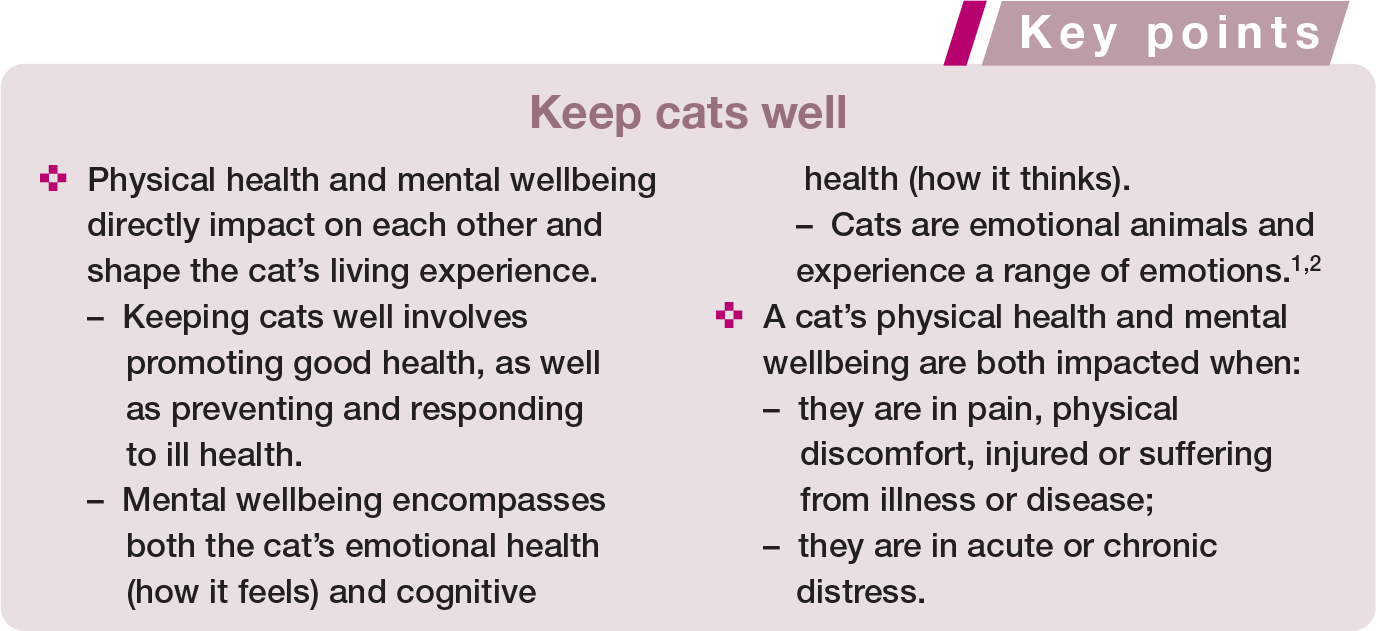
The training of veterinary professionals is heavily focused on the physical health of the patient. In addition to the management of illness, clinicians have further training in preventive healthcare and the early recognition of chronic disease. Measures to prevent disease through vaccination and appropriate use of parasiticides reduce the impact that chronic health conditions can have on the cat’s welfare. However, it is also important to understand the behavioural biology of the species and, in turn, the impact of suboptimal home environments and/or suboptimal cat-caregiver interactions, as these factors also influence the cat’s presentation to the veterinary clinic.
✜ The veterinary team is often the first point of contact for cats who are displaying problem behaviours or experiencing intercat conflict that is leading to physical injury. Identifying and addressing the underlying causes of these issues is as important as treating the physical injury.
✜ Recognition is emerging of the association between distress in feline patients and the occurrence of clinical diseases, such as idiopathic cystitis and other sickness behaviours.6-8 Appropriate consideration of the interrelationship can lead to more successful treatment and preventive healthcare plans.
✜ Taking a proactive approach to preventive healthcare gives an opportunity to manage the cat’s physical health and mental wellbeing from kittenhood right through to the super senior stage of life. It provides scope to raise awareness with caregivers of aspects of the home environment and/or human-cat interactions that may be having a negative impact, before the cat’s welfare is compromised.9-11 Demonstrating an understanding of how these aspects can influence a cat’s physical health and mental wellbeing can build the caregiver’s confidence in the clinic, resulting in them returning to seek further advice and care for their cat.
✜ Recognising the impact that a treatment plan and clinical decision-making have on a cat’s mental wellbeing can improve caregiver attitude to, and compliance with, the treatment. Frequent veterinary appointments, as well as factors such as the route and frequency of medication administration, 12 and confinement during or after a procedure or course of treatment, can all impact on a successful outcome through effects on the cat’s mental wellbeing, the cat-caregiver relationship and caregiver confidence. It is important to consider whether the longer term benefit to the cat’s physical health outweighs the short-term negative impact on their mental wellbeing; for example, in the case of a course of chemotherapy that involves weekly clinical appointments and intravenous medication.
✜ Cooperative care should be practised to help cats feel more comfortable, both physically and emotionally, with veterinary care. The aim is to encourage and facilitate them to become collaborative participants in their necessary husbandry and veterinary care procedures. Key to cooperative care is having a cat friendly environment set-up, 5 ensuring cat friendly interactions 4 between people and cats, and providing positive reinforcement. Using these three methods in combination, we can teach cats to:
- calmly and comfortably accept human proximity;
- calmly and comfortably accept physical touch (which will vary in type, pressure and location on the body, and at times will include unavoidable interactions);
- voluntarily cooperate in medical interventions and necessary care procedures.


Worldwide, at the point of graduating from their veterinary degree programme and registering with their respective governing body, all veterinary professionals take some form of oath that includes wording based on the concept of ‘do no harm’. While this is a principle central to the role of the veterinary professional, it is currently often limited to physical health. There is growing recognition that ‘do no harm’ should also include protecting mental wellbeing and addressing factors that can impact on future welfare, as outlined below.
✜ Veterinary professionals have a professional duty to remain current and up to date with their knowledge to ensure they are providing the best care available to their patients. As with everything, feline medicine is not static, and what was accepted practice previously, such as scruffing a cat as part of a procedure, is now recognised – due to a better understanding of mental wellbeing – as being unacceptable and detrimental to the cat. 13
✜ Veterinary professionals are required to perform interventions such as surgical procedures and dental care. The vast majority of these are in the cat’s best interests, as their welfare may otherwise be compromised by pain and/or poor physical health, which, in turn, can impact mental wellbeing. However, any intervention should only take place if the necessary equipment and clinical care are available, including appropriate analgesic and anxiolytic drugs, and postoperative nursing. Furthermore, using validated pain assessment tools and ensuring a robust pain management protocol exists within the post-procedural care plan will aid in returning the cat to their home environment more rapidly. This is important to promote mental wellbeing, while still ensuring good clinical care. In other words, reducing the short-term ‘harm’ that interventions may cause requires balancing of risks (eg, postoperative pain vs situational distress).
✜ In some countries, veterinary professionals may be called upon to perform surgical interventions that are predominantly in the interests of people, and may, in fact, compromise cat welfare. An example of this is onychectomy (declawing), which can lead to chronic pain for cats 14 and an inability to perform their natural scratching behaviour. In line with its Cat Friendly Principles, iCatCare advocates that veterinary professionals refuse to perform any such procedure that has no overall net benefit for the cat.
✜ There are other opportunities for veterinary professionals to prevent future poor welfare:
- Working with, and advising, breeders with regards to screening for health conditions can improve the health of a pedigree. Recognition of inherited traits that compromise the welfare of cats and their offspring (eg, osteochondrodysplasia of Scottish Folds), or where the breeding itself is detrimental to the welfare of the breeding animals (eg, the danger to a domestic cat when being bred with a wild cat to create a hybrid breed), will prevent harm.
- Working in the unowned cat sector, either with homing organisations or trap-neuter-return (TNR) programmes, provides an opportunity to shape good welfare. Veterinary professionals are crucial to population management efforts, including for neutering, infectious disease control, and health advice and treatment. Applying the Cat Friendly Principle ‘respect cats’ – including understanding the cat as an individual – requires recognition that interventions which may be appropriate for the management of an owned pet cat may be completely inappropriate for a feral or street cat; for these individuals, the negative impact of confinement or medication on mental wellbeing may far outweigh any positive impact on physical health that may be gained. Veterinary professionals are also well placed to discuss with their local charity groups what is appropriate for those at the feral or street cat end of the lifestyle spectrum and discourage them from bringing such cats into a homing centre for any length of time.
✜ Life stage advice can also prevent harm:
- Advising caregivers and breeders on the importance of parental genetics (eg, friendly temperament) and kitten socialisation can aid in the creation of pet cats with robust social skills to help promote their mental wellbeing and resilience to stress in the veterinary clinic environment.
- Ensuring that the cat has appropriate preventive healthcare in place at each life stage 15 and, towards the end of life, ensuring that quality of life is taken into consideration when decisions are made about palliative care and euthanasia, are all positive welfare actions.
✜ It could be argued that the veterinary professional’s duty of care extends to ensuring that the process of actually visiting the veterinary clinic does not cause harm to the individual cat. Educating caregivers about carrier training and transport, and making sure that the experience within the clinic is as cat friendly as possible, are as important as the clinical aspects of the appointment.


The veterinary community processes available evidence on husbandry, preventive healthcare, medical and surgical treatments, and behavioural and welfare science to create the best possible veterinary care for cats. The level of care needs to be sustainable in the context of the local community, however, and decisions must be pragmatic: it may not always be possible to implement more advanced veterinary care.
While diagnosis of a problem lies with a veterinary professional, responsibility for administering any treatment outside of the veterinary clinic usually lies with the caregiver. Therefore, choice of treatment will depend on the caregiver’s ability to put the treatment into action, their resources (time and money, as well as physical and emotional budgets) and the temperament of the cat in terms of their acceptance of treatment. A pragmatic and sustainable approach takes all of these factors into account.
In parts of the world where veterinary care is limited, focusing on core vaccination and cost-effective population management through best-practice neutering may be the most appropriate way to improve the welfare of cats. In regions where vaccination and neutering are mainstream, the focus may be more on preventive healthcare. Regardless of the resources available, the first three Cat Friendly Principles are the foundation blocks for creating an appropriate solution that also meets the cat’s welfare needs.


To create a truly cat friendly experience for all cats coming through the clinic, the entire team, including the reception team, needs to have an understanding and acceptance of the Cat Friendly Principles. A respectful approach that takes into account the reasons for a caregiver’s resistance and increases their knowledge of the aims and importance of the cat friendly experience, is required to improve cohesion.
The veterinary team needs to explain to caregivers the benefits of a cat friendly approach to the care of their cats, and share with them ideas of what they can do in the home (for example, through optimisation of resources, feeding plans and cat carrier training) to make the environment more cat friendly, to continue to improve the mental wellbeing of their cats and to make future veterinary visits more positive. Active listening should be adopted to understand a caregiver’s point of view, and will help to tailor communication content and style.
Clinics should actively communicate their cat friendly nature – through promotion of their ISFM Cat Friendly Clinic or AAFP Cat Friendly Practice status (where relevant), through photographs of cats on their website, through social media posts and by sharing information highlighting preventive healthcare for cats and addressing common concerns.


Applying the Cat Friendly Principle ‘communicate for cats’ more broadly leads to collaboration on welfare with other professionals and groups who work with cats, such as clinical animal behaviourists, cat sitters, local homing organisations and TNR charities. All of these groups can benefit from the knowledge and skills of the veterinary community within their spheres of work. In addition, people who, rather than working directly with cats, are in areas that may impact on the welfare of cats, such as in housing authorities or government departments involved in waste management or water care, may also benefit from veterinary input into issues such as population management or zoonotic diseases. In particular, the input of the veterinary profession on humane population management will lend weight to individuals or organisations trying to raise standards and campaign for good cat welfare. There is also huge scope to educate the next generation of caregivers and feline professionals by collaborating with educational establishments, groups and organisations. Veterinary professionals working with groups outside of their local or national area enable the sharing of problems and solutions, with the common goal of improving cat welfare.

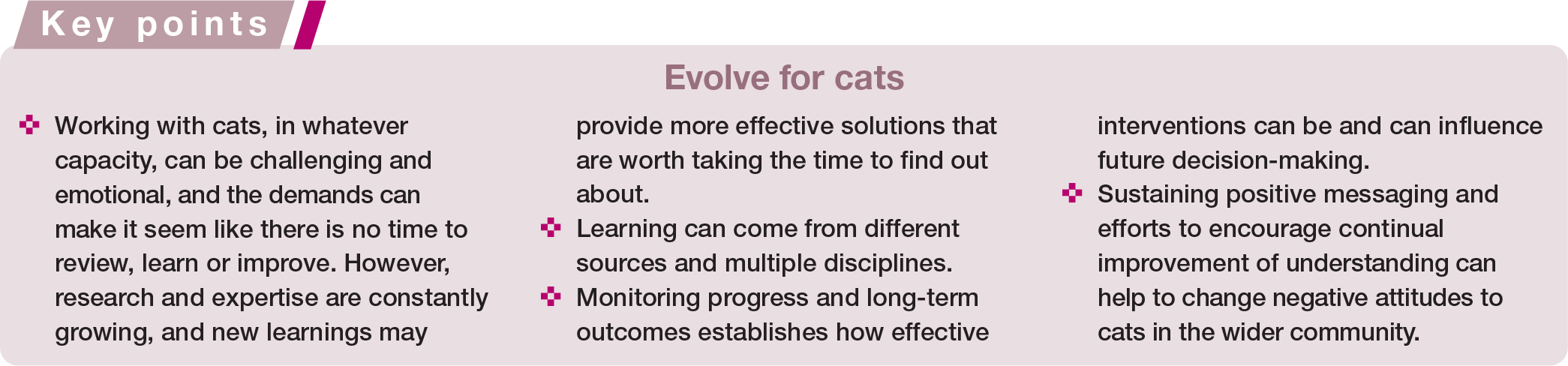
The more people learn, the more they accept that there is so much more they still do not know. The art and science of feline medicine continues to grow, and, alongside the pursuit of clinical knowledge, veterinary professionals should continue to cultivate and develop their cat friendly credentials. A focus on reflective practice within veterinary care is needed, asking questions such as: What works now? What can we do better? What do we need to do next? By applying the Cat Friendly Principles within day-to-day work, a cat friendly evolution will emerge organically as a natural process that is motivating and inspiring, rather than overwhelming.