Abstract
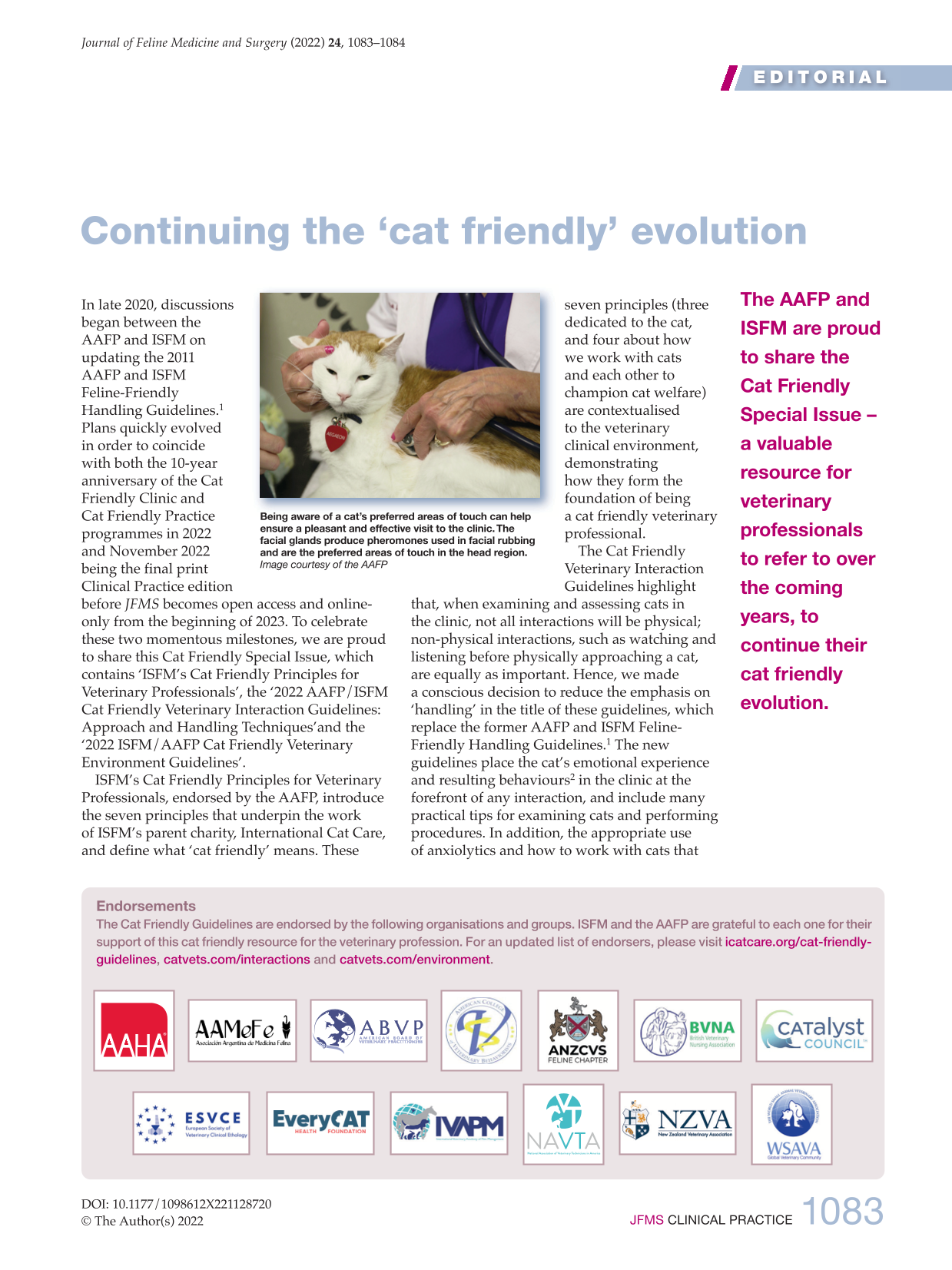
Being aware of a cat’s preferred areas of touch can help ensure a pleasant and effective visit to the clinic. The facial glands produce pheromones used in facial rubbing and are the preferred areas of touch in the head region. Image courtesy of the AAFP

In late 2020, discussions began between the AAFP and iSFM on updating the 2011 AAFP and ISFM Feline-Friendly Handling Guidelines. 1 Plans quickly evolved in order to coincide with both the 10-year anniversary of the Cat Friendly Clinic and Cat Friendly Practice programmes in 2022 and November 2022 being the final print Clinical Practice edition before JFMS becomes open access and online-only from the beginning of 2023. To celebrate these two momentous milestones, we are proud to share this Cat Friendly Special Issue, which contains ‘ISFM’s Cat Friendly Principles for Veterinary Professionals’, the ‘2022 AAFP/ISFM Cat Friendly Veterinary Interaction Guidelines: Approach and Handling Techniques’ and the ‘2022 ISFM/AAFP Cat Friendly Veterinary Environment Guidelines’.
ISFM’s Cat Friendly Principles for Veterinary Professionals, endorsed by the AAFP, introduce the seven principles that underpin the work of ISFM’s parent charity, International Cat Care, and define what ‘cat friendly’ means. These seven principles (three dedicated to the cat, and four about how we work with cats and each other to champion cat welfare) are contextualised to the veterinary clinical environment, demonstrating how they form the foundation of being a cat friendly veterinary professional.
The Cat Friendly Veterinary Interaction Guidelines highlight that, when examining and assessing cats in the clinic, not all interactions will be physical; non-physical interactions, such as watching and listening before physically approaching a cat, are equally as important. Hence, we made a conscious decision to reduce the emphasis on ‘handling’ in the title of these guidelines, which replace the former AAFP and ISFM Feline-Friendly Handling Guidelines. 1 The new guidelines place the cat’s emotional experience and resulting behaviours 2 in the clinic at the forefront of any interaction, and include many practical tips for examining cats and performing procedures. In addition, the appropriate use of anxiolytics and how to work with cats that are exhibiting protective behaviours is discussed.

The Cat Friendly Veterinary Environment Guidelines review the physical environment of the veterinary clinic, and provide advice and tips on what changes can be made to minimise any distress experienced by the cat during the clinic visit. Our goal with these guidelines is to give all clinics, no matter where they are in the world or how cat friendly they already are, practical options that can easily be put in place to improve the experience for cats and their caregivers.
In addition to the Cat Friendly Guidelines and their supporting supplementary material, we have also created a ‘toolkit’ for cat caregivers. One guide summarises what cat friendly is and will help caregivers to understand why your advice and way of working may be different to what they have previously experienced. A second guide covers cat carriers and transportation, as the physical process of taking a cat to a clinic remains a significant source of distress, both to cats and their caregivers. We hope that these materials will contribute to achieving a more positive experience.
Our aim for this Cat Friendly Special Issue has been to create a resource that veterinary professionals can access and refer to over the coming years, in order to continue their cat friendly evolution. We hope that this issue really does prove to be invaluable for your clinic.