Abstract

ISFM Cat Friendly Clinic competition showcases accomplishments
As the Cat Friendly Clinic (CFC) programme began life with a competition, ISFM wanted to celebrate CFCs 10-year anniversary with another competition. This time to showcase the amazing accomplishments that accredited clinics have achieved in making their clinics more cat friendly.
At the end of 2021, CFCs were asked to submit a short video of an innovative change they have implemented to make their clinic a better place for cats to visit. The change could be procedural (improving the way they work with cats) or a physical change to the clinic.
There were many fantastic entries and in the words of one of the ISFM team members, Vicky Halls: Tt is interesting how times have changed; it is no longer innovative to put high perches for cats in waiting rooms and hides in cages! That has to be a sign of progress.’ These videos have really shown the evolution of CFC as a programme - ideas that were novel 10 years ago have now become mainstream. This did not make the job of judging them any easier, but each category was narrowed down to three finalists by the panel (see box).

Winner - physical change
The winner in the physical change category is Orchid Vets, of Best Friends Vet Group, UK. The panel
praised the level of detail shared in their video, which showed the changes that can be made in a clinic to make it more cat friendly without major renovation works. Niki Pullen (RVN, ISFM, AdvCertFB) who submitted Orchid’s entry said: ‘Winning shows us it was worth it. But even if we hadn’t won, the evidence it was worth it shows in our clients and our patients. Since we have implemented these changes the (previously protective) cats are letting us examine them. Those practices thinking about becoming cat friendly but think it’s a lot of effort - no - it is so worth it!’
Winner - procedural change
The winner for the procedural change category is DAP De Witte Raaf for their use of the lick mat as a distraction technique. Responding to the news, the team at DAP De Witte Raaf said: ‘Winning the competition is the icing on the cake for our efforts to make our clinic as stress free as possible for our feline friends. It’s the ideal incentive to keep searching for ways to improve our cat friendly approach!’
ISFM thanks and congratulates all the finalists and winners of the 2022 CFC competition. The winners have each received two tickets to a 2022 ISFM congress.

AAFP Cat Friendly Practices share tips and ideas
AAFP asked their Cat Friendly Practices (CFPs) to share some tips and ideas that they have integrated into their practices in order to provide a calmer and better experience for cats and their caregivers. It was exciting to see that many practices are integrating similar cat friendly techniques. Below is a small selection of tips that CFPs have shared:
✜ Use fleece blankets sprayed with pheromone products.
✜ Provide heating pads under pheromone-sprayed soft baskets, blankets or cat beds to keep patients feeling warm and more calm.
✜ Minimize time in the lobby for
check in
✜ Make notes in the cat’s chart as to tips on handling, blood draws, what works and what does not.
✜ Provide a cat parking zone or carrier shelf where clients can put their carriers so that cats do not have to make eye contact.
✜ Adjust lighting and heating to provide a more dimly lit and slightly warmer environment than the rest of the practice.
✜ Go slow, let the cat adjust to the nev room / experience and give breaks.
✜ Greet cats at the door with pheromone-sprayed towels.
✜ Use slow and steady movements.
✜ Move patients directly from their cars to a cat-specific examination room.
✜ Be really conscious of the environment (eg, noises in the practice from people and other pets, movements, moving the cats, smells).
✜ Encourage clients to bring blankets from home and remind them to cover the carrier with the
blanket prior to leaving home.
✜ Set up portable speakers to play classical music where cats are present.
✜ Offer cat-only visits one night a week.
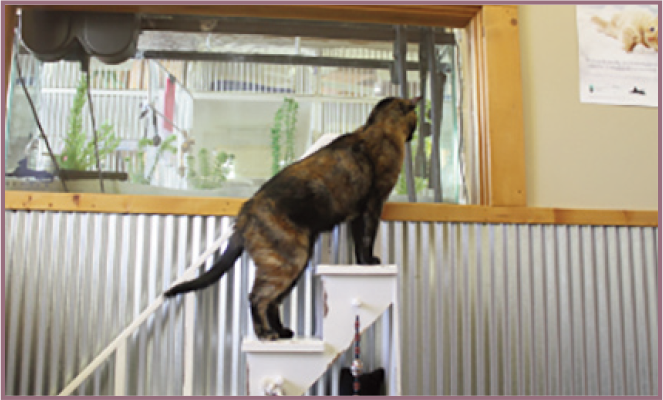
✜ Consider installing a fish tank and / or perches in your feline examination room.
✜ Provide distraction and high value treats - eg, toys, canned food, lickable cat treats or catnip (but avoid too much stimulation).
✜ Consider a sliding door for decreased noise.
✜ Use a towel folded lengthwise to help handle cats so they feel protected and fewer hands are needed to keep them in position for examinations and sample collection.
✜ Create ‘calm kits’, ‘happy cat kits’ or ‘kitty relax packs’ that are provided to cat owners prior to the visit. These can include carrier information, tips for getting the cat to the vet, pheromone wipes and sometimes an anxiolytic, depending on the situation. This can help to create a good bond between the patient, client and veterinarian, as well as reduce stress prior to the examination.
✜ When communicating with cat owners, focus more on the examination benefits and early detection of disease / pain because of how cats age so quickly and hide discomfort so well. Also, review the costs of certain diseases that can be potentially avoided compared with the cost of preventive care.
✜ Be more attentive to the needs of hospitalized cats and proactive in providing them with hidey boxes and partially covered cages. Be sure to calculate caloric requirements for all hospitalized patients and ensure every patient receives a pain score at each visit.
✜ Encourage cat clients to incorporate their cat’s carrier into their home life - like a bed / sleeping area, treat area or safe hiding spot. Also, provide positive rewards to cats entering on their own.
Courtesy of Mia Vida Medicina Felina, Brazil

Courtesy of Mint Hill Animal Hospital, NC, USA


Courtesy of Mariposa Veterinary Wellness Center, Lenexa, KS, USA