



Abstract
Objectives
From the authors’ experience, the consumption of a balanced prescription home-prepared diet that includes zucchini (courgette) benefits cats with recurrent urolithiasis, but there is no published evidence to support this. The aim was to study the effects on urinary parameters of (1) a balanced prescription home-prepared diet containing zucchini, and (2) the addition of zucchini to a dry food, compared with two commercial therapeutic diets.
Methods
Eight healthy cats were included in a Latin-square designed protocol. Five diets were evaluated: two commercial diets, designed for cats with urinary disorders, one high-moisture (U-WET) and one high-sodium dry (U-DRY); one home-prepared diet (HOME); one commercial dry food for adult maintenance (DRY); and DRY given together with 10 g of zucchini per kg body weight (DRY-Zuc). After a 7-day adaptation period, urine was collected and daily food and water intakes were assessed for 12 days. Urinary parameters, and relative supersaturation (RSS) for calcium oxalate (CaOx) and struvite, were determined. Data underwent repeated measures ANOVA analysis.
Results
The digestibility of energy, dry matter, protein and fat was highest with the HOME diet. CaOx RSS was lowest in cats eating the HOME diet, but not significantly different from the U-WET or U-DRY diets. CaOx RSS was lower in cats eating the DRY-Zuc diet than in cats eating the DRY diet. Struvite RSS did not differ significantly among groups.
Conclusions and relevance
This study shows that a balanced prescription home-prepared diet was safe and allowed a very low urinary CaOx RSS. It also showed that adding zucchini to dry food lowered the urine CaOx RSS.
Introduction
Increasing urine volume and lowering relative supersaturation (RSS) of crystals in the urine is considered as the mainstay of the prevention of urolith formation,1,2 including calcium oxalate (CaOx), which is not amenable to medical dissolution, unlike struvite. Urine pH is no longer regarded as the only critical factor in the formation of uroliths.
Cats do not increase their water intake adequately when fed dry cat foods, leading to increased risk of urolithiasis. Older studies showed that feeding cats dry diets (even with high sodium chloride content) resulted in a total daily water intake lower than for high-moisture diets. 3 Moreover, feeding high-moisture diets (canned or dry hydrated) has been shown to increase daily fluid intake and urine volume, resulting in a more dilute urine. This reduced the risk of CaOx crystal formation (but not that of struvite formation). 4 Another way of increasing water intake and urine volume is to increase dietary sodium intake, because of its stimulatory effect on hormones such as vasopressin and angiotensin, which can drive thirst.
While much of the variation in urinary CaOx excretion rate remains unexplained,5,6 many dietary factors are implicated in the formation of urinary CaOx crystals. Some, such as protein, minerals, moisture, fibre, fat and nitrogen-free extract, may have opposite effects on CaOx and struvite crystalluria. 7 Increased protein intake increases urine volume. 8
Moreover, the goal of nutrition is not only to prevent both CaOx and struvite uroliths, but also to fully cover the nutritional requirements of cats. Cats need 5.2–6 g of protein intake per kg body weight (BW) to maintain fat-free body mass. 9 Knowing that the maintenance energy requirement of a neutered indoor cat is approximately 50 kcal metabolisable energy (ME)/kg BW/day, 10 cats need a diet containing between 104 and 120 g protein/Mcal ME to maintain protein requirements.
Home-prepared diets are an option for cats that refuse to eat commercial diets formulated to prevent urolithiasis. Improperly prepared homemade diets can be unbalanced 11 or at contamination risk. 12 Nevertheless, properly prepared homemade diets represent the most tailored approach to the dietary and medical needs of veterinary patients. 13 However, to the authors’ knowledge, the effects of such a diet on urinary parameters have not been documented.
Since the oxalic acid content of Cucurbitaceae is very low, 14 and zucchini (courgettes) have a high water content and a low energy density (16 kcal ME/100 g, as fed), the authors started to add small amounts of zucchini to the diets of cats some years ago. This was first as the vegetable part of balanced home-prepared recipes, and as a means to increase dietary volume without significantly increasing energy intake.
The aim of this study was to evaluate (1) the effects of a moderate-sodium balanced home-prepared diet containing zucchini on urinary parameters of adult cats, and (2) the effect of the consumption of zucchini on lowering the urine saturation in cats.
Materials and methods
Animals
Eight (six male, two female) healthy, neutered domestic shorthair cats (all cats were 5 years old, mean BW = 4.7 kg [SD 1.0], mean body condition score [BCS; nine-point scale] = 5.0 [SD 0.8]) were included in a Latin-square designed protocol. They were housed according to the regulations for animal welfare of the French Ministry of Agriculture and Fisheries. Experimental protocols adhered to European Union guidelines and were approved by the Animal Use and Care Advisory Committee of Pays de la Loire (authorization number 00281.02).
Diet
Five diets were evaluated: a fresh home-prepared steam-cooked diet (HOME) balanced to meet Fédération Européenne de l’Industrie des Aliments pour Animaux Familiers (FEDIAF) nutritional guidelines; 15 one wet veterinary food for urolithiasis treatment with high water content (Royal Canin Urinary S/O LP34 [cat]; U-WET); one dry veterinary food for urolithiasis treatment with high sodium content (Royal Canin Urinary S/O high dilution UHD34 [cat]; U-DRY); one dry food from a grocery store targeted at neutered cats (Affinity Ultima adult cat; DRY); and the DRY diet given with zucchini (DRY-Zuc, 10 g zucchini/kg BW).
The HOME diet comprised 60% raw weight chicken breast, 30% raw weight zucchini, 5% canola oil, 3% rolled oats, 2% vitamin and mineral mix containing 10% calcium with no added phosphorus (Vit’i5 Bleu) and salt added to reach about 450 mg NaCl/100 g dry matter. The fresh homemade diet was prepared in our laboratory in one batch, split into portions and immediately frozen. Chicken, zucchini and oat flakes were cooked in a standard rice cooker for 20 mins, cooled down at room temperature for 30 mins, then canola oil and the vitamin and mineral mix were added. In the evening before use, the necessary portions of the HOME diet were placed in the refrigerator to thaw and left at room temperature for 30 mins before each meal. The HOME diet was given in two equal-sized meals (half morning and half evening). Other diets were given in one meal per day.
For the DRY-Zuc diet, zucchini was washed in water, cut into 5 mm cubes similar to the size of kibble, weighed raw for each cat and frozen in individual portions to provide 10 g/kg BW/day. The individual portions were defrosted in warm water, and strained and mixed with the dry food each day.
One kilogram of food from each diet group was sampled and analyzed for moisture, protein, fat, nitrogen-free extract, crude fibre, ash, calcium, phosphorus, magnesium, sodium, potassium and chloride, as described elsewhere.2,16 Oxalic acid was measured by adaptation of the AOAC 974-24 method. 17 Briefly, this started with the extraction of 3 g in 100 ml of 0.5% hydrochloric acid (V:V) in a boiling water bath for 15 mins. Then centrifugation and filtration to separate the precipitate were followed by the addition of an internal standard (tartaric acid or succinic acid). Filtration at 0.22 µm was undertaken, followed by capillary electrophoresis with pyromellitic acid buffer and 3 mM diethylenetriamine at pH 7 and UV detection at 220 nm.
Cats were fed for maintenance 15 according to their BW and BCS in each phase.
Study design and procedures
Each trial phase lasted for 3 weeks. The first week was the adaptation period and cats were in a group. For the following 2 weeks, cats were in metabolic cages and food intake, total daily water intake (TWI: diet moisture + fresh water), quality of faeces, urine volume, pH and specific gravity were recorded daily. The urine was collected during the last 24 h at the end of each phase and pH was measured. A 25 ml aliquot of urine was titrated down to pH 2 with concentrated hydrochloride and then immediately frozen (the pH before acidification was noted). The sample was then analysed for sodium, potassium, magnesium, calcium, chloride, sulfate, phosphate, oxalate, citrate, ammonium, nitrogen, creatinine and urate as described elsewhere. 2 The concentrations of calcium, phosphate, magnesium, sodium, potassium, ammonium, oxalate, citrate, sulfate and uric acid in the urine pool were measured by ionic chromatography (Dionex) as described by others. 16 Supersat software was used to calculate RSS of the urine for CaOx and struvite 18 (http://rsscalculatorforpets.royalcanin-world.com).
Statistics
The effect of the five diets on urinary parameters was assessed with repeated measures ANOVA analysis. For each model, a post-hoc analysis Bonferroni test was used to compare the differences in averages.
The power of the significant Bonferroni tests was systematically checked and was >90%. The analyses were performed with R 2015 statistical software (R Foundation for Statistical Computing). Variation is expressed as standard deviation. Significance was set at P <0.05.
Results
Diet composition and consumption
The composition of the diets is shown in Table 1. The HOME diet contained the highest protein (112 g/Mcal ME) and the lowest nitrogen-free extract (18 g/Mcal ME), ash (10.1 g/Mcal ME, equivalent to 4.55% of the dry matter) and oxalic acid (52 g/Mcal ME) content, moderate sodium content and the lowest chloride content.
Analytical composition of the diets

U-DRY = Royal Canin Urinary S/O high dilution UHD34 (cat); U-WET = Royal Canin Urinary S/O LP34 (cat); HOME = home-prepared diet (chicken breast, zucchini, oat flakes, canola oil and vitamin and mineral mix [Vit’i5 Bleu]); DRY-Zuc = DRY + 10 g zucchini/kg body weight; DRY = Affinity Ultima adult cat
Calculated from in vivo digestibility
The addition of zucchini to the DRY diet led to a dilution of all components but fibre and ash, which slightly increased (13.9 to 15.2 g/Mcal ME and 19.1 to 21.4 g/Mcal ME, respectively). Ash increased mainly due to potassium.
The DRY diet was the highest in oxalic acid and crude fibre, and comparable in ash content to the U-DRY diet. The DRY diet contained more calcium, while the ash in the U-DRY diet was higher in sodium and potassium.
Compared with the HOME diet, the U-WET diet was higher in all parameters measured except energy, protein and magnesium.
Cats consumed more than 90% of all dry diets and the HOME diet (U-DRY 99 ± 2%, DRY 95 ± 11%, HOME 94 ± 11%, DRY-Zuc 91 ± 7%) and left more than 10% of the U-WET diet (82 ± 16%). The energy intake was lower with the U-WET and DRY-Zuc diets. Over the course of the study, the BW and BCS of the cats did not vary significantly.
Digestibility
The digestibility data are shown in Table 2. Protein, organic and dry matter digestibility was significantly higher for the HOME diet than for all other diets. Comparing the DRY-Zuc diet with the DRY diet, the digestibility of dry matter, crude protein, crude fat and organic matter was not significantly affected by the addition of zucchini. Only the digestibility of energy was significantly lowered by zucchini.
In vivo digestibility of the five diets
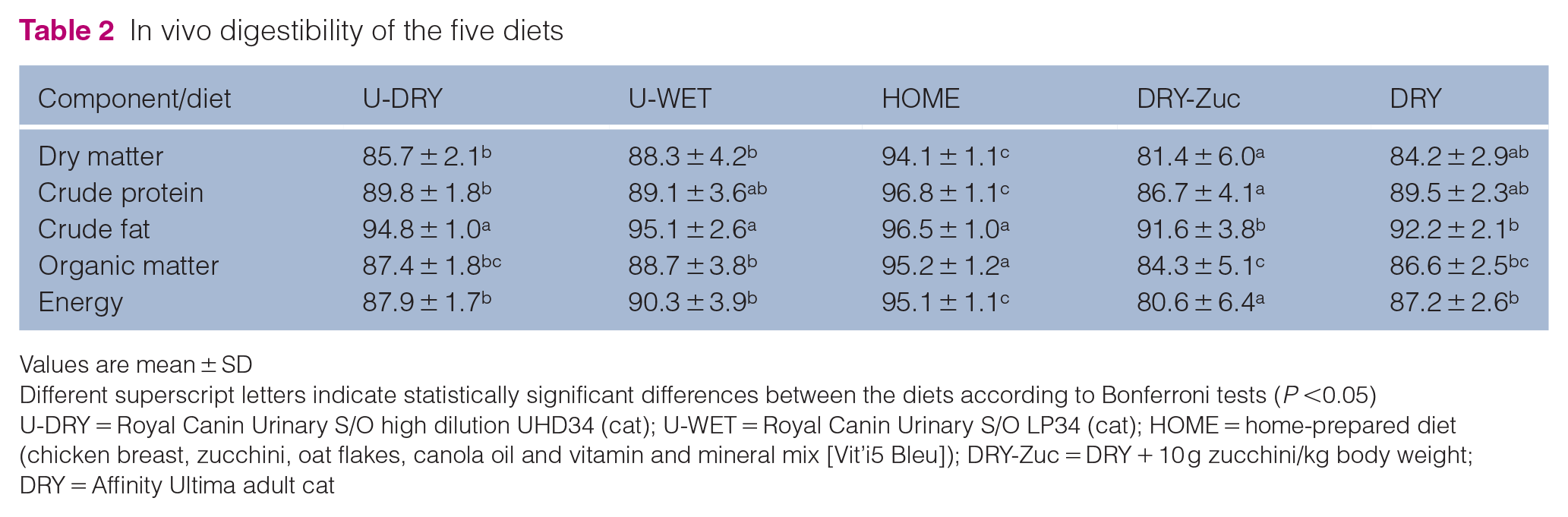
Values are mean ± SD
Different superscript letters indicate statistically significant differences between the diets according to Bonferroni tests (P <0.05)U-DRY = Royal Canin Urinary S/O high dilution UHD34 (cat); U-WET = Royal Canin Urinary S/O LP34 (cat); HOME = home-prepared diet (chicken breast, zucchini, oat flakes, canola oil and vitamin and mineral mix [Vit’i5 Bleu]); DRY-Zuc = DRY + 10 g zucchini/kg body weight; DRY = Affinity Ultima adult cat
Water intake and urinary data
The U-WET diet, which had the highest water content (81.1%), was associated with the highest total water intake (Table 3), the highest urine volume, the lowest urine specific gravity (1.031 ± 0.004) and the lowest free water consumption (results not shown).
Main results of food and water consumption, and faecal and urine characteristics in cats fed the five diets
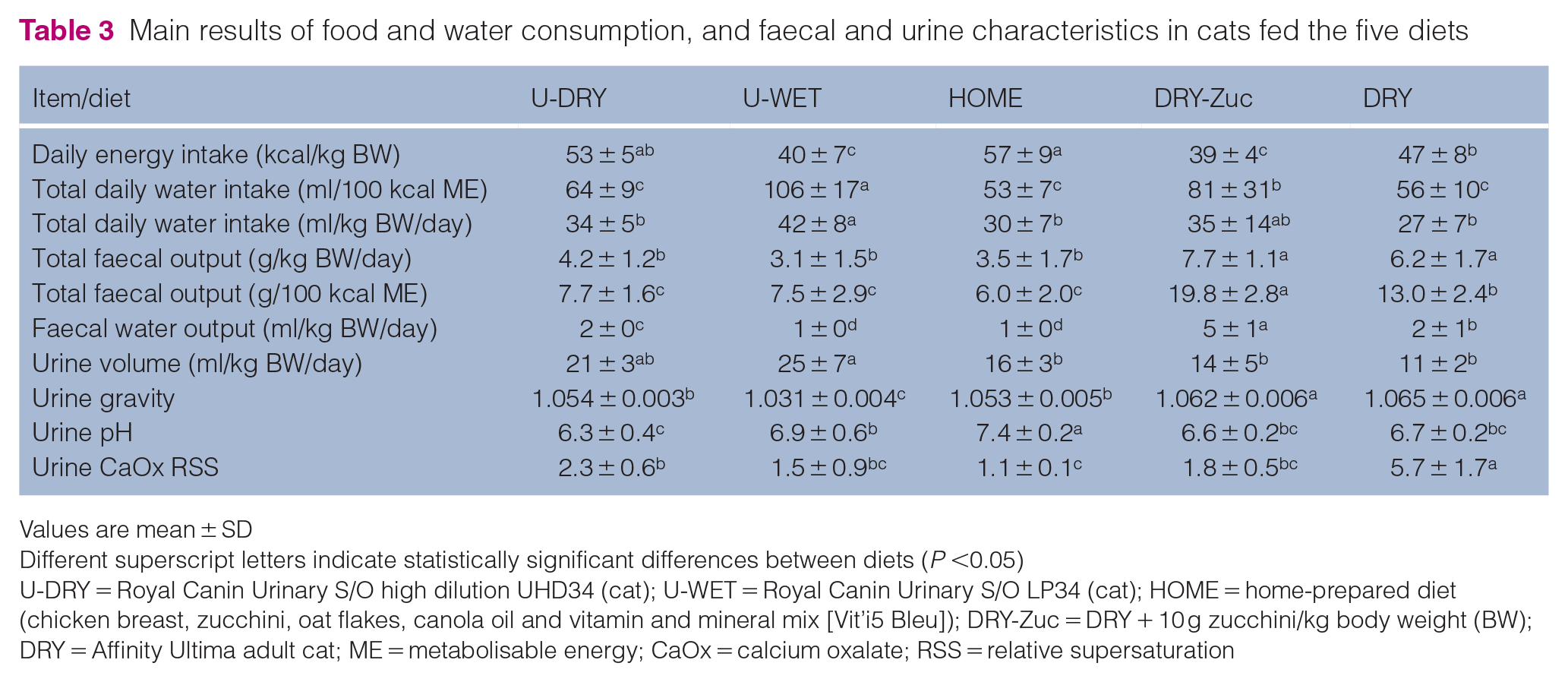
Values are mean ± SD
Different superscript letters indicate statistically significant differences between diets (P <0.05)U-DRY = Royal Canin Urinary S/O high dilution UHD34 (cat); U-WET = Royal Canin Urinary S/O LP34 (cat); HOME = home-prepared diet (chicken breast, zucchini, oat flakes, canola oil and vitamin and mineral mix [Vit’i5 Bleu]); DRY-Zuc = DRY + 10 g zucchini/kg body weight (BW); DRY = Affinity Ultima adult cat; ME = metabolisable energy; CaOx = calcium oxalate; RSS = relative supersaturation
The effect of diet on CaOx RSS was significant (P <0.0001). The HOME diet resulted in the lowest urine CaOx RSS values, close to the undersaturated zone for CaOx RSS, which is defined as <1. It was not significantly different from those associated with the U-WET diet, but values were more homogeneous (1.1 ± 0.1 vs 1.5 ± 0.9, respectively). The urine CaOx RSS in cats fed DRY-Zuc (1.8 ± 0.5) was significantly lower than in cats fed the DRY diet (5.7 ± 1.7) (Figure 1). The addition of zucchini to the commercial dry food resulted in a dramatic drop in the urine CaOx RSS (1.8 ± 0.5 vs 5.7 ± 1.7) (Table 3).

Calcium oxalate relative supersaturation in cats’ urine from the consumption of the five diets. Results are presented as box plots from the first to the third quartiles; horizontal bar = mean; X = median. U-DRY = Royal Canin Urinary S/O high dilution UHD34 (cat); U-WET = Royal Canin Urinary S/O LP34 (cat); HOME = home-prepared diet (chicken breast, zucchini, oat flakes, canola oil and vitamin and mineral mix [Vit’i5 Bleu]); DRY-Zuc = DRY + 10 g zucchini/kg body weight; DRY = Affinity Ultima adult cat
There was no significant effect of diet on urine struvite RSS (Figure 2).
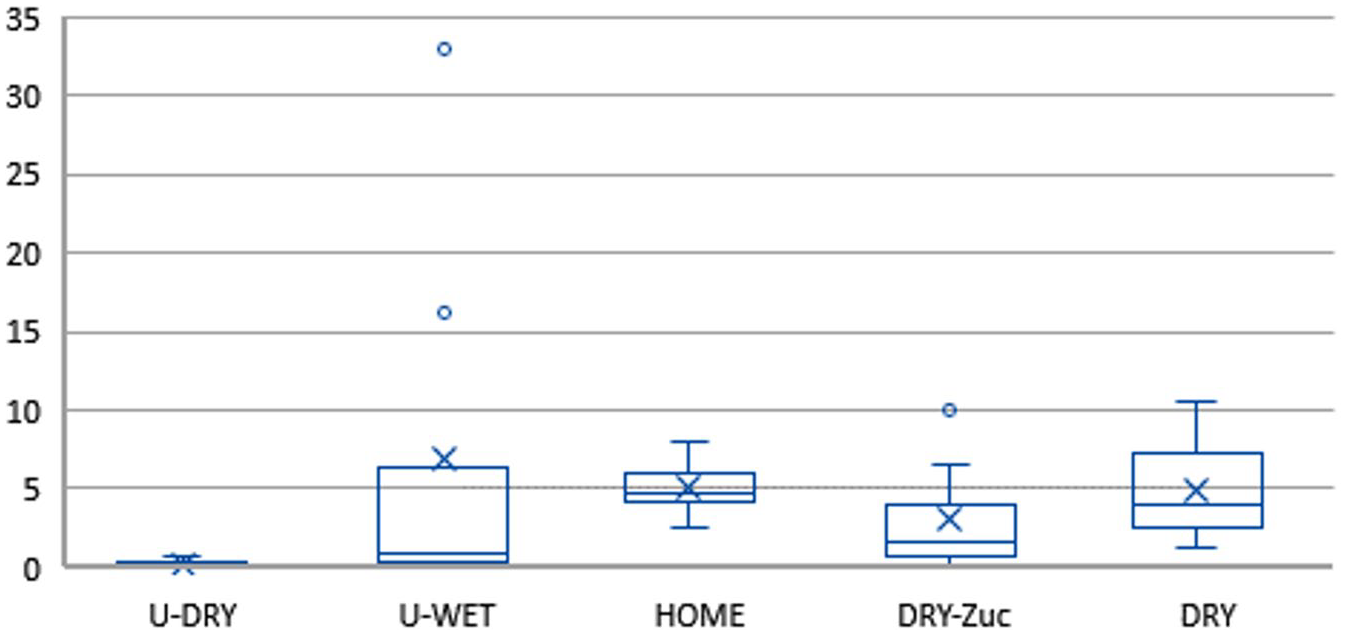
Struvite relative supersaturation in cats’ urine from the consumption of the five diets. Results are presented as box plots from the first to the third quartiles; horizontal bar mean; X = median. U-DRY = Royal Canin Urinary S/O high dilution UHD34 (cat); U-WET = Royal Canin Urinary S/O LP34 (cat); HOME = home-prepared diet (chicken breast, zucchini, oat flakes, canola oil and vitamin and mineral mix [Vit’i5 Bleu]); DRY-Zuc = DRY + 10 g zucchini/kg body weight; DRY = Affinity Ultima adult cat
Discussion
A low CaOx RSS may be considered as a goal to lower the risk of urolithiasis. 2 Strategies to minimise CaOx urolith occurrence include increasing water consumption, and providing a diet high in moisture or high in sodium chloride to achieve lower urine concentrations of CaOx. 19 With this aim, we investigated the effects of five diets on urinary parameters in healthy cats.
The diets used recognised dietary strategies for cats suffering from urolithiasis: high-moisture commercial wet food and high-sodium commercial dry food, which were compared with a moderate-sodium balanced home-prepared diet.
Balanced home-prepared diet
The wet commercial option is often considered preferable, but some cats (or some owners) prefer a home-prepared option. Furthermore, neutered indoor cats have a reduced energy requirement, while all other nutrient requirements are about the same as those of entire active outdoor cats. Therefore, to provide enough of each nutrient but with a lower energy intake, the diet needs to contain a higher nutrient:energy ratio, as for instance a higher protein:energy ratio (PER). This adjustment is easy to achieve by altering the formulation of the home-prepared diet.
It is recommended that home-prepared diets are formulated by a board-certified veterinary nutritionist (dipl ACVN or EBVS-ECVCN),13,19 as it was in the present study. The general principle is to create the diet with a few standard ingredients that are easy for the pet owner to find. Grossly, it can be composed of muscle meat, canola oil, cooked vegetables, possibly a source of starch, and an adapted mineral and vitamin supplement. The ingredients may be selected, then amounts calculated and the recipe prepared, in order to (1) cover the needs and requirements of the target pet, (2) be accessible to the pet owner and (3) be palatable and compatible with the pet’s appetite. Apart from this, the diet used in this study could be considered as a prescription high-protein, low-mineral moderate-sodium balanced home-prepared diet (see the ‘Nutritional strategy’ section below).
Digestibility
Digestibility of all diets was high, with about 89% digestibility for protein among all commercial diets tested. A much higher protein digestibility (96.7%) was found with the home-prepared diet, in which the protein came from muscle meat, which had been steam-cooked to avoid any microbial contamination risk.
These results are similar to the digestibility reported in a previous unpublished study, 20 in which the composition of the home-prepared diet included more rice and consequently more starch.
Other studies have shown a digestibility of protein of 92–95% in a raw meat-based diet in cats.21–23
It is also notable that digestibility was very homogeneous among cats consuming the home-prepared diet. The present study showed that steam cooking preserved the very high digestibility of the meat in the home-prepared diet, which notably allows the use of Atwater coefficients (ie, 9 kcal ME per gram of fat, and 4 kcal ME per gram of protein or nitrogen-free extract) to determine the energy value of such diets in cats.
Nutritional strategy – home-prepared diet
In the first author’s experience, the recipe for the home-prepared diet used in this study appears to provide good long-term effects in cats, including a lower recurrence of urolithiasis. It is for this reason this diet was included and why this study was performed. Most commercial diets do not provide the minimum of 5.2 g protein/kg BW 9 required for neutered indoor adult cats when fed at maintenance level, of 50 kcal ME/kg BW. 10 This minimal protein concentration corresponds to a P:ER of 100 g/Mcal ME. The home-prepared diet was formulated to exceed 100 g/1000 kcal ME, with a P:ER of 112. The level of sodium in the HOME diet was 0.8 g/Mcal ME, close to the lowest value described in studies that examined the effect of sodium.2,24 Eventually, the mineral content of the HOME diet was 10.1 g ash/Mcal ME, the lowest of the five diets, and low compared with diets for adult cats on the market. So, this home-prepared diet was called a high-protein, low-mineral, moderate-sodium balanced diet.
A home-prepared diet can be formulated in many different ways, using different easily found ingredients in order to easily provide most of the essential nutrients and cover, at its best, all the nutritional requirements of a pet: grossly, meat for protein, amino acids and fat, canola oil for essential fatty acids and fat, vegetables for fibre and water, and a mineral and vitamin supplement for all micronutrients not found in the other ingredients. Energy comes from protein and fat, as well as from carbohydrates if a source of starch such as oat flakes or rice is added. When raw ingredients are chosen and not canned, sodium content may be low and salt needs to be added. For this reason, salt was added to the HOME diet. The judicious choice of ingredients and their respective quantities must cover all the nutritional needs of the animal, while satisfying its appetite.
The cats in this study were expected to have a low energy requirement because they were neutered and sedentary, so the home-prepared diet was formulated with a very lean muscle meat (chicken breast). Zucchini was chosen for its high water, low energy and low oxalic acid content. The mineral and vitamin supplement was chosen with no added phosphorus and was included in order to provide a final calcium:phosphorus ratio of just above 1, to lower the general amount of minerals, but still provide adequate micronutrients.
In our research, as the dietary moisture level increased, the cats compensated by significantly reducing the amount of water they drank. The consumption of the high-moisture or high-sodium diets resulted in low CaOx RSS. However, the lowest and most homogeneous low CaOx urine saturation was obtained with the HOME diet, which contained only 66% moisture, and had the lowest sodium content. It was also the lowest in ash (total minerals) and oxalic acid, the highest in protein and the most digestible. Such an association of nutrients is much easier to obtain with a home-prepared diet than with a commercial food, even one that is wet or designed for lower urinary tract disease.
Moreover, home-prepared diets can be balanced and adapted as the physiological or pathological situation requires. Furthermore, the inclusion of vegetables as fibre sources has beneficial consequences on the digestive microbiome. 25 Vegetables additionally contribute water and greater bulk to the diet.
Moisture
Cats are naturally poor spontaneous drinkers. Much of their daily water requirement is obtained from their prey, which typically contains 70% moisture. 26 The home-prepared diet we used in this study mimicked this moisture content.
This behaviour puts cats at a higher risk of lower urinary tract disease when fed low-moisture diets, based on a higher urine specific gravity, 4 which would be related to a more concentrated urine 27 and an associated increase in CaOx RSS. Diets with high moisture content have also been shown to reduce CaOx RSS in urolith-forming cats. 4
Indeed, our data suggest that high-moisture diets may drive cats to ingest more dietary water, resulting in a positive effect on urinary parameters. However, this may not be the only positive effect, as the home-prepared diet also showed a very positive effect on urinary parameters, but was not the wettest one.
pH, sodium and RSS
Evidence has shown that struvite RSS correlates with urinary pH.4,28–30 In our study, the highest urinary pH was observed with the home-prepared diet, and the lowest with the U-DRY diet, which could explain the lowest, but not significantly different, struvite RSS observed with the latter. The struvite RSS did not differ significantly among the diets, and even showed heterogeneous values, with two high values in two cats when consuming the U-WET diet. Both showed urine crystals with this diet on urine microscopic observation.
The RSS value in this study, of about 1.1 for the HOME diet, was close to the undersaturation zone of 1, 4 and lower than those obtained for both commercial prescription diets, U-WET (1.5) and U-DRY (2.3). The addition of zucchini substantially lowered the RSS value for a representative commercial dry food diet from 5.7 to 1.8. The addition of zucchini appeared to be very effective compared with adding sodium, which decreased the RSS substantially less from 3.34 to 1.64 when sodium was increased from 0.67 to 3.27 g/McalME. 2
Urine pH may affect the solubility of struvite. In healthy cats fed with similar diets differing only in their acidifying or alkalinising properties, urinary saturation with CaOx was lower when the urine pH was higher than 7.2 and higher when urine pH was lower than 6.5. 4 In our study, urinary pH was 7.4 with the home-prepared diet, which may partly explain the lower CaOx RSS in cats fed this diet.
However, the high pH value obtained from the HOME diet cannot be the only explanation for the lowest CaOx RSS observed with this diet because the addition of zucchini to the DRY diet showed a decreased CaOX RSS and no change in the urinary pH. This is possibly linked to the low oxalic acid and low mineral level, or the high potassium level and high potassium:sodium ratio in the home-prepared diet, as suggested recently in another study. 31 Nevertheless, further studies may be necessary.
In feline nutrition, the effects of dietary sodium on CaOx uroliths are controversial. However, the potassium:sodium ratio is rarely considered. It is notable that the U-WET and HOME diets showed a high potassium:sodium ratio (3.5 and 2.75, respectively).
High dietary sodium content resulted in higher production of urine with lower specific gravity than in previous studies.32–34 Moreover, higher dietary sodium content was associated with both higher calcium concentration and lower oxalate urinary concentration of the diets, such that CaOx RSS was not affected by sodium intake.33,34 It is plausible that the effects of sodium on water intake and its diluting effect on urine calcium concentration are relatively greater than the possible effect of sodium on promoting urine calcium excretion. 34
Our results agree with previously published work showing greater water consumption by cats given wet canned foods compared with dry foods.3 The home-prepared diet, as formulated in this study, also increases the number of possible and safe options for feeding cats with a history of CaOx urolithiasis. This diet was palatable, because voluntary intake maintained BW, and amply satisfied the protein requirements of the neutered indoor cats used in this study.
Urine specific gravity
The goal is to dilute urine to lower specific gravity. The urine specific gravity obtained with the U-WET diet was lower than the minimal range of normality of 1.035, described as compatible with a properly hydrated status(http://www.iris-kidney.com/education/urine_specific_gravity.html), and such a diet may be used carefully in cats.
Zucchini
The addition of zucchini to the DRY diet decreased the energy intake of cats from 47 kcal/kg BW to 39 kcal/kg BW, a similar energy intake to cats fed U-WET (40 kcal/kg BW). BW did not significantly vary for any of the diets, which could be explained by the short duration of the trials. In this regard, it should be noted that with the exception of the HOME diet, which was fed in two meals, the cats received all of the food in one meal per day. This may explain the lower energy intake with U-WET and DRY-Zuc, because the bulk of a more diluted diet may be more difficult to ingest in one meal (see the ‘Practical recommendation’ section below).
The addition of zucchini to dry food only significantly affected energy digestibility, with protein and fat digestibility preserved. This means that the addition of zucchini to the diet of cats is an attractive strategy to decrease energy intake; for example, in overweight or obese cats.
The addition of zucchini to the DRY diet dramatically decreased urine CaOx RSS, even though not all the zucchini was ingested. This addition showed no side effects on the stool quality (results not shown).
From the authors’ experience, zucchini cubes are very well accepted by cats, after a slow introduction. Thus, this slight negative effect on appetite was more likely due to the laboratory conditions, coupled with the rapid food transition, and taking into account feline neophobia and the fact that the laboratory cats had never had zucchini before. We recommend introducing zucchini very slowly (see the ‘Practical recommendation’ section below).
Adding zucchini to any diet, with an amount as low as 10 g/kg BW, could be a strategy to lower CaOx RSS in cats.
In the first diets formulated by the authors some years ago, to limit oxalic acid and precursors such as ascorbic acid, potential fibre sources were screened. Cucurbitaceae appeared to be low in both ascorbic and oxalic acid content, and palatable to cats. With time, strategies to encourage the cats to accept the zucchini were developed; for example, the zucchini can be cut into small kibble-sized cubes, and either cooked, or frozen and thawed, and introduced to the diet very gradually. This study confirmed the acceptance of such an addition of zucchini to a cat’s diet.
Practical recommendation
These results suggest that a balanced prescription home-prepared diet, such as the HOME diet studied here, could be used, as can the tested U-WET urinary food, in the prevention of recurrent CaOx urolithiasis, but with a significant difference in the amount of protein provided. The home-prepared diet provided protein to meet the recommendation of 5.2–6 g of protein/kg BW/day. Not all commercial diets meet this standard because many (including those tested here) were formulated to meet an older, lower standard, which might not maintain fat-free mass. 9 We recommend that cats should be fed diets that meet the newer standard.
The results also suggest that, as an alternative to wet food, the addition of zucchini to dry food decreases energy density while maintaining satiety through increased dietary volume and decreases CaOx urine saturation. From the authors’ experience, zucchini is well accepted if cut into small kibble-sized cubes (about 5 mm), and introduced first as a few cubes provided with the usual food, once a day, until accepted. The amount may then be increased slowly once the previous amount given is fully ingested daily for 2–4 days.
Finally, it should be noted that this study was conducted with the moist food divided into only two meals, and under laboratory conditions. Nevertheless, the authors strongly recommend offering limited amounts to avoid overconsumption, and to split the daily amount of food into at least four meals per day, regardless of whether canned, home-prepared or dry food is offered.
Conclusions
This study shows that a prescription, balanced, moderate-sodium, high-protein, home-prepared diet was palatable, safe and resulted in a very low urinary CaOx RSS in cats. It also showed that adding 10 g/kg BW of zucchini to dry food lowered the urine CaOx RSS of cats.
Footnotes
Acknowledgements
The authors thank Dr Chantal Thorin for assistance with statistical analysis. Manuscript proofreading was performed by Dr Kurt Verkest of VetWrite (
Conflict of interest
Animal Nutrition Expertise (Dr G Blanchard) formulated and manufactured the Vit’i5 products used in this study.
Funding
The authors disclosed receipt of the following financial support for the research, authorship, and/or publication of this article: the study was financed by grants from the authors’ own respective organisations.
Ethical approval
The work described in this manuscript involved the use of experimental animals and the study therefore had prior ethical approval from an established (or ad hoc) committee as stated in the manuscript.
Informed consent
Informed consent (verbal or written) was obtained from the owner or legal custodian of all animal(s) described in this work (experimental or non-experimental animals, including cadavers) for all procedure(s) undertaken (prospective or retrospective studies). No animals or people are identifiable within this publication, and therefore additional informed consent for publication was not required.
