




Abstract
Practical relevance:
An understanding of the process of musculoskeletal ageing – which all senior and geriatric cats will experience – is vital to maintaining the health and welfare of our ageing cat population.
Clinical challenges:
Assessment of the feline musculoskeletal system is not always straightforward. Diagnosis of impairment relies on input from owners and veterinarians in terms of visual observation, and clinical and orthopaedic examination, in addition to diagnostic imaging
Audience:
This review is written for the primary care veterinary team.
Aims:
The goals are to raise awareness and improve clinical diagnosis of musculoskeletal impairment as a result of ageing. The article also reviews therapeutic options and considers the evidence available for the prevention/deceleration of musculoskeletal ageing and impairment.
Evidence base:
There is good evidence of a high prevalence of osteoarthritis (OA) and degenerative joint disease (DJD) in older cats. There is also good evidence to indicate that functional impairment and chronic pain are sequelae of musculoskeletal disease. However, there is a paucity of information for what is best practice for the management and treatment of musculoskeletal impairment in a clinical situation. There is also a lack of evidence on how prevention of central stimulation of the nervous system caused by musculoskeletal impairment and, in turn the development of chronic pain, can be avoided.
Ageing is not a disease
Ageing is not a disease, but it is characterised by a progressive loss of physiological integrity leading to functional impairment. 1 The boundaries between what is normal physiological ageing of tissues and what is a ‘diseased state’ are blurred. Musculoskeletal disease can be considered present | where there is functional impairment, pain or loss of mobility. 2 In the human musculoskeletal system, bone loss, degradation of articular cartilage and degenerative, narrowed intervertebral disc spaces are considered the primary features of musculoskeletal ageing. 2

Aspects of feline musculoskeletal ageing
Bone loss as a feature of normal musculoskeletal ageing has not been determined in cats. 2 Osteoporosis following feline ovariectomy has been shown not to occur; 3 therefore, the ageing-related hormonal effects leading to bone loss seen in women 2 are unlikely to affect cats, but other causes of age-related bone loss have not been investigated.
Degradation of articular cartilage leading to osteoarthritis (OA) and degeneration of the intervertebral disc spaces are both common in ageing cats.4–11 Numerous radiographic studies have shown a high prevalence of OA and degenerative joint disease (DJD) (see box on page 1070).
Age has been shown as being the greatest risk factor for the presence of radiographic OA9,11 or DJD, 10 with the severity of changes and the number of joints affected increasing with age.


Diagnostic considerations in musculoskeletal ageing
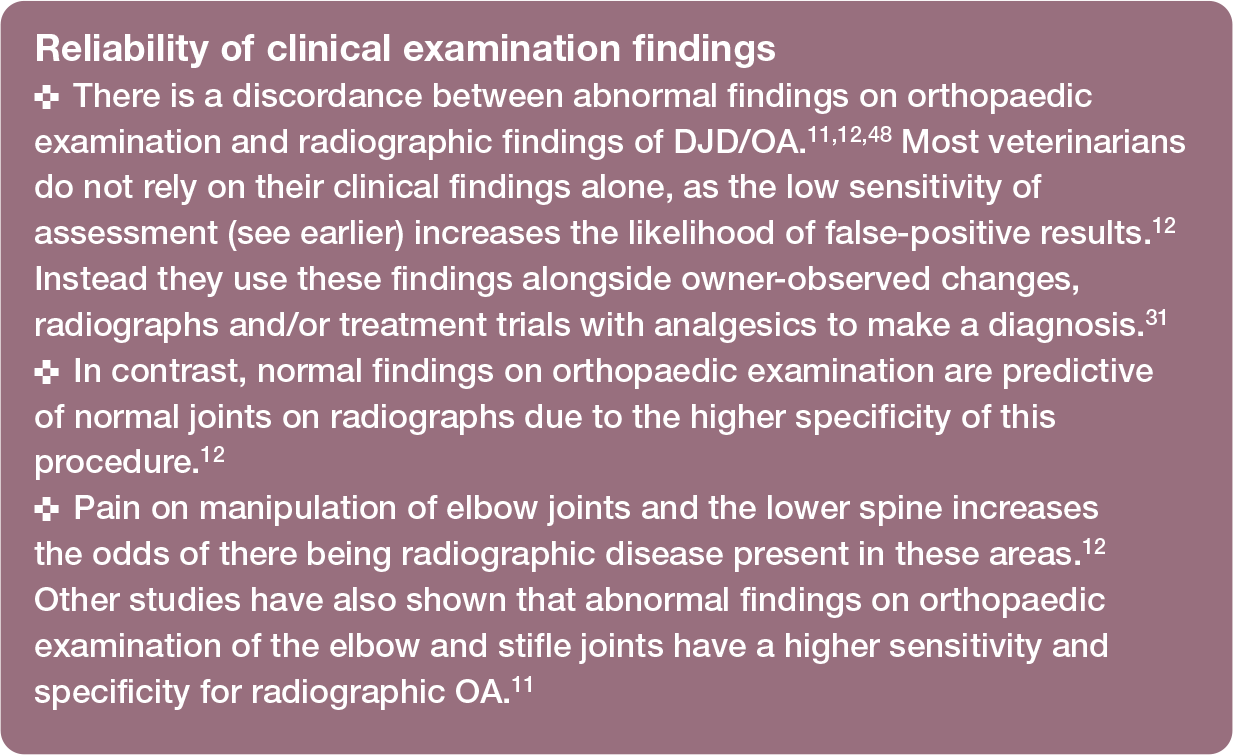
In cats with radiographic changes consistent with OA or DJD, there is not necessarily always a corresponding clinical diagnosis of pain or functional impairment.9,12 The sensitivity and specificity of different aspects of an orthopaedic examination in cats with DJD are variable, with Lascelles et al reporting: 12
Pain response to palpation: sensitivity 0–67%, specificity 62–99%
Crepitus: sensitivity 0–56%, specificity 87–99%
Presence of effusion: sensitivity 6–38%, specificity 82–100%
Joint thickening: sensitivity 0–59%, specificity 74–99%
The higher specificity for crepitus and presence of effusion in a joint leads these findings to be more predictive of radiographic changes consistent with OA/DJD. The absence of these findings on examination is likely to predict radiographically normal joints. The low sensitivity of all aspects of the orthopaedic assessment, however, increases the likelihood of false-positive results. This study did use radiographic changes to determine a diagnosis of OA/DJD, so while some of the findings on orthopaedic assessment may be true false positives, this may not be the case with all.
Unfortunately, radiography is also poor at detecting cartilage degradation in appen-dicular joints.13,14 Cartilage damage without any radiographic evidence of joint disease has been shown to be present in the stifle, hip, elbow and tarsal joints in 30 cats, 13 and the shoulder, elbow, hip, stifle, carpus and tarsus in 58 cats. 14 Positive findings on orthopaedic assessment indicative of DJD/OA in cats with radiographically normal joints may reflect the presence of pain caused by cartilage degradation. 12 It has been shown in a feline OA model that radiographic degenerative changes can take up to 4 months to become apparent post-surgical transection of the cranial cruciate ligament. 15
Feline sarcopenia and its impact on musculoskeletal ageing
Loss of lean body mass in the absence of disease (sarcopenia) is also associated with feline ageing. 16 In people, sarcopenia is closely related to adverse health-related outcomes such as increased risk of falls, fractures and disability. 17 Sarcopenia is a complex process characterised by loss of muscle quantity (from atrophy and loss of motor units) and muscle quality (from infiltration of non-contractile material, fat and connective tissue). 18 In people, the diagnosis of sarcopenia requires the demonstration of low muscle mass in addition to either low muscle strength or low physical performance. 19
While a loss of lean tissue mass with age has been demonstrated in cats, 20 a reduction in muscle strength and physical performance has not. Further complicating the diagnosis of sarcopenia in cats is the high prevalence of DJD/OA in ageing cats, as a diagnosis of sarcopenia relies on the absence of other disease processes (otherwise the muscle loss would be considered cachexia). 21 Tumour necrosis factor-alpha (TNF-a) has been shown to be elevated in feline DJD/OA 22 and has also been shown to have a role in cachexia. 21 In addition, chronic pain associated with DJD/OA has been shown to reduce activity in cats,23,24 leading to an increased risk of disuse atrophy developing. This does raise the question of whether sarcopenia in cats is true sarcopenia or whether some of the loss of lean body mass is a result of a cachexic process secondary to DJD/OA. Cats also have a tendency to develop obesity in their mature to senior years, 25 which may exacerbate an impairment of mobility, especially if there is concurrent loss of muscle mass.
A longitudinal study of feline gait is currently being performed at the Feline Healthy Ageing Clinic (University of Liverpool, UK). 26 The researchers will be assessing the impact that ageing has on feline gait kinematics as part of a larger study into feline ageing. ‘Usual gait speed’ is included in the diagnosis of sarcopenia in humans and it has been shown to have a non-linear relationship with leg strength. 19 Changes in gait speed with age have not been studied to date in cats.
Diagnosis of feline musculoskeletal impairment
For the abovementioned reasons, diagnosis of musculoskeletal impairment and pain in cats can be challenging.11–13 Diagnostic approaches can be separated currently into subjective and objective measures. Subjective measures involve physical examination find-ings11,12 and use of clinical metrology instruments (CMIs).27–29 Objective measures can be divided into quantitative measures and diagnostic imaging of the musculoskeletal system. 30 Quantitative measures can be variously generated by force plates, pressure-sensitive walkways and activity monitors. The use of analgesic treatment trials has also been reported as a diagnostic tool in clinical settings. 31 However, a response to analgesic treatment should include improvement in both subjective and objective measures to mitigate a placebo effect, 30 and this is seldom ascertained outside of clinical trials.
Subjective measures
CMIs
CMIs are questionnaires designed to measure the sensory and affective effects of pain and have been used in therapeutic trials.32–35 The affective domain of pain assessment is the emotional component of the pain. 36 Diagnosing feline musculoskeletal disease requires an understanding of what is ‘normal’ for that individual cat,37,38 and this can be difficult to determine in a clinical setting. Owner questionnaires or clinical questioning are often the first step in the diagnosis of mobility issues.37,38 Owner-observed abnormalities were used in the diagnosis of OA in 94% of cats in one study, with changes in gait, jumping and stair climbing being the most commonly reported mobility-associated issues. 31
Feline musculoskeletal disease CMIs are designed to determine if pain related to mus-culoskeletal disease is present and detect any improvement following therapy, 32 and have been shown to be clinically valuable in both research and clinical settings.33–35 A number of feline OA-specific CMIs have been developed, four of which have recently been evaluated and compared. 32 The ‘Owner Behaviour Watch’ is an owner questionnaire-based tool that was developed from behavioural/lifestyle changes that feline experts expected to be induced by chronic musculoskeletal pain. 33 The ‘Zamprogno Question Bank’ was initially developed using questions chosen by the study investigators that were based on personal opinion as well as opinions expressed in the veterinary literature. These questions were then refined in owner focus groups and interviews. The questions aimed to assess the impact that DJD has on the cat’s lifestyle, environment, diet, activity and quality of life. 29 The ‘Feline Musculoskeletal Pain Index’ (FMPI) is a CMI built on the Zamprogno Question Bank, optimising the questionnaire for readability. 27 The fourth was the ‘Feline Physical Function Formula’, which was developed by the authors of the review, 32 based on the Owner Behaviour Watch; 33 to date, this CMI is not published. In addition to the four CMIs discussed in this review, there is also the ‘Montreal Instrument for Cat Arthritis Testing’. 39 Initially developed as a pain scale for veterinary surgeons,39,40 there is a version of the questionnaire for caretakers/owners. 41
Currently, the FMPI is the most developed CMI. 32 This tool has undergone further development and modification. 28 Most recently it has formed the basis of a six-question checklist that can be used as a DJD screening tool, with the complete FMPI being used on cats that score highly on the checklist. 42 It is able to distinguish between normal cats and cats with painful OA/DJD. 28 It has subsequently been used to test the effectiveness of meloxicam as an analgesic for cats with DJD.27,43 This instrument is freely available from painfreecats.org and it can be used by clinicians to aid in the diagnosis and management of painful OA/DJD. Full directions on its use in clinical practice are on the website.
A CMI that is more specific to the individual has also been developed, the ‘Client-Specific Outcome Measures’ (CSOM) CMI. This questionnaire is based on distinct activities that the owner feels are problematic for their cat. 44 The instrument has undergone some validation testing. A randomised, stratified, double-blinded, placebo-controlled, crossover clinical trial using meloxicam found no treatment effect using the CSOM tool but a significant treatment effect using the FMPI. 43 A further placebo-controlled, blinded clinical study assessing feline-specific anti-nerve growth factor antibody by the same group did find a significant treatment effect using the CSOM tool but no significant treatment effect on the FMPI tool. 45 This CSOM tool was also used in a randomised, placebo-controlled, crossover study assessing gabapentin, which found a significant treatment effect using the CMI. 46 The value of a CSOM-based CMI over a CMI that is not based on the individual has therefore yet to be determined.
CMIs have been used to evaluate responses to therapy.27,33,34,40,41,43,45,47 However, it is important to recognise that when CMIs are solely used to evaluate a cat’s response to therapy, the caregiver placebo effect may inflate the success rate. 30
Orthopaedic examination
In the clinic, orthopaedic assessment can be separated into visual assessment of the cat moving around the consulting room (if the cat is willing) and a detailed physical assessment of the musculoskeletal system.37,38 Orthopaedic examinations are not always straightforward to perform in cats,37,38 but the current authors would recommend incorporating a routine visual and physical assessment into annual health examinations to allow the clinician to determine what is normal for that individual and recognise any changes.
For the first (visual assessment) component of the examination, place the cat carrier on the floor of the consulting room and allow the cat to come out and explore the environment at its own pace. 38 Lameness in cats with OA has been reported to be low in prevalence (13–17% of cats with OA/DJD) but a ‘stiff’ gait may be noted,11,38 in addition to other subtle changes such as a ‘hip hike’ or a ‘head bob’. 38 If possible, assess how the cat is sitting or lying for asymmetry; look out for weight shifting from painful limbs or the inability to flex joints. 38 Confident cats will often be happy to explore the room, so having different objects at various heights around the room can be useful to assess the ability to jump (Figure 1). Finally, if you can, record what jumping and walking behaviour you see from the cat during the physical examination and monitor how this changes over time.37,38 Recording what you see in a systematic way that is used by all members of the clinical team will enable the rapid detection of changes over time.

Examples of cats exploring different heights in the consultation room at the Feline Healthy Ageing Clinic, University of Liverpool, UK
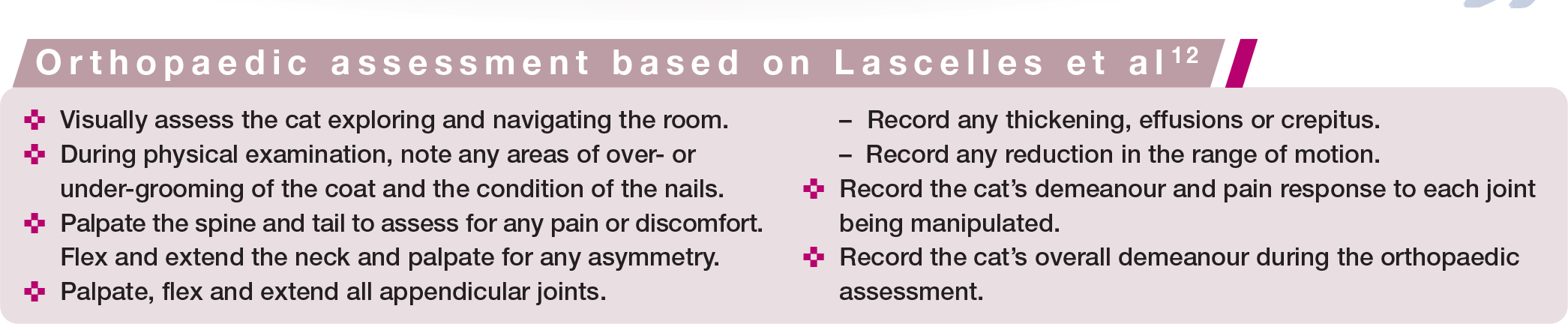
Several methods of performing an orthopaedic examination have been described.37,38 The authors use the system summarised in the box below, checking for asymmetry, and any cervical, lumbar and coccygeal pain, and then manipulating each of the large joints, assessing for pain, thickening and crepitus. 12 Finally, the overall demeanour of the cat during the examination should be recorded, 12 as well as the coat and nail condition of the cat as poor grooming may also indicate musculoskeletal pain (Figure 2). 33

Examples of poor grooming and nail care showing (a) thickening of the nails and (b,c) matting of hair on the lower spine
Objective measures
Quantitative, objective measures can be generated by a range of equipment such as accelerometers,23,24,49 force plates, which enable the collection of ground reaction forces, 50 and pressure-sensitive walkways, which enable the collection of gait kinematic data as well as ground reaction forces.51–54 In addition, there are specific tests for nociception – the von Frey anaesthesiometer;40,55,56 and for the central sensitisation of pain – mechanical repetitive stimuli quantitative sensory testing 55 or thermal sensitivity. 56 These tests are not easily accessible for most clinical practitioners, as generally they are being used in research and analgesic efficacy trials.43,44,47,52,55,57,58 However, some knowledge of these modalities is useful for clinicians for interpretation of studies.
Accelerometers
Actical MiniMitter (Bend) and ActiWatch Minimitter/Respironics (Bio-Lynx Scientific) are the two most common accelerometer systems that have been employed in feline medicine studies. The equipment, which is fitted to cats’ collars, has been used to measure daily activity levels, as well as response to analgesia and veterinary diets.23,24,43,44,47,57,58 Accelerometers are often used in combination with other quantitative measures and qualitative tools such as CMIs.43–45 Note that the ActiWatch Minimitter device is no longer being produced.
Pressure and force plate analysis
Force plates and pressure-sensitive walkways (Figure 3) measure the ground reaction forces created between the paw and the ground during locomotion. 59 Peak vertical force (the point that is the highest product of the mass of the body and the net vertical acceleration of the centre of mass 53 ) can detect asymmetry 52 and distinguish between healthy and osteoarthritic cats. 23 Ground reaction forces have been used to evaluate different surgical and analgesic protocols.60,61

A cat walking on a Tekscan pressure-sensitive walkway
Pressure-sensitive walkways can also collect data on spatiotemporal kinetic parameters, though these are less commonly investigated. 59 Such parameters include swing time (the amount of time each leg is off the ground), stance time (the amount of time the paw is on the ground) and stride length (the distance between two foot falls of the same limb during a gait cycle). Spatiot emporal parameters, as well as ground reaction forces, have been investigated in healthy cats51,54,62,63 and cats with cranial cruciate ligament disease. 52 Studies looking at longitudinal changes in gait kinematics in addition to pressure distribution associated with naturally occurring musculoskeletal disease in ageing cats are currently being undertaken at the Feline Healthy Ageing Clinic (University of Liverpool, UK).
Testing for nociception/allodynia/central stimulation
von Frey anaesthesiometers, thermal sensitivity and mechanical repetitive stimuli quantitative sensory testing have been used to demonstrate central stimulation in naturally occurring OA and to assess the response to therapeutics in cats.40,55,56,58 The von Frey anaesthesiometer uses a filament at increasing forces applied to the skin to determine what force the cat reacts to. These studies have demonstrated that cats with OA have a lower paw withdrawal threshold upon von Frey anaesthesiometry than non-osteoarthritic cats.40,55,56 It has been shown that mechanical repetitive stimuli quantitative sensory testing evokes temporal summation of pain faster in cats with OA compared with non-osteoarthritic cats. 55 Temporal summation refers to an increased perception of pain in response to a repetitive stimulus. The faster temporal summation demonstrated indicates that central sensitisation is involved in chronic pain associated with OA. 55 Gabapentin therapy in cats with OA can increase the paw withdrawal threshold determined by von Frey anaesthesiometry. 40
Imaging
To date, radiography has been the diagnostic tool of choice in most studies of feline musculoskeletal disease.10–12 CT and MRI have also been used,5,49 but radiography is the most readily available imaging modality for clinical practitioners in the diagnosis of OA/DJD, and also the most affordable for clients (Figure 4).
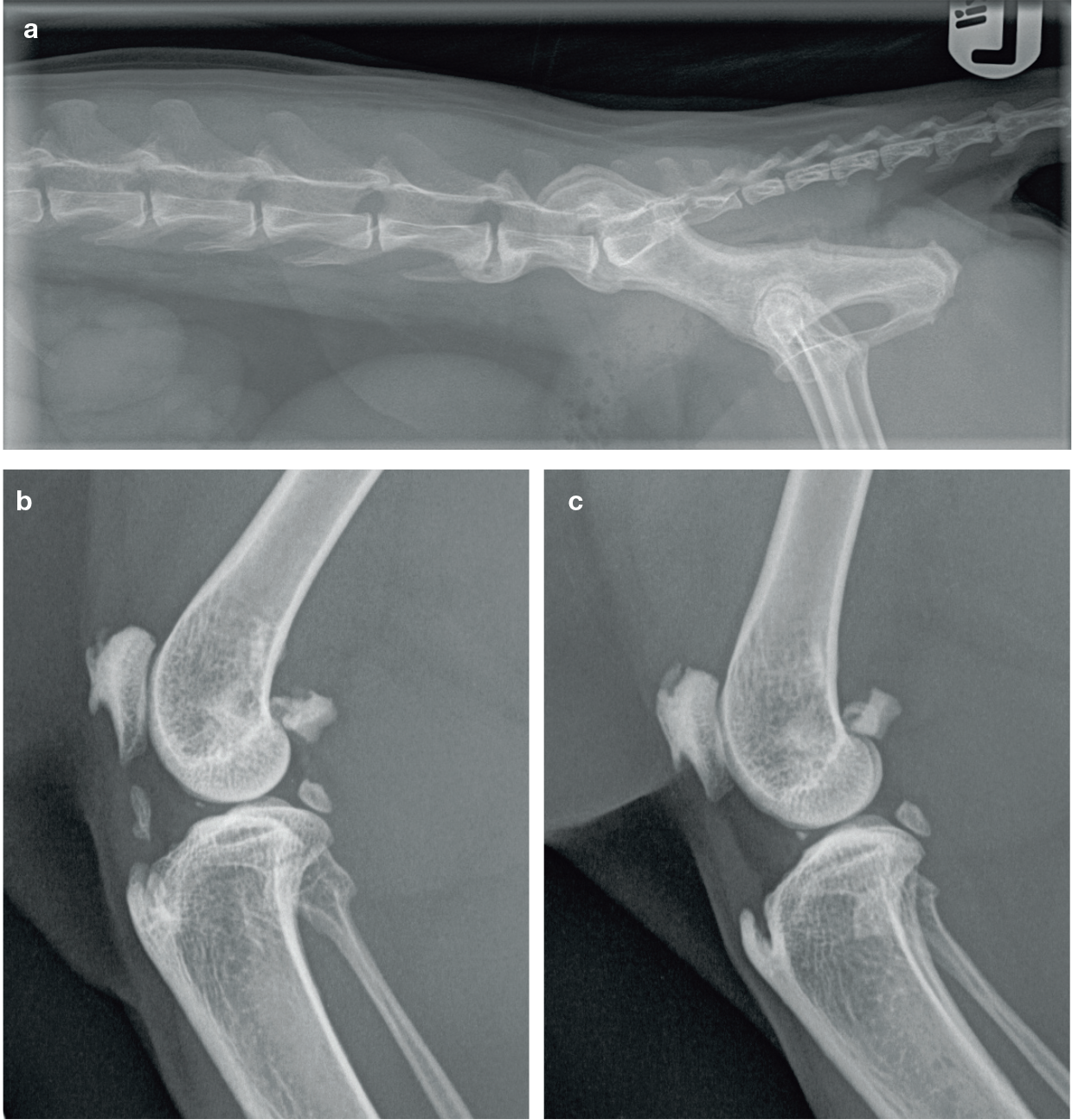
Radiographs of a mature cat with spondylosis and degenerative joint disease. (a) Lateromedial view showing spondylosis in the lower spine at L6-L7. (b,c) Lateromedial views of the (b) right and (c) left stifle joints. Intrameniscal mineralisation is present in both stifle joints of this cat. An enthesiophyte is also present in both joints where the patellar ligament attaches to the tibial tuberosity and there is new bone formation on the patella and fabella. Note the mineralisation within the synovium in the right stifle joint. L = lumbar. Images courtesy of University Veterinary Practice, The University of Liverpool, UK
Radiographic changes consistent with OA/DJD do not always equate with clinically evident musculoskeletal impairment.9,11,12 Conversely, detection of musculoskeletal impairment through physical examination/CMIs may be low, especially with early or mild disease.11,12 As discussed earlier, radiographs are also not sensitive for detecting cartilage degradation.13,14 In other words, clinically significant lesions may not create radiographic changes that are observable with current technology. CT is considered superior to radiography for examining and assessing mineralised tissue 5 and MRI may allow assessment of structural changes related to OA and a more global assessment of osteo-arthritic joints. 49 However, large studies using these advanced forms of imaging for feline OA/DJD are lacking.
Other diagnostics aids
Treatment trial
A response to analgesics or other treatments is used as a supporting diagnostic tool in cases where owner-perceived signs and/or physical examination findings are consistent with feline OA/DJD but where the diagnosis has not been definitively confirmed. 31 One study found that treatment response was used in 24% of cases of feline OA to support a diagnosis, in conjunction with owner-reported signs, orthopaedic examination findings and radiographic changes. 31
Use of CMIs or a health-related quality of life tool for OA/DJD 64 can help to standardise treatment responses observed by the owner if applied before, during and after the treatment. It has been suggested that the time point of day 15 of treatment may serve as a better baseline than a pre-treatment assessment to allow a learning period for the owner and reduce any placebo effect. 43
A review of six placebo-controlled studies looking at therapy for feline DJD showed success rates of 54–75% using a CSOM CMI 30 compared with success rates of 10–63% for objectively measured activity scores using an accelerometer. CMIs may, however, be overestimating treatment success by up to 63% in some studies. 30 So, ideally, an objective measurement, such as accelerometry data, should also be used in any trial to assess the efficacy of an analgesic treatment and reduce the potential placebo effect of CMIs. Currently objective measures are not commonly used in a clinical situation, though this may change in the future with the increased availability of fitness trackers for pets.
Biomarkers
To date, no biomarkers have been identified for diagnosing feline DJD/OA. Cytokines and chemokines have been reported,22,65 as have higher serum concentrations of interleukin (IL)-4 and IL-8 in cats with higher radiograph-ic DJD scores, and higher serum concentrations of IL-2, IL-8 and TNF-a in cats with higher pain scores associated with DJD. 65 IL-8, however, has also been found to increase with age and a lack of age matches in the study in question makes it difficult to determine if the increase in IL-8 is more strongly associated with pain/DJD or age. 22
Treatment of feline musculoskeletal impairment and disease
A large number of different treatments are prescribed for feline chronic musculoskeletal disease, often with little evidence to back up their effectiveness. 66 A multimodal approach involving therapeutics, environmental management and other complementary therapies has been described to manage feline chronic pain, 67 and is the focus of the following discussion.
The effect of obesity on musculoskeletal disease is discussed later in the prevention section; suffice to say at this point that controlled weight loss should be part of the treatment programme for obese cats with established musculoskeletal disease. 67
Therapeutics
A recent survey of predominantly North American veterinarians recorded the top five therapeutics prescribed for chronic muscu-loskeletal pain as being gabapentin (75%), joint supplement (67.8%), meloxicam (64%), opioids (62.6%) and fish oil (62.1%). 66 Therapeutics can be divided into analgesics and disease-modifying osteoarthritis (DMOA) drugs. Note that therapeutic licensing laws vary around the world.
Analgesics
Analgesics are often the mainstay of therapy for feline musculoskeletal disease, which is the principal cause of chronic pain in cats. 67
Grapiprant is a new class of NSAID, which has recently been licensed for dogs with OA (Galliprant; Elanco). It is a prostaglandin E receptor 4 (EP4) antagonist and works by blocking prostaglandin E2 (PGE2) receptors. Safety and toxicity of this drug has been investigated in cats, and administration at doses of up to 15 mg/kg q24h for 28 days was shown to have no adverse effects. 76 There was a large variation in serum half-life in this study (2–15 h), so further work on formulation and dosing frequency is required in cats. In addition, grapiprant’s pharmacokinetics have been investigated in a small group of healthy adult cats, using a dose rate of 2 mg/kg, and no adverse effects were reported. 77 Further work to establish the effectiveness of grapiprant for feline OA is required before treatment recommendations can be made.
A neutralising antibody against feline NGF has been created for the treatment of pain in cats. 85 A placebo-controlled, blinded, clinical pilot study has been performed using felinised anti-NGF (NV-02) in 34 cats. 45 NV-02 had analgesic effects in cats with DJD-associated pain and a single injection of NV-02 resulted in an increase in objectively measured activity for 2–6 weeks after treatment, as well as an improvement in CSOM CMI assessment. 45 Further studies are required into feline anti-NGF but its use looks promising, and work is ongoing in this area.
Further studies investigating feline anti-nerve growth factor for the treatment of pain are required, but its use looks promising
DMOA therapies
DMOA therapies inhibit structural disease progression and may improve the clinical signs of disease. Currently there are no licensed DMOA drugs for cats but there are nutraceuticals that may fall into this category. Some early work using gene therapy to reduce IL-1 expression has been performed in OA models with promising results, 86 though it may take some time before these types of therapy become available for companion animals.
A systematic review of studies using chron-droprotective treatments for human knee OA found that Glucosamine–chondroitin may serve as a cartilage protector and slow the progression of OA. 88 Veterinary Glucosamine–chondroitin products are available, as are diets that contain Glucosamine–chondroitin and are high in eicosapentaenoic acid (EPA)/docosahexaenoic acid (DHA), and these are marketed as helping to maintain cartilage health. To date, the evidence is not conclusive as to their benefits.
The use of PSGAGs has been investigated in cats with idiopathic lower urinary tract disease, 89 but there are no studies investigating their use for feline musculoskeletal pain. There is some indication that PSGAGs may have disease-modifying effects in carti-lage, 67 but currently there is no clear evidence for this in cats. There is better evidence for their benefit in dogs, showing the reduction of cartilage destruction in synovial joints with OA. 90
Omega-3 fatty acid supplementation There are two studies reporting omega-3 supplementation in cats with DJD/OA.47,91 The first used a diet high in EPA and DHA, as well as green-lipped mussel extract and glucosamine chondroitin, in a randomised, controlled, blinded, parallel group, prospective design. 47 The study was completed by 40 cats, all with DJD/OA, 20 in each group. A significant increase in activity levels assessed by accelerometer in the group on the therapeutic diet compared with the control group was determined after regression analysis to account for weight loss. 47
The second study reported the sole use of omega-3 fatty acid supplementation. 91 This was a randomised, double-blinded, placebo-controlled, crossover design, with 16 cats with OA/DJD completing the study. Significant differences were shown between the omega-3 and the placebo in the reported CMI. 91 The CMI used in this study was based on questionnaires created for two previous studies;11,29 however, as mentioned earlier, caregiver placebo effect may inflate the outcome when a CMI is the sole outcome measure.
Both studies are small but suggest some benefit for the use of omega-3 fatty acid supplementation in cats with DJD/OA. In vivo cellular models of arthritis have shown that EPA can reduce inflammation.92,93 A canine chondrocyte OA model showed a negligible effect with DHA, but EPA and arachidonic acid decreased inflammatory markers. 93 There is, at this time, greater evidence for the benefit of EPA supplementation compared with glucosamine-chon-droitin products in companion animals.87,94,95
Complementary therapy
Complementary therapies can also be considered as non-pharmacological treatments to aid in the management of musculoskeletal disease and are becoming increasingly important in pain management. 67
Acupuncture
Acupuncture has become an accepted treatment modality for pain in animals; it is minimally invasive and generally well tolerated. 67 To date there are no controlled clinical trials to show the effectiveness of acupuncture for chronic pain associated with feline muscu-loskeletal disease, though there is some evidence to support the use of acupuncture in cats with musculoskeletal pain, mostly in the form of case reports/series that indicate some benefit.96,97
Hydrotherapy
Canine hydrotherapy is readily available and is used for orthopaedic conditions as well as for weight loss and fitness. 98 Feline hydro-therapy is far less common but may be beneficial in patients that will tolerate it.99,100 To date there are no formally published case reports on feline hydrotherapy.
Environmental modification
While environmental modification is not medical care, it is an important part of a multimodal approach to managing chronic musculoskeletal pain in cats.67,101 Examples of environmental modifications that can be considered are presented in the box below and Figure 5.


Examples of environmental modifications: (a) steps to allow access to the window sill; (b) elevated water bowl; (c) elevated feeding bowl; (d) flat feeding mat; (e) large, high-sided litter tray with easy access; and (f) sleeping places next to a heat source for the cats of one of the authors (ND). (a) Courtesy of Jeanette Bradshaw; (b,c) courtesy of Lucie Allcut; (d,e) courtesy of Kelly Eyre
Physiotherapy
Physiotherapy can play a role in the rehabilitation of cats after injury to prevent the development of musculoskeletal disease, and in cases of established musculoskeletal disease it can help to maintain and improve the range of motion in joints and improve muscle strength and tone 100 Techniques appropriate in cats with musculoskeletal disease include joint mobilisations and manipulations, and soft tissue techniques such as massage and stretches, as well as forms of therapeutic exercise. 100 In addition, therapeutic programmes can also consider the chronic pain element of musculoskeletal disease and use heat/cold therapy and electrophysical therapies to help address this. 101 There are a number of review articles about feline physiotherapy101-102 and some case studies showing its benefit post-surgery following femoral head and neck excision.102,103
Prevention strategies
Maintenance of a healthy weight
The cause of the high prevalence of DJD/OA in ageing cats is poorly understood, which makes it difficult to offer clear preventive advice.37,104,105 It has been shown that activity levels are lower in overweight adult cats, 106 albeit the cats in this study, aged between 3.9 and 5 years, were not screened for musculoskeletal disease. While the prevalence of OA/DJD is usually considered low in young adult cats, one study has reported prevalence rates of 80% for appendicular and 16% for axial radiographic OA/DJD in cats aged 6 months to 5 years. 10 Hence, musculoskeletal disease as a confounder for the reduced activity levels in the above-mentioned study cannot be ruled out. 106
Body condition scores of over 6/9 have been shown to be associated with an increased incidence of musculoskeletal disease in an Australian cat population; 107 although the retrospective nature of this study means a causal relationship between obesity and muscu-loskeletal disease could not be established. In addition to the mechanical load on joints associated with obesity, the metabolic effects of obesity may create a pro-inflammatory state, with elevations in C-reactive protein, IL-6 and TNF-a reported in obese humans. 108 As the prevalence of obesity peaks in middle-aged cats, 109 maintaining a healthy weight and preventing obesity is important in cats of all ages for health and longevity.107,110
Prevention of muscle loss
Muscle wastage is not uncommon in older cats and sarcopenia, as discussed earlier, is recognised as the loss of lean body mass in the absence of another disease process. 16 Sarcopenia in people increases their risk of physical disability, poor quality of life and death. 19 Loss of muscle strength is likely to play a role in functional impairment of the feline musculoskeletal system. Preventing muscle loss needs to include early diagnosis and treatment of any underlying disease process that may lead to reduced food intake or absorption. 16 Some environmental modifications may help to improve food intake (see box on page 1078 and Figure 5). In addition, dietary intervention has been shown to extend longevity and preserve lean body mass. 111 Obesity is common in older cats, and many senior diets are formulated to reflect this; so, for some cats, changing to a senior formulation diet that is more calorie dense is appropriate to help preserve muscle mass. 16 An exercise programme may also be beneficial in maintaining muscle strength and tone. Developing an enriched environment for the cat is important in its own right, in addition to facilitating appropriate play and interaction between the cat and the owner. 101
Slowing of disease progression
The prevention or slowing of the development of OA is focused on the reduction of inflammation within the joint and preserving cartilage integrity.88,112 As discussed earlier in the section on DMOA therapies, there is some evidence that some therapeutics may aid with slowing disease progression.
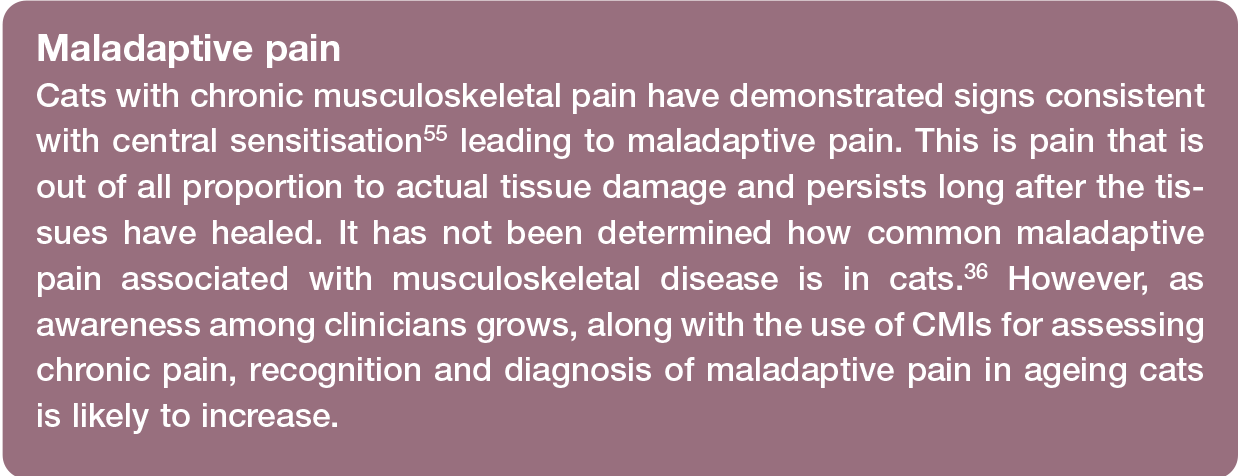
Avoidance of chronic maladaptive pain
Finally, preventing central stimulation/maladaptive pain is an important consideration, given that chronic pain in cats with DJD/OA can lead to maladaptive pain.40,55,56 Early identification and appropriate treatment are likely to be key in preventing chronic maladaptive pain; however, the difficulty in diagnosing early musculoskeletal pain in cats makes this a challenge. An increased awareness of musculoskeletal pain by both the owner and the veterinary team, alongside a consistent annual veterinary assessment including a CMI and an orthopaedic examination, may improve the clinician’s ability to detect early changes in musculoskeletal health.
Key Points
There is a large deficit in our knowledge as to what healthy ageing of the feline musculoskeletal system is and how it can be identified and managed.
Currently, age-related musculoskeletal disease in cats is predominantly diagnosed by recognition of pain and loss of mobility, which is subjective and unreliable. 31
Early recognition of ageing in the musculoskeletal system and appropriate intervention will improve the cat’s quality of life and welfare in their advancing years. As part of this, it is important to:
– Remember that all cats are individuals and will age differently. – Develop a consistent approach for assessing the musculoskeletal health of feline patients through regular clinical assessment. – Raise awareness of musculoskeletal impairment among cat owners. – Consider using a regular CMI or questionnaire with cat owners to help diagnose musculoskeletal impairment. – Aim to identify and treat musculoskeletal pain early in the disease process to prevent/reduce central stimulation. – Use a multimodal approach to treating musculoskeletal impairment, including appropriate analgesia, nutraceuticals, exercise, environmental modification and additional complementary therapies in appropriate cases. – Try to preserve lean body mass and prevent obesity in cats of all ages. – Encourage activity in cats of all ages. – Encourage appropriate weight loss in cats that are obese.
Footnotes
Author note
At the time of writing, Nathalie Dowgray was based at the University of Liverpool, UK, while studying for a PhD, where she also remains as a research assistant/post doc on a part-time basis.
Conflict of interest
The authors declared no potential conflicts of interest with respect to the research, authorship, and/or publication of this article.
Funding
Nathalie Dowgray’s PhD and work with the Feline Healthy Ageing Clinic is funded by Royal Canin.
Ethical approval
This work did not involve the use of animals and therefore ethical approval was not necessarily required.
Informed consent
This work did not involve the use of animals and therefore informed consent was not required. For any animals or humans individually identifiable within this publication, informed consent (either verbal or written) for their use in the publication was obtained from the people involved.