




Abstract

ISFM Congress poster session
A total of seven clinical/ research abstracts were accepted for presentation online during the ‘virtual’ 2020 ISFM International Feline Congress, 8–10 August.

Activity Monitoring and Quality Of Life Assessment of Cats with Degenerative Joint Disease
Evangelia Maniaki1, Jo Murrell1, Sorrel J Langley-Hobbs1, Axel Montout2, Emily J Blackwell1
1Bristol Veterinary School, University of Bristol, UK
2Population Health Sciences, University of Bristol, UK
Email:
A blinded, nested case-control study was designed to: (a) compare the activity profiles of cats with early signs of degenerative joint disease (DJD) and disease-free cats; and (b) evaluate changes in their quality of life (QoL). Physical dysfunction stemming from chronic pain associated with DJD was assessed by means of orthopaedic examination, accelerometry and subjective evaluations of impaired mobility and QoL using owner-completed questionnaires (Feline Musculoskeletal Pain Index [FMPI]; VetMetrica).
There was no significant difference between groups for age, breed, sex, temperament and body condition score. The scores of case cats were significantly lower than those of control cats for the FMPI (P = 0.003), as well as for the VetMetrica QoL domains of vitality, comfort and emotional wellbeing (P = 0.009, P = 0.002 and P = 0.018, respectively). In addition, total pain (P <0.0001), crepitus (P = 0.002) and thickening (P = 0.003) scores were higher in case cats, as was the presence of bilateral disease (P = 0.005) and the number of bilaterally affected joints (P = 0.001). Moreover, accelerometry was successful in differentiating cases from controls, with a 90.9% overall accuracy and a precision of 91% and 90% for controls and cases, respectively.
In conclusion, both FMPI and orthopaedic examination were able to differentiate cats with early signs of DJD from healthy cats and can thus be used for the timely diagnosis of DJD. The importance of diagnosing DJD as early as possible is further supported by the results of the VetMetrica questionnaire, which indicated that cats with early DJD have an impaired QoL compared with healthy cats. Finally, accelerometry provided a good reflection of owner-reported mobility changes and may be a useful tool in the future diagnosis of DJD.

Comparison of Cat Stress Score (CSS) Under Standard and Cat Friendly Conditions in Healthy Hospitalized Cats
María P Iturriaga1, María J Ubilla2, Mariela L Goich2, Carol S Chávez1, Ana A Alfaro1, José M Fuenzalida2, Valeria D Cabello1, María C Silva1
1Escuela de Medicina Veterinaria, Facultad de Medicina Veterinaria y Agronomía, Universidad de Las Américas, Santiago, Chile
2Escuela de Medicina Veterinaria, Facultad de Ciencias de la Vida, Universidad Andrés Bello, Santiago, Chile
Email:
Cat friendly conditions are an important measure in veterinary hospitals to decrease stress and fear in patients. The purpose of this study was to assess behavioral stress levels in healthy hospitalized cats after elective surgery. The study was approved by the ethics committee of the Universidad de Las Américas.
Twenty one cats (5–18 months old) undergoing ovariohysterectomy were randomized to a cat friendly hospitalization conditions group or standard hospitalization conditions (control) group. Cat Stress Score (CSS) is a scoring system that ranges from 1 (fully relaxed) to 7 (terrorized). CSS was determined prior to surgery (T0) and during the 24 h after extubation by three observers. Each cat was allowed 1 h of acclimatization before the T0 measurement. In both groups respectful handling was performed and commercial food and litter boxes were provided during hospitalization. For the cat friendly group, a synthetic facial pheromone (Feliway spray; Ceva) was sprayed in hospital cages and on blankets, an appeasement pheromone (Feliway Friends diffuser; Ceva) was used in the hospital room, cardboard boxes were placed inside cages, wide and flat plates were provided for water and food, treats were provided during evaluations and a soft E-collar was used.
In both groups, CSS decreased with time in the majority of cats (19/21); 9/11 cats in the cat friendly environment reached a lower score at 12 h vs 6/10 in the control group. At 24 h, 10/11 cats in the cat friendly group reached score 1 (fully relaxed) vs 3/10 in the control group (P = 0.016).
Implementing cat friendly conditions in the hospital area is relatively easy and reduces stress and fear in hospitalized cats (even after surgery), which, in turn, increases the wellbeing of our patients.
Lidocaine 2.5%/Prilocaine 2.5% Cream Formulation Decreases Reaction Score during Peripheral Catheter Placement in Cats
María P Iturriaga1, Carol S Chávez1, María J Ubilla2, Mariela L Goich2, Valeria D Cabello1
1Escuela de Medicina Veterinaria, Facultad de Medicina Veterinaria y Agronomía, Universidad de Las Américas, Santiago, Chile
2Escuela de Medicina Veterinaria, Facultad de Ciencias de la Vida, Universidad Andrés Bello, Santiago, Chile
Email:
Feline surgical patients undergo several potentially stressful/painful procedures such as venipuncture. In human medicine the use of a topical anesthetic agent (EMLA cream) is effective in patients for needle insertion. In cats it has been investigated for the placement of jugular catheters and venipuncture with a butterfly infusion set. The purpose of this study was to determine the response to peripheral catheter placement in cats treated with lidocaine 2.5%/prilocaine 2.5% cream formulation.
Twenty cats undergoing ovariohysterectomy were randomized to either a lidocaine 2.5%/prilocaine 2.5% cream or placebo cream group. In each group, 1 g of cream was applied to shaved skin overlying the cephalic vein (10 cm2 surface area) using gloves. The area was covered by an occlusive dressing and after 30 mins the cream was removed with 70% isopropyl alcohol, and venipuncture was carried out using a 22 G catheter. The cat’s response during venipuncture was evaluated using a scoring system (see table). No skin signs were observed in any of the 20 cats after cream application.
The treatment group had a significantly lower score compared with the placebo group (P = 0.009; U = 16); 8/10 cats in the treatment group showed no reaction vs 2/10 in the placebo group.
The use of a lidocaine 2.5%/prilocaine 2.5% cream formulation decreased catheter placement reaction in cats, assisting in the performance of pain/fear-free procedures.
Scoring system used to assess the response to venipuncture

Heart Rate Variability and Heart Murmurs in Mature Cats during Clinical Examination
Nathalie J Dowgray1, Gina L Pinchbeck2, Eithne J Comerford1,3, Kelly J Eyre1, Y Becca Leung4, Alexander J German1,3
1Institute of Ageing and Chronic Disease, University of Liverpool, UK
2Institute of Infection and Global Health, University of Liverpool, UK
3Institute of Veterinary Science, University of Liverpool, UK
4Royal Canin Research Centre, Aimargues, France
Email:
Data were collected from enrolment examinations of cats aged between 7 and 10 years at the University of Liverpool’s Feline Healthy Ageing Clinic. The heart rate (HR) was recorded and the cat was examined for the presence of a heart murmur at three time points, 10–15 mins apart, during the enrolment examination. The auscultation procedure involved listening initially on the cat’s sternum before moving to listen to both the left and right sides of the heart. Results from all three time points were available for 169 cats.
The overall prevalence of heart murmurs detected on at least one of the three occasions was 30% (50/169). The proportion of cats with murmurs was 64% (32/50) at HR1, 54% (27/50) at HR2 and 60% (30/50) at HR3. The detection of a murmur varied within the individual cat; 28% (14/50) of the cats had murmurs present on 3/3 occasions, 26% (13/50) on 2/3 occasions and 46% (23/50) on 1/3 occasions. The majority (82% [50/61]) of murmurs auscultated were grade I–II/VI. Murmurs grade III or greater were present in 18% (9/50) of the affected cats; 66% (6/9) of these cats had murmurs present on all three occasions.
HR was normally distributed and there were no differences in HR between the cats with and without a heart murmur at each time point (two-sample t-test, HR1 P = 0.65, HR2 P = 0.24, HR3 P = 0.53). HR was not associated with the grade of murmur (repeated measures ANOVA, P = 0.53).
In cats with a heart murmur, there was a significant difference in HR across different time points (P = 0.02). Following post-hoc testing, the HR at HR3 was significantly lower than at HR1 (P = 0.03). In ‘healthy cats’, there was also a significant difference in HR across the different time points (P <0.001). Following post-hoc testing, the HRs at HR2 and HR3 were significantly lower than at HR1 (P <0.001, P = 0.01, respectively).
HR coefficient of variation (CoV) and variation around the mean (Var) were calculated for each cat, and were not normally distributed. CoV (P = 0.02) and Var (P = 0.02) were significantly lower in cats with a heart murmur (Wilcoxon rank sum test).
There was marked variability in feline HR and the detection of heart murmurs at different points during the appointment. Reduced variation in HR is associated with cardiac disease in other species but, given that echocardiography was not performed, the significance of the group differences identified here requires further study.
Is There a Stress Component to Chronic Gastrointestinal Disease in Cats? A Look at the Environmental and Behavioural Risk Factors
Anna B Garvey¹, Aarti A Kathrani², Ed J Hall¹, Jess L Williams¹, Emily J Blackwell¹
¹Department of Veterinary Medicine, University of Bristol, UK
²Royal Veterinary College, London, UK
Email:
Using data from owner questionnaires completed as part of the Bristol Cats Study (a longitudinal prospective cohort study of 2444 cats), risk factors for chronic gastrointestinal signs were analysed using multivariable logistic regression. A subset of 40 cats (20 cases and 20 unaffected controls) were visited at home. Behavioural tests were conducted to examine individual differences in response to novelty.
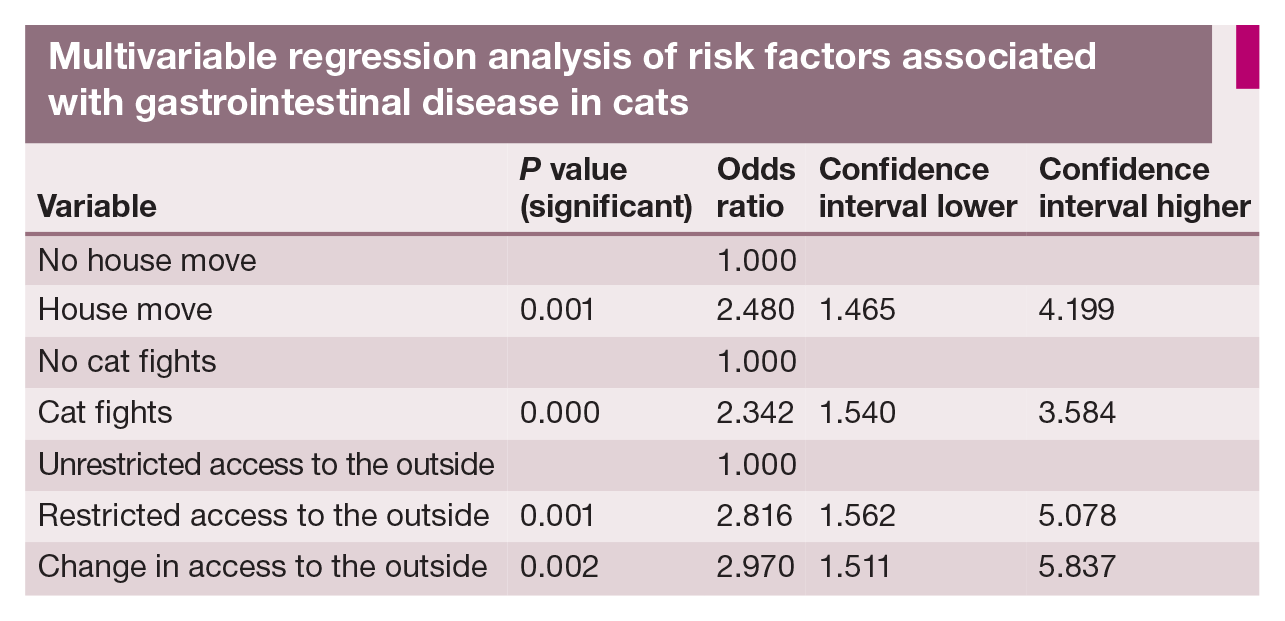
The prevalence of chronic gastrointestinal signs in the population of cats at 2.5 years old was shown to be 6.82%, calculated from owner-reported incidents of vomiting and diarrhoea regardless of whether they involved a vet visit. Multivariable logistic regression identified that restricted outdoor access (the cat not having 24 h control of when it entered or exited the house, regardless of how much time it spent outside), a change in access to the outdoors, moving house and cat fights were all associated with an increased odds ratio of having recurrent gastrointestinal signs (see table).
The risk factors for feline chronic gastrointestinal signs are poorly understood, particularly as to whether an affective or stress component is involved. These findings demonstrate that daily environmental stressors may have an effect and therefore support the idea that stress should be considered when presented with cats suffering chronic gastrointestinal signs.
Multivariable regression analysis of risk factors associated with gastrointestinal disease in cats
Description and Spread Evalution of a Quadratus Lumborum Block Technique in Cat Cadavers
José D dos-Santos1,2,3, Mário M Ginja1, Sofia R Alves-Pimenta1, Pablo E Otero4, Lénio M Ribeiro2, Bruno A Colaço1
1School of Agrarian and Veterinary Sciences, Centre for the Research and Technology of Agro-Environmental and Biological Sciences, University of Trás-os-Montes and Alto Douro, Portugal
2Department of Veterinary Science, University Lusófona, Portugal
3VetOeiras, Portugal
4Facultad de Ciencias Veterinárias, Universidad de Buenos Aires, Argentina
Email:
Epidural anesthesia provides abdominal analgesia, but it is not without risk in cats. The aims of this study were to assess the feasibility of the quadratus lumborum block technique in cat cadavers and to evaluate the anesthetic distribution following ultrasound-guided injections in the fascia between the musculus quadratus lumborum (QL) and musculus psoas minor (Pm) in an attempt to block visceral and somatic innervation.
The QL, Pm and abdominal wall muscles were identified using a linear ultrasound probe (L14-6NE, Mindray, 6–14 MHz) positioned parallel at the L2 transverse processes level. A 22 G 2” spinal needle was introduced in plane and at 10–25º to the skin, through a ventrodorsal approach, until the tip of the needle was positioned in QL–Pm fascia. The administration of 0.4 ml/kg of ropivacaine, tissue dye and iohexol solution (3/5:1/5:1/5 proportions, respectively) was performed in eight cat cadavers. Anesthetic distribution was assessed via CT scans and dissection.
Consistent dyeing of the splanchnic major nerves (87.5%), splanchnic minor nerves and celiac ganglion pathways (100%) was observed. The sympathetic trunk was consistently dyed between T13 and L3 (88%) (Figure 1). Seventy-five percent of the ventral spinal nerves L1–L3 were dyed (Figure 1). The agreement between dissection and the CT scan methods was substantial (k = 0.72).

Characteristics of anesthetic spread in the sympathetic trunk segment (solid arrows) and ventral spinal nerves (dashed lines)
This QL block technique demonstrates the potential to produce a visceral analgesic effect in cats. The dispersion observed in the cadavers indicates that this technique might not be enough to provide analgesia of the entire abdominal wall.
Feline Mycobacterial Diseases: New Diagnostic Approaches
Conor O’Halloran1,2, Jayne Hope1,2* and Danièlle Gunn-Moore1,2*
1Royal (Dick) School of Veterinary Studies, University of Edinburgh, Scotland, UK
2The Roslin Institute, University of Edinburgh, Scotland, UK
*Joint supervisors
Email:
Tuberculosis caused by the Mycobacterium tuberculosis-complex (MTBC) of organisms remains one of the most prevalent and deadly infectious diseases of man and other animals. Cats are susceptible to MTBC infections and understanding of the significance and frequency of these infections has grown in recent years. Cats (and dogs) share unrivalled proximity to their owners and therefore pose a risk for the zoonotic transmission of tuberculous infections. Despite the frequency of mycobacterial infections observed in cats, diagnostic tests to identify the commonly encountered mycobacterial species are limited.
The first aim of this work was to improve the currently available diagnostic test methodologies for detecting mycobacterial infections in companion animals. A diagnostic PCR assay was developed and applied to over 380 samples from cats that were previously confirmed as mycobacteria infected by histopathology. This novel assay specifically targeted the mycobacterial species most frequently identified by mycobacterial culture (Mycobacterium bovis and Mycobacterium microti) and was optimised for use with formalin-fixed tissue, necessary for the safe handling of tuberculous tissue by UK laboratories. The novel assay has the potential to provide a quicker turnaround time with a greater proportion of diagnostic test results. Notably, the test showed a significant increase in the proportion of M microti diagnoses compared with previously reported culture results.
Cytokine profiling is an emerging diagnostic technique for tuberculosis in human patients, and this project explored its potential use in cats for diagnosing mycobacteriosis. This study used 116 serum/plasma samples from naturally infected cats and demonstrated a consistent elevation in the concentration of cytokines associated with macrophage activation and continued antigenic stimulation in comparison with control cats. Discriminating between infections caused by different organisms of the MTBC has always been challenging. Further subgroup analysis in this study found that elevation in platelet-derived growth factor BB was specifically associated with M microti infections, while elevated tumour necrosis factor alpha identified M bovis infections more consistently than currently available commercial diagnostic tests.
Both established and newly developed techniques were used in this project to investigate an unprecedented outbreak of M bovis tuberculosis in UK cats associated with consumption of a commercial raw food venison product. Overall, 45 clinical cases were diagnosed and at-risk cats were screened by interferon gamma release assay (IGRA), which identified 77 subclinically infected cats, the first time that the feline IGRA has been used in this way. Nearly a third of IGRA test-positive cats were subsequently found to have structural disease detected by diagnostic imaging. Though this raises questions regarding the specificity of the IGRA in clinically normal cats, it was an invaluable diagnostic tool to evaluate individual cats involved in the outbreak.
The infection was confirmed by culture as being caused by genotype 10:a and cases were distributed across England and Scotland, within areas of the UK considered to be both at low and high risk for endemic M bovis.
This project has so far contributed three peer- reviewed papers to the literature regarding feline mycobacterial infections, with two more currently under review.
Conor O’Halloran received the 2020 ABCD–Boehringer Ingelheim Young Scientist Award for this research.