



Abstract

AAFP Conference abstracts A total of 13 clinical/research abstracts were accepted for either oral presentation or inclusion in a poster session held during the 2019 AAFP Conference in San Francisco, CA, USA, 31 October to 3 November.


Pilot Study to See if a Pet Health Technology Ecosystem (PHTE) Can Help in a Weight Management Program in Multiple-Cat Households
1West Towne Veterinary Center, Madison, WI, USA
2Ontario Veterinary College, Guelph, Ontario, Canada
Email:
Four out of nine client surveys and 8/9 veterinary surveys were returned. Diaries from 7/9 owners were received. Average weight loss was 0.84% per week over a 4-week period for 14 cats. The dropout rate was 22%.
A PHTE was found to be effective for gathering weight management data remotely and this short, small, uncontrolled pilot study resulted in weight loss rates about the same as previously reported without a strict feeding protocol. A randomized controlled observational study for further investigation was conducted in 2019.
Quantification and Evaluation of Cortisol in Feline Fur and Claws: A Novel, Non-Invasive Measurement of Chronic Stress in Cats
Department of Clinical Sciences, Center for Companion Animal Studies, Colorado State University, Fort Collins, Colorado, USA
Email:
Fifty adult owned or community cats were included in this study. Patches of fur (2 x 2 cm) were clipped from various body areas, and front and rear nails were clipped. A commercial laboratory extracted and quantified the cortisol from the samples and validated a commercial EIA kit. Medical and behavioral questionnaires were designed, and these were completed by the owners of the owned cats. Correlation and multiple regression analyses were conducted to assess the relationship between average hair and nail cortisol concentrations and associated factors identified from the questionnaires.
The EIA was successfully validated for the quantification of cat hair and nail cortisol. Large variations in hair cortisol concentrations were detected within cats depending on the body location from which the hair was clipped, hair type and portion of hair sampled, while nail cortisol concentrations were generally consistent within each cat. Overall cortisol concentrations are listed in Table 1.
Cortisol concentrations (pg/mg)

There was a positive correlation between hair and nail cortisol concentration, r = 0.84, P <0.001. Univariate analysis for nail cortisol concentration identified the following significant associations: being front declawed (P = 0.001; 95% CI 1.1–4.0); unkempt fur (P = 0.003; 95% CI 0.6–2.9); chronic illness (P = 0.02; 95% CI 0.2–2.2); and age (P = 0.02; 95% CI 0.02–0.2). Univariate analysis for hair cortisol concentration only identified one significant association: being front declawed (P = 0.001; 95% CI 13.5–50.6).
Multivariate regression for nail cortisol concentration identified three significant associations: unkempt fur, litter box issues and being front declawed (P = 0.006), with an R2 of 0.37.
This study suggests that quantitation of nail cortisol by EIA may prove to be an accurate measure of chronic stress in cats. This noninvasive, objective tool could be used to recognize chronic stress in individual cats so that interventions could be started and monitored, ultimately improving animal welfare. In contrast, the hair cortisol variation in cats renders use of this medium inaccurate.
This work was funded by the Winn Feline Foundation/Miller Trust as the 2017 New Feline Investigator Award in memory of Fred Jacobberger.
Open-Label Pilot Efficacy Study of Recombinant Feline Erythropoietin in Client-Owned Cats With Non-Regenerative Anemia
Kindred Biosciences, Burlingame, CA, USA
Email:
On day 0, rfEPO was initiated at 3 μg/kg SC. Subsequent doses at weeks 1–5 were tailored to each cat. HCT assessments were performed on-site at all scheduled and unscheduled study visits. Doses were administered no more frequently than weekly. A cat was considered a treatment success if the HCT returned to within the laboratory normal reference interval by week 6 or the HCT had improved by 30% compared with baseline. Owners completed a validated, generic, feline health-related quality of life (HRQL) assessment online on day 0, and weeks 1, 2, 3, 4, 5 and 6.
In this study, rfEPO rapidly increased mean HCT, with a statistically significant improvement seen as early as week 1 (P <0.0001). The effect was sustained at weeks 2, 3, 4, 5 and 6 (P <0.0001 at each visit). Compared with baseline, the mean peak relative improvement in HCT was 55.4%. In addition, 95.5% of the 22 evaluable patients achieved treatment success over the 6-week treatment period. Furthermore, cats treated with rfEPO demonstrated statistically significant improvements over baseline (P <0.01 to P <0.05) across all three HRQL domains: vitality, comfort and emotional wellbeing, as measured by a validated QoL instrument.
The administration of rfEPO was generally well tolerated. Based on preliminary review, adverse events were mild, and most were consistent with underlying CKD. No cat required early discontinuation of rfEPO owing to an adverse event associated with treatment. Two cats were humanely euthanized due to rapidly progressive CKD or osteoarthritis.
In this study, treatment success was achieved in 95.5% of the 22 evaluable client-owned cats with non-regenerative anemia secondary to IRIS stage 3 CKD administered rfEPO. Based on a preliminary review of the safety data, rfEPO appears to be generally well tolerated.
This study was sponsored by Kindred Biosciences.
Attitudes of French Feline Veterinarians and Breeders Towards Prepubertal Neutering
1La Clé des Chats, Saint André-Lez-Lille 59350, France
2Université de Lyon, VetAgro Sup, Marcy l’Etoile 69280, France
Email:
Questionnaires were returned by 999 breeders, 609 small animal veterinarians and 10 feline practitioners (Figures 1 and 2).

Percentage of feline practitioners, small animal veterinarians and breeders who perform or require neutering before 4 months of age

Percentage of feline practitioners and small animal veterinarians who perform neutering before 4 months of age at the request of breeders, owners and/or shelters (more than one answer possible)
Of the vets that performed prepubertal neutering consistently or occasionally (235/609), 11% of small animal veterinarians performed surgical gonadectomy on kittens at 2 months, 52% at 3 months and 37% at 4 months of age. Of those not neutering by 4 months, 80% did so by 6 months of age.
The main advantages given by breeders for early spay/castration were: peace of mind for them and expected peace of mind for the future owner, better recovery for the kitten, control of reproduction and prevention of backyard breeding.
Feline practitioners expressed that early gonadectomy was easy to do, offered faster recovery for the kitten, reduced urine odour in the hospital associated with sexually mature tom cats and reduced stress for everyone.
The main advantages given by small animal veterinarians neutering before or at 4 months were: faster and easier surgery (no fat, no unplanned discoveries during surgery), faster recovery and less pain for the kitten, no unwanted litters and reduced relinquishment.
Very few disadvantages were expressed by breeders other than needing to bear the cost of surgery. Very few veterinarians expressed disadvantages other than needing to be more careful about anesthetic protocols.
Prepubertal neutering is commonly requested by breeders in France; this has driven veterinarians to adopt new practices. Despite the strong evidence that prepubertal neutering is safe, an illogical fear and a reluctance to change remains among many veterinarians. Advantages noted by breeders and veterinarians include lower stress, better recovery and protection against backyard breeding, all resulting in better short- and long-term wellbeing of cats.
Hematological and Bone Marrow Evaluation of Feline Leukemia Virus-Infected Cats With Leukemia and Myelodysplastic Syndromes
1Department of Animal Medicine, College of Veterinary Medicine, Federal University of Rio Grande do Sul, Porto Alegre, RS, Brazil
2Graduate Program in Veterinary Sciences, Federal University of Rio Grande do Sul, Porto Alegre, RS, Brazil
3Department of Clinical Pathology, College of Veterinary Medicine, Federal University of Rio Grande do Sul, Porto Alegre, RS, Brazil
Email:
The mean age of the patients was 3.25 years (ranging from 6 months to 6 years), including one intact male, one intact female, one neutered male and three spayed female mixed-breed cats. The patients lived from 3 to 61 days (mean of 22 days), and treatment included blood transfusion in one cat (cat 3). The diagnoses based on the bone marrow examination were: MDS with erythroid predominance (MDS-Er; cats 2 and 4), acute lymphoblastic leukemia (ALL; cats 1, 5 and 6) and erythroleukemia subtype of acute myeloid leukemia (AML-M6; cat 3). Hematologic alterations are described in Table 1 and bone marrow findings in Table 2.
Complete blood count results with myelodysplastic syndrome and leukemia in six cats

Bone marrow findings in six cats with myelodysplastic syndrome and leukemia

D = decreased; N = normal; E = erythroid cells; G = granulocytic cells; M = megakaryocytic cells; ND = not determined; + = yes; – = no
66% of rubriblasts, myeloblasts and monoblasts
The proposed mechanism of hematological changes is related to the insertional mutagenesis caused by the virus, which triggers a neoplastic transformation of the hematopoietic cells leading to a poor prognosis for the infected cats. As a consequence, myeloproliferative disorders are characterized by hematopoietic tissue substitution and, hence, bone marrow suppression, resulting in peripheral cytopenias and dysplastic alterations in different cell lines.
Profile of Cats With Mammary Tumors and Their Comorbidities Diagnosed in a Prospective Study at a Veterinary Teaching Hospital in Southern Brazil Between January 2017 and December 2018
1Graduate Program in Veterinary Sciences, Federal University of Rio Grande do Sul, Porto Alegre, RS, Brazil
2Laboratory of Histopathology, State Foundation of Agricultural Research, Institute of Veterinary Research, El Dourado do Sul, RS, Brazil
3Veterinary Teaching Hospital of Rio Grande do Sul Federal University, Porto Alegre, RS, Brazil
4Department of Animal Medicine, School of Veterinary Medicine, Federal University of Rio Grande do Sul, Porto Alegre, RS, Brazil
Email:
This prospective study included 34 female cats with mammary tumors treated at the VTH for 2 years. Data collected from the patients included: epidemiological information, tumor staging, treatment, histological type, patients’ comorbidities and frequency of prophylactic care. Descriptive statistics used Microsoft Excel. The mean age of the cats was 10.9 (range 3–17 years). Most cats (n = 29, 85%) were of mixed breed, and other breeds included Siamese (n = 4, 12%), and Himalayan (n = 1, 3%). Only 24 (71%) were neutered before the age of 2 years (range 0.5–8) and, of these, only six (18%) were neutered before 1 year. Fifteen (44%) had a history of exogenous progesterone administration to prevent pregnancy.
When classified according to clinical staging, 10 (29%) cats were in stage 1; seven (21%) in stage 2; 10 (29%) in stage 3; and seven (21%) in stage 4. The treatments performed were: unilateral mastectomy (n = 11, 32.35%), bilateral mastectomy (n = 4, 11.76%), unilateral mastectomy and chemotherapy (n = 4, 11.76%), palliative treatment and delayed euthanasia (n = 4, 11.76%), excisional biopsy (n = 3, 8.82%), euthanasia at the time of diagnosis (n = 3, 8.82%), chemotherapy and euthanasia (n = 2, 5.88%), excisional biopsy and delayed unilateral mastectomy (n = 1, 2.94%) and mastectomy with splenectomy (n = 1, 2.94%). The 34th patient died before starting treatment.
The histological types of tumors with the highest occurrence were cribriform (n = 11, 32%), tubulopapillary (n = 9, 27%) and tubular (n = 2, 6%). Twelve cats (35%) presented tumors with histological grade 3, while six (18%) presented with grade 2 and another six (18%) with grade 1. Twenty-two cats (65%) had International Renal Interest Society (IRIS) chronic kidney disease (CKD) stage 1, three cats (9%) had stage 2 and three (9%) had stage 3 CKD.
Other comorbidities found in the patients were: inflammatory cystitis (n = 6, 17%), orthopedic disease (n = 6, 17%), triaditis (n = 4, 12%), pancreatitis (n = 3, 9%), inflammatory bowel disease (n = 2, 6%), cholangiohepatitis (n = 2, 6%), hepatitis (n = 1, 3%), hypertrophic cardiomyopathy (n = 1, 3%) and extrahepatic biliary adenocarcinoma (n = 1, 3%).
Only four (12%) cats went to the veterinarian periodically, and only two owners palpated the cats’ mammary glands periodically. One (3%) cat was vaccinated annually, 20 (59%) had access to the street, two (6%) received flea medication and 34 (100%) were dewormed 2–3 times a year.
CKD and other diseases are common in cats aged over 7 years, so periodic visits to the veterinarian are important for them. In addition, cats should be spayed at an early age. One possible explanation for the data obtained in this study is that the research was performed at a VTH in Brazil, where most cats have owners with a low income. Thus, it is concluded that a culture of disease prevention should be created for the feline population of southern Brazil, especially with respect to early spaying and castration, and disease prevention in geriatric patients.
This study was funded by Coordenacao de Aperfeicoamento de Pessoal de Nivel Superior, Education Ministry (CAPES-MEC).
Treatment of Feline Generalized Demodicosis With Oral Afoxolaner
1Faculdade de Veterinária, Universidade Federal Fluminense, Niterói, RJ, Brazil
2Clinicat Veterinary Clinic, Niterói, RJ, Brazil
3Werner&Werner, Laboratory of Veterinary Pathology, Curitiba, PR, Brazil
4Niterói Veterinary Hospital, Laboratory of Clinical Pathology, Niteroi, RJ, Brazil
Email:
A 2-year-old neutered male mixed-breed shelter cat presented with chronic pruritus, self-induced ulcerative dermatitis around the cervical region (6 cm width; Figure 1), and erythema with alopecia of the flanks and limbs. The cat was taken into foster care to minimize environmental stress. Dinotefuran/pyriproxyfen was administered topically to rule out flea infestation. General physical examination (thoracic auscultation and abdominal palpation) was otherwise normal. Skin cytology showed intense inflammation and bacterial infection. No mites were present in skin scrapes/acetate tape imprints. D gatoi was identified only by fecal examination (mean body length 102 μm). Skin biopsy was taken 2 months prior to treatment and showed chronic active dermatitis; the second skin biopsy was taken 1 month after the first administration of afoxolaner and histopathology was normal. Ancillary tests are shown in Table 1.

Patient before (a) and after (b) treatment with oral afoxolaner
Ancilliary tests before and after treatment with oral afoxolaner
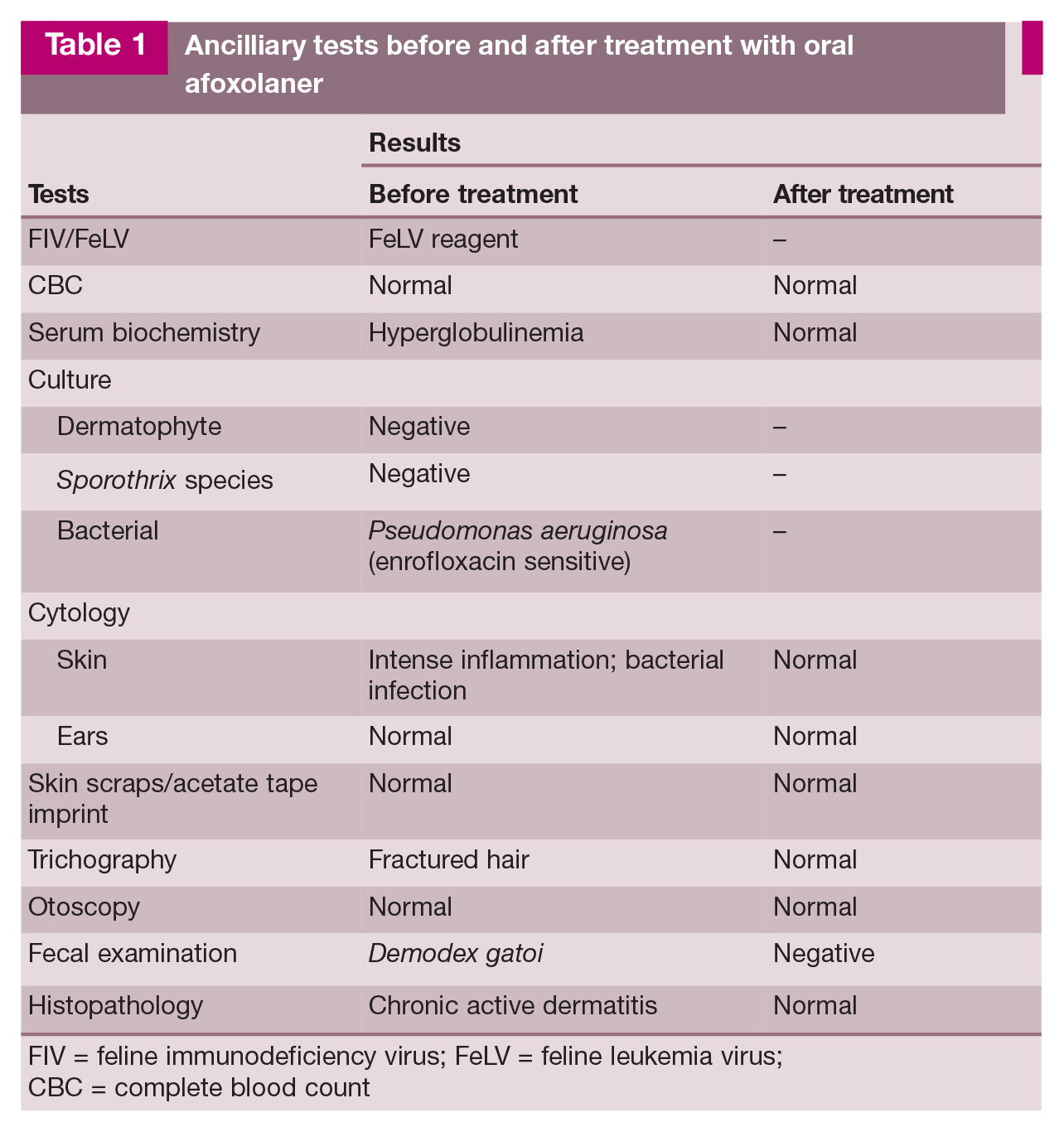
FIV = feline immunodeficiency virus; FeLV = feline leukemia virus; CBC = complete blood count
The ulcerative lesion was treated with enrofloxacin 5 mg/kg PO q24h for 30 days, according to antibiogram results. Clemastine 0.68 mg/cat PO q12h was used for 7 days. However, intense pruritus remained, so an anti-inflammatory dose of prednisolone 0.5 mg/kg PO q24h was administered until pruritus diminished (10 days). Miticidal treatment was initiated 3 months after the cat was moved to foster care in order to observe the effects of the environment on the course of infestation. Afoxolaner was administered in three doses, 2.5 mg/kg PO every 28 days. As the isoxazoline class of chemical compounds is considered safe for mammals, afoxolaner was chosen.
To the authors’ knowledge, this is the first report of the use of afoxolaner to treat feline demodicosis, although fluralaner has already been used successfully. No side effects were observed during or after treatment. The complete blood count/biochemistry panel remained normal. Fecal samples were analyzed weekly for 20 weeks (Table 2). One week after the first administration of afoxolaner, fecal examinations were negative for Demodex mites. Fecal examinations should be included in cases of pruritus to rule out demodicosis. Oral afoxolaner was safe for treating generalized demodicosis in this patient.
Fecal examination timeline

Antibodies Against Feline Panleukopenia Virus, Herpesvirus and Calicivirus in Retrovirus-Seropositive Cats Compared With Retrovirus-Seronegative Cats
Department of Veterinary Medicine (DIMEVET), University of Milan, Italy
Email:
Frozen archived surplus serum samples from 64 randomly selected retrovirus-seropositive cats (34 FIV+, 23 FeLV+ and 7 FIV+FeLV coinfected cats) and 64 retrovirus-seronegative cats were used in this study. Samples were originally tested for clinical reasons for antibody to FIV target antigens p24 and gp40 and for FeLV p27 antigen using a commercial rapid ELISA kit (SNAP Combo Plus FeLV Ag/FIV Ab). A feline-specific point-of-care ELISA (ImmunoComb, Feline VacciCheck) previously validated for the determination of protective antibody titers (PAT) against FPV, FHV-1 and FCV (1:80, 1:16 and 1:32, respectively) was used to measure antibody titers. Data on signalment (age, breed, sex), origin (owned, shelter, stray), health (healthy/unhealthy) and vaccination status (last trivalent vaccination <3 years, between 3 and 7 years, never accinated, unknown) were statistically compared between retrovirus-seropositive and retrovirus-seronegative cats.
No statistically significant differences were observed in the number of FIV+, FeLV+ and FIV+FeLV coinfected cats with PAT for FPV, FHV-1 and FCV compared with retrovirus-seronegative cats (Figure 1 and Table 1). There were significantly fewer young cats (⩽1 year old) (P = 0.0019) in the FIV+ group (0/34) in comparison with retrovirus-seronegative cats (16/64). Unhealthy cats had a higher incidence of FeLV+ (14/23, P = 0.0193) and FIV+FeLV coinfection (6/7, P = 0.0066) than retrovirus-seronegative cats (21/64). Finally, FIV+FeLV coinfected cats had received fewer (3/7 never vaccinated, P = 0.0215) and less frequent vaccinations (0/7 vaccinated in the past 3 years, P = 0.0057) than retrovirus-seronegative cats (29/64 and 5/64, respectively).

Percentage of retrovirus-seronegative, and feline immunodeficiency virus (FIV)-, feline leukemia virus (FeLV)- and FIV+FeLV-seropositive cats with protective antibody titers against feline panleukopenia virus (FPV), feline herpesvirus type 1 (FHV-1) and feline calicivirus (FCV)
Number of retrovirus-seropositive cats with protective antibody titers against field or vaccine FPV, FHV-1 and FCV compared with retrovirus-seronegative cats

FPV = feline panleukopenia virus; FHV-1 = feline herpesvirus type 1; FCV = feline calicivirus; FIV = feline immunodeficiency virus; FeLV = feline leukaemia virus
Antibody levels against field or vaccine strains of FPV, FHV-1 and FCV in retrovirus-seropositive cats were similar to those in retrovirus-seronegative cats. Based on these results and supporting a recent study in the literature, retrovirus-seropositive cats seem to mount a normal antibody response to common field or vaccine viruses.
Gross Pathology and Surgical Removal of P3 Fragments in Declawed Cats
Feline Medical Center, Houston, TX, USA
Email:

Hemorrhage and exudate seen in a declawed cat prior to surgical removal of third phalanx fragments
Surgery was pursued in all cases to remove the P3 fragments. The skin and pads were dissected away from any attachments to the second phalanx (P2) and/or the P3 fragment. Remaining collateral ligaments were incised along with the P3 remnant attachment to the deep digital flexor tendon. Pathological findings intraoperatively included fragmented continued growth of cornified (Figure 2) and non-cornified tissue, bony projections on the surface of P2 and exudate. Excess skin was excised to reduce dead space. A purse string suture was placed, using 4-0 fast absorbing undyed polyglycolic acid braided suture, from the subcutaneous paw pad to the subcutaneous tissue and fascia surrounding P2 (Figure 3) to anchor the pad and decrease the chance of pad-to-cartilage misalignment postoperatively. The incisions were sutured closed. Aggressive pre- and postoperative pain management was necessary.

Fragmented cornified claw regrowth seen in a declawed cat intraoperatively during removal of third phalanx fragments

A purse string suture was used to attach the subcutaneous tissue dorsal to the second phalanx
Long-term (>6 months) postoperative follow-up data were available for 38/83 cats. As reported by owners and shelter staff, periuria improved in 63% (10/16), biting in 56% (5/9), aggression in 78% (7/9) and barbering in 80% (4/5).
Two methods of declawing cats are detailed in the veterinary literature, including partial amputation of P3 and disarticulation of the entire P3 bone. In an earlier study published in this journal, the author demonstrated that cats with P3 fragments left behind at the time of declaw fared worse than those that did not with regard to chronic pain and adverse behavior. In that study, 63% of the study population examined had P3 fragments present. Other than nail regrowth, there is currently no report in the literature of pathology resulting from the partial P3 amputation method after the immediate postoperative period.
The demonstrated physical and behavioral pathology in this report should encourage closer evaluation of declawed digits in cats, along with any medical or surgical treatment needed, especially in those with P3 fragments. The novel information in this report includes the observed pathology, effort to replace the paw pad to adequately cover the P2 cartilage and the positive follow-up results.
Funding for 78/83 surgeries was provided by the Paw Project 501(3)c non-profit organization.

