



Abstract
Objectives
The aim of this study was to analyse cat breeders’ application of and opinions concerning early-age (ie, <16 weeks old) neutering in cats in France.
Methods
This study analysed a retrospective cohort. A web survey was designed for French cat breeders and was published in June 2017 on the Facebook page of Livre Officiel des Origines Félines, the official feline studbook for purebred cats born in France. The early-age cat neutering habits, opinions and expectations of breeders were collected.
Results
A total of 999 breeders returned the questionnaire. Almost half of the breeders (49%) reported consistently requesting neutering of kittens before selling them, 32% claimed that they never requested it and the remaining 19% reported that they inconsistently requested it. When performed, 83% of breeders had kittens neutered at 12 weeks of age; for a large majority of these breeders (94%), the neutering was undertaken on their own initiative. Various reasons for neutering were provided, including the prevention of uncontrolled breeding, short- and long-term welfare benefits for neutered cats, and practical and economic reasons. Reported incidents related to early-age neutering were scarce. Nearly half of breeders who did not apply early-age neutering to their kittens cited a veterinarian’s unwillingness to perform the surgery as a cause.
Conclusions and relevance
A large majority of surveyed French cat breeders supported early-age neutering that would occur before kittens were sold, most of the time at the age of 3 months. These breeders reported high satisfaction with early-age neutered cats, with a low number of incidents and accidents reported.
Introduction
Early-age neutering, also called prepubertal gonadectomy, is performed before the onset of puberty (ie, before 4 months of age). Short- and long-term consequences, as well as the risks and benefits, of early-age neutering have been reviewed and documented in large cohorts.1–4 Benefits include less risk of relinquishment, control of overpopulation and less risk of undesirable behaviours. Disadvantages are the same as neutering at the traditional age.
In the USA, early-age neutering has been performed since the mid-1980s on millions of animals. Initially, this technique was instituted in shelters as a means of reducing pet overpopulation and thereby lowering the euthanasia rate of unwanted healthy pets. 1 The American Association of Feline Practitioners (AAFP) is in favour of early-age neutering both for cat populations and individual cats. 5
In Europe, neutering practices vary widely. In the UK, The Cat Group (a collection of professional organisations including the main cat welfare charities and veterinarian associations) is in favour of early-age neutering. 6 In a recent cohort (2011–2015), 7 57.1% of kittens were neutered before or at the age of 4 months (n = 366). In the region of Wallonia in Belgium, it has been a mandatory policy since 1 November 2017 that all shelter cats are neutered before rehoming and that all other cats not intended for breeding are neutered before they reach 6 months of age. 8 In contrast, in Scandinavian countries, neutering pets of any age is uncommon. In Sweden, it is generally recommended that cats should not be castrated before the age of 6 months, owing to the general national recommendations. 9
In France, there are currently no peer-reviewed recommendations about early-age neutering. French veterinary schools vary in their teaching of early-age neutering practices.
The objective of this study was to provide knowledge on the current early-age neutering habits and opinions of French cat breeders.
Materials and methods
Subjects
The inclusion criterion for the web survey was to be a cat breeder subscribed to the Facebook page of the official feline French studbook, Livre Officiel des Origines Félines (LOOF). Each breeder could only complete the survey once. A ‘breeder’ was defined as a person who produced and sold at least one kitten. According to LOOF, a total of 9299 breeders are registered in France, for at least one litter within the past 2 years. In the study, neutering is considered ‘early’ when performed before the age of 4 months.
Data collection
Data were collected using a SurveyMonkey electronic questionnaire comprising both open-ended and multiple-choice questions. Questions were developed using a skip logic pattern, in accordance with the LOOF; for each breeder, there were between four and eight questions, depending on the breeder’s application of early neutering (see Appendix 1 in the supplementary material). Questions focused on their use of early-age neutering, the reasons to request it or not and, when performed, the age of the kittens, the advantages and disadvantages, the adverse effects and who initiated it. To collect breeders’ opinions as accurately as possible, several free-text answers were intentionally included in the survey. Responses were then ranked into different categories. For example, in the section on adverse reactions, answers were classified into the two following categories: reported ‘incidents’ referred to minor events, and ‘accidents’ referred to life-threatening events during the entire neutering procedure, from induction of anaesthesia up to the kitten’s departure from the cattery.
Descriptive statistics were conducted with the analysis tools in programme R, 10 as was a Pearson’s χ2 test. Results are presented with the associated confidence interval (CI), provided by the binom.test function.
A P value <0.05 indicated statistical significance.
Results
The survey was open from 23 June 2017 to 9 July 2017, when the objective of 1000 answers was achieved. Afterwards, one questionnaire was removed, as it contained no answers at all. Of the 999 questionnaires returned, the response rate varied for each question from 59–84%. No question was mandatory and some had been skipped.
Breeds represented
There were 727 responses available, among which almost 20% of breeders declared several breeds within their catteries (n = 144/727). A total of 39 breeds were represented. The most represented breeds are shown in Figure 1.

Main breeds and number of catteries for each represented in this study
Kittens born per year per cattery
The number of kittens born per year varied widely among the 720 replies available. Most of the breeders had a small-sized cattery; 65% (95% CI 62–69; n = 470/720 answers) had <10 kittens born per year, 19% (95% CI 16–22; n = 133/720 answers) declared 11–19 kittens born per year and 16% (95% CI 14–19%; n = 117/720 answers) declared 20 or more kittens born per year. The maximum declared was 100 kittens born per year. Several breeders replied that the number of kittens born varied from year to year.
The difference was not statistically significant between early-age neutering and cattery size (χ2 = 7.753, df = 4, P = 0.1011).
Length of experience of breeders in early-age neutering
A total of 450 breeder replies were useable. A majority of breeders (62% [95% CI 58–67]; n = 280/450 answers) had been requesting early-age neutering from their vet for <5 years. Breeders with between 5 and 10 years of experience represented 31% of replies (95% CI 26–35; n = 138/450 answers). Breeders with more than 10 years of experience represented 7% of replies (95% CI 5–10; n = 32/450 answers).
Breeders applying neutering before selling kittens
Almost half of the breeders (49% [95% CI 45–52]; n = 485/999 answers) consistently requested neutering before selling their kittens and 32% (95% CI 29–35; n = 321/999 answers) never requested it. The remaining 19% (95% CI 17–22%; n = 193/999 answers) requested it depending on the context (at the request of the buyer, with regard to the kitten’s sex, other reasons such contractual request from the breeder of the queen).
Responses from breeders requesting consistently and non-consistently early-age neutering were combined for the analysis of the age to apply early neutering, the initiative for doing it and the related incident rates and nature.
Age of kittens when neutered at an early age
A total of 568 breeders responded to a question asking about the age of kittens when early-age neutering was performed. Eighty-three percent (95% CI 80–86; n = 474/568 answers) of respondents had kittens neutered at 12 weeks of age (Figure 2).

Age of kittens when undergoing early-age neutering
Who requested early-age neutering
Early-age neutering of kittens was performed following the breeder’s request in an overwhelming majority of cases, 94% (95% CI 91–95; n = 522/558 answers), and rarely on the veterinarian’s initiative (3% [95% CI 2–4]; n = 15/558 answers). Of the breeders who never applied early-age neutering (n = 321), 245 responded to a multiple-choice question concerning their reasons. They could choose several responses. The main reason was fear (62% [95% CI 56–69]; n = 153/245 answers). This fear concerned the anaesthesia, surgery and impact on the kitten’s development (physical and behavioural). In nearly half of these replies (47% [95% CI 41–54]; n = 116/245 answers), veterinarian refusal was mentioned. In 26% of replies (95% CI 21–32; n = 64/245 answers), the cost of the intervention was mentioned. In 35% of replies (95% CI 30–42; n = 88/245 answers), other reasons were mentioned: depletion of breeding cat pool, to let the buyer choose, to avoid stress for kittens, because they prefer their kittens to be neutered at the traditional age or because it delays the departure date of the kitten.
Incidents
No incidents were reported in the majority of cases (87% of breeders [95% CI 84–90]; n = 451/516 answers). Incidents and accidents were scarce. Incidents were reported by 8% of breeders (95% CI 5–10; n = 39/516 answers) and accidents by 4% of breeders (95% CI 3–6; n = 22/516 answers). Four replies were unusable as they were off topic. The reported incidents were mostly wound complications.
Reasons for breeders requesting early-age neutering
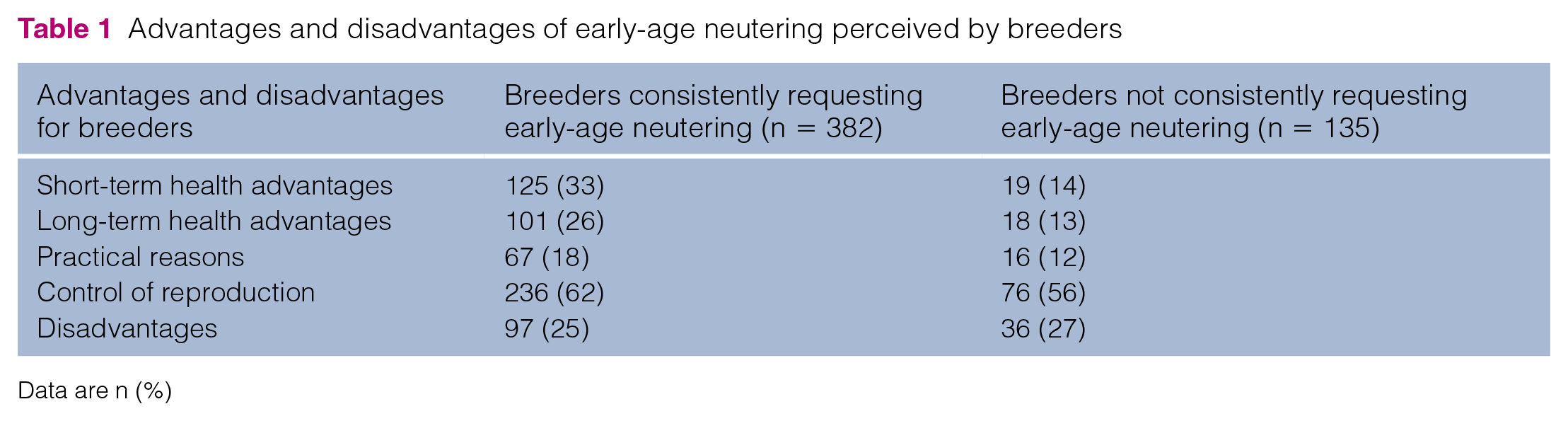
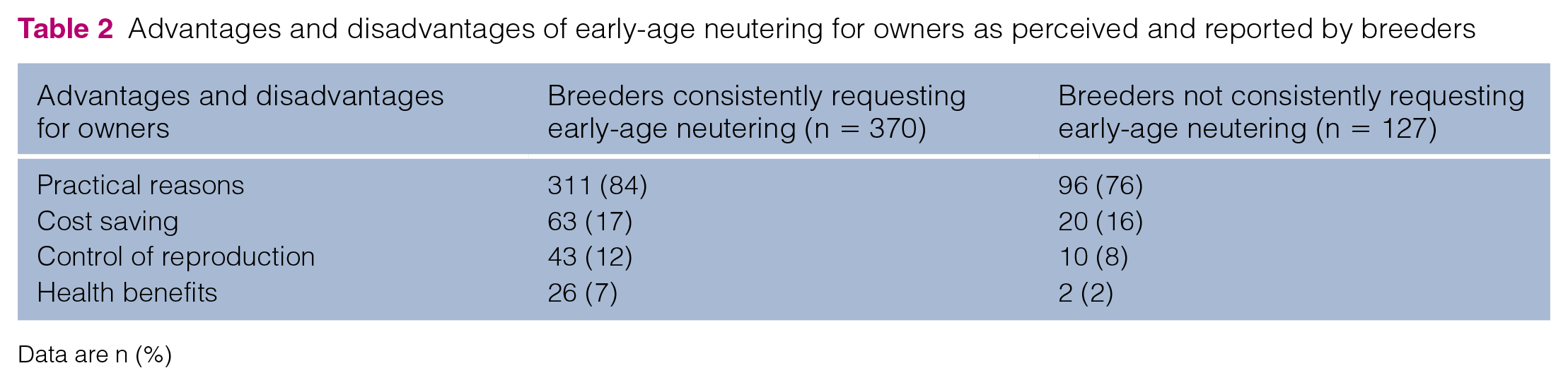
Through free-text answers, the advantages and disadvantages of early-age neutering, both for breeders and for buyers expressed to their breeders, were collected. Some replies contained several arguments. Statements were grouped according to five sections for breeders and four sections for buyers as perceived and reported by breeders.
Reported short-term health advantages included a quick recovery from surgery and less frequent related complications. Reported long-term advantages included the prevention of mammary tumours, avoidance of genital affections and prevention of unwanted behaviours. Health benefits reported by buyers included those previously mentioned for long-term advantages and, in addition, a reduced risk of contracting infectious diseases and fighting wounds. The ‘practical reasons’ category implied for breeders a no-stress sale, with associated guaranteed compliance, a lower risk of relinquishment and better collective management. The ‘practical reasons’ for buyers, as perceived and reported by breeders, were different: early-age neutering relieved them from the need to plan the intervention, and avoided any stress of the surgery and management of recovery. Control of reproduction was also an advantage mentioned. For breeders, advantages included removing the possibility of backyard breeding, excessive breeding and mis-breeding. For buyers, as perceived and reported by breeders, reproduction-related benefits included avoiding: oestrus periods, the need for contraceptives, young-age pregnancies and undesirable litters. Procedure irreversibility, cost, stress and responsibility were noted by breeders and grouped as ‘disadvantages’ in the early-age neutering category. Cost saving was mentioned as a potential benefit for buyers. Tables 1 and 2 show the results. There were few disadvantages reported compared with advantages.
Advantages and disadvantages of early-age neutering perceived by breeders
Data are n (%)
Advantages and disadvantages of early-age neutering for owners as perceived and reported by breeders
Data are n (%)
Breeders who consistently requested early-age neutering were asked about their reaction to a buyer’s refusal. A total of 390 breeders’ replies were analysed. Answers were variable and arguments put forward to convince owners were classified into the following categories: health and behaviour considerations (22% [95% CI 18–26]; n = 85/390 answers), practical consideration for buyers (15% [95% CI 12–19]; n = 60/390 answers), control of reproduction (11% [95% CI 8–15]; n = 43/390 answers), protection of breeder’s work (9% [95% CI 6–12]; n = 34/390 answers) and cost saving (4% [95% CI 2–6]; n = 14/390 answers).
Many breeders answered that neutering before selling was a non-negotiable condition (79% [95% CI 75–83]; n = 308/390 replies). Some answers belonged to more than one category (22% [95% CI 18–26]; n = 84/390 replies).
Additional comments
At the end of the survey, breeders were offered the opportunity to raise their own concerns regarding early-age neutering in a free-text answer. Of 157 answers, with more than one item, the main reported concerns were regarding anaesthesia (15% [95% CI 10–22]; n = 24/157 answers) and impact on growth (19% [95% CI 13–26]; n = 30/157 answers). Concerns about behavioural development, weight gain, as well as the related occurrence of lower urinary tract disease, were scarce (<3%).
Discussion
In recent decades, the topic of early-age neutering has been the subject of growing interest.11–15 It remains controversial among veterinarians with regard to its indications and consequences, and this is reflected in habits. In the UK, since 2006, The Cat Group has recommended that domestic kittens should be neutered at about 4 months of age. 16 Despite these recommendations, in the 2008 study by Murray et al, 17 5% of veterinarians considered it appropriate to neuter cats aged 8–11 weeks, while 28% considered it appropriate for cats aged 12–16 weeks. In 2011, neutering cats in the UK still predominantly occured at around 5–6 months of age. 6
Early-age neutering is commonly recommended for cats in rescue centres or feral situations, but data for pedigree cats are still scarce. 9 To our knowledge, this study is the first with such a large sample size, as it provides the point of view of 999 breeders. The motivation of cat breeders to participate was significant; the goal of 1000 answers was achieved in less than a month. The survey was based on volunteer responses. Breeders who applied and/or were in favour of early-age neutering were probably more likely than uninterested breeders to respond to the survey.
The cat breeds represented in this sample, as well as the reported cattery size, were in accordance with the national data (LOOF). Small catteries (⩽10 kittens born per year) were the most represented. In our study, there was no difference in the application of early-age neutering between catteries of varying sizes.
Although some breeders in this survey reported that they had been practising a policy of neutering kittens before selling since 1999, the practice remains a new trend in France. Most breeders surveyed have been using it for <5 years, since 2012.
This is the first time that data have been gathered on the application of early-age neutering to French purebred kittens. A majority of breeders (68%) reported that they had requested neutering before selling, on an either consistent or occasional basis. This finding seems consistent with data from the only related available study, in which 54.9% of Swedish pedigree kittens were neutered before rehoming. 9
There are many definitions of ‘early-age’ and the term is sometimes confusing. Neutering can be performed safely from the age of 8 weeks, as long as anaesthetic and surgical protocols are adapted.6,11,18,19 In accordance with the definition recognised by The Cat Group, 6 International Cat Care and the AAFP, 5 early-age neutering was defined in this study as neutering undertaken at or before 4 months of age. In our study, 83% of breeders who reported pre-sale neutering of kittens, consistently or not, reported it at 3 months of age. This timing is closely related to the preventive healthcare programme. Early-age neutering included in this programme, asynchronously to the primary vaccinations, may provide better compliance to neutering a kitten and let new owners enjoy their kittens without worrying about surgery and accidental pregnancy.
According to 94% of respondents, early-age neutering was performed at the breeder’s request. For only 3%, it followed the veterinarian’s initiative. When early-age neutering was never performed, it was not only because breeders were afraid about the intervention or health issues (62% of their replies, n = 153/245); in nearly half of the replies of breeders who never have their kittens neutered before selling (47%, n = 116/245), the veterinarian’s refusal was underlined. This percentage must be carefully interpreted as it represents <120 replies.
However, this study highlights that many veterinarians agree to perform early-age neutering. It has been revealed that veterinarians with early-age neutering experience have a positive attitude to early-age neutering.17,20 Changing habits is always a challenge and, today, there is unequal and insufficient exposure to early-age neutering procedures during academic teaching in France. This situation is similar to that observed in Australia and New Zealand. 21 Further studies are needed to evaluate French veterinarians’ perceptions and their application of feline early-age neutering.
For breeders who requested early-age neutering, 87% reported no incidents or accidents, emphasising the ease of recovery. Eight percent of breeders reported related incidents and 4% reported accidents. It was not possible to evaluate the overall incident or accident rate when neutering is performed at an early age, as the total number of kittens neutered in this way is unknown. Wound complications, the most reported incident, may be related to the difficulty of getting kittens to rest, as their recovery is faster than cats neutered after 4 months of age. 22 Similarly to Howe’s study, 23 the postoperative complication rate was not greater following prepubertal neutering (8–12 weeks of age) than after neutering at the traditional age (6–8 months) in the study by Porters et al. 18 In the recent veterinary literature, the overall wound complication rate following neutering was 6.09% and not related to age. 24
To collect breeders’ opinions as accurately as possible, several free-text boxes were intentionally included in the survey. Grouping and classifying free-text answers may cause a bias. Some responses were ambiguous (too many items in a sentence). For instance, the answer of the permanent nature of surgery in response to the question about advantages and disadvantages of early-age neutering can be interpreted in various ways. Regardless, the inclusion of free-text answers has brought to light some arguments little known to the veterinary profession, such as reducing the phenomenon of ‘backyard breeding’. This term describes amateur animal breeding without kennel club registration. This breeding is considered substandard, with little or misguided efforts towards ethical and selective breeding. Spontaneous responses about advantages/disadvantages, concerns and questions for breeders applying early-age neutering, were classified into three main topics: the pet kitten, the breeder and the new owner.
For the pet kitten, as an individual, advantages mentioned were protection against irresponsible breeding, mis-breeding and relinquishment. Some breeders commented that early-age neutering was a solution to avoiding breeding in order to recoup the expense of the kitten’s purchase. As described in the literature, the benefits of a quicker recovery and less affective pain were underlined in this study. 22 The health aspects of neutering pet cats are well known. The specific impact of early-age neutering on mammary carcinoma development and weight gain need further study. Control of reproduction can be interpreted as a benefit for the individual cat but also for the cat population, to limit overpopulation.
For the breeder, early-age neutering allows them to sell the kittens to motivated buyers. Early-age neutering lowers the risk of misuse of breeders’ kittens. The term ‘misuse’ implies inappropriate mating, use of a kitten not suitable for reproduction or excessive breeding. The common statement that applying early-age neutering in pedigree kittens is a way for breeders to keep their breeding stock was not supported by a Swedish study. 9 In our study, protection of their stock was infrequently cited as a motivation by surveyed cat breeders (n = 34/390 replies). Conscientious breeders carry out selection work to improve the breed. Early-age neutering is the most appropriate technique with which to place animals that should not breed into adoptive homes. It must be considered that not all kittens are suitable for breeding, that health tests are necessary and that an appropriate genetic combination must be selected.
For the new owner (as perceived by the breeder), having kittens neutered prior to buying provides peace of mind and cost saving.
Compared with the advantages mentioned, there were few disadvantages expressed by breeders who requested early-age neutering. This indicates a high level of satisfaction. These breeders were strongly convinced of the merits of this practice, which is mostly advantageous in their opinion.
It is important to bear in mind that this study is based on breeders’ perceptions and veterinarians were not surveyed. In our study, many concerns were reported in the free-text section of the survey, mostly about anaesthesia, surgery and health. Protocols for anaesthesia and procedures for surgery have been documented for paediatric patients, but the impact on health following early-age neutering still needs to be assessed.
Conclusions
This survey highlights the expansion of early-age neutering practices to breeding habits in France, without incident or accident reported in an overwhelming majority of breeders’ replies. The majority of French cat breeders requesting early-age neutering had their kittens neutered at 3 months of age. The breeders reported many more benefits than inconveniences, which indicated a high level of satisfaction with this technique. For some breeders whose kittens were not neutered before selling, the study highlights the discrepancy between their expectations and the veterinarian’s ability and motivation to perform it. However, the study also showed that several veterinarians do perform early-age neutering. Teaching and training veterinarians early-age neutering techniques need to be undertaken as part of the academic curriculum.
Supplemental Material
Appendix_1 – Supplemental material for A retrospective internet-based survey of French cat breeders about early-age neutering
Supplemental material, Appendix_1 for A retrospective internet-based survey of French cat breeders about early-age neutering by Anne-Claire Gagnon, Camille Langlade, Samuel Buff and Emilie Rosset in Journal of Feline Medicine and Surgery
Footnotes
Acknowledgements
The authors are particularly grateful to all the French cat breeders who participated in this survey, which was distributed by the Livre Officiel des Origines Félines, and Dr Cyrielle Taveau for her precious advice and help.
Supplementary material
The following file is available online: Appendix 1: Survey of French cat breeders about early-age neutering (June 2017).
Conflict of interest
The authors declared no potential conflicts of interest with respect to the research, authorship, and/or publication of this article.
Funding
The authors received no financial support for the research, authorship, and/or publication of this article.
Ethical approval
This work did not involve the use of animals and therefore ethical approval was not necessarily required.
Informed consent
This work did not involve the use of animals and therefore informed consent was not required. No animals or humans are identifiable within this publication, and therefore additional informed consent for publication was not required.

References
Supplementary Material
Please find the following supplemental material available below.
For Open Access articles published under a Creative Commons License, all supplemental material carries the same license as the article it is associated with.
For non-Open Access articles published, all supplemental material carries a non-exclusive license, and permission requests for re-use of supplemental material or any part of supplemental material shall be sent directly to the copyright owner as specified in the copyright notice associated with the article.
