



Abstract
Practical relevance:
Good communication skills are at the heart of best practice for veterinarians and behaviourists (be they veterinarians/nurses/technicians with specialist behaviour training and qualifications or clinical animal behaviourists). Hence gaining an understanding of how to engage clients to become involved in their pets’ treatment, both medical and behavioural, is relevant to all who work in this field.
Clinical challenges:
Poor communication skills can be responsible for owners’ lack of compliance regarding both medical treatment and implementation of behavioural protocols.
Evidence base:
Much of the evidence-based information on effective communication comes from the fields of human psychology and psychotherapy, human medicine and business, with only a limited amount coming from the veterinary field. Therefore, some opinions expressed in this article are based on the author’s experience of treating cases in a cat-specific behaviour referral practice over the past 20 years and her work as a humanistic counsellor.
Audience:
Any veterinarians, veterinary nurses or technicians who are involved in the diagnosis or treatment of problem feline behaviour in practice would benefit from knowledge of what promotes and also hinders owner understanding and involvement.

The veterinarian–owner relationship
There are various aspects of the veterinarian–owner relationship that can be explored and considered to encourage more flexibility in the way veterinarians communicate with their clients and to gain a better understanding of what motivates them. Every owner, and the relationship with their cat, is unique but there are types and styles that are common to many. Appreciating these and adapting accordingly can mean the difference between success and failure of a treatment programme. The aspects that will be considered in this article are shown in the box below.

Flexibility of approach – learning styles
In order to create a programme that the owner is willing to follow, an understanding of how adults learn is helpful. For years the accepted truth has been that people remember only certain – defined – amounts of what they read or hear, and this has influenced training programmes as a result. However, the amount that an owner will remember, learn or forget is variable 1 and dependent on many factors, including personal relevance to the individual, whether new knowledge relates in some way to existing beliefs, emotional arousal (eg, did the information make the owner happy or sad), motivation to acquire knowledge (fixing a problem), etc.
The owner will be more likely to embrace the suggestions in a behavioural modification programme if they feel really involved in its formulation, if the goals and objectives are important to them, and if they don’t feel pressurised, tested or judged. How the owner approaches the task will differ from one individual to another but it may be helpful to view this from the perspective of one popular learning style model. 2 Peter Honey and Alan Mumford described four distinct learning styles: activist, reflector, theorist and pragmatist. Having some idea of where an owner falls within these categories may influence the way that any programme of change is presented to them.
Activists
Activists involve themselves fully in new experiences and are open-minded and happy to embrace the challenge of resolving the problem. They learn by doing, so they are not usually keen on reading lengthy reports with explanations and rationales, preferring to get down to what matters, which is fixing the problem. In their enthusiasm to get on with the job they are less concerned with reading instructions carefully so, in this context, they may need some follow-up to discuss recommendations in detail to ensure they implement them correctly.
Reflectors
Reflectors learn by observing and thinking about the problem and solution from every possible angle. They enjoy collecting data to analyse so are particularly proficient at keeping diaries or spreadsheets; for example, on soiling incidents or litter box usage. These owners will benefit from a comprehensive written analysis of the problem, including very specific instructions, but will require some time to digest the content before discussing further. They often do not work well under the pressure of specific deadlines for implementation.
Theorists
Theorists, even more so than reflectors, like to understand the theory behind the protocols that the specialist behaviourist/veterinarian puts in place. They tend to be perfectionists and apply logic and rational objectivity to solving problems. Avoidance of ambiguity and limited references to feelings or emotions in the behavioural modification programme would keep the theorist motivated.
Pragmatists
Pragmatists are practical, down-to-earth people who get frustrated with long, open-ended discussions and simply yearn for the solution. They are open to trying out new ideas but need to be shown exactly what to do, with clear guidelines and plenty of feedback from the expert. Behavioural modification programmes for the pragmatist need to be practical and definitely not full of generic information; the concepts of resource distribution or environmental enrichment, for example, are theoretical and therefore require some adaptation in order to be practically applied. Non-essential elements to the programme should be avoided; everything to be carried out must be specifically related to tackling the problem that has been identified.
Understanding the owner–cat relationship
Clearly, successful behaviour programmes are not simply a matter of determining the learning style of the owner. Arguably the most significant thing to understand, and to work with, is the owner’s emotional connection with their pet and the specific owner–cat relationship.
The role of the companion animal has changed dramatically and human–cat relationships are becoming increasingly complex. There is now a blurred line between cat behaviour and human problems, with numerous instances, in the author’s experience, of owners relating to their cats in a way that mimics the patterns of dysfunctional human relationships. This can be seen where, for example, the owner is overwhelmed by their cat’s attention-seeking behaviour; they may describe feeling ‘bullied’ but unable ‘to stand up to’ the cat or ‘deny their wishes’ due to their own sense of guilt and helplessness. Sometimes the relationship between human and cat may be related in some way to a significant trauma in the owner’s life, and this may lead intelligent, rational people to make decisions based on a framework that only a clinical psychologist could comprehend. These owners are equally in need of support and guidance as any other, no matter how confusing their motivation.
In order to work with owners it is therefore important to understand the basis of their relationship with their pets. Owners fall somewhere on a spectrum that includes three fundamental categories: anthropomorphic, possessive and integrated. 3
Anthropomorphic
The anthropomorphic owner projects human thoughts and feelings onto their cat; not only human emotions but, very specifically, how that owner would feel in that particular situation. This results in rigid and unrealistic views about the cat’s motivations and behaviour, which are often difficult to unravel. This type of owner will likely offer human food to their cat and may treat their pets with the same alternative remedies that they use for their own wellbeing. These owners care for cats in a way that fulfills their own nurturing and relational needs.
When working with an anthropomorphic owner it is necessary to discuss complex species-specific behaviour by using analogies rather than scientific fact. For example, to illustrate the potential distress a cat might feel when an unfamiliar cat comes into the house through an unlocked cat flap, the behaviourist/veterinarian may use the analogy of ‘how would you feel if your front door was left open and a burglar came in and took food out of your fridge while you hid upstairs?’ By using analogies in this way, and also by giving the real context of the cat’s experience, it is possible to respect the motivations of the species without alienating the anthropomorphic owner. For example, you might explain that ‘Your cat is scared and because he can’t escape he feels he needs to fight as he sees me as a threat’, rather than using derogatory, misleading and anthropomorphic terms such as ‘spiteful’ or ‘aggressive’.
Possessive
The possessive owner sees the cat as an object or chattel, having acquired the cat for a purpose; for example, to control vermin or to accede to the demands of their children. This type of owner will accept scientific language more readily, but will be more concerned with the outcome and how a problem would be fixed rather than why it is occurring or the rationale behind the therapeutic programme of change. These owners often appear to have a lack of emotional connection with their cat and are less committed to their welfare. They are also less likely to look for support and guidance on behavioural problems, as they may relinquish the cat to a homing centre, give it away or just exclude it from the house as a practical solution to an intolerable problem.
Integrated
The integrated owner accepts that the cat is a separate, sentient being that sometimes behaves in such a way that is incomprehensible. This is where the veterinarian or behaviourist can inform the owner and increase their knowledge to enable them to understand their cat better. The integrated owner cares about the cat, respects the species and attempts to fulfil its specific needs, rather than assuming that it is pseudo-human.
The need for self-reflection
There will be times when the veterinarian or behaviourist needs to reflect on their own personal beliefs in order to work effectively with a broad range of owners. All owners will have, to some degree, limits to what they can agree to regarding a programme of therapeutic change, such as time constraints or financial, physical, behavioural or emotional limits. For example, while it is often difficult to work with someone who appears to lack an emotional bond with their pet, an important lesson to learn is that it is impossible for a behaviourist or veterinarian to make an owner care. The thing that helps is learning to allow and tolerate alternative viewpoints and beliefs – otherwise the owner’s attitude may not be acceptable to the veterinarian, which results in the owner being judged as wrong. Ultimately it is better for the veterinarian to accept the owner’s view (despite not agreeing with it) and work within those limits to maintain the line of communication, as this is more likely to ensure the cat’s wellbeing (see ‘Case notes’ on page 1018).
Unfortunately many avoidable medical and behavioural problems in cats, such as obesity and aggressive behaviour, result from acts of ‘love’. If owners believe their motivation to be genuine love then their error should, in theory, be corrected by acquiring the necessary knowledge. Sentimentality is easy to confuse with love as they are both directed towards the same object (ie, the cat). 4 It does, however, only benefit the owner, as it prioritises their pleasure and pain without any empathetic understanding that the cat is a separate sentient and very different creature. It is easy for owners to create a fantasy world in which the cat can be anything they wish, based on their own perception of the world. The cat, being so ambiguous in its expression, makes it easy for this fakery to remain unchallenged. Hence owners may receive the necessaryinformation yet continue in their old ways, as strongly held beliefs will work to resist new information that challenges them. It is important, therefore, for veterinarians and behaviourists to recognise this phenomenon and also consider their own beliefs about love, in order to develop more understanding of those that do not meet their ideals.


Building the relationship – communication skills
Miscommunication lands practitioners in far more trouble than clinical incompetency, as an owner will be more trusting of a veterinarian/behaviourist if they understand what is happening and why, despite the outcome. So building a relationship of trust and helping owners to recognise species-appropriate and species-typical behaviour (Figure 1) can work as an important preventive measure against problems in the future.

Helping owners to recognise and facilitate species-appropriate behaviour can work as an important preventive measure. (a) In the setting of the veterinary clinic this cat is free to explore rather than being restrained on the table. (b) Back at home, environmental stimulation is being provided with the use of a puzzle feeder
In order to do this successfully the veterinary team needs to have the necessary behavioural knowledge so that the right information can be imparted with confidence. Many owners rely on the internet or friends
5
to answer their behavioural enquiries, and tend to separate the physical from the behavioural when attempting to resolve problems. As part of the relationship-building exercise the veterinarian has to constantly reinforce the inextricable link between behaviour, emotions and physical health with their client (see article in Part 1 on
A key element of successful history taking and treatment planning for problem behaviour is building the relationship. An understanding of the possible consequences of living with a problem behaviour is therefore helpful when discussing the owner’s situation. Many owners appear extremely tolerant of ‘unacceptable behaviour’ such as house-soiling and may have been experiencing issues for a number of years before bringing the problem to the attention of their veterinarian. In that time they will have developed a way of dealing with the problem, and carried out daily chores based around it, which may appear ludicrous to an outsider but, over time, have become the norm for them. Many owners feel incredibly guilty and see the problem as a reflection on themselves related to something they have done or should have done. Problem behaviour can also cause enormous friction in personal relationships with partners or family members, particularly where there is someone else in the household who feels that there is a quick, black and white solution to the problem (often rehoming).
What the owner really wants from their veterinarian or behaviourist is a listening ear from an understanding and empathetic person who will give helpful advice and, for some, emotional support to carry out any proposed programme (Figure 2).

A key element of successful history taking and treatment planning for problem behaviour is building the veterinarian–owner relationship
In human counselling, relationship factors are twice as likely to predict a positive outcome than the therapist’s technique or chosen therapeutic model. 7 Perhaps unsurprisingly it has been found that the most important aspects of therapy are a place and time to talk and someone who cares, listens and understands, encourages, reassures and offers a different perspective and advice about a problem. 8
The role of the behaviourist may be described on this basis as pet behaviour ‘counsellor’, as counselling skills are essential to create a good working relationship and encourage the owner to follow any recommended programme of change. A behaviourist, and indeed a veterinarian, can be highly skilled and knowledgeable but, if unable to relate appropriately to the owner, the outcome of any therapeutic intervention will inevitably be compromised.
‘Core conditions’, as applied to working with the veterinary client
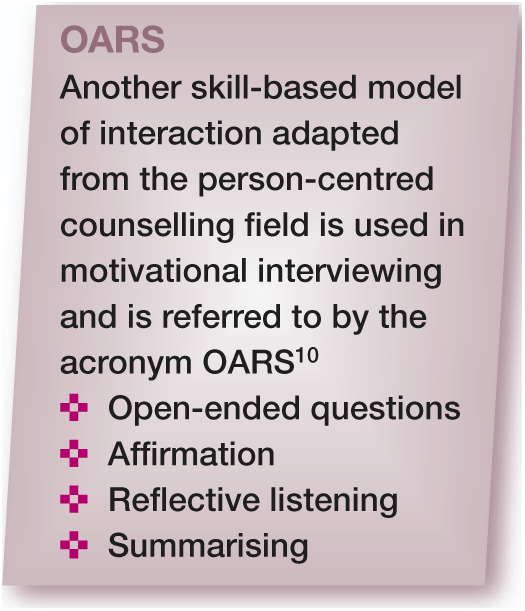
Taking principles that apply to the field of human counselling, in particular the person-centred model, certain conditions (referred to as the ‘core conditions’ 9 ) should be present for the required relationship between veterinarian and owner to be established (see box below, and also ‘Case notes’ on page 1021).

Empathy
Some people are naturally more empathetic than others. Nonetheless empathy can be practised and achieved sufficiently for the purposes of both gaining the trust of the owner and good communication, via ‘active listening’. The latter refers to a means of communicating with another person that requires concentration and focus so that their story, the words chosen and their body language are all absorbed and remembered without reference to the counsellor’s own personal thoughts and feelings. This can be achieved through reflection and mirroring, and paraphrasing:
Faced with a distressed owner describing the particular behavioural problem, the veterinarian/behaviourist can express empathy by saying, for example, ‘I can see how upsetting this is for you; it seems that it’s hard for you not to take your cat’s behaviour personally’. Encouraging behaviour, such as nodding, or words and sounds such as ‘go on’ and ‘mmm’ will help the owner to feel relaxed and able to tell the story without feeling rushed or needing to leave gaps for input. Active questioning can be used to get more information about something that the veterinarian/behaviourist feels is relevant but the owner has mentioned only briefly; for example, ‘Please can you tell me more about that time your cat saw another cat through the window’. It is also helpful to gain more clarity from the owner regarding vague remarks; for example, ‘He was very aggressive towards me’ could mean anything from ‘he hissed at me’ to ‘he bit me and I required hospital treatment’. As well as the techniques described above, active listening is also conveyed via body language. Keeping an open posture (leaning forward slightly if seated, direct eye contact, arms and legs relaxed) is important to show that the veterinarian/behaviourist is fully open to hearing the owner’s story.
Congruence
A truly empathetic listener will find that the owner’s subtle body postures or expressions may be mirrored in their own face; though care must be taken by the listener not to allow their own personal thoughts and feelings that are in contrast with the owner’s to be expressed via body language, as this may look like a judgement on what the owner is saying. Feelings and attitudes, for example likes and dislikes, are conveyed predominantly in the way the words are said and the speaker’s body language, rather than in the chosen words themselves (Figure 3). 11 This means that authenticity when speaking with owners is important as it is likely they will see through the veterinarian’s expression of a sentiment that is not a true reflection of how they feel.

Two studies conducted by psychologist Albert Mehrabian in the 1960s looked at the relative importance of verbal and non-verbal messages when, specifically, the communicator is not expressing genuine feelings and attitudes. As shown in this graph, Mehrabian determined that 93% of the meaning inferred by his 47 study participants was ‘non-verbal’
Congruence means being real, honest and genuine. There will be occasions when the behaviourist or veterinarian does not agree with sentiments expressed by the owner but it is still possible to work with that person by internally acknowledging that difference and intellectually putting it to one side as being unhelpful in this situation. Different perspectives can be explored without being considered judgemental; for example, I can see how you might think that, but when I think about it, it occurs to me that your cat may have been preoccupied with something else rather than just ignoring you’.

Unconditional positive regard
Being non-judgemental about what an owner is saying enables them to feel comfortable and free to tell an uncensored version of events. So often, an owner will say what they feel the veterinarian/behaviourist wants to hear and therefore prevent a true history from being obtained. Unconditional positive regard will enable the veterinarian/behaviourist to appreciate the owner’s behaviour, attitude and beliefs without prejudice and to understand the nature of the person’s ‘reality’.
The behaviour modification programme – improving owner understanding and involvement
The success or failure of any treatment programme is dependent on the owner carrying out the recommendations of the veterinarian/behaviourist (see box on page 1022). Information regarding the planned programme of change should be imparted in short segments, keeping language simple and avoiding jargon. Throughout the process the veterinarian/behaviourist should keep checking that the owner understands why they are recommending certain things, by asking ‘Does that make sense to you?’ or ‘Do you have any questions about this part?’
Whatever is in place has to feel like the right solution to the problem for the owner, so the programme needs to be developed in collaboration. This way, any resistance, whether voiced or detected in the owner’s body language, can be discussed and any adaptations to the ‘ideal’ programme can be negotiated. Resistance is best tackled with openness and positivity, with phrases such as, ‘I can see that idea isn’t appealing to you’, ‘Is there any part of this you feel you can do?’ or ‘Can you tell me what it is specifically about this that is concerning you?’ Such phrases will be helpful in showing the owner that their feelings are valid and that the veterinarian/behaviourist is doing everything to take them into consideration. In the author’s experience it is better to get an owner motivated to complete a programme that is slightly less than ideal, than persevere with the original idea and demoralise the owner, who inevitably will then not follow it.

Owner feedback
During the course of a programme the veterinarian/behaviourist is there to provide support. In order to give the necessary guidance on how the situation is progressing it is important for the owner to understand that good quality feedback is required. The owner will not appreciate exactly what is expected of them unless this is explicitly outlined at the very beginning. For example, if daily observations are required to be fed back, the owner needs to be told, and details confirmed in writing, exactly what is needed and how this should be provided; for example, via email, in spreadsheet form, over the telephone, etc. The owner will not necessarily understand the difference between subjective interpretation of behaviour (for example, ‘Tigger was aggressive towards me because I was late back from work’) and reports of what exactly has been observed (‘When I came in from work and was standing in the hallway, Tigger walked towards me slowly with his head lowered, his ears flattened and his tail held slightly lower to the horizontal. He started to growl and stopped about 2 m away from me, adjacent to the staircase’). Unhelpful language such as ‘He is still spray marking everywhere’ or ‘He is aggressive all the time’ should be avoided for clarity and all comments of this nature should be explored regarding exactly ‘where’ and ‘how often’.
Threats to compliance
The human emotions of sentimentality, guilt and love can sabotage even the most carefully developed behavioural modification programme. If an owner views the relationship with their cat purely from the perspective of sentimentality, guilt and love this takes up a lot of emotional energy and can prevent help from being taken, even when it is so clearly needed. Unfortunately, while advice can be given in these instances the solution always lies with the owner, who is tasked with the job of carrying out the recommendations. There is only so much that a veterinarian/behaviourist can do for an owner who has their own perception of the problem and its solution.
One study that recruited the owners of 85 cats exhibiting problem behaviour showed a compliance rate of 61% overall. The degree of improvement after behaviour therapy, as rated by the clinician and owner, significantly correlated with the compliance of the owner to the treatment programme. 12
Non-compliance is not unique to the veterinary client. A review of 63 studies assessing medical patient compliance showed that nearly 80% of patients fail to follow dietary and exercise advice or continue to smoke and abuse alcohol despite their doctor’s advice. 13 A study conducted by the American Animal Hospital Association revealed that client compliance is much lower than veterinarians predicted. The study looked specifically at areas of preventive healthcare and, in general, concluded that the majority of the practitioners surveyed believed their client adherence levels were as high as 75% when in reality the average rate was found to be 50%. 14 This means that only half of the clients seen in those practices followed through on the treatments their veterinarians recommended.

Key Points
Veterinarians need to be flexible in their approach to the management of problem behaviour, taking into consideration the diversity of clients they will be working with and their various learning styles.
The relationships that owners have with their cats are complex. This can sometimes result in perfectly rational people making incomprehensible decisions, from the veterinarian’s perspective, when it comes to the care of their pets.
Resolving problem behaviour can often depend on the quality of the relationship that the veterinarian builds with their client.
Empathy, honesty and a non-judgemental attitude are needed when communicating with clients. This helps to achieve the best level of understanding and cooperation when it comes to following instructions for resolving problem behaviour.
Supplemental Material
Supplementary Material
Special issues on feline behaviour and problem behaviours
Footnotes
Acknowledgements
The author would like to thank Pete Coleshaw for allowing his veterinary clinic, Jaffa’s Health Centre for Cats, Salisbury, UK, to be photographed for Figures 1a and 2.
Conflict of interest
The author declared no potential conflicts of interest with respect to the research, authorship, and/or publication of this article.
Funding
The author received no financial support for the research, authorship, and/or publication of this article.
References
Supplementary Material
Please find the following supplemental material available below.
For Open Access articles published under a Creative Commons License, all supplemental material carries the same license as the article it is associated with.
For non-Open Access articles published, all supplemental material carries a non-exclusive license, and permission requests for re-use of supplemental material or any part of supplemental material shall be sent directly to the copyright owner as specified in the copyright notice associated with the article.
