




Abstract
Objectives
Vaccination is the most important measure for prevention of feline infectious diseases. Cat owner compliance with vaccination recommendations has been investigated in the UK but not in other European countries. The aim of the present study was to determine cat owners’ attitudes towards vaccination in cats in Germany, to identify factors that are associated with the vaccination status of their cats and to compare the results with those of the UK survey.
Methods
The survey was conducted using an online questionnaire and was aimed at respondents throughout Germany. Respondents under 16 years of age, cats that were less than 9 weeks old and veterinarians were excluded. A total of 920 questionnaires were evaluated, and information about cats and respondents was assessed with respect to the current vaccination status of the cats using a linear logistic regression model.
Results
The majority of cats (77.9%; n = 717) were vaccinated according to current guidelines; only 5.4% (n = 50; 95% confidence interval [CI] 5.00–9.00) of cats had never received a vaccine. Having visited a cattery, a cat show or travelled abroad in the past 12 months (n = 96/773; odds ratio [OR] 6.95; 95% CI 1.65–52.19) had the highest positive impact on the vaccination status of cats. In addition, detailed veterinary advice about vaccination had a positive impact (n = 275/773; OR 2.09; 95% CI 0.67–6.25) on the attitude of owners towards vaccinating their cats.
Conclusions and relevance
A history of travelling abroad or visiting cat shows or a cattery, and thus regulatory requirements, had the greatest positive impact on the current vaccination status of the cats. Veterinary consultation on preventive measures, including vaccination, is crucial for protecting the cat population against infectious diseases.
Introduction
Vaccination remains the most important measure for protection against feline infectious diseases. 1 According to expert groups, all cats should be vaccinated against feline parvovirus (FPV), feline calicivirus (FCV) and feline herpesvirus 1 (FHV-1), independent of age and lifestyle.2–4 To prevent an epidemic, more than 70% of any given population must be vaccinated,3,5 which current evidence suggests is not always achieved.6,7 However, one study found that 70.6% (n = 247/350) of cats in Germany, thus just about the critical percentage, had antibodies against FPV. 8
Recent data indicate that of the 28 million pets in Germany, 11.5 million are cats, 9 and spending on veterinary services is more than €2 billion, with an average of €60 spent per cat annually. 10 In 2013, more than one-third of all small animals were presented to veterinarians for preventive healthcare in Germany, 11 highlighting the importance of this branch of veterinary medicine. 11
Compliance of pet owners with vaccination guidelines is important. In human medicine, an anti-vaccination movement has led to an increase in parental concern about the safety of recommended vaccines in infants.12,13 It has been suggested that pet owners have similar concerns regarding safety, necessity and efficacy of vaccination in cats and dogs.14,15 A study in the UK, which evaluated the attitude of respondents towards vaccination, found that cats that visited catteries or attended cat shows were almost 12 times more likely to have a current vaccination status than other cats, and the vaccination of kittens had a positive effect on the future vaccination status of adult cats. 16 To date, there are no other studies on vaccination compliance of respondents in European countries, except the UK. Therefore, the aim of the present study was to determine the compliance of respondents with vaccination recommendations and to identify factors related to the vaccination status of cats in Germany.
Materials and methods
Data collection
A questionnaire comparable to the one designed in the UK was sent to respondents to determine their attitudes towards recommended feline vaccinations (Table 1). 16 Slight modifications to the UK survey were made; for example, information about vaccination recommendations of veterinarians was added. 16 The questionnaire included 24 closed-ended questions about the following items: sociodemographic information of the respondents, vaccination history of the cats, general knowledge of owners about feline diseases and feline vaccinations, previous vaccine-associated adverse events (VAAEs) in the cats and factors influencing the decision to vaccinate. Respondents were asked to rate factors that affected their decision to vaccinate using a scale from 1 to 5, with 1 being not important and 5 being very important. Respondents had the option of omitting questions, which resulted in a number of incomplete data sets. The questions were ranked in terms of difficulty, with easier questions appearing earlier in the questionnaire. 16
Description of cats owned by respondents participating in the web-based questionnaire used in the present study with all questions that were included in the statistical analysis (n = 773)

On statistical analysis, 10 categories were associated with the cats’ recent vaccination status (see right-hand column)
n = 729
OR = odds ratio; CI = confidence interval; VAAE = vaccine-associated adverse event
A preliminary study was carried out using 50 paper versions of the questionnaire. The questionnaire was then revised in a pilot study by obtaining the feedback of 50 respondents on the clarity or ambiguity of questions via an online survey. The pilot study revealed that no modifications were required, and thus the data were incorporated into the present analysis. The final online questionnaire took approximately 10 mins to complete and was available online from August 2014 to August 2015. A link to the online questionnaire was published on the homepage of the Clinic of Small Animal Medicine, LMU Munich, as well as in owner information letters, trade magazines, cat forums, and on Facebook.
Vaccination status
Cats that had received any vaccination(s) within the preceding 3 years were considered to be ‘recently vaccinated’ and cats that had not received a vaccination in the last 3 years or that had never been vaccinated were considered to be ‘not recently vaccinated’, for the purpose of this study.
Survey response
A total of 1137 owners responded to the questionnaire. Data sets of owners with cats under 9 weeks of age (n = 2) and respondents under 16 years of age (n = 2) were excluded, and 213 data sets were not included because the survey was terminated prematurely. Veterinarians were also not allowed to participate in the study. A total of 920 questionnaires were evaluated descriptively. Not all participants answered all questions, but all questions that were answered were included in the study. A total of 773 questionnaires were statistically analysed in the ultimate regression model.
Data analysis
The statistical package R version 3.2.0. was used for data analysis, and a descriptive summary of all questions was produced. Statistical analysis was undertaken by linear logistic regression; the target variable was the cats’ ‘recent vaccination status’. The final model resulted from stepwise backward variable selection based on the Akaike information criterion (AIC) starting with a set of 24 variables (Table 1). The AIC is a popular criterion for model selection and balances model complexity and fit, whereby the model with the lowest AIC is considered to be the appropriate model. 17
Results
Description of respondents and cats
The descriptive characteristics of respondents are summarised in Table 1. The descriptive characteristics and VAAEs of cats are also shown in Table 1.
Vaccination status of the cats and veterinary recommendations
The majority of cats (77.9%; n = 717/920) had been vaccinated within the past 3 years. The last vaccination was administered more than 3 years ago in 15.5% (n = 143/920) of cats. Only 5.4% (n = 50/920) of all cats had not received any vaccinations, and 1.1% (n = 10/920) of the respondents did not answer the question on vaccination status.
Most owners had received veterinary recommendations to have their cat(s) re-vaccinated annually (65.8%; n = 599/910) or every 2 years (11.9%; n = 108/910). A minority (6.9%; n = 63/910) of owners was advised to have their cat(s) re-vaccinated every 3 years or less frequently (3.3%; n = 30/910).
Respondents were asked to identify factors that might prevent them from making an appointment for vaccination of their cat(s); of 796 respondents, 312 (39.2%) chose one or more factors, the most common of which were distance from a veterinary practice and problems with transportation of the cat (20.8%; n = 65/312), opening hours of the veterinarian (19.2%; n = 60/312), finding and catching the cat (15.4%; n = 48/312) and time involved with a visit to the veterinarian (4.2%; n = 13/312). About 40.4% (n = 126/312) chose the category ‘other’ and explained that current illness in the cat (30.2%; n = 38/126) or previous VAAEs (15.9%; n = 20/126) were reasons why they did not take their cat(s) to a veterinarian for vaccination. The remaining 60.8% of the owners (n = 484/796) stated that none of the listed factors would deter them from making a vaccination appointment.
Factors with positive and negative effects on the vaccination status
Based on AIC model selection, 10 factors were associated with the ‘recent vaccination status’ of the cats in the final model (Table 1). Having visited a cattery or a cat show, or travelled abroad in the past 12 months (n = 96/773; odds ratio [OR] 6.95; 95% confidence interval [CI] 1.65–52.19) and detailed veterinarian consultations (n = 280/773; OR 3.35; 95% CI 1.57–7.29) had the largest positive effect on the vaccination status (Table 2). Waiting times at the veterinary practice (n = 12/773; OR 0.00; 95% CI 0.00–0.02) and elderly age of the cat (n = 106/773; OR 0.20; 95% CI 0.06–0.63) had the largest negative effect on the vaccination status of cats (Table 3).
Factors with the biggest positive impact on the recent vaccination status of cats in Germany resulting from logistic regression after stepwise variable selection based on Akaike information criterion (AIC) (n = 773)
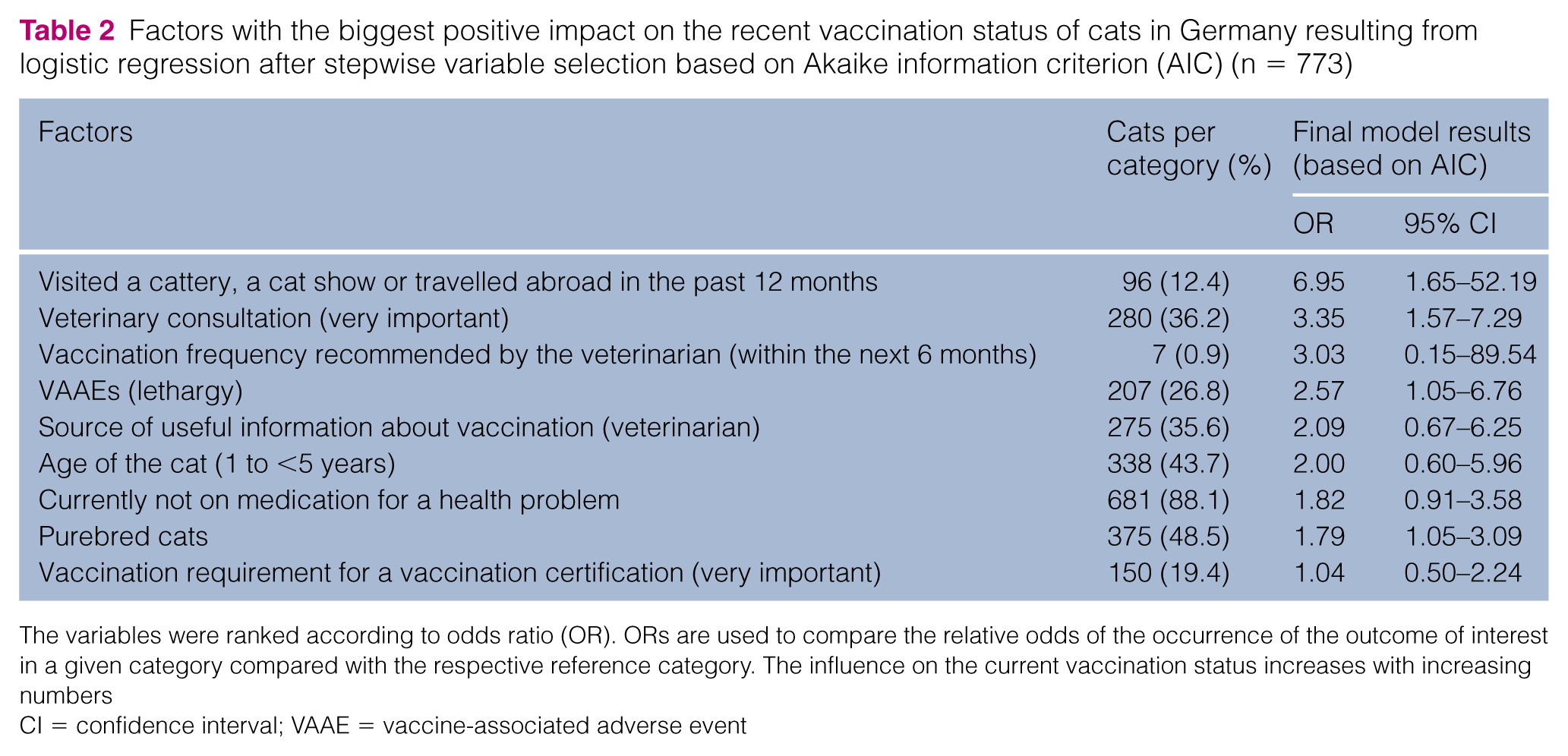
The variables were ranked according to odds ratio (OR). ORs are used to compare the relative odds of the occurrence of the outcome of interest in a given category compared with the respective reference category. The influence on the current vaccination status increases with increasing numbers
CI = confidence interval; VAAE = vaccine-associated adverse event
Factors with the biggest negative impact on the recent vaccination status of cats in Germany resulting from logistic regression after stepwise variable selection based on Akaike information criterion (AIC) (n = 773)

The variables were ranked according to odds ratio (OR). ORs are used to compare the relative odds of the occurrence of the outcome of interest in a given category compared with the respective reference category. The influence on the current vaccination status increases with decreasing numbers
CI = confidence interval; VAAE = vaccine-associated adverse event
Discussion
It has been determined that >70% of cats in a given population must be protected against a given infectious disease to prevent an epidemic.3,5 Results of the owner survey in this study showed that 77.9% of cats were ‘recently vaccinated (‘within the past 3 years’)’, suggesting that the cat population in Germany is well protected. Self-reporting, the online nature of the study and over-representations of owners with particular interest in cats might have resulted in sampling bias overestimating the number of up-to-date vaccinated cats. However, it is important to note that a ‘recent vaccination status’ does not necessarily imply protective immunity. In addition, owners of purebred cats were over-represented in this study.
Current guidelines recommend a frequency of vaccination of up to every 3 years for core vaccines,2–4 and, according to current vaccination guidelines, FPV, FCV and FHV-1 vaccines are considered core vaccines.2–4 Revaccination for FPV is recommended every 3 years and for FHV-1 and FCV every year to every 3 years after basic immunisation, depending on the guidelines and on the specific situation of the cat.2–4 Thus, a vaccination interval of 3 years was chosen for the purpose of the current study as the criterion for inclusion into the group of ‘recently vaccinated’ cats. The results of this study indicate good owner compliance with current vaccination recommendations with almost 80% having been vaccinated in the preceding 3 years. Similar results were reported in Australia, where 72.2% of the cats had been vaccinated in the past 3 years.18,19 In the UK, only 69% of cats had a ‘current vaccination status’, but ‘current vaccination status’ in the UK survey included only those cats that had been vaccinated in the past 12 months (and not in the past 3 years), as the survey was performed prior to current guidelines and the possibility of tri-annual vaccines. 16
Regarding the results from the logistic regression, particular attention was given to the categories with the strongest effect upon comparison with the reference category. The likelihood of a ‘recent vaccination status’ was up to seven times higher in cats that had accompanied owners on trips abroad, or visited a cat show or a cattery in the past 12 months than in cats that did not travel or visit a cat show or cattery, which was in line with the results of the UK study. 16 The greater vaccination rate in cats traveling within Europe can be attributed to the requirement of a European Pet Passport documenting vaccination against rabies.20,21 Accordingly, current vaccination records were associated with cats that participated in cat shows requiring up-to-date vaccination certificates to prevent outbreaks of infectious diseases. 22
Client education by veterinarians was another crucial factor for the ‘current vaccination status’ (3.35 higher likelihood). That underlines that the education of owners by veterinarians plays an important role in improving the vaccination status of cats.
Surprisingly, and in contrast with the UK study, the likelihood of a ‘recent vaccination status’ was up to two times higher in cats between 1 and 5 years of age than in cats aged between 9 weeks and 1 year. Recommendations for kitten vaccinations advise a primary vaccination series starting at the age of 6–8 weeks with subsequent booster vaccinations in 3–4 week intervals until 16 weeks of age, and a booster 11–13 months later as a foundation for a strong immunity indispensable.2–4 This needs to be clarified with owners.
‘Recent vaccination’ records were seen more often in cats that received no medication for health problems. This corresponds with vaccination recommendations; vaccinations should only be given to healthy cats, otherwise the safety and effectiveness of vaccinations could be reduced.3,23
‘Recent vaccination’ records were seen more often in purebred cats than in domestic shorthair (DSH) cats. This could create a certain bias regarding breed distribution and can be due to a higher awareness among owners of purebred cats; high purchase price associated with the fear of loss through infectious diseases might motivate owners to vaccinate purebred cats. Furthermore, purebred cats participate more often in cat shows than DSH cats and therefore require up-to-date vaccina-tions.22,24
Owners reported inappropriate waiting times as an important reason preventing them from having their cats(s) vaccinated. Veterinarians should therefore reduce waiting times (eg, offering consultation hours) and potentially provide home visits.
‘Recent vaccination status’ was less common in cats aged 10 years or older than in younger cats. Owners of older cats might assume that these cats are more likely to be protected against infectious diseases because of a longer vaccination history. It should, however, be mentioned that the results concerning this factor were generated by a small number of participants. Regular boosters are recommended for cats, regardless of their age.2–4 So far vaccination recommendations tailored to older cats do not exist, and there are no studies indicating that older cats should receive fewer or more vaccinations than younger cats.2,3 Elderly people are known to have a reduced immune response.25,26 Thus, specific vaccination recommendations apply to elderly people,26–28 and vaccines designed to stimulate a stronger immune response, for instance influenza vaccines, have been developed specifically for them.26,27 Old cats have also been shown to have a significantly lower number of circulating lymphocytes than young cats. 29 One study found that many cats and dogs failed to mount an adequate immune response to rabies virus when they were vaccinated for the first time at an advanced age. 30 However, in another study, antibodies were present for much longer than 3 years after vaccination against FPV, FHV-1 and FCV, indicating that most old cats are likely protected. 31 Further studies are needed to evaluate the immune response in older pets to determine whether specific vaccination guidelines should be established.
In the present study, female cat owners had their cats vaccinated less often than male cat owners. This is in contrast to the results of another study, in which women were found to carry the responsibility for healthcare of family pets, including vaccinations; 32 the predominance of women among the respondents to the questionnaire could be a reason for the contrasting result in the present study. According to another study, it was shown that women in Germany were particularly affected by vaccination-critical reporting. 33 Therefore, it is possible that women are also more likely to be influenced by vaccine-critical reporting for pets.
Interestingly, annual household income did not affect the vaccination status of cats, and the cost of vaccination was not considered a reason not to vaccinate. In the UK, 40% of pets are insured and the insurance covers most veterinary treatments but not vaccinations.34,35 In contrast, only 1% of cats in Germany have health insurance, 8 and therefore their owners are accustomed to paying for all veterinary services.
The potential for VAAEs was another factor that negatively affected feline vaccination status. The majority of respondents (36.7%; n = 121/330) felt that VAAEs were rare but significant. The most common VAAEs described by owners were lethargy and fever. Of interest, the proportion of participants of the present study reporting VAAEs was greater than the proportion of veterinarians reporting VAAEs in a recent survey (51.6 VAAEs in 10,000 cats vaccinated). 36 It is possible that owners overestimated VAAEs, and it is not clear whether measurement of body temperature was carried out by owners or veterinarians. It is important that veterinarians educate owners how to recognise and handle VAAEs. As in the UK study, an unexpected finding was that cats with previous lethargy after vaccination were more likely to be ‘recently vaccinated’. Lethargy is the most common transient VAAEs after vaccination and indicates an effective immune response,36,37 but it is not clear whether owners were aware of this. Respondents who noted lethargy might have been more concerned about their cat’s health in general and thus more dedicated to maintaining the vaccination schedule.
There was no difference in the ‘recent vaccination status’ of cats with different lifestyles (urban or rural areas; indoors or outdoors). In a study from Italy, more frequent veterinarian visits and vaccinations were related to living in urban areas. 38 This result could not be demonstrated in the present study. This could point to a good relationship between the owners and their veterinarians in rural, as well as urban, areas.
Two-thirds of the respondents reported that their veterinarian recommended annual vaccinations, which was surprising. Annual revaccination is recommended for some of the non-core vaccines, such as Chlamydia felis and Bordetella bronchiseptica, and might also apply for some of the core vaccines in high-risk situations. However, most of the cats were indoor cats (67.2%; n = 618/919) living in a single-cat (17.4%; n = 160/920) or two-cat (35.1%; n = 323/920) household and therefore the need for annual boosters with these non-core vaccines appears questionable. Lack of knowledge of feline vaccination guidelines or economic considerations might have been factors associated with incorrect veterinary recommendations. The current guidelines recommend revaccination for core vaccines every 3 years, especially in low-risk situations, such as for indoor-only cats.2–4
This study had some limitations. A cat with any vaccination within a 3 year interval was defined as being ‘recently vaccinated’ for the purpose of this study. However, 3 year interval vaccinations are not compatible for every vaccine and every situation. A detailed analysis of each cats’ vaccination history and epidemiological background was not possible with such a high number of animals. Validation of the data provided by the participants was not possible. The limitation of the statistical model is that post-selection inference is invalid and AIC selection is known sometimes to lead to over-fitting the data. The wide CI can be caused by a comparatively small number of participants. It should also be mentioned that some of the influencing factors have wide CIs. This might be owing to a relatively small number of cats in a category. Furthermore, internet access was a requirement for participation; however, according to the German Federal Office of Statistics, the majority of the German population uses the internet (up to 85% of all households) and both women and men of all ages use it regularly. 39 Finally, because the survey was publicised via social media, there might have been a bias towards dedicated owners with an interest in optimal vaccine protection of their pets. According to one study, 76.4% of surveyed pet owners regularly obtain pet health information online. 40 Based on that, it is likely that owners who support regular vaccination of their cats, as well as those who do not, participate in social media platforms.
Conclusions
In the present study, 77.8% of cats in Germany were ‘recently vaccinated’. A history or prospect of travelling abroad with the owner had the greatest positive impact on the vaccination status, and waiting times at veterinary clinics had the greatest negative impact. Furthermore, a ‘recent vaccination status’ was less common in cats aged 10 years or older than in younger cats.
Footnotes
Acknowledgements
The authors would like to thank Professor T Gruffydd-Jones, School of Veterinary Sciences, University of Bristol, for his assistance in designing the questionnaire.
Author note
Some of the results were presented as an abstract (<250 words) and oral presentation at the 22nd FECAVA Euro Congress Vienna, Austria, 2016. Some of the results were also presented as an abstract (<250 words) and poster at the 24th annual conference of the German Society of Internal Medicine an Clinical Pathology of the German Veterinary Association (DVG) in Berlin, Germany, 2016.
Conflict of interest
The authors declared no potential conflicts of interest with respect to the research, authorship, and/or publication of this article.
Funding
The authors received no financial support for the research, authorship, and/or publication of this article.