




Abstract
Objectives
We evaluated the use of rocuronium 0.3 mg/kg intravenously (IV) to facilitate tracheal intubation in cats anesthetized for elective ovariohysterectomy.
Methods
Thirty female cats were randomly allocated to receive rocuronium 0.3 mg/kg IV or an equal volume of normal saline, following induction of anesthesia with ketamine and midazolam. Thirty seconds after induction, a single investigator, unaware of treatment allocation, attempted tracheal intubation. The number of attempts and the time to complete intubation were measured. Intubating conditions were assessed as acceptable or unacceptable based on a composite score consisting of five different components. Duration of apnea after induction was measured and cases of hemoglobin desaturation (SpO2 <90%) were identified.
Results
Intubation was completed faster (rocuronium 12 s [range 8–75 s]; saline 60 s [range 9–120 s]) and with fewer attempts (rocuronium 1 [range 1–2]; saline 2 [range 1–3], both P = 0.006) in cats receiving rocuronium. Unacceptable intubating conditions on the first attempt occurred in 3/15 cats with rocuronium and in 10/15 with saline (P = 0.01). Apnea lasted 4 ± 1.6 mins with rocuronium and 2.3 ± 0.5 mins with saline (P = 0.0007). No cases of desaturation were observed.
Conclusions and relevance
Rocuronium 0.3 mg/kg IV improves intubating conditions compared with saline, and reduces the time and number of attempts to intubate with only a short period of apnea in cats.
Introduction
Neuromuscular blocking agents (NMBAs) are commonly used to facilitate tracheal intubation in people; it is well established that the inclusion of NMBAs during the induction of anesthesia in humans improves the quality of intubation and reduces the incidence of trauma.1,2 The use of NMBAs during intubation has also been evaluated in cats, showing that placement of the tracheal tube is facilitated with these agents.3–5 However, non-depolarizing NMBAs at the doses commonly used almost invariable result in apnea of long duration, which may increase the risk of hemoglobin desaturation during induction and require the institution of positive pressure ventilation for prolonged periods. 4
A recent dose-finding study in a laboratory setting evaluating the NMBA rocuronium in cats showed that reducing the dose of this agent from 0.6 to 0.3 mg/kg intravenously (IV) can significantly limit the time of apnea while preserving the ability to blunt laryngospasm in response to laryngeal stimulation. 6 However, to our knowledge, whether the technique improves tracheal intubation in a clinical setting has not yet been evaluated.
In the current study we evaluated the use of a low dose of rocuronium to facilitate tracheal intubation in cats anesthetized for elective ovariohysterectomy (OHE). We hypothesized that administration of rocuronium 0.3 mg/kg IV after induction of anesthesia with ketamine and midazolam: (1) improves the quality of intubation; (2) reduces the time and number of attempts to intubate; and (3) causes no significant difference in the duration of apnea after induction of anesthesia compared with cats not receiving rocuronium.
Materials and methods
This study was approved by the Institutional Animal Care and Use Committee of Cornell University. Thirty female cats scheduled for OHE were included. Cats were classified as American Society of Anesthesiologists (ASA) status 1–2, based on clinical examination. Any cat classified as ASA status >2, weighing <2 kg or with orofacial masses or malformations that may interfere with direct laryngoscopy was excluded. Cats were fasted from solid food for at least 12 h; water was not withheld.
Each cat received dexmedetomidine 5 μg/kg (Dexdomitor; Zoetis) and butorphanol 0.2 mg/kg intramuscularly (Torbugesic-SA; Zoetis) prior to anesthesia. At least 20 mins later, a catheter was placed in a cephalic vein and 100% oxygen (2 l/min) was supplemented through a tight-fitting facemask for 2 mins. General anesthesia was induced with ketamine 5 mg/kg and midazolam 0.2 mg/kg administered IV as a single bolus in the same syringe. Immediately after administration of the induction agents, either rocuronium 0.3 mg/kg IV (rocuronium bromide; X-Gen Pharmaceuticals) or an equal volume or saline was administered IV and flushed with 1 ml saline. Treatment allocation was selected at random by removing labels from an opaque envelope (starting with 15 labels for each group) prior to induction of anesthesia. Thirty seconds after injection of rocuronium or saline, the cat’s mouth was held open and direct laryngoscopy was performed using a Miller blade #1 by an experienced veterinary anesthesiologist (DMS) unaware of treatment allocation.
Intubating conditions were assessed based on a composite score modified from Fuchs-Buder et al, 7 consisting of five categories, which included ease of laryngoscopy, arytenoid/vocal cord position, and three categories describing reaction to intubation: movement of vocal cords, coughing and movement of the limbs (Table 1). The investigator scored the quality of laryngoscopy as ‘easy’, ‘fair’ or ‘difficult’ based on absence or presence of muscular tone and/or swallowing; scored the position of the arytenoid cartilages and vocal cords as ‘abducted’, ‘neutral’ or ‘closed’, as observed on initial visualization; and scored the coughing reflex during intubation as ‘absent’, ‘diaphragmatic movement’ and ‘vigorous’. The score was modified by adding two categories for response to intubation: laryngeal movement and movement of limbs. Intubating conditions were scored as ‘acceptable’ if all components were ‘excellent’ or ‘good’, or ‘unacceptable’ if at least one component was scored as ‘poor’.
Composite score of intubating conditions for cats (modified from Fuchs-Buder et al 7 )
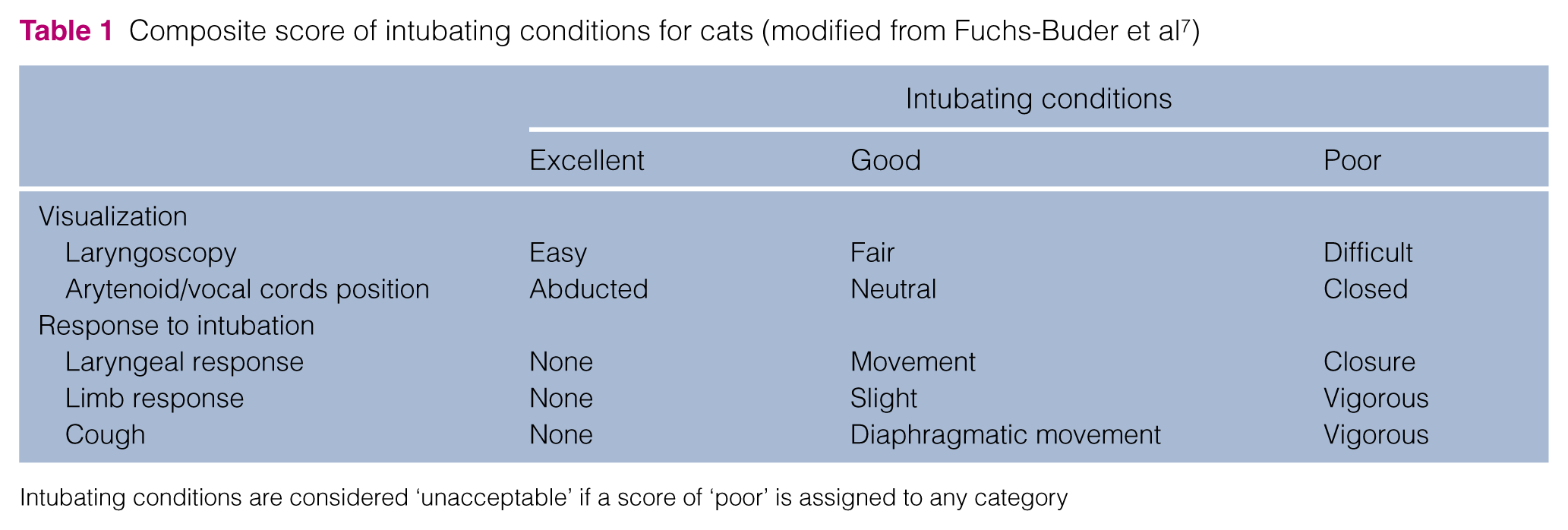
Intubating conditions are considered ‘unacceptable’ if a score of ‘poor’ is assigned to any category
Tracheal intubation with a 3–3.5 mm ID polyvinylchloride cuffed tube without the use of a stylet, and lubricated with a water-soluble gel, was performed. If intubating conditions were deemed as ‘unacceptable’ based on the composite score, then one actuation of lidocaine 1% (approximately 0.1 ml) was sprayed with an atomizer on the laryngeal mucosa and intubation attempted again 30 s later. Desensitization with additional topical lidocaine could be repeated after another 30 s if intubation was still unsuccessful. The number of attempts and the time to complete intubation was measured.
Upon placement of the tracheal tube, a mainstream capnograph (Cardell Touch; Midmark) was attached and the capnographic waveform was observed for spontaneous breaths. If no spontaneous breath was observed within 30 s, positive pressure ventilation (PPV) was instituted manually at a rate of 2 breaths/min until spontaneous ventilation (breathing interval <30 s) resumed with a normal capnographic waveform. The incidence and duration of PPV were measured. The SpO2 (Cardell Touch; Midmark) was placed on the tongue as soon as possible after intubation and observed continuously; if hemoglobin desaturation (SpO2 <90%) was observed, PPV would be instituted immediately until the SpO2 increased above 90%. After restoration of spontaneous ventilation, edrophonium 0.5 mg/kg (Enlon; Mylan) and atropine 0.02 mg/kg (Atroject SA; Henry Schein Animal Health) were administered IV to reverse potential residual block. Meloxicam (0.1 mg/kg SC) was administered. Cats were moved onto the surgical table; the anesthetic monitoring thereafter was performed as routinely by the local personnel.
The train-of-four (TOF; 2 Hz, 200 ms, 40 mA) ratio was measured with an accelerometer placed over the dorsal aspect of the metatarsus (Stimpod; Xavant Technology) with the electrodes (subcutaneous needles) placed over the lateral aspect of the stifle to stimulate the peroneal nerve once the surgical procedure was completed, and prior to extubation in order to detect any potential residual neuromuscular block.
Data analysis
Distribution of all results was evaluated with the Shapiro–Wilk test. The significance of differences in age, weight, number of attempts to intubate, time to intubate and time of PPV was evaluated with unpaired t-tests or Mann–Whitney tests, for parametric and non-parametric results, respectively.
The scores for each component of the composite score for intubating conditions and the overall score for intubating conditions (acceptable vs unacceptable) was compared between groups with one-tailed Fisher’s exact tests or χ2 tests. Differences were considered significant when P <0.05. Results are summarized as mean ± SD for parametric and median (range) for non-parametric results.
Results
All cats completed the study. There was no significant difference in weight between groups (rocuronium 3.0 ± 0.4 kg vs saline 3.2 ± 0.6 kg; P = 0.2); however, age was different between groups (rocuronium 1.5 years [range 0.5–3 years] vs saline 1.0 years [range 0.3–2.0 years]; P = 0.01).
The number of attempts to intubate and the time to intubate were significantly less in cats receiving rocuronium (Table 2). There were no differences between groups for individual components of the intubating conditions score (all P ⩾0.07; Figure 1); however, intubating conditions were unacceptable in more cats receiving saline (10/15) than in those receiving rocuronium (3/15; P = 0.01). Conditions were deemed unacceptable in cats receiving saline due to closed arytenoid/vocal cords observed during direct laryngoscopy (n = 3) or closure of the larynx during intubation (n = 9). Conditions were unacceptable in the three cats receiving rocuronium due to closed arytenoid/vocal cords observed at laryngoscopy. Three of the 10 cats receiving lidocaine in the saline group, but none in the rocuronium group, required a second dose of topical lidocaine before intubation was possible.
Median (range) number of attempts to intubate and time required to intubate the trachea of 30 cats anesthetized with midazolam and ketamine, and receiving either rocuronium 0.3 mg/kg intravenously (IV) or normal saline IV


Number of cats assigned each score for every category of the intubating conditions composite score at the first attempt. (a) Quality of laryngoscopy: ‘easy’, ‘fair’ or ‘difficult’ based on muscular tone and/or swallowing. (b) Position of the vocal cords and arytenoids during laryngoscopy: ‘abducted’, ‘neutral’ or ‘closed’. (c) Movement of the larynx during intubation attempt: ‘none’, ‘movement’ or ‘closure’. (d) Movement of limbs during intubation attempt: ‘none’, ‘slight’ or ‘vigorous’. (e) Presence of coughing during intubation attempt: ‘none’, ‘diaphragmatic movement’ or ‘vigorous’. The first two classifications of each category were considered ‘acceptable’ and the last classification was considered ‘unacceptable’ and lidocaine was sprayed over the laryngeal mucosa before the second attempt at intubation
PPV was administered for 4 ± 1.6 mins to cats receiving rocuronium and 2.3 ± 0.5 mins to those receiving saline (P = 0.0007). PPV was required for all 15 cats receiving rocuronium and seven cats receiving saline (P = 0.0022). No cases of hemoglobin desaturation (SpO2 <90%) was observed.
Surgery was completed within 15–20 mins in all cats. The TOF ratio was not measured in the first three cats receiving rocuronium. No cases of residual neuromuscular block (TOF ratio <90%) were observed in the remaining 12 cats; TOF ratio was 120 ± 13% prior to extubation.
Discussion
The main findings of this work are that administration of rocuronium 0.3 mg/kg IV after induction of anesthesia improved the quality of intubation when compared with no treatment, and decreased the number of attempts and time required to place the tracheal tube. The duration of PPV after induction of general anesthesia was also prolonged by administration of rocuronium.
Despite the many benefits of tracheal intubation, this procedure is not without risks. There are abundant reports of injuries resulting from intubation in this species.8–10 Moreover, it has been reported that tracheal intubation in cats is an independent factor associated with increased risk of death. 11 Difficulties during tracheal intubation in cats may stem from vigorous laryngospasm triggered during direct laryngoscopy or placement of the tube.
Many techniques have been adopted to facilitate intubation. Bougies, or guidewires, have been used either to guide the endotracheal tube into the larynx or to add rigidity to the tracheal tube; rigid guidewires have been implicated in trauma of the trachea during intubation. 8 Topical desensitization of the laryngeal mucosa is also commonly used to prevent laryngospasm and aid intubation. While this technique has shown to facilitate intubation, a long onset time (up to 1.5 mins) is required before desensitization is fully effective.12,13 It is possible that the topical lidocaine applied in some cats in this study did not reach peak effect. We attempted intubation 30 s after application in an attempt to expedite placement of the tracheal tube. Laryngeal mucosa desensitization also relies, at least in part, on a uniform application of the drug over the mucosal area. Regardless of specific advantages and disadvantages of each technique, the present association between intubation and increased risk of mortality, 11 or the occurrence of tracheal and laryngeal lesions following intubations in this species,8–10 suggest that neither method has completely resolved the issue.
To assess the effect of rocuronium on intubation we used different variables. The number of attempts required to intubate and the time to complete intubation were measured. To decrease variability, all intubation attempts were made by a single investigator. In addition, intubating conditions were assessed using a composite score consisting of five categories, which was modified from a score previously used in people. 7 We modified the score by adding two categories: laryngeal and limb movements in response to intubation. We did not find statistical differences between groups when individual categories of the score were compared; however, the composite score reflecting whether intubating conditions were deemed acceptable or unacceptable were different in favor of those cats receiving the NMBA.
One disadvantage associated with the use of NMBAs is that they almost invariably result in apnea, which may increase the risks of hemoglobin desaturation and require PPV. When 0.6 mg/kg rocuronium was administered to cats to facilitate intubation, PPV was required for approximately 30 mins. 4 The current investigation confirmed the findings of a laboratory study that showed that a lower dose of rocuronium-blunted laryngospasm while substantially reducing the duration of apnea. Duration of apnea with the current method was reduced to an average of 4 mins. Apnea in cats receiving saline was shorter; however, it was still present and averaged 2.3 mins. These findings underscore the importance of pre-oxygenation, even when NMBAs are not included during induction, and highlight the potential apneic effects produced by the combination of midazolam and ketamine.
Neuromuscular block was reversed once spontaneous ventilation had returned. Thereafter, PPV ceased; that is, cats breathed spontaneously for the duration of surgery. In dogs, return of ventilation parameters to pre-blockade levels does not ensure recovery of neuromuscular function for the entire skeletal musculature. 14 Therefore, we decided to systematically reverse the neuromuscular block with edrophonium. Edrophonium is an inhibitor of acetylcholinesterase in the neuromuscular junction. This class of pharmacological agents promotes an increase in the concentration of acetylcholine and hastens the recovery in the neuromuscular function. 15 This approach decreases the occurrence of residual muscular weakness during emergence from general anesthesia. In concordance with the previous statement, no cases of residual neuromuscular block were identified upon recovery from surgery; the TOF ratio after surgery was 120%. TOF ratio values >90% are associated with fewer complications in the postoperative period. 16 The short duration of apnea after induction, and the complete recovery of the TOF ratio (albeit, enhanced by the use of edrophonium), in these cats suggest that this technique is suitable even for short procedures. In comparison, the effects of spraying 2% lidocaine over the laryngeal mucosa lasted between 17 and 100 mins, 13 blunting the protective reflexes of the larynx beyond the time the trachea is extubated.
Rocuronium was selected for this study as it has a quick onset time in cats. 17 While the onset of action was not measured in the current study, the improved intubating conditions 30 s after the injection of rocuronium suggest that this period of time was sufficient for most cats. Such a short onset time represents an advantage over topical laryngeal anesthesia, which might have a slower onset of action.12,13 Other NMBAs might provide similar benefits. In the past, the depolarizing agent succinylcholine has been used successfully to intubate cats. 5 Succinylcholine is also characterized by quick onset and short duration of action; 18 however, its use is associated with several side effects, including muscular fasciculations, 19 arterial hypotension and, 20 in some cases, hyperkalemia; 21 no such associations exist for rocuronium. Gantacurium is a novel, ultra-short-acting non-depolarizing NMBA. In cats it produces a fast onset of paralysis, blunts laryngospasm and has a short duration of action. 22 However, at the time this manuscript was prepared, gantacurium was not commercially available.
In this study, no cases of hemoglobin desaturation <90% were observed, despite periods of apnea. However, it should not be assumed that hypoxemia may not occur with this technique. First, PPV was applied during periods of apnea, albeit at a low rate. Second, cats were denitrogenized for 2 mins with oxygen using a tight-fitting facemask. Denitrogenation increases the amount of oxygen available in the functional residual capacity during periods of apnea and extends the time to desaturation in dogs. 23 If pre-oxygenation is not performed, it is possible that hypoxemia may ensue.
There are some limitations to consider. First, pulse oximetry was not measured before or during intubation while the mouth was held open. While we cannot comment on the SpO2 levels during that short period, no cases of hypoxemia were observed when the pulse oximeter was applied, immediately after intubation. Second, spontaneous ventilation was assessed with ETCO2. Further information such as tidal volume would improve the analysis of the ventilatory effects of rocuronium. Third, we evaluated the effects of rocuronium in cats receiving ketamine/midazolam. It is possible that the results would vary if other induction agents are used. Lastly, the quality of intubating conditions was assessed with a subjective score. This score is commonly used to assess intubation in people. To reduce variability, only one investigator, unaware of treatment allocation, scored the larynx. In addition, we added other measurable outcomes such as time to intubation and number of attempts to increase the validity of our observations.
Conclusions
Rocuronium 0.3 mg/kg IV improves intubating conditions and reduces the time and number of attempts to intubate when compared with no treatment, with only a short period of apnea. Apnea requiring PPV may occur during induction of anesthesia even if rocuronium is omitted.
Footnotes
Acknowledgements
The authors thank Midmark Animal Health for generously providing monitoring equipment for this project, and the Chemung County Humane Society and SPCA for consenting to the use of its facilities and animals.
Conflict of interest
The authors declared no potential conflicts of interest with respect to the research, authorship, and/or publication of this article.
Funding
This work was funded by the Clinical Fellowship Program, College of Veterinary Medicine, Cornell University.