




Abstract
Objectives
The objectives of this study were to assess owner perceptions of their cat’s quality of life during treatment for lymphoma with a doxorubicin-containing multi-agent chemotherapy protocol, whether various health-related parameters correlated with quality of life scores, and to assess owner satisfaction with the protocol.
Methods
A postal questionnaire was sent to the owners of 33 treated cats. Owners retrospectively assessed their cat’s quality of life using a Likert scale (1–10) before lymphoma was diagnosed, at diagnosis and during chemotherapy. Owners assigned scores to various health-related parameters previously reported to affect quality of life at the three time points, and correlations with quality of life scores were sought. Owners were asked to rate the importance of these health-related parameters. Satisfaction with the protocol was investigated.
Results
Twenty questionnaires were completed (61% response rate). The median quality of life score before diagnosis (10, range 5–10) was higher than at diagnosis (3, range 1–9) (P <0.05). The median quality of life score during chemotherapy (7, range 3–9) was lower than before diagnosis (P <0.05) and higher than at diagnosis, but this was not statistically significant. Quality of life scores did not correlate with individual health-related parameter scores consistently; however, quality of life scores did correlate with appetite scores during chemotherapy. Appetite, vomiting and diarrhoea were parameters perceived as important in affecting quality of life. Most owners (75%) were happy they had treated their cat.
Conclusions and relevance
The quality of life scores observed were comparable to a previous study using cyclophosphamide, vincristine and prednisolone, employing the same scoring system. Although quality of life scores during chemotherapy were not significantly improved at diagnosis, owner satisfaction with the protocol was high. The factors perceived by owners to determine quality of life in their pets may be different to those previously conjectured, but appetite during chemotherapy remains important.
Introduction
Lymphoma is the most common malignancy in cats, accounting for 30% of all feline tumours and 90% of haematopoietic tumours.1–3 Chemotherapy is the treatment of choice for most cases of feline lymphoma; 4 however, some owners decline treatment owing to concerns regarding a decrease in quality of life (QoL), potential suffering and lack of cure.5,6 Pet owners may perceive QoL as more important than longevity,6,7 and this should be taken into account when establishing treatment objectives. 8
There is no globally accepted definition of QoL.9,10 It is generally considered to be a multifaceted concept involving the subjective evaluation of factors that contribute to overall wellbeing. 11 In human patients with cancer, the need to assess the impact of cancer and its treatment on a patient’s QoL is well recognised. 12 Patient-based measures such as appetite and mood have been shown to be significant independent predictors of survival.13–15 This evidence from human medicine supports the need for regularly assessing QoL in veterinary patients with cancer.
In people, it is well reported that there is a discrepancy between an individual’s opinion of their own QoL and that of a proxy informant.16–18 This is potentially a source of error in veterinary medicine; however, proxy assessing is currently the best means for evaluating QoL in animals, 9 and the owner is considered a better proxy informant than the attending veterinarian. 19 Previous studies suggest that a simple questionnaire can be useful in assessing health-related QoL of dogs and cats with cancer.20–26 Questionnaire design should employ objective measures to help standardise responses and increase the reliability of proxy QoL assessments. 9
It has been suggested that the QoL of cats receiving a cyclophosphamide, vincristine and prednisolone (COP) protocol for treatment of lymphoma might be superior to that of cats receiving a doxorubicin-containing protocol (CHOP-type protocol). 24 Incorporation of doxorubicin might introduce additional adverse effects, such as myelosuppression, nausea, vomiting, anorexia and renal toxicity, which could all affect QoL.27–34 However, to our knowledge there have been no previous QoL assessments in cats receiving a doxorubicin-containing chemotherapy protocol for lymphoma.
The purpose of this study was to assess owner perceptions of their cat’s QoL during treatment of lymphoma with a doxorubicin-containing multi-agent chemotherapy protocol, and to draw comparisons with a previous study using COP chemotherapy. 24 Associations between various health-related parameters previously reported to reflect QoL (eg, appetite) and the owner’s assessment of their cat’s QoL were explored. The null hypothesis was that there would be no difference in QoL, as perceived by owners of cats with lymphoma at three time points – before diagnosis of lymphoma, at time of diagnosis and during the doxorubicin-containing chemotherapy protocol – and that there would be no correlation between previously reported health-related parameters perceived to affect QoL and QoL scores. Owner satisfaction with the protocol was assessed.
Materials and methods
The medical records database of the Queen Mother Hospital for Animals, Royal Veterinary College, University of London, was searched for cats diagnosed with lymphoma between 2001 and 2008. Cats met the inclusion criteria if a cytological or histological diagnosis of lymphoma was made and the cats received ⩾4 weeks of a modified University of Wisconsin–Madison doxorubicin-containing chemotherapy protocol (see supplementary material). Cats pretreated with corticosteroids or other chemotherapeutic agents were excluded. Information regarding age, sex, breed, duration of clinical signs prior to treatment and anatomical location of lymphoma was collected. A postal questionnaire was designed and pre-tested for readability and ambiguity. The Royal Veterinary College ethics committee approved the study.
The questionnaire (see supplementary material) was sent to owners of all eligible cats, a maximum of 9 years after the initial diagnosis. The questionnaire included questions about their perception of their cat’s QoL at three time points: before diagnosis of lymphoma, at diagnosis and during chemotherapy. The questions were structured using a 10-point Likert scale where 1 = QoL could not be worse and 10 = QoL could not be better. The owners were asked to score various health-related parameters that might affect their cat’s QoL – appetite, body weight, general activity level, playfulness, sleeping, grooming activity, vomiting, and diarrhoea – at the same three time points on similar 10-point Likert scales. They were also asked if fur and whisker loss occurred during chemotherapy. The owner’s perception of the importance of the different health-related parameters on their cat’s QoL was interrogated. The owners were asked how they felt towards chemotherapy for pets before their cat was diagnosed with cancer, how they felt about treating their own cat with chemotherapy and how they felt about chemotherapy for pets in general, after their experience of having treated their cat.
Data analysis was performed using Microsoft Excel 2002 and R software (R v 3.1.2; R Foundation for Statistical Computing). Non-parametric continuous data were broken into quartiles and summarised as median and range. Categorical variables were summarised as counts and percentages. Cat variables were age, sex, breed, anatomical location of the lymphoma, duration of clinical signs, plus owner feelings about chemotherapy. They were assessed for effect on QoL scores using the Kruskal–Wallis test. Friedman’s ANOVA was used to test the effects of owner’s rating of their cats’ characteristics on QoL scores before diagnosis of lymphoma, at diagnosis and during chemotherapy. Follow-up post hoc tests were performed with the friedmanmc() function from the pgirmess package in R. The association between QoL scores and scores for health related parameters affecting QoL were determined using Spearman’s rank order correlation test. The level of significance was set at P <0.05.
Results
The questionnaire was found to be unambiguous and readable in the pre-testing stage. Thirty-three cats met the inclusion criteria and 20 owners completed the questionnaire, giving a response rate of 61%.
The median age at diagnosis was 5 years (range 13–168 months). Eleven cats (55%) were neutered males, two cats (10%) were entire males and seven (35%) were entire females. Breeds represented were domestic (n = 15), and one case each of Burmese, Siamese, Exotic Shorthair, British Shorthair and Abyssinian. Five cats (25%) were diagnosed with alimentary lymphoma, eight cats (40%) were diagnosed with extra-nodal lymphoma (renal [n = 3] and one each for spinal, nasopharynx, pericardium/pleural, laryngeal and tracheal), five cats (25%) were diagnosed with mediastinal lymphoma and two cats (10%) were diagnosed with multi-centric lymphoma. The median duration of clinical signs before treatment was instigated was 20.5 days (range 1–28 days). All cats received doxorubicin.
Before their cats were diagnosed with lymphoma, 30% (n = 6) of owners supported the use of chemotherapy in pets, 25% (n = 5) had no strong feelings either way about chemotherapy and 45% (n = 9) had not thought about chemotherapy for pets. As expected, none of these owners objected to the use of chemotherapy in pets prior to treatment. These feelings did not have a significant effect on the QoL scores before treatment.
A total of 75% (n = 15) of owners were happy they chose to treat their cat, 15% (n = 3) were not sure how they felt and 10% (n = 2) regretted treating their cat. Having treated a cat with lymphoma with the current protocol, 80% (n = 16) of owners supported the use of chemotherapy in pets, 15% (n = 3) had no strong feelings about chemotherapy and 5% (n = 1) objected to the use of chemotherapy in pets.
The QoL scores are presented in Figure 1. The scores were significantly lower at diagnosis than before lymphoma was diagnosed. The QoL scores during chemotherapy were significantly lower than the QoL scores before lymphoma was diagnosed and were higher during chemotherapy than at diagnosis, although this difference was not statistically significant.

Box and whisker plot illustrating the quality of life scores (1–10) given by the owners of 20 cats with lymphoma at three time points: before lymphoma was diagnosed (‘before diagnosis’), at diagnosis (‘at diagnosis’) and during a modified University of Wisconsin–Madison chemotherapy protocol (‘during chemotherapy’)
Appetite, body weight, general activity, playfulness and grooming scores were significantly lower at diagnosis compared with the time before lymphoma was diagnosed. Sleeping and vomiting scores were significantly higher at diagnosis compared with before lymphoma being diagnosed. For these a higher score reflected an increase in sleeping and vomiting. None of the health-related parameter scores changed significantly at diagnosis compared with those during chemotherapy.
Correlations between QoL scores and the health-related factors were assessed using Spearman’s rank test. Before diagnosis, there was no correlation between any of the parameter scores analysed and the QoL scores. At diagnosis, body weight, general activity level, playfulness and grooming scores were significantly correlated with QoL scores and during chemotherapy, appetite scores were significantly correlated with QoL scores (see Table 1).
Spearman’s rank correlation showing the correlation of variables and quality of life scores in 20 cats diagnosed with lymphoma at three time points: before diagnosis, at diagnosis and during chemotherapy
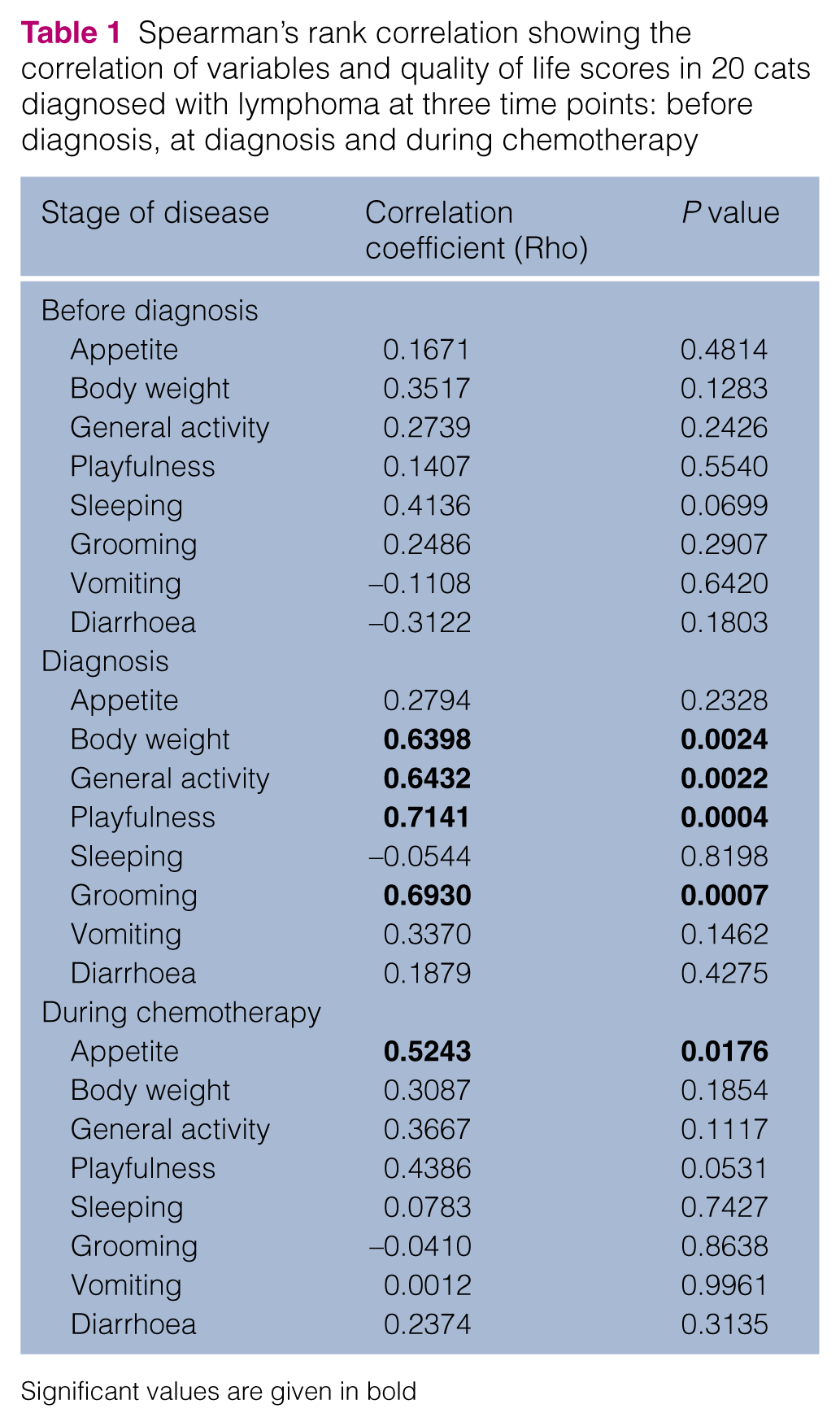
Significant values are given in bold
Owners were asked to rate the importance of the different parameters in relation to their effect on QoL (see Figure 2). A total of 65% of owners perceived that appetite was very important in affecting their cat’s QoL, while 75% and 70% of owners perceived that vomiting or diarrhoea were very important, respectively.

Owner (n = 20) assignment of the importance of various different health-related parameters when evaluating their cat’s quality of life. Percentage of owners and their ratings of importance are represented on the x-axis and the health-related parameters are represented on the y-axis
The investigators did not interrogate specifically whether hair loss or whisker loss were related to QoL scores. A relatively high percentage of owners classed these factors as ‘not important’ in relation to QoL compared with the other health-related factors (see Figure 2). It is interesting to note, however, that 25% of cats (n = 5) experienced fur loss and 45% (n = 9) experienced whisker loss during treatment.
The age at diagnosis, sex, breed, anatomical location of lymphoma and median duration of clinical signs before treatment was instigated did not significantly affect the QoL scores given (data not shown).
Discussion
To our knowledge, this is the first study assessing the QoL of cats with lymphoma treated with a doxorubicin-containing (modified University of Wisconsin–Madison) protocol. The questionnaire response rate of 61% was high, showing that the owners of these cats were, as expected, highly motivated. The pilot study demonstrated that the questionnaire was easily readable and the results of the survey reaffirm that a questionnaire-based method is an appropriate way to assess owner perceptions.
In this study, while the chemotherapy did not significantly improve perceived QoL, it did not reduce it from the score given at time of diagnosis. We might have hoped that QoL would have improved significantly with chemotherapy treatment, particularly if treatment was effective. The QoL scores in this study were, however, comparable with a previous study assessing a COP protocol that used a similar 10-point Likert scale scoring system, 24 suggesting that the current doxorubicin-containing protocol was as well tolerated as a COP protocol in cats. The fact that 80% of the owners in this study supported the use of chemotherapy in pets, having treated a cat with the current protocol, endorses its use. These results can be used to guide owner expectations for cats receiving a doxorubicin-containing chemotherapy protocol. The use of doxorubicin did not appear to adversely affect QoL; however, its incorporation into the treatment protocol potentially carries extra expense and risks (eg, tissue damage if extravasated). Thus, a randomised prospective clinical trial should ideally be performed to compare this protocol with COP in terms of efficacy and QoL, to see if doxorubicin provides added clinical benefit.
Various health-related parameters, considered to affect QoL in previously published studies, were assessed to investigate their effect on the QoL of cats’ scores in this study. QoL scores did not correlate with individual health-related parameter scores consistently at the different time points. Most owners perceived that appetite, vomiting and diarrhoea were very important factors in relation to QoL and yet only appetite scores during chemotherapy and body weight, activity level, playfulness and grooming at diagnosis correlated with QoL scores. These findings suggest that there are other factors at play when we ask an owner to evaluate their cat’s QoL, besides those conjectured by previous authors of QoL studies in pets; and that the measurement of QoL is complicated and multifactorial. The discordance between what owners in this study thought was important and which factors actually correlated with QoL scores suggests that perhaps we are not assessing QoL in the correct way, and leaves us with the question of whether we can at present reliably assess the QoL of pets.
Sixty-five percent of owners in the current study considered that appetite was very important in QoL and appetite did correlate with QoL during chemotherapy. It is noteworthy that, in a recent study of cats with lymphoma, 75% of cats treated with a similar protocol (containing L-asparaginase, vincristine, cyclophosphamide, doxorubicin and prednisolone) suffered anorexia. 31 While appetite is important nutritionally, owners are also using it as a marker of QoL and thus may discontinue treatment or have negative feelings around chemotherapy if appetite is not a treated as a priority. Low body condition score at diagnosis of lymphoma is a negative prognostic indicator, further supporting the need for adequate caloric intake.34,35 Instituting good prophylactic care, such as antiemetics, gastric protectants, appetite stimulants (and in some cases temporary feeding tubes) could be effective measures in improving perceived and actual patient wellbeing.
Data from human patients with dementia have shown that proxy scores are often very different to the individual’s own scores.18,36 Discrepancies have been shown to be associated with caregiver-related factors such as psychological burden, depression and health.17,18,37 In children with asthma it has been shown that negative caregiver affect, that is, the negative emotions the caregiver feels, is a primary determinant of how the caregiver scores their care-receiver’s QoL, 38 and we know from human medicine that caregiver perceptions of their own personal situation change their perception of their proxy’s QoL. 39 Therefore owners’ state of mind may play a role in proxy informing.
The primary limitation of this study was that there were low numbers of owners completing the questionnaire. It is possible that the increase in QoL scores during chemotherapy would have been statistically significant if a larger number of cats had been studied. In addition, the study was retrospective and therefore not all data were available for all cases, including response to chemotherapy, feline leukaemia virus/feline immunodeficiency virus status, median survival time and further cytological or histopathological information. Remission status was not consistently assessed in this study and the disease status might have played a role in affecting the QoL scores. The questionnaire was also sent to owners up to 9 years after the initial diagnosis, which is another major limitation. We attempted to address non-respondent bias by having both positive and negative descriptors in the questionnaire; however, this is unlikely to have removed it entirely. Although the questionnaire has not been validated, it was pre-tested for readability and ambiguity and, to date, there are no validated questionnaires designed to measure QoL in pets with cancer. 11 A larger, prospective study, directly comparing the QoL of feline patients with lymphoma receiving different protocols, with uniform staging and follow-up procedures, concurrently assessing owner demographics and owner QoL, would be an ideal model to explore, following on from this study. As it is still unclear what parameters owners and veterinarians use to evaluate the QoL of cats, it would seem prudent to investigate this further.
As previously alluded to, there is no universally accepted definition of QoL and there is also no universally accepted measure of QoL of cats. We believe it may be possible to objectively measure QoL; however, results from this study suggest this area needs further work. This does not mean the concept of QoL should not be discussed with owners but that they should be asked what the phrase ‘quality of life’ means to them, as different owners may not use the factors we conjecture, to evaluate QoL.
Conclusions
QoL is of paramount importance when treating cats for lymphoma. The QoL scores observed with this doxorubicin-containing protocol were not worse than a previous study using cyclophosphamide, vincristine and prednisolone, employing the same scoring system. Although QoL scores during chemotherapy were not significantly improved over those at diagnosis, the protocol was well tolerated and owner satisfaction with the protocol was high. Since appetite during chemotherapy was positively associated with the owner’s perception of their cat’s QoL during chemotherapy, appetite should be proactively monitored and reasons for poor appetite addressed. Factors contributing to QoL are multifactorial and complex. Further work is needed to determine what parameters owners truly use to assess the QoL of their cats.
Supplemental Material
Chemotherapy Protocol
Supplemental Material
Supplementary Questionnaire
Postal questionnaire entitled ‘Owner perceptions of their cat’s quality of life when treated with a modified University of Wisconsin–Madison protocol for lymphoma’ sent to the owners of 33 cats
Footnotes
Acknowledgements
The authors would like to thank the owners of the cats that participated in this study.
Supplementary material
Postal questionnaire entitled ‘Owner perceptions of their cat’s quality of life when treated with a modified University of Wisconsin–Madison protocol for lymphoma’ sent to the owners of 33 cats.
Conflict of interest
The authors declared no potential conflicts of interest with respect to the research, authorship, and/or publication of this article.
Funding
The authors received no financial support for the research, authorship, and/or publication of this article.
References
Supplementary Material
Please find the following supplemental material available below.
For Open Access articles published under a Creative Commons License, all supplemental material carries the same license as the article it is associated with.
For non-Open Access articles published, all supplemental material carries a non-exclusive license, and permission requests for re-use of supplemental material or any part of supplemental material shall be sent directly to the copyright owner as specified in the copyright notice associated with the article.
