



Abstract
Objectives
The aim of this study was to report the demographics of feline hip dysplasia (FHD) in the Maine Coon cat.
Methods
The complete hip dysplasia registry (public and private) collected by the Orthopedic Foundation for Animals through April 2015 was accessed. There were 2732 unique cats; 2708 (99.1%) were Maine Coons, and only these were studied. Variables analyzed were sex, month/season of birth and hip dysplasia score. Two groups were created: those with and without FHD. P <0.05 was considered statistically significant.
Results
The youngest cat with FHD was 4 months of age. The majority of the radiographs (2604/2708 [96.2%]) were performed between 4 and 60 months of age. Non-borderline scores for these 2604 cats were available in 2548, and were the data used for this study. The overall prevalence of FHD was 24.9% (635/2548), and was slightly higher in males (279/1023 [27.3%]) than females (356/1525 [23.3%]) (P = 0.025). Those with more severe dysplasia were older. The percentage of bilateral FHD was 56%, and bilateral cases had more severe dysplasia than unilateral cases but with no age difference. Month/season of birth or geographic region of origin did not influence the prevalence of FHD.
Conclusions and relevance
This is the largest demographic study of FHD in the Maine Coon cat. The overall prevalence in the Orthopedic Foundation for Animals registry was 24.9%, and slightly higher in males (27.3%) than females (23.3%). Dysplasia was more severe in bilateral than unilateral cases and with increasing age. Caution should be used when extrapolating these findings to other feline breeds or other groups of Maine Coon cats. Further studies need to be performed among other breeds and geographic locations to better understand the demographics of feline hip dysplasia.
Introduction
Hip dysplasia is a very well known condition in dogs,1–4 especially among certain breeds. There are only a few studies of feline hip dysplasia (FHD)5–10 and there has been no study of the demographics of FHD using a large data set. We wished to pursue this question using the Orthopedic Foundation for Animals (OFA) registry. Upon reviewing the cats from this data set, the vast majority were Maine Coon cats; we are reporting our findings for this breed.
Materials and methods
The data for this study were the complete hip dysplasia registry (both public and private) collected by the OFA through April 2015. There were a total of 1,430,979 records. Duplicate records and canine cases were deleted, resulting in 2732 unique cats; 2708 were Maine Coons and the remaining 24 various other breeds. Only the 2708 Maine Coon cats were analyzed in this study.
The variables analyzed were sex, month/season of birth, and hip dysplasia score. The OFA hip score uses the American Veterinary Medical Association grading system: 1 = excellent, 2 = good, 3 = fair, 4 = borderline dysplasia, 5 = mild dysplasia, 6 = moderate dysplasia and 7 = severe dysplasia. The borderline score of 4 was excluded creating two groups: those with FHD (scores 5–7) and those without FHD (scores 1–3). Season of birth was arbitrarily defined as winter – December through February, spring – March through May, summer – June through August, and autumn – September through November. For those cats with FHD, laterality was also studied.
Statistical analyses
Categorical variables are expressed as frequencies and percentages, and continuous variables as the average ± 1 SD. Differences between categorical variables were assessed using Fisher’s exact test for 2 × 2 tables and Pearson’s χ2 test for tables larger than 2 × 2. Differences for continuous variables were assessed with non-parametric tests due to non-normal distributions (Mann–Whitney U-test for two variables, Kruskal–Wallis test for >2 variables). While the American Veterinary Medical Association grading system is a numerical grade, it is not a continuous variable such as the Norberg angle, but rather a categorical ordinal variable determined by subjective criteria (www.ofa-org). For this reason, the hip score was analyzed as a categorical variable. All statistical analyses were performed with Systat 10 software, and a P <0.05 was considered statistically significant.
Results
The vast majority (2604/2732 [95.3%]) of the radiographs were performed between 4 and 60 months of age (Figure 1); the youngest cat with FHD was 4 months of age. The hip score in these 2604 cats was 1 in 114; 2 in 1240; 3 in 559; 4 in 56; 5 in 426; 6 in 168; and 7 in 41. Thus, 2548 cats had non-borderline scores (<4 or >4) and comprise the data for this study. The geographic residence for these 2548 cats was known in 2450, and was North America in 1281 (52.3%), Europe in 1114 (45.5%), and Asia, Australia or New Zealand in 55 (2.2%). The five countries submitting the largest numbers of radiographs were the USA (1159 [47.3%]), Finland (249 [10.2%]), Sweden (181 [7.4%]), Germany (174 [7.1%]) and Austria (154 [6.3%]), accounting for 78.3% of all cases.

Histogram of all 2708 Maine Coon cats. The vast majority (96.2%) had the radiographs performed between 4 and 60 months of age
There were 1525 female and 1023 male cats (Table 1). The prevalence of FHD was 24.9% (635/2548), and was slightly higher in males (279/1023 [27.3%]) than females (356/1525 [23.3%]) (P = 0.025). Those without FHD were statistically younger (19.4 ± 11.9 months) than those with FHD (20.4 ± 11.6 months) (P = 0.003). Cats with more severe dysplasia were older (Figure 2). The percentage of cats with FHD by age groups is shown in Figure 3. There were no differences in FHD prevalence by month or season of birth.
Demographics of feline hip dysplasia (FHD) in the Maine Coon cat
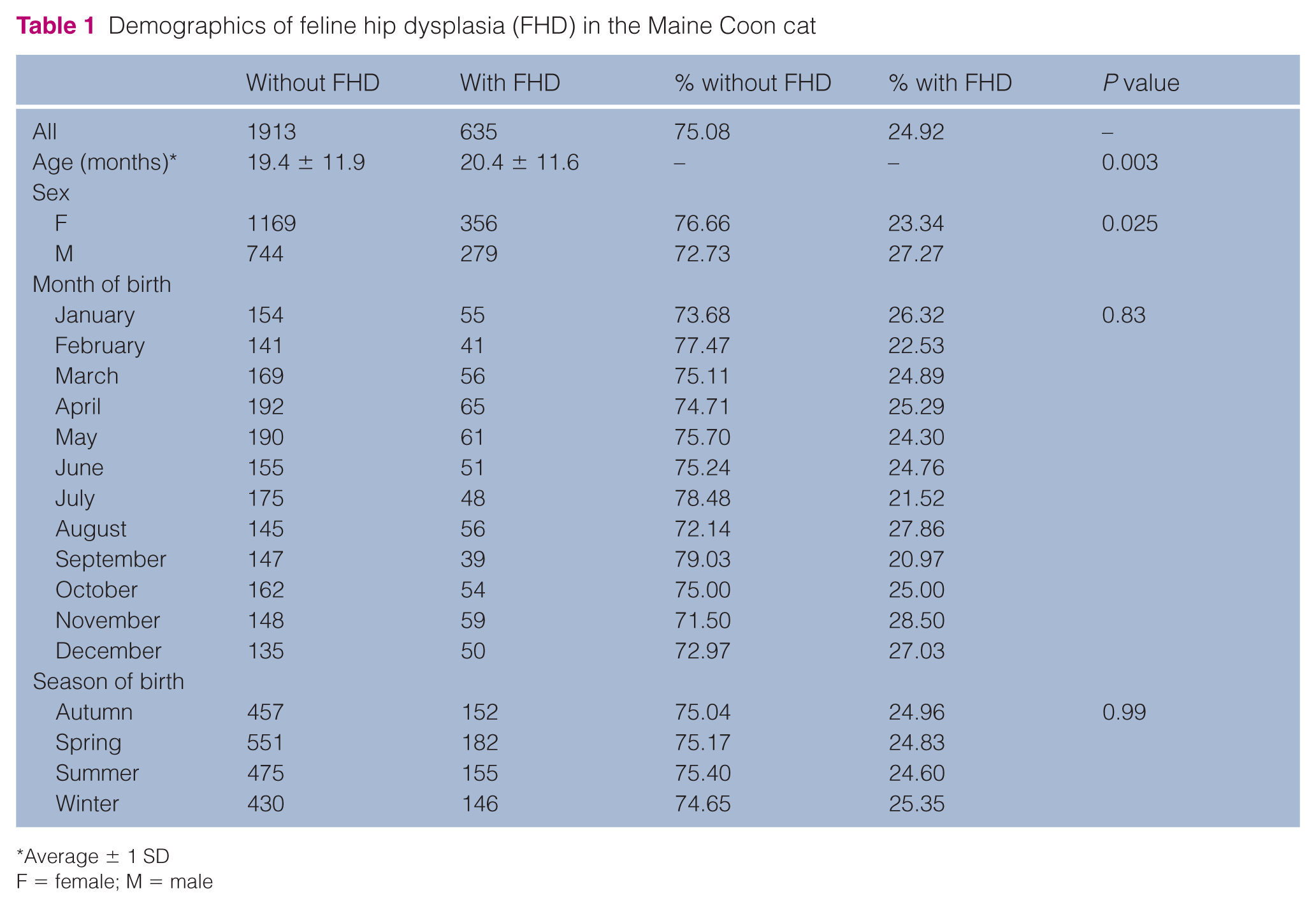
Average ± 1 SD
F = female; M = male

Average age for each hip score severity. The age difference between the three groups with hip dysplasia (scores 5, 6 or 7) was statistically significant (P = 0.00004). There were significant differences between the mild and moderate group (P = 0.0003) and the mild and severe group (P = 0.017) but not between the moderate and severe group (P = 0.99)

Number of cats and percentages with and without feline hip dysplasia (FHD) by different age groups at the time of the radiograph. The actual number of the cats are the values within each section of the bars
Bilateral FHD was present in 55.3% (225/407) of females and 57.5% (131/228) of males (P = 0.62). The dysplasia was more severe with bilateral involvement (Figure 4). There was no age difference between those with unilateral (18.9 ± 11.0 months) or bilateral (20.5 ± 11.7 months) FHD (P = 0.07). In unilateral cases, the right hip was involved in 126 (60.9%) and the left in 81 (39.1%). There was no difference in the proportion of right and left hips by sex (P = 0.77) or hip score (P = 0.13). There were no differences in the prevalence of FHD between the three geographic regions (North America, Europe and Asia/Australia/New Zealand), or the USA and Finland, the two countries submitting the largest numbers of radiographs to the OFA (Table 2).
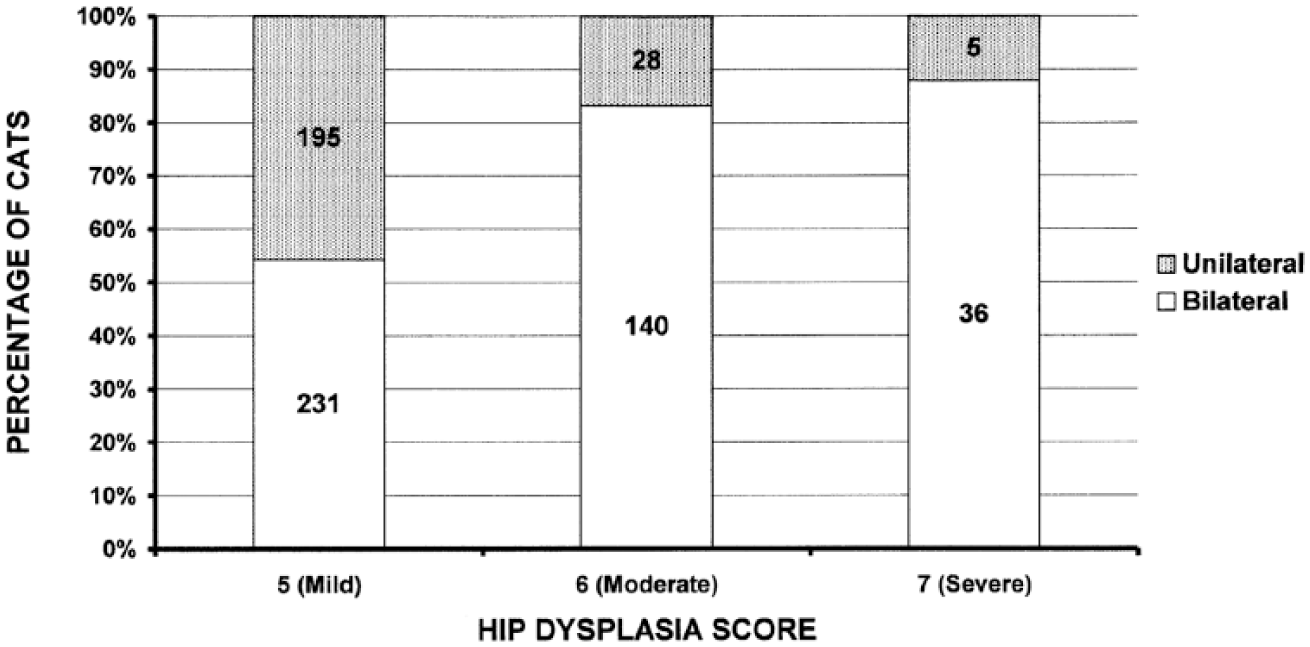
Differences in feline hip dysplasia by severity and unilateral/bilateral nature. The numbers within each box denote the number of cats. The age difference between all three groups was statistically significant (P <10−6). There were significant differences between the mild and moderate group (P <10−6) and the mild and severe group (P = 0.0002), but not between the moderate and severe group (P = 0.63)
Prevalence of feline hip dysplasia (FHD) in the Maine Coon cat by geographic region

Discussion
The presentation of FHD is gradual with subtle behavioral changes such as inactivity or aggression, lack of response to human attention, reluctance to go up or down stairs, and resistance to handling.7,11 The onset typically occurs between 3 months and 3.5 years of age. 7 Physical examination may demonstrate muscle atrophy and restricted hip motion; crepitus or pain on manipulation may occur in the more advanced case. 11 An Ortolani sign may be present in some cases. 12 The ventrodorsal radiograph is obtained and the Norberg angle measured, with a lower angle reflecting increasing subluxation. The distraction index can also be measured; a higher distraction index indicates more laxity. It should be remembered that cats have shallower acetabulae and more hip laxity than dogs.7,13,14 The diagnosis of FHD is confirmed by noting the shallow acetabulum, subluxation of the femoral head and often early degenerative changes at the cranial border of the acetabulum.11,13
The diagnosis of FHD in the OFA database was determined using the standard method of a consensus score among three different radiologists. The overall accuracy of this distinction between animals with and without hip dysplasia using the OFA scoring schemes was 94.9% in 1.8 million radiographs (http://www.ofa.org/hd_grades.html). Although the system is primarily used in dogs, the OFA hip score has been used in a previous study of FHD, 5 and a similar OFA-like system was used by the Pennsylvania group. 14 We believe that the consensus among three different radiologists gives assurance as to the correctness of the diagnosis. Those cats designated as having FHD likely did have it; and those designated as not having FHD likely did not have FHD. There is a possibility of a false-negative diagnosis if FHD later appeared in a cat as it aged after the radiograph had been submitted. This would only result in a higher prevalence of FHD.
The first mention of FHD appears to be by Peiffer in 1974 and Holt in 1978.8,15 Peiffer et al described pectineus tenotomy as a treatment but gave no details regarding cases of FHD. 15 Holt described FHD in a 3 3.5-year-old castrated male Persian cat. 8 Since then there have been three studies discussing FHD aside from case reports of a single litter. Köppel and Ebner in 1989 at the University of Vienna described 293 cats, 9 of which 285 were domestic shorthairs. The prevalence of FHD was 14.5% in the males (23/159) and 22.4% in the females (30/134); this difference by sex is not statistically significant. Langenbach et al in 1998 at the University of Pennsylvania studied 78 cats (sex not mentioned) with a 32% prevalence of FHD. 14 These 78 cats were from nine different breeds and at least 6 months old when the radiographs were performed; there were no excellent scores even in those without FHD. Keller et al in 1999 at the University of Missouri studied 684 cats with, 603 being domestic shorthairs. 5 The overall prevalence of FHD was 6.6% and did not differ by sex.
This is the largest series to date describing the demographics with FHD. Owing to the preponderance of the Maine Coon cat breed in the OFA registry we could only study the demographics of FHD in one breed. Of the 2732 cats in the registry, 2708 were Maine Coon (99.1%). The remaining 24 cats were comprised of 10 British Shorthair, six Persian, three Siamese, two domestic shorthair, and one each of Somali, Ragamuffin and Bengal Tiger. In this study of the Maine Coon cat in the OFA database the overall prevalence of FHD was 24.9%. There are certain limitations to the findings in this study. First, it only describes the Maine Coon cat population within the OFA database, which likely has a selection bias, as the OFA registry only consists of those cats with radiographs that were voluntarily submitted for analysis. It is very possible that owners or breeders with obviously dysplastic cats never submitted radiographs. Such a bias in the OFA data set has been previously discussed in dogs. 16 Thus, the prevalence of 24.9% is likely a low estimate. A more accurate number would require obtaining radiographs of a large number of Maine Coon cats without any pre-selection by the owners/breeders. Finally, if the cats that had radiographs performed when they were under 1 year of age underwent repeat radiographic examination after 1 year of age, it is possible that some of the normal cats would have developed FHD, again resulting in a higher prevalence. We chose 4 months of age as the cut-off as that was the age of the youngest cat in the registry having a score of 5–7.
The reason why the OFA database is comprised of nearly all Maine Coon cats is owing to previous reports of hip dysplasia as a specific problem in that breed. 5 The goal of our study was to describe the demographics of feline hip dysplasia using presently available data. In the USA, the submission of images to either the OFA registry or others is voluntary as there is no compulsory registry for FHD in North America. Besides the OFA registry, there is another voluntary and public registry for the Maine Coon cat. This registry is administered by PawPeds (https://www.pawpeds.com/healthprogrammes/hd.html) and a single radiologist reviews all the radiographs. Other breed clubs are encouraged to join. The most recent data from that registry gives an overall prevalence of FHD in Maine Coon cats of 32.4% (969/2988). 17
The 24.9% prevalence of FHD in this study is similar to that of Langenbach et al, 14 and higher than that of Keller et al, 5 and Köppel and Ebner. 9 There are several possible explanations for these differences. One possible explanation is that this study involved only Maine Coon cats, while two of the three studies mentioned above are predominantly domestic shorthair cats,5,9 with the third a mixture of breeds. 14 This may be due to genetic differences for FHD by breed. Another explanation is that the gene pool for FHD may vary by geographic residence location of the cat. However, we noted no difference in the prevalence of FHD by geographic region. A final explanation may involve the effect of neutering. None of the studies investigated this potential factor, and the status of neutering is not known in the OFA database. Finally, the 29.4% prevalence of FDH in the OFA Maine Coon cat database is very similar to the 32.4% prevalence in the Swedish PawPeds registry. 17 The PawPeds registry uses a four-level grading protocol: normal, grade 1 (mild dysplasia), grade 2 (moderate dysplasia) and grade 3 (bad dysplasia). The exact criteria for the dysplastic grades are not given on their website and are likely different than the OFA American Veterinary Medical Association grading system; 17 however, both demonstrate a similar prevalence of FHD.
Conclusions
This study gives the clinician new, detailed background data regarding the demographics of FHD in the Maine Coon cat. The overall prevalence of FHD in the OFA database was 24.9% and slightly higher in males (27.3%) than females (23.3%). The percentage of bilateral FHD was 56% (of the 24.9%) with no difference by sex. The dysplasia was more severe in bilateral cases. Caution should be used when extrapolating these findings to other feline breeds, as well as to other groups of Maine Coon cats. Further studies need to be performed among other breeds and geographic locations to better understand the demographics of FHD.
Footnotes
Acknowledgements
The authors wish to thank Mr Eddi Dzuik and Jon Curby, Orthopedic Foundation for Animals, for granting access to the entire hip dysplasia registry.
Conflict of interest
The authors declared no potential conflicts of interest with respect to the research, authorship, and/or publication of this article.
Funding
This research was supported, in part, by the Garceau Professorship Endowment, Indiana University, School of Medicine, Department of Orthopedic Surgery, and the Rapp Pediatric Orthopedic Research Endowment, Riley Children’s Foundation, Indianapolis, IN.